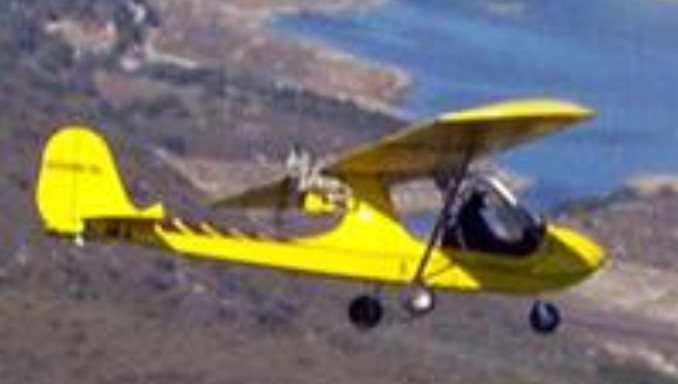
US Light Aircraft Hornet

The entire airframe is completed by the factory, assembled in precise factory jigs, with over 7,000 rivets.
The Hornet components are manufactured by computer automated equipment, especially designed by U.S.L.A.C. to produce the most precise, highest-quality aircraft possible. 2009 Price: 18950 US$

The Hornet has pneumatic suspension on all three wheels, electrically actuated flaps and horizontal staliser. First flown in 1993. The Hornet qualifies under the 51% rule.

Engine: Hirth, 55 hp
HP range: 55-70
Fuel cap: 10 USG
Weight empty: 490 lbs
Gross: 454 kg / 1000 lbs
Height: 6 ft
Length: 20ft
Wing span: 27.5 ft
Wing area: 137 sq.ft
VNE: 104 kt / 120 mph / 193 kmh
Cruise: 61 kt / 70 mph / 113 kmh
Range: 400 sm
Stall: 35 mph
ROC: 700 fpm
Glide Ratio: 9:1
Take-off distance: 175 ft / 53 m
Landing distance: 150 ft / 46 m
Service ceiling: 12,000 ft
Seats: 2
Landing gear: Nose wheel

US Aviation SuperFloater / Wind Walker Aircraft Co Super Floater

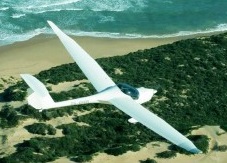
A remake of Klaus Hill’s design of the 1970’s primary glider. Designed by Klaus Hill and Larry Hall. An ultalight sailplane, the Super Floater is designed to accommodate a ballistic recovery emergency parachute and comply with U.S. FAA part 103 rules. It has full span ailerons which, as an option, can be configured as flaperons.
Price (1998) US$9995

US Aviation SuperFloater Article

The Super Floater was produced by US Aviation initially and later by Wind Walker Aircraft Co.

Span: 11.6m / 38ft
Area: 15.5 sq.m / 168sq.ft
Height: 5 ft
Length: 20 ft
Empty Weight: 81kg / 179lb
Payload: 100kg / 221lb
Gross Weight: 182kg / 400lb
Wing Load: 11.74kg/sq.m 2.38lb/sq.ft
L/DMax: 15 56 kph / 30 kt / 35 mph
Speed max: 60 mph
Cruise: 55 mph
Stall: 23 mph
MinSink: 0.9 m/s / 3.0 fps / 1.78 kt
Water Ballast: 0
Aspect ratio: 8.4
L/D: 15-1
Seats: 1
Landing gear: single main wheel

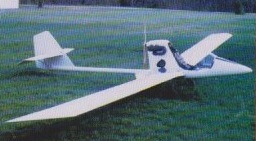
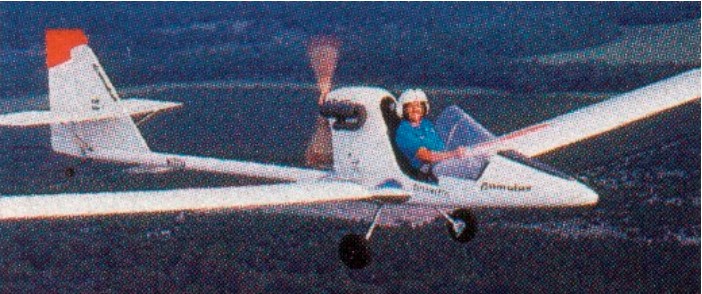
US Aviation Cumulus

The Cumulus has a foldable cantilever wing in riveted sheet dural, dacron covered, and a welded steel spaceframe fuselage and a composite cockpit.

In 1998 the Cumulus returned to the market after and inflight failure of the spar involving the designer.

An Ultralight / Microlight Motorglider Construction is steel and fabric, first flown in 1995. Was available as a kit manufactured by AeroDreams, for $9995. 2009 Price: 7995 US$ airframe only.

Engine: Rotax 277, 28 hp
HP range: 28-35
Height: 4.5 ft
Length: 20.5 ft
Wing span: 43 ft
Wing area: 141 sq.ft
Fuel cap: 5 USG
Weight empty: 320 lbs
Gross: 560 lbs
Speed max: 90 mph
Cruise: 82 mph
Range: 275 sm
Stall: 27 mph
ROC: 600 fpm
Take-off dist: 120 ft
Landing dist: 170 ft
Service ceiling: 15,000 ft
Seats: 1
Landing gear: tail wheel
Glide: 20:1@ 43 mph
Sink: 195 fpm @ 30 mph
Fuel: 1 USG/h.

Engine: Rotax 447, 28 hp
HP range: 28-40
Height: 4.5 ft
Length: 20.5 ft
Wing span: 43 ft
Wing area: 140 sq.ft
Fuel capacity: 5 USG
Empty weight: 163 kg / 360 lbs
Gross weight: 290 kg / 640 lb
Top speed: 90 mph
Cruise: 56 kt / 65 mph / 105 kmh
Stall: 29 mph
VNE: 78 kt / 90 mph / 145 kmh
Aspect ratio: 13-1 sm
L/D: 20-1 fpm
Landing dist: 250 ft
Service ceiling: 15,000 ft
Seats: 1
Landing gear: tailwheel
ROC: 800 ft/min / 4 m/s
Range: 275 sm
Glide Ratio: 20.1
Take-off distance: 170 ft / 52 m
LSA: yes

Engine: Rotax 447, 42 hp
Wing span: 13.1 m
Wing area: 12.7 sq.m
MAUW: 291 kg
Empty weight: 164 kg
Fuel capacity: 19 lt
Max speed: 144 kph
Cruise speed: 97 kph
Minimum speed: 55 kph
Climb rate: 5 m/s
Seats: 1
Fuel consumption: 6 lt/hr
Kit price (1998): $7995

US Aircraft A-67 Dragon

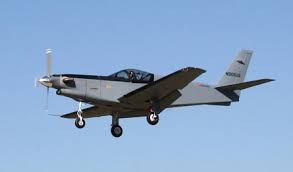
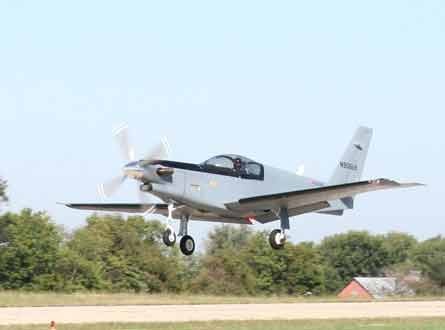
Start-up US Aircraft changed direction in its plans to develop a low-cost counter-insurgency aircraft for use in Afghanistan, Iraq and elsewhere. After funding design of the A-67 Dragon by US warbird restoration specialist Golden Aviation, it began working with Brazil’s Geometra on an aircraft based on a design by Josef Kovacs, former chief designer of Embraer’s EMB-312 Tucano trainer.

The original A-67 made its only flight in October 2006 in Missouri. The aircraft flew from Cassville, Missouri to Golden’s base at Monett Municipal Airport, ending with a landing gear collapse.

The Ohio-based company planed to base its A-67 on a scaled-up version of Kovacs’ K52, a general-aviation aircraft strongly resembling the Tucano, after testing a Brazilian-built prototype. US Aircraft planned to combine features from both designs, but where the original A-67 had side-by-side seating, the new design uses a tandem set-up.

Powered by a 1,250shp (930kW) Pratt & Whitney Canada PT6A-68 turboprop, the 4,620kg (10,200lb) gross-weight A-67 has an estimated maximum cruise speed of 381kt (706km/h) at 20,000ft (6,100m). Endurance will be 10h and external payload 1,620kg.

A subsidiary of US Technology, which produces the plastic media used for stripping paint from aircraft, US Aircraft was funding design work on the A-67, but sought private investors to complete development and begin production.

A-67 prototype
Engine: 1 × Pratt & Whitney PT6A-67 turboprop, 1,250 shp (930kW)
Prop: four-blade
Wingspan: 38 ft (11.6 m)
Wing area: 211 ft² (19.6 m²)
Empty weight: 4,800 lb (2,200 kg)
Max. takeoff weight: 10,200 lb (4,640 kg)
Maximum speed: 371 knots (427 mph, 687 km/h) at 20,000 ft
Range: 1,880 mi (3,008 km)
Service ceiling: 35,000 ft (11,000 m)
Rate of climb: 4,882 ft/min (1,488 m/min)
Wing loading: 35.1 lb/sq ft
Crew: 2
Urbánek II

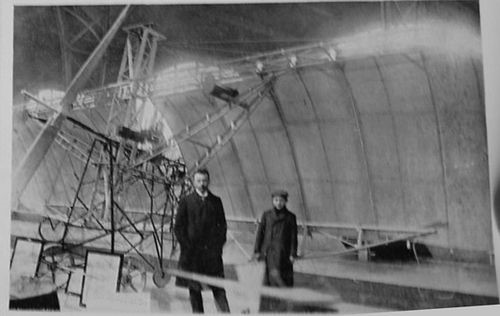
The second design of Vilém Urbánek (sometimes identified as Urbánek II) which was exhibited at the Prague Automobile Salon of 1910 in an unfinished form. The aim of Urbánek was to design an “automatic” device for lateral control.

In the available photographs of the machine can be seen a long construction of lattice fitted before the wing used in such a way that when one wing half dropped (or rose) the other wing half would automatically compensate in the opposite direction. The machine was never finished, so it was never determined whether the automatic stability system devised by Urbánek would work in actual flight.

Umbra M.B.902

Aeronautica Umbra’s design office was responsible for a heavy fighter of advanced and unorthodox design, the M.B.902 designed by Ing. Bellomo. The M.B902 was actually built, although flight testing had not commenced when the prototype was destroyed.

The construction of the M.B.902 was begun in 1942, and this single-seat fighter was unusual in being powered by a pair or 1,250 h.p. Daimler-Benz DB 605 liquid-cooled engines buried in the fuselage and driving twin contra-props mounted outboard on the wings via extension shafts. Featuring a retractable nose wheel undercarriage and carrying an armament of four 20-mm. and two 12.7-mm. guns, the M.B.902 had an estimated maximum speed or 429 m.p.h., and a maximum range of 1,056 miles.

Umbra A.U.T. 18

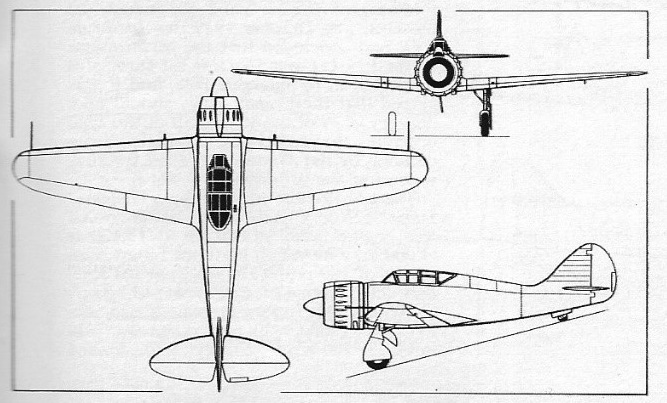
The A.U.T.18 – the designation signifying Aeronautica Umbra S.A., the manufacturer, Ing Felice Trojani, the designer, and the originally-planned wing area of 18sq.m – was an all-metal stressed-skin single-seat fighter, one example of which was ordered in 1936 for evaluation by the Regia Aeronautica. Unusual among contemporary Italian single-seat fighters in having its armament of twin 12.7mm guns mounted in the wings, the A.U.T.18 was powered by a Fiat A.80 R.C.41 18-cylinder radial engine rated at 1030hp for take-off, and flew for the first time on 22 April 1939. Initial trials were performed with an NACA-type engine cowling, but this was supplanted from April 1940 by a close-fitting cowling with the rocker arms partly enclosed by fairings. Evaluation of the sole prototype was completed on 5 November 1940, when the aircraft was delivered to the Regia Aeronautica, but the Ministero dell’Aeronautica did not consider that the Trojani fighter offered any advantages over the Macchi C.200 and Fiat G.50, both of which were in production, and further development of the A.U.T.18 was discontinued.

Umbra A.U.T.18 Article

Max take-off weight: 2975 kg / 6559 lb
Empty weight: 2320 kg / 5115 lb
Wingspan: 11.50 m / 38 ft 9 in
Length: 8.56 m / 28 ft 1 in
Height: 2.88 m / 9 ft 5 in
Wing area: 18.70 sq.m / 201.28 sq ft
Max. speed: 480 km/h / 298 mph
Range: 800 km / 497 miles

Urban Air UFM-13 Lambada / UFM-15 Lambada / Distar Air UFM-13 Lambada

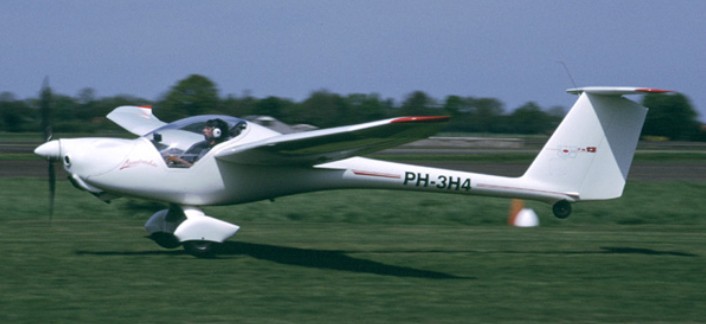
The Urban Air UFM-13 Lambada is a two-seat side by side mid-wing motorglider / ultralight aeroplane. The UFM-13 Lambada is developed and built by Urban s.r.o. in Czech and is constructed from composite with sandwich construction. The prototype of the side-by-side two-seat Lambada flew first in May 1996. This UL-plane is a taildrager with quickly dismounting wings. The wings with a total wingspan of 12 meter, quickly to increase by mounting 2 x 1,5 meter wingtips into 15 meter, giving the Lambada excellent gliding performances.

Versions: UFM 13/15 Lambada S-LSA. New versions for the US market equipped with ailerons. Wingspan from 46.6 to 49.0 ft (optional wingtips).

Design features: Conforms to ASTM, JAR-VLA (BCAR-S). Wings and HTU easily detach (self control lines connections) for storage and transport.
Flying controls: UFM 13/15 Lambada is controlled by conventional ailerons, rudder, one-piece elevator and upper surface spoilers.
Structure: Laminated glass fibre and carbon fibre with CFRP wing spar.
Landing gear: Fixed tricycle or tailwheel type. Hydraulic brakes. 2009 Price: 48000 EURO

UFM 13/15 Lambada
Stall: 43 kt / 49 mph / 80 kmh
Cruise: 81 kt / 93 mph / 150 kmh
VNE: 108 kt / 124 mph / 200 kmh
Empty Weight: 280 kg / 617 lbs
MTOW Weight: 472 kg / 1041 lbs
Climb Ratio: 1000 ft/min / 5 m/s
Glide Ratio: 1:30
Take-off distance (50ft obstacle): 490 ft / 150 m
Landing distance (50ft obstacle): 660 ft / 200 m

Engine: Rotax 912, 80 hp
Wing span: 11.80 m
Wing area: 10.80 sq.m
MAUW: 450 kg
Empty weight: 270 kg
Fuel capacity: 40 lt
Max speed: 170 kph
Cruise speed: 150 kph
Minimum speed: 65 kph
Climb rate: 3 m/s
Seats: 2
Fuel consumption: 6-8 lt/hr