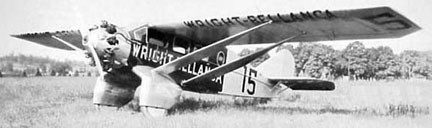
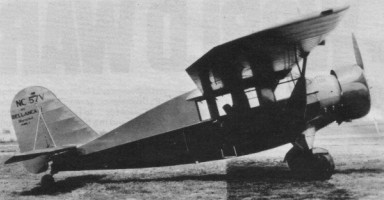
In 1925, Bellanca went to work for the Wright Aeronautical Corporation of Paterson, NJ. His assignment there was to develop an aircraft around the new Wright Whirlwind engine. He already had a design in mind, which was an improved version of the CF, called the CG. This design evolved into the Wright-Bellanca WB-1.
First flying in September 1925 piloted by Lt Fred Becker, the WB-1 enjoyed a short, but successful flying career. The aircraft had already won one race and efficiency contest at the 1925 Nationals, piloted by Becker, before an untimely accident destroyed the craft during preparation for an attempt to break the world’s non-refueled endurance record. It was destroyed in a crash-landing during speed and payload trials in 1926 at Curtiss Field, seriously injuring Becker.
At the time of the crash, Bellanca was already working on an improved version of the WB-1 designated the WB-2.
In 1921, a group of investors lured Bellanca westward to Omaha, NE, in hopes of establishing that town as a center for aircraft manufacture. Before the aircraft could be built, the company went bankrupt, but construction of the aircraft continued under the financial backing of a local motorcycle dealer named Victor Roos. The resultant aircraft, the Bellanca CF, was called by Janes’s All the World’s Aircraft “the first up-to-date transport aeroplane that was designed, built, and flown with success in the United States.” Among the local people helping to build the aircraft was the daughter of Bellanca’s landlord, Dorothy Brown. Giuseppe and she were married on November 18, 1922. Despite its advanced design, the Bellanca CF could not compete with the economics of the time. In the days just after World War I, a surplus Curtiss Jenny could be purchased for as little as $250.00. A Bellanca CF, with a price tag of $5000.00, was just too expensive and the aircraft never went into production.
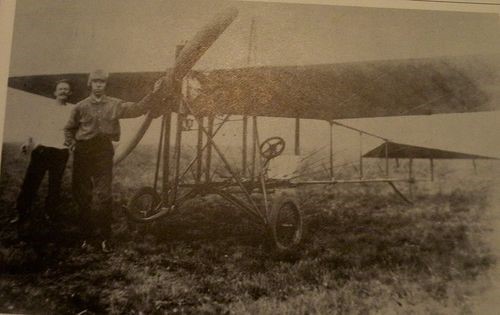
At the urging of his brother Carlo, who was already established in Brooklyn, New York, Giuseppe Bellanca immigrated to America in 1911. Before the end of the year, he began construction of his third airplane design, a parasol monoplane. The engine was a 3-cylinder Anzani of 30 hp, mounted before the wing. Built in the backyard of his brother Carlo’s grocery shop in New York, after construction was completed, he took the small craft to Mineola Field on Long Island, NY, and proceeded to teach himself to fly.
He began by taxiing. He then, taxied faster, which gave way to short hops. The hops got longer, until, on May 19, 1912, there was not enough room to land straight ahead, and Bellanca had to complete a turn in order land safely. Having successfully taught himself to fly, Bellanca then set about teaching others to fly, and from 1912 to 1916, he operated the Bellanca Flying School with two more copies he built. One of his students was a young Fiorello La Guardia, the future mayor of New York City. In return for flying lessons, La Guardia taught Bellanca how to drive a car.
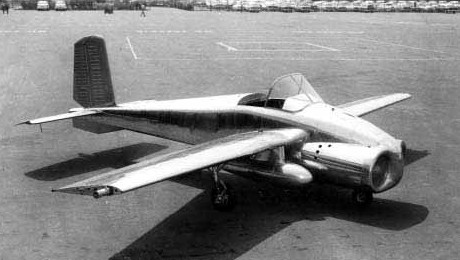
The Bell X-14 was produced as a vertical take-off prototype and achieved its first hovering flight on 17 February l957. The X-14 was originally created to explore the feasibility of operating a VTOL aircraft from a normal pilot station using standard flight instruments and references. Of equal importance, the X-14 was to demonstrate various VTOL systems and engine technologies—the aircraft was the first to demonstrate the concept of using vectored jet thrust as the only power system. The airframe was as simple and light as possible, and was characterized by an open cockpit and fixed tailwheel landing gear. In its original form the aeroplane was powered by a pair of Bristol Siddeley Viper turbojets located side-by-side in the extreme nose of the aeroplane exhausting via nozzles on the sides of the aeroplane on the centre of gravity. For vertical take-off the nozzles were vectored directly downward, and for transition into forward flight were vectored gradually aft. The first successful transition was accomplished in May 1958, and the aeroplane was later re-engined with General Electric J85 turbojets. The X-14 made its last flight on 29 May 1981. The X-14 successfully demonstrated that the concept of vectored jet thrust was viable, as subsequently used on the BAe/McDonnell Douglas Harrier. Flight tests using the X-14’s variable stability control system resulted in major contributions to the understanding of V/STOL handling characteristics. The X-14 also proved useful as a testbed for various unique V/STOL concepts, such as NASA’s direct side-force maneuvering system. Over 25 pilots from around the world “previewed” V/STOL handling qualities in the X-14 prior to making test flights in other V/STOL designs. The single X-14 continued flying for nearly a quarter century before being retired to the Army Aviation Museum at Fort Rucker, Alabama. It is currently in storage at a private collection in Indiana.
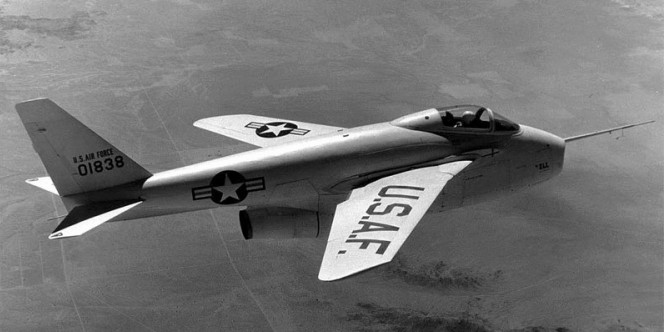
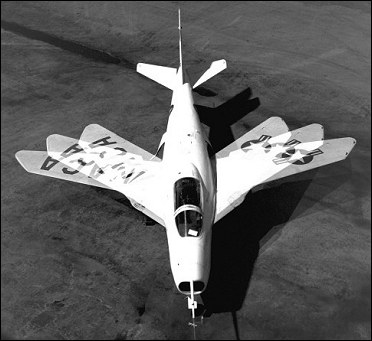
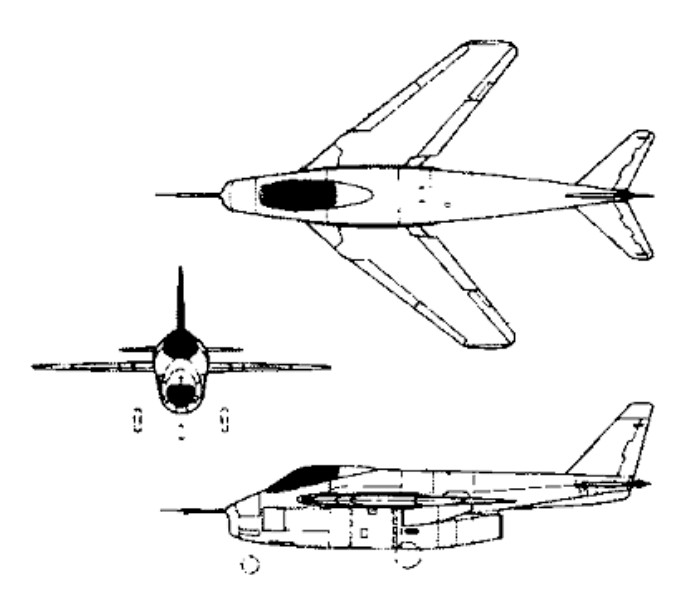
The Bell X-5 was produced to investigate the aerodynamic consequences of altering the wing geometry in flight, and first flew on 20 June 1951. Work on the two X-5s began in 1948, the basis of the design being the Messerschmitt P.1101 prototype that had almost been completed by the Germans at the end of World War II. Two X-5s were manufactured by Bell, differing from their German ancestor primarily in being able to adjust their wing sweep angle in flight. The variable sweep wing could be adjusted to 20, 40 or 60 degrees the hydraulic operating mechanism automatically compensating for the inevitable shift in the position of the design’s centre of gravity.
Powered by a 4900-lb (2222-kg) thrust Allison J35-A-1; turbojet located in the lower fuselage and exhausting under the tail boom. Special fairings were also fitted to ensure that the leading and trailing edges of the wing roots presented smooth aerofoil surfaces at all times.
The first prototype (50-1838) was completed on February 15th, 1951 and first flown on June 20th, 1951. A second prototype (50-1839) followed into the air on December 10th, 1951. Both airframes accounted for some 200 total flights with the first prototype netting 133 flights alone. All three wing sweep positions were trialed on the first prototype’s ninth flight with success.
In practice, it was found that the X-5 inherited some particularly vicious stall-spin instability characteristics. The cause was believed to be the positioning of the tail section within the design and compounded by the position of the vertical tail fin itself. As the wing sweep changed, essentially the entire aerodynamic qualities of the aircraft changed with it. The resulting action could lead the aircraft into an irrecoverable spin – this eventually occurring on October 14th, 1953 – the second prototype was lost to such a spin while running its wing sweep at 60-degrees, killing Air Force test pilot Captain Ray Popson.
The program was shelved and ultimately cancelled by the USAF. Testing did continue on with the first prototype into 1955 after which the aircraft served out the rest of her term as a chase plane until early 1958.
During Neil Armstrong’s first (and only) flight in the Bell X-5 in October 1955, the landing gear door fell off. Armstrong recalled; “My checkout pilot was Jack McKay, and he explained that they often had trouble getting the nose gear tucked up. So, after take off, when retracting the gear, you were advised to nose over and go for about half a G. That would help get the nose gear in place, due to less download on the gear. So I attempted to do it, but it didn’t seem to be locking up. In thee meantime, I was nosing over, getting into a nose down position and, of course, the aircraft was speeding up, and I suspect that I actually ‘oversped’ the gear-limit speed, knocking the fairing door off. I never got the indication that the gear was completely retracted, so I put it back down and wasn’t able to conduct my flight plan. I never got a chance to fly the airplane again. They decided it was at the end of its research lifetime”.
The remaining Bell X-5 was handed over to the National Museum of the United States Air Force in Dayton, Ohio, in March of 1958 where it resides even today as part of the Research & Development Gallery at Wright-Patterson Air Force Base.
Engine: 1 x Allison J35-A-17 tubojet, 2223kg Take-off weight: 4536 kg / 10000 lb Wingspan: 5.66-9.39 m / 18 ft 7 in-30 ft 10 in Length: 10.16 m / 33 ft 4 in Height: 3.66 m / 12 ft 0 in Max. speed: 1046 km/h / 650 mph
Two X-2s were built by Bell Aircraft at their Niagara Falls, New York, facility. The airframes were composed primarily of stainless steel and “K-Monel,” an advanced lightweight heat-resistant stainless steel alloy swept wings.
The powerplant comprised a 15,500 lb (6804 kg) thrust throttable Curtiss-Wright XLR-25-CW-1 liquid propellant rocket.
The jettisonable cockpit can be separated from the fuselage in an emergency by an explosive charge, a ribbon-type parachute lowering the complete cockpit to a lower altitude at which the pilot can bale put.
The first X-2 was dropped into Lake Ontario on 12 May 1953 following an explosion and fire that also caused extensive damage to the EB-50A launch aircraft.
A leather gasket made by the Ulmer Company, when saturates with liquid oxygen, was so unstable that a shock of and magnitude caused the gasket to blow. A number of accidents occurred involving the X-1-3, X-1A, X-1D, and X-2, before the malfunctioning gasket was identified and a fix made.
Bell X-2 and Boeing B-50
The second aeroplane made the type’s first powered flight on 18 Novernber 1955, and recorded an altitude of 126,000 ft (38,465 m) as well as a speed of Mach 3.2 (2,094 mph; 3,370 km/h), the latter being recorded during the type’s fatal last flight on 27 Septernber 1956. This remained the highest speed at which man had flown until 1961. The aircraft experienced “inertia coupling” resulting in complete loss of control—pilot Milburn Apt was killed in the accident. No examples of the X-2 survive.
Dick Day warned his air force associates not to push ahead so fast with the X-2, piloted by Ivan Kinchloe, Frank ‘Pete’ Everest, and Milburn G. Apt. Data from their work was confirming evidence from NACA wind tunnel tests that the X-2 would experience ‘rapidly deteriorating directional and lateral (roll) stability near Mach 4’. On 25 April 1956, the X-2 broke the sound barrier for the first time. Less than a month later, it flew past Mach 2. By mid-summer it was pushing Mach 3. When Mel Apt took the X-2 up on 27 September 1956, for his very first flight in the aircraft, his flight plan called for ‘the optimum maximum energy flight path,’ one that would rocket him past Mach 3 – and into roll coupling. The fatal crash happened just as Dick Day thought it might. At 65,000ft and a speed of Mach 3.2, Apt lost control of the X-2 due to roll coupling and became unconscious. By the time he came to it was too late. He died instantly when the plane hit the desert floor.
The two X-2s achieved 20 flights in total between 1952 and 1956.
Engine: 1 x Curtiss-Wright XLR25-CW-1 rocket engine, 6804kg Wingspan: 9.75 m / 31 ft 12 in Length: 13.41 m / 43 ft 12 in Height: 4.11 m / 13 ft 6 in Max. speed: M3.2 (2,094 mph; 3,370 km/h). Ceiling: 38405 m / 126,000 ft / 38,465 m Crew: 1
The Bell 65 VTOL was built to test the practicability of rotatable turbojets providing thrust for both lift and forward propulsion. Two turbojets, which raised it off the ground for take-off, could be turned 90 degrees in the air to provide forward thrust, leaving the fixed wing to provide lift.
Constructed largely from existing parts, power was provided by two 1000 lb thrust Fairchild J44 turbojets and one Continental-Turbomeca Palouste compressor.
Control at low-speed being obtained from compressed-air jets at the tail and wingtips fed by the Palouste.
Engines: two x 1000 lb thrust Fairchild J44 turbojet Wingspan: 26 ft Wing area: 130 sq.ft approx. Length: 21 ft Loaded weight: 2200 lb approx.
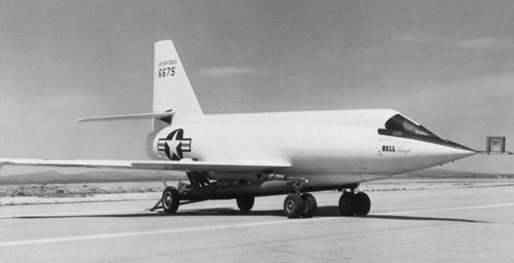
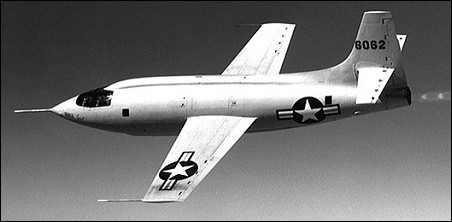
Initially designated the XS-1, (the S, which stood for Supersonic, was dropped early in the program), the X-1 was the first aircraft given an “X” designation, and became the first aircraft to exceed the speed of sound in controlled level flight on 14 October 1947. Developed jointly by the USAF, Bell and NACA, the type reached Mach 1.015 at approximately 45,000 feet in the hands of Captain ‘Chuck’ Yeager. The type was planned specifically for investigation into transonic and supersonic flight, and was based on a cylinderical fuselage that accommodated the 6000 lb (2722kg) thrust Reaction Motors E6000-C4 rocket motor and the tanks for its liquid propellants. The flying surfaces were straight but thin, and the first X-1 air launch of the X 1 was made on 19 January 1946, but powered flights were not attempted until 9 December 1946 after an air drop from a Boeing B-29 motherplane, using the second prototype. The third was destroyed at Edwards AFB during flight fuelling operations.
Supersonic flight was achieved by Captain Charles ‘Chuck’ Yeager on 14 October 1947. The speed reached by the X 1 on that occasion was 670 mph (1,078 kph) at a height of 42,000 ft (12,800 m), and therefore equivalent to a Mach number of 1.015.
On 5 January 1949, piloted by Chuck Yeager, the X-1 took-off from the ground under its own power. After a take-off run of 2300 ft it climbed at 13,000 fpm.
The three X-ls were followed by the second generation X-1s were designed to double the speed of sound and set altitude records in excess of 90,000 feet. Only the X-1A and X-1B were actually built—the X-1C, which was designed to test high-speed armaments, was cancelled before completion.
The X-1A had a longer fuselage for greater fuel capacity, a revised cockpit canopy, and turbopumps replacing the previously pressurised nitrogen fuel system: the X-1A reached a speed of Mach 2.435 and an altitude of more than 90,000 ft (27430m) on 4 June 1954.
In 1955 this aircraft was given new wing panels, but was destroyed before its first flight in this configuration. The X-1A was destroyed after it was jettisoned following an inflight explosion over Edwards AFB on 8 August 1955.
The X-1A and X-1B differed by having a stepped canopy, a 4 ft 7 in longer fuselage, and a turbo-pump fuel system. The X-1A attained Mach 2.5 (1650 mph) at 70,000 ft on 16 December 1953. The X-1B was used for thermal research,
X-1B
The X-1D was destroyed during what was to be its first powered flight in August 1951 after being jettisoned from its B-50 carrier-plane, following an explosion.
On 8 August 1955, just an instant before Joe Walker was to be dropped in the X-1A, an explosion within its rocket engine rocked the B-29. Walker immediately scrambled up and out of the X-1A and into the bomb bay of the mothership. The X-1A was to damaged to fly, and the B-29 could not risk landing with it still hooked to the underside. B-29 pilot Stan Butchart had no choice but to jettison the X-1A into the desert. The machine exploded on impact, ending the X-1A programme. It was learned later that a gasket blew when Walker threw the switch to pressurise the liquid oxygen and water alcohol in the X-1A’s fuel tanks. A leather gasket made by the Ulmer Company, when saturates with liquid oxygen, was so unstable that a shock of and magnitude caused the gasket to blow. A number of accidents occurred involving the X-1-3, X-1A, X-1D, and X-2, before the malfunctioning gasket was identified and a fix made.
Neil Armstrong and Stan Butchart air-dropped pilot Jim McKay in the X-1B for a zoom to 55,000ft, one that did not slow enough at the top to check out reaction controls. Immediately after McKay’s flight, mechanics found irreparable cracks in the rocket motor’s liquid oxygen tank (by then the X-1B was about 10 years old), ending the entire X-1B program.
Despite the loss of the third X-1 and the X-1D, a requirement still existed for a higher performance X-1 so that the NACA could continue high-speed research. To satisfy this requirement, the second X-1 was almost completely rebuilt and redesignated the X-1E. Significant modifications included an updated knife-edge windscreen canopy, ultra-thin wings (4 percent thickness/chord ratio), turbo-driven fuel pumps, and a rocket assisted ejection seat. With these aircraft, a speed of 1,650 mph (2655 km/h) at 70,000 ft (21,325 m) and altitudes of up to 90,000 ft (27,425 m) were attained in 1953-54. The maximum altitude achieved by the X-1E was over 75,000 feet, and the top speed was Mach 2.24 (1,450 mph). During its test series, the X-1E demonstrated that the thin wing section was technically feasible for use on supersonic aircraft. An improved Reaction Motors XLR11, using a low-pressure turbopump, was also validated during X-1E test flights. The aircraft was retired from service in November 1956 after 26 flights, and is now on permanent display in front of the NASA Dryden Flight Research Center. The first X-1 is on permanent display in the National Air and Space Museum in Washington, DC. The third X-1 was destroyed on 9 November 1951 at Edwards AFB, California. A total of 156 flights were made with the X-1, 21 with the X-1A, 27 with the X-1B, one with the X-1D and 26 with the X-1E.
X-1 Powered by: One Reaction Motors XLR-11-RM 5 four-chamber bi-fuel (alcohol and liquid oxygen) rocket, maximum of 6,000 lb (2722 kg) st for 2.5 min. Wing span: 28 ft 0 in (8.53 m). Length: 31 ft 0 in (9.45m). Height: 10 ft 8 in (3.25m). Empty Weight: 8,100lbs (3,674kg) Gross wt: 13400 lb (6,078 kg). Max speed: 1000 mph (l609 kph) at 60,000 ft (18,2 90 m). Rate of climb: 28.000 ft (8,534 m)/min. Ceiling: 22250 m / 73000 ft Accommodation: Crew of 1. No built: 3 Operated: 1946-51 No of flights: 157
X-1A Power: 6,000 lb thrust Reaction Motors XLR-11-RMS rocket Span: 28 ft Weight: 16,000 lb Speed: 1650 mph. Ceiling: 90,000 ft. Full power endurance: 4.2 minutes No built: 1 Operated: 1953-55 No of flights: 25
X-1B Endurance: 4.2 min Empty weight: 7000 lb Loaded weight: 18,000 lb Wingspan: 28 ft Length: 35 ft 7 in Height: 10 ft 8 in No built: 1 Operated: 1954-58 No of flights: 27
X-1D No built: Operated: 1951 No of flights: 1
X-1E No built: 1 Operated: 1955-58 No of flights: 26
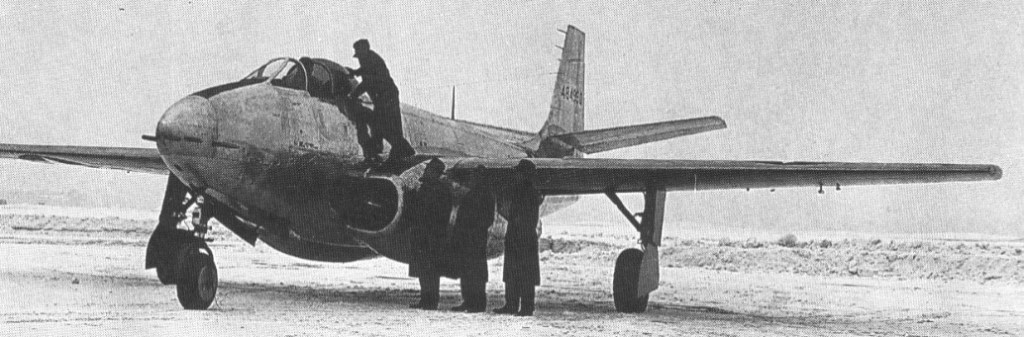
Bell’s last fighter, designed to replace the P-51, was the long range single seat XP-83. On 24 March 1944 the USAAF tasked Bell to build a larger, longer-range jet fighter to superceed the P-51 Mustang. Bell assigned engineer Charles Rhodes to develop the XP-83, powered by two 1633kg thrust General Electric 1-40 (later J33-GE-5) turbojets, and to be armed with six 12.7mm Browning nose machine-guns. First flown on 25 February 1945, the first XP-83 proved underpowered and unstable. The close proximity of the two low-slung powerplants caused hot exhaust gases to buckle the tail-plane unless, during run-ups, fire trucks were used to play streams of water over the rear fuselage.
The second XP-83 was completed with a slightly different bubble canopy and extended nose to accommodate six 15.2mm guns, the increase in barrel diameter being based on anticipated firepower needs for the planned amphibious invasion of Japan. This airframe was used in gunnery tests at Wright Field, Ohio. Modified tailpipes, angled outwards, resolved the heat/buckling problem. Wind tunnel tests showed than a 45.7mm extension of the vertical tail would assure stability, though it is not clear whether this modification was actually made. Except range, which was 3540km with underwing drop-tanks, the Bell XP-83 offered no improvement over the Lockheed F-80 Shooting Star then in production. For the post-war fighter-escort role, the newly independent USAF turned to the North American F-82 Twin Mustang. The redesignated XF-83 operated as a flying testbed for new technology. The first XP-83 was assigned to a ramjet engine test programme. A hatch was cut in the belly to provide entry into the aft fuselage and an engineer’s station with a small port-side window, was created behind the pilot. Experimental ramjets were slung under the wings. The intent was for the XF-83 to serve as a proving vehicle for ramjet power, once aloft flying with the ramjets alone. On 4 September 1947, just as this test programme had begun, a ramjet caught fire and flames spread to the wing. Pilot Chalmers ‘Slick’ Goodlin and engineer Charles Fay, without benefit of ejection seats, bailed out safely and the XF-83 was destroyed.
XF-83 Engines: 2 x General Electric J33-GE-5, 1814kg Max take-off weight: 10927 kg / 24090 lb Empty weight: 6398 kg / 14105 lb Wingspan: 16.15 m / 52 ft 12 in Length: 13.66 m / 44 ft 10 in Height: 4.65 m / 15 ft 3 in Wing area: 40.04 sq.m / 430.99 sq ft Max. speed: 840 km/h / 522 mph Ceiling: 13715 m / 45000 ft Range w/max.fuel: 2784 km / 1730 miles Crew: 1 Armament: 6 x 12.7mm machine-guns
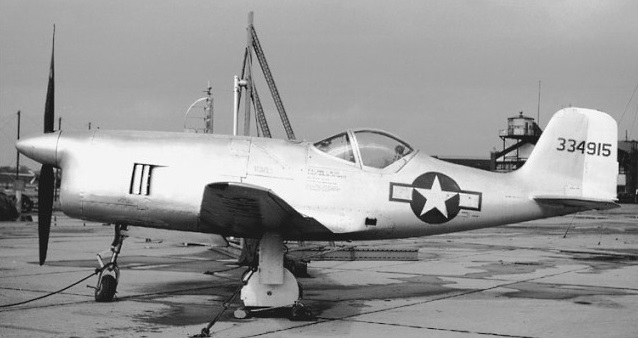
Initially, the idea of a small, cheap, all-wood fighter built with few strategic materials had held high appeal. In early 1941, Larry Bell’s upstate New York fighter team had begun work on a plane at first called the ‘Tri-4’, shorthand for an informal USAAF requirement for ‘400hp, 4,000lbs, 400mph’. On 16 May 1942, the USAAF ordered 25 ‘Tri-4’ aircraft. Delays, technical problems with subcontracting on plywood construction, and disappointing wind-tunnel tests caused the manufacturer to suggest by early 1943 that the number of machines on order be reduced to six. In May 1943, the USAAF reduced this to two, seeing the XP-77 as having no operational utility but as useful in lightweight fighter research.
The all-wood Bell XP-77, using a Ranger inverted V-12 inline piston engine, was of Sitka spruce and intended to operate from grass and the first of two XP-77s flew on 1 April 1944 at Niagara Falls, New York, test pilot Jack Woolams at the controls.
Beginning in July 1944, the second XP-77 was tested at Eglin Field, Florida. Spin problems led to a crash of this aircraft on 2 October 1944, which the pilot survived.
Plagued by noise and vibration, an unexpectedly long take-off run, and general performance ‘inferior to the present fighter aircraft employed by the USAAF’, the XP-77 programme was stopped on 2 December 1944. The prototype went to Wright Field, then back to Eglin, then to Wright again. It was seen at post-war displays wearing spurious markings and its final disposition is unknown.
XP-77 Engine: 1 x Ranger XV-770-7, 388kW Prop: 2 blade Wingspan: 8.38 m / 27 ft 6 in Length: 6.97 m / 22 ft 10 in Height: 2.50 m / 8 ft 2 in Wing area: 9.29 sq.m / 100.00 sq ft Max take-off weight: 1827 kg / 4028 lb Empty weight: 1295 kg / 2855 lb Max. speed: 531 km/h / 330 mph / 285 kt Ceiling: 9175 m / 30100 ft Range: 885 km / 550 miles Crew: 1 Armament: 2 x 12.7mm machine-guns Bombload: 136kg / 300 lb