In 1989, Cory Bird was a shop fabricator at Scaled Composites, aviation designer Burt Rutan’s company, when he decided to use his knowledge of composite construction to build aeronautical art. Built by Patti and Cory Bird, after 14 years of on again, off again construction, Symmetry first flew in April 2003. The aircraft took the Grand Champion award at Oshkosh 2004.
In 1989, Cory Bird was a shop fabricator at Scaled Composites, aviation designer Burt Rutan’s company, when he decided to use his knowledge of composite construction to build the Bird Symmetry.
The 53-year-old Bird, a project manager at Scaled, was hard at work on another design for a plane that will carry two and land on shorter airstrips than Symmetry.
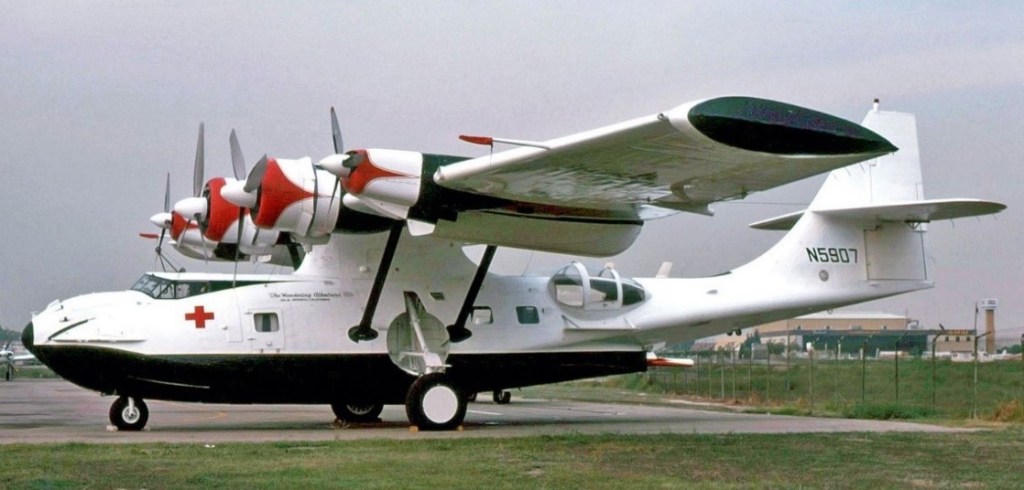
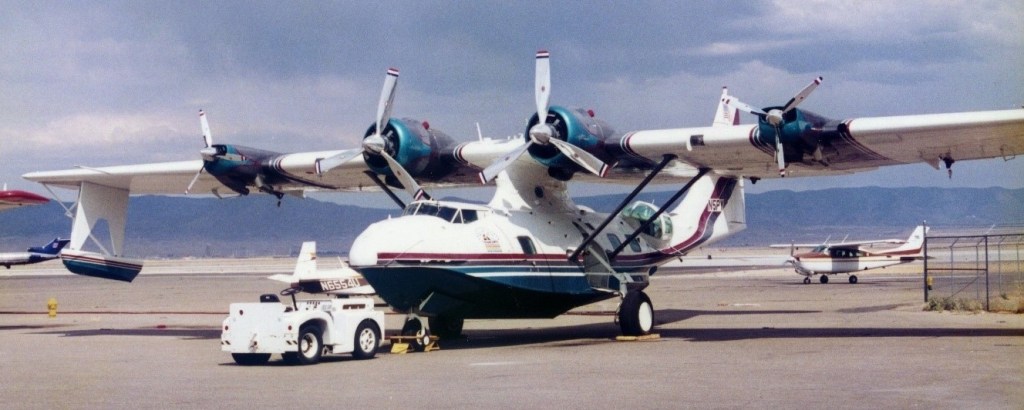
During the late 1960s Forrest Bird designed, and his Bird Corporation developed a conversion for the PBY Catalina to improve performance.
The Catalina was modified by adding two 340 hp (254 kW) Lycoming GSO-480-B2D6 engines positioned outboard of the original Pratt & Whitney radials to increase range and performance. (These engines and cowlings had originally been installed on the McKinnon four engine Grumman Goose. When they were removed by McKinnon to convert the Goose to twin turboprop power, they were purchased by Bird for his PBY Innovator conversion. Engineering for the Innovator conversion was performed by Spectro engineering of Los Angeles).
The wing attach fittings were strengthened and fuel capacity increased by adding fuel bladders to the outer wing panels. The engineer’s controls were previously moved to the cockpit by Southern California Air Service during their “Landseaair” conversion to allow operation without a Flight Engineer. Propeller control for the two Lycomings was electrical. The Lycoming’s propellers were fully reversible, distinctly improving the handling dexterity on the water. The main engine propellers were controlled by the standard mechanical linkage. The larger “Super Cat” rudder and increased power main engines (1830–94) had been installed at an earlier time. The angle of incidence of the wing and horizontal surfaces were not modified during the conversion.
First flying in 1967, the effect of the extra engines exceeded expectations, such that it was capable of a cruising speed of 152 mph (244 km/h) on four engines, and of maintaining 124 mph with one of the main engines feathered. The original PBY cruised at about 125 mph. The downside of the Innovator conversion was the gross weight of the aircraft increased to over 29,000 lbs. This exceeded the 27,000 lbs maximum that the US Military considered safe for water operations.
Only one Innovator was converted, a 28-5AMC Canso A (This was a Consolidated built aircraft. Built in November 1941 (under a contract for Canada), registration N5907, formerly RCAF serial number 9746, which was already used by Dr. Bird as a flying classroom/salesroom for medical equipment. Bird Corporation registered it as N81RD, and sold it in 1976, when its registration reverted to N5907. In the late 1970s, Pyramid Corporation purchased the Innovator and converted it to a camera platform to count whales along the west coast of the Americas. A plastic bubble with camera was installed in the nose and cameras were installed in the right blister and air stair door.
The Innovator was stored in Titusville, Florida at the end of this contract. While in storage a local law enforcement official decided that, since it was a large seaplane, it must have been used for illegal purposes and the aircraft was confiscated. Many years of lawsuits later, the Innovator was exonerated but time and the Florida sun had taken its toll. In the early 1990s, a New Mexico aircraft salesmen bought the Innovator, registered it as N5PY and spent the better part of a year restoring the aircraft to flying status. In 1997, during inspection, the new owners found an improper repair to the main keel truss from an earlier gear-up landing in the 1960s.
The extent of the damage, the previous attempt at repair and corrosion issues showed the need for a major IRAN (Inspect and repair as necessary) of the aircraft. At this time it was decided that, due to the extreme weight gain and aging complexity of the Innovator conversion, returning the aircraft to its original twin engine “Landseaire” condition was the safest and best option for the future preservation of the aircraft. As of 2013, restoration continues with the bow, pylon, and tail sections completely restored and a complete new keel truss, keelson, stringers, and bottom skins currently being installed; currently registered as N5PY.
Innovator Engines: 2 × Pratt & Whitney R-1830-94 Twin Wasp, 1,350 hp (1,010 kW) with 3-bladed Hamilton Standard constant-speed propellers & 2 × Lycoming GSO-480-B2D6, 340 hp (250 kW) with 3-bladed Hartzell 83XF-3A fully-feathering reversible-pitch propellers Wingspan: 104 ft 0 in (31.7 m) Wing area: 1,400 sq ft (130 m2) Aspect ratio: 7.73 Length: 63 ft 10 in (19.46 m) Height: 20 ft 2 in (6.15 m) Gross weight: 29,000 lb (13,154 kg) + Fuel capacity: 1,750 US gal (1,457 imp gal; 6,624 l) main tank + 375 US gal (312 imp gal; 1,420 l) in 3x additional bladder wing tanks Cruise speed: 174 kn (200 mph, 322 km/h) maximum 137 kn (158 mph; 254 km/h) at 34,000 lb (15,422 kg) gross weight and 5,000 ft (1,524 m) 132 kn (152 mph; 244 km/h) at 64% power and 11,000 ft (3,353 m) 125 kn (144 mph; 232 km/h) starboard auxiliary engine feathered 124 kn (143 mph; 230 km/h) port auxiliary engine feathered 112 kn (129 mph; 207 km/h) both auxiliary engines feathered 110 kn (127 mph; 204 km/h) starboard main engine feathered 108 kn (124 mph; 200 km/h) port main engine feathered Service ceiling: 15,000 ft (4,600 m) one main engine inoperative Service ceiling: 10,000 ft (3,048 m) with both port engines inoperative Rate of climb: 750 ft/min (3.8 m/s) at 75% power at sea level Take-off run: 1,000 ft (305 m) at 34,000 lb (15,422 kg) Take-off at 85% power: < 2,000 ft (610 m) at 34,000 lb (15,422 kg) Crew: 2
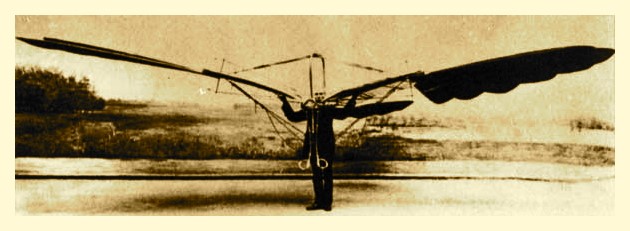
Designed and built by Comte de Massia in 1879, leading to flights made by Gaston Biot. Biot flew the glider several times at Clamart, a suburb of Paris approximately 3 km south-southwest of Issy-les-Moulineaux. Donated to the Musée de l’Air in 1925 and restored in 1960, the glider is currently on display at the Musée de l’Air et de l’Espace, and is said to be the oldest surviving heavier-than-air flying machine in the world.
The film “Those Magnificent Men in Their Flying Machines” is notable for reproductions of 1910-era aircraft, including a triplane, monoplanes, biplanes and also Horatio Phillips’s 20-winged multiplane from 1904. Air Commodore Wheeler insisted on authentic materials but allowed the use of modern engines and modifications necessary to ensure safety. Of 20 types built in 1964 at £5,000 pounds each, six could fly, flown by six stunt pilots and maintained by 14 mechanics. The race takeoff scene where seven aircraft are in the air at once included a composite addition. Flying conditions were monitored with aerial scenes filmed before 10 am or in early evening when the air was least turbulent, for the replicas, true to the originals, were flimsy – and control, especially in the lateral plane, tended to be marginal.
The actual machine upon which they were based on was No.20 built by the Clement Bayard Motor Co in Paris. They were built at White Waltham using a welded steel tube fuselage, wooden wings (with ailerons instead of wing warping) and a 30 hp Ardem 4C02 engine. Initial flight trials were very poor and a 50 hp Ardem 4C02 and a two foot extension to the wing span was put in before they could fly well enough.
The replica of the Santos-Dumont Demoiselle was in its early form unable to leave the ground except in short hops. Extending the wingspan and fitting a more powerful Ardem 50 hp engine produced only marginal improvement. When Doug Bianchi and the Personal Planes production staff who constructed the replica consulted with Alan Wheeler, he recalled that the Demoiselle’s designer and first pilot, Alberto Santos-Dumont was a very short, slightly built man. A suitably small pilot, Joan Hughes, a wartime member of the Air Transport Auxiliary who was the Airways Flying Club chief instructor, was hired. With the reduced payload, the diminutive Demoiselle flew very well, and Hughes proved a consummate stunt flyer.
Joan Hughes – former WW2 ATA pilot
After filming they were dispersed: PPS/REP/2 – PPS/DEM/1 to RAF Gatow, Berlin PPS/REP/3 – PPS/DEM/2 to Sydney, Australia PPS/REP/4 – PPS/DEM/3 to R.Jude at Laleham, UK
The aircraft was a full-scale replica of a Fokker Eindecker EIII that was built circa 1975 to be as close as possible to the original design which entered military service in 1915.
The plans for the aircraft were based on contemporary records and measurements of the only surviving original example, which is housed in the Science Museum in London.
The E.III G-AVJO was marked up as Fok.E.III/157.
The replica E.III with a Continental A75 engine. Registered G-AVJO serial PPS/REP/6 and PPS/FOK/1, it flew with WW1 markings as ‘Fok.EIII/157’ and later in Dutch Air Force colours as ‘La34’. It went into store at Booker.
A Morane N replica was built purely for fun by Doug Bianchi at Wycombe Air Park. It differs from the genuine article in that it has a fixed tailplane and normal elevators, as distinct from an all flying tailplane, and ailerons are used in¬stead of wing warping.
The engine was a Continental C 90 and although the nose shape is correct it is nine inches too long. The fuselage is made of welded steel and the wings are of wood. The gun is gas operated and works although so far it has only been fired on the ground, as it is rather too close to the petrol tank for comfort. The replica performs well, with a top speed of 100 mph, and will cruise at 80 mph
Type N (replica)
A M.S. Type N replica was built by Personal Plane Services at Booker in 1969. Powered by a Warner Super Scarab in flew that year, registered G-AWBU PPS/REP/7. It flew in French Air Force colours as ‘No.50’.