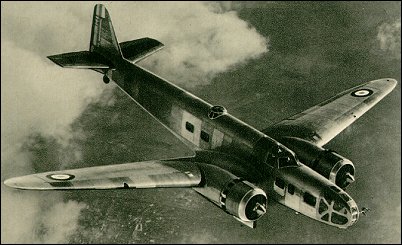
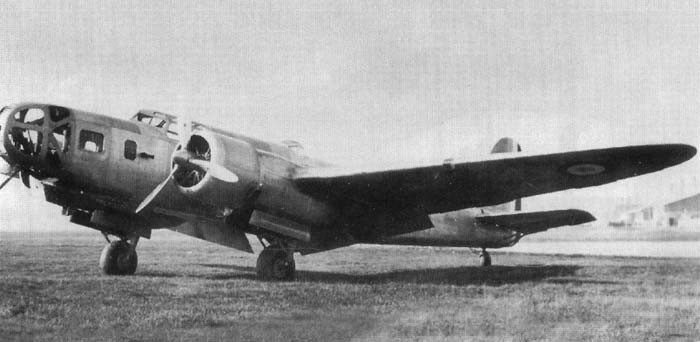
Bloch 134 B4 Engines: 2 x Gnome-Rhone 14N 48/49, 1140 hp TO pwr, 1035 hp at 15,750 ft Wingspan: 70 ft 5.25 in Wing area: 661.98 sq.ft Length: 52 ft 9 in Empty weight: 14,312 lb Loaded weight: 21,662 lb Max speed: 323 mph at 16,400 ft Range at 275 mph with 567.5 Imp Gal: 1678 miles Range at 275 mph with 445 Imp Gal: 1243 miles Armament: 1 x fixed forward firing 7.5mm MAC 1934 mg (500rds), 1 x 20mm Hispano 404 cannon (120rds) dorsal turret, 1 x 7.5mm MAC 1934 mg (800rds) ventral trap Bombload – with 445 Imp.Gal fuel: 96 x 22 lb, 24 x 110 lb, 8 x 220 lb, or 6 x 440 lb bombs Bombload – with 567.5 Imp.Gal fuel: 64 x 22 lb, 16 x 110 lb, 8 x 220 lb, or 4 x 440 lb bombs
The Bloch MB.130 and its derivatives were a series of French monoplane reconnaissance bombers developed during the 1930s. The MB.130 was developed in response to the August 1933 French Aviation Ministry request for a reconnaissance and tactical bomber.
The low-wing Bloch 130 was a smaller version of the Bloch 210, but with a fixed and trousered undercarriage. The Bloch 130.01 Guynemer prototype first flew on 29 June 1934. Despite very ordinary performance, soon entered production, 40 machines being ordered in October 1935. An improved version, the MB.131 was first flown on 16 August 1936, but still needed more work to overcome its deficiencies. The radically revised second prototype which flew on 5 May 1937 eventually formed the basis for series production, with aircraft being manufactured by SNCASO, the nationalised company that had absorbed Bloch and Blériot.
As with the Potez 540, given the role that the aircraft was expected to fill, the evaluation was cursory and simply confirmed that the aircraft was completely unsuited to the intended role and should not be considered further.
A total redesign led to the Bloch 131, with a glazed nose and tall single fin and rudder, and powered by two 708kW Gnome-Rhone 14N radial engines. A retractable undercarriage was fitted. Armament comprised 7.5mm machine-guns in nose, dorsal turret and ventral positions.
The single Bloch 133, with a new twin fin and rudder tailplane, was later converted to a standard Bloch 131.
One hundred and thirty-nine production Bloch 131 were built for the Armee de l’Air in the RB4 category as four-crew machines intended for bombing and reconnaissance. The first six aircraft were delivered by June 1938, the rest by September 1939. Entering service in June 1938, the MB.131 went on to equip seven reconnaissance Groupes, six in metropolitan France and one in North Africa. Upon the outbreak of the war, the metropolitan Groupes suffered heavy losses in attempts at daylight reconnaissance of Germany’s western borders. From October 1939 they were restricted to flying night missions, though they still suffered heavy losses even then, and for training. The max bomb load in various combinations was 800kg. By May 1940, all metropolitan units had been converted to Potez 63.11 aircraft, with only the African groupe retaining them for front-line duty.
Following France’s capitulation, the Vichy regime used surviving Bloch 131s for target-towing. 21 planes were reported captured by the Luftwaffe in inoperable condition, but photographic evidence suggests at least a few flew for the Nazis.
Bloch MB.131 Engine: 2 x Gnome-Rhône 14N-10/11, 610kW(950 hp) Take-Off Weight: 6500 kg / 14330 lb Wingspan: 20.0 m / 65 ft 7 in Length: 17.9 m / 58 ft 9 in Wing Area: 52.0 sq.m / 559.72 sq ft Max. Speed: 400 km/h / 249 mph Cruise Speed: 350 km/h / 217 mph Service ceiling: 23,785 ft Range: 2000 km / 1243 miles Crew: 5 Armament: 3 × 7.5 mm (.295 in) MAC 1934 machine guns Bombload: 4 × 200 kg (440 lb) or 6 × 100 kg (220 lb) or 8 × 50 kg (110 lb) or 64 × 10 kg (22 lb) bombs
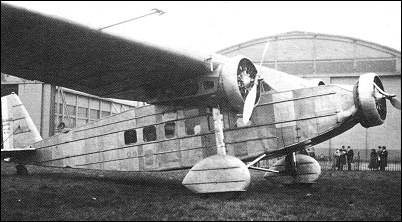
Selected by the French government from competing designs for a transport for colonial duties (passenger, mail and freight, transport and policing) in French overseas territories, the Bloch M.B.120 was a cantilever high-wing monoplane of all-metal construction. The M.B.120.01 prototype was the re-worked M.B.71 monoplane. It was put into service in 1934 on the routes of Air Afrique, a new airline established by the French government, on 11 May 1934, to link various French African territories. Ten series aircraft followed the prototype, six of them for civil use and four in Armee de I’Air service; all served in French Africa. The Air Afrique civil aircraft made scheduled flights between Algiers, Niamey, Fort Lamy, and the French Congo. Two of them connected Tananarive, Madagascar with Broken Hill, South Africa. The four military M.B.120s were joined subsequently by a fifth aircraft, formerly the civil F-APZV. One aircraft (F-ANTK, Ville de Paris) was reported to be in service as late as 1942. Standard accommodation was for a crew of three and up to 10 passengers. More usually, however, the civil M.B.120s carried four passengers and a substantial load of mail. The general structure and layout of the three-engined M.B.120 was similar to that.of the M.B.200 twin-engined bomber.
M.B.120 Engine: 3 x Lorraine Algol 9Na radial piston engines, 224kW Take-off weight: 6000 kg / 13228 lb Loaded weight: 3700 kg / 8157 lb Wingspan: 20.54 m / 67 ft 5 in Length: 15.3 m / 50 ft 2 in Wing area: 61 sq.m / 656.60 sq ft Max. speed: 260 km/h / 162 mph Cruise speed: 230 km/h / 143 mph Ceiling: 6300 m / 20650 ft
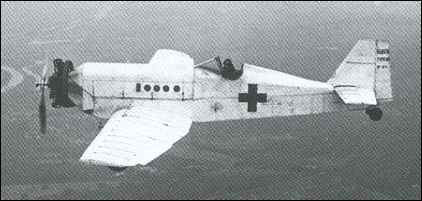
Developed in response to a government-sponsored competition in support of the new doctrine of “aerial first aid”, it was employed exclusively in the overseas colonies, specifically Morocco and Syria. The M.B.80 was followed by the M.B.81.01 coded F.301, which made its initial flight in October 1932, powered by a Salmson 9Nc engine of 101kW.
Unlike the MB.80 prototype, the MB.81 had a closed cockpit and a somewhat larger cargo space. This was the company’s first design which made it out of prototyping.
The aircraft was built without any assistance from the government, but an initial order of 20 was placed by the Ground French Forces (the French Armée de l’Air was founded in 1933), and it was one of the aircraft that relaunched Marcel Bloch in the aeronautical construction industry.
The production MB.81 was fitted with a French Salmson 9Nd of 128.68 kW (175 hp). It took part in military operations in Morocco and in Syria at the beginning of the 1930s.
A production order followed, the first of 20 M.B.81 production aircraft being delivered and entered service in 1935, and was used extensively throughout North Africa and the Middle East. A few were used in 1939-1940, before the French surrender, and in July, 1941 in the battle for Syria between the Vichy French and the British/Free French.
It rendered the greatest services, in particular for the military operations in Morocco and Syria at the beginning of the thirties. A few aircraft were used for the France campaign in 1939-1940 in Africa and the Middle East. One of them was used by the Free French Forces transport group commanded by Colonel Lionel de Marmier in Syria.
The fourth example flew with the RAF under serial AX677.
Bloch M.B.81 Engine: 1 x Salmson 9Nd radial piston engine, 130kW (172.56 hp) Wingspan: 12.59 m (41 ft 4 in) Wing Area: 17.8 sq.m / 191.60 sq ft Length: 8.4 m (27 ft 7 in) Height: 2.9 m (9 ft 6 in) Empty weight: 580 kg (1,279 lb) Max Take-Off Weight: 880 kg / 1940 lb Maximum speed: 188 km/h (117 mph; 102 kn) Cruise Speed: 161 km/h / 100 mph Range: 654 km (406 mi; 353 nmi) Ceiling: 6400 m / 21000 ft Crew: 1 Service ceiling: 6,400 m (20,997 ft) Capacity: 1 seated or stretchered
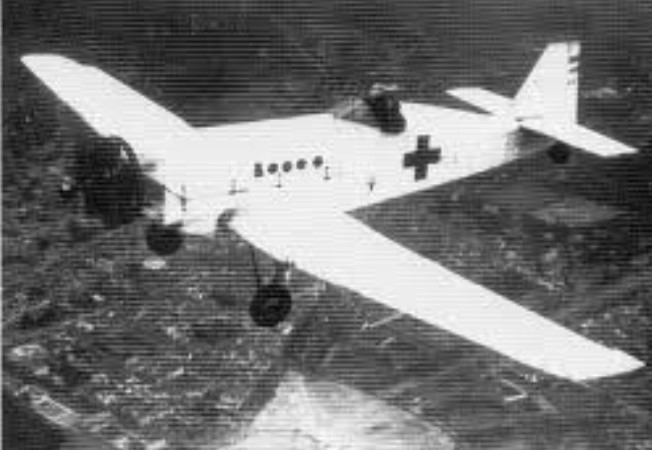
The aircraft was designed to be able to seek patients or casualties by scouting, even at high altitudes, during military operations in mountainous countries, like then-French Morocco over the Atlas Mountains.
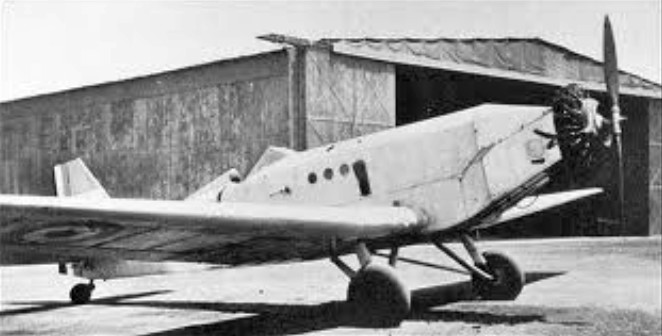
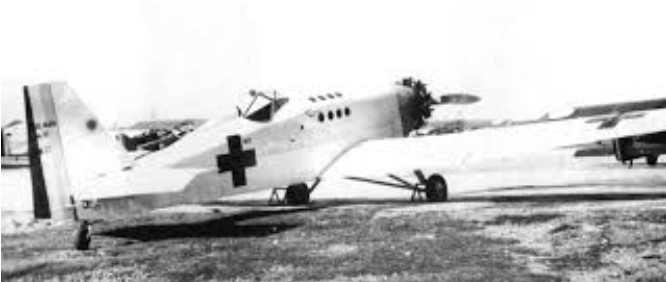
The M.B.80 prototype was an angular cantilever low-wing monoplane, powered by a single 89kW Lorraine 5Pc engine, and with fixed wide-track divided landing gear to facilitate operations from unprepared strips. Its pilot was seated forward in an open cockpit and behind him in the rear fuselage, under easily accessible panels, was accommodation for a single stretcher.
The main design feature made it possible to transport a casualty lying prone, in a compartment placed between the pilot and the engine. The wings could also be adapted to hold casualties, remaining constantly under the sight of the pilot and connected to him by an Aviaphone communication system.
The MB.80 made its first flight at the beginning of summer 1932 in Villacoublay, piloted by Zacharie Heu. An all-metal monoplane with low wings, it was equipped with a French Lorraine 5 Pc of 88.24 kW (120 hp) which allowed him to reach a speed of 190 km/h (119 hp) at an altitude of 6,400 meters (21,000 ft). It was able to take off in 70 meters (230 ft) and to land in 95 meters (312 ft). In a 1932 test, the MB.80 carried out 209 landings in one and a half days without any problems.
The aircraft was built without any assistance from the government, but an initial order of 20 was placed by the Ground French Forces (the French Armée de l’Air was founded in 1933), and it was one of the aircraft that relaunched Marcel Bloch in the aeronautical construction industry.
The production model was called the MB.81.
Engine: Lorraine 5 PC, 120 hp Maximum speed: 190 km/h Ceiling: 6400 m Take-off distance: 70 m Landing distance: 95 m
Avions Marcel Bloch was formed in 1930, and its first designs were the Bloch MLB.60 (later M.B.61) and M.B.71 high-wing postal monoplanes, neither of which passed beyond the prototype stage.
Avions Marcel Bloch was formed in 1930, and its first designs were the Bloch MLB.60 (later M.B.61) and M.B.71 high-wing postal monoplanes, neither of which passed beyond the prototype stage.
Built by И. А. Блиндерман, a son of Russian emigrants, and В. В. Майоров, a Russian athlete who learned to fly in France. The “Kassa”, flown by Blinderman at Nice in April 1911, later crashed by Lecomte.
It used a one-piece wing construction with joined bent spars patented by Blinderman.