Boeing 737 / P-8 Poseidon / C-40 / T-43 / E-7

Boeing 737-500

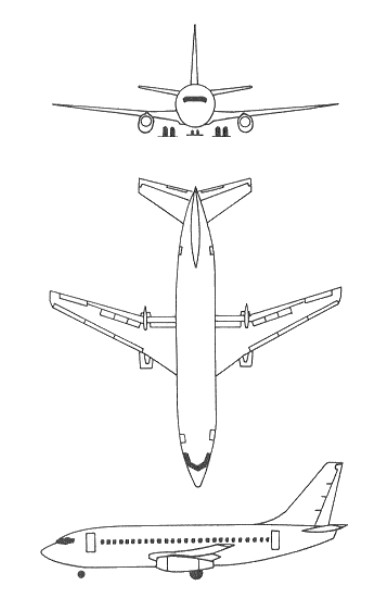
As originally conceived, the Boeing 737 series 100 could accommodate sixty to eighty-five passengers but after talks with Lufthansa this was increased to around 100 seats. The newly designed wing was required to give good lift and have excellent low speed characteristics for short-field operations, around 870nm. The engines selected were two Pratt & Whitney JT8D-1 turbofans, each of 14,000 pounds thrust, but following negotiations with Lufthansa the more powerful JT8D-7 turbofan was chosen for it could maintain the same thrust at higher ambient temperatures. The aircraft has almost the same fuselage cross-section as the longer 707 and 727, designed so that maximum use could be made of 727 tooling and components to keep initial costs low. The aircraft is powered by the JT8D turbofan engine developed for the 727, and has the 727’s high-lift system. The 737 utilised the same nose and fuselage section as the 727. Wing sweepback on the 737 is 25 degrees. The prototype 737-100 first flew on 9 April 1967 and was so successful that by 15 December 1967 FAA certification was complete and Lufthansa took delivery of their first machine on 28 December 1967. They made their first scheduled 737 passenger flight on 10 February 1968. Only 30 of the -100 series were built.

Boeing 737 Article

United Airlines launched the 737-200 with a 1.82m fuselage stretch, first flown on 8 August 1967. The -200 was added to the 737-100 type certificate on 21 December 1967, and first delivery to United Air Lines on 29 December 1967.

In production from 1966 to 1988 (1114 aircraft), the 737-100 offered 85 – 90 seats and a maximum take-off weight of 110,000 lb initially with two JT8D-7 of 14,000 lb thrust. The Dash 9 engine of 14,500-lb thrust was also available. The -200 Series offered a maximum take-off weight of 115,500 lb, rising to 128,100 lb for the Advanced version. Engine types available were the Dash 7, the 9A with 14,500 lb, the l5A with 15,500 lb and the l7A with 16,000 lb thrust.

The T-43As being navigation trainers and the C-40A being the 737-NG model 700. Boeing has delivered the 19th and final T-43 Navigator Trainer aircraft to the USAF’s Air Training Command in 1974. The aircraft, a military derivative of the 737-200 twinjet, flew to Mather AFB, Sacramento, California. Boeing says the T-43 programme was completed on schedule and within the $81.7m contract which Boeing won in May 1971. Deliveries began in 1973.

In 1978 British Airways ordered 19 737-200 Advanced, which entered service in February 1980. More followed in 1980/1981, and another batch of 16 was ordered in Autumn 1983, with the last delivered in spring 1985, bringing the fleet to 44 aircraft. In October 1988 new orders were announced, which included firm placements for 24 737s, with built in flexibility to choose from the 737-300, or the new -400 or -500 models. British Airways eventually opted for the larger -400. Eleven options were also included and soon taken up, with the new type introduced into service in October 1991.

A maritime surveillance version of the 737-200, the Surveiller is equipped with a Motorola side-looking modular multi-mission radar (SLAMMR), linked to two 5m-long antennae mounted on each side of the upper rear fuselage. The radar has a typical range of 185km on each side of the aircraft at a patrol height of 9,150m (30,000ft). B737-219 is a quick change variant, from freight to passengers.

Boeing 737-2A6 ZK-NEE

The last of 1,114 Boeing 737-200s (and 30 737-100s) was delivered in August 1988. The total includes 19 T-43A navigation trainers for US Air Force (subsequently redesignated CT-43A) and three Surveillers for Indonesian Air Force.

In the end it was the rather noisy JT8D-15 engines that prompted Boeing to look for a replacement for the 737-200 advanced. Already operators throughout the world were turning to Europe for replacement jets such as Airbus and the Hawker Siddeley 146 both of which offered quieter and more fuel efficient engines. Initial design analysis showed that the new high by-pass ratio turbofans were all too big and Boeing prompted the development of the smaller diameter CFM-56 which offered 20,000 lbs thrust. The new aircraft retained about 70 percent commonality with the previous 737-200. The biggest changes, apart from the engines, were the increased fuselage length and minor changes to the wing tip. The larger turbofans did need new pylons and Boeing, with the help of CFM, redesigned the arrangement of auxiliary units inside the pod so that instead of fitting them symmetrically around the engine they were arranged on the sides giving the 737-300 engine pods that characteristic squashed look.

Production go-ahead for the Series 300 was given in March 1981 at the first flew on 24 February 1984, the 737-300 powered by CFM56-3 engines was FAA certified on 14 November 1984 and Boeing made the first delivery to USAir on 28 November 1984.

Boeing 737-341 PP-VOO

On 8 January 1989, a newly-delivered 737-400 belonging to British Midland crashed onto the M1 motorway at Kegworth, UK, during an emergency landing attempt, killing 32 people. The crew believed that an engine was on fire, but incorrectly wired cockpit systems may have given them false information.

Approval for 120-minute ETOPS given November 1986, but withdrawn July 1989 due to concerns related to operation in heavy rain and hail; approval restored 14 September 1990.
Commonwealth of Independent States Interstate Aviation Committee certified the Boeing 737 family with P&W or CFM engines 18 January 1993 and the first delivery for Russian Federation and Associated States (CIS) registration (737-300 to National State Aviacompany Turkmenistan) was on 12 November 1992.
A 737-300 for Ansett Worldwide (and subsequent lease to British Midland Airways) rolled out at Renton on 19 February 1990 (as 1,833rd 737); 737 orders passed 3,000 when Southwest Airlines ordered 34 in third quarter 1992.
The 2,500th 737 rolled out 16 June 1993; 3,000th Classic’ 737, a 737-400 for Alaska Airlines (N793AS) first flew on 16 January 1998. Production of Classic’ averaged 9.5 per month during 1998.

Further developments at Boeing resulted in the even larger 737-400 which was first announced in June 1986 and the first example flew on 19 February 1988. Considerably longer than the 737-300 (3.05 metres). Announced June 1986, the first rolled out on 26 January 1988 and first flew on 19 February 1988.

Certified for up to 188 passengers on 2 September 1988, the first delivery (to Piedmont Airlines) was on 15 September 1988.

A high gross weight structure variant rolled out on 23 December 1988; certified by the FAA and delivered to first customer 21 March 1989. ETOPS approval was granted on 14 September 1990. Russian Federation and Associated States (CIS) certification with CFM engines was on 18 January 1993, as for the 737-300.

Initially known as 737-1000 and then announced as the 737-500 on 20 May 1987, the -500 first flew on 20 June 1989; certified 12 February 1990 after 375 hour test programme; and first delivery (to Southwest Airlines) 28 February 1990. ETOPS approval was given on 14 September 1990. Russian Federation and Associated States (CIS) certification with CFM engines was given on 18 January 1993, as for 737-300 and -400. Smallest, and exactly the same size as the original 737-200, is the turbofan powered 737-500. Capable of carrying 108 passengers in comfort, the 737-500 consumes up to 20 percent less fuel per seat-mile than a comparably loaded 737-200. The 737-500 went into regular service in March 1990 with SouthwestAirlines.

Boeing 737s up to and including -500 are known as Classic' series to differentiate them from ‘Next-Generation’ variants beginning at -600.
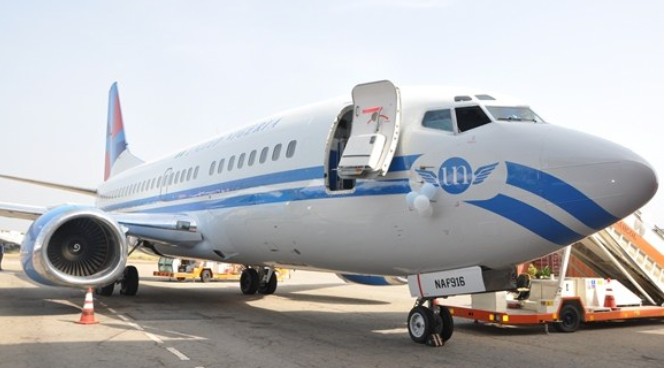
United Nigeria – B737-500 – NAF 916

In 1996 the Lufthansa fleet included 89 Boeing 737 and 26 Boeing 747s.

The 737-700 first flew on 9 February 1997, was delivered to Southwest and entered service on 18 January 1998.

Boeing 737-700BBJ M53-01

In 2003, the Australian Defence Force’s first 737-700 “Wedgetail” aircraft had installed a multi-role electronically scanned array antenna, 35.5 ft long and weighing over 3 tonnes, the antenna was described a “the critical sensor aboard the aircraft”. The Royal Australian Air Force Wedgetail airborne early warning and control (AEW&C) aircraft entered service in 2009. Six Boeing 737 NGs were modified to accommodate sophisticated mission systems and radars that will increase Australia’s surveillance and air combat capability, provide air defence support for the naval fleet, and assist in civil operations such as border protection and search and rescue. The Wedgetail AEW&C aircraft were operated by No 2 Squadron from RAAF Base Williamtown, near Newcastle.
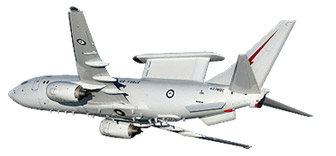
The first two Wedgetails were modified in the United States of America, with the remaining four modified at RAAF Base Amberley, near Brisbane.

Boeing E-7A Wedgetail Article

In February 2006 Boeing delivered the 5000th 737, a 730-700 for Southwest Airlines and 38 years after the first example was delivered. At the time of handover 541 operators were flying over 4100 737s and total sales exceeded 6150.

In January 2007 the first 737-700ER was rolled out, this available in normal airliner form or as in 48-seat all business class configuration with a maximum range of 5510 nm / 10,200 km if fitted with maximum fuel.

The B737-800, essentially a stretched version of the earlier B737-400 seating up to 189 passengers, earned its type certification from the FAA on 13 March 1998. The 737-800NG was launched by Boeing on 5 September 1994. The first delivery of the type was to Hapag-Lloyd on 22 April 1998. Boeing announced on 18 February 2000 that it would offer the blended winglet version of the B737-800NG to customers – a new, advanced technology winglet that has become a standard option. First deliveries of the winglet jet commenced in May 2001. The winglets can be retrofitted and, because of commonality through the 737 range, the blended winglet will be an option for other models that have the B737-800 wing, including the B737-700C/QC and the B737-900. A winglet-equipped 737 is able to fly further, burn less fuel and carry additional fuel than one without winglets. Each winglet is 2.5m long and 1.2m in width at the base, narrowing to approximately 0.6m at the tip. They add approximately 1.5m to the airplane’s total wingspan taking it to 35.8m (all next-generation 737 models have the same wingspan of 34.3m). Each winglet weighs about 60 kg and the overall increase is about 170 kg. Structural modifications to accommodate the winglet include strengthening of the wing’s centre section.
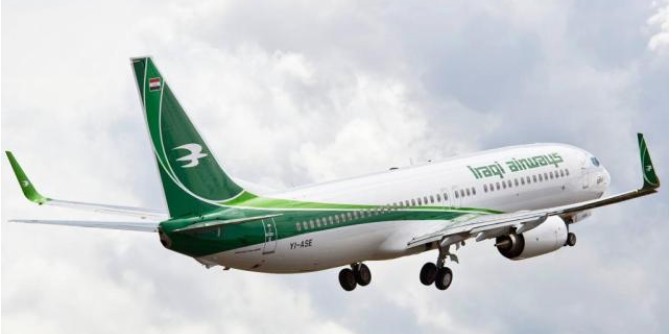
Boeing 737-800

On 26 July 1993 Boeing delivered the 2000th 737NG family example – a 737-700 to Southwest Airlines, eight years after the first one was delivered to the same airline. Total 737NG orders were about 3400, eclipsing the combined total of the first two 737 generations.

The B737-BBJ is a high performance derivative combining the fuselage of the 737-700, strengthened in the aft section, with the centre-section, wing and landing gear of the 737-800. The 737-BBJ is operated by the USAF as the C-40C.
The BBJ combines the fuselage of the Boeing 737-700 aircraft with a strengthened aft section, and the centre-section, wing and landing gear of the 737-800 aircraft. Winglets are standard, affording 5 to 7 per cent reduction in cruise drag, resulting in 4 to 5 per cent increase in range. The BBJ features the same panel as the Boeing 777 and also adds a heads-up display. A variety of fuel tank configurations allow the BBJ to have a more than 6,000 nm range. With a customized interior, some of which feature a conference room and a gymnasium, the BBJ approaches a $50 million total acquisition cost.
Increased fuel capacity is provided by the installation of between three and nine auxiliary tanks in the underfloor baggage holds, providing a maximum range of 6200 nm / 11,485 km.

With the minimum number of three auxiliary tanks installed, range is reduced to 5025 nm / 9310 km but payload increases, allowing about 50 passengers to be carried with full fuel. The first BBJ flew on 4 September 1998, joint FAA/JAA certification was awarded the following month and the first delivery was made in November 1998 to General Electric. The 100th 737-based BBJ – for the Indian Government – flew in November 2006.

A stretched version (19 feet longer) of the original BBJ, the BBJ2 offers 25% more cabin space and 100% more baggage space. First delivery of the larger Boeing Business Jet was in early 2001.
Two Boeing 737 BBJ (Boeing Business Jet) special purpose aircraft are operated by the Royal Australian Air Force’s No 34 Squadron, based at Defence Establishment Fairbairn in Canberra. Both BBJs are permanently converted to VIP configuration, comprising two conference tables and seating for 30 passengers. The BBJs joined the VIP fleet in July 2002.
The 737-900 first flew on 3 August 2000, from Boeing Field. The 900 retains the same wing and engines (CFM56-7s) as the 600, 700, and 800 models. Two fuselage plugs, ahead and aft of the wing box increase the fuselage length by 8ft 8in (2.6m) over that of the 800, for 177 passengers in a two-class configuration, 15 more than the 800. Because of emergency exit requirements, the maximum seating number of 189 is the same as for the 800. Two aircraft were used for FAA and JAA certification. The launch customer being Alaska Airlines with an order for ten placed in November 1997.
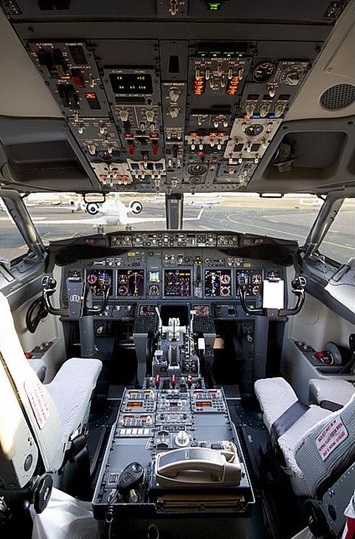
Boeing 737-900

On 5 September 1993 the 180-215 seat 737-900ER recorded its maiden flight. Boeing delivered the first 737-900ER to Indonesia’s Lion Air on 27 April 2007. The airline had 60 on order. By June 2007 Boeing had received 7000 orders for all 737 models.

The P-8A Poseidon for the US Navy is the third military derivative of the 737NG airliner after the 737-700BBJ based C-40 clipper cargo and personnel transport and the 737 AEW&C Wedgetail/Peace Eagle.
Chosen by the Navy in 2004 to replace the bulk of its P-3C Orions, the airframe is based on the 737-800 mated with the strengthened wings of the 737-900. The P-8A is powered by two 27,300 lb (122kN) thrust CFM56-7E engines fitted with 180kVa generators. Boeing has changed 75% of the –800s primary structure maily through stronger gauge materials for the expected flight loads. Other changes include a refuelling receptacle in the forward upper fuselage, an integral fuel tank in the aft third of the fuselage, and an internal weapons bay. The weapons bay has five hard points each rated for 650 kg, and two hard points on each wing, outboard of the engines are rated for 1360 kg, and two hard points in tandem on the centre forward fuselage are rated for 650 kg. Raked wingtips are developed from those of the 767-400.
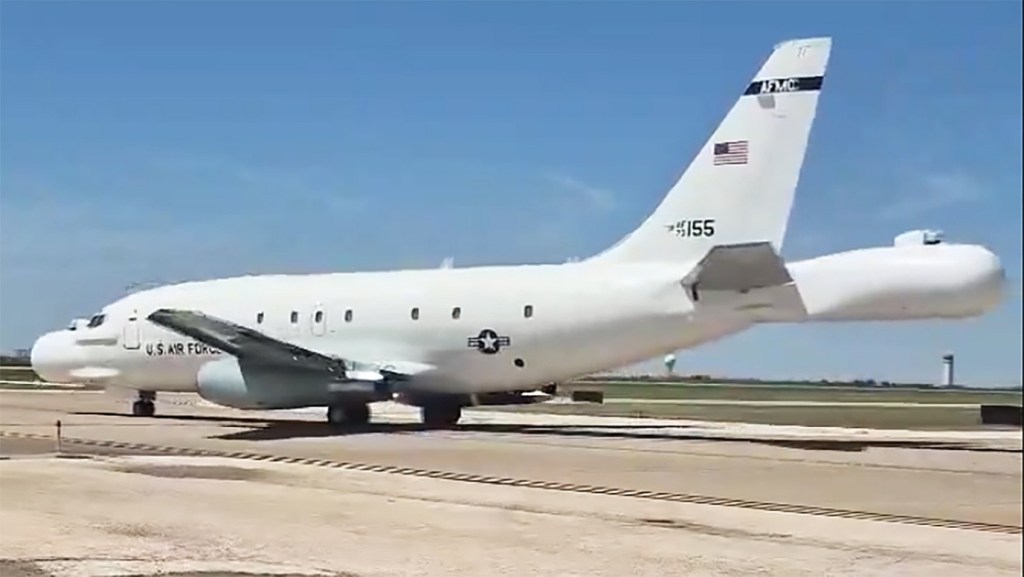
Boeing 737 RAT55

The “RAT” in the name stands for Radar Airborne Testbed, while the “55” refers to the last two digits in its tail number. RAT55 spends most of its flying life in the vast and remote range complexes that span South-Central California and Southern Nevada. The aircraft seems to live at the high-security Tonopah Test Range Airport (TTR) and spends time in the skies near Area 51 and Edwards Air Force Base. While the one-off NT-43A has ventured beyond its usual protected operational confines — it needs major servicing just like any other 737 — usually these trips seem to be planned to expose the aircraft to minimal public eyeballs. That is clearly no longer the goal.

RAT55 is critical to the development and sustainment of America’s aerial stealth technology. Simply put, RAT55 uses its two huge radar arrays — one front and one back — to take fine measurements of the radar signatures of stealthy aircraft while flying through the air near them. It does this to validate low-observable designs and skin treatments. It also has electro-optical/infrared capabilities above its radomes and can be fitted with dorsal fairings for other systems. While there are facilities on the ground that can take similar measurements of aircraft flying through the air, doing it from another specially-equipped aircraft in the air allows the target to be measured from every angle, including from overhead aspects, and continuously.

Even when B-2 Spirits come out of depot maintenance, they usually spend time in the sky with RAT55 to validate that the work done fits established design goals and parameters. That is the most visible of the NT-43A’s work, but the aircraft is also involved with the most advanced and secretive stealth aircraft development programs in the Pentagon’s portfolio, many of which we don’t know about and likely never will.

Gallery

737-100
Engines: 2 x JT8D-7, 14,000 lb thrust.
Length: 90 ft 7 in (27.6m)
Wingspan: 93 ft
Height: 37.07ft (11.30m)
MTOW: 110,000 kg.
Empty Weight: 61,994lbs (28,120kg)
Maximum Speed: 544mph (876kmh; 473kts)
Pax cap: 85-90
Ceiling: 30,000 ft
Range: 1,840 mls
Engines: 2 x JT8D-9, 14,500 lb thrust

737-219
MTOW: 53,070 kg

737 297

737-2Y5
Engines: 2 x JT87D-15A, 15,000 lb thrust
MTOW: 56,600 kg
Pax cap: 100

737-300QC
MAUW: 63,277 kg
Capacity: 142 pax or 17,000 kg cargo

737 713C

737-33R
Engines: 2 x CFM-3C-1 turbofan, 20,000 lb
Wingspan: 28.9m
MTOW: 62.82 tonne
Vne: 566 kts
Max Mach: 0.82

737-37Q
Engines: 2 x GE CFM56-3C-1 turbofans, 22,000 lb
MTOW: 62.82 tonne
MLW: 32.722 tonne

737-4L7
Engines: 2 x GE CFM56-3C-1 turbofans, 23,500 lb
MTOW: 68,000 kg
MLW: 56,200 kg
Fuel cap: 19,000 kg
Length: 115 ft 7 in (35.22m)

737-600
Engines: 2 x GE CFM56-7B turbofans
Seats: 110-132
Range: 3000+ nm
Wing area: 1340 sq.ft
Fuel cap: 26,136 lt
Length: 31.24m

737-700
Engines: 2 x CFM 56-7, 24,000 lb
Wing span: 34.32m
Wing area: 1340 sq.ft.
Length: 33.63m
MTOW: 70,080 kg
Empty wt: 37,971 kg
Zero fuel wt: 54,657 kg
Fuel cap: 26,136 lt
Pax cap: 126-149

737-800
Engines: 2 x CFM56-7B24 (24,000 lb)
MTOW: 74,990 kg (165,325 lb)
Empty wt: 41,554kg (91,610 lb)
Max ldg wt: 66315 kg (144,000 lb)
Fuel cap: 20800 kg
Max cruise: 0.82 mach
Max cruise alt: 41,000 ft
Wing span: 33.41m (112 ft 7 in)
Wing area: 1345.5 sq.ft (125 sq.m)
Fuel cap: 26,025 lt (51,562 lb)
Max payload range: 1900 nm
Pax cap: 162-189
Length: 39.47m (129 ft 6 in)
Height: 12.55m (41 ft 2 in)
T/O dist: 7400 ft (2256m)
Ldg dist: 5250 ft (1600m)

737-8Q8
Engines: 2

Boeing 737 MAX 8
Length: 129 ft 6 in (39.47 m)
Height: 40 ft 4 in (12.29 m)
Cabin Width: 139 in (3.53 m)
Max Payload: 46037 lbs (20882 kg)
Range: 3,800nm (7000km)
Maximum seating: 178

737-900
Engines: 2 x CFM56-7
Length: 138 ft 2 in (42.1m)
Wing area: 1340 sq.ft
Fuel cap: 26,136 lt
Pax cap:177-189

Boeing 737 BBJ (Boeing Business Jet)
Role: Special purpose passenger and VIP transport
Crew: Two pilots and up to four crew attendants
Engines: Two CFM International CFM56-7 turbofans (118.4kN (27,300 lbs) each)
Length: 33.6m
Height: 12.5m
Wingspan: 35.8m (including winglets)
Max take-off weight: 77,565kg
Max landing weight: 60,781kg
Gross weight: 171,000 lbs
Empty weight: 94,570 lbs
Speed: 630km/h normal operations
Range: 11,390km
Ceiling: 41,000 feet
Accommodation: 30 passengers in VIP configuration

BBJ2
Engines: two 26,400 lb. CFM International CFM 56-7 turbofans
Seats: 63
Gross weight: 174,200 lbs
Empty weight: 100,815 lbs
Max cruise: Mach 0.82
Long-range cruise: Mach 0.79
Range: 4,935-6,200 nm
Ceiling: 41,000 ft

CT-43 / T-43A
Engines: 2 x Pratt & Whitney JT8D-9A turbofans. 14,500 lbs thrust
Wingspan: 92.85ft (28.30m)
Length: 100.07ft (30.5m)
Height: 37.07ft (11.30m)
Empty Weight: 61,050lbs (27,692kg)
Maximum Take-Off Weight: 128,100lbs (58,105kg)
Maximum Speed: 586mph (943kmh; 509kts)
Maximum Range: 2,187miles (3,520km)
Rate-of-Climb: 3,760ft/min (1,146m/min)
Service Ceiling: 36,745ft (11,200m)
Accommodation: 5

Boeing 737 NG Wedgetail AEW&C
Role: Airborne early warning and control
Crew: Pilot, co-pilot and airborne electronics analysts and mission specialists (10 mission consoles)
Engines: Two CFM International CFM56-7 turbofans (118.4kN (27,300 lb) thrust each)
Length: 33.6 m
Height: 12.6 m
Wingspan: 34.3 m
Maximum take-off weight: 77,565 kg
Maximum landing weight: 60,782 kg
Maximum speed: 870 km/h
Cruise speed: 760 km/h
Endurance: 10 hours (without air-to-air refuelling)
Ceiling: 12,500 m (41,000 feet)
Equipment:
Multi-role electronically scanned array (MESA) radar with range in excess of 400 km
Electronic warfare self-protection measures including directed infra-red counter-measures , chaff and flares
Communication systems including HF, VHF, UHF, Link-11, Link-16, UHF SATCOM and ICS
Boeing 727 / C-22

727-100

Design work of the Boeing 727, in its distinctive tri jet configuration, had begun in early 1956 with the design being finalised in Septem¬ber 1959. Considerable savings in construction were envisaged with the fuselage upper sections being identical to the B.707/720 series. The airliner was to be independent of ground support with a Garrett¬AiResearch GTC85 auxiliary power unit for electrics, pneumatic starting and cabin airconditioning. Construc¬tion go ahead came in August 1960 and, on 3 February 1963, N7001U made the first flight, out of Renton. FAA certification of the B.727 100 followed on 20 December 1963 and the first commercial flight of the type was made by Eastern Airlines on 1 February 1964 between Philadelphia and Florida.

The wing, with leading-edge slats and the newly-invented Kruger flaps to provide high lift for takeoff from short landing strips, was the most advanced then built. The wingtip of a 727 was bent upward 9 ft before structural failure occurred in static tests. It successfully took loads in excess of 425,000 lb. Unlike the 707, the 727 has power-operated control surfaces, but tabs on the primary controls enable the pilot to take over in emergencies. The 727 has a main passenger access at the rear, via a hydraulic stairway beneath the rear fuselage, and a pressure-tight bulkhead door inside.

Boeing 727 Article

The 727-100 first flew on 9 February 1963, first entering service with Eastern Air Lines on 1 February 1964, with the 727-100C first entering service on 23 April 1966.

In 1963 a series of demonstration flights to 41 cities in 23 countries was carried out. Orders by the added up to 137 including six more for TWA giving then 16 in total.

In 1965 United Air Lines ordered 25 more Boeing 727’s for $110,000,000, bringing United’s 727 fleet to 65 by 1966.

Boeing built a cargo version, installing a heavier flooring, floor beams and a cargo door and the first 100C was ready in mid 1964; a convertible passenger/freight configuration and able to carry 30,000 lb (13608 kg) over a range of 1,900 miles (3058 km). The 727-100Cs are powered by three Pratt and Whitney JT8D M turbofans of 14500 lbs thrust each, are capable of a maximum speed of around 512 knots and a cruise of 461 knots while lifting a maximum take off weight of 80740 kg (178000 lbs) over a maximum range at all up weight of 4800 km (2476 nm).

D.B. Cooper Boeing 727 Hijack

A total of 582 Series -100 were built, the last delivered in October 1972.

Originally built as the to seat a maximum of 131 passengers (727 100), it was quickly followed by a stretched version, the 727 200 which had a 20 ft (6,10 m) longer fuselage than the 727 100. The 727-200 first flying on 27 July 1967 and received FAA certification on 30 November 1967. The improved and stretched fuselage 727-200 entered service with Northeast Airlines 14 December 1967.

1976 Boeing 727-200 Super27

The last of 1,260 727-200s was delivered in September 1984.

B.727

As built, the standard 727 100 had most of its fuel in three main tanks, one in each wing (Nos 1 and 2) and one in the wing center section (Main Tank No 3). At the request of Australia’s two major domestic airlines, Boeing increased the capacity with the use of a cell added to the No 2 tank. Fuel capacity remained unchanged for the 727 200 but under the ‘Advanced 727’ program to improve the breed (of which more fuel was but one of many refinements), the standard fuel capacity was increased with a larger No 2 tank. In addition, a series of optional flexible ‘modular’ fuel tanks could be installed in the forward and aft baggage compartments.

Boeing 727-276 VH-TBH

The Boeing 727 had a factory option for JATO bottles and Mexicana ordered theirs that way for high elevation airfields.

Boeing 727 Jato take-off

Only six examples of the 727 have ever been operated by the American armed forces. All but one of the six belonged to Detachment One of the District of Columbia Air National Guard (DC ANG) at Andrews AFB, Maryland. General Maxwell R. Thurman, head of US Southern Command in Panama, used the sixth machine for his frequent travels between Central America and Washington. Thurman’s aircraft is Boeing C-22A 84-0193, a model 727-030 (c/n 18362) which once served with the Federal Aviation Administration under the civil identity N78. It is maintained and operated by the US Air Force’s 310th Military Airlift Squadron, 61st Military Airlift Group, at Howard AFB, Panama.

Somewhat confusingly, the C-22A has a higher serial number than the four Boeing C-22Bs (model 727-035) which are operated by the DC ANG. The C-22Bs were purchased to replace six Boeing T-43A (model 737) transports formerly flown by the DC ANG. The C-22C is a ‘stretched’ 727-200 series version. The C-22Bs and C-22C are all painted in such a way that national insignia can be quickly removed.

A total of 1,832 examples had been built when production ended in 1984.

The RNZAF purchased three Boeing 727-100C (one for spares) in 1981 for long range passenger and cargo ops with No.40 Squadron.

Boeing 727-100C

US operator United Parcel Service’s re-engined their 727s with RR Tay 651s. This provided an 18% fuel burn improvement.

Gallery

727 100
Engines: 3 x Pratt & Whitney JT8D 7 turbofans, 14,000 1bs thrust each.
Length: 133 ft 2 in.
Wingspan: 108 ft.
Ceiling: 37,400 ft.
Range: 1,900 mls.

727-100C
Engines: 3 x Pratt & Whitney JT8D-7, 14000 lb.
Length: 133 ft.
Cruise speed: 607 mph.
Max speed: 630 mph @ 22,000 ft.
Range: 2020 sm.
Pax capacity: 131.

727-200
Powerplants: 3 × Pratt & Whitney JT8D turbofans,
-15 rated at 15,500 lbf (69 kN) thrust
-17 rated at 16,000 lbf (71 kN) thrust
-17R rated at 17,400 lbf (77 kN) thrust
Wingspan: 108 ft (32.91 m)
Length: 153 ft 2 in (46.69 m)
Tail height: 34 ft (10.36 m)
Cruising speed: 570 to 605 mph (890 to 965 km/h)
Cruising altitude: 30,000 to 40,000 feet (9,100 to 12,200 m)
Range: 1,500 to 2,500 miles (2,750 to 4,020 km)
Max. number of passengers: 189

727-200
Engines: 3 x Pratt & Whitney JT8D-7 turbofan, 14,000 lb (6350 kg) st.
Wing span: 108 ft 0 in (32.92 m)
Length: 153 ft 2 in (46.69 m).
Wing area: 1,700 sq.ft (157.9 sq.m).
Gross weight: 172 000 lb (78 015 kg).
Max cruising speed: 595 mph (958 kph) at 21,600 ft (6585 m).
Typical range: 1290 miles (2,076 km).
Crew: 3.
Pax cap: 163-¬189.

727 200
Engines: 3 x Pratt & Whitney JT8D 9, 14,500 lb thrust.
Length: 153 ft. 2 in.
Height: 34 ft.
Wingspan: 108 ft.
Wing area: 1,700 sq.ft.
Wing loading: 107 lb/sq.ft.
Power loading: 3.91 lb/lb.
Operating weight: 100,840 lbs.
Useful load: 72,160 lbs.
Payload with full fuel: 17,957 lbs.
Maximum taxi weight: 173,000 lbs.
Maximum brake release weight: 172,600 lbs.
Usable fuel: 54,203 lbs.
Maximum landing weight: 150,000 lbs.
Zero fuel weight: 136,000 lbs.
Maximum rate of climb: 2,500 fpm.
One engine out rate of climb: 1,000 fpm.
One engine out climb gradient at 213 kt (Vy): 4.6 degrees.
Service ceiling: 36,000 ft.
Certificated ceiling: 42,000 ft.
One engine out ceiling: 23,000 ft.
Maximum speed: 549 kts.
Maximum cruise speed: 514 kts.
Economy cruise speed: 495 kts.
Duration to dry tanks, max cruise: 4.5 hrs.
Duration to dry tanks, econ cruise: 5.2 hrs.
Stall speed, clean: 165 kts.
Stall speed, full flaps: 100 kts.
Cabin pressurization differential: 8.6 psi.

727-225A
Engines: 3 x Pratt & Whitney JT8D-15, 14,500 lb.
Seats: 173.

727-77C
Engines: 3 x Pratt & Whitney JT8D-7A, 14000 lb.
Freight cap: 44,068 lb.

Boeing 720

Boeing 720B

The most important aerodynamic change compared with the 707-120 is a refinement to the wing leading-edge, which increases the angle of sweepback and decreases the thickness/chord ratio, with improvement in take-off performance and cruising speed. These modifications were incorporated subsequently on the Boeing 707-120B.
Major weight saving has been achieved by lightening the structure to the extent made possible by reducing the standard fuel load.

First flying on 23 November 1959, and first ordered by United Airlines, only 154 Boeing 720s were built before production ceased in September 1967, the type being replaced by the Boeing 727.

Gallery

Engines: 4 x P+W JT-3 D-1, 75.6kN
Wingspan: 39.9 m / 130 ft 11 in
Length: 41.5 m / 136 ft 2 in
Height: 11.7 m / 38 ft 5 in
Wing area: 226.0 sq.m / 2432.64 sq ft
Take-off weight: 103870 kg / 228995 lb
Empty weight: 49705 kg / 109581 lb
Cruise speed: 1000 km/h / 621 mph
Ceiling: 12800 m / 42000 ft
Range w/max.fuel: 8400 km / 5220 miles
Range w/max.payload: 6700 km / 4163 miles
Crew: 3-4
Passengers: 110-149

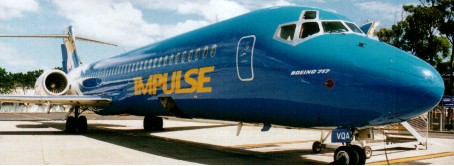
Boeing 717

Boeing 717-200

By the early 1990s, the three leading airframe manufacturers became aware of the demand for a smallerjet airliner. In particular, over the next two decades there is a market requirement for approximately 2,600 aircraft having a nominal seating capacity for 100 passengers.

Boeing 717 Article

To meet these requirements Boeing announced its new generation 737 600; Airbus the A319 and McDonnell Douglas the MD 95, all smaller derivatives of highly successful medium haul airliners. The B737 600 was given the build go ahead in March 1995, with entry into service scheduled for mid 1998 and the MD 95 was shown the green light six months later in October 1995. At that stage the A319 was ahead of the field, the lead aircraft configured in 116 seat layout being readied for delivery to Swissair in April 1996.
Launched in October 1995, by the end of 1999, the first of a 100 MD-95 contract (50 firm, plus 50 options) to AirTran Airlines (formerly ValueJet) was signed. With the merger of Boeing and McDonnell Douglas, commercial pressure resulted in the B717. The B717 200 has changed little from the McDomell Douglas concept for the MD-95. Similar in size to the DC 9 30, with a wingspan of 28.45m (93ft 3.5in) and overall length of 37.8m (124ft 0in).
The BMW Rolls Royce BR715 turbofan engine was developed specifically for it. First flew on 2 September 1998 and certified on 1 September 1999.
The Boeing 717-200 received simultaneous joint certification from the US FAA and European JAA on 1 September 1999. Five teat aircraft flew over 2000 hrs in more than 1900 flights.
On September 23, 1999, the first production 717-200 (N717XD, to be re-registered N949AT) was handed over to launch customer AirTran Airways at Long Beach, California.

On 23 May 2006 the last ‘Douglas Commercial’ airliner, a Boeing 717, was handed over to Air Tran at Long Beach, California.

B717-100
Seats: 86.

B717-200
Engines: Two BMW Rolls Royce BR715 turbofans, 82.2kN (18,500 lb) take off thrust with options available up to 93.4kN (21,000 lb).
Total fuel capacity 13,892 litres (3,056 Imp gal).
Max cruising speed, 0.76 Mach; 438kts (811 km/h).
FAA take off field length, (MTOW, SL, Temp = 30 degC) 1,950m (6,400ft).
FAA landing field length, (MLW, SL) 1,445m (4,740ft),
Range (domestic reserves, 106 passengers and baggage), 2,867km (1,547nm
Weights: Space limited payload, 12,220kg (26,940 lb).
Design gross maximum ramp weight, 52,163kg (115,000 lb).
Maximum take off weight, 51,710kg (114,000 lb).
Maximum landing weight, 46,266kg (102,000 lb).
Maximum zero fuel weight, 43,545kg (96,000 lb).
Operator’s empty weight, 30,785kg (67,870 lb).
Wingspan, 28.45m (93ft 43/4in).
Wing area, 305 sq.m (1,000.7 sq.ft).
Length, 37.81 m (1 24ft 0in).
Height, 8.92m (29ft 1 in).
Cargo hold, 26.5 sq.m(935 sq.ft).
Accommodation: Two crew and up to a maximum of 106 passengers in typical two class configuration.
Total cargo volume: 26.33 cu.m (930 cu.ft).

Boeing 707 / E-6 / E-8 / VC-137

Boeing 707

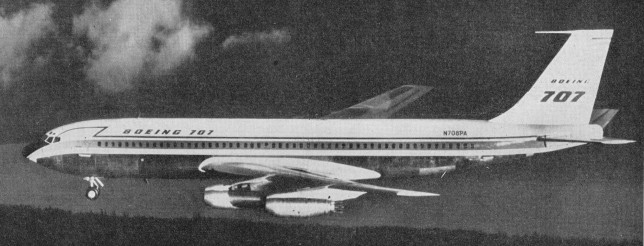
In October 1954 an order came through for 29 KC-135 tankers, based on the 367-80. When the company enlargened the cross-section of the fuselage, Boeing decided to design a new upper lobe for the commercial 707, while keeping the original one for the KC-135. The new fuselage upper lobe was of 140 in diameter making it easier to accommodate a triple seat each side of the aisle. The first 707 flew on 20 December 1957.

The 1st Boeing 707

Three airlines put Conway-engined Boeing 707s into service across the North Atlantic in the spring of 1960. The first was Lufthansa.

1st Lufthansa 707

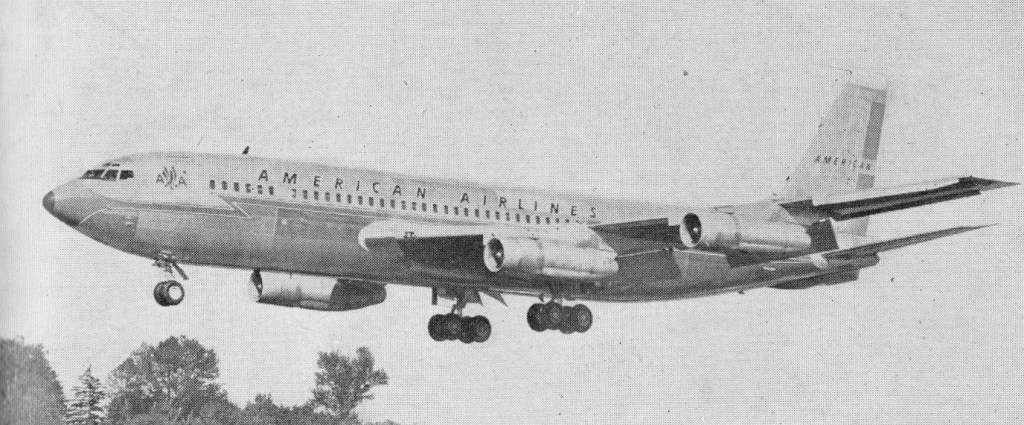
The Boeing 707-120 was introduced in 1954. As the 707-121, the first of a whole family of passenger and cargo variants, it was launched on its career by Pan Am in 1958 with a $296 million order for 20 — on the transatlantic route for prestige reasons, although it was designed and subsequently used for medium-range domestic service.

Boeing 707 Article

The first flight of a Pratt & Whitney JT3D turbofan powered 707-120B was made on 22 June 1960.

707-120B

The first operator of the 707-120 was Pan American who started daily service between New York and Paris on 26 October 1959.

Pan American began using its 707-120s on US domestic routes on 20 March 1959. Starting in July 1965, Pan American Airways replace the human navigator with inertal navigation systems in their entire fleet of 55 Boeing 707s at a cost of $12,500,000.

A brand-new presidential Boeing VC-137A, purchased in 1959, was equipped by a CIA team with a series of large cameras under conditions of secrecy at Andrews Air Force Base. Of the three military Boeing 707 aircraft provided for the White House and the American Government, 86970 was most frequently used as ‘Air Force One’.

VC-137A Air Force One

Some photographs were taken during test flights with the Special Air Mission Boeing, proving that from a height of 9 km the number plates of cars could be read. The large cameras in the belly of SAM 970 were installed behind hidden panels. The operation was controlled from the cockpit in such a way that possible Soviet ‘escorts’ would not notice anything.

The 707-121 was followed by the intercontinental -320, the largest passenger jet of its era (which flew the first ever round-the-world service in 1959) and the short-range -720. The Boeing 707-320B was introduced in 1959.
The 707-138 was tailored exclusively to QANTAS specifications, combining the short fuselage of the -120 with P&W JT3D turbofans (replacing the JT3C-6 turbojets), and taller tail fin, and other aerodynamic improvements significantly boosting performance. Modification to 707-138B standard included fitting leading edge flaps and the installation of JT3D-1 turbofans.

The first QANTAS 707 (and Australia’s first jet) VH-EBA, a 707-138B, was retored at Southend and returned to Australia on 16 December 2006. Now registered VH-XBA (EBA was taken) it was to be delivered to the QANTAS Founders Outback Museum at Longreach QLD.

In the early months of 1960, modifications were adopted on the 707 to improve its controllability under certain critical conditions. The modifications, first applied to the Conway-engined 707-436s of BOAC, included a taller fin and a small ventral fin.

Lufthansa Boeing 707-430 jets first entered service on the non-stop Frankfort-New York route on 17 March 1960.

On 29 July 1963 BOAC’s flight 568, a Boeing 707, left Montreal for a non-stop to London. At the controls were Capts. Hilbert Alcock and Ernest E. Brow. On 15 June 1919 two British Navy pilots. Capt. John Alcock ant d Lt. Arthur Brown, made the first non-stop flight across the Atlantic in 16 hr 12 min. The jet flew 1300 miles further in 6 hrs 10 min.

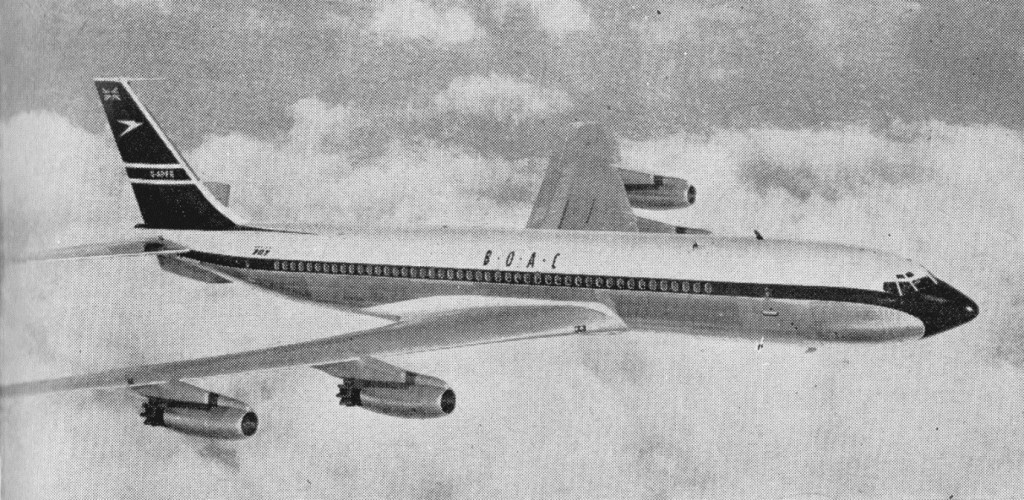
BOAC 707-436

On 707s only the rudder is power operated; the other control surfaces, aerodynamically balanced, are moved by spring tabs on the trailing edges. Though criticized for being noisy and excessively smoky, and for needing longer runways than existed at most airports in the 1950s, the 707 quickly overcame all opposition by flying more passengers and cargo faster, farther and more economically than any other passenger plane. Models fitted with turbofan engines were considerably quieter than the early turbojet-powered versions and by the early 1960s, runways at major airports had been extended to accommodate the new generation of jets. During the two decades of 707 production, almost 2,000 have been built.

A modified Boeing 707-353B joined the US Presidential fleet in August 1972, designated as a VC-137C.
President John F. Kennedy’s VC-137 (tail number 26000) was based on a USAF C-137C model which in turn was based on the Boeing 707. This aircraft gained more significance in becoming the aircraft used to transport Kennedy’s body back from Dallas, Texas in 1963. The aircraft served as the official office to which Vice President Lyndon B. Johnson was sworn in as the 36th President of the United States following Kennedy’s assassination at the hands of Lee Harvey Oswald. Today, this very aircraft resides at the United States Air Force Museum in Dayton, Ohio. The aircraft exhibit details the event complete with text and pictures showing the swearing in and the area of the aft portion of the interior cabin modified to fit the coffin of John F. Kennedy for the trip back to Washington, D.C.

The same aircraft transported the body of President Lyndon B. Johnson back to Texas for final rest. President Richard M. Nixon utilized VC-137 on his historic visits to China and the Soviet Union.

John F. Kennedy’s VC-137 was the first presidential aircraft to be popularly known as “Air Force One”.

Powered by four turbojet engines the long range 707-320C can carry up to 202 passengers and has provided safe, fast and comfortable jet travel around the world. Its success can be measured by the fact that no fewer than 859 had been delivered by 1 June 1972.

In 1982 Boeing modified a commercial 707-320 airliner to demonstrate its potential as a tanker/ transport. As flown, the demonstrator has a centreline and wing-tip hose and drouge refuelling systems, but several alternatives are offered, including a centreline flying boom installation. For the tanker role an optional tank may be fitted in the lower rear cargo hold to provide an additional 19,000 lt of fuel. Spain will receive two tanker/transports with VIP interiors during 1987, while Brazil will take delivery of its fourth and last in November 1987.

Boeing completed the first 707-320 Inter-continental as no.16 off the Renton line, flying it on 11 January 1959. The Intercontinental had been ordered by nine airlines. Britain’s CAA caused a minor hiccup by insisting on extra vertical tail area. At first this was met by a big underfin, but the definitive answer was a taller fin, which Boeing made standard. The name Inter-continental was later dropped. The -320B had the JT3D engine and wings with a high-lift leading edge with full-span Kruger flaps and longer-span curved wingtips. These matched weight increases to 333,600lb, paralleled by the -320C mixed-traffic version cleared for 202 passengers or 96,126 lb of cargo.

The -320C remained in production until March 1982, the final total standing at 917. This does not include such military versions as the E-3 AWACS and KE-3A, E-6, E-8A and EC-18 series; with these the total is almost exactly 1,000.
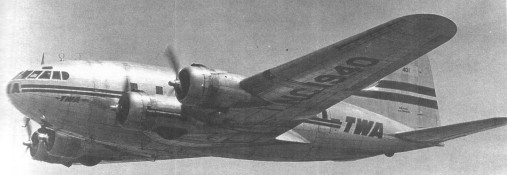
Northrop Grumman undertakes production of E-8C Joint STARS as joint USAF and U.S. Army co-operation program for an airborne surveillance and target acquisition system (first flown August 1995 for first production E-8C).
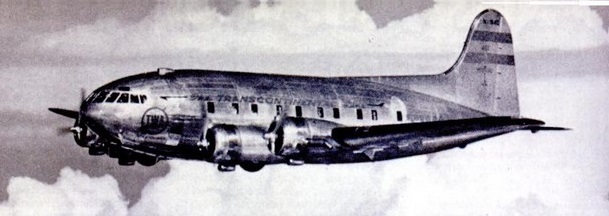
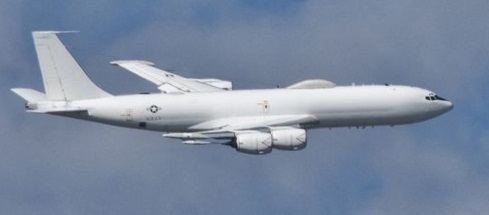
U.S. Navy Boeing E-6B Mercury airborne command post

The last commercial 707 was 707-320C for Moroccan government delivered March 1982.

Based on the E-3 airframe and powered by four CFM International Fl08-CF-100 turbofans rated at 22,000 lb st (9 979 kgp) each, E-6As will replace EC-130Q Hercules in the TACAMO (Take Charge And Move Out) role to communicate with nuclear submarines. The E-6A is equipped with very-low-frequency (VLF) radio systems for commu¬nication with the US Navy’s Trident nuclear submarine fleet.

In 1990 the US Navy ordered eleven Boeing 707 derivatives. The particular USN variant ordered was the E-6 submarine communication aircraft which uses a five mile long trailing wire as a very low frequency antenna to produce a carrier wave to penetrate the ocean surface and reach submerged submarines worldwide.

For the US Navy, Boeing is building 15 of these survivable airborne communications systems, based on the Model 707 airliner airframe. E-6A – Powered by CFM-56 engines, the E-6A proto¬type flew on 19 February 1987 (minus avionics). Development of the survivable airborne communications system for the US Navy will continue until 1989.

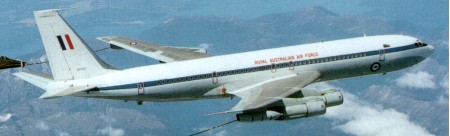
Five Royal Australian Air Force Boeing 707 jets, with 29 years of service, where used for air-to-air refuelling and transport. A 707 tanker can carry up to 43 tonnes of fuel – the wingtip refuelling pods removable to reduce weight and drag and increase range on non-tanker missions.

As a transport aircraft, the 707 can seat up to 152 passengers or carry 60 tonnes of cargo. From 2009, the RAAF 707s were progressively replaced by new KC-30B Multi-Role Tanker Transports, specially-modified Airbus A-330s.

A re-engined Boeing 707 with four Pratt & Whitney JT8D-219 engines has shown up to 22% improvement in fuel usage over its original engines. This aircraft has been dubbed the B707RE. Also tested (as 707-700) was a re-engined version with CFM56.

The Boeing 707 80 prototype obtained speeds well below 100 mph during landing approach in tests conducted by NASA and Boeing at Langley Research Centre. The plane, which once set a coast-to-coast record at 612 mph, was modified by Boeing at its own expense. It has large wing flaps, a boundary layer control system, thrust modulating system and instruments to provide flight data. The Boeing 707 80 prototype was presented ultimately to the Smithsonian Air and Space Museum.

Keen to market its own AEW system for the Israeli Air Force (IAF) and for export, Israeli Aircraft Industries (IAL) developed the Phalcon Airborne Early Warning, Command and Control System and mounted it on a Boeing 707 airframe. The Phalcon system has attracted interest from a variety of countries, however, when China expressed an interest in mounting the radar system on a Russian-built Ilyushin/Beriev A-501 Mainstay in Jul 2000, the USA eventually blocked the sale.

Boeing 707 Phalcon

Gallery

B707-120
Engines: 4 x Pratt & Whitney JT3C-6 turbojet.
Length: 145 ft 1 in.
Seats: up to 180.

B707-138B
Engines: 4 x Pratt & Whitney JT3D-1 turbofan.

Engines: 4 x Pratt & Whitney JTD 3 turbofan, 18,000 lb. (8,165 kg.) thrust.
Length: 149 ft 7 in (46.61 m)
Height: 12.9 m / 42 ft 4 in
Wing span: 145 ft 8 in (44.42 m)
Wing area: 273.3 sq.m / 2941.77 sq ft
Weight empty: 138,385 lb (62,771 kg)
Take-off weight: 148780 kg / 328005 lb
Cruise speed: 960 km/h / 597 mph
Max. accommodation: 189
Ceiling: 42,000 ft (12,800 m) fully loaded
Range w/max.fuel: 8690 km / 5400 miles
Range w/max.payload: 7885 km / 4900 miles
Crew: 4

B707-220
Seats: up to 180

707-320
Engines: 4 x Pratt & Whitney JT-4A turbojet

707-320B
Engines: 4 x Pratt & Whitney JT9D 7 turbofan, 19,000 lb
Wing span: 145 ft 9 in (44.42 m)
Length: 152 ft 11 in (45.61 m)
Height: 42 ft 5 in (12.92 m)
Max TO wt: 333,600 lb (151,315 kg)
Max level speed: 627 mph (1010 kph)
Ceiling: 42,000 ft
Range 6,160 miles
Seats: up to 219

B707-320C
Engines: 4 x Pratt & Whitney JT3D-7 turbofans, 19,000lbs thrust
Length: 149.61ft (45.6m)
Width: 145.73ft (44.42m)
Maximum Speed: 551mph (886kmh; 478kts)
Maximum Range: 4,300miles (6,920km)
Service Ceiling: 38,993ft (11,885m)
Accommodation: 9 + 189
Empty Weight: 145,999lbs (66,224kg)
Maximum Take-Off Weight: 333,592lbs (151,315kg)

B707-720
Seats: up to 180

B707-420
Engines: 4 x Rolls-Royce Conway
Seats: up to 219

B707RE
Engines: 4 x Pratt & Whitney JT8D-219

B707-700
Engines: 4 x CFM56

E-6A
Engine: 4 x CFM56-2 turbofan.
Installed thrust: 392.6 kN.
Span: 45.2 m.
Length: 46.6 m.
Empty wt: 78,380 kg.
MTOW: 155,130 kg.
Max speed: 980 kph.
Ceiling: 12,200 m
T/O run: 1650 m.
Ldg run: 720 m.
Range: 11,750 km.
Endurance: 15.4 hr.
Air refuel: Yes.

Boeing 707
RAAF Role: Air-to-air refuelling, passenger and cargo transport
Crew: Two pilots, flight engineer, loadmaster, navigator (air-to-air refuelling role), up to six crew attendants
Engines: Four Pratt and Whitney JT3B turbofans (8,172kg thrust each)
Length: 46.5m
Height: 12.9m
Wingspan: 44.5m
Weight: 152,000kg
Speed: 890 km/h
Range: Over 7,400km
Ceiling: 42,000 feet
Accommodation: Up to 152 passengers

Boeing VC-137B Stratoliner
Maximum Speed: 628mph (1,010kmh; 545kts)
Maximum Range: 5,757miles (9,265km)
Rate-of-Climb: 4,000ft/min (1,219m/min)
Service Ceiling: 49,869ft (15,200m; 9.4miles)
Engines: 4 x Pratt & Whitney JT3D-3 Turbofans, 80kN (18,000 lbs)

Boeing 314 / C-98

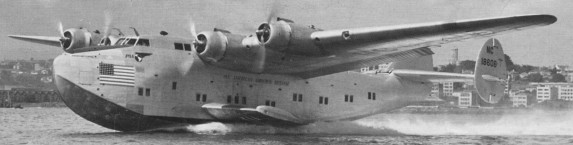
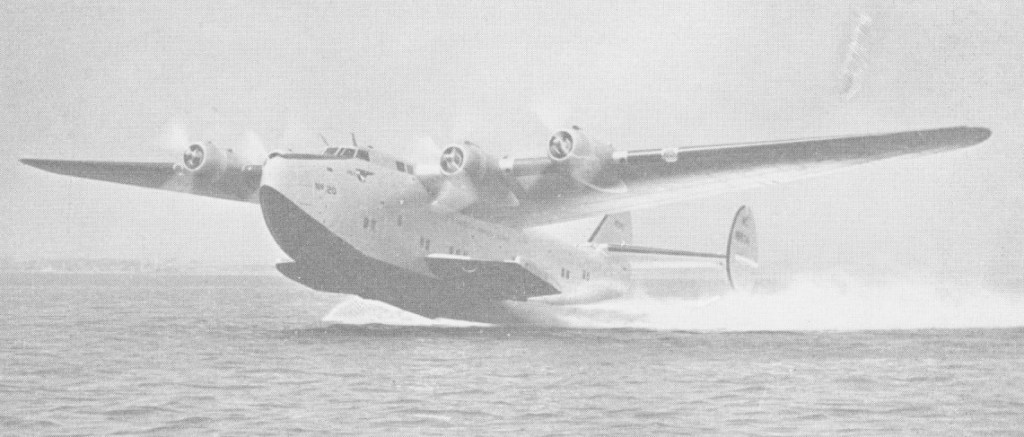
As early as January 1935, Pan American Airways had signified to the US Bureau of Air Commerce its wish to establish a transatlantic service and, the airline wanted a new aircraft for the route.

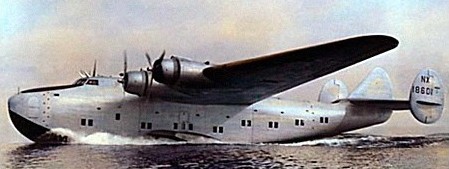
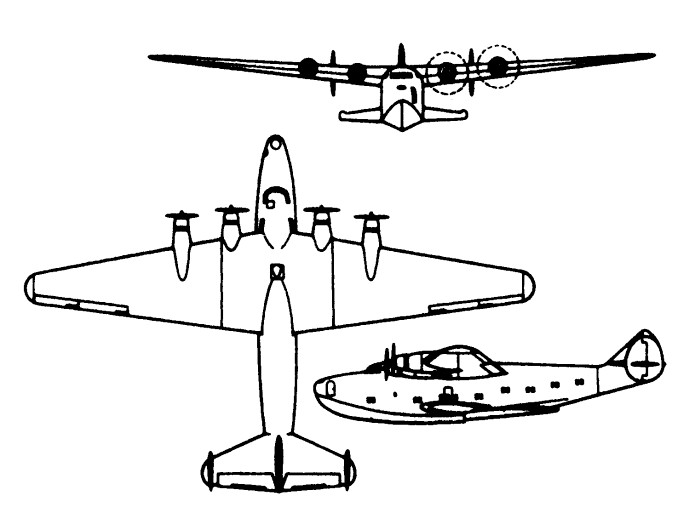
Boeing submitted a successful tender to the Pan American specification and a contract for six Boeing Model 314 flying-boats was signed on 21 July 1936. They used features of the XB-15 heavy bomber, adapting the wing and horizontal tail surfaces for its 37421kg gross weight flying-boat, which could accommodate a crew of 8 and up to 74 passengers in four separate cabins. The engines 1119kW Wright GR-2600 Double Cyclones which gave the machine a maximum speed of 311km/h. The fuel capacity of 15898 litres giving a maximum range of 5633km. Some of the fuel was stored in the stabilising sponsons, which also served as loading platforms.
The first Boeing 314 made its maiden flight on 7 June 1939, this original version having a single fin and rudder, later replaced by twin tail surfaces to improve directional stability. These proved to be inadequate, and the original centreline fin was restored, without a movable rudder.

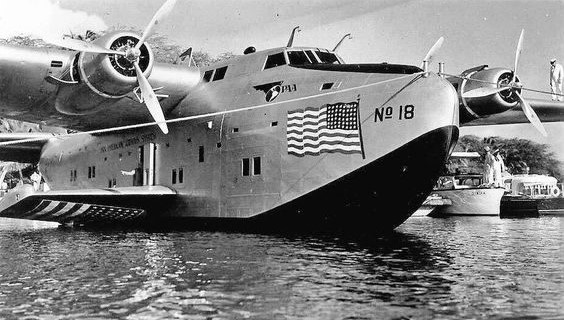
The aircraft was awarded Approved Type Certificate No. 704 and entered transatlantic airmail service on 20 May 1939. PAA Boeing 314 ‘Yankee Clipper’ flew by way of the Azores to Spain and then on to Southampton. On June 17 ‘Atlantic Clipper’ made first passenger crossing, carrying reporters and airline officials. Regular passenger service commenced on 28 June 1939, when ‘Dixie Clipper’ carried twenty-two paying passengers. One passenger having booked his seat in 1931. At that time the Model 314 was the largest production airliner in regular passenger service.

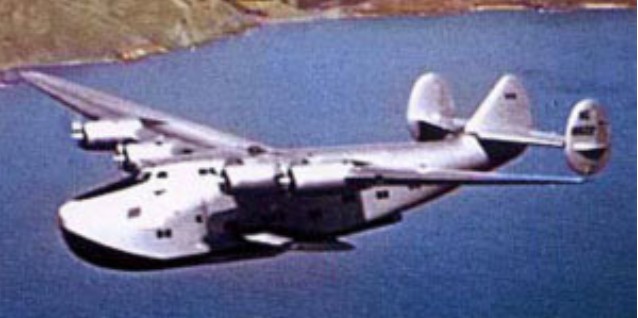
Known as “California Clippers” they operated over the South Pacific Ocean routes for Pan American Airlines. One such “California Clipper” flew from Los Angeles Harbor to Auckland, New Zealand, an 8,000-mile, 50-hour route with night layovers at Honolulu, Canton Island, and Noumea, New Caledonia. On two decks—an upper or control deck and a passenger deck—there were accommodations for a crew of 11 and 68 passengers or 36 sleeping passengers. The passenger deck was divided into nine sections, including a lounge, six separate passenger compartments, a specially furnished deluxe compartment, a galley and restrooms.

Clippers were in service with distinguishable names from 1939 through 1951 and were represented as the Honolulu Clipper, Cape Town Clipper, Anzac Clipper, Pacific Clipper, American Clipper, Yankee Clipper, California Clipper and the Atlantic Clipper – all operated by Pan Am.

Pan American ordered another six aircraft which were designated Model 314A, improved by the installation of 1193kW Double Cyclones with larger-diameter propellers, and additional 4542 litres of fuel capacity, and a revised interior. The first Model 314A flew on 20 March 1941 and delivery was complete by 20 January 1942. Five of the original order were retrospectively converted to Model 314A standard in 1942. Three of the repeat order were sold, before delivery, to BOAC for transatlantic service and operation on the Foynes-Lagos sector of the wartime ‘Horseshoe Route’. The three Boeing 314As, G AGBZ Bristol, G AGCA Berwick, and G AGCB Bangor, with fuel capacity of 5,448 US gallons giving a range of over 3,600 miles, were acquired by the British Government and delivered new from Boeing’s Seattle factory specifically to provide the UK West Africa ‘lifeline’. The three Boeings commenced operation UK West Africa in May 1941. It transpired that a valuable, albeit irregular, trans Atlantic service was an incidental development due to the necessity for them to return to their Baltimore base for certain overhauls after every 120 hours flying, and Atlantic flights were therefore interpolated into the schedules to permit this to happen. BOAC operated its last B.314A on January 17, 1948.

Of Pan American’s nine Model 314/ 314As, four were requisitioned by Army Transport Command and given the military designation C-98. They were little used, however, and in November 1942 one was returned to the airline. The other three were transferred to the US Navy to join two acquired direct from Pan American; the airline provided crews for the US Navy’s B-314 operations and the aircraft were partially camouflaged but operated with civil registrations.

BOAC and Pan American terminated Boeing Model 314 services in 1946 and the surviving aircraft were sold to American charter airlines

Only 12 were ever built.

Gallery

Boeing 314 Clipper
Engines: 4 x Wright R-2600 Double Cyclone, 1,500 hp

Boeing 314A Clipper (C-98)
Engines: 4 x Wright R-2600 Cyclone 14, 1193kW, 1600 hp
Props: full-feathering constant-speed
Length: 32.31 m / 106 ft 0 in
Height: 8.41 m / 27 ft 7 in
Wingspan: 46.33 m / 152 ft 0 in
Wing area: 266.34 sq.m / 2866.86 sq ft
Maximum Take-Off Weight: 83,776lbs (38,000kg)
Empty Weight: 48,281lbs (21,900kg)
Fuel capacity: 5408 USG
Max. speed: 311 km/h / 193 mph
Cruise speed: 295 km/h / 183 mph
Maximum Range: 3,664miles (5,896km)
Ceiling: 4085 m / 13400 ft
Passengers: 74

Boeing 367 / 377 Stratocruiser / C-97 Stratofreighter

C-97

In early 1942 Boeing initiated a design study to examine the feasibility of producing a transport version of its B-29 Superfortress. The company’s proposal was submitted to the USAAF for consideration and, because at that time the long-range transport was a much-needed type of aircraft, a contract for three prototypes was awarded on 23 January 1943. Identified by the company as the Boeing Model 367, and designated XC-97 by the US Army Air Force, the first made its maiden flight on 15 November 1944.
The XC-97 had the entire wing and engine layout of the B-29. The ‘double-bubble’ section fuselage appears to be entirely new, but the lower ‘bubble’ was basically a B-29 structure, and so was the tail unit attached to the new (and larger) upper ‘bubble’. On 6 July 1945, following brief evaluation of the prototypes, 10 service-test aircraft were ordered. These comprised six YC-97 cargo transports, three YC-97A troop carriers, and a single YC-97B with 80 airline-type seats in its main cabin.

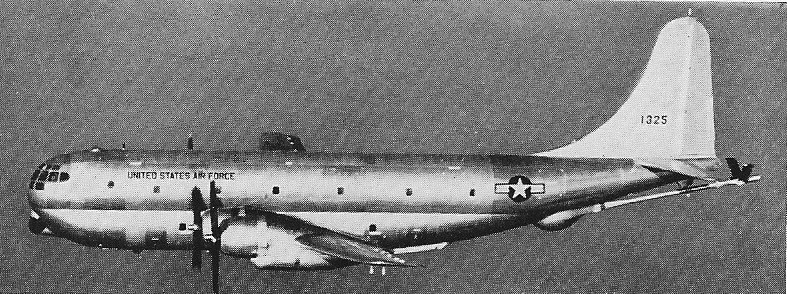
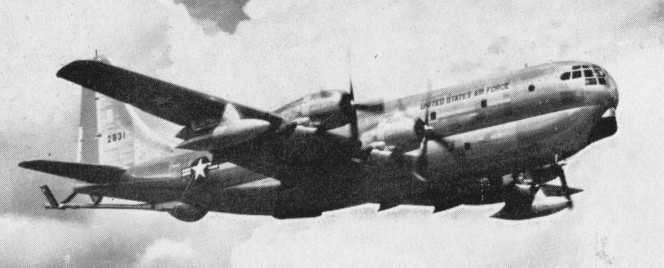
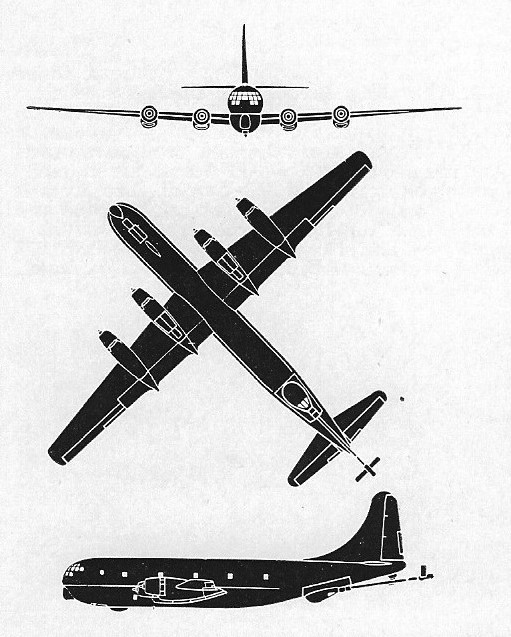
The first production contract, on 24 March 1947, for 27 C-97A aircraft with 2425kW Pratt & Whitney R-4360-27 engines, specified accommodation for 134 troops, or the ability to carry a 24,040kg payload. Two transport versions followed, under the designation C-97C and VC-97D, and following trials with three KC-97A aircraft equipped with additional tankage and a Boeing-developed flight-refuelling boom, KC-97E flight-refuelling tankers went into production in 1951. This version was powered by 2610kW R-4360-35C engines.

C-97F

Boeing 367 / 377 Stratocruiser / C-97 Stratofreighter Article

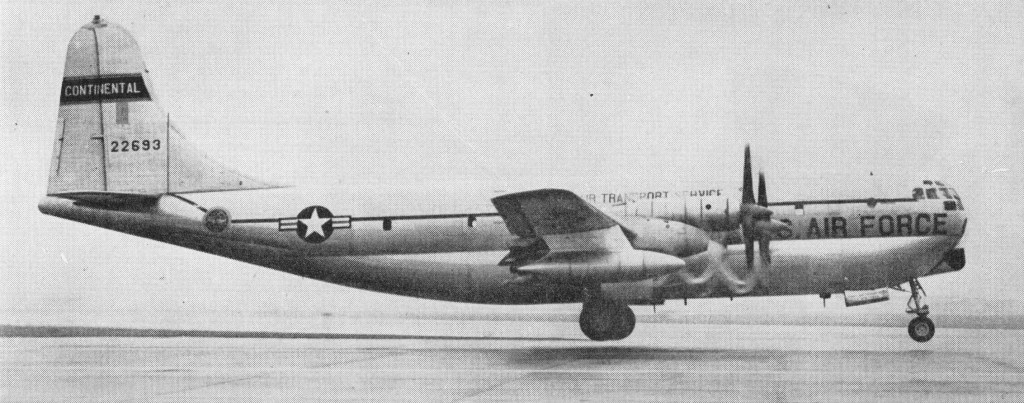
The KC-97F differed only in having R-4360-59B engines. Both the KC-97E and KC-97F were convertible tanker/transports, but for full transport capability the flight-refuelling equipment had to be removed. The most numerous variant, with 592 built, was the KC-97G which had full tanker or full transport capability without any on-unit equipment change.

Boeing KC-97G

When production ended in 1956 a total of 888 C-97s had been built, and many were converted later for other duties. The KC-97L variant had increased power by the installation of a 2359kg thrust General Electric J47-GE-23 turbojet beneath each wing to improve rendezvous compatibility with Boeing B-47s. KC-97Gs converted to all-cargo configuration were redesignated C-97G, and in all-passenger configuration became C-97K. Search and rescue conversions were HC-97G, and three KC-97Ls went to the Spanish air force, being designated TK-1 in that service. Several have served in many roles with Israel’s air force.

Twenty KC-97s are assigned to each 45-plane wing of B-47 bombers. The KC-97G combines in one aircraft the duties of transport and ” flying boom” tanker, its boom being a permanent fixture. Earlier versions had removable booms for conversion into transport role. The KC-97G usually carries two 1700-gal. fuel tanks under outer wings.

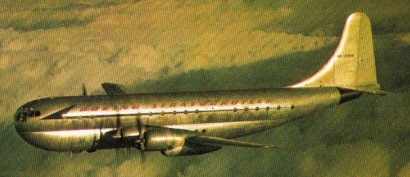
The Boeing Model 377 Stratocruiser was a commercial transport development of the Model 367 (military C-97), and based on the improved-structure YC-97A with Pratt & Whitney R-4360 engines. The first flight of the prototype Model 377-10-19 was made on 8 July 1947, and it was delivered subsequently to Pan American World Airways, which was the biggest user of the Stratocruiser. There were a variety of interior configurations in the Models 377-10-26, -28, -29, -30, -32 accommodating from 55 to 112 passengers or, if equipped as a ‘sleeper’, with 28 upper- and lower-berth units, plus five seats. The main cabin was in the upper lobe of the ‘double-bubble’ fuselage, with a luxury lounge or cocktail bar seating 14 on the lower deck, reached via a spiral staircase.

Of the total of 55 that were built, Pan Am was operating 27 at one period. Of these, 10 were given additional fuel capacity to make them suitable for transatlantic operations, and were known as Super Stratocruisers. At a later date the entire fleet was equipped with General Electric CH-10 turbochargers, enabling each engine to develop an additional 37.3kW. British Overseas Airways Corporation also acquired a fleet of 17 with only six of these were original purchases from Boeing, the remainder acquired from other airlines. After just over nine years’ service with BOAC, 10 were sold to Transocean Airlines in the USA during 1958. Of these, four were converted to 117-passenger high-density seating, the remainder each having an additional 12 seats added to their standard 63- and 84-seat layouts. Before Stratocruisers disappeared from service during 1963, a few had been modified to a cargo configuration, but by far the strangest conversion resulted from those airframes acquired by Aero Spacelines Inc. Under the designation 377-PG, this company built an oversize cargo aircraft which it named ‘Pregnant Guppy’ and subsequently built other examples, using both Model 367 and 377 airframes, under variations of the Guppy name.

The YC-97J designation for two KC-97Gs converted for USAF use as flying test-beds, each with four 4250kW (5,700-shp) Pratt & Whitney YT43-P-5 turboprop engines.

YC-97J

During the course of the Berlin Airlift emphasis was placed more on eavesdropping activities. For those missions the USAF at the West German airbase at Wiesbaden had the 7405th Operation Squadron which used only two Boeing EC-97G Stratocruisers. The only obvious difference from normal transports was an extra aerial blister under the fuselage.

EC-97G

The EC-97G kept on flying to and from Tempelhof in West Berlin up to 1976 when they were replaced by C-130E.

Gallery

Variants:

Boeing Model 367 / XC-97

YC-97
Cargo transport

YC-97A
Troop carrier

YC-97B
80 airline-type seats

C-97A
Engines: 4 x Pratt & Whitney R-4360-27 Wasp Major, 2425kW / 3,500 hp
Maximum Range: 2,672miles (4,300km)
Service Ceiling: 30,000ft (9,144m)
Crew: 4
Capacity: 134 troops, or 24,040kg payload.

C-97C
Transport version

C-97D
Designation applied to the third YC-97A, the YC-97B, and two C-97As following conversion to a standard passenger configuration; the three VC-97Ds were subsequently redesignated C-97D

VC-97D
Transport version

KC-97A
Convertible tanker/transports with additional tankage and a Boeing-developed flight-refuelling boom

KC-97E
Flight-refuelling tankers
Engines: 4 x R-4360-35C, 2610kW

KC-97F
R-4360-59B engines.
Convertible tanker/transports

KC-97G
Full tanker or full transport

C-97G
KC-97Gs converted to all-cargo configuration

C-97K
KC-97Gs converted to all-passenger configuration

KC-97H
Designation applied to one KC-97F, following modification for service trials as a tanker using the probe-and-drogue flight-refuelling system developed in the UK

YC-97J
Final designation of two KC-97Gs converted for USAF use as flying test-beds, each with four 4250kW (5,700-shp) Pratt & Whitney YT43-P-5 turboprop engines

KC-97L / TK-1
Increased power with a 2359kg thrust General Electric J47-GE-23 turbojet beneath each wing

Boeing Model 377-10-19
First prototype. Improved-structure YC-97A with Pratt & Whitney R-4360 engines.

Models 377-10-26, -28, -29, -30, -32
Variety of interior configurations in the accommodating from 55 to 112 passengers or, if equipped as a ‘sleeper’, with 28 upper- and lower-berth units, plus five seats.

377 Stratocruiser
Engines: 4 x Pratt & Whitney R-4360 B6 Wasp Major, 3500 hp, 2610kW.
Prop: 4 blade 16 ft 7 in (5.05m).
Wing span: 141 ft 3 in (43.05m).
Length: 110 ft 4 in (33.63 m).
Height: 11.66 m / 38 ft 3 in
Wing area: 1,769 sq ft (164.3sq.m).
Weight empty 83,500 lb. (37,870 kg.).
Max wt: 145,800 lb (66,134 kg).
Max. speed: 604 km/h / 375 mph
Typical cruising speed: 300 mph (483 km/h) at 25,000 ft (7,620 m).
Max cruise speed: 340 m.p.h. (550 kph).
Ceiling: 32,000 ft. (10,000 m.) fully loaded.
Typical range: 2,750 miles (4,426 km) with max payload.
Max range: 4 600 miles (7,400 km.).
Cruise 50% pwr: 270 kts @ 25,000 ft / 135 USG/Hr/engine.
Endurance: 14 hr.
T/O run: 7200 ft.
Crew: 5.
Pax cap: 55-100

Boeing 377 Stratocruiser
Engines: 4 x Patt & Whitney R-4360-TSB3-G, 3500 hp
Wingspan: 141 ft 3 in
Length: 110 ft 4 in
Height: 38 ft 3 in
Empty weight: 83,500 lb
Loaded weight: 142,500 lb
Max speed: 375 mph
Cruise: 196 mph
Normal range: 1500 mi

KC-97G
Engines: 4 x Pratt & Whitney R-4360-59B Wasp Major, 2610kW / 3500 hp
Wingspan: 43.05 m / 141 ft 3 in
Length: 33.63 m / 110 ft 4 in
Height: 11.66 m / 38 ft 3 in
Wing area: 164.34 sq.m / 1768.94 sq ft
Take-off weight: 79379 kg / 175002 lb
Empty weight: 37421 kg / 82500 lb
Max. speed: 604 km/h / 375 mph
Cruise speed: 483 km/h / 300 mph
Ceiling: 9200 m / 30200 ft
Range: 6920 km / 4300 miles

KC-97G
Transport and flight refuelling tanker
Engines: 4 x Pratt & Whitney R4360-75, 3,500 h.p.
Wingspab: 141 ft. 3 in.
Length: 110 ft. 4 in,
Loaded weight: 153,000 lb
Max speed: 375 m.p.h.
Ceiling: 35,000 ft.
Max range: 4,200 miles at 300 m.p.h. at 25,000 ft.
Crew: 5
Capacity: 96 troops or 68 500 lb. cargo

YC-97J
Engines: 4 x 5700 hp Pratt & Whitney T34 turboprop

Boeing 377 Stratocruiser
KC-97G

Boeing 307 Stratoliner / C-75

In early 1934 Boeing began design studies for a multi-engine bomber and a basically similar civil transport. When, in June 1934, the USAAC invited proposals for a new bomber, Boeing’s Model 299 was revamped to meet the Army specification and duly became built by the thousands as the B-17 Flying Fortress.

The Model 300 was also changed as ideas were developed and in its Model 307 form was similar to the B-17C, except for a very different fuselage. This was of circular cross-section with pressurisation for the crew of five and 33 passengers. The Model 307 introduced an extra crew member – known as the flight engineer – to relieve the captain of certain duties such as power plant, fuel and pressurisation management and monitoring.

The prototype Model 307 (named Stratoliner because of its high cruising ceiling) flew for the first time on 31 December 1938.

A total of ten were built: the prototype; five SA-307B for Transcontinental & Western Air; three S-307 for Pan American; and a single SB-307B for the late Howard Hughes.

First delivered to PanAm in 1940, the Boeing 307 went into service in 194, carrying passengers on long haul American routes. The night plane version had berths for 16 passengers and reclining chairs for a further 9.

The 307B differed from the 307 in having 1100 Wright Cyclone GR-1820-G105A engines instead of G-102s, and slotted flaps in place of split trailing edge flaps.

TWA’s SA-307B were impressed for service with the Army’s Air Transport Command during World War II, being used as C-75 for VIP transport over the North and South Atlantic.

307B

The TWA 307Bs were extensively modified after wartime USAF service; the cabin pressurisation equipment was removed, and B-17 wings and 1200 hp Wright R-1820 engines were fitted. These were eventually sold to France.

A special model SB-307B for Howard Hughes was built with more powerful engines and extra fuel tanks for an around-the-world flight that was cancelled due to the start of World War II. The flight was never made. It was the first Stratoliner delivered to a customer; its initial flight (with experimental license NX19904) occurred on July 13, 1939. Postwar it was fitted with a luxury interior, including a bedroom, and named The Flying Penthouse.

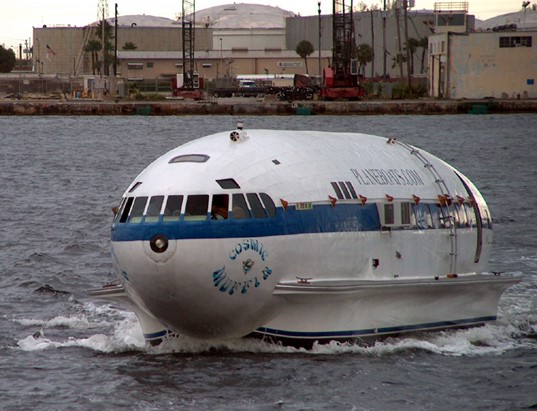
A 1964 hurricane severely damaged it and rendered it unflyable. In 1969 it was purchased as scrap for $61.99 — the fuselage was salvaged (the aft rounded pressure bulkhead formed the cabin after end), then mounted on a boat hull and converted into a luxury yacht named The Londonaire. It was rebuilt beginning in 1994, and is a Florida based, operating yacht named Cosmic Muffin, with N19904 painted on its sides.

Gallery

S-307
Engines: 4 x Wright GR-1820 Cyclone, 671kW
Take-off weight: 19050 kg / 41998 lb
Empty weight: 13608 kg / 30001 lb
Wingspan: 32.61 m / 106 ft 12 in
Length: 22.66 m / 74 ft 4 in
Height: 6.34 m / 20 ft 10 in
Wing area: 138.05 sq.m / 1485.96 sq ft
Max. speed: 396 km/h / 246 mph
Cruise speed: 354 km/h / 220 mph
Ceiling: 7985 m / 26200 ft
Range 50 % pwr: 1,635 miles / 2,616 km
Crew: 4
Pax cap: 33

Boeing XL-15 / YL-15

The L-15 Scout was a light and small observation liaison aircraft produced in limited numbers by the Boeing Aircraft Company following World War 2 – only twelve of the type were produced with the United States Army becoming its top operator. The YL-15 requirements included an aircraft that could be quickly dismantled and loaded on a standard 2.5 ton truck.

First flight was achieved on July 13th in 1947 and production spanned from 1947 into 1949.

The all-metal construction L-15 was designed for operations from short runways (STOL) and specifically intended for the light scout observation role. The L-15 was designed at Boeing’s Wichita, Kansas facility.

The aircraft featured a high mounted monoplane wing assembly to which were affixed “flaperons”, wing devices that could double as ailerons and flaps. The two-person crew, made up of the pilot and the observer, sat in a glassed-in nacelle-type fuselage under the main span of the wings. The engine was mounted at the extreme front of the fuselage with the empennage extended out over the rear portion of the aircraft. The tail section had twin vertical tail fins. The undercarriage was a conventional “tail-dragger”, with two main landing gears and a tail wheel. All were fixed and the tail wheel was positioned under the rearward portion of the fuselage nacelle. The aircrafts size made it suitable for transport in a C-97 aircraft, that is once broken down for the journey. Should the mission call for it, the L-15 could also be fitted with twin floats for water landings.

The Scout could be towed as a glider at speeds up to 165 mph without having its airscrew removed.

No firm L-15 Scout contracts were secured. The remaining seven were later employed by the Federal Fish and Wildlife Service.

Boeing L-15 Scout
Engines: 1 x Lycoming O-290-7, 125hp.
Length: 25.00ft (7.62m)
Wingspan: 39.99ft (12.19m)
Height: 8.69ft (2.65m)
Empty Weight: 1,512lbs (686kg)
Maximum Take-Off Weight: 2,055lbs (932kg)
Maximum Speed: 112mph (180kmh; 97kts)
Rate-of-Climb: 628ft/min (191m/min)
Service Ceiling: 16,398ft (4,998m)
Accommodation: 2

Boeing 299 / B-17 Flying Fortress / B-40 / C-108 / F-9

B-17G

Designed to a US requirement for a four-engine bomber capable of long distance travel with a full 2,000lb bombload and reach speeds between 200 and 250 miles per hour. The result was the Boeing Model 229 which first flew in 1934, though was later lost to pilot error. Nevertheless, the US Army Air Corps pursued the design with an order for further developmental models fitted with differing powerplants. Early B-17 models were mostly developmental production variants that included the additions of seal-sealing fuel tanks, better armor protection and a redesigned tail.

America’s USAAC had been a little ahead of Britain in specifying their need for a four engined bomber, and the prototype Boeing Model 299 / XB 17 designed to meet this requirement flew for the first time on 28 July 1935. Powered by four 750 hp Pratt & Whitney Hornet engines, the prototype crashed three months later at Wright Field when the control locks were inadvertently left engaged before takeoff.

Boeing B-17 Article

A pre production batch of 13 Y1B 17s was bought for evaluation.

It was not until 1938 that the USAAC was able to place an order for 39 production B-17B, the last of this batch entering service in March 1940. These were the first B-17 production aircraft to be equipped with turbocharged Wright Cyclone engines, providing a higher maximum speed and much increased service ceiling.

Of the B-17C which followed, a batch of 20 were supplied to the RAF (designated Fortress I) and used operationally in Europe for evaluation, leading to improved B-17D and B-17E aircraft with self-sealing fuel tanks and revised armour and armament.

The Royal Air Force used them to bomb the German naval base at Wilhelmshaven on July 8th, 1941, marking the B 17’s first hostile action.

In late Summer of 1941, Great Britain bought 20 of the B-17C bombers recently produced by the USA, but the RAF had nothing but bad experiences with them. The B-17C’s first war deployment was on Monday 8 September 1941, when they attacked several targets along the Norwegian coast from from close to 20,000ft / 9000m. But the Germans received radar warning of their presence and sent out Me 109s from 77 Sqn, 13th Fighter Wing (based on Stavanger), which shot down 2 Fortress Is and seriously damaged three. After other fiascos with the B-17C, British Bomber Command concluded that they were completely unsafe, ineffective and unsuitable for use in any serious missions.

Following an extensive redesign, to increase armour and armament, new versions were introduced and were widely used by the Americans, both in Europe and the Pacific.

Y1B-17

The initial definitive Flying Fortress model would arrive with 512 examples of the B-17E model which were the first to incorporated the twin .50 caliber tail armament for defense.

Many changes were made as a result of combat experience first by the RAF and then by the USAAF in Europe. Even the B 17E , armed with one 7.62mm and 12 12.7mm machine-guns for defence and able to carry a maximum 7,983kg of bombs, was given a mauling by the Luftwaffe when it first ventured over Europe in daylight: but the Americans stood by their beliefs in the effectiveness of day bombing added still more guns, learned new tactics and eventually made possible the crushing round the clock bomber offensive. This model was followed by the similar B-17F models of which 3,405 were produced.

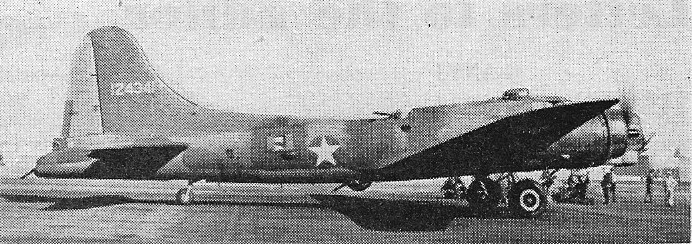
A further modification programme, this time to improve the bomber’s ability to repel air attacks from the front, produced the B17G with its twin-gun ‘chin’ turret which you can see clearly on this example.

Most extensively built variant was the B-17G (8,680), built by Douglas (2,395) and Lockheed Vega (2,250) as well as at the Boeing plant, Seattle (4,035). The B 17G model, the seventh variation of the original design, was equipped Pratt & Whitney R-1820-97 radial engines with super-chargers that allowed the airplane to cruise at 35,000 feet at a maximum speed of 285 miles per hour. It also carried up to thirteen .50 caliber machine guns and 6,000 pounds of bombs. The addition of a chin turret below the nose (containing two 12.7mm machine-guns) provided better defence against the head-on attacks. U.S.forces used it primarily for high level daylight bombing over Europe. The formidable machine gun placement enabled B 17s to develop a highly effective defensive tactical formation. Production of the B-17G started in July 1943.

Flying the Boeing B-17 Flying Fortress

B-17G manufactured after January 1944 were no longer given a camouflage coating because they were lighter and faster without it

The bombardier sat on a type of swiveling stool with a Norden Bombsight before him. The navigator sat off-set to his rear at a small map-filled desk. Both were supplied with defensive .50 caliber machine guns with the Bendix chin turret under the bombardiers control in the G model and onwards. Access to the nose was accomplished through a smallish passage way underneath the main flight deck.

The pilot and co-pilot sat on the flight deck above and behind the navigator’s position with the pilot to the left and his copilot to the right with both offered equal control access and views of all four of the engines. To their rear was the top gunners position with a catwalk crossing between the payload in the bomb bay. Once past the bomb bay, the radio operators station and his equipment was apparent. The radio operator was also afforded a table and seating along with his communications equipment. Access to the belly turret was available following this area, which further opened up to the staggered waist gunner positions which might or might not have been covered by plexiglass depending on the model.

On 1 July 1942 the first heavy bomber of the American 8th Army Air Force laned in Britain by the North Atlantic route. B-17E “Jarring Jenny” landed at Prestwick airfield, Scotland,

The B-17 flew the 8th Air Force’s first combat mission out of England in August 1942. At 3:20pm on Monday 17 August 1942, 12 B-17E of the 97th Bomber Group (US 8th Air Force) took off on their first mission over Europe, flying with four RAF Spitfire squadrons to provide them cover. US Brigadier General Ira Eaker flew with them, in the plane of the Group Commander, known as ‘Yankee Doodle’. The bombers target was Sotteville-les-Rouen on the left bank of the Seine, site of a railway switch yard crucial to the supplying of Le Harve. The Flying Fortresses released their 166 ton bombload from an altitude of over 22,000 ft. all the bombers returned to base.

The British were skeptical about daylight bombing, but the American strategy was made possible by the ruggedness built into high-flying bombers like the B-17 and by the deadly accuracy of the Norden bombsight. Used as the spearhead of the U.S. Army Air Force’s attacks in Europe, the aircraft also saw combat duty in all theaters of war. Three days after Pearl Harbor, the Japanese convoys en route to Luzon in the Philippines were met by Flying Fortresses.

They flew high in huge formations, protecting each other with cross fire, and dropped 640,036 tons of bombs in Europe for a loss of 4,750 aircraft.

Special variants included the B-40 with up to 30 machine-guns/cannons, which was intended as a B-17 escort, but proved to be an operational failure; BQ-7 pilotless aircraft packed with explosives to be deployed against German targets by radio control, which failed due to unreliable control equipment; CB-17 and C-108 transports; and F-9 long-range B-17 equipped to serve as an air-sea rescue aircraft and able to deploy a lifeboat carried beneath the fuselage.

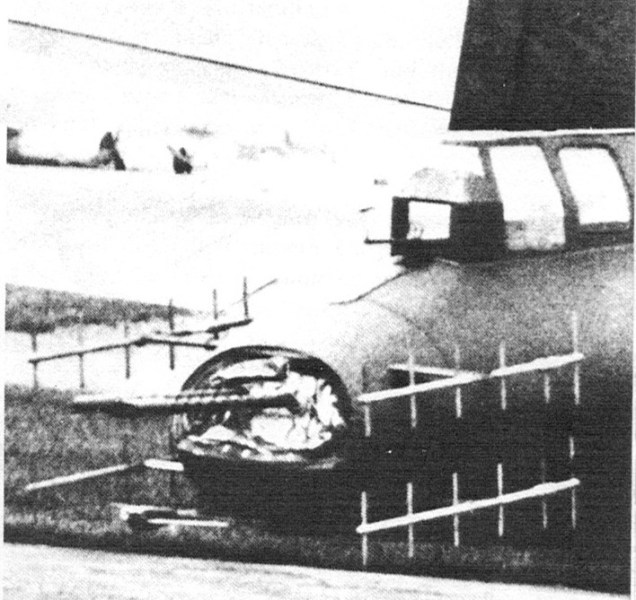
The YB-40 escort fighter variant airframe and engines were typical B-17 but the armament was 31 guns. The largest was a 40mm faired into the radio hatch. In each waist position was a 20mm cannon plus two 0.5in machine guns. A four-gun turret was in the nose and another in the tail. The upper turret had four more 0.5in, the ball turret two. There were 10 more 0.5in machine guns in various locations.

YB-40

Boeing XB-40 Escort Fortress Article

At the height of production Boeing’s Seattle plant alone produced a completed aircraft every ninety minutes. A total of 12,731 built by Boeing, Douglas, and Lockheed Vega of which just over two-hundred were supplied to the RAF.

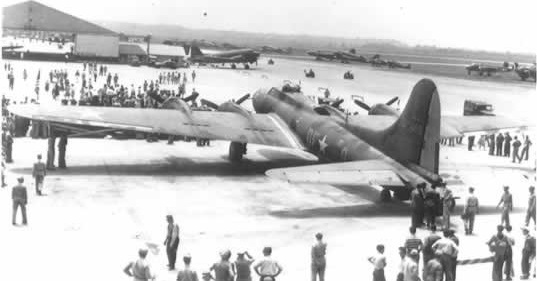
B-17 “Memphis Belle” would be stored at Altus AAF after public relations tour

RAF forces took several B-17 models with their applied “Fortress 1”, “Fortress 2” and “Fortress 3” designations, utilizing some in the electronic countermeasures role. Reconnaissance variants appeared with the US Army Air Corps, US Navy and US Coast Guard as well, each with differing designations shown below.

The B-17 Flying Fortress accounted for over 290,000 sorties with 640,000 tons of ordnance dropped during World War Two.

The German 200th Bomber Wing, KG200, carried out special transport missions using captured US B-24 Liberator and B-17 Flying Fortress which the Germans called by the code name Dornier Do 200.

Versions of the wartime Flying Fortress were still in service in 1955 include lhe U.S.A.F.’s QB-17G drone, SB-17 with an airborne lifeboat and CB-17G V.I.P. transport; and the U.S. Navy’s PB-1G air-sea rescue and PB-1W radar early-warning aircraft. All have four Wright R-1820-97 piston engines.

Boeing QB-17G Fortress
QB-17 testing guided missiles

US Navy and Coast Guard rescue version are similar to the SB-17G is designated PB-1G.

SB-17G

In New Mexico in 1950, Project Cirrus involved seeding rain clouds with dry ice from a B-17.

Project Cirrus
Project Cirrus
Project Cirrus
USAF Research & Development Command B-17G testbed with 3500hp Wright R-3350

Replica:
Bally B-17

Gallery

Allison Engines Testbed Gallery

XB-17
Engines: 4 x P&W Hornet, 750 hp
Wingspan: 103 ft 9 in
Length: 68 ft 9 in
Take-off weight: 43,000 lb
Bombload: 2570 lb
Loaded range: 2000 mi at 204 mph

STANDARD DATA:
Gross weight: 49,650 lb
Empty weight: 30,620 lb
Fuel capacity: 1,700 Usgals
Engines: four 1,200 hp Wright Cyclone radials.
Top speed: 323 mph
Cruise speed: 250 mph
Climb to 25,000 ft.: 41 min
Range: 3,400 nm
Ceiling: 37,000 ft.

B-17
Engines: 4 x Wright R 1820-97, 1,200 hp, 885kW
Length 73.9 ft. (22.5 m)
Height: 5.8 m / 19 ft 0 in
Wing span: 103 ft 8 in (31.6 m)
Wing area: 141.9 sq.m / 1527.40 sq ft
Weight empty 32,250 lb. (14,630 kg)
Max. bomb load: 9,600 lb (4,350 kg)
Max. Speed 317 mph (510 kph)
Cruise speed: 250 km/h / 155 mph
Range 2,000 miles (3,220 km) with 4,000 lb. of bombs
Ceiling: 10700 m / 35100 ft
Crew: 10
Armament: Up to thirteen 0.30 and 0.50 in. machine guns

B-17E
Engine: 4 x Wright R-1850-65 Cyclone, 1200 hp
Wing span: 103 ft 9 in (31.62 m)
Length: 73 ft 10 in (22.5 m)
Height: 19 ft 2 in (5.84 m)
Engines: 4 x Wright, 1200 hp
Max TO wt: 53,000 lb (24,040 kg)
Max level speed: 275 kts / 317 mph / 510 kph
Service ceiling: 36581 ft / 11150 m
Range: 2592 nm / 4800 km
Crew: 9
Armament: 13x MG 12,7mm, 7985 kg Bomb

B 17G
Engines: 4 x Wright Cyclone R-1820-97, 1,200 hp
Wing span: 103 ft. 9.5 in / 31.62m
Length: 74 ft. 9 in / 22.78m
Height: 19 ft. 1 in / 5.82m
Wing area: 1,420.0 sq ft / 131.92 sq.m
Loaded weight: 66,000 lb
Empty Weight: 36,136lbs (16,391kg)
Maximum Take-Off Weight: 72,003lbs (32,660kg)
Maximum Speed: 287mph / 462kmh; 249kts at 25,000 ft / 7,620 m
Cruise speed: 182 mph
Rate-of-Climb: 541ft/min (165m/min)
Climb to 20,000 ft / 6,095 m: 37 min 0 sec
Service Ceiling: 35,597ft (10,850m)
Armament: 13 x 0.5in Browning mg
Bombload: 8000 lb / 17,600 lb
Crew: 10
Range: 3,400 miles / 5,470 km
Range with 500lb load: 2100 miles / 3,220km

CB-17G

QB-17G Fortress
Engines: four Wright R-1820-97
Span: 103 ft. 9 in
Weight: 49,500 lb
Max Speed: 295 m.p.h.