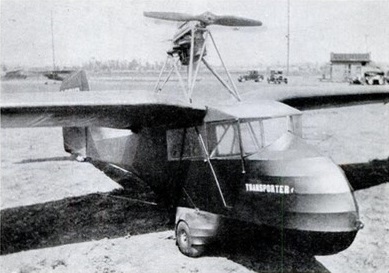
In 1935 Jay Buxton of Hawthorne, California, completed his Transporter powered glider. The engine is a 2 stroke inline, inverted type of unique design. It is a three cylinder, three port engine that weighs 115 lb and develops 35 hp at 2100 rpm.
The motor cabane is completely removed and replaced by a plain cabane when used for gliding.
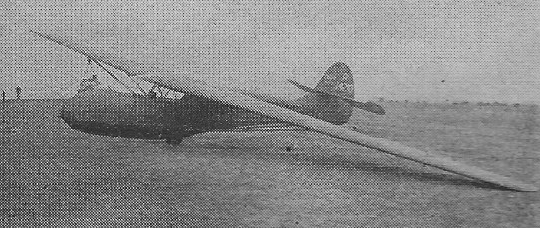
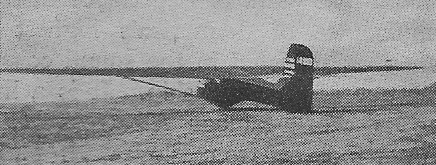
A single-seat sailplane designed by G.M. (Mungo) Buxton and built by Slingsby Sailplanes in 1935.
The sole example built was of conventional wooden construction, cantilever wing, with no air brakes or flaps. The undercarriage was main skid and tail skid.
With Slingsby c/n 215C and C of A No BGA242, the first flight was made at Sutton Bank, Yorkshire on 27 May 1935.
It was flown by Phillip Wills in the 1937 International Competitions at the Wasserkuppe, registered G-GAAA.
Later registered as BGA.301.
Sold to South Africa in 1938 where it was registered ZS-23.
The initial layout of the Buxton Hjordis 2 were commenced by Mungo Buxton but it was built as the Slingsby T.9 King Kite. Many of the King Kite drawings were entitled Hjodris 2 (King Kite).
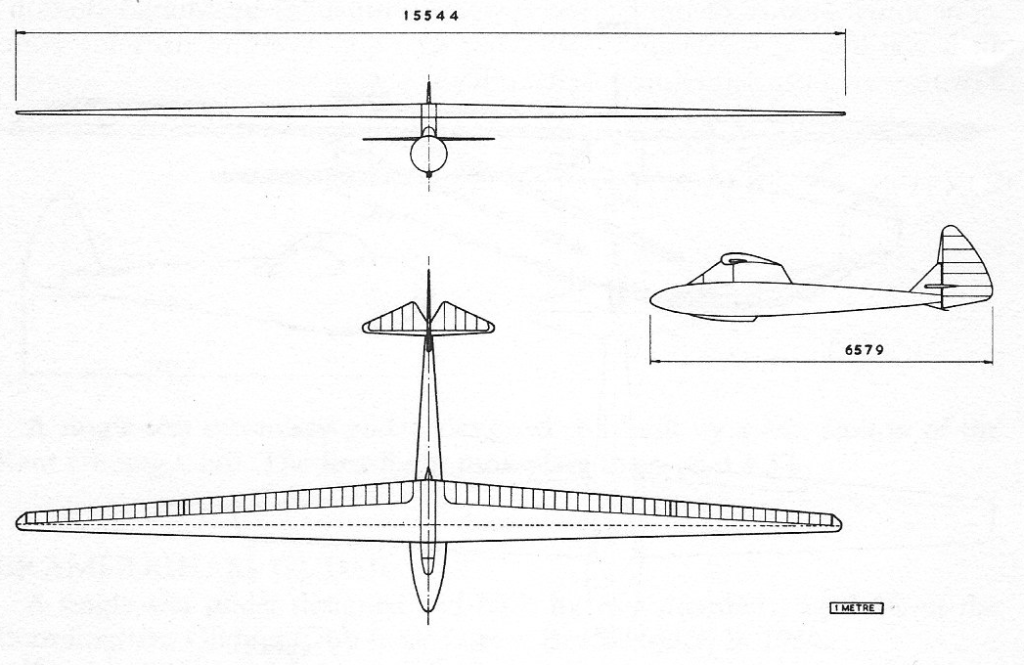
Wingspan: 15.54 m / 51 ft 0 in Length: 6.58 m / 21 ft 7 in Wing area: 11.52 sq.m / 124 sq.ft Aspect ratio: 21 Wing section: Gottingen 652 root / RAF 32 tip Empty weright: 143.79 kg / 317 lb AUW: 217.72 kg / 480 lb Wing loading: 18.94 kg/sq.m / 3.88 lb/sq.ft Max L/D: 24 Min sink: 0.61 m/sec at 56 kph / 2 ft/sec at 35 mph
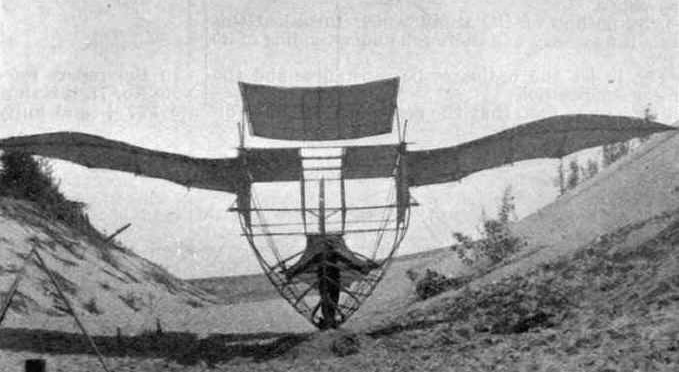
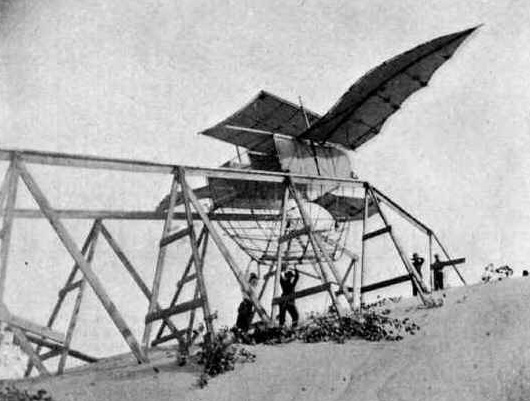
Chanute and his four assistants pitched their tents on a spot within the present city limits of Gary, Indiana, on June 22, 1896. Augustus Herring, the most experienced member of the group, had brought a glider based on the standard Lilienthal monoplane design. William Avery, a Chicago carpenter, had constructed a multi-wing glider designed by Chanute, while William Butusov would attempt to launch his own glider, the Albatross, down a wooden ramp. Dr. James Ricketts, a Chicago physician with “a slack practice and a taste for aeronautics,” would cook for the group and provide emergency medical service as required. Chanute’s dogs, Rags and Tatters, rounded out the party.
The Albatros was the invention of Butusov, who claimed that he had already attained success in soaring flight with it, and as this closely resembled the machine of Captain Le Bris, who was said to have sailed with such a machine in France, in 1867, it was determined to give the design a trial.
It was a complicated apparatus. Over the top was an aeroplane, below which two great wings extended, 40 feet across, and beneath which again there was a boat-like frame which could be transformed into a skiff by enclosing it with oiled canvas. The whole spread of supporting surface was 266 square feet and it weighed 190 pounds. As this could not, like the other machines, be carried about on a man’s shoulders, special appliances were required to launch it.
This appliance consisted of trestle work built down the slope of the hill. It involved the great disadvantage that it could only be used when the wind blew straight up the trestle, a rare occurrence. Nevertheless two launches were made, but in ballast, as there was no absolute certainty about the equilibrium. On the first occasion, with 130 pounds of ballast, it went off very well indeed, but did not sail very far. In alighting, some of the ribs of the boat-frame were cracked but were replaced in an hour. On the second trial, with 90 pounds of ballast, but in a quartering, unfavorable wind, the latter swung the machine around, after it left the ways, and upon one of the wings striking a tree, the apparatus fell and was broken. On neither occasion would the operator have been hurt had he been in the machine, but it was evidently much too heavy and too cumbrous to be successfully used in experiments designed solely to work out the problem of equilibrium.
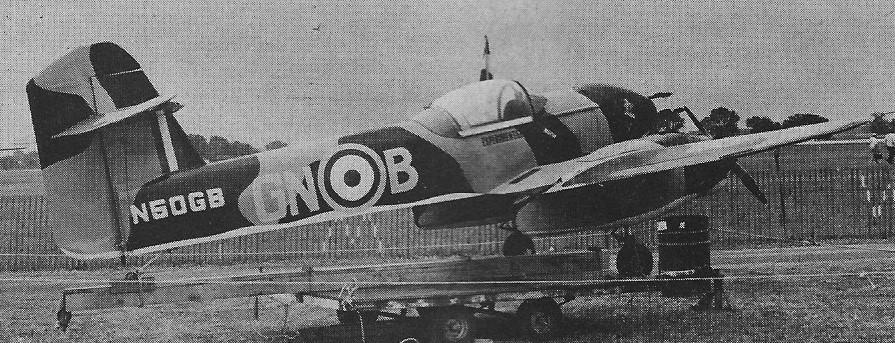
The Butterworth Westland Whirlwind was a 2/3 scale flying replica of the British Westland Whirlwind fighter aircraft of World War II that was built in the United States in the 1970s.
The aircraft was based on the wings and horizontal tail of a Grumman American AA-1A modified and mated to an all-new fuselage. Power was provided by two Volkswagen air-cooled horizontally opposed four-cylinder engines with the result bearing only a passing resemblance to the real Whirlwind.
First flying in July 1977, Butterworth marketed plans in the late 1970s and early ’80s, with at least 15 sets selling and at least three aircraft reportedly under construction by 1985.
Butterworth Westland Whirlwind Engines: 2 × Volkswagen, 65 hp (49 kW) each Wingspan: 28 ft 0 in (8.53 m) Length: 19 ft 6 in (5.94 m) Height: 7 ft 1 in (2.16 m) Empty weight: 1,042 lb (472 kg) Gross weight: 1,400 lb (635 kg) Maximum speed: 145 mph (233 km/h, 126 kn) Range: 700 mi (1,126 km, 610 nmi) Service ceiling: 8,000 ft (2,440 m) Crew: One pilot
Produced by Lohner but designed by Oberoffizial Hugo L. Nikel, Hauptmann Eugen von Stephaits and Doro Stein in Austria, this monoplane was delivered by Lohner on 10 September 1910. It was destroyed several weeks afterwards when flown by von Stephaits. It had a characteristic wing construction with a “feather” look at the wing tips, which could have been ailerons, and front elevator. An Argus 50 hp engine drove a two-bladed tractor propeller. Contemporary journals identified the machine as the Bussard designed by Stephaits, Nikel and Stein.
In 1963 Robert Bushby began work on a two place design based on the Midget Mustang. In 1965 the first ever Mustang II (N1117M) was brought to the EAA convention at Rockford (by trailer). In July 1966 the prototype was flown to the convention and was well received. The Mustang II is a high performance side by side seating aircraft, featuring a tapered wing with a laminar flow airfoil to give the Mustang a cruising speed of 215mph on 180hp. Due to aerodynamic as well as geometric washout in the wing, the Mustang has very good stall characteristics. At gross weight the wing loading is 16.5 lb/ft^2, high enough for a good ride but still allowing for a stall speed of 58mph in the landing configuration. The Mustang II has an excellent stall/spin safety record and compares quite favorably to other homebuilt as well as factory built designs. Most new Mustang flyers have less than 300 hours total time. Transitioning into a Mustang II can be compared to stepping up to a Cessna 182 Skylane. With fixed landing gear it has very good short field capabilities operating off of sod strips as short as 1600 feet with a large safety margin. Construction is all metal with stressed skins There are no complicated fittings or parts that require special skills or tools. The wings are made in three parts, namely a constant chord centre section and tapered outer panels. The wing is a two spar flush riveted stress skin aluminium structure having aluminium ailerons and plain trailing edge flaps. The fuselage is a flush riveted stressed skin aluminium monocoque structure. The empennage is acantilever all metal structure with a controllable trim tab on the starboard elevator. A 10 Imp.gal. fuel tank is fitted behind the firewall. The Mustang II can now be equipped with the 150-hp Lycoming and Rayjay RJ0325 turbocharger. Price in 1982: $4,500. All metal components included. Other parts available separately. Units delivered to June 1982: 1100. The cockpit is about 39 inches wide, with a sliding bubble canopy. It can be custom fit for the tallest of pilots. The baggage compartment located behind the seats will hold up to 80lbs. There is space in the tailcone for additional storage if careful attention is given to the center of gravity. At 1350 pounds gross the design is fully aerobatic to +6/-4.5 G’s. Ultimate strength is 9 G’s and it has a roll rate of over 180 degrees per second. It’s controls are light and responsive making it a good “sport” aerobatic airplane with proper training.
The prototype has been upgraded from an O-290 to an O-320 160hp Lycoming. It has had a tri-gear conversion, various wood props, a constant speed prop, and a folding wing design added to it. Since 1965, N1117M has flown to every yearly national EAA convention (Rockford, Milwaukee, or Oshkosh) except one (1997). After 30+ years of developing and supporting the Mustang II and Midget, Robert Bushby sold the design rights to Mustang Aeronautics headed by Chris Tieman in 1992. Both designs were originally plans built only. Today, the kits have been refined to modern advanced assembly kits that greatly simplify construction. This has resulted in a strong resurgence in the popularity of the Mustang II as build times of less than 3 years part time work (10-15 hrs/week) are typical.
In 1948 Dave Long, chief engineer with Piper Aircraft at the time, designed and built an all metal racer which he called the Midget Mustang, known as the Long Midget. The public debut of the aircraft was at the 1948 Cleveland National Air Races. The closed course midget racers had a minimum weight of 500 lbs., minimum wing area of 66 sq. ft., fixed gear, at least a 6G structure, and the powerplants were limited to stock 190 cubic inch engines.
The Midget Mustang’s 9-G ultimate structural strength and low power loading give a true high performance fully aerobatic sport plane that can also be used for cross country flying. With a 100hp Continental it will have a top speed close to 200mph and can cruise over 175mph burning only 6gal/hr. The cabin size will accommodate persons over 6ft tall. The new M-IA bubble canopy creates room for pilots as tall as 6 ft 4 in. A baggage compartment behind the seat will hold up to 30lbs. The wing is a two piece cantilever structure consisting of flanged aluminium ribs, two folded metal spars with re-inforcing booms and aluminium covered. Both flaps ailerons are all metal. The fuselage is a stressed skin semi-monocoque structure of eliptical cross-section. The tail unit is also all metal construction and incorporates a bungee elevator trim. The fixed undercarriage consists of two spring steel main legs and a steerable tailwheel. A 12 Imp. gallon fuel tank is located immediately behind the firewall. The Midget Mustang cowling and forward fuselage have been modified to fit a horizontally opposed four cylinder engine compared with the V12 Merlin of the original Mustang, but with the wing and tail design identical, the handling characteristics are very similar. It has a high wing loading, but the power to weight ratio is good, making it very fast, but it’s forward visibility at take-off and landing is poor. It has a very abrupt stall – it drops a wing every time. Maximum engine size is 160hp. The prototype Midget Mustang #67 was close in the competition, taking 2nd in the elimination heat. Engine problems caused Dave Long to drop out of the finals however. He went on to build a prototype production aircraft and had made an arrangement with Schweizer Aircraft to produce the design before his death in 1950. The Midget Mustang is well known for its air racing legacy during the late ’40s and early ’50s.
August 1964
In 1959 Robert Bushby purchased the rights to the design along with the tooling, formblocks, etc. Some of these formblocks are still being used for the M-I bulkheads today. Bob began to sell prints for the M-I and as the demand for the aircraft increased material kits were offered for sale as well. Over the years the kits have expanded and improved so that today a complete kit can be finished in less than 1000 hours. Price in 1982: $2,900.
Very few major changes have been made to the Midget Mustang and it still retains it’s original racing appearance. One option that has been added is the bubble canopy design. By lowering the turtledeck and installing a full sliding bubble canopy the little airplane has more of a military style appearance. Other modifications by builders include larger engines, full IFR panels, and additional fuel capacity. Changes are to the control system to use pushrods for the ailerons and elevator. The Mustang II aileron is now used as well with a piano hinge attached to the top skin.
There have been 4 Midget Mustang Oshkosh EAA Grand Champions.
After 30+ years of developing and supporting the Mustang II and Midget, Robert Bushby sold the design rights to Mustang Aeronautics headed by Chris Tieman in 1992. Both designs were originally plans built only. Today, the kits have been refined to modern advanced assembly kits that greatly simplify construction. This has resulted in a strong resurgence in the popularity of the Mustang II as build times of less than 3 years part time work (10-15 hrs/week) are typical.