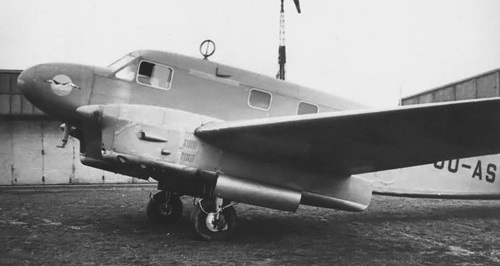
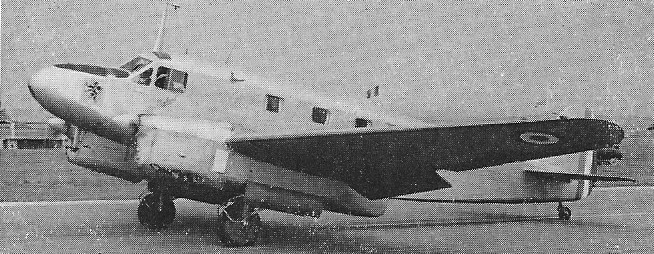
A bomber/transport aircraft, this large cantilever monoplane of 1935 did not go into production. Powered by two 800 hp 18-cylinder Renault engines, it had a crew of four and could carry either 15 troops or an equivalent bombload.
Engines: two 800 hp 18-cylinder Renault Span: 28.96 m (95 ft 0 in) Length: 19.3 m (63 ft 6 in) Gross weight: 10 070 kg (22 200 1b) Crew: four Capacity: 15 troops or equivalent Maximum speed: 270 km/h (168 mph)
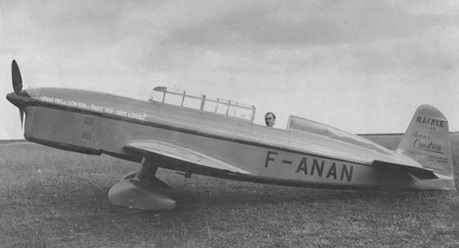
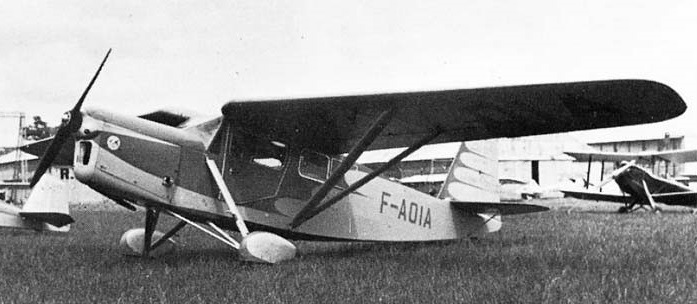
The Caudron C.530 Rafale (Gust of wind) was a French two-seat competition aircraft. The Rafale’s two seats were in tandem, one over the wing and the other just behind the trailing edge, under a long (about a third of the fuselage length), narrow multi-framed canopy with a blunt, vertical windscreen and sliding access.
The Rafale was intended as a competition aircraft and in 1934 it was very successful. On 8 July, Rafales took the first three places in the Angers 12-hour event and later that month filled the top six Esders Cup positions. Late in August, one won the Zénith Cup with a flight over the prescribed 1,578 km (981 mi) course at 240 km/h (149.1 mph).
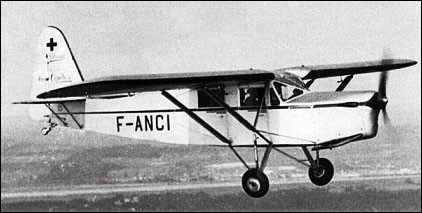
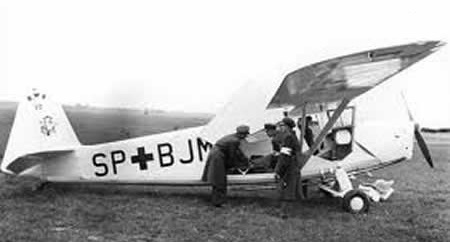
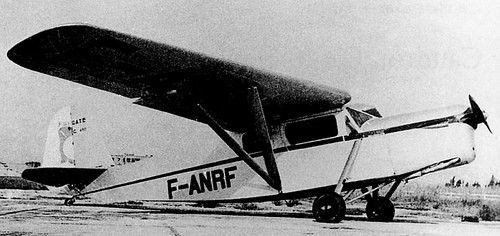
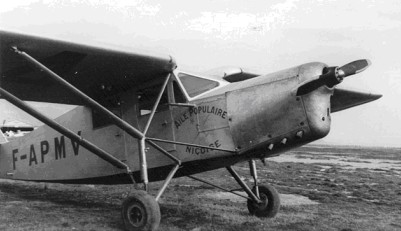
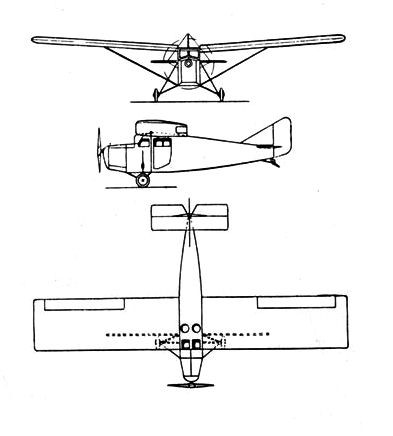
The Caudron C.510 Pélican was a 1930s French air ambulance or touring monoplane. Designed and built by Caudron and based on the earlier Caudron C.282/8.
To create room for a stretcher and attendant the earlier Caudron C.282/8 design was modified with a lengthened fuselage, an improved wing and tailplane design. A single-engined high-wing monoplane, the Pélican had a conventional landing gear. As a touring aircraft the Pélican could carry three passengers. First flying in 1934, a total of 62 were built as both air ambulances and tourers.
The C.510 was operated in the Belgian Congo by Force Publique, and by the French Air Force.
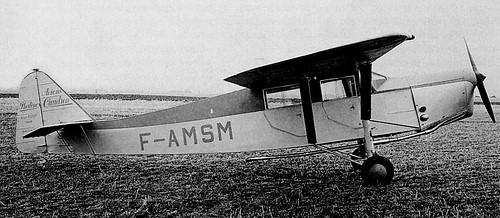
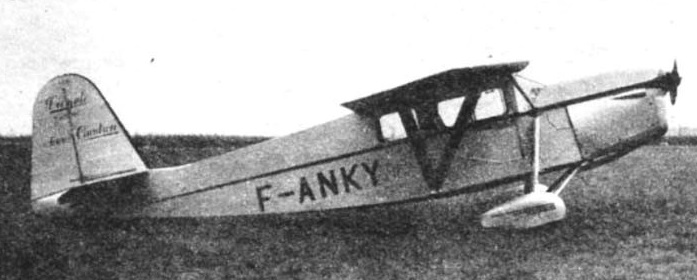
The Caudron C.480 Frégate was a French three-seat touring monoplane designed by Maurice Devlieger and built by Société des avions Caudron.
Based on the earlier Caudron C.280 the Frégate was a high-wing braced monoplane with an enclosed cabin for the pilot with two side-by-seats behind for passengers. Powered by a front-mounted 140 hp (104 kW) Renault 4Pei inline piston engine it had a tailwheel landing gear. First flown in 1935, the company built 27 Frégates, in 1939, 20 were requisitioned into service with the French Air Force for liaison work.
Engine: 1 × Renault 4Pei, 100 kW (140 hp) Length: 8.18 m (26 ft 10 in) Wingspan: 11.90 m (39 ft 1 in) Height: 2.12 m (6 ft 11 in) Wing area: 20.00 m2 (215.3 sq ft) Empty weight: 600 kg (1,323 lb) equipped Max takeoff weight: 1,050 kg (2,315 lb) Maximum speed: 210 km/h (130 mph; 113 kn) Cruising speed: 185 km/h (115 mph; 100 kn) Range: 850 km (528 mi; 459 nmi) Service ceiling: 4,500 m (14,764 ft) Crew: 1 Capacity: 2
Originally produced in 1934 as the C.440, The Goeland was produced throughout the occupation of France by Caudron-Renault for both Vichy Government and the Luftwaffe. After the liberation of France and the incorporation of the Caudron factory into the SNCA du Nord, production of the Goeland was continued as the C.445-3 and C.449-1 versions. A total of 325 post-war machines being built.
C.449-1
About 1,700 examples of C 440 (later AA.1) Goeland, twin-engined six-passenger transport were built in about ten years.
C.445-3 Engines: 2 x Renault 6Q-10 or 6Q-11, 220 hp Passenger capacity: 6
C.449-1 Engines: 2 x Renault 6Q-20 or 6Q-21, 220 hp Wingspan: 57 ft 7 in Wing area: 430 sq.ft Length: 44 f 9 in Height: 15 ft 9 in Empty weight: 6005 lb Loaded weight: 8140 lb Max speed: 191 mph Cruise: 163 mph Service ceiling: 21,320 ft Range: 350 mi Passenger capacity: 6
The 1933 Caudron C.340 Micro Phalène series were a reduced-scale Phalène light aircraft. Of wooden construction with fabric covering, five were built.
C.340 Folding wings Engine: 30 hp Chaise 4D motorcycle engine
C.344 Junior Phalène C.340 re-engined with 1 x 40 hp Chaise 4E 2-cyl. First flight: 29 April 1933 Wingspan: 9.20 m Length: 5.55 m Wing area: 13.80 m² Empty weight: 270 kg Total weight: 375 kg Maximum speed: 135 km / h Seats: 1 One built
C.345 Phalène Junior, revised struts Engine: 40 hp Train 4E One built
The C.282 Phalene models differ primarily in the type of engine installed.
The C.480 Fregate is a development of the Phalene with 140 hp Renault 4 Pei and accommodation for five persons.
C.282-3 Engine: Gipsy Major I, 120 hp
C.282-8 Phalene VIII Engine: Renault 4 Pdi. 120 hp Wing span: 38 ft 1 in Wing area: 252 sq.ft Length: 27 ft Height: 6 ft 7 in Loaded weight: 2420 lb Max speed: 115 mph Cruise: 96 mph Ceiling/; 14,760 ft Range: 528 mi
Although almost all the aircraft designed by the Caudron brothers were biplanes, they did in 1911-2 produce three monoplane types. These were the single seat racing Types M and N and the related but somewhat larger Type M2 military version.
The Types M and N were very similar and, though the designations were reported together with some details in contemporary accounts, it has proved difficult for modern historians to distinguish them. They shared the same fuselage and both used a variety of engines but a comparison of data from different contemporary sources suggests that the Type M had a larger wing than the Type N. Though there is some scatter, the span of the Type M was close to 8.7 m (28 ft 7 in) and of the Type N to 8.0 m (26 ft 3 in). In contrast, wing area varied within types.
Around this time, various French manufacturers like Voisin and Farman were hoping to improve the stability of aircraft against gusts by using wings that were partly flexible like those of birds and the Caudron Types M and N also included this feature. Each wing had two steel tube, wood filled spars, one at the leading edge and the other 500 mm (19.7 in) aft, a little behind one third chord, with ash ribs and wire bracing. The number of ribs varied between 10, 11 and 12 and they were conventionally rigid between the spars. Behind the rear spar the upper part of each rib was also rigid, ending at about 70% chord; the lower part was completed by a thin, flexible extension strip for about 60% of the chord. The wing was then fabric covered, though the flexible portion was only covered on the upper side. The wings were supported from above by landing wires from a four-legged pylon above the fuselage and by lifting wires from another below, shorter on the Type N than on the Type M. On the latter the tip of the lower pylon was braced by a horizontal, longitudinal strut to the centre of the undercarriage frame. Lateral control was by wing warping.
The structural fuselage of the Types M and N was a rectangular section, ash framed lattice girder with wire cross bracing. Poplar formers and stringers produced a more rounded, fabric covered section. The pilot sat well down in an open cockpit over the wing and behind the upper pylon. A wide range of engines were fitted, including the 35 hp (26 kW) Anzani three-cylinder inverted Y radial engine, the 45 hp (34 kW) Anzani 6-cylinder two row radial and the 50 hp (37 kW) Gnome. The last, a rotary engine, was usually covered over the upper part to screen the pilot from oil spray; the Anzanis were mounted uncowled. They all drove large, rather broad chord propellers. The very broad chord, low aspect ratio tailplane was constructed like the wing with a flexible rear surface acting both to improve stability and, by warping, act like conventional elevators, its trailing edge extending well beyond the end of the fuselage. A small, near rectangular, one piece, rigid fin was pivoted near its leading edge from the extreme tail.
The Types M and N had a tailskid undercarriage. A transverse steel bar was fixed at each end to an ash V-strut from the lower fuselage and further braced with a steel V-strut from its centre. A pair of axles, hinged at the centre of the bar, passed through the vertices of the ash struts via rubber shock absorbers with the mainwheels, slightly toed out and 1.4 m (4 ft 7 in) apart, beyond them. Early versions of the undercarriage used a single axle rather than a split one. There was an unusually long, curved, tall tailskid at the rear to keep the long tailplane clear of the ground.
Apart from basic specification (dimensions, weights and speed) in Laérophile 1912 and Jane’s All the World’s Aircraft 1913, no records of the Type M2 are currently known.
The first flight dates are not currently known, nor which type flew first, but there are reports of a Type N, piloted by Renée Caudron, flying on 23 December 1911. Fitted with the 35 hp (26 kW) Anzani engine, it flew an out and return flight from Caudron’s Le Crotoy base to Pointe-Saint-Quentin at 100 km/h (62 mph). Two days later it was on display at the 1911 Paris Salon. It was re-engined with a 45 hp (34 kW) Anzani for an English owner, E.W. Ewen, who flew it home across the English Channel on 2 May 1912. Flown by Maurice Guillaux it took part in a circuit of London race in June 1912, starting from Hendon, but retired from lack of fuel just before the end when it looked a likely winner. After many modifications it was on display at the Olympia show in February 1913. In September 1913 F. Goodden demonstrated it the Aerial Derby at Hendon, powered by a 35 hp (26 kW) Anzani; it had been entered for the race with the 45 hp (34 kW) engine but did not compete. The 8.4 m2 (90 sq ft) wing area of this aircraft, possibly the only Type N, was much smaller than that usually quoted (10 m2 (108 sq ft)). Though its span was 230 mm (9.1 in) less than the 8 m (26 ft 3 in) said to indicate a Type N and shown on the three-view in L’Aérophile, the main cause was a narrow chord (1.2 m (4 ft 0 in)) compared with the 1.4–1.5 m (4 ft 7 in – 4 ft 11 in) found in the French references.
Emile Obre flew many demonstration flights in early 1912 with a Type M, powered by a 50 hp (37 kW) Gnome engine. He flew across mainland France and in Corsica, Sardinia and French colonies in North Africa, visiting Tunis and Carthage, where the aircraft was damaged in an accident. At least three Type Ms were built.
Type N
Variants:
Type M Span 8.7 m (28 ft 7 in) and long lower pylon braced to the undercarriage cross-member.
Type M2 Military machine span 9.4 m (30 ft 10 in) wing area 14 sq.m (151 sq ft) length 6.1 m (20 ft 0 in) weight 235 kg (518 lb) maximum speed about 115 km/h (71 mph).
Type N Span 8.0 m (26 ft 3 in) and short lower pylon.
Type N Engine: 1 × Anzani or Gnome, 26–37 kW (35–50 hp) Propeller: 2-bladed Caudron, 2.03 m (6 ft 8 in) diameter Wingspan: 8.0 m (26 ft 3 in) Wing area: 10.0 m2 (108 sq ft) Length: 6.0 m (19 ft 8 in) Height: 2.0 m (6 ft 7 in) Empty weight: 175 kg (386 lb) Gross weight: 300 kg (661 lb) Maximum speed: 125 km/h (78 mph, 67 kn) Crew: One