USA
Established at Bettendorf, Iowa, this company produced a small two-seat sporting monoplane known as the Central States Monocoupe. Powered by a 70 hp engine, it was reputedly able to become airborne within five seconds of starting its take-off run.
Monoplane
Centrair Sup’aero
In the 1980s was developing Sup’aero as single-seat canard monoplane powered by two Microturbo jet engines.
Celier Aviation XeWing
The Celier XeWing (contraction of Xenon Wing) is a Polish ultralight aircraft that was designed by Frenchman Raphael Celier and produced by his company Celier Aviation of Jaktorów-Kolonia, Poland.
The XeWing was developed by mating the fuselage from the Celier Xenon 2 gyroplane with a newly designed folding strut-braced parasol wing in place of the rotor system. The aircraft was intended to comply with the Fédération Aéronautique Internationale microlight rules. It features a two-seats-in-side-by-side configuration enclosed cockpit, fixed tricycle landing gear and a single engine in pusher configuration.
The aircraft wing is made from aluminum sheet, has a span of 6.6 m (21.7 ft) and an area of 10 m2 (110 sq ft). The wing can be folded for ground transportation and storage. The standard engine specified was the 100 hp (75 kW) Rotax 912ULS four-stroke powerplant.
Despite the commonality of the fuselage and engine package with the Xenon 2, the XeWing cannot swap its fixed wing for a rotor system.
It was introduced at AERO Friedrichshafen in 2009. The aircraft was intended to be supplied as a kit for amateur construction or as a complete ready-to-fly-aircraft (projected price of €60,000, assembled, in 2011).
By 2012 the company was no longer advertising the XeWing and it is unlikely that it progressed beyond the prototype stage.
XeWing
Engine: 1 × Rotax 912ULS, 75 kW (101 hp)
Wingspan: 6.6 m (21 ft 8 in)
Wing area: 10 m2 (110 sq ft)
Empty weight: 300 kg (661 lb)
Gross weight: 472.5 kg (1,042 lb)
Fuel capacity: 85 litres (19 imp gal; 22 US gal)
Cruise speed: 150 km/h (93 mph, 81 kn)
Stall speed: 70 km/h (43 mph, 38 kn)
Crew: one
Capacity: one passenger
Celair Celstar GA-1
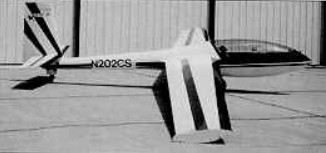
Designed by South African power aerobatics champion Peter Celliers and first flown in 1989, is a new composite aerobatic glider, the Celair Celstar GA 1, designed to JAR 22 specifications (10 g) for competition flying. The machine is stressed to +10g and 10g, with a best glide angle of 23:1.
It has full span mass balanced ailerons. Airbrakes are used for approach control. The main wheel is retractable.
Wing span: 11.2m / 36.75ft
Wing area: 11.54sq.m / 124.22sq.ft
Empty Weight: 265kg / 584lb
Payload: 120kg / 265lb
Gross Weight: 385kg / 849lb
Wing Load: 33.36kg/sq.m / 6.83lb/sq.ft
Water Ballast: 0
Aspect ratio: 10.9
Airfoil: Wortmann FX-71-L-150/25
Structure: glass fiber/ epoxy / aramid
L/DMax: 25
MinSink: 0.89 m/s / 2.9 fps / 1.75 kt
No. of Seats: 1
CEI Free Spirit Mk. II

Originally developed by Cabrinha as the Free Spirit Mk I and first flown 1986.
A composite design with forward swept wing and 2+1 seating. First flown in 1995. The kit price in 1998 was US$24,950.
Engine: Continental IO-360, 210 hp.
Speed max: 265 mph.
Cruise: 220 mph.
Range: 1400 sm.
Stall: 52 mph.
ROC: 2000 fpm.
Take-off dist: 600 ft.
Landing dist: 750 ft.
Service ceiling: 24,000 ft.
Fuel cap: 52 USG.
Weight empty: 1150 lbs.
Gross: 2150 lbs.
Height: 7.5 ft.
Length: 20.6 ft.
Wing span: 30.3 ft.
Wing area: 85 sq.ft.
Seats: 3.
Landing gear: retractable nose wheel.
CEA-UFMG CEA-311 Anequim

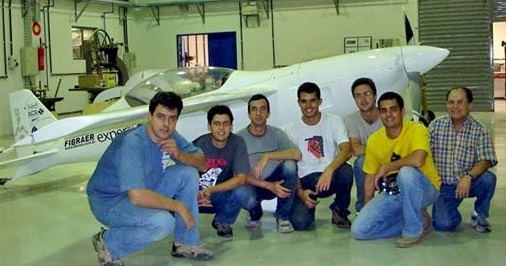
The CEA-UFMG CEA-311 Anequim was built by students of the Center for the study of Aeronautical Engineering at the Federal University of Minas Gerais in Belo Horizonte, Brazil, directed by Professor Paulo Iscold.

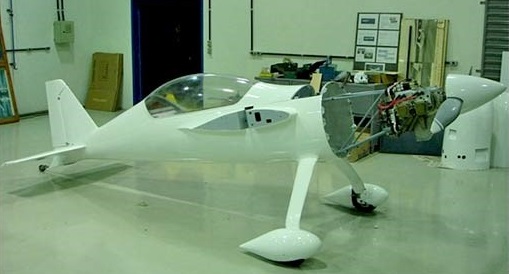
CEA-311 Anequim is a Brazilian experimental single-engine plane, designed and built by a team of students and researchers from the Center for Aeronautical Studies at the Federal University of Minas Gerais. The project started in March 2011 and the first flight took place in November 2014 with Gunar Armin in command.

The Portuguese word for the Mako Shark is Anequim, a name adopted for a single-engine speedster designed by a team of professors and students at the Center for Aeronautical Studies at the Federal University of Minas Gerais (CEA-UFMG) in Belo Horizonte, Brazil. With lines similar to those of a Mako’s body, Anequim CEA-311 is a light-composite airplane powered by a four-cylinder Lycoming IO-360 (albeit modified for Anequim). Anequim has been clocked at 282 knots (324 mph) and achieved five speed records. In August 2015, the single engine entered the world history of aviation by breaking 5 international speed records of the International Aeronautical Federation for airplanes from 300 to 500 kilos.

CEA-UFMG CEA-308
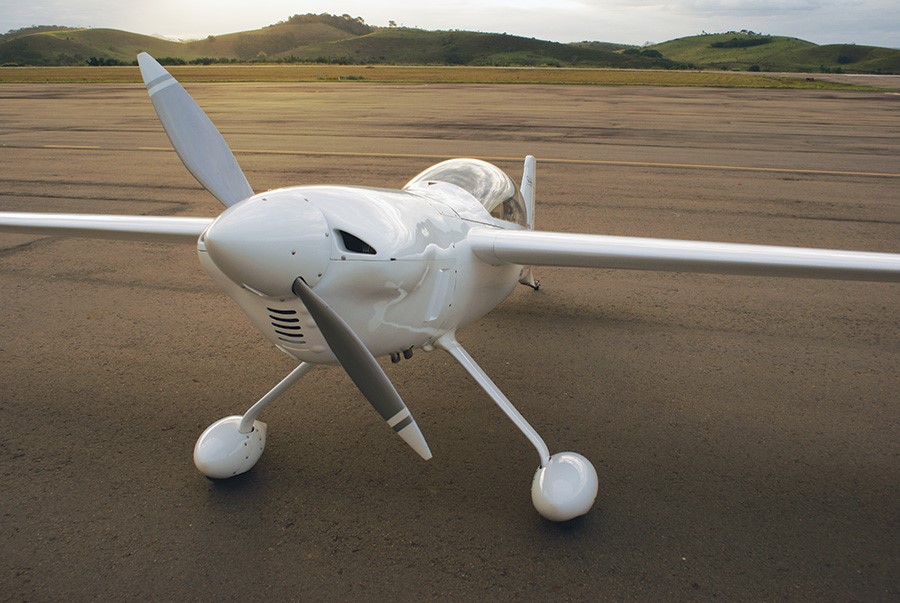
The design phase of the CEA-308 started in 1999 as Paulo Iscold’s undergraduate project. The construction of the design started in 2000 and used wood and steel for the fuselage with white foam formed in between bulkheads and stringers which was carved to shape and covered with fiberglass. The wing is built-up wood ribs and a wood spar; like the fuselage the spaces between the wood parts were filled with white foam which was carved to shape and covered with fiberglass.
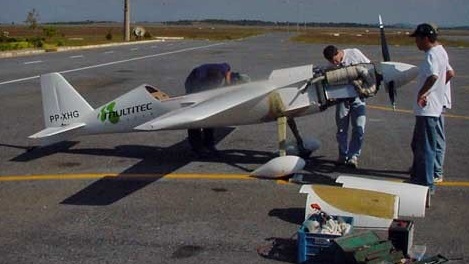
The first flight was flown in 2002, powered by a Rotax 532. The intention was to do initial flight test with the 532 and install a 100hp Hirth 3701 (3 cylinder, 2 cycle) for the records. Early in the flight test program the Rotax 532 failed, while the pilot was able to save the airplane, the engine was lost. As a result, the project was shelved from 2002 until 2005 when Gúnar Armin (former Brazilian Aerobatic Champion) took interest in the project. At this time, the Hirth was still the engine of choice, but an undisclosed problem procuring a suitable engine forced the team to look into other engines. The Jabiru 2200 was selected and one was bought used, and installed in the airplane.
Catto props are also a favorite for absolute speed and other records, where the prop can be optimized for a single flight condition. “Catto has been very supportive of our projects,” says Dr. Paulo Iscold, professor of aerodynamics at UFMG in Brazil, consultant to several Red Bull and Reno air race teams, and holder of four world records with his CEA-308. “The first prop that he sent for our 308 was almost perfect, and the second prop was better than perfect. I’m not afraid to say that Catto’s props are the best aerodynamic setup in the world today. He has been trying many different ideas through the years, and his propellers incorporate many features that are not listed in the usual literature. On the 308 I must remind you that we set the 3 km absolute speed record and the 3000 m time-to-climb record with the same prop!”
The Jabiru installation has been on the airplane ever since. Paulo did not say what happened to the exotic custom three bladed propeller they had designed and built for the Hirth. The records (all of which were in the C-1.a/0 weight class) were set on the 1st and 3rd of December 2010 and all attempts were flown by Gúnar on Craig Catto 58×69 propellers. The first flight of the day was the time to climb to 3000m. This was a Russian record and it stood at 13min 40 sec held by Mikhail Markov in a MAI-89 (Rotax 532 USSR 8/6/90). Mr. Armin’s attempt was successful (8 min 15sec), his record also eclipsed the American record (9 min 36 sec) held by Brian Dempsey in a Sonerai (VW 1600 Easton MD 2/19/89). The second record was the 15 km speed record which Gúnar set at 204 mph, previously 181 mph also held by Brian Dempsey in his same Sonerai on the same date and location. The final record set on the 1st of December was the 100 km speed record set at 202 mph, previously 184 mph set by Charles Andrews in the Monex (Aero Vee, Fond du Lac, WI 8/3/82).

The most impressive record setting attempt was on the second day of flying. On the 3rd of December the team tackled the 3km speed record. The record stood at 218 mph set by a BD-5B in Zeltweg Austria (8/28/99). The American record is slower still at 213 mph set by Mike Arnold’s AR-5 (now hanging in the Hiller museum). The CEA-308 took the record at 223 mph, thereby setting four records in two days of attempts.
Cayre, Edmond and Ernest
In 1911 Edmond and Ernest Cayre designed and built a monoplane in France. The span was 32’10” and length 35’1″.
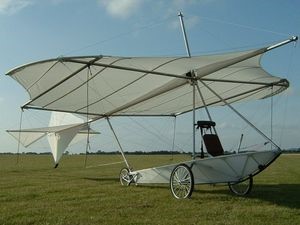
Cayley Glider
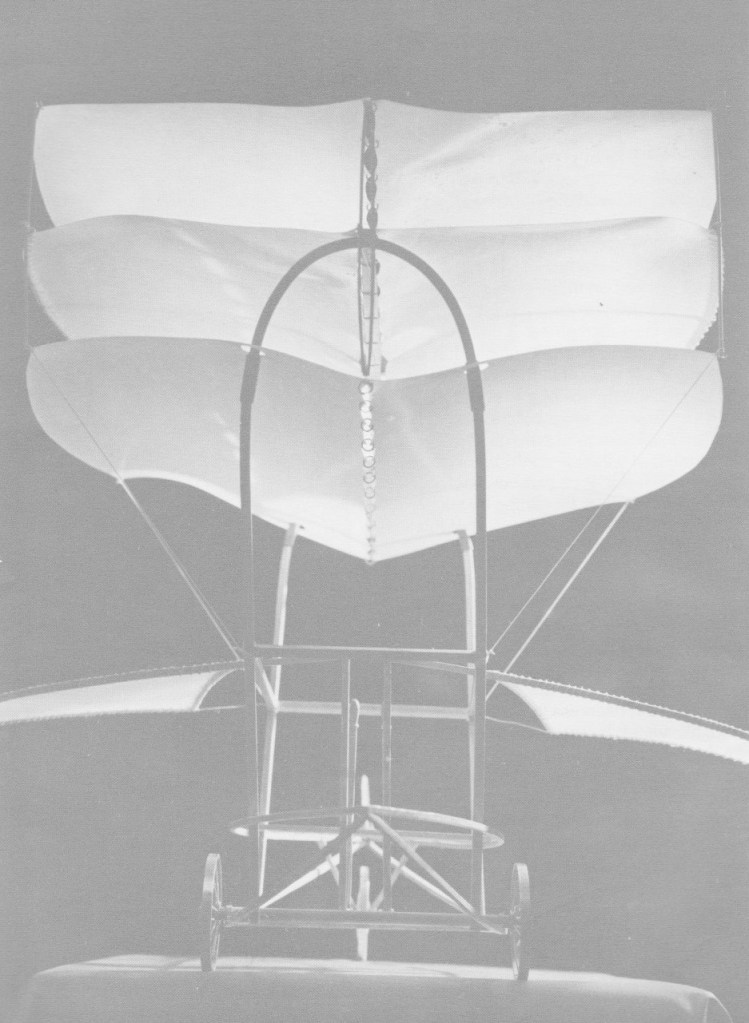
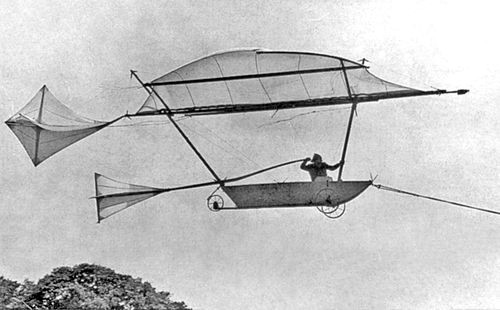
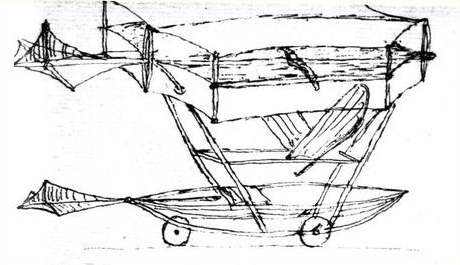
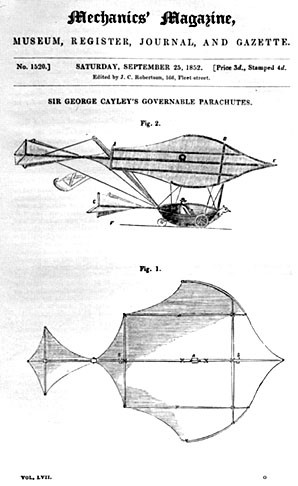
The first Cayley glider was a triplane hang glider designed with an open section in the centre for self-propelled starts. A young boy is reported to have been gently lifted and carried a few yards.
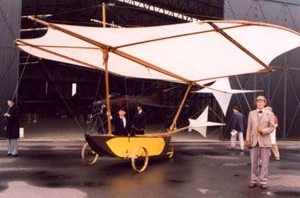
Sir George Cayley (1773-1857) was first to design an aerofoil and one of his flying machines made the world’s first manned heavier-than-air flight at Brompton Dale, near Scarborough, in 1849. This was more than 54 years before the Wright brothers made the first powered flight from Kitty Hawk Sands in the USA on 17 December 1903. Another machine, which Cayley called a ‘governable parachute’, was flown in 1853 at Brompton Dale, carrying Sir George’s coachman, who on coming back to earth said, “I wish to give notice, I was hired to drive not to fly”.
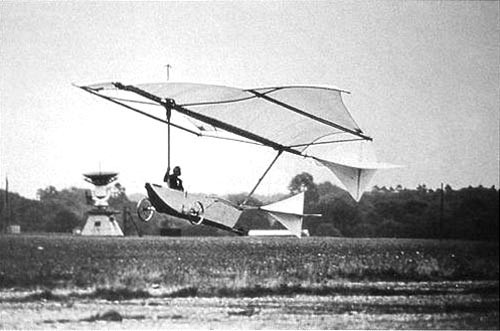
A young girl who was there wrote later: “the wings acted rather on the principle of the parachute, merely flating the experimentor, who started from a moderate elevation, by a gradual descent towards the earth”.
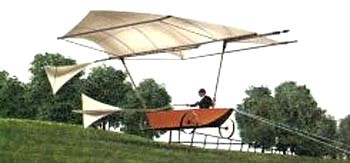
It was the world’s first aeroplane with inherent stability.
Wing area: 338 sq.ft
Empty weight: 132 lb
Caudron C.880


