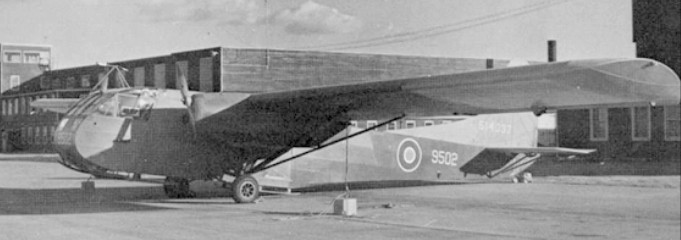
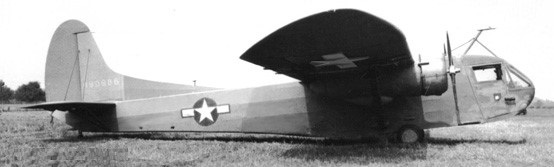
The Waco PG-2A was a unique powered development of the Waco CG-4 Hadrian standard glider. In 1943, the US military had originally developed a prototype powered-version of the Hadrian with two Franklin flat-four piston engines in nacelles beneath the wings. The object of this conversion was to allow the glider to return under its own power after completing a mission. The idea was to use the glider normally and after landing attach the engines and fly it home. After tests with this prototype, a further ten conversions of the aircraft were ordered with Ranger L-440-7 piston engines. These production versions were then known by the PG-2A designation. The service trials were apparently of interest to the RCAF and one PG-2A was briefly trialled in Canada during the immediate post-war period.
There was one each XPG-1, XPG-2 and XPG-3 (Waco designation Model 2-YEU), two XPG-2A and ten PG-2A built.
The conversion to a PG was done by glider mechanic trainees under direction of Ernest LaSalle at Sheppard Field, Texas. LaSalle also added various instruments for flight testing and was allowed, under direction of CCAAF personnel, to pilot the glider from Texas to Ohio. The first was an XPG-2 built by Ridgefield in New Jersey which was converted to an XPG-2A by installing 200 horsepower engines at CCAAF. The “PIG” was the second of two XPG-2A gliders.
Both were used at CCAAF and remained there until the base closed in November 1945 in readying it for an All-Weather Flying base.
Waco XPG-3 44-90986
PG-2A Engines: two Ranger L-440-7 piston Span: 83 ft 8 in (25.50 m) Length: 48 ft 4 in (14.73 m) Height: 12 ft 7 in (3.84 m) Wing Area: 852 sq ft (79.15 sq m) Armament: None Crew/Passengers: two pilots and up to 13 troops
During 1942 the U.S. Navy let contracts for the development of several amphibious transport gliders. At the same lime as the requirement for a twelve seat glider was issued, the US Navy ordered a small number of Waco CG 4A (Hadrian) gliders under the designation LRW 1. At least thirteen Waco LRW-1s were delivered (BuAer Nos. 37639 481 44319, and 69990 1), and the Naval Aircraft Factory modified two further CG 4As under the designation XLRN 1 (BuAer Nos. 36431 2).
Because military planners did not want to divert scarce strategic resources and aircraft workers from powered aircraft production to build gliders, the CG-4A was built by hundreds of subcontractors with experience in woodworking, including employees of furniture companies. The only large production facility was Ford Motor Company’s wooden station wagon plant. The CG-4A was a front-loading glider de¬signed to carry a pilot, co-pilot and 13 fully equipped glider infantrymen or an equivalent load of equipment or munitions.
On the Sunday afternoon of August 1, 1943, St. Louis aircraft manufacturer William B. Robertson was hosting the first public demonstration of a new Waco CG-4 glider, built under sub-contract by his company. As a crowd of spectators watched at the Lambert St. Louis Airport, Mayor William Becker, Robertson, and other St. Louis luminaries boarded the glider that was towed along by a transport plane for a flight over the city. Immediately after the release of the towing cable, the right wing of the glider broke off, and it plummeted from an altitude of 1,500 feet, killing all ten persons on board.
August 1, 1943 demonstration for a new aircraft. As soon as it took off, its right wing broke, and all ten passengers were killed. This is the group pictured before takeoff.
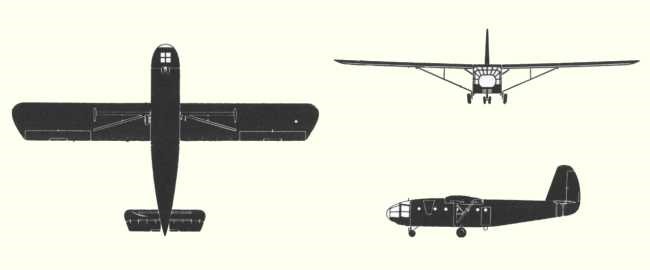
Including the two pilots in the hinged nose, it could carry 15 fully armed troops or a jeep with its crew, or an Army 75 mm howitzer with crew and ammunition. It could carry a total military load of around 3,500 lb and could land in a field 660 feet by 200 feet surrounded by 50 feet obstacles at a loaded stalling speed of 50-60 mph. The fuselage of the Hadrian was 6 feet 5 inches wide and made of a steel tubular framework covered with fabric on wooden formers with a wooden floor. The wingspan was 83 feet 8 inches and the wings and tail unit were made of wood with a plywood and fabric covering. The training undercarriage consisted of independent wheels, with shock absorbers and hydraulic brakes. The operational undercarriage could be jettisoned by parachute and was a simple cross axle with brake-less wheels. The glider then landed on skids.
Operation Husky, the Allied invasion of Sicily beginning 10 July 1943, involved 400 Dakota C-47 transport aircraft and 170 Waco CG-4A cargo gliders. The operation verged on failure. Ninety-seven of the British and US gliders released from their towropes too early plunged into the sea, and another 24 were reported missing: only 12 of the gliders, all British, landed in the target zone. Then strong anti-aircraft fire confused the paratroops in the Dakotas, so they jumped too soon and were scattered over almost 60 miles. Six of the Dakotas were shot down, and only 73 British paratroops reached their target, the Ponte Grande bridge.
In mid-June 1943, for the first time, a Dakota FD900 of the RAF Transport Command landed in Prestwick, Scotland, the end of the North Atlantic route, towing a glider. The two planes had taken off together twenty-four hours earlier from Dorval (Montreal). The glider – a Waco CG-4A Hadrian – had been built in a New York piano factory. It carried a full load of urgently needed vaccine and radio and engine parts for the Soviet Union. The pilots, Sqn.Ldr. Seys and Sqn.Ldr. Gobeil: ‘We could not take our eyes off the Dakota and the tow rope, which was especially difficult in clouds or at night. We had to stay the whole time in the same position in relation to the towplane, which kept disappearing from our field of vision. Thank God we had radio contact with our Dakota. Unfortunately, there was no heating in the glider, so our teeth chattered with cold during the night or during prolonged flight through cloud, whereas sunshine changed our cockpit into a hothouse’.
Several hundred CG-4A gliders were built in 1945 with a paper composition floor rather than the reinforced plywood box floor. The glider could carry 13 infantrymen or a Jeep. Because of the floor, a trailer or howitzer could not be carried. The floor was reinforced at the Jeep wheel locations but not reinforced where the trailer or howitzer wheels would normally be positioned.
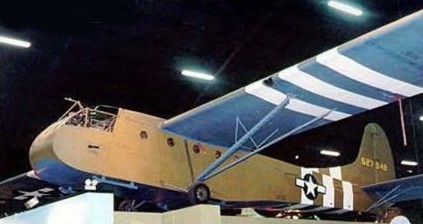
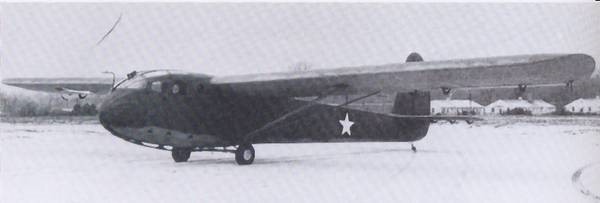
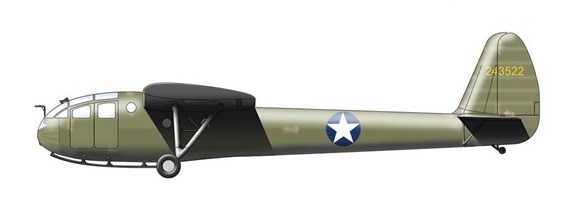
WACO CG-4A
It was named Hadrian when in service with the British forces, and was the only American built troop-carrying glider to be used by the allied forces in the airborne invasions of Sicily and France.
Ford produced the CG-4A. Approximately 14,000 were built.
The Waco CG-13 was an American military transport glider aircraft developed during World War II. Wright Field Glider Branch realized a need for a glider larger than the CG-4A and requested designs. The response by several companies produced designs for five larger gliders. One of these designs was the XCG-13 by Waco Aircraft Company of Troy, Ohio.
The XCG-13 (Waco designation NLB) contract was for a 30-place design with an 8,000 lb (3,600 kg) useful load capacity to fly 174 mph (280 km/h) at an altitude of 12,000 feet (3,700 m) altitude. Flight testing of the prototype was performed at Clinton County Army Air Field and the type was approved on 10 March 1943. Testing found that a tricycle landing gear should be used, and that a hydraulic system be incorporated to open the top-hinged nose opening. These features were incorporated into the second XCG-13.
XCG-13
Ford Motor Company at Kingsford, Michigan and Northwestern Aeronautical at St. Paul, Minnesota built YCG-13 models and were given contracts to build the production CG-13A. WACO was not given a production contract. Northwestern Aeronautical built 49 production articles. Ford built 48 as 30 place and 37 as 42 place by adding a bench down the center of the cargo section. Between the two companies, 268 contracted articles were canceled in favor of producing more CG-4A gliders after 135 CG-13 were built.
The CG-13A glider maximum useful load was 10,200 lb (4,600 kg). The 79 mph (127 km/h) stall speed was 19 mph higher than specified. One CG-13A was flown in combat in the Appari Mission in the Philippines. The CG-13A gliders were not flown in combat in Europe but were used as transports in England and France.
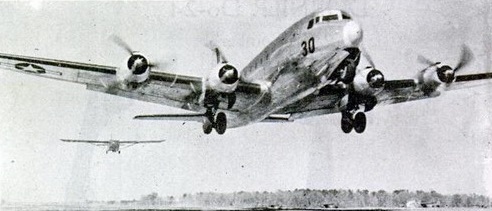
Waco CG-13 towed by a Douglas C-54A
CG-13A Wingspan: 85 ft 8 in (26.11 m) Length: 54 ft 4 in (16.56 m) Height: 20 ft 3 in (6.17 m) Wing area: 873 ft² (81.10 m²) Empty weight: 8,700 lb (3,946 kg) Loaded weight: 18,900 (8,572 kg) Useful load: 10,200 lb (4,626 kg) Maximum speed: 165 knots (190 mph, 306 km/h) (maximum towing speed) Stall speed: 79 mph (127 km/h) Wing loading: 21.65 lb/ft² (105.7 kg/m²) Crew: 2 pilots Capacity: 30 or 42 troops (including flight crew)
The CG-3A was the United States Army Air Force’s first production troop-carrying glider. First flown in early February 1942, 300 CG-3A 9-place gliders were initially ordered, but 200 of these were cancelled. A few of the 100 built by Commonwealth Aircraft (formerly Rearwin Aircraft) were used as trainers for the improved CG-4A, but most remained in their shipping crates in storage.
The production CG-3A was developed from the experimental XCG-3 which was the only one built by Waco and given Army Air Forces Serial No. 41-29617. Unit cost: approx $24,000.
The CG-3A became obsolete with the development of the much improved Waco designed CG-4A 15-place glider with its alternate load of military equipment. The CG-3A did not see any combat and several were used in limited training roles.
Variants XCG-3 Prototype 8-seat glider. One built 1942.
CG-3A Production 9-seat glider. 100 built by Commonwealth Aircraft.
Specifications: CG-3A Wingspan: 73 ft 1 in (22.28 m) Length: 43 ft 4 in (13.21 m) Empty weight: 2,044 lb (927 kg) Max takeoff weight: 4,400 lb (1,996 kg) Maximum speed: 120 mph (193 km/h; 104 kn) (under tow) Normal tow speed: 100 mph (87 kn; 161 km/h) Minimum control speed: 38 mph (33 kn; 61 km/h) Crew: 2 Capacity: 7 troops
Bruckner and Junkin actually began designing aircraft in 1919 with a flawed plan for a floating airplane that never flew. Meyers, too, had already designed an aircraft with Weaver and the pair approached Bruckner and Junkin, asking them to join their construction efforts on a parasol wing, plywood fuselage, single-seat monoplane named the “Cootie.”
Costing $1,200, unfortunately, Weaver crash-landed the Cootie during its first flight attempt in 1920 and suffered extensive injuries in the crash. It was rebuilt.
A 1928 five place low wing cabin monoplane powered by a 260hp Salmson “superposed radial”. First flown on 20 April 1928 as NC5246 c/n 51-C, the aircraft was put into storage in Oct 1920 at (Frank) O’Neal Aircraft Co, Vincennes IN, USA.
It was then acquired by O’Neal in a court sale on 2 October 1933 to satisfy a storage bill. It was sold on 15 October 1934 to Peter Soderling Jr, of Petersburg IN, who installed a 360hp Salmson and converted it to three place. The CAA cancelled the registration on 15 November 1937.
The 1942 XBT-16 was BT-13A 41-9777 rebuilt with a plastic-impregnated plywood (Duramold) fuselage, tail section, and wing sections by Universal Products Corp, Bristol VA (aka Vidal Research Corp). A wartime experiment to replace vital aluminum with a less expensive material that didn’t prove too successful. It reportedly ended up heavier than the original metal-clad ship. Only one was built.
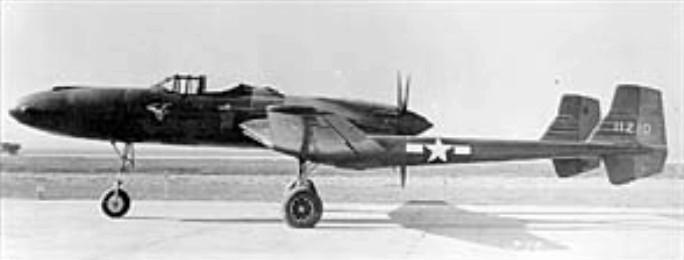
The XP-54, Vultee Model 70, was designed as a fast interceptor using the Pratt & Whitney X-1800-4AG engine. When the engine program was canceled, the aircraft was redesigned for the Lycoming XH-2470 and redesignated Vultee Model 84. With a pressurized cockpit, a pilot emergency ejection was downward, through a hole in the floor.
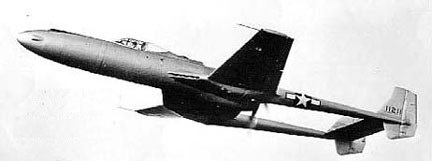
The first of two XP-54s built (S/N 41-1210) made its initial flight on 15 January 1943, piloted by Frank Davis, and flew 86 times before it was grounded by engine problems. The second aircraft (S/N 41-1211) flew only once, on 24 May 1944.
Vultee XP-54 – The only flight of 41-1211
The XP-54 nose section had a very unusual design feature. It tilted slightly upwards when firing its 37mm cannon to increase the firing range while the .50-cal. machine guns were tilted down at the same time. All had compensating gunsights.
Both were eventually scrapped.
XP-54 Span: 53 ft. 10 in. Length: 54 ft. 9 in. Height: 13 ft. 0 in. Weight: 15,262 lbs. empty/18,233 lbs. gross Armament: Two 37mm cannon and two .50-cal. machine guns Engine: Lycoming XH-2470 of 2,200 hp. Maximum speed: 381 mph. at 28,500 ft. Service ceiling: 37,000 ft. Range: 500 miles
The Vultee A-31 Vengeance dive-bomber was designed led by Richard Palmer to meet French air force requirements.
The RA-31 (Model V-72) export model (as prototype V-85) first flew on 30 March 1941 piloted by Vance Breese. There was a second prototype with twin tails, but pilot Vance Breese refused to fly after finding dangerous tendencies during taxi tests, and it was quickly modified with a single tail. It first flew (as Vengeance I) on 30 November 1941, piloted by Moye Stephens.
400 went to the RAF as Vengeance I/IA, subcontracted to Northrop Corp for production during 1941-42, of which 99 went to the RAAF, plus 300 to the USAAF as RA-31 in a special Restricted classification (41-30848 – 41-31047, and 41-31048 – 41-31147), the last batch of 100 built by Northrop; 300 to RAF as Vengeance II, plus 243 to USAAF with type re-designation as model 85 in 1942; 100 as Vengeance III, becoming Army A-31C, with subsequent production as A-35.
Vultee RA-31
The 1942 V-86 was a single place version of the A-31.
The XA-31A Model 85 of 1942 (42-35824) was a test-bed for the 3000hp P&W XR-4360 engine. It was re-designated XA-31B Model 86 for flight tests.
The A-31C of 1942 was t first production of the Vengeance III. One hundred were built; 41-30148 – 41-31147.
The XA-31C of 1942 was a test-bed for the 2200hp Wright R-3350 engine.
Five YA-31C were built in 1942 and went to Wright Field for testing of four-bladed props in the B-29 development program.
The A-35 Vengeance (Model 88) were A-31 for the USAAF, with similar data, but improved armament.
Vultee A-35A 41-31166
The 1942 A-35A were the second production of Vengeance III. Ninety-nine were built; 41-31148 – 42-31246.
781 A-35B of 1942 were built; 41-31247 – 41-31447, 42-94149 – 42-94548, and 42-101236 – 42-101465. Contradicting factory records show 831 A-35Bs built, with 562 going to the RAF and RAAF as Vengeance IV, and 29 to Brazil AF. (67 A-35A and -35B were supplied to the Free French, but it is unclear whether these were culled or a separate production.)
Vultee A-35B
All models were powered by Wright R-2600 Cyclone engine.










 All Aero