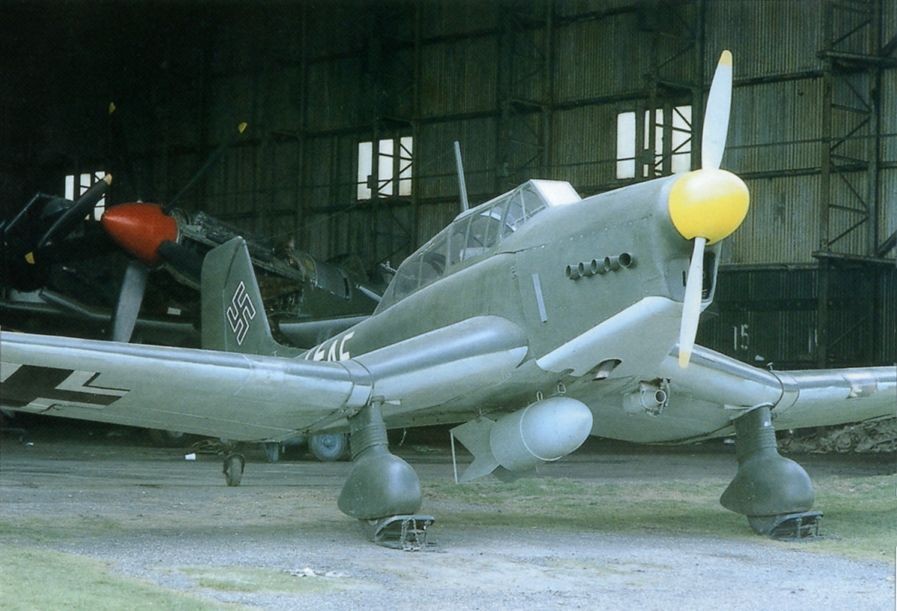
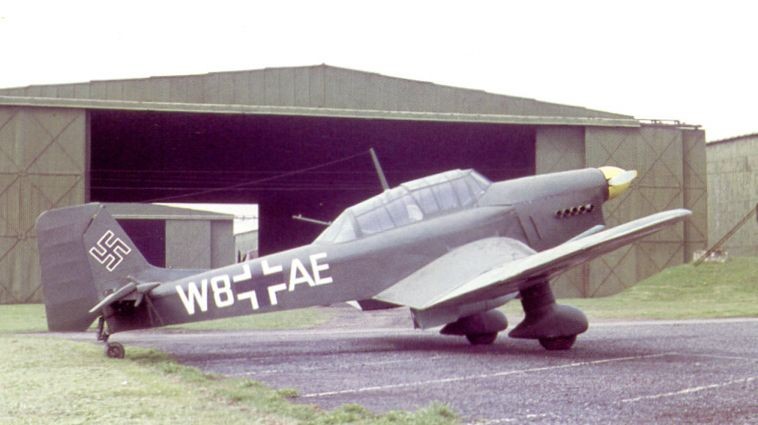
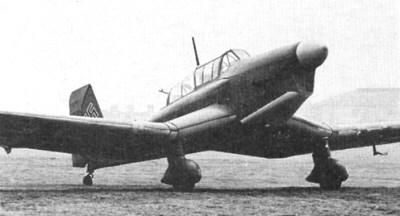
Vivian Bellamy’s Percival Proctor/Junkers Ju 87 Stuka conversion was built for the ‘Battle of Britain’ movie.
This aircraft was known as a “Proctuka”, and was a Percival Proctor trainer that had been heavily modified in order to make it look like a German Stuka dive bomber, including the addition of the cranked wings. Flight characteristics of the Proctukas were not good, though, and their flying footage was not used in the film (models were used for the Stukas instead).
It was considered by one pilot as “too dangerous to fly”
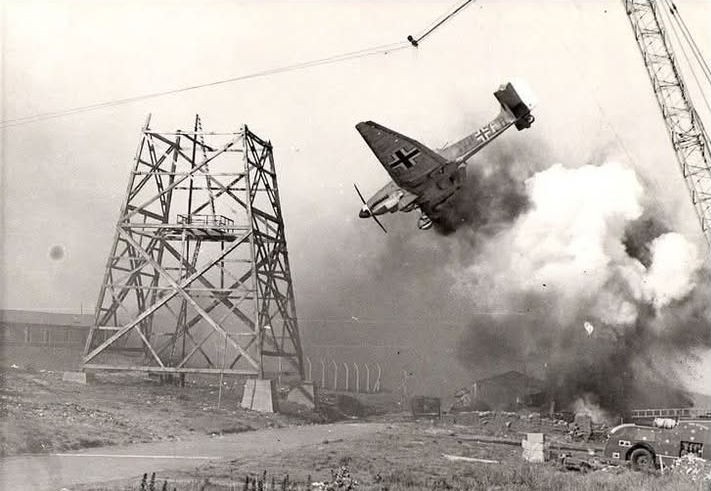
replica Stuka sliding down a cable which was suspended between two cranes, crashing into Chain Home antenna tower
The Stuka impacting the tower, from an unknown magazine
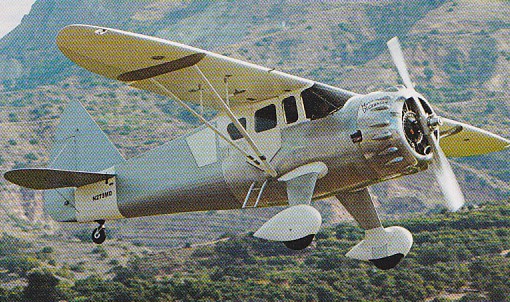
In 1999, Dickinson laid out on his hanger floor in Santa Paula, California, the first piece of what would be a brand new Howard. The goal was to build the airplane he believed Benny Howard would have built had he continued to build Howards.
He wanted Mr Mulligan’s speed and performance, as well as the DGA-15’s handling qualities and stability.
Dickinson adapted the original Mr Mulligan wing configuration, which had been replaced in later production models, and up-graded the DGA-15’s 450 hp Pratt & Whitney Wasp engine with a modern version, one that delivers 600 hp. He built every piece of the plane, or modified something from a DGA-15 or another airplane.
First flying in 2008, at 225 mph, it is 50 percent faster than the DGA-15. The designation, DGA-21 is the sum of DGA-6 (Mr Mulligan, and -15.
The Armitage S-8 of 1938 was a single-place open cockpit mid-wing monoplane all-metal racer. Featuring retractable undercarriage, it was built for George Nelson, registered NX2585, and wore race number 50, but it is unknown if it ever flew.
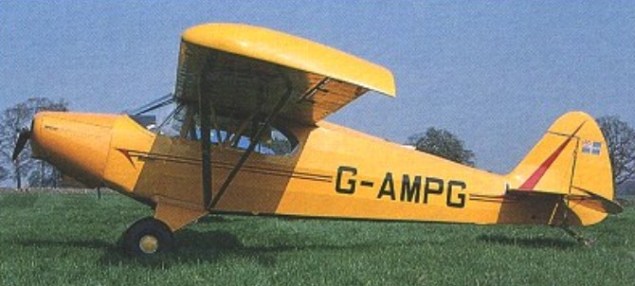
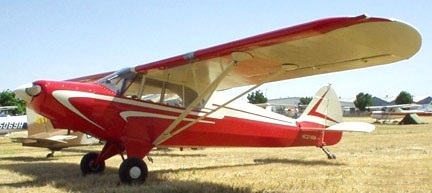
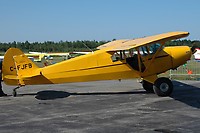
Although technically a three-seat aircraft, the Piper PA-12 Super Cruiser (ATC 780) was more usually used and regarded as a deluxe two-seater, and differed from the J-5C only in a number of cosmetic refinements including two wing tanks.
Dimensionally little had changed from the J-5C, and having the same 100 or 108 hp Lycoming O-235-C engine, the PA-12 had a maximum speed of 183km/h at sea level.
The prototype was flown in December 1945 and attracted so much attention that the company soon had an enormous backlog of orders at $2,995 in 1945, and $3,205 in 1947 (both less radio, starter and generator).
After the J-5, the type re-entered production in 1946 in refined form as the PA-12.
When production of this version ended in 1948 3,758 had been built. Lock Haven more than 3,500, Ponca City more than 250.
First around-the-world lightplane flights by City of Washington (p: Clifford Evans) NX2365M, and City of Los Angeles (p: George Truman) in 1947 NX3671M.
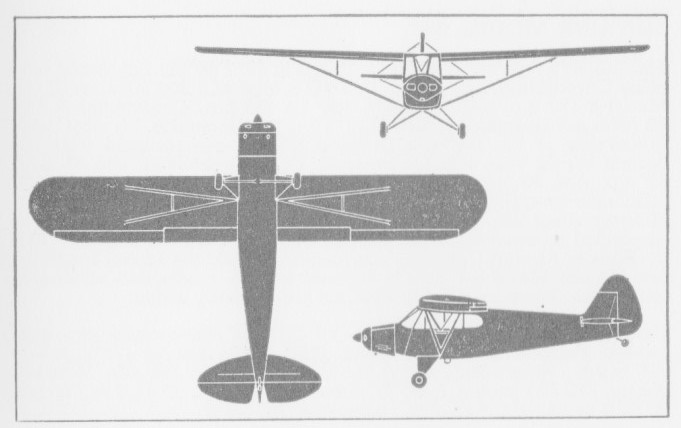
Piper PA-12-125 Super Cruiser
Engine: Lycoming O-235, 100 hp @ 2600 rpm Prop diameter: 76 in Wingspan: 35 ft 6 in Wing area: 179.3 sq.ft Length: 22.8 ft Height: 82 in Gross weight Normal: 1750 lb Gross weight utility: 1500 lb Empty weight: 950 lb Fuel capacity: 38 USG Power loading: 17.5 lb/hp Wing loading: 9.8 lb/sq.ft Baggage capacity: 41 lb Tire pressure: 18 lb/sq.in Max speed: 114 mph Cruise: 105 mph Stall: 42 mph Rate of climb: 600 fpm Service ceiling: 12,600 ft Absolute ceiling: 15,500 ft Cruise range: 600 sm Fuel burn: 6.5 USG/hr Seats: 3
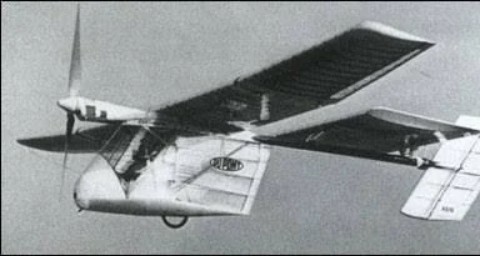
The Solar Challenger was a solar-powered aircraft designed by Paul MacCready’s AeroVironment. The aircraft was designed as an improvement on the Gossamer Penguin, which in turn was a solar-powered variant of the human-powered Gossamer Albatross. It was powered entirely by the photovoltaic cells on its wing and stabilizer, without even reserve batteries, and was the first such craft capable of long-distance flight. In 1981, it successfully completed a 163-mile (262 km) demonstration flight from France to England. The Solar Challenger was designed by a team led by Paul MacCready as a more airworthy improvement on the Gossamer Penguin, directly incorporating lessons learned from flight testing the earlier aircraft. As with the Gossamer Penguin, construction was sponsored by DuPont in exchange for publicity for the company’s patented materials incorporated in the design. AstroFlight, Inc. supplied the motors and solar panels, designed by Robert Boucher. The plane’s wings carried 16,128 solar cells yielding a maximum solar power of 3,800 watts. It was flight tested in Western USA in winter 1980–1981.
First flown on 6 November 1980, at Shafter, California, the Solar Changer then made several training flights including one of 90 minutes on 14 November 1980 reaching 1600 ft / 488 m. For these initial flights an electric battery was carried providing for an output of 3 hp for less than 30 minutes, the remainder of the flight using soaring techniques. Subsequently 15,000 solar cells were fixed to the wing and tailplane with the capability of producing similar power, and further flights were made in December 1980 including one of nearly 2 hrs and another to 3500 ft / 1067 m.
All flights to February 1981 were made by Janice Brown.
On July 7, 1981, the aircraft flew 163 miles from Pontoise – Cormeilles Aerodrome, north of Paris, France to Manston Royal Air Force Base in Manston, United Kingdom, staying aloft 5 hours and 23 minutes, with pilot Stephen Ptacek at the controls. Currently the plane is owned by the Smithsonian Institution’s Air and Space Museum.
The Solar Challenger was designed to be sturdier, more powerful, and more maneuverable than the Gossamer Penguin so as to be able to withstand sustained high-altitude flight and normal turbulence. It was over three times as heavy (without pilot) as the Gossamer Penguin and had a shorter wingspan, but was proportionately more powerful, with electricity supplied by 16,128 solar cells powering two three-horsepower motors. The solar panels were directly affixed to the wing and large horizontal stabilizer, both of which had to be flat on top to accommodate them. The two motors, each 3 inches wide and 17 inches long and incorporating samarium-cobalt permanent magnets, operated in tandem on a common shaft to drive a single, controllable-pitch propeller. The design incorporated advanced synthetic materials with very high strength to weight ratios, including Kevlar, Nomex, Delrin, Teflon, and Mylar, all supplied by the aircraft’s sponsor, Dupont.
Powerplant: 1 × solar-powered electric motor, 2.75 hp (2 kW) Wingspan: 47 ft 0 in (14.3 m) Length: 29 ft 0 in (8.8 m) Empty weight: 205 lb (90 kg) Gross weight: 350 lb (159 kg) Maximum speed: 40 mph (64 km/h, 35 kn) Service ceiling: 14,300 ft (4,360 m) demonstrated g limits: +6, -3 Rate of climb: 150 ft/min (0.765 m/s) Seats: 1

 All Aero