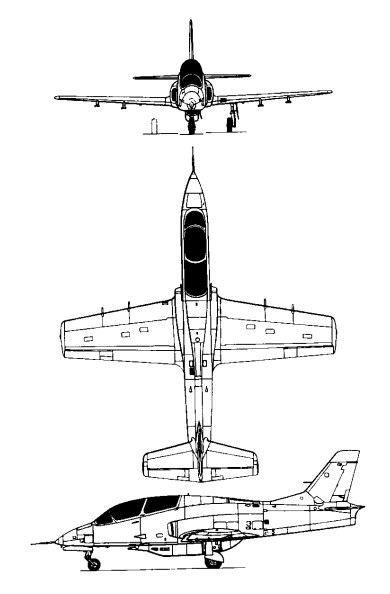
Derived from the IAR-827, the IAR-828 agricultural aircraft of 1981. The first Rumanian turboprop aircraft.
Engine: PT-6 or M601
Derived from the IAR-827, the IAR-828 agricultural aircraft of 1981. The first Rumanian turboprop aircraft.
Engine: PT-6 or M601

The IAR-827 made its first appearance in the West at the 1981 Paris Air Show, having been in production for more than a year after first flying in mid-1976, primarily for domestic heavy-duty agricultural needs. The IAR-827 is an enlarged and developed version of the IAR-826 with more powerful engines and increased payload.
Production was transferred to Brasov from Bucharest.
Testing indicated that the IAR-827 with a 400 hp Lycoming IO-720-DA1B was under-powered, and the IAR-827A evolved with a PZL-3S of 600 hp, seating two, side-by-side.
Construction of the forward fuselage is of welded chrome molybdenum steel tube, covered with light alloy panels, and the rear fuselage is a light alloy monocoque; the wing has two electrically-operated all-metal single-slotted flaps, and plain slotted ailerons. Automatic trim tabs are fitted in both ailerons and the port elevator, and a manually controlled tab is fitted in the starboard elevator.
The hopper can carry up to 2200 lb / 1000 kg, but normal operating loads are 1764 lb / 800 kg dry or 264 Imp.Gal / 1200 ltf liquids.
Engine: PZL-35
Engine: Lycoming IO-720, 400 hp
Wingspan: 47 ft 6.75 in / 14.50 m
Length: 33 ft 9.5 in / 10.30 m
Empty weight: 2800 lb / 1270 kg
Chemical payload-2hr mission: 1807 lb / 820 kg
Max payload: 1984+ lb / 900+ kg
MTOW: 5202 lb / 2360 kg
Cruise speed: 87 kt / 112 mph / 180 kph
ROC: 689 fpm / 210 m/min
Operating ceiling: 8200 ft / 2500 m
Service ceiling: 9850 ft / 3000 m
Max range at 3306 lb / 1500 AUW: 323 nm / 372 mi / 600 km
Seats: 1
IAR-827A
Engine: PZL-3S, 600 hp
Cruise 75%: 412 hp
Econ cruise: 60%: 330 hp
Prop: 4 blade VP CS 8 ft 7 in / 2.62 m
Max speed: 143 mph / 230 kph
Working speed: 92-112 mph / 150-180 kph
Stall: 71 mph / 115 kph
ROC: 590 fpm / 3 m/sec
Service ceiling: 13,120 ft / 4000 m
Take off run: 656 ft / 200 m
Landing run: 492 ft / 150 m
Working range: 217 mi / 350 km
Empty weight: 3638 lb / 1650 kg
Norm payload: 1764 lb / 800 kg
MTOW: 6173 lb / 2800 kg
Wingspan: 45 ft 11 in / 14.00 m
Length: 28 ft 2.5 in / 8.60 m
Height: 12 ft 3.5 in / 3.75 m
Wing area: 322.9 sq.ft / 30.0 sq.m
Aspect ratio: 6.6
Dihedral: 6 deg constant
Seats: 2

IAR-825TP Triumf – Retaining the wing and landing gear of the IAR-823, the turboprop powered Triumf has a new fuselage with two seats in tandem, and a new swept fin. Two underwing hardpoints are provided. The IAR¬825TP first flew on June 12, 1982, and series production for the Romanian Air Force, using uprated 559kW Pratt & Whitney Canada PT¬6A-25C engines, was due to begin in 1986.
IAR-825TP Triumf
Engine: 1 x P&WAC PT6A, 560 kW.
Span: 10.3 m.
Length: 8.9 m.
Wing area: 15 sq.m
Empty wt: 1200 kg.
MTOW: 2300 kg.
Max speed: 470 kph.
Initial ROC: 960 m / min.
Ceiling: 9000 m.
T/O run (to 15m): 250 m.
Ldg run (from 15m): 300 m.
Fuel internal: 360 lt.
Range/Endurance: 1400 km / 3 hr.

The piston-engined IAR-823 two/five-seat training/liaison aircraft first flew in July 1973 and series production started in 1974. The aircraft has a retractable tricycle undercarriage, two underwing hardpoints for fuel tanks or practice weapons, and is aerobatic under certain payload conditions. Power plant is a 216kW Lycoming IO-540.

Engine: 1 x Lycoming IO-540-G1D5, 215kW / 290 hp
Prop: Hartzell
Wingspan: 10.0 m / 32 ft 9.25 in
Wing area: 15.0 sq.m / 161.46 sq ft
Length: 8.24 m / 27 ft 0.25 in
Height: 2.5 m / 8 ft 2 in
Empty weight aerobatic: 880 kg / 1940 lb
Empty weight utility: 900 kg / 1984 lb
MTOW aerobatic: 1186 kg / 2614 lb
MTOW utility: 1380 kg / 3042 lb
Loaded weight: 880 kg / 1940 lb
Usable fuel: 90 USG
Fuel Burn: 15 USG/Hr
Max speed: 300 km/h / 186 mph
Max cruise speed 75%: 280 km/h / 174 mph / 151 kt at 5750 ft / 1750 m
Service ceiling: 5800 m / 19050 ft
ROC: 1378 fpm / 420 m/in
Range w/max.fuel: 1350 km / 839 miles 728 nm
Range w/max.payload: 700 km / 435 miles / 700 km
Seats: 4
Loading: +6/-3
Cabin baggage capacity: 88 lb / 40 kg

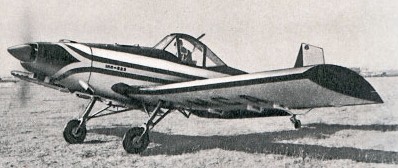
Designed for agricul¬tural use the first I.A.R. 822 flew in 1970. Series production started in 1971.
The IAR-822 was the initial single seat version of mixed wood and metal construction. The tandem two seat IAR-822B was used for training and glider towing.
The IAR-826 was as the IAR-822 but of all-metal construction.

IAR-826
Engine: 1 x Lycoming IO-540-G1D5, 215kW
Take-off weight: 1900 kg / 4189 lb
Loaded weight: 1060 kg / 2337 lb
Wingspan: 12.8 m / 41 ft 12 in
Length: 9.4 m / 30 ft 10 in
Height: 2.8 m / 9 ft 2 in
Wing area: 26.0 sq.m / 279.86 sq ft
Max. speed: 195 km/h / 121 mph
Cruise speed: 170 km/h / 106 mph
Ceiling: 4500 m / 14750 ft
Range w/max.fuel: 500 km / 311 miles


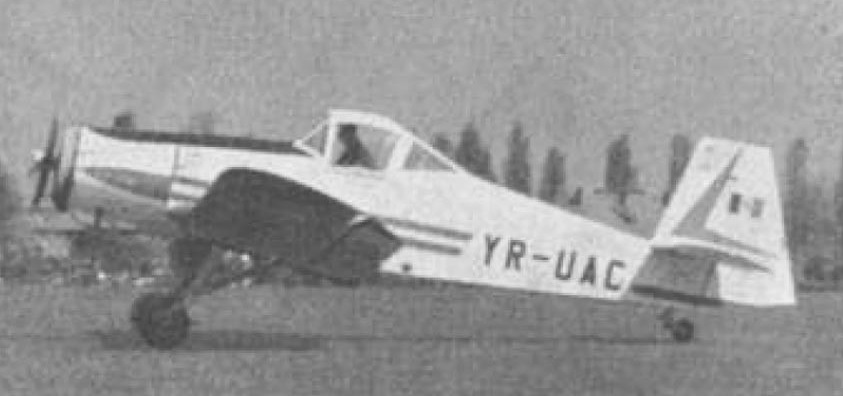
The IAR-821 is an agricultural crop sprayer and duster aircraft. The design was completed under the leadership of eng. Radu Manicatide in 1967, at IMFCA Bucharest (Institutul de Mecanica Fluidelor si Cercetari Aerospatiale – Institute of Fluid Mechanics and Aerospace Research).
A low-wing monoplane, it featured mixed wood-metal structure, with the fuselage and wing roots built from welded chrome-molybdenum tube, and the outer wings and tail unit from wood. The three-part, self-supporting rectangular wing is attached to the fuselage with a 5 ° angle of incidence. While the wing center part is designed without a V-position up to about 1/3 of the span, the wing ends have a V-position of + 5 °. The wing center section, which runs straight through, has a frame of welded chrome-molybdenum tubes and is clad with metal planking that can be walked on. The outer wings made of wood and covered with fabric also house the two fuel tanks with a total capacity of 130 lt. The front fuselage had aluminium panels, while the rest of the surface was plywood covered with fabric.
The ailerons are also made of wood and covered with fabric. As landing flaps simple slotted flaps are used. The container for 800 kg of spray is located between the fire bulkhead and the cockpit. Both solid and liquid funds can be applied.

The propulsion was provided by an Ivchenko AI-14 RF, a single row air-cooled 9-cylinder radial capable of delivering 300 hp (221 kW), located at the apex of the front fuselage contained in a NACA cowling and combined with a three-blade propeller with fixed pitch. It was with fixed, tailwheel undercarriage.
It was built at IRMA (Intreprinderea de Reparatii Material Aeronautic – Enterprise for Aeronautical Material Repairement), in Bucharest, first flying in 1967. A small series of 20 aircraft was produced in 1968 and 1969, plus a single example of a trainer aircraft designated IAR-821B that had a second cockpit installed in place of the IAR-821’s chemical tank, and was equipped with a new chemical tank of smaller capacity (100 lt). The fuel capacity was been increased to 160 lt. This version flew for the first time in September 1968. It was intended that this aircraft should equip Romanian flying schools from 1969, but this did not happen.
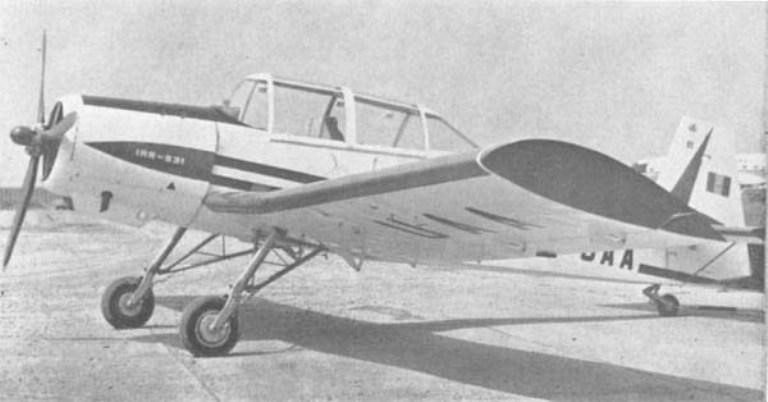
The IAR-821 was built until the end of 1969, when replaced by the IAR-822 which had a six-cylinder Lycoming engine.
IAR-821
Engine: 1 × Ivchenko AI-14RF, 220 kW (300 hp)
Wingspan: 12.80 m (42 ft 0 in)
Wing area: 26.0 sq.m (280 sq ft)
Wing profile: NACA 23012
Wing chord: 2.10 m
Wing extension: 6.3 m
Length: 9.20 m (30 ft 2 in)
Height: 2.78 m (9 ft 1.5 in)
Empty weight: 1,080 kg (2,380 lb)
Gross weight: 1,900 kg (4,180 lb)
Capacity: 600 kg (1,300 lb) chemicals
Maximum speed: 212 km/h (132 mph, 115 kn)
Cruising speed: 205 km / h
Application speed: 120-150 km / h
Endurance: 2 hours 36 minutes
Service ceiling: 6,200 m (20,300 ft)
Rate of climb: 8.0 m/s (1,575 ft/min)
Takeoff roll: 130 m
Crew: One pilot
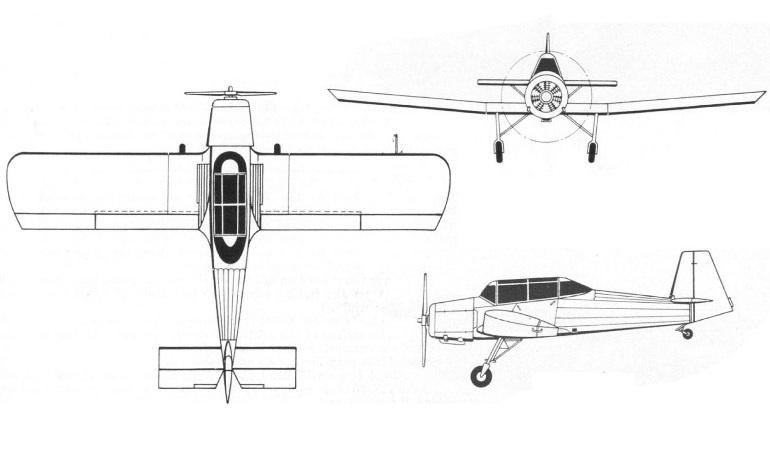


A 1960 product of the Rumanian aircraft industry was the general purpose IAR 818 derived from the earlier IAR 817. The I.A.R. 818 first flew in 1960 and was reported to possess a maximum speed of 115 mph (185 kph) and normal and maximum ranges of 298 mls (480 km) and 603 mls (970 km) respectively, the IAR 818 is suitable for agricultural and ambulance duties.
IAR.818
Engine: 1 x M-337, 155kW
Take-off weight: 1300 kg / 2866 lb
Loaded weight: 825 kg / 1819 lb
Wingspan: 12.1 m / 39 ft 8 in
Length: 10.0 m / 32 ft 10 in
Wing area: 25.4 sq.m / 273.40 sq ft
Max. speed: 185 km/h / 115 mph
Cruise speed: 165 km/h / 103 mph
Ceiling: 4000 m / 13100 ft
Range w/max.fuel: 900 km / 559 miles
Range w/max.payload: 250 km / 155 miles


In 1955, a prototype of a new utility aircraft, the IAR-817, was first flown at the URMV-3 works of Industria Aeronautică Română at Brașov. The URMV-3 works had been formed at the Sovromtractor tractor factory, itself on the site of the Industria Aeronautică Română aircraft works. It was a single-engine high-wing monoplane with a pod-and-boom type fuselage of welded steel tube construction and fabric-covered wooden wings. It had a fixed tricycle undercarriage. The aircraft was powered by a single 120 kW (160 hp) Walter Minor 6-III air-cooled six-cylinder inverted inline engine.

An air-ambulance version of the IAR-817, the IAR-817S, entered production in 1957, with over 60 built.

The type formed the basis of the IAR-818, built from 1961.
Engine: 1 × Walter Minor 6-III, 120 kW (160 hp)
Propeller: 2-bladed variable-pitch
Wingspan: 12.6 m (41 ft 4 in)
Wing area: 25.4 m2 (273 sq ft)
Length: 9.8 m (32 ft 2 in)
Height: 3.4 m (11 ft 2 in)
Empty weight: 800 kg (1,764 lb)
Max takeoff weight: 1,150 kg (2,535 lb)
Maximum speed: 175 km/h (109 mph, 94 kn)
Cruise speed: 165 km/h (103 mph, 89 kn)
Stall speed: 70 km/h (43 mph, 38 kn)
Range: 560 km (350 mi, 300 nmi)
Ferry range: 930 km (580 mi, 500 nmi)
Service ceiling: 3,000 m (9,800 ft)
Time to 1,000 m (3,300 ft): 7 minutes 30 seconds
Take-off run: 150–180 m (490–590 ft)
Landing run: 60 m (200 ft)
Crew: 1 or 2
Seats: 4-5


The IAR 813 is a two-seater light sports and training aircraft developed from the earlier IAR 811. The IAR 813 is a low-wing cantilever monoplane of wooden and composite construction powered by a Walter Minor 6-III six-cylinder in-line inverted air-cooled engine providing a top speed of 185km/h and a range of 500km.
Engine: 1 x Walter Minor 4-III, 77kW
Take-off weight: 760 kg / 1676 lb
Empty weight: 520 kg / 1146 lb
Wingspan: 10.1 m / 33 ft 2 in
Length: 8.4 m / 27 ft 7 in
Height: 2.3 m / 7 ft 7 in
Max. speed: 190 km/h / 118 mph
Cruise speed: 175 km/h / 109 mph
Ceiling: 5500 m / 18050 ft

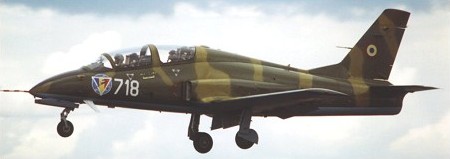
Making its first flight in December 1985, the IAR-99 Soim (Falcon) is designed as a basic jet trainer/light ground attack aircraft, the Soim has lateral intakes for the single 4,000 lb st (17,8 kN) R-R Viper Mk 632-41 turbojet. The wings are unswept, with provision for up to four attachment points, as well as a gun pod on the fuselage centreline. Maximum take-off weight is in the 5,500kg class, with a maximum level speed of 865km/hr (467kt) and a service ceiling of 13,900m (46,000ft).
The first prototype flew on December 21, 1985. The aircraft was in production for the Romanian Air Force to replace the L-29 Delfin in Romanian Air Force service.
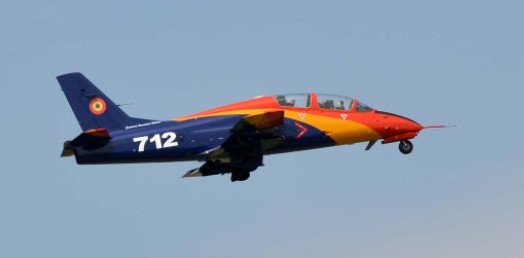
IAR 99 Soim
Engine: 1 x Rolls-Royce “Viper” Mk.632-41M, 1820kg
Take-Off Weight: 4400-5560 kg / 9700 – 12258 lb
Empty Weight: 3200 kg / 7055 lb
Wingspan: 9.85 m / 32 ft 4 in
Length: 11.01 m / 36 ft 1 in
Height: 3.90 m / 12 ft 10 in
Wing Area: 18.71 sq.m / 201.39 sq ft
Max. Speed: 865 km/h / 538 mph
Ceiling: 12900 m / 42300 ft
Initial ROC: 2190 m / min.
T/O run: 790 m.
Ldg run: 750 m.
Hardpoints: 4.
Range: 970-1100 km / 603 – 684 miles
Crew: 2
Armament: 1 x 23mm cannon, up to 800kg of weapons