K10W1 trainer, copied from North American NA-16, built in 1941; production after first 26 given to Nippon.
Monoplane
Wasp Airplane Co T-2 Air Coach
The 1928 T-2 Air Coach was a five place cabin high wing monoplane. The price was $6,500.
Engine: 200hp Anzani (later 220hp Wright J-5)
Wingspan: 38’6″
Length: 25’0″
Useful load: 1100 lb
Max speed: 140 mph
Cruise speed: 110 mph
Stall: 52 mph
Range: 400 mi
Seats: 5
Wasp Airplane Co T-2 Air Coupe
The 1928 T-2 Air Coupe was a three place cabin high wing monoplane. The price was $2,345.
Engine: 120hp Anzani
Wingspan: 38’0″
Length: 25’0″
Useful load: 500 lb
Max speed: 110 mph
Cruise speed: 90 mph
Stall: 53 mph
Range: 400 mi
Seats: 3
Wasp Airplane Co Special

Designed by W H Woerner, the sole 1927 Wasp Special NX7571 c/n 2 was a Dole Race entry but it spun in and crashed prior to the race.
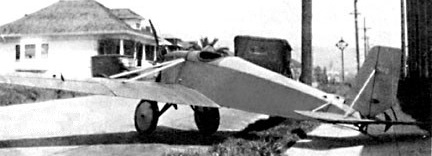
Engine: 80hp Anzani
Seats: 1
Washington Aeroplane Co Columbia
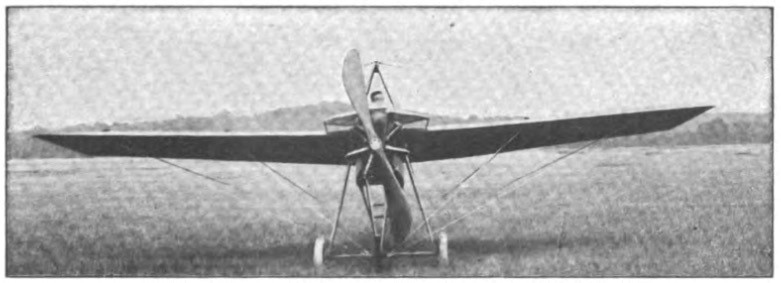
The Columbia monoplane was entered for the 1912 Gordon Bennett aviation race held in Chicago, to be piloted by Paul Peck, known as “The Birdman of West Virginia”, powered by a rotary rated at 50 hp. In 1912 Peck was killed while flying the Columbian at a Chicago exhibition. Peck started a steep spiral, ignoring a sudden storm, the engine came loose, cut through the pilot’s seat with its whirling propeller, and the airplane disintegrated in the air.
Warwick Tiny Champ
The 1960 Tiny Champ single place cabin high wing monoplane was registered N3632G.
Engine: Continental A-65, 65hp
Wingspan: 20’0″
Length: 19’0″
Useful load: 250 lb
Max speed: 115 mph
Cruise speed: 105 mph
Stall: 60 mph
Range: 250 mph
Warwick Bantam

Bill Warwick built his third plane, the Bantam, first flying in 1966. The first Bantam, N2258B, first flew in June 1966.
Designed for simple fabrication, the Bantam uses no compound curves and very few simple ones. The cockpit area is a steel tube structure taking all wing, gear and engine mount loads. The steerable front wheel has a spring leaf shock absorber. The remaining is wood construction with a plywood cover.
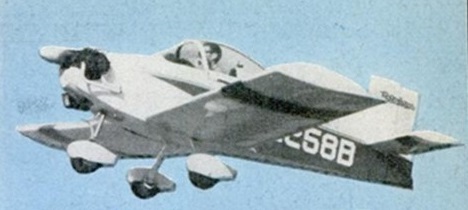
The Bantam is a single-seat, low-wing plane that can use any engine from 65 to 100 hp.
Blueprints cost US$55 in 1972.
Engine: Lycoming O-145, 65 hp
Wingspan: 18 ft 6 in
Length: 13 ft 9 in
Height: 6 ft 0 in
Gross weight: 790 lb
Empty Wt. 535 lbs
Fuel capacity 11.5 USG
Top speed: 140 mph
Cruise speed: 105 mph
Stall 52 mph
ROC: 1000 fpm
TO run: 550 ft
Ldg run: 500 ft
Warsztaty Szybowcowe Wrona (Crow) / Kocjan Wrona
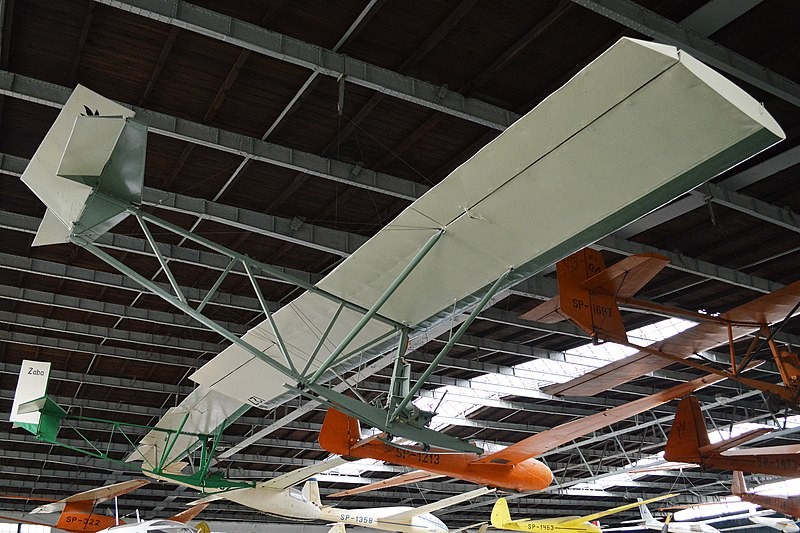
The Warsztaty Szybowcowe Wrona (Glider Workshops Crow), or Kocjan Wrona after its designer, was the most numerous and widely used Polish pre-war primary glider.
Designed by Antoni Kocjan, the Wrona was in competition with the Czerwiński and Jaworski CWJ flown in 1931. Both were simple, high-wing and open frame (flat, uncovered girder fuselage) gliders in the style of the earlier German Zögling. With LOPP funding five pre-production airframes were built by Warsztaty Szybowcowe, the first flying from Mokotów on 6 September 1932.
Its two-part wing, mounted on top of the fuselage, was rectangular in plan and built around two spars. It was plywood-covered ahead of the forward spar, forming a torsion-resistant D-box, with the rest fabric-covered. On each side a pair of parallel struts braced the spars to the lower fuselage. Long, rectangular ailerons reached from strut to tip.
The upper and lower longerons or chords of the open-frame fuselage were joined together with vertical and diagonal braces. The pilot sat, unprotected, under the wing leading edge on a seat on the forward vertical brace. Aft, the Wrona’s triangular fin extended above and between the longerons and carried a tall, nearly rectangular rudder which reached down to the lower longeron. Its narrow, triangular tailplane, mounted on the upper longeron, carried rectangular elevators with a deep cut-out for rudder movement. Fixed tail surfaces were ply-covered and the control surfaces fabric-covered. Wronas landed on a tandem pair of sprung skids on the lower longeron.
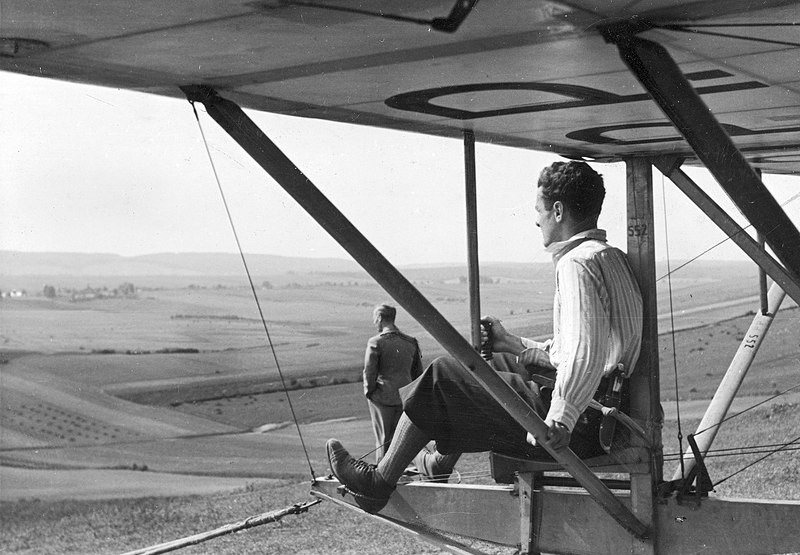
The early Wronas had a wing with a span of 8.8 m (28 ft 10 in) and area of 13.2 m2 (142 sq ft) but by 1934 the revised Worna bis had span and area increased by about 5%. Extended exposure to novice pilots revealed a tendency to enter a spin at high angles of attack caused by over-sensitive elevators. Several proposed solutions were tested and in the later 1930s, the problem was successfully resolved when all Wrona bis had their elevator areas reduced, together with a tailplane of increased area set at a negative angle of incidence (-2º).
Wrona production began in 1933 and continued up to the Invasion of Poland in 1939, with about 100 built at Kocjan’s Warsztaty Szybowcowe factory and another 250 built under licence in at least seven other European countries. Construction drawings, materials and parts were sold, with at least 50 aircraft built by clubs and similar organizations.
It is not surprising that a basic trainer set no major records; but in June 1938, a Wrona bis made a 6.5 km (4.0 mi; 3.5 nmi) cross-country flight, a first (and last) record for an open girder glider in Poland. In April 1935 another, accompanied by a Warsztaty Lotnicze Czajka, made the first winch launchings in the country.
Only one or two survived the war. One Wrona bis remained in use until 1950, after which it became a museum exhibit. In December 1963 it was acquired by the Polish Aviation Museum in Krakow, where it remains on display.
Variants:
Wrona
Prototypes and 1933 production variant.
Wrona bis
Superseded Wrona in 1934 production with a wing of greater span and area. Modified in the late 1930s to overcome over-sensitive elevators and associated spinning tendencies.
Wingspan: 9.31 m (30 ft 7 in)
Wing area: 13.9 m2 (150 sq ft)
Length: 5.6 m (18 ft 4 in)
Height: 1.9 m (6 ft 3 in)
Empty weight: 75 kg (165 lb)
Gross weight: 150 kg (331 lb)
Maximum glide ratio: 11 at 50 km/h (31 mph; 27 kn)
Rate of sink: 1.2 m/s (240 ft/min) at 48 km/h (30 mph; 26 kn)
Minimum speed: 45 km/h (28 mph; 24 kn)
Capacity: One
Warsztaty Szybowcowe Orlik / XTG-7
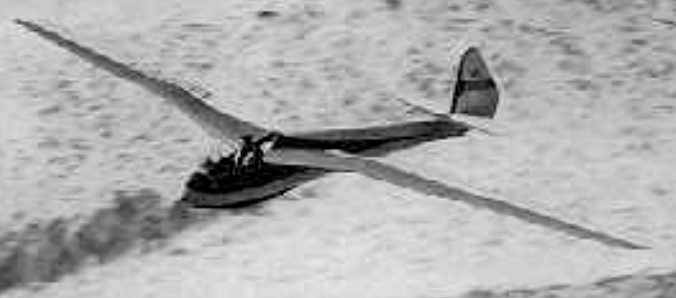
Designed by Antoni Kocjan, the Orlik 2, which first flew in 1938, was a development of the 1937 14.4 m. Orlik 1. A special model (Orlik 3) was developed for the Olympic design competition for the 1940 games (won by the German D.F.S. Meise). It has unusual airbrakes on the wing undersurface, close to the leading edge, from the root to the wing bend.

One example came to the U.S., and in WWII was imposed into the military as the XTG-7. Later, flown by Paul MacCready, it briefly held the world altitude record in 1948 at over 9,000 m. in the Sierra wave as well as winning the 1948 and 1949 U.S. Nationals.
Structure: Wood/ fabric wing and tail, wood fuselage.
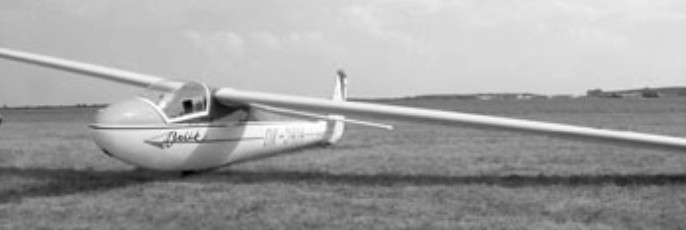
Orlik 2 / XTG-7
Wing span: 15m / 49.2ft
Wing area: 14.8 sq.m / 162.5 sq.ft
Aspect ratio: 15.2
Empty Weight: 160 kg / 353 lb
Payload: 85 kg / 187 lb
Gross Weight: 245 kg / 540 lb
Wing Load: 16.5 kg/sq.m / 3.32 lb/sq.ft
L/DMax: 24@ 71 kph / 38 kt / 44 mph
MinSink: 0.64 m/s / 2.1 fps / 1.24 kt
Seats: 1
No. Built: 18
Warrior Aeronautical Corp Monoplane
Circa 1930 Warrior Aeronautical Corp built a Salmson powered single place open cockpit mid-wing monoplane registered prototype N950W c/n 501. The registration was cancelled in 1933.
 All Aero