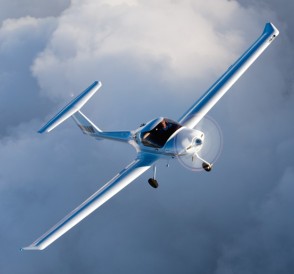
Diamond DA20 Katana

DA20

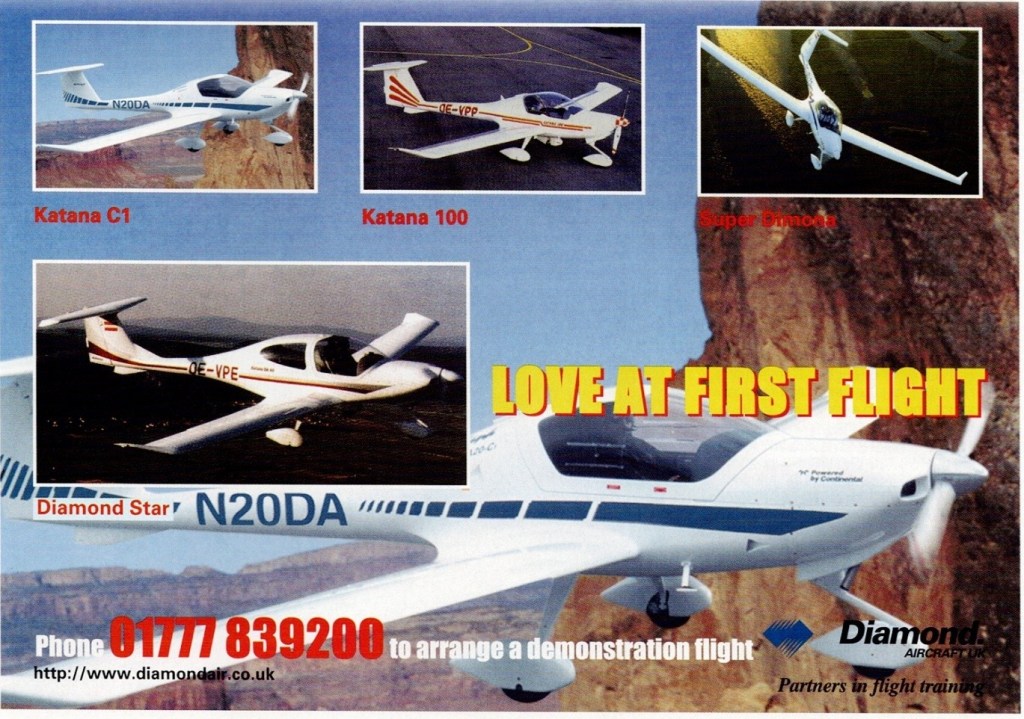
A primary training and sport aircraft of composite construction. Some forty changes were made to the Canadian-built Katana DA20-A1 from the original Austrian DV20. Major changes included a wider cabin, electric trim and a doubling of the electrical system capacity. The original Katana A1 was certified in 1994, with first customer deliveries beginning in January 1995. The last of this model was delivered in April 1998 with a total of 331 manufactured. Over 100 significant design changes were incorporated in the Katana DA20-C1, from the original aircraft. Production deliveries of the Katana Cl started early 1998 with a 1999 production rate of three aircraft per week.
May 2000

The Katana’s fuselage is built as one piece from glass reinforced plastic (GRP), with local areas of carbon reinforced plastic (CRP) with reinforcement in high stress areas. The total length of the aircraft is 7.17 metres (23 ft 6 in) and the skin is made of GRP laminate. The skins of the wings, however, are a GRP/foam/GRP sandwich. The wing is a Wortman laminar profile and the inner 50 percent of the wing features slotted flaps. Each wing is attached to the fuselage with three bolts. In the wing several ribs provide structure and mounting surfaces for guides and support for control bellcranks. The rudder, also made of a GRP/foam/GRP sandwich, is cable operated by dual adjustable pedals. The horizontal stabiliser and elevator are of the same construction with local GRP reinforcement. A steel control tube actuates the elevator, but centering and force gradients on the stick are assisted by two compression coil springs which are mounted concentric to the vertical push/pull tube of the elevator control system. The elevator trim function, which is operated on the central control panel, works by moving the common spring base with an electric actuator. The flaps are actuated electrically through a mechanical linkage that operates to both sides. The ailerons, on the other hand, are driven by steel control tubes and aluminium bellcranks. The landing gear is a conventional, non-re¬tractable tricycle system. The main gear struts are spring aluminium, while the nose gear strut is a steel tube sprung on an elastomeric spring pack. The castoring nose wheel is friction damped and the aircraft is steered by differential braking of the main wheels. The engine is mounted on a conventional welded steel tube frame attached to the ceramic fibre matting and stainless steel skin firewall. The maximum gross weight was increased by 66 lb on 8 April 1999 by the FAA to 780 kg (1720 lb).
The Katana has a central control stick that is mounted at the front of the comfortable, and rather deep, four-point harness bucket seats. It is interesting to note that this aircraft is built for the changing Canadian weather and a heating system, as well as air vents at the lower position on the instrument panel, make for an easily controlled cockpit environment.
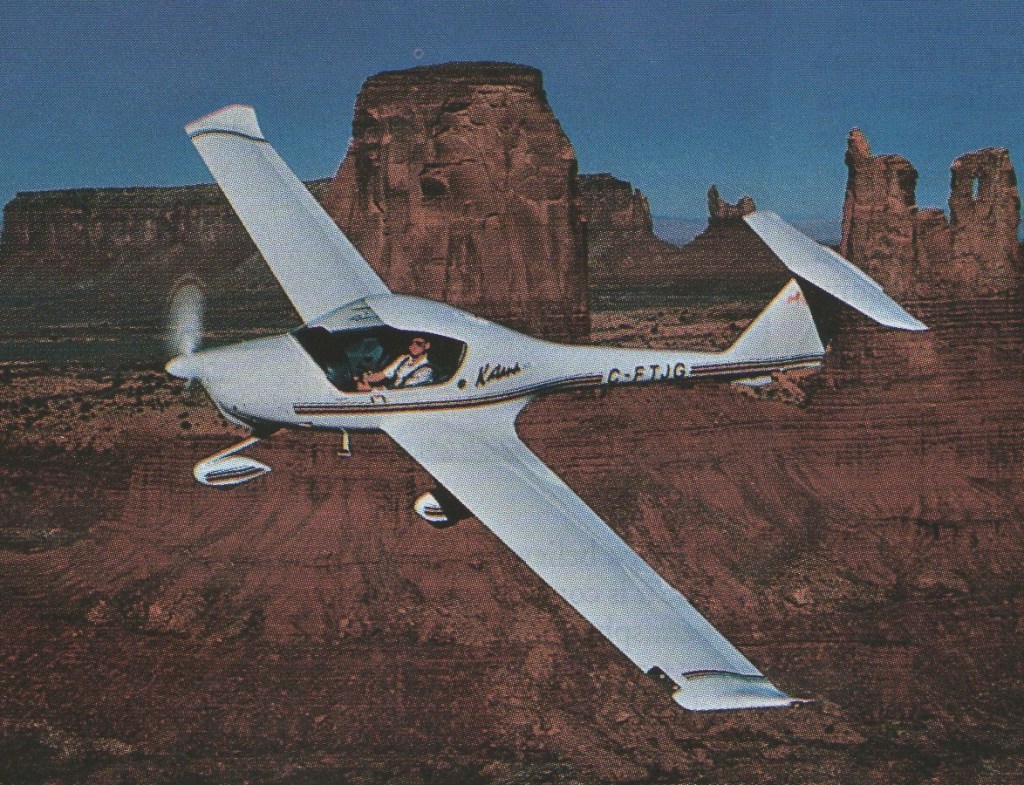
Diamond DA-20

Gallery

DA20
Engine TCM IO-240-B3B, 125 hp
Propeller Sensenich 2-blade fixed pitch
Airworthiness category Utility, spin certified
Length 23 ft 6 in
Height 7 ft 2 in
Wing Span 35 ft 8 in
Maximum takeoff weight 1,764 lbs
Useful load 600 lbs
Fuel capacity, usable 24.0 gal
Fuel AVGAS 100LL
Takeoff distance, ground roll 1,280 ft
Takeoff distance, 50-foot obstacle 1,640 ft
Landing distance, ground roll 661 ft
Landing distance, 50-foot obstacle 1,360 ft
Rate of climb, sea level 1,000 ft/min

DA20-A1
Engine: Rotax 912F-1, 81 hp.

DA20-C1
Engine: Teledyne Continental IO-240-B3B, 125 hp.
Recommended TBO: 2,000 hr
Prop: 1.75-rn dia Sensenich fixed-pitch wood-fibre.
Length: 23 ft 6 in
Height: 7ft 2 in
Wing span: 10.87 m (35 ft 8 in).
Wing area: 11.6sq.m (125 sq.ft).
Wing Loading: 13.2 lb/sq ft
Power Loading: 13.2 lb/hp
Seats: 2.
Empty weight, typical: 1,166 lb
Maximum gross weight: 1,654 lb
Fuel capacity, std: 25 US gal / 93 litres (91 litres usable).
Fuel usage @ 2500 rpm: 20 lt/hr.
Oil capacity: 6 qt
Takeoff distance, ground roll: 952 ft
Takeoff distance over 50-ft obstacle: 1,263 ft
Max demonstrated crosswind component: 15 kt
Rate of climb, sea level: 1105 fpm
Cruise Speed @ 75% power, 6,000 ft: 132 ktas
Endurance: 4.5 hr.
Operating ceiling: 13,123 ft
Landing distance over 50-ft obstacle: 1,235 ft
Landing distance, ground roll: 550 ft
W (best angle of climb): 60 kias
Vy (best rate of climb): 75 kias
Va (design maneuvering): 106 kias
Vfe (max flap extended): 78 kias
Vne (never exceed): 163 kias
Vs (stall, clean): 42 kias
Vso (stall, in landing configuration): 34 kias

2008 Diamond DA20-C1 Eclipse
Base Price: US$174,495
Engine: Continental IO-240-B3B, 125 hp@SL
TBO (hrs.): 2000
Fuel type: 100LL
Propeller: 69-in. Sensenich FP
Landing gear type: Tri./Fixed
Gross weight (lbs.): 1764
Empty weight, std. (lbs.): 1164
Useful load, std. (lbs.): 600
Payload, full std. fuel (lbs.): 456
Usable fuel, std. (USgals.): 24
Wingspan: 35 ft. 8 in.
Overall length: 23 ft. 6 in.
Height: 7 ft. 2 in.
Wing area (sq. ft.):125
Wing loading (lbs./sq. ft.): 14.1
Power loading (lbs./hp.): 14.1
Seating capacity: 2
Cabin doors: 1
Cabin width (in.): 45
Cabin height (in.): 44
Cruise speed (kts.): 75% power: 138
Fuel consumption (USgph): 75% power: 5.5
Vso (kts.): 45
Best rate of climb, SL (fpm): 1000
Service ceiling (ft.): 13,120
Takeoff ground roll (ft.): 1280
Takeoff over 50 ft. obstacle (ft.): 1640
Landing ground roll (ft.): 661
Landing over 50 ft. obstacle (ft.): 1360

DA20
Engine: TCM IO-240-B3B, 125 hp
Propeller: Sensenich 2-blade fixed pitch
Airworthiness category: Utility, spin certified
Length: 23 ft 6 in
Height: 7 ft 2 in
Wing Span: 35 ft 8 in
Maximum takeoff weight: 1,764 lbs
Useful load: 600 lbs
Fuel capacity, usable: 24.0 USgal
Fuel: AVGAS 100LL
Takeoff distance, ground roll: 1,280 ft
Takeoff distance, 50-foot obstacle: 1,640 ft
Landing distance, ground roll: 661 ft
Landing distance, 50-foot obstacle: 1,360 ft
Rate of climb, sea level: 1,000 ft/min
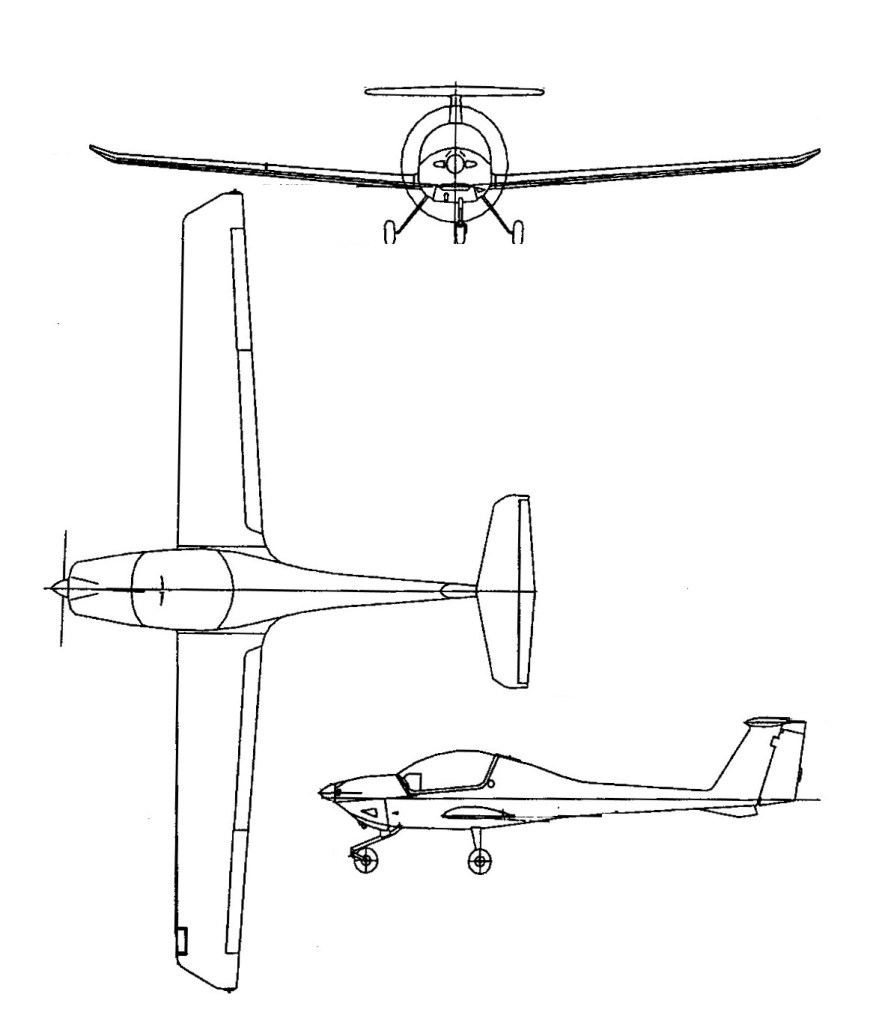
Katana DA20-Cl

DG Flugzeugbau Silence

The developers of the Silence single place ultralight joined DG to produce both kits and finished aircraft. The main components are of a honeycomb sandwich.

Silence Twister

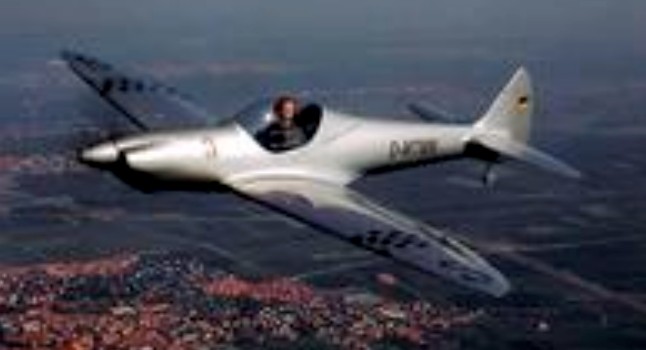
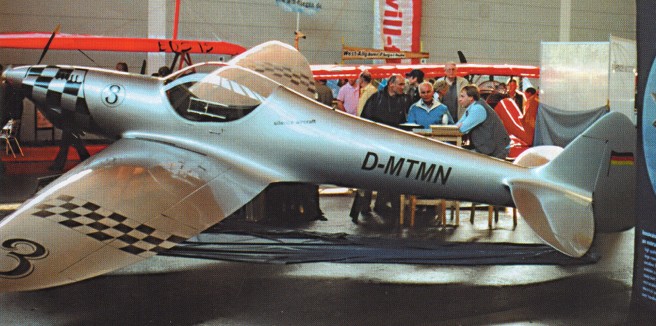
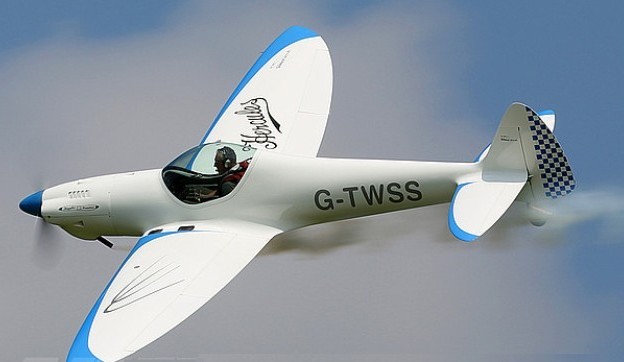
Silence, manufactured by Silence Aircraft in Verl near Bielefeld, Germany.

Silence Twister

The Swiss company H55 was working with the Solar Impulse project co-founder and pilot André Borschberg. They use the Silence Aircraft Twister and jointly with Siemens they developed a single seat aerobatic airplane.

Engine: Jabiru 2200, 80 hp.
Stall: 41 kt / 47 mph / 76 kmh
Cruise: 127 kt / 146 mph / 235 kmh
VNE: 162 kt / 186 mph / 300 kmh
Empty Weight: 238 kg / 525 lbs
MTOW Weight: 399 kg / 880 lbs
Climb Ratio: 1275 ft/min / 6 m/s
Max speed: 140 kts.
Seats: 1.

DFS Prüfling

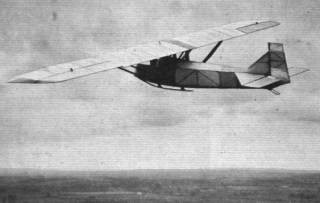
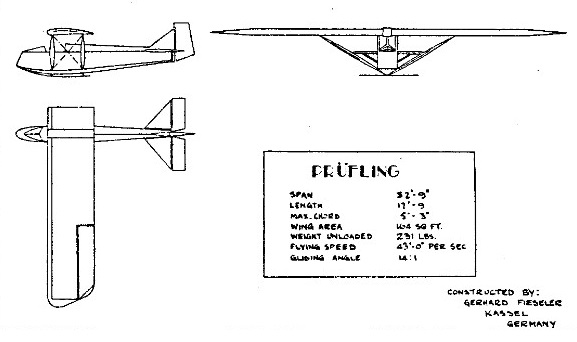
The German RRG Prufling of 1926 was a secondary training glider designed for club use. It was to be cheap to build, given the difficult financial situation of many Germans after the First world war, as well as simple enough that skilled non-professional builders and gliding clubs could successfully build them from plans.

The concept took shape shortly at the Martens gliding school at the Wasserkuppe in the rhön-Rossitten-Gesellschaft GBR at the end of 1925. Chief Martens instructor Fritz Stamer and Alexander Opisem were to produce two gliders in a few days; a Zogling and Prufling. Some parts, such as wings, and to a lesser extent, horizontal tails, the two aircraft were similar.

Both were almost rectangular in shape, two-spar wooden structures, with two-piece wings with fabric covering everywhere except the front edges of which were covered with plywood. In Pruflings the tips of the wings were more rounded and his wingspan 500 mm more. The ailerons were simple, though Pruflings were a little longer. Both had triangular tailplanes carrying elevators, which were rectangular pieces cut-out for rudder movement, though the tail Pruflings was more strongly swept and wider in chord.

The main difference between the two was in the fuselage. In the Zogling was very simple to open a longeron of the fuselage, Prufling more regular hexagonal cross section, wood-frame structure, covered with plywood forward from under the wing, and fabric aft. The wing was supported over the fuselage with a pair of parallel lift struts on each side, tying it almost in the middle of the span when the spars to the lower fuselage longerons. The open cockpit was under the wing center section was supported by two pairs of struts to the upper longerons of the fuselage. Front pair located in the front part of the cabin was a single, upright struts and in the back, just back, had a friend with an inverted V-steam. In the center there was a noticeable gap between the wings, connected by short wooden the link of the chord. The horizontal tail was located on the top longerons. with a triangular fin to wear vertically, straight edged balanced rudder, which was at an angle just below the heel and extended down to the keel. In Prufling landed on the rubber suspension below the frame forward the whole ply skin of the fuselage, helped a very small skid.

It first flew in 1926 and was soon in use with the corresponding RRT rhön Rossitten gliding clubs.

The plans were sold and many of them were built inside and outside of Germany. As an example, one was flying from the Lancashire Aero club and the other with the London gliding club in the early 1930s. Despite this success, Prufling was something of a disappointment as an additional training aircraft, for their performance was not much better than a typical primary. Handling also was not good, with lack of stability.

Wingspan: 10.50 m / 34 ft 5 in.
Wing area: 15.24 sq.m / 164.0 sq ft.
Aspect ratio: 7.23
Length: 5.484 m / 18 ft 0 in
Empty weight: 105 kg / 231 lb
Gross weight: 195 kg / 430 lb
Wing loading: 12.8 kg/sq.m / 2.6 lb/sq ft
Seats: One

DFS 230

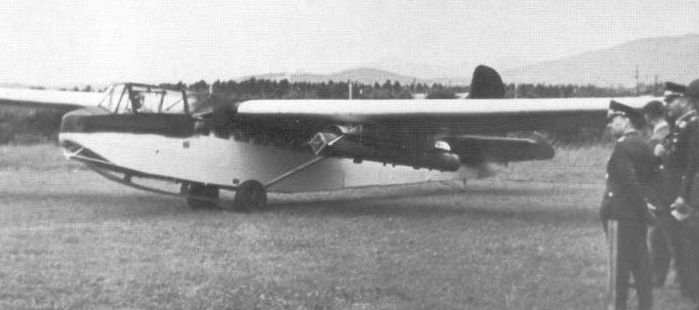
German assault glider. The major contribution of the Deutsches Forschungsinstitut for Segelflug (German Research Institute for Gliding) to Germany’s Second World War armoury was the DFS 230 assault glider of 1937. With a rectangular section fabric covered steel tube fuselage, and a long tapering wing covered in plywood and fabric and braced by metal struts to the fuselage, the glider could carry some 272 kg (600 lb) of freight in addition to the pilot plus nine troops and their equipment. Three prototypes were built and tested by the DFS, and further DFS 230s were produced by Gothaer Waggonfabrik, a series of A 0 pre production models being followed by production A 1s and dual control A 2s. Deliveries began in October 1939. Some modifications were incorporated in the B 1 and B 2 production series, notably a parachute pack for braking, a stronger landing skid and a mounting for a single MG 15 machine gun.
The DFS 230 made its operational debut in the attack on Fort Eben Ernael and Albert Canal bridges in Belgium and Holland in May 1940. It went on to take part in attacks on the Corinth Canal, and in the airborne invasion of Crete in May 1941. However, such heavy losses were suffered during the later operation that thereafter DFS 230s were largely confined to transport duties in the Mediterranean and on the Eastern Front. One other spectacular operation involved DFS 230s, however, when DFS 230c 1s B 1s fitted with forward firing braking rockets in a special nose cone were used to land German commandos on the Matto Grosso as part of the rescue of Italian leader Benito Mussolini. A total between reported figures of 1022 and 1500 DFS 230s were produced, and the glider soldiered on in the supply role almost until the end of the war.

DFS230 glider with Argus AS014 pulsejets

DFS 230A-1
Wingspan: 68 ft 5.5 in / 20.87 m
Length; 36 ft 10.5 in / 11.24m
Height; 9 ft / 2.74 m
Wing area; 444.55 sq.ft / 41.3 sq.m
Empty weight; 1896 lb / 860 kg
MAUW: 4630 lb / 2100 kg
Max towed speed: 130 mph / 210 kph

DFS 230B 1
Span: 21.98 m (72 ft 11 in)
Length: 11.24 m (36 ft 10.5 in)
Gross weight: 2100 kg (4630 lb)
Maximum speed: 290 km/h (180 mph)

DFL Tango

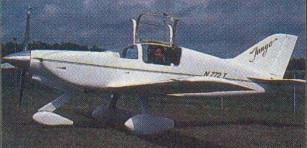
Fabricated in Asia from American moulds, prefabricated instrument panels and firewall forward options reduce the build time.

Top speed: 225 mph
Cruise: 208 mph
Stall: 63 mph
Range: 850 sm
Rate of climb: 1500 fpm
Takeoff dist: 600 ft
Landing dist: 800 ft
Engine: Lycoming O-360, 180 hp
HP range: 150-200 hp
Fuel capacity: 40 USG
Empty weight: 1040 lb
Gross weight: 1800 lb
Length: 19.3 ft
Height: 7.25 ft
Wing span: 25 ft
Wing area: 75 sq.ft
Seats: 2
Landing gear: nose

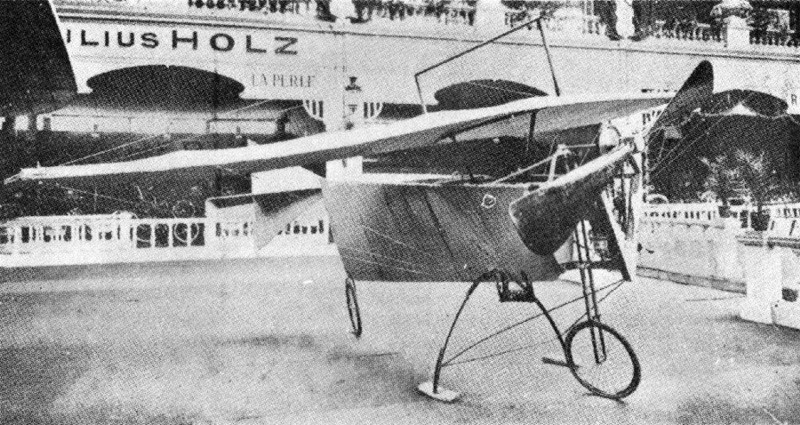
DFG Hintner Eindecker

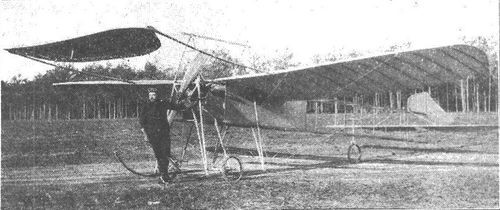
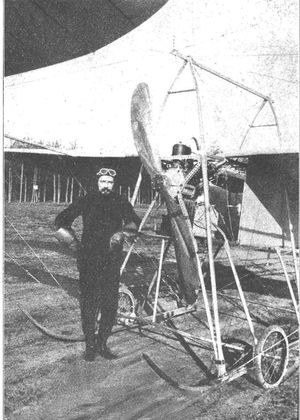
DFG Hintner Eindecker of 1910 was a monoplane drawn up by the Cornelius Hintner – a successful Austrian artist who later became famous as a film director – realized by the German firm of Deutsche-Flugmaschinenbau-GmbH.

The Hintner Eindecker was special in that the elevator was mounted in front of the tractor propeller. Power was supplied by a 25 hp Anzani 3-cylinder radial driving a Chauvière propeller. The wing area was about 30 m², where total weight (inclusive the pilot) was 280 kg.

During the first test flight the machine flew for 500 meters at a height of 25 meters, most likely only in a straight line. The machine lifted after a run of only 25 to 30 meters.

When Hintner flew his Eindecker he had no licence and almost certainly no flying experience whatsoever. He later received German flying licence No.110 on September 9, 1911 flying an Albatros biplane at Berlin.

Dewoitine C-38

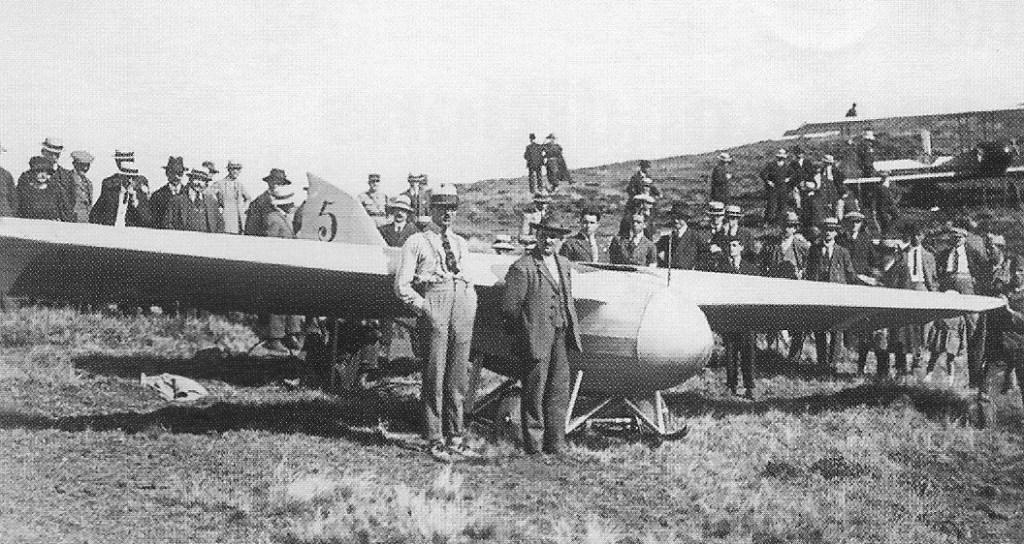
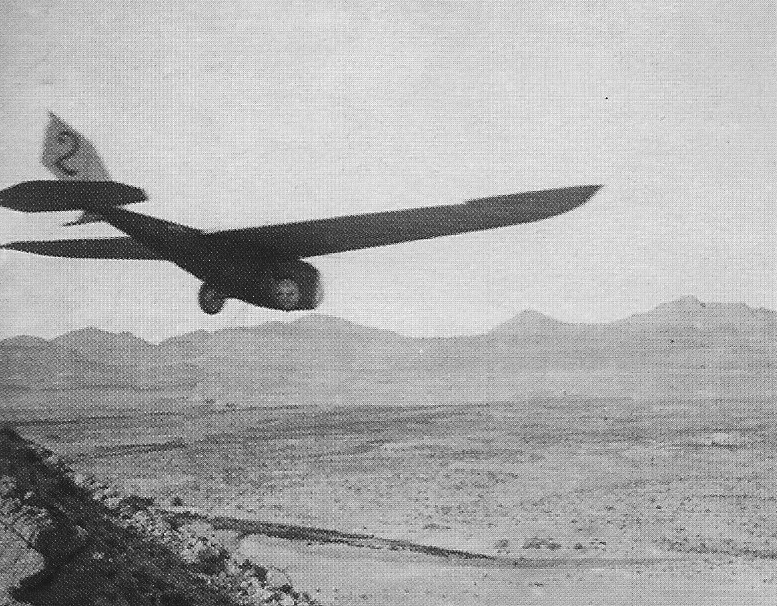
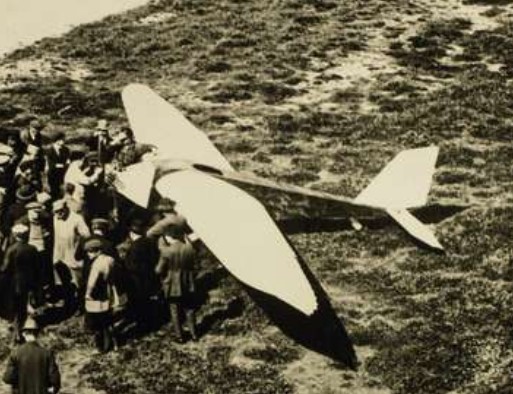
The Dewoitine monoplane had already been flown in the first French soaring contest at Clermont Ferrand in 1922. It was able under Georges Barbot, in the autumn of 1922, to make a gliding flight of 20 minutes from the plateau of Super-Bagderes (Pyrenees) with an altitude difference of 1200 meters. In 1923, it was flown by Barbot 8 hours, 36 minutes and 56 seconds in Biskra, Africa.

The Dewoitine monoplane has flexible wings without external brace-wires. For transportation, the wings can be folded back against the fuselage, without being entirely disconnected. Each wing has a hollow main spar and tapers outward.

It is steered by warping the ends of the wings, the rear two-thirds being flexible and the front third rigid.

The fuselage has a streamline form made by oval ribs- connected by light spars. On the glider, the front end of the fuselage consisted of a spherical cap of plywood, the latter was replaced by an engine on the low-powered airplane.

Flown at Biskara by Barbot 1922

The 7 to 10 HP Anzani engine was originally designed for motorcycles. It had two opposite cylinders and was air-cooled. The brake horse-powers were;
7 HP at 1250 R.P.M.
8 HP at 1350 R.P.M.
9 HP at 1450 R.P.M.
11.75 HP at 1800 R.P.M.
12.75 HP at 2200 R.P.M.
With wide-open throttle, the revolution speed was about 1350 R.P.M., hence 8 HP.

The weight of the supporting structure is 35 kg (77.2 lb) or 4.375 kg (9.65 lb) per HP. The weight of the fuel is about 20 kg (44.1 lb) and the power plant 80 kg (176.4 lb). With a total weight of 250 kg (551.2 lb) the total load per HP is 31.25 kg (68.9 lb).

The engine is located in the front end of the fuselage and drives a two-bladed propeller. The fuselage is supported by an ordinary landing gear with rubber-tired wheels. The fuselage and wings are covered with fabric.

The flight performances are said to have been satisfactory. Barbot reached an altitude of 500 m (1640 ft) in a 25-minute flight from Francavat to Toulouse. The start was made from a level field.

Barbot made another flight from St. Inglevert (France) across the English Channel to Lympne (England) and back. The time going was 50 minutes; returning, 43. minutes. The consumption for both flights was 4.5 liters (1.2 gallons) gasoline and 0.7 kg (1.54 lb) oil. At 1500 R.P.M. near the ground, the speed was 90 km/hr (56 mi/hr). At 1200 R.P.M it was 75 km/hr (47 mi/hr). The theoretical ceiling was 2000 m (6562 ft).

Span: 11.3 m (37.07 ft)
Wing area: 11.5 sq.m (123.78 sq ft)
Aspect ratio: 10
Length 4.9 m (16.08 ft)
Weight empty 115.0 kg (253.5 lb)
Total weight 250.0 kg (551.2 lb)

Dewoitine D.570

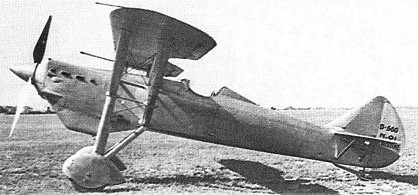
At the end of March 1933, criticism of the gulled wing of the D 560 led Emile Dewoitine to replace this with a wing of parasol form and of reduced span and area. Re-designated D 570, the modified prototype entered flight test on 27 November 1933, transferring from Francazal to the Centre d’Essais at Villacoublay early in December. It flew back to Francazal for minor modifications, and, on 21 December, while returning to Villacoublay, suffered an aileron failure and was destroyed.

Engine: HS 12Xbrs, 600 hp
Max take-off weight: 1709 kg / 3768 lb
Empty weight: 1284 kg / 2831 lb
Wingspan: 11.58 m / 37 ft 12 in
Length: 8.53 m / 27 ft 12 in
Height: 3.42 m / 11 ft 3 in
Wing area: 17.00 sq.m / 182.99 sq ft
Max. speed: 338 km/h / 210 mph