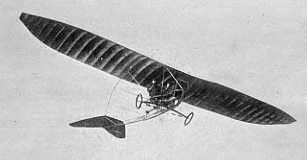
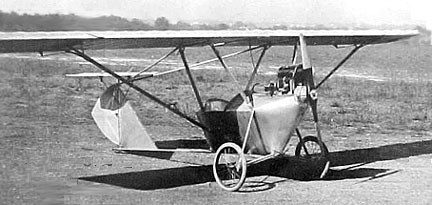
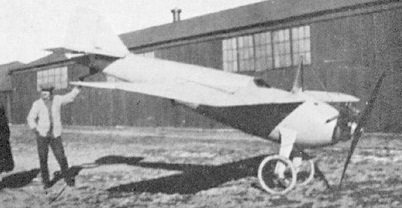
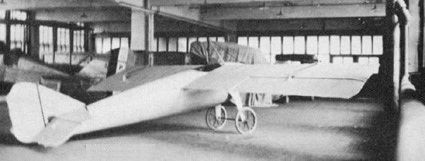
The Dorner monoplane was a well known sight around Johannistahl. Georg Schendel set a German record for altitude of 2010 meters on 6 June, 1911, and a World Altitude record with passenger, of 1690 meters on 9 June, 1911, in his Dorner. Type II had a 20 hp Dorner-Motor and cost 13,500 Marks. Type III came with a 40 hp Dorner-Motor at 15,500 Marks, or 50 hp at 16,500 Marks. The T.III version had a fatal accident for both passenger and pilot on 9 June, 1911 at Johannistahl.
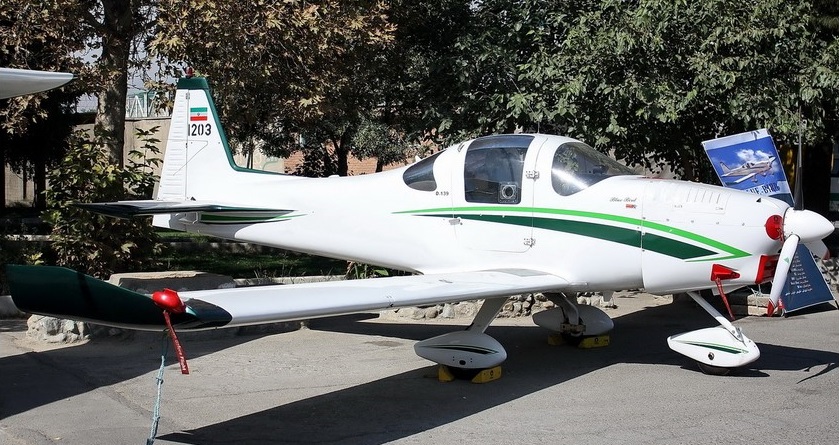
The Dorna Free Bird is an Iranian light-sport aircraft, designed and produced by Hava Faza Dorna Co. of Hasanabad. Designed to comply with the US light-sport aircraft rules, it features a cantilever low-wing, an enclosed cabin with two-seats-in-side-by-side configuration accessed by doors, fixed tricycle landing gear, with wheel pants and a single engine in tractor configuration.
The aircraft structure is made entirely from composite material, with the fuselage a monocoque design. Its 9.45 m (31.0 ft) wing has an area of 11.06 m2 (119.0 sq ft), is built with dual spars and features winglets. It has a low-mounted horizontal stabilizer with a single spar. Both the seats and the rudder pedals are adjustable for pilot height. The cabin is 107 cm (42 in) in width. The standard engine used is the Austrian 100 hp (75 kW) Rotax 912ULS, four-stroke powerplant, driving a Czech-built Woodcomp three-bladed, ground adjustable propeller.
As of February 2017, the design does not appear on the Federal Aviation Administration’s list of approved special light-sport aircraft.
The aircraft was supplied complete and ready-to-fly in 2015 at €85,000 and was still in production in 2017.
Free Bird Engine: 1 × Rotax 912ULS, 75 kW (101 hp) Propeller: 3-bladed Woodcomp ground adjustable Wingspan: 9.45 m (31 ft 0 in) Wing area: 11.06 m2 (119.0 sq ft) Empty weight: 380 kg (838 lb) Gross weight: 600 kg (1,323 lb) Fuel capacity: 70 litres (15 imp gal; 18 US gal) Wing loading: 54.2 kg/m2 (11.1 lb/sq ft) Maximum speed: 220 km/h (137 mph; 119 kn) Stall speed: 64 km/h (40 mph; 35 kn) Rate of climb: 5 m/s (980 ft/min) Crew: one Capacity: one passenger
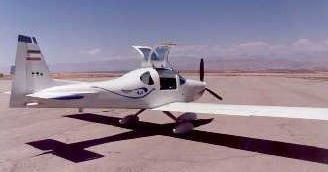
The design of the Parandeh Abi, Blue Bird in English, recreational and training aircraft was begun in 1994 and the first flight was on 27 July 1998. The designer was Mohammad Hassan Karami.
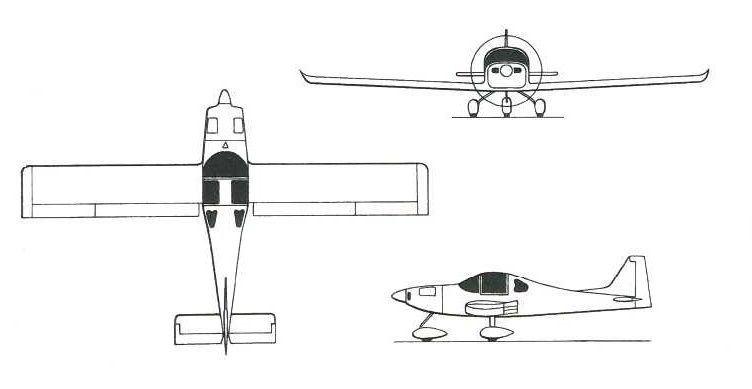
It is a conventionally laid out low wing single-engine monoplane, built entirely from composite materials and seating two side-by-side. Its two spar wings and single spar horizontal tail are rectangular in plan. The wing carries 2.5° of dihedral and the tips are slightly upturned. Plain flaps fill the trailing edges inboard of the ailerons. The elevators are horn balanced, as is the rudder. Together, the fin and rudder are straight tapered, with a small dorsal fillet.
The Parandeh Abi is powered by a Rotax 914 F3 horizontally opposed four-cylinder engine driving a thee-bladed propeller. Its fixed, self-sprung steel cantilever tricycle undercarriage is attached to the fuselage. All wheels have speed fairings. In early production aircraft, access to the cabin was via the top hinged, upward opening canopy, but later examples have forward hinged doors reaching down almost to the wing. The doors contain a framed window, though the total cabin transparency is noticeably reduced. All models have a pair of small, fixed windows in the tapering fuselage behind the seats, where there is a baggage compartment. The aircraft can be equipped with either a stick or yoke for primary control. Other differences between early and later production models include improved engine cooling with the addition of chin and cheek air intakes, enlarged rudder horn balances, tailplane root fillets and fluted skinning on the ailerons and rudder.
The design was type certified to JAR-VLA standards.
Production of the Parandeh Abi began in 2001 with orders for 5 from Iranian flying clubs. By March 2006 Dorna had orders for 14 and options on another 30 and by November 2008 28 had been built at a unit cost of €120,000. As well as supplying clubs and training centres, Parandeh Albis also went to the Iranian Police and to the Civil Aviation Organisation.
By the end of 2012 the company’s website was gone and the domain was for sale. The company may no longer be in business.
Parandeh Abi Engine: 1 × Rotax 914 F3 Propeller: 3-bladed MT-Propeller MTV-6-A/172-8, 1.72 m (5 ft 8 in) diameter Wingspan: 9.45 m (31 ft 0 in). Wing area: 11.06 m2 (119.0 sq ft) gross Airfoil: NACA 63-215 Length: 6.17 m (20 ft 3 in) Height: 2.70 m (8 ft 10 in) Empty weight: 490 kg (1,080 lb) Max takeoff weight: 750 kg (1,653 lb) Fuel capacity: 120 L (26.4 Imp gal, 31.7 US gal) Maximum speed: 282 km/h (175 mph; 152 kn) at 4,267 m (14,000 ft) Cruise speed: 161 km/h (100 mph; 87 kn) economical, at 3,658 m (12,000 ft) Stall speed: 83 km/h (52 mph; 45 kn) sea level, flaps down Never exceed speed: 321 km/h (199 mph; 173 kn) Range: 1,094 km (680 mi; 591 nmi) with maximum fuel Service ceiling: 4,265 m (13,993 ft) Rate of climb: 3.8 m/s (750 ft/min) at sea level Crew: one Capacity: one passenger
The 1924 Dormoy Bathtub won the Rickenbacker Trophy for its class at the 1924 Nationals. After the 1924 races Dormoy sold it to a farmer, who taxied it around his cow pasture, but was afraid to fly it. It eventually ended up parked in the field, and his cows chewed the wings away.
The 1925 Bathtub was built from scratch with a full-length, covered fuselage.
Only the two originals were built. Many subsequently replicated by home-builders even into the 1990s.
The 1920 single place open cockpit monoplane designed by Etienne Dormoy was based on the Deperdussin, and powered by a 15hp converted V-twin motorcycle engine
Only one was built, sometimes listed as a Packard Motor Co product but actually a spare-time project by Dormoy and his co-workers while employed there.
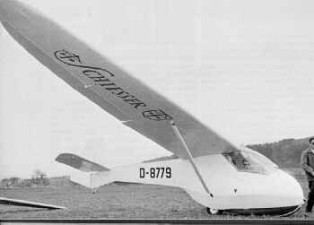
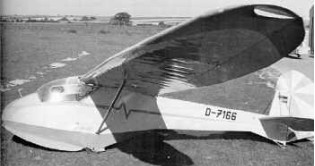
Designed by Fritz Raab. A 1950 glider trainer that was well used after the war because its compactness and low cost. The instructor seat was elevated and had no controls. The instructor having to reach over the students shoulders to take the controls.
Wing span: 12.76m Wing area: 18sq.m Length: 29.692 ft / 9.05 m Empty Weight: 185kg Gross Weight: 350kg Wing Load: 19.4kg/sq.m Aspect ratio: 9.05 Airfoil: Go 550 MinSink: 0.85 m/s 50 kph L/DMax: 20 @ 55 kph No. of Seats: 2 No. Built: 220
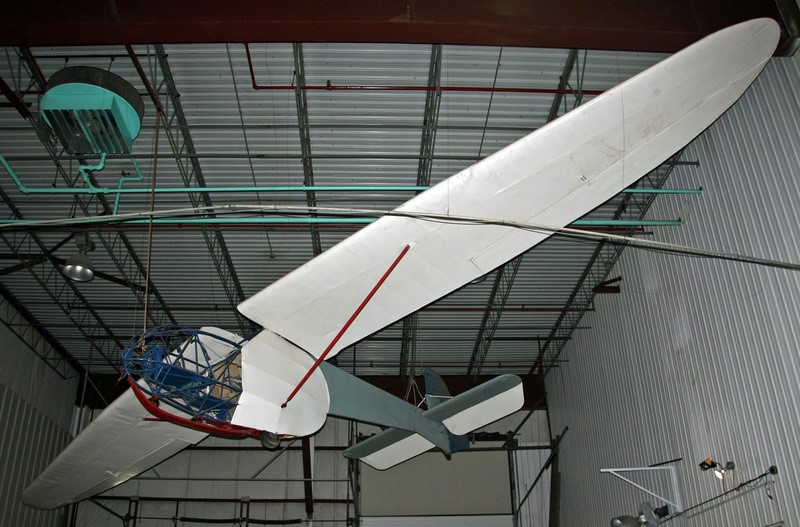
Dave Donohoe, a colleague of Tom Cadet, developed the Boorabee’s airfoil. This wing was mated to a new fuselage mould to use a 4 x 3 inch rectangular boom and Dave called the result the Shuttle. Similar in overall appearance, the Shuttle has a single wing strut and a different tail and undercarriage and control system. After the undercarriage of the Shuttle proved weak, some Shuttles adopted that of the Boorabee.
The Shuttle design was abandoned after Dave’s second aircraft, powered by a 1600cc Jabiru, developed aileron flutter. The wings were damaged extensively, but Dave was able to land the aircraft. Vibration from the Jabiru, coupled with a control system that was too slack, caused the flutter.
The Domrachiev “Leningrad” (Russian: Домрачев «Ленинград») glider was designed by Yuri Vladimirovich Domrachiev as a single-seater glider and built in the OSOVIAJIM glider workshops in Leningrad. Construction was completed in time to participate in the IX National Sailing Competitions held between August 12 and September 20, 1933 in Koktebel.
Structurally, the “Leningrad” was designed as a high-wing braced monoplane. The wings, built with No.60R aerodynamic profile, featured large wingspan with a constant chord central zone and notable taper towards the ends of the consoles. Steel tapes used as turnbuckles that were attached to the landing ski departed from the wing intrados. In the upper part of the centroplane, just above the longitudinal axis of the glider, there was a raised structure to which the extrados bracing straps were attached. The wing trailing edge featured double-section louvered ailerons.
The tail unit was attached to a high bar. On both sides of this bar the horizontal planes, of an integral type, were fixed. The empennage was oval in shape and inserted symmetrically into the bar, half above and half below.
The pilot was located in a low gondola in the bow region, in an open-type cockpit. Under this gondola the landing ski was located.
First flying in August 1933, the “Leningrad” participated in the IX National Sailing Competitions, held in Crimea. During the IX edition of the glider competitions and during a landing, the “Leningrad” made a ground connection supporting two points: the landing ski and the wing tip. This caused the tail bar to break and the glider was unable to continue in the competition.
Leningrad Wingspan: 21.80 m Wing area: 21.10 m² Aspect ratio: 22.5 Length: 9.10 m Height: 2.15 m Empty weight: 185 kg Wing loading: 13.0 kg / m² Glide ratio: 25 Elevator area: 1.87 m² Empennage surface: 0.75 m² Rudder surface area: 0.75 m² Ailerons area: 2.10 m² Accommodation: 1
The Domrachiev D-2 (Russian: Домрачев Д-2) was designed as a two-seater aerobatic glider. Its construction was carried out in the LENOAX construction workshops in 1934 with the aim of participating in the X National Sailing Competitions to be held that year in Koktebel.
The D-2 was designed as a high-bridged, two-seater glider with long wings and a high tail bar. The wing was braced by means of steel tapes that started from the wing intrados towards the landing ski and from the extrados towards a raised structure located on the longitudinal axis of the glider. This configuration made it possible to build an extremely light wing without detriment to its structural rigidity.
Another significant detail was the wing attachment to a vertical pile located above the head of the second crew member, which allowed excellent visibility and easy access to the cabins. This vertical pile had as a distinctive feature the possibility of being moved forward or backward in order to modify the aerodynamic centering of the glider.
The landing gear consisted of a fixed ski located in the ventral region of the nacelle, following the line of the glider axis.
The gondola with the tandem cabins also featured an additional luggage area with a capacity of 80 kg. In the rear cabin a shelf was to locate a telephone set that could be used for communication with the tug aircraft.
Built in Leningrad in 1934 and first flying that September, it participated in the X National Sailing Competitions, held in Crimea, where it was aero-towed. The acrobatic two-seater Domrachiev D-2 glider arrived at the competitions in Koktebel by air, towed by a plane.
D-2 Wingspan: 18.10 m Wing area: 19.80 m² Length: 8.05 m Height: 2.68 m Empty weight: 230 kg Optimal speed: 61 km / h Glide ratio: 20 Minimum descent speed: 0.78 m / s Wing loading: 19.70 kg / m² Surface of the horizontal plane: 2.82 m² Vertical plane surface: 1.58 m² Ailerons area: 2.10 m² Wing elongation: 16.5 Accommodation: 2