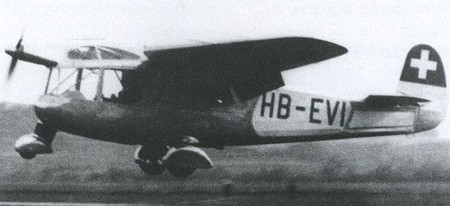
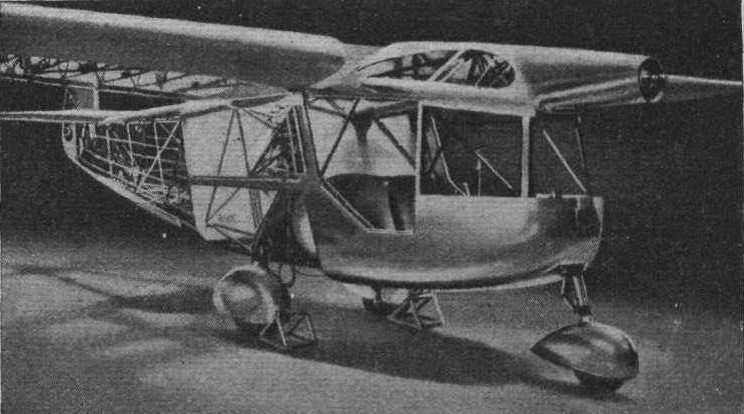
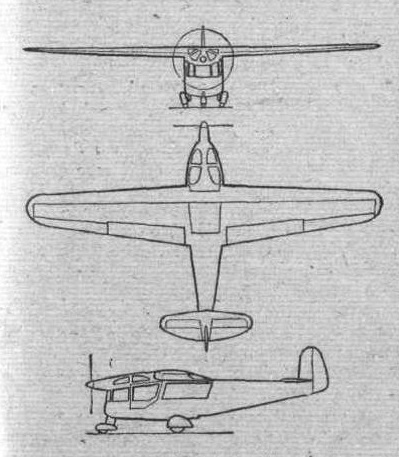
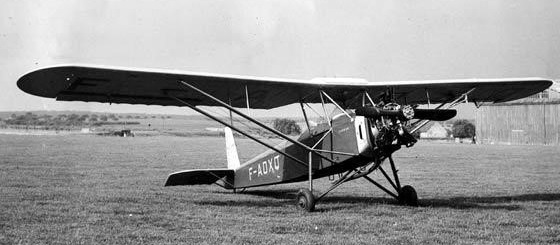
The W.F.12 two-seater trainer and touring aircraft is a high-wing monoplane with a fixed and faired undercarriage and a nose wheel landing gear. The cabin has side-by-side seating accommodation with dual controls.
In the prototype WF.12 built 1943, the Blackburn Cirrus-Minor 4-cylinder air-cooled in-line engine of 90 h.p. for take-off and of 82 h.p. cruising power at 2,300 r.p.m. is mounted in the fuselage aft of the cabin. The airscrew extension shaft comprises two parts linked together and connected with the airscrew shaft by means of universal joints; it runs over the top of the cabin and is supported forward in a structure projecting ahead of the top of the fuselage nose section. In this manner the airscrew axis lies in a plane with the wing and the view forward and downward is unimpaired.
Engine: Blackburn Cirrus-Minor, 90 hp Span: 36.1 ft / 11.00 m Length: 24.4 ft Height: 8.5 ft Wing area: 172 sq.ft Empty weight: 1,235 lb Gross weight: 1,765 lb Wing loading: 10.24 lb./sq.ft Power loading: 19.6 lb/hp Maximum speed: 109 mph Landing speed (with flaps): 46.6 mph
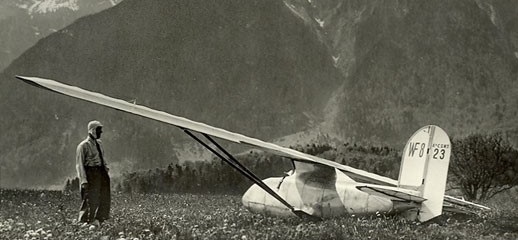
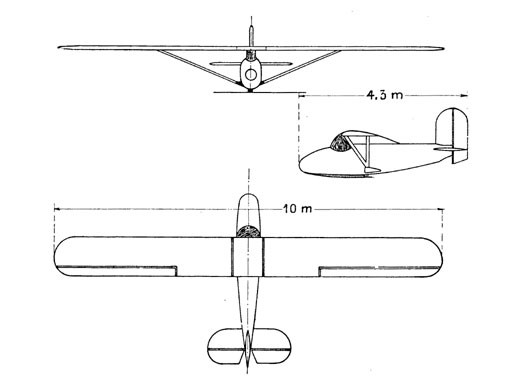
The 1933 wood and canvas Farner WF.8 single-seat parasol training glider was designed by Willi Farner & Hermann Aecherli.
The only WF.8 built was stored at the Swiss Museum of Transportation.
Wingspan: 10.00 m Wing area: 9.8 sq.m Length: 4.3 m Height: 1.2 m Empty died: 66 kg Max weight: 136 kg Min speed: 45 kph Glide ratio: 18 Min sink: 1.2 m/sec Seats: 1
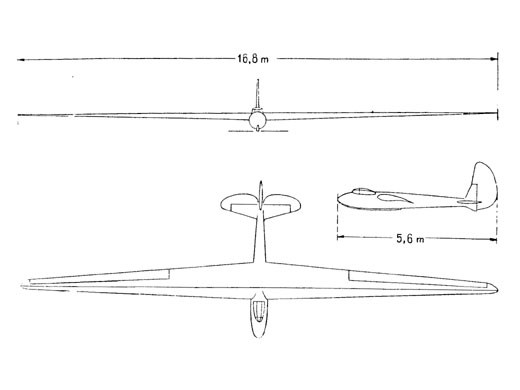
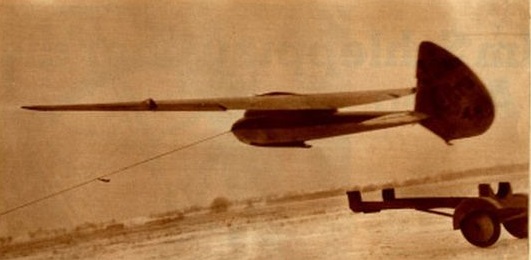
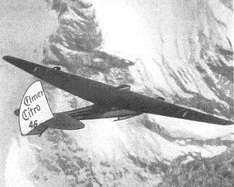
The “Elmer Citro” glider is a WF 5 and was built in 1932 by Willy Farner (assisted by August Hug). The glider is unique. Farner was the first pilot in the world who did aerobatics using the WF5 in 1932. It gave him a reputation even outside Switzerland.
Willy Farner made his first demonstration of gliding with the WF5 at the international aviation meeting in Zürich in 1932. He subsequently did demonstrations at the end of 1932 in Basel, and then in 1933 at an international meeting in Paris. He was towed for this occasion from Zürich to Paris, then for the return, by a Max Gugolz.
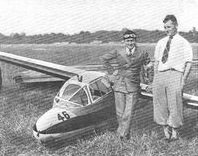
Max Gugolz and Willy Farner
On February 13, Willy Farner, aboard his “Elmer Citro” was towed through the Alps by Robert Fretz flying a Puss-Moth. The tow train carries 7 bags of philatelic mail for a total of 51.5kg. Takeoff place in Dübendorf 2:45 p.m. ET was the landing of the aircraft tug airport has Tagliedo 16.48. Farner follows 14 minutes later, after a total flight time of 2:17. The two pilots were connected by a phone that takes the sound in the larynx rather than in the mouth, whose cable was wound around the tow rope. On the flight back the next day, Farner had to land at Bellinzona because of a storm over the Alps and Fretz carried the letters in his plane until Arosa, where it was distributed to its recipients.
WF 5 “Elmer Citro” Wingspan: 11.00 m Length: 5.30 m Wing area: 11 sq.m Wing loading: 21 kg/ sq.m Empty weight: 150 kg Takeoff weight: 230 kg Glide ratio: 15 Sink rate: 1.4 m/sec
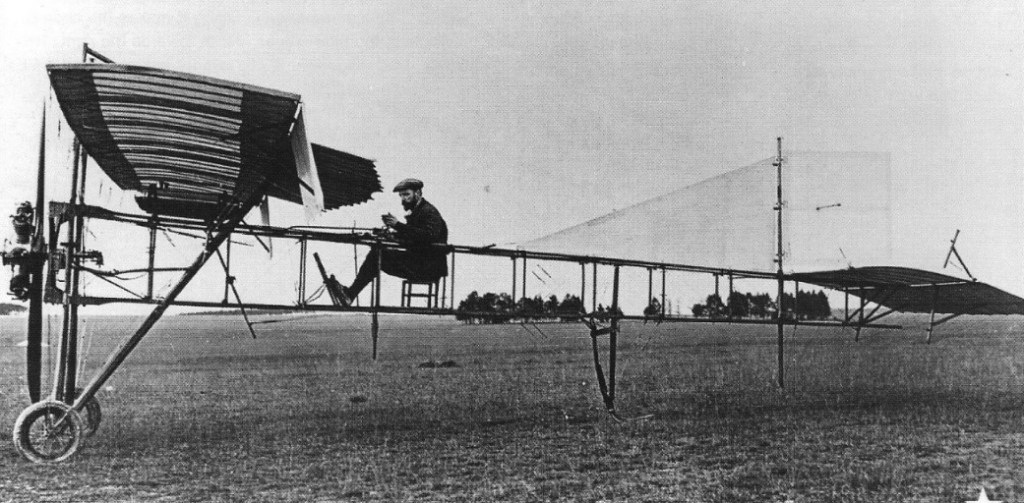
Henry Farman was a supporter of pusher biplanes, but he realized that his business needed to gain expertise in the field of tractor monoplanes.
His first tractor monoplane was produced in the beginning of 1911. It was an ultra light high wing monopplane where the pilot sat in a fully open fuselage on a very basre chair. In the end this paid back in a monoplane with a total weight of 300 kg. The 50 hp developed Gnôme rotary engine gave this monoplane a top speed pf 115 km/hr,
The monoplane was tested at Bouy (Camp du Chalons)
It consisted of a rectangular wing of 23 ft span with a chord, including ailerons, of 6 ft 6 in. about 13 ft behind is a tail, composed of a small horizontal surface, and vertical and horizontal rudders. The Gnome motor, with propeller, is in front, while to pilot’s seat is located on a level with the main plane and just behind it.
It is mounted on a steel chassis with two wheels.
The monoplane carries 48.5 lb/sq.m at more than 25 mph.
This design got the factory identification HF.2/2. This development monoplane model was followed in due course by at least two other tractor monoplanes.
The Farman F.1020 was built to test a novel wing design, the study of which had begun in 1926. Its plan was essentially semicircular, with the straight edge leading. The chord was thus broad and the aspect ratio very low. Such a wing has high induced drag but was thought to offer good transverse stability and low speed behaviour. It has such features in common with some tailless and delta designs.
The wing of the F.1020 had a near circular trailing edge which squared off into straight tips. The leading edge was a little further forward than the diameter of the idealised semicircle would have been and was slightly swept; it was also extended beyond the rest of the wing, carrying conventional ailerons. The maximum chord, at the wing root, was 5 m, compared with a span of 7.2 m; the aspect ratio was 2.1. The trailing edge carried deep chord control surfaces, two per side: the outer pair were used differentially like ailerons and the inner ones as flaps.
This wing was mounted on the fuselage of a Farman F.402, retaining the empennage, undercarriage and the 110 hp (82 kW) Lorraine 5-cylinder radial engine. As on the F.402, the wing was placed on top of the cabin with two square windows in the roof for upward visibility. The control system enabled the pilot to switch between conventional (aileron, elevator, rudder) control and that provided by the trailing edge surfaces.
The first flight of the F.1020, nicknamed the Pelle-bêche (en:Digging-shovel or Spade) and registered as F-AMOG, was in December 1933, piloted by Lucien Coupet. Thereafter it was only flown by Henry Farman who found it almost impossible to spin, but without any other particular merits. A design study was made for a variant with a shorter, 4 m, chord, designated F.1021, but this was not built.
Powerplant: 1 × Lorraine 5 Pb, 82 kW (110 hp) Wingspan: 7.50 m (24 ft 7 in) Wing area: 27 m2 (290 sq ft) Aspect ratio: 2.1 Length: 8.27 m (27 ft 2 in) Height: 2.22 m (7 ft 3 in) Maximum speed: 200 km/h (120 mph, 110 kn) Crew: 2
Shortly after the end of World War I, Farman introduced a low powered single seat monoplane for sport and tourism. It flew for the first time in May 1919 and was named the Moustique (in English, Mosquito). A little later, aircraft of this kind became known in the United Kingdom as motor gliders, the subjects of the first Lympne Trials of 1923. In 1922 one Aviette, without its engine, had already won prizes at a national glider competition. Three months before the Lympne Trials several Aviettes competed in an equivalent French meeting for moto-aviettes at Buc. The design was revived, over 17 years after its first appearance, as the F 450 Moustique and was one of the aircraft purchased by the French government as part of l’Aviation Populaire programme.
The original Moustique, later known as the Moustique I, was a shoulder wing monoplane. The wing was rectangular in plan, fabric covered and was wired braced from above and below. The upper wires were attached to a king post protruding from the raised, curved decking ahead of the cockpit and lower wires went to the undercarriage structure. The wings carried full span ailerons.
Behind the cockpit the fuselage, which reached up only to the pilot’s waist, was slender. It was square sectioned and covered with thin plywood. The parallel chord horizontal tail had separate elevators with the deep rudder moving between them. These surfaces were fabric covered and the rudder was round topped; there was no fixed fin. The undercarriage consisted of two parallel spruce panels mounted on the fuselage, bearing two mainwheels on a single axle. This first aircraft was powered by a 30 hp (22 kW) flat twin ABC Scorpion engine.
The first Moustique flew in May 1919, but by the following year its span had been reduced from 7.65 m to 5.0 m (from 25 ft 1 in to 16 ft 5 in), saving a little weight, and was known as the HF 206 or the HF206 Moustique I. No other Moustique had so short a span.
In 1922 a glider version called the Aviette had flown. This had an extended span of 10.50 m (34 ft 5 in) and an unladen weight of only 43 kg. It also had a deeper fuselage, allowing the pilot to sit with his head just clear of the upper surface, and a new upper wing bracing system with the bracing wires attached to the top of a tall, three post pylon, just in front of the pilot. It also had a reshaped rudder with a linear, rising top. It was the only Moustique type glider, but the fuselage, wing bracing and rudder modifications were carried forward into all later variants.
In 1923 three powered Aviettes were entered for the competition at Buc, Yvelines. All had an 18 hp (13 kW) engines but one aircraft had a 3-cylinder radial Salmson 3 Ad and the other two, 4-cylinder inline Sergant As. The Moustique II or F 21 of 1924 was powered by a 35 hp (26 kW) 3-cylinder Anzani 3 A2 radial and had a wing with a span of 8.20 m (26 ft 11 in), fitted with short span ailerons. Two took part in the 1924 Tour de France.
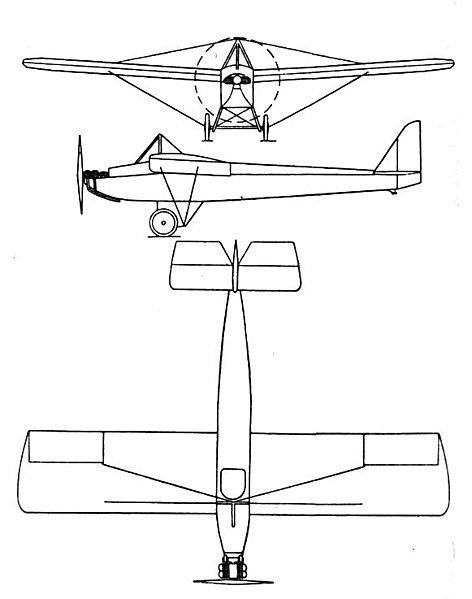
In the mid-1930s there was a government-driven revival of interest in low cost flying with the introduction of the Aviation Populaire programme. In response, Farman relaunched the Moustique with a slightly shorter span of 8.07 m (26 ft 6 in) and a longer fuselage. It first flew in December 1935. The first five prototypes were designated F 450 Moustique. The first was initially powered by a 35 hp (26 kW) Poinsard 2 Ca flat twin engine; later it, like the others had Mengin engines of the same type and power. A visual difference between this and earlier Moustiques was the presence of a normal fin, carrying a round-topped rudder. The production version, the F 451 Moustique, had a 25 hp (19 kW) AVA 4A-00 flat-four two-stroke. This variant was produced in much greater numbers (46) than any other Moustique.
Farman F.451
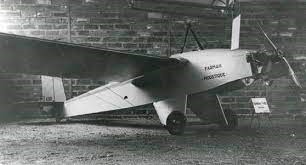
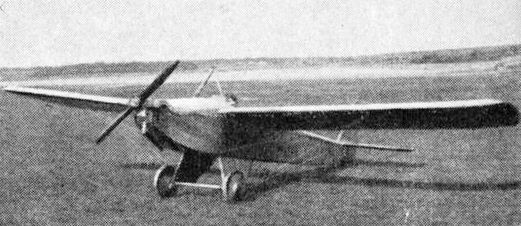
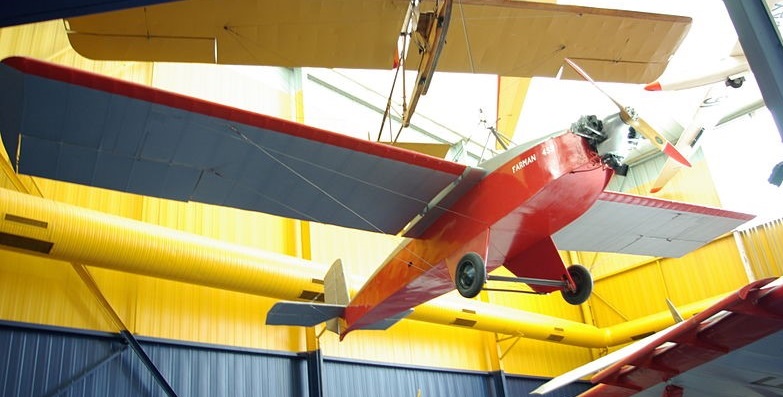
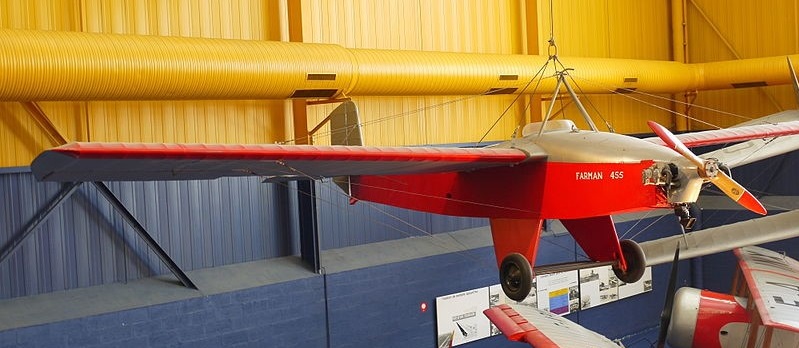
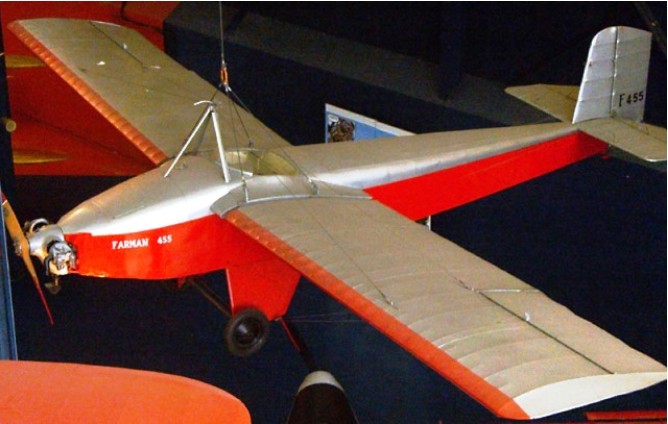
The last Moustique development was the two seat F 455 Super Moustique, initially called the Moustique III, which first flew in 1936. Its span was increased by 1.65 m (5 ft 5 in) and it had a more powerful 35 hp (26 kW) Mengin 2 A-01 engine. Only one was built; its performance in the climb was poor. The light aircraft section of the Farman works was shut down when the company was nationalised in March 1937.
During the early 1920s Farman entered Moustiques into several competitions. In August 1922 the first national French glider meeting, the Congrės expérimental d’aviation sans moteur, organised by the Association of French Flyers (AFF) and partly government-funded, was held in Combegrasse, Puy-de-Dôme. Farman entered two aircraft, the Aviette glider and a biplane (a de-motorised Farman FF 65); overall there were 17 contestants. The Aviette, piloted by Lois Bossoutrot, won several prizes in the competition between catapult-launched gliders, achieving the lowest sinking speed, the greatest altitude (80 m or 262 ft) and longest over-launch site duration of 3 min 30 s. The Aviette was placed second in the distance-covered contest, flying 5.28 km (3.28 mi). Over the fortnight-long event, the Aviette was in the air for 48 min 25 s.
In July 1923, three powered Aviettes competed at Buc, Yvelines for the Grand Prix de Motoaviette against eighteen other entrants. The competition was open to all aircraft with a maximum takeoff weight of less than 250 kg (551 pounds). There was a 125,000 FF prize for the fastest flight of 30 laps around a 10-kilometer (6.21-mile) course. The winner was Lucien Coupet in the Salmson-powered Aviette, covering 310 kilometers (192.5 miles) in 4 hours 37 minutes 19 seconds. No other aircraft could overcome the wind and rain.
Farman 455 Super Moustique, F-AOYL
A year later, Farman entered two MF 21 Moustique IIs into the Tour de France, an eight-stage contest organised by the AFF. Initial elimination trials in bad weather reduced the 15 entrants to a starting group of three for the Tour proper. The MF 21 flown by Maurice Drouhin was the only survivor by the end of the second stage, and he was declared the winner, having covered 1,807 km (1,123 mi) in 20 hr 40 min 27 s. Drouhin also won the Prix Solex, worth 50,000 FF in April 1925, flying the Salmson-powered Aviette. This required a flight from Paris to Rouen (about 120 kilometres or 75 miles) using less than 3 kg (6.6 lb) of petrol and oil.
In 1938 the first F 450 was used to test-fly a device called a gouvernes autoptères, invented by Marcel Granoli. Its purpose was to provide automatic lateral and longitudinal stability in the event of a momentary sideslip. The test showed only limited success.
Farman 455 Super Moustique, F-AOYL
Thirty-six of the 46 production F 451 Moustiques were bought by the state under their Aviation Populaire programme, intended to bring people from all walks of life into aviation and make pilots of them. Other F 451s were bought by individuals, partly attracted by the low costs: the aircraft sold at just under 20,000 FF. To make the Moustique attractive to the hunting fraternity, Farman advertised an optional rear locker “for the transport of a dog.”
Farman F.455 Moustique III
Variants:
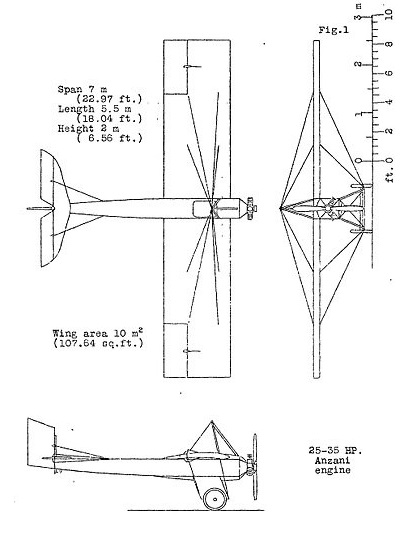
Moustique Later Moustique I, one only. Engine: Anzani, 25-30 hp Wingspan: 7.65 m / 25 ft 1 in Wing area: 10 sq.m / 107.64 sq.ft Length: 5.5 m / 18.04 ft Height: 2 m / 6.56 ft
HF 206 The original Moustique with wings cropped to a 5.0 m (16 ft 5 in) span.
Aviette 4 built with Salmson or Sergant engines. 10.50 m (34 ft 5 in) span. One converted to glider for Combegrasse competition. 3 entered for the competition at Buc
F 21 Moustique II 2 built with Anzani engines. 8.20 m (26 ft 11 in) span. Entered into Tour de France.
F 450 Moustique 1936 revival. 5 built with Poinsard or Mengin engines. 8.07 m (26 ft 6 in) span.
F 451 Moustique Production version of F 450; 46 built Engine: 1 × Ava 4A-00, 19 kW (25 hp) Propeller: 2-bladed wooden Merville Srs.639 Wingspan: 8.07 m (26 ft 6 in) Wing area: 10.50 m2 (113.0 sq ft) Length: 6.40 m (21 ft 0 in) Height: 1.90 m (6 ft 3 in) Empty weight: 151 kg (333 lb) Gross weight: 285 kg (628 lb) Maximum speed: 130 km/h (81 mph, 70 kn) Range: 350 km (220 mi, 190 nmi) Capacity: 1
F 455 Super Moustique Initially known as the Moustique III. Two side-by-side seat, dual control version. 1 built with Mengin engine. 9.72 m (31 ft 11 in) span.