Monoplane
Whitney DW200 Boomerang

The ‘official’ first flight of the Whitney Boomerang was at manufacturer Dean Wilson Aviation’s Kingaroy Queensland on 16 July 2006. The real first flight was conducted a couple of days earlier.
Whitney DW200 Boomerang Article
The Whitney Boomerang was designed by C W (Bill) Whitney and gained FAA23 certification on December the 18th 2007 – the fifth Australian designed aircraft to do so.
A distinctive feature of the fuselage is a 4130 tubular steel frame cockpit cage tested to withstand 12g forward loads, that also provides roll-over and side intrusion protection.
It is powered by a Lycoming O-235-N2C engine and a McCauley 1A135/JCM7147 propeller. MCTOW is 825kg.
It went into production as the DW200 Whitney Boomerang with Dean Wilson Aviation’s Queensland Aviation Manufacturing division at Kingaroy, Queensland in 2006 and first flew that July. It was hoped that it would be a replacement for the Piper PA-38 Tomahawk and the Cessna 152. It was demonstrated on numerous occasions and even made the flight to NZ arriving at Kerikeri on 03-10-2008.
New Zealand Type Acceptance was been granted to the Dean-Wilson DW200 Series (also known as the Whitney Boomerang) on 24-10-2008 based on the FAA and CASA type certificates. The application for New Zealand type acceptance of the Model DW200 was from the manufacturer, dated 7 October 2008.
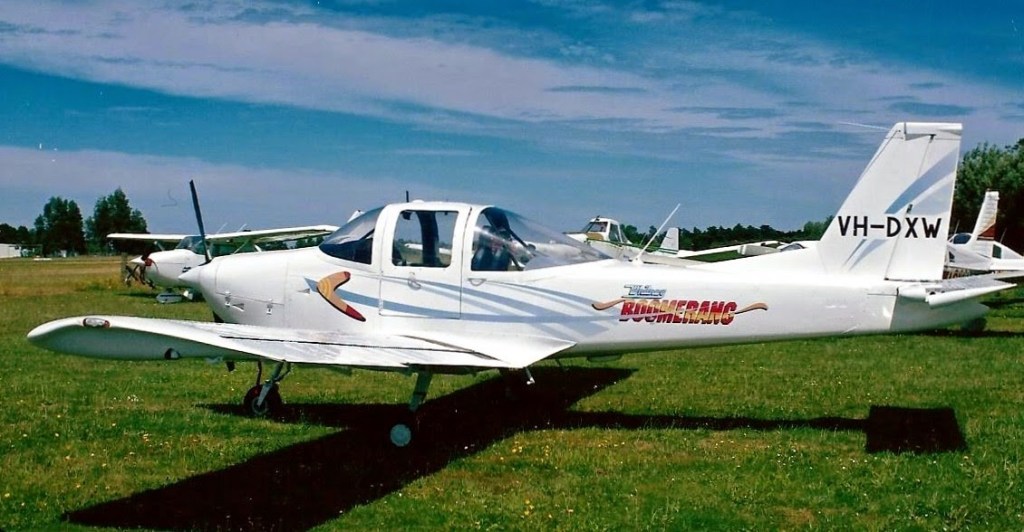
The new Boomerang made an ‘official’ first flight on 16 July 2006. The first real flight was a few days earlier.

Following the gaining of its NZ certification VH-DXW returned across the Tasman Sea to Australia.
The launch customer was Minovation Flying Training at Jandakot, Perth and then with Flight One at Archerfield, Brisbane. Foreign interest faded after a burst of initial interest and an order for 10 aircraft from India.

Due to lack of sales the assets of the collapsed Dean-Wilson Aviation company at Kingaroy were offered for sale. On 27-05-2011 an advert in the “Australian” newspaper invite expression of interest in acquiring the assets of the Companies manufacturing the Whitney Boomerang. This included the type certificate, plant and equipment, parts and tooling and the hangar housing the facility at Kingaroy.
Engine: Lycoming O-235, 115 hp / 86 kW
MTOW: 750 kg / 1653 lb
Cruise: 95 kt / 176 kph
Load: +4.0 / -2.2 g
White Lightning WLAC-1 / Reflex Fibreglass Works / RFW White Lightning
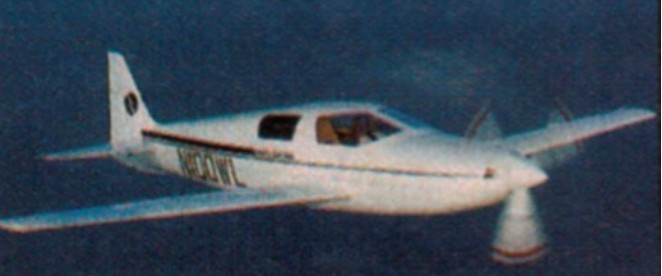
A high speed, four place composite aircraft designed by Nick Jones. By 1998 about 50 examples had een finished.
Speed max: 280 mph
Cruise: 265 mph
Range: 1600 sm
Stall: 67 mph
ROC: 1900 fpm
Take-off dist: 1300 ft
Landing dist: 1300 ft
Service ceiling: 20,000 ft
Engine: Continental IO-360, 210 hp
Fuel cap: 70 USG
Weight empty: 1400 lbs
Gross: 2400 lb
Height: 7.17 ft
Length: 23.33 ft
Wing span: 27.67 ft
Wing area: 89.2 sq.ft
Seats: 4
Landing gear: retractable nose wheel
Engine: Continental, 210 hp
Wing span: 8.4 m
Wing area: 8.2 sq.m
MAUW: 1088 kg
Empty weight: 635 kg
Fuel capacity: 265 lt
Max speed: 450 kph
Cruise speed: 426 kph
Minimum speed: 100 kph
Climb rate: 9.5 m/s
Seats: 4
Fuel consumption: 45 lt/hr
Kit price (1998): $45,000
White-Kremsreiter W-K Special
The 1937 White-Kremsreiter W-K Special, NX18219, was a single place open cockpit monoplane powered by an 85hp Schilberg engine.
Whitehead Number 21

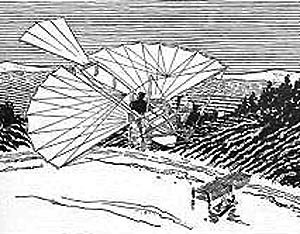
Circa 1901, the Number 21 was a single place open cockpit mid-wing monoplane, reportedly had an acetylene gas-powered motor. Silk-covered, twin-tractor powered glider with a birdlike appearance (one of some two dozen Whitehead designs) was claimed by Whitehead, and his many supporters, to have attained powered flight two years before the Wright brothers, on 21 November 1901, but there apparently is no grounded substantiation.
A replica of this craft was built by Otto Timm, for the 1938 film, “Men With Wings,” and another by Andy Kosch in 1986.
Whitehead 1911
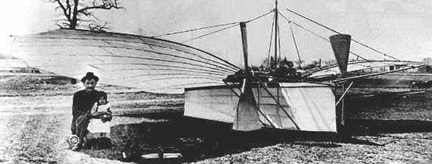
A single place multi-rotor type consisting of an open, tubular framework, carrying two rows of 6′ lifting screws on either side of the central frame.
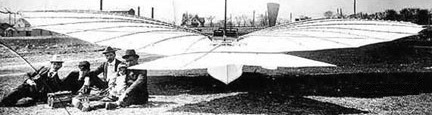
Probably the vehicle was powered with Whitehead’s own engine, fuelled by acetylene.
Whitehead is claimed to have achieved powered flight with this monoplane at Fairfield, Connecticut on August 14, 1901 – more than two years before the Wright brothers’ first flight at Kitty Hawk. In 1968 the state of Connecticut officially recognized Whitehead as the “Father of Connecticut Aviation”.
In the Fairfield field, Gustave Whitehead, taking control of an aircraft of his own design, a 21-horsepower monoplane-type model with 12 horsepower, managed to fly over no less than 850 meters at an altitude of about 15 meters, in the presence of a few witnesses, including a journalist.
White Aircraft Gull
The 1939 White Aircraft Gull was a design modified from Argonaut. A four place cabin, high wing monoplane amphibian, one was built powered by a 160hp Menasco pusher engine.
The project was shelved when a market failed to materialise.
White Aircraft A-R
The 1938 White Aircraft A-R was a three seat cabin high wing amphibian powered by a 165hp Ranger. One was built registered NX77Y.
White Aircraft Co Sport S-30 / Burdette S-30
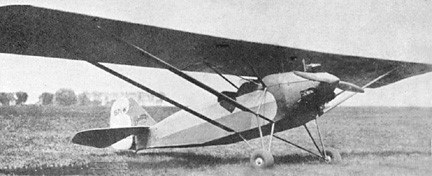
The White’s Sport S-30 aka Burdette S-30 of 1931 was a larger, slower version of the C-1 with a 40hp Szekely SR-3. Priced at $1,495, one was built, N571W c/n 25.
Engine: 40hp Szekely SR-3
Wingspan: 35’0″
Length: 18’11”
Useful load: 442 lb
Max speed: 70 mph
Cruise speed: 58 mph
Stall: 30 mph
White Aircraft Co Sport C-3
Three 1932 Sport C-3 were built powered by a 60hp Anzani engine, N814, N10586 c/n 1000, and N12947 c/n 28.
 All Aero