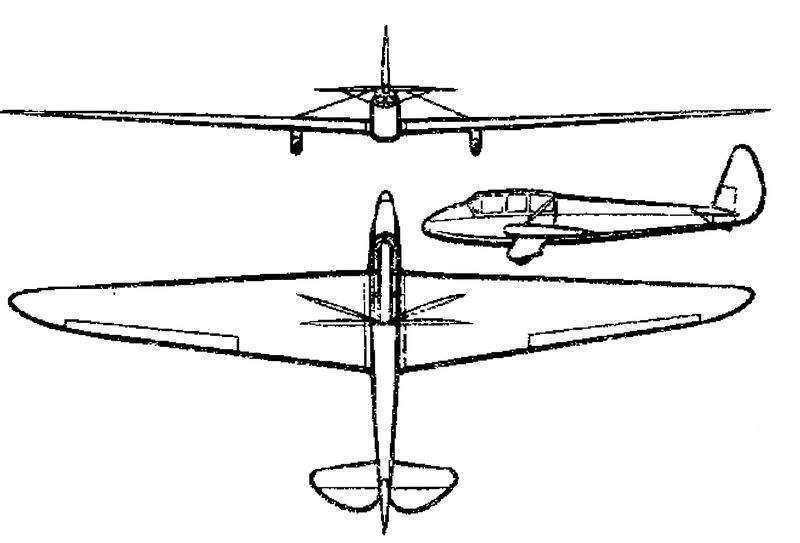
The Grigorovich E-2, or DG-55 (Russian Григорович Э-2, ДГ-55), was a two-seat, twin-engined, low-wing, prototype sport aircraft of Soviet origin.
Inspired by the de Havilland DH.88 Comet racer which had won the MacRobertson Air Race in 1934, the Grigorovich OKB began work on a similar aircraft. Like the DH.88, the Russian “Kometa” was a highly streamlined conventional low-wing monoplane with twin engines forward of retractable main undercarriage in nacelles under each wing. Built of wood, it also featured an enclosed cockpit and landing flaps.
Intended to be a lightweight, high-speed sport aircraft the DG-55, later designated the E-2, was slightly smaller than the DH.88 and with less powerful engines, using the 120 hp (89 kW) Cirrus Hermes.
Only one prototype was constructed, flying in 1935.
Following completion of its flight tests, the E-2 Kometa was handed over to the OSOAVIAKhIM paramilitary sports organisation, who used it for light liaison duties.
Engines: 2 × Cirrus Hermes, 89 kW (120 hp) each Propellers: 2-bladed fixed pitch propellers Wingspan: 11 m (36 ft 1 in) Wing area: 13.8 m2 (149 sq ft) Length: 7.9 m (25 ft 11 in) Empty weight: 1,051 kg (2,317 lb) Max takeoff weight: 1,546 kg (3,408 lb) Maximum speed: 296 km/h (184 mph; 160 kn) Cruise speed: 265 km/h (165 mph; 143 kn) Range: 2,200 km (1,367 mi; 1,188 nmi) Service ceiling: 5,000 m (16,000 ft) Crew: 2
When the production of the Gribovski G-11 was restarted in 1943 at the Ryazan Factory, Gribovski began the development of an improved version based on the experience accumulated during combat operations.
The project of this new moto-glider would receive the name G-31 (Russian: Грибовский Г-31) from the OKB and by April 1944 it was ready for discussion.
The G-31 also featured a high wing monoplane structure, but in this model with bracing to the fuselage by uprights. The wing design with R-II profile was maintained. The centroplane had a rectangular shape and the wing consoles were fixed to it with inflection on the leading edge and the straight trailing edge. Wing mechanization included ailerons and flaps, located in the wing soffit and intended to improve landing characteristics.
Another difference that was obvious to the naked eye was the new semi-monocoque fuselage with an oval cross section.
In the nose there was a two-seater cabin with double control and side-by-side seating. The entire nose could be opened to one side in order to allow the loading of large packages or equipment in the cargo hold.
At the request of the Landing Troops (VDV), the possibility of using one or two M-11 engines was maintained.
Despite the fact that the G-31 project was considerably more refined than that of the G-29 and was approved by the NKAP committee of experts during its presentation, it was decided not to proceed with its production. A little earlier, SA Moscaliov had presented a similar project that led to the SAM-28 glider and its development had already been approved.
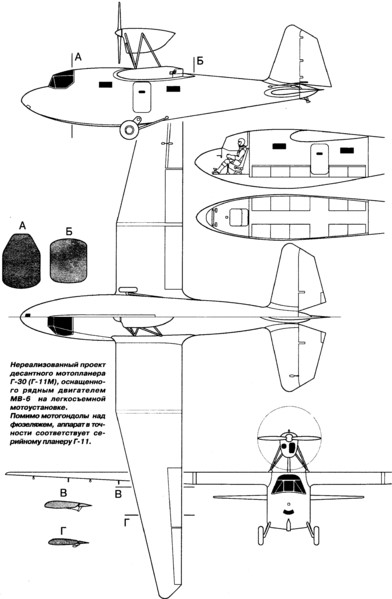
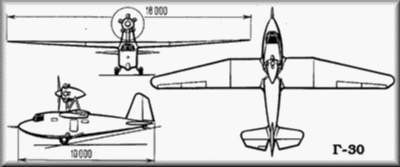
In 1942 Gribovski began development of a motorized version of the G-29 glider with a 100 hp M-11 engine. Two possible variants of the powerplant installation were analyzed: on the nose of the glider or on a pylon on the centroplane. After analyzing the advantages and disadvantages, the second option was finally decided, considering that it could be executed with minimal changes in the production chain.
The moto-glider was named G-11M (G-30 in consecutive Gribovski models) Russian: Грибовский Г-11M (Г-30).
One example was modified in the summer of 1942 at Factory No.471, but it is not clear whether it was ever tested. Maslov states that it was successfully tested in 1942, but other sources such as Shavrov state that it was never tested without explaining reasons. In any case, the need to increase motive power was valued, so the wing installation of two M-11 or MV-6 engines was recommended. In this way the G-30 became a transport airplane.
The decision to produce the model was affected by the cancellation of serial production of the G-11 glider in 1942 itself. On the other hand, the need for a small twin-engine transport aircraft had already been covered by the Scherbakov Sche-2. The VVS did not approve production, so development was abandoned. Other competitors such as the Polikarpov MP or the Moscaliov SAM-22 would have the same fate.
G-30 (G-11M) Engine: M-11 100 hp Wingspan: 18.0 m Wing area: 30.0 m² Length: 9.71 m Empty weight: 1500 kg Loaded weight: 2400 kg Fuel + oil load: 70 kg Payload: 830 kg Wing loading: 80 kg / m² Power load: 24kg / hp Surface of the horizontal planes: 5.64 m² Vertical plane surface: 2.7 m² Spoiler area: 3.1 m²
With the beginning of the war the OKB-28 received a new task of creating a landing glider capable of transporting 11 people. The order to begin development of the glider was announced by the NKAP leadership on July 7, 1941. That day, the deputy commissioner for the experimental construction of the NKAP, AS Yakovlev asked Gribovski how long it would take to project the glider. Gribovski, without much thought, replied that two months. Considering the response little serious, Yakovlev asked him to put this commitment in writing and signed.
The first plans for the construction of the G-29 (Russian: Грибовский Г-29) were delivered to the production workshops on July 11 and by August 2 the glider was practically finished. On September 1, with a few days remaining for the two months, the new model, named by the OKB G-29 (Gr-29), was ready for the first flight.
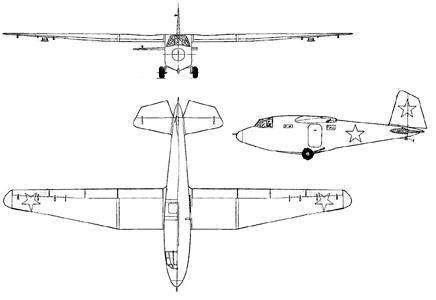
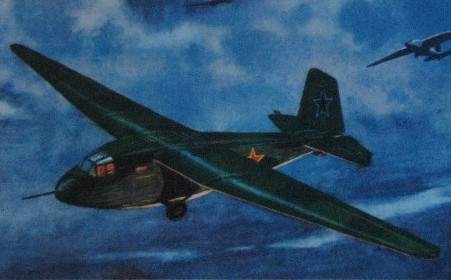
The G-28, also known as the Gr-29, was designed as a landing glider with a monoplane structure with a high cantilever wing and entirely made of wood.
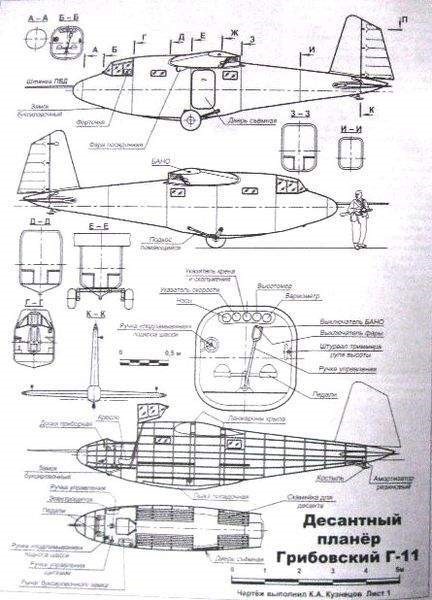
The wing had a box-shaped double spar structure, made of wood. The wing profile used was the R-II. The centroplane had a rectangular shape and the wing consoles were fixed to it with inflection on the leading edge and the straight trailing edge. Wing mechanization included ailerons and flaps, located in the wing soffit and intended to improve landing characteristics. In the upper and lower part of the fuselage there were emergency hatches measuring 0.51×0.46 meters, which could also be used for the defense of the glider.
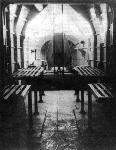
The fuselage was box-shaped with a rectangular cross section. The entire construction had been conceived paying great attention to the simplicity of production and the necessary structural strength. In the central area of the fuselage, there were two master frames to which the centroplane was attached. The cargo cabin, 3.24 meters long and 1.36-1.25 meters wide, featured 1.2 x 0.7 m cargo doors on both sides, as well as two small rectangular windows, which could be opened for operation. shot from them. Wooden benches were placed on both sides of the walls to accommodate the landing troops.
G-11 landing glider transport cabin interior
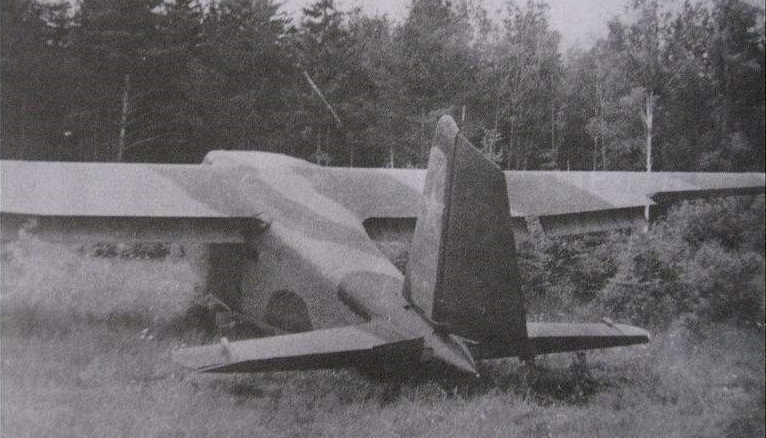
The tail was of the conventional monoplane type with large surface rudders. The landing gear was a fixed combination type, with 600 x 250mm wheels used during takeoff and a ski on the underside of the fuselage for landings. A crank on the left side of the cockpit allowed the main landers to be retracted for landing. The use of skis significantly decreased the landing roll.
In the nose area there was a single-seater cockpit for the pilot with the steering organs and covered by a transparent lantern that opened up and back, pivoting on a hinge. The cabin equipment was quite austere (a clock, a speedometer, a barometer, an angle indicator and an altimeter).
The first test flight was on 1 of September of 1941 performed by VL Rastorguyev. The good results obtained resulted in the approval of the serial construction of the model in two factories on September 18: number 471 in Shumerlya city and 494 in Kozlovka village.
At the end of September, the military acceptance tests were carried out, which showed totally acceptable results. As a conclusion, a request was made to slightly advance the wings to achieve the necessary centering of the plane once it had been abandoned by the paratroopers.
The tests also showed that with the glider empty and the flaps extended, the tail creaked. This was eliminated by introducing perforations in the flaps.
G-11 glider with flaps extended
The 28 as September as 1941, as soon as they finished the tests, Gribovski traveled to the Factory No.471 and his deputy, Landyshev the Factory No.494. Already on October 18, the first base prototype for production arrived in Shumerlya together with a group of specialists from the OKB-28. By the end of the year, Factory No.471 had finished 10 copies, which soon entered service with the Landing Troops (VDV), receiving the name G-11 (in view of the number of places).
The production of the G-11 was maintained until June 1942, when it was concluded that the military was not prepared for the execution of large landing operations with gliders. The lack of prepared crews in tow and glider pilots was being felt. The absence of conditions for the conservation of these airplanes caused them to be affected by weather conditions, which affected their resistance and reliability.
As a result of this situation the production of the G-11 glider was stopped in 1942 . The OKB-28 collective was reassigned as technical personnel to Factory No.471, which at that time received the mission to start producing the Yakovlev Yak-6. Gribovski was placed at the disposal of the Commissariat for the Aeronautical Industry (NKAP).
In the year of closure of production, Factory No.471 had produced 127 copies (to which must be added the 10 produced in 1941 and the prototype), while Factory 494 delivered 170 copies. Thus, the total number of units produced in this first stage reached 308 copies.
At the end of 1943, the logistical supply needs for guerrilla and combat groups caused the restart of production. This time the Ryazan aviation factory was chosen as the production base. Vladislav Gribovski would be appointed chief builder.
The first G-11 produced in Ryazan was tested in March 1944 by the glider test pilot Lieutenant Chubukov, who even performed spins, inverted flight and barrel roll.
During production various modifications were made. Starting from the standard number 21 on the left side, an increased door 1.4 meters wide with two-leaf opening was introduced. The cargo door located on the right side, present in previous versions, was eliminated. The number of copies produced at this stage, which would last until 1948, is unknown. It is estimated that the total number produced was between 500 and 600 copies.
By the final stage of the war, the VVS leadership had internalized the importance of the gliders in the actions of rapid troop transfer, carrying out surprise attacks on enemy positions, supporting offensive missions and supplying logistics to units. The experiences during the war had not been good, so it was necessary at high speed to start working on the preparation of glider crews and the development of preparation exercises in this type of operations.
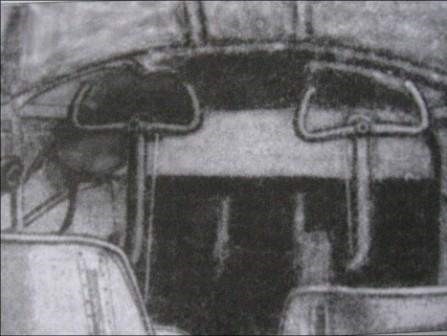
Dual control cockpit
As of October 1944, the manufacture of landing gliders equipped with dual flight control, a landing ski suspension system and structural reinforcements would begin in Ryazan. This version would be renamed G-11U.
Production of the G-11U version was closed in mid- 1945, but a little less than a year later it would be resumed, remaining until 1948.
In 1942 Gribovski proposed to develop on the basis of the G-11 a motor glider with an M-11 engine, which would eventually be produced in prototype form under the company name G-30, although it was also known as G-11M.
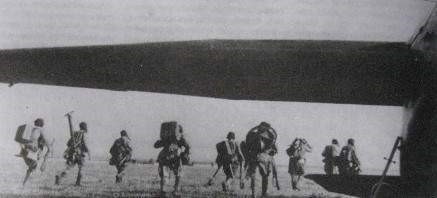
The landing actions carried out in the USSR during the war were scarce and in some cases catastrophic. The main use of gliders was restricted to specific supply operations, fundamentally to guerrilla groups and the transport of small sabotage units, which operated in the enemy rear.
Perhaps the most brilliant performance of the landing gliders took place in 1943 when they were used in supplying the Belarusian guerrillas in the Minsk region. The gliders were prepared to transport fuel, weapons and ammunition, including those for cannons.
Landing troops board the G-11
The glider launch operation over Belarus was kept a great secret, so for the Germans it was totally unexpected. This operation was directed by the headquarters of the Air Landing Troops (VBV) and its development was personally followed by Stalin.
It was planned to be executed at night. Ilyushin DB-3F and Lisunov Li-2 towed Moscaliov and Gribovski gliders in pairs, releasing about 50 to 60 km from the target. The guerrillas had prepared surfaces for the landing and at the agreed time they lit bonfires as signalling. This operation was successful and allowed the Belarusian partisans to achieve significant successes against the fascist groups.
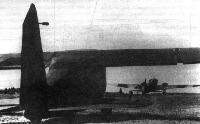
A G-11 glider prepares to be towed by an Ilyushin Il-4.
The aeronautical designers OK Antonov, AS Moscaliov and VK Gribovski received the 2nd rank “Guerrilla of the Great Patriotic War” medal for their contributions to the partisans, which was one of the few exceptions for the delivery of this medal to personnel from the deep rear.
The G-11 gliders were also used on a small scale during the crossing of the Dnieper, carrying guns and mortars from one shore to the other. Another notable action was the creation of a supply bridge between Moscow and Stalingrad in November 1942 to carry deicing fluids for Soviet tanks, which were preparing for the offensive.
Versions:
G-29 (G-11) Original version as a transport glider from 1941 with capacity for 11 people and a rectangular section fuselage. Built 308 copies in factories 471 in Shumerlya city and 494 in Kozlovka village.
G-11U 1944 training version with dual controls, structural reinforcements and changes to the landing gear. The quantity produced is unknown.
G-30 (G-11M) Motorized version of the G-29 with M-11 powerplant. A prototype was built in 1942. With the closure of production in 1942 the development would be abandoned.
Specifications G-11 Wingspan: 18.00 m Wing area: 30.00 m² Length: 9.71m Height: 2.7 m Empty weight: 1250 kg Maximum takeoff weight: 2400 kg Wing loading: 83 kg / m² Payload: 10 equipped soldiers or 1200 kg Surface of the horizontal planes: 5.64 m² Vertical plane surface: 2.7 m² Spoiler area: 3.1 m² Maximum towed speed: 370 km / h Maximum planing speed: 146 km / h Glide ratio: 16 Accommodation: 1
Initially, in December 1939, a new Construction Bureau was created as a subsidiary of Factory No.301. This new organization was based on a garage under construction belonging to the “Mosvoyentorg” located in the Pavshino village, belonging to the Moscow suburbs.
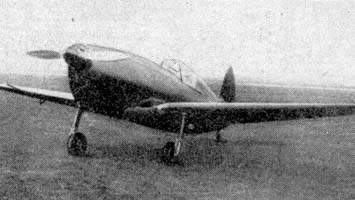
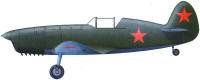
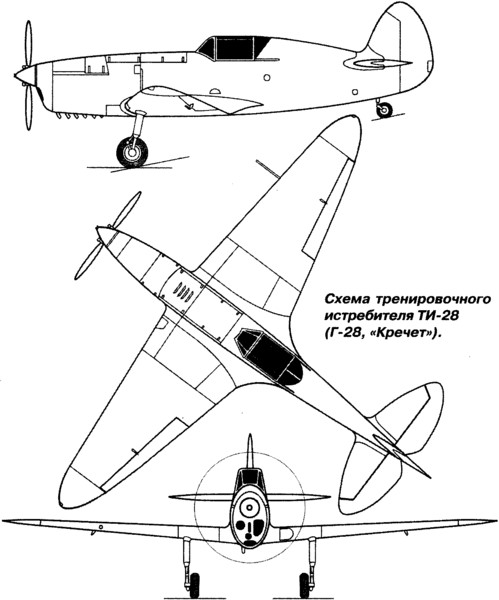
In this period under the direction of Gribovski, several conceptual projects of training aircraft would be developed, among which a fighter trainer called G-28 and nicknamed “Krechet” (Gyrfalcon) (Russian: Грибовский Г-27 Кречет) stood out.
In order to ensure its development, the order was issued on March 10, 1940 to create the Experimental Construction Bureau No.28 (OKB-28), subordinate to the NKAP structure and under the leadership of VK Gribovski. At the VVS controls the plane would be registered as TI-28, an acronym for Trenerovochni Istrebitiel or Fighter Trainer.
The G-28 was designed as a low-wing cantilever aircraft with a trapezoidal shape in the plane and rounded ends. The construction was developed mostly with wood. The entire structure of the wings and the fuselage was built with this material. Only the stabilizers and flight control surfaces featured a fabric-covered duralumin frame.
The wings featured a double-spar structure with an RAF-34 airfoil. Aerodynamically balanced spoilers were located on the trailing edge.
The fuselage featured a semi-monocoque structure with plywood skins and ended in a conventional-type tail unit. The empennage was built as an integral part of the structure of the fuselage tail section. The elevators and rudders had weight balance and aerodynamic compensation.
In order to simplify the construction of the model it was decided to use a fixed landing gear of conventional type. The main landing gear was attached directly to the forward wing spar and the tailwheel was located at the rear of the fuselage.
In the nose there was an inverted six-cylinder in-line MV-6 engine (a copy of the French Renault Bengali 6 engine manufactured in the USSR under license) of 220 hp. The propeller had two blades and constant pitch. The tunnel-type radiator was located at the bottom of the engine.
The pilot’s cabin was enclosed and rearward in the fuselage. The transparent top cover featured rear opening. As a fighter trainer, the TI-28’s instrument panel featured a fairly complete set of equipment, allowing it to perform day and night flights.
For training in the use of weapons, the TI-28 received a 7.62 mm ShKAS synchronized machine gun with 400 rounds, a photo machine gun and a PAK-1 type collimator. Under the wings were located some supports capable of carrying bombs of 10, 25 and 40 kg.
The TI-28 trainer was built in the spring of 1940. The first flight took place on May 22 of that year with the pilot of LII V. Gravrílov.
In less than a month the TI-28 passed the entire test flight program. In addition to Gavrilov, the TI-28 was air-tested by well-known Soviet NII VVS test pilots such as MM Gromov, AB Yumashiev, and PM Stefanovski, who gave the aircraft an excellent rating. Unfortunately, the beginning of the Great Patriotic War prevented the completion of the tests in Moscow, so in 1941, when the NII VVS was evacuated, the TI-28 prototype flew to Sverdlovsk. Its fate thereafter is unknown.
In order to improve the aircraft’s characteristics, the military recommended replacing the power plant with the improved 240 hp MV-6A and repeating the tests. It was felt that the landing run of 280 meters could be shortened and by installing a slightly more powerful engine some gain in speed could be obtained.
The construction of a second example had begun. During the evacuation, Gribovski decided to keep it, with the aim of continuing its development when the situation allowed. These ideas also did not happen. With the beginning of the war the needs for fighter training aircraft would be covered from the conversion to two-seaters of single-seater models in production.
Г-28 Powerplant: 1 x 220 hp MV-6 Wingspan: 9.00m Wing area: 11.60 m² Length: 7.66m Height: 2.80m Empty weight: 897 kg Normal takeoff weight: 1157 kg Wing loading: 100kg/m² Power load: 4.8kg/hp Fuel + oil capacity: 122+15kg Maximum speed at sea level: 275 km/h Top speed at 1600m: 303km/h Cruising speed: 226km/h Landing speed: 90.5km/h Practical range: 500 km Practical ceiling: 6600 m Take-off run: 280m Armament: One 7.62mm ShKAS synchronized machine gun, one photo-machine gun Bombload: 40kg Accommodation: 1
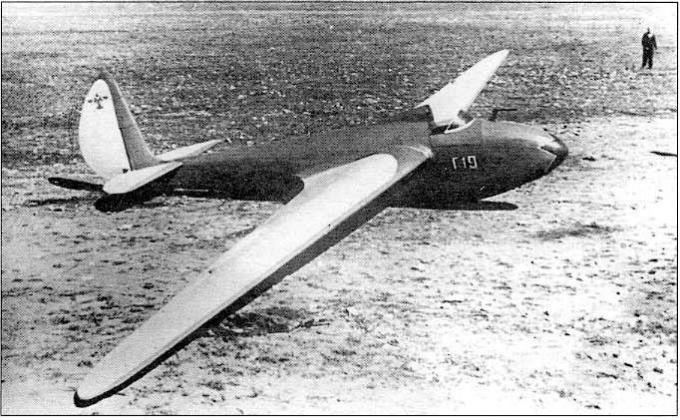
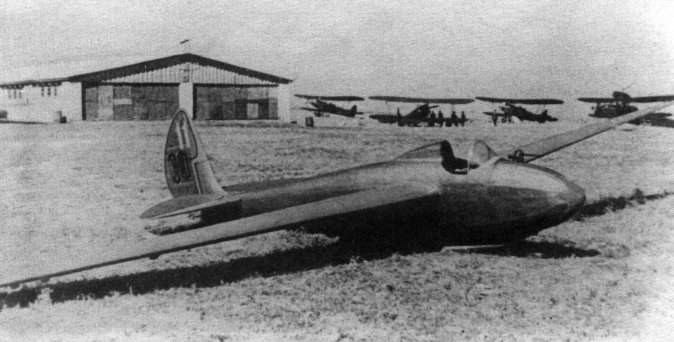
The G-19 (Russian: Грибовский Г-19) glider was designed as a development of the record – breaking G-17 single – seater and was generally similar to it. It would be the last glider designed by Gribovski, who would from there on design and construct light aircraft.
The Gribovski G-19 was designed as a single-seat cantilever mid-wing glider, specially prepared for aero-tow.
The double spar wing, presented in the front part of the wing was covered with 1 mm plywood sheets, up to the position of the second spar. The rest of the wing and ailerons were covered with fabric. The wing design used the TsAGI R-II profile proposed by the engineer PP Krasilschikov. Unlike the previous G-17, in addition to the louvered ailerons, it featured flaps to improve operations during landing. As with the G-18, great attention was paid to improving the attachment of the wings to the fuselage.
The trimmed tail unit featured cantilever planes and monoplane configuration. The leading edge of the empennage and horizontal planes also featured plywood overlay. The rudders were covered in fabric.
The fuselage featured a monocoque structure with a plywood coating. At its bottom there was a landing gear in the form of a ski with suspension.
The pilot was located in an open cockpit located in front of the wing leading edge, protected by a windshield. At the rear of the cockpit, the fuselage deepened to form a headrest.
The G-19 glider was designed and built by the Moscow Building Bureau (MKB) of OSOVIAJIM in 1935. This glider entered the XI National Gliding Competitions.
G-19 Wingspan: 16.00 m Wing area: 14.40 m² Length: 6.15 m Height: 1.70 m Empty weight: 142 kg Wing loading: 15.4 kg / m² Surface of the horizontal planes: 1.60 m² Empennage surface: 0.85 m² Ailerons surface: 1.50 m² Glide ratio: 24.3 Accommodation: 1
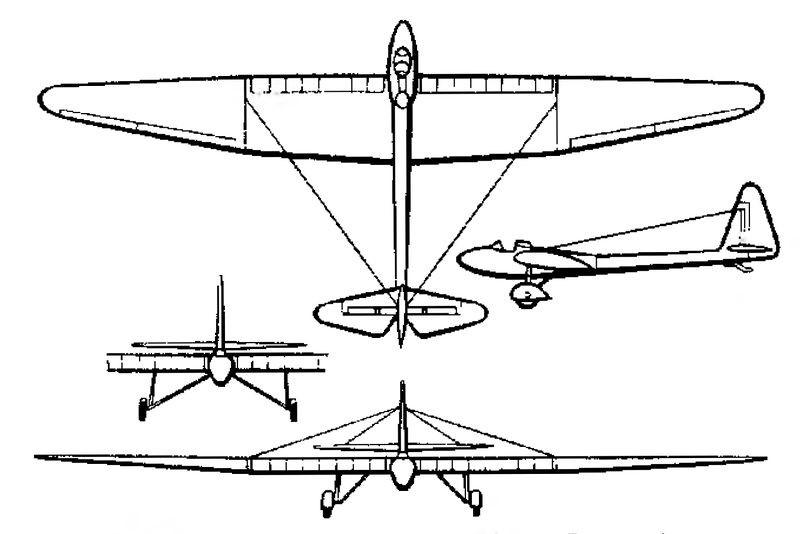
In parallel with the G-17 single – seater glider, Gribovski would develop a tandem two-seater version designed as a development of the G-14. This model was projected in the Moscow Construction Bureau (MKB) of OSOVIAJIM in 1935, receiving the name G-18 (Russian: Грибовский Г-18).
The Gribovski G-18 repeats the structure of the G-14, appearing as a low-wing monoplane braced to the sides of the fuselage by struts. The large wing had a straight leading edge and an inverted trailing edge and was designed with an R-II wing profile. In order to improve aerodynamics, the joint with the fuselage was modified. The trailing edge of the wing featured large louvered ailerons measuring 2 square meters in area.
The landing gear maintained the composition of the previous G-14 with two simple wheels in pants and fixed to the wing soffit. The wide span between the two wheels allowed the necessary stability during aero-tow training.
The wide fuselage, covered with plywood, could be used to transport loads and luggage in the towed mode, so the structure was reinforced.
The cockpits, located in tandem, had a dual control system and were covered by transparent windows.
The G-18 glider was built in OSOVIAJIM’s own MKB workshops. By 1935 Gribovski managed to organize a small productive workshop in a neighbouring basement to the one occupied by the MKB. The entire staff of this workshop consisted of eight men. They practically did not have machine tools, so most of the metal parts had to be hired from other workshops. Another major problem arose when removing the finished parts from the basement. It was necessary to increase the size of a window.
Despite these conditions during 1935 this workshop would build the G-18, G-19 gliders and the G-20 light sport aircraft.
The G-18 glider was sent to participate in the XI National Gliding Competitions, being destroyed during its first flight in September 1935. The pilot IL Kartashiev managed to get out of the accident alive.
G-18 Wingspan: 15.60 m Wing area: 19.00 m² Length: 7.1 m Height: 1.50 m Ailerons surface: 2.00 m² Empty weight: 210 kg Wing loading: 19.5 kg / m² Glide ratio: 19 Accommodation: 2
With a view to participating in the XI National Sailing Competitions, Gribovski decided to build a single-seater glider capable of flying long distances taking advantage of thermal currents.
The Gribovski G-17 (Russian: Грибовский Г-17) was designed as a single-seat cantilever mid-wing glider, specially prepared for aero-tow.
The double spar wing, presented in its front part of the wing was covered with 1 mm plywood sheets, up to the position of the second spar. The rest of the wing and ailerons were covered with fabric. The wing design used the TsAGI R-II profile proposed by the engineer PP Krasilschikov. The slotted ailerons occupied 46% of the wingspan.
The tail unit featured cantilever planes and monoplane configuration. The leading edge of the empennage and horizontal planes also featured plywood overlay. The rudders were covered in fabric.
The fuselage featured a monocoque structure with plywood coating. At its bottom there was a landing gear in the form of a ski with amortization.
The pilot was located in an open cockpit located in front of the wing leading edge, protected by a windshield. At the rear of the cockpit, the fuselage deepened to form a headrest.
The G-17 glider was projected at the Moscow Construction Bureau (MKB) of the Union of Defense and Aviation Assistance Societies-Chemical Construction of the USSR, but at that time it still lacked productive capacity, so the construction of the only example built was made at the Frunze factory (ZIF) in 1934 – 1935. This was the reason for the three interlocking ZIF letters that were painted on the rudder. Completed in 1935 it was ready in time to participate in the XI National Sailing Competitions, in the fall of that year, where it would compete with the number 11 in its empennage.
G-17 Wingspan: 15.60 m Wing area: 13.60 m² Length: 6.15 m Height: 1.30 m Surface of the horizontal planes: 1.60 m² Empennage surface: 0.85 m² Aileron surface: 1.50 m² Empty weight: 126 kg Wing loading: 15.2 kg / m² Glide ratio: 23 Accommodation: 1
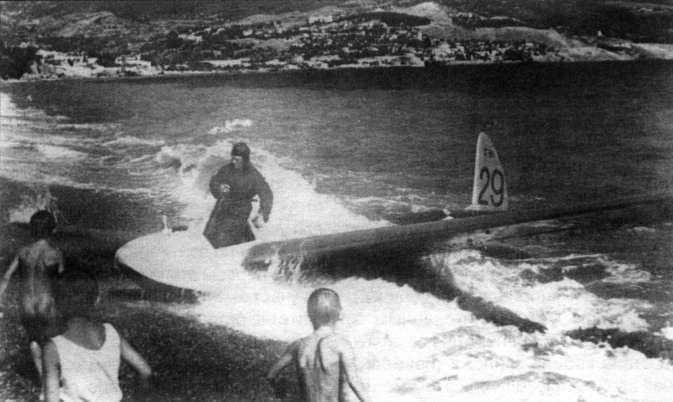
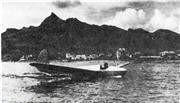
After the failure of the G-12 in its water operations, Gribovski opted to develop a lighter and smaller version that received the name G-16 (Russian: Грибовский Г-16).
The G-16 glider was designed as a hydrofoil with a single deck hull and high cantilever wing, which had stabilization floats fixed to a support on its intrados and braced by means of uprights on its outer side. The wing structure comprised two box-like spars, joined together by light ribs. The wing was covered with 1 – 1.5 mm thick plywood, creating a flexible but strong structure. On the extrados, the wing had a fabric covering. The wing design used the TsAGI R-II profile proposed by the engineer PP Krasilschikov.
The hull had straight sides with a curved top and a 19-frame structure, a tail spar and five stringers. The entire hull was covered with 1.5 – 3 mm thick plywood nailed to the structure with galvanized laces and covered with glued and enameled canvas. Oil paint was used internally.
For operations on water, it had an ash skid at the bottom of the hull designed for landing on land.
The tail area made transition towards the empennage and the thin stabilizer braced in its lower part by two short uprights.
The pilot was located in an open cockpit forward, in front of the wing leading edge.
Built at the OSOVIAJIM Glider Factory, the G-16 participated in the X National Sailing Competitions held in Koktebel. On 25 September 1934 this glider, piloted by Gribovski, performed for the first time in the USSR, a takeoff from the water in a glider towed by an amphibious Shavrov SH-2 piloted by LG Minov.
A little later pilot N. Baruzdin made a takeoff from the sea towed by a Shavrov Sh-21Sh-2. This flight would cover the Koktebel – Gurzuf in Yalta.
G-16 Wingspan: 14.20 m Wing area: 14.90 m² Length: 5.57 m Height: 1.42 m Surface of the horizontal planes: 1.70 m² Empennage surface: 1.2 m² Ailerons surface: 1.36 m² Empty weight: 139 kg Wing loading: 14.7 kg / m² Glide ratio: 20.1 Optimal flight speed: 56 km / h Minimum descent speed: 0.72 m / s Accommodation: 1

 All Aero