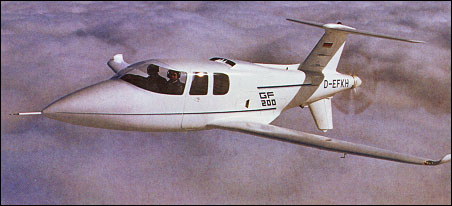
The GF 200 pusher piston-engined and pressurised 4/5-seat lightplane was first flown in November 1991.
Engine: 1 x 233kW Teledyne Continental TSIOL550 turbocharged flat-six Take-off weight: 1600 kg / 3527 lb Wingspan: 11.00 m / 36 ft 1 in Length: 8.70 m / 28 ft 7 in Height: 3.42 m / 11 ft 3 in Cruise speed: 370 km/h / 230 mph Ceiling: 7625 m / 25000 ft Range: 1850 km / 1150 miles Crew: 2 Passengers: 4
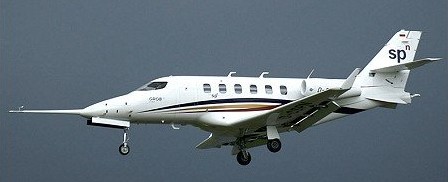
The Grob G-180 SPn (or spn) is a low-wing twin-engined corporate jet projected by Grob Aircraft in 2005. It can land on both paved surfaces and unimproved runway capability.
Engines: 2 x 1270kg Williams FJ44-3A turbofans Max take-off weight: 6300 kg / 13889 lb Wingspan: 14.86 m / 49 ft 9 in Length: 14.81 m / 49 ft 7 in Height: 5.12 m / 17 ft 10 in Cruise speed: 754 km/h / 469 mph Ceiling: 12497 m / 41000 ft Range: 3334 km / 2072 miles
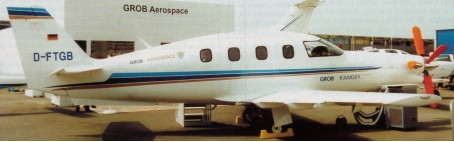
A seven seat business aircraft, considered a competitor for the TBM700, the Ranger maintains the German company’s tradition to produce composite carbon fibre. It has a big cabin for a single engined aircraft in this business market segment 16ft long, over 5ft wide and 4.7ft high and in addition to pressurisation, it has various internal options for a toilet, folding tables and power connections for laptops.
G160 Ranger – (provi¬sional) Powerplant: One 850shp Pratt & Whitney Canada PT6A-42A turboprop. Max cruise speed, 270kt (500km/h). Range with six people at 25,000ft with 30min reserves, 1,800nm (3,300km). Sea level take-off to 50ft (15m): 2,130ft (650m). Max take off wt: 7,275 lb (3,300kg). Max payload, 1,587 lb (720kg). Span, 42ft 8in (13m). Length, 37ft 8in (11.5m) Height: 11ft 3in (3.4m).
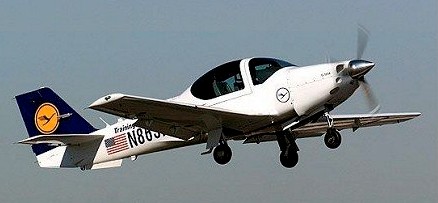
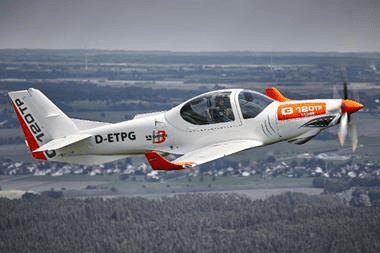
The 1999 Grob G 120A is a two seated training and aerobatic low-wing aircraft with a carbon composite airframe. It is based on the Grob G 115TA training aircraft and is specially designed for military and civil pilots training.
G120TP
In 2025 the Royal Canadian Air Force (RCAF) planned to operate 23 G120TPs under the designation CT-102B Astra II. To be based at CFB Moose Jaw in Saskatchewan, they will serve as a basic flight instruction platform, succeeding Canada’s Grob CT-120A (G120A) trainers.
The prototype Grob G-116 was a four seat, composite 200 hp Lycoming powered single. A four-seat version of the Grob G.115, the G 116 first flew on 29 April 1988 (D-EGRF), and was certificated in 1989.
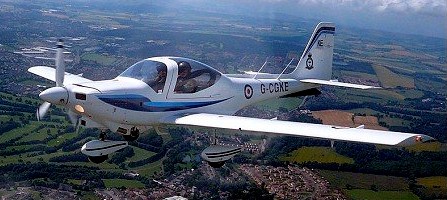
By 1990 the G 115 had orders totalling more than 100 since production began in 1987. The two-seat, side-by-side light aircraft makes extensive use of composite materials in its construction and the resulting smooth finish gives low drag and high efficiency. The production G 115-C is powered by a single 150 hp (112 kW) Lycoming O-320-E2A piston engine driving a constant speed propeller. The Royal Navy Flying Grading Flight operate the G.115D as the Heron. Ninety-nine G.115E (at Tutors) were purchased for Air Cadets and University Air Squadrons in the UK. The E variant with a 3-blade variable pitch propeller is in Royal Air Force service as an elementary flying trainer.
G 115C Engine: 150 hp (112 kW) Lycoming O-320-E2A Propeller: constant speed
G.115D / Heron
G.115E Engine: 1 x 134kW / 180 hp Textron Lycoming AEIO-360-B1F Prop: Hoffman 3 blde CSU Max take-off weight: 990 kg / 2183 lb Empty weight: 690 kg / 1521 lb Wingspan: 10,00 m / 33 ft 10 in Length: 7,79 m / 23 ft 12 in Height: 2,82 m / 7 ft 7 in Wing area: 12,21 sq.m / 129.17 sq ft Max. speed: 270 km/h / 168 mph Cruise speed: 230 km/h / 143 mph Initial climb rate : 1399.61 ft/min / 7.11 m/s Service Ceiling: 4875 m / 16000 ft Range: 1250 km / 777 miles Crew: 2
The G110 got into an un-recoverable spin on its second spin flight. The pilot bailed out and the plane was destroyed. The pilot pulled the chute a bit early and some chute shrouds were cut by the prop. The pilot, a German TP, has no interest in flying any other Grob aircraft. The program was cancelled two weeks later.
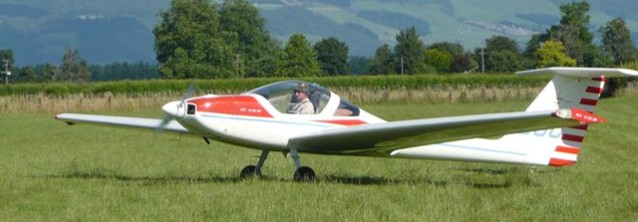
Designed by Burkhart Grob GmbH, the two seat Grob 109 motor glider features side by side seating and fixed tail dragger undercarriage with a steerable tail wheel. The fuselage and wings are made of industrial carbon fibre and glass fibre composites with air brakes. Glass Reinforced Plastic (GRP) is the main structural material with Carbon Fibre for the T-tailplane and rudder. Hard foam sandwiched between fibreglass cloth is used for stringers and formers in the fuselage as well as many other applications.
Grob’s G 109 has the ability to shed its wings, tailplane and elevators to enable it to be neatly packaged for transportation in a suitable road-borne trailer. Each wing has a tapered tongue that extends through the centre section to lock into the opposite wing root rib. The ailerons and air brakes are operated through push-pull control rods. The horizontal tailplane is fitted atop the fin and the quick connect fittings for the elevator and trim tab are fitted. The Limbach L 2000 EB lA engine is rated at 59kw/80hp at 3,400 rpm. The engine has a single Slick magneto, twin Stromberg carbs with “pancake” sport air filters, Motorola alternator and a Hoffman feathering propeller with START (take-off and climb) and CRUISE pitch settings.
The 17.5 Imp gallon fuel tank is behind the cockpit and filled from above the left wing trailing edge. There are GRP skids/tie down points under each wing tip and the engine cooling air exits from fixed louvers in the bottom cowl.
The glassfibre monocoque fuselage has frames and longerons, while the low wing has a glassfibre roving main spar and a glassfibre/epoxy resin sandwich skin; there are aluminium air brakes in the upper wing surfaces. The fixed undercarriage has Scheibe hydraulic brakes on the spatted main wheels, and the tailwheel is steerable. The pilots sit under a one-piece forward-opening canopy and, after some flight testing, this was fitted with a central frame, while changes made to the undercarriage included moving the main wheels further back so as to unload the tailwheel, the main wheel struts being of steel. Wing span was increased from the original 15m (49ft 2.5in) to 54ft, the empty weight was increased and the motor cowling and wing roots were aerodynamically refined.
The prototype, D-KBGF, made its first flight on 14 March 1980, and the Grob G 109 was certified to JAR 22 in March 1980.
The prototype of the G.109B two-seat, side-by-side motorglider first flew in March 1983 as a version of the original G. 109, with increased span. The GROB G109B is a two-seat motor glider with T-type stabilizer, fixed landing gear and airbrakes. It is classified as a TMG (Touring Motor Glider). It was designed by Burkhart Grob GmbH and features side by side seating as well as a classical tail-dragger undercarriage with a steerable tail wheel. The fuselage and wings are made of industrial carbon-fibre and glass-fibre composites. The G109B’s engine was made by Grob (GR 2500) and is an aircooled 4-stroke flat engine. In 1983 a Grob G109B motorglider extended the gliding world altitude record to 6,406m (21,018ft) and the gliding world altitude gain record to 5,042m (16,544ft). Powered by a 75 hp (56 kW) Limbach engine, the G 109B in RAF service is known as the Vigilant T Mk 1 with the self-launching Volunteer Gliding Schools of the ATC and CCF. The Royal Air Force ordered the last 54. Although production of this motorglider ceased in 1986, during 1990, Burkhart Grob Luft-und Raumfahrt was building between 70 and 100 more G.109Bs to meet a number of orders – including from the RAF. A total of 322 of the G109 and 322 of the G109B aircraft were built from 1983 through to 1990.
In 1983 a Grob 109B extended the gliding world altitude record to 6406m / 21,018 ft and the gliding world altitude gain record to 5042 m / 16,544 ft.
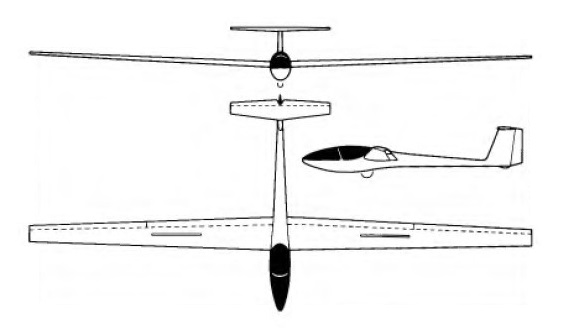
This single-seater Unrestricted 15m Class version of the Astir is generally similar to the Astir CS 77 except for wings of reduced area and different section, which have carbon-fibre spars and are fitted with so called ‘elastic flaps’ in which the gaps between the flap and the wing trailing edge are elastically sealed; these flaps can be deflected upwards to act as air brakes as well as downwards, and the ailerons can be drooped with the flaps.
The Speed Astir has the same cantilever mid-wing and T-tail as the Astir, but with a shorter fin and rudder and constructionally it is the same as its predecessor. The water ballast capacity has been increased to 330 lb.
After 25 of the original Speed Astirs had been built, production switched to the Speed Astir II which first flew on 11 November 1978.
This had a new and slimmer laminar flow fuselage, with carbon-fibre reinforcements in high stress areas, and a two-piece canopy, the rear section of which hinges to open aft. The tail unit is similar to that of the Astir CS but with shorter fin and rudder, and the new tailplane has a sealed elevator hinge line.
The slotless flaps extend half-way along the trailing edges, and the ailerons, which can be deflected in the same way, continue to the wingtips. Mounted on tracks and rollers, the ailerons and flaps articulate with the lower wing surface and can slightly increase the wing area. The wing upper surface features ‘elastic’ strips which form a permanent seal between flap and wing.
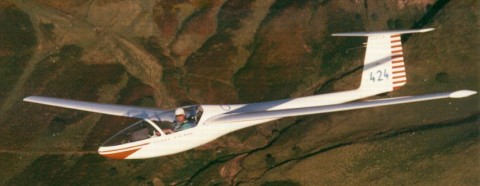
Grob G-104 Speed Astir II
In October 1979 the cockpit was lengthened by nearly 8in to accommodate taller pilots, and the Speed Astir IIB has carbon-fibre spars. From the same date the Speed Astir II 17.5, a version with a longer span of 17.5m, was due to become available. Altogether 98 Speed Astir IIs had been built by December 1979 and the type is out of production.
Speed Astir II
G 104 Speed Astir II & IIb Wing span: 15m / 49 ft 2.5 in Wing area: 11.46 sq.m / 123.4 sq.ft Length: 21 ft 11.25 in Height: 4 ft 2 in Empty Weight: 265 kg / 584 lb Payload: 250 kg / 551 lb Gross Weight: 515 kg / 1135 lb Wing Load: 44.94 kg/sq.m / 9.19 lb/sq.ft Water Ballast: 140 kg / 308 lb Max speed:168 mph (smooth air) MinSink: 0.70 m/s / 2.3 fps / 1.36 kt at 47mph L/DMax: 40 95 kph / 52 kt / 60 mph Best glide ratio: 41.5:1 at 74.5 mph Aspect ratio: 19.6 Airfoil: Eppler E 662 Seats: 1 No. Built: 107
Speed Astir II Wing span: 15.0 m / 49 ft 2.5 in Length: 6.60 m / 21 ft 8 in Height: 1.27 m / 4 ft 2 in Wing area: 11.5 sq.m / 124.8 sq ft Wing section: Eppler E660 Aspect ratio: 19.6 Empty weight: 250 kg / 551 lb Max weight: 515 kg / 1,134 lb Water ballast: 180 kg / 397 lb Max wing loading: 45 kg/sq.m / 9.2 lb/sq ft Max speed: 146 kt / 270 km/h Stalling speed: 35 kt / 64 km/h Min sinking speed: 0.57m/sec / 1.87 ft/sec at 40 kt / 75 km/h Best glide ratio: 41.5 at 65 kt / 120 km/h




 All Aero