Heinkel He 2

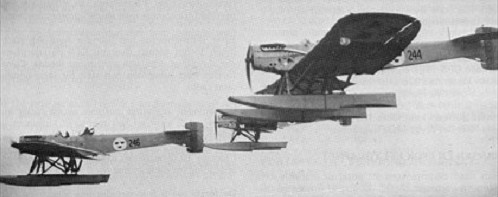
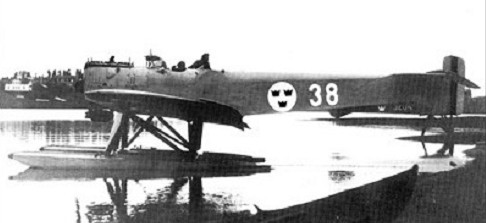
The He.1s were followed rapidly by the He 2, a tandem two seat open cockpit seaplane, with larger span wings allowing better and safer takeoffs and landings.
Engine types again were varied, the 268kW / 360 hp Rolls Royce Eagle IX, 223kW Hispano-Suiza, or 298kW Liberty being preferred. He 2s were also built in Sweden by Svenska Aero AB and served with the Swedish air force in the reconnaissance role, continuing in front line service until 1928. In Sweden the He 1 and 2 were designated S 1 and S 2 respectively.
The Svenska S.2 was exported to Finland and possibly other countries.

Maximum level speed: 185km/h

Heinkel He 1

In the early 1920s German aviation development was severely restricted by the 1919 Treaty of Versailles and the 1922 Committee of Guarantees. The latter allowed only limited production and the use of very low powered engines. Ernst Heinkel, in common with other German air¬craft manufacturers of the period, had his designs built abroad. He formed his own company on December 1, 1922, and its first product was the He 1 single engined three-seat seaplane monoplane, which flew for the first time in May 1923. It was built under licence by the army workshops in Sweden and was designed to take engines in the 250 hp range. The engine commonly fitted on production mod¬els was the 240 hp Armstrong Siddeley Puma or 179kW Maybach Mb IVa. He 1s served mainly as trainers with the Swedish navy. In Sweden the He 1 and 2 were designated S 1 and S 2 respectively.

He 1
Span: 17.5 m (57 ft 5 in)
Length: 12.6 m (41 ft 4 in)
Gross weight: 2595 kg (5720 1b)
Maximum speed: 164 km/h (102 mph)

Hegetschweiler Moswey IV

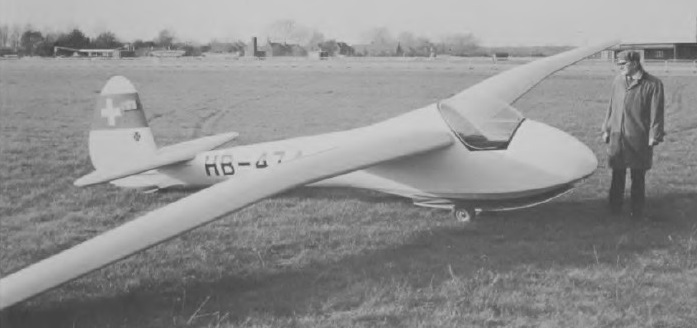
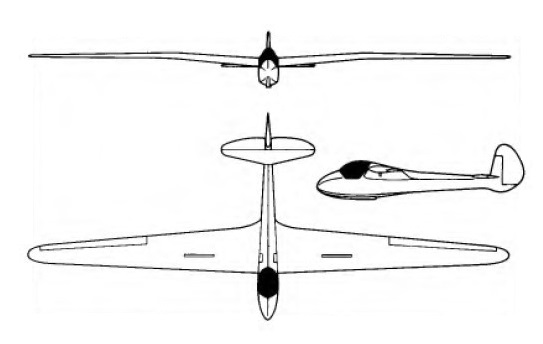
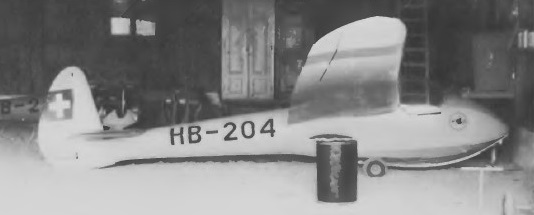
Before the war and during the 1940s the best-known sailplanes to emerge from Switzerland were the Moswey range of training and competition single seaters designed by Georg Muller and produced by the Hegetschweiler firm.

In 1950 the Mk III was succeeded by the Moswey IV, which had a span increased to 47 ft 3 in, a roomier cockpit and an enlarged one-piece Plexiglas canopy which gives excellent visibility. There are air brakes in the wing upper and lower surfaces, and landing gear consists of a nose skid and a monowheel plus a tail bumper fairing.

One Mk IVA was still on the Swiss register at the beginning of 1964.

Hegetschweiler Moswey III

Before the war and during the 1940s the best-known sailplanes to emerge from Switzerland were the Moswey range of training and competition single seaters designed by Georg Muller and produced by the Hegetschweiler firm.

Like the 2A, the Moswey 3 is made of traditional plywood and fabric, though the wing span is reduced to 14.0 m (45 ft 11 in) for aerobatic training.

The Moswey III first flew in October 1943. In 1948 a Mk.III piloted byAlwin Kuhn took third place in the World Championships at Samedan in Switzerland, and that same year one flown by Siegbert Maurer made the first sailplane crossing of the Alps from north to south. After the war a Moswey III set the first world record for speed over a 100km triangle, and this variant captured most of the Swiss national records of early postwar years.

In 1950 the Mk III was succeeded by the Moswey IV.

Ten of the 14 Moswey IIIs built were still on the Swiss register at the beginning of 1964.

Moswey III
Span: 45ft 11 in / 14.0 m
Length: 19 ft 8 in / 6.0 m
Height: 4 ft 7 in / 1.4 m
Wing area: 141 sq ft / 13.1 sq.m
Wing section: Gottingen 535
Aspect ratio: 15.0
Empty weight: 353 lb / 160 kg
Max weight: 250 kg / 551 lb
Water ballast: None
Max wing loading: 19.1 kg/sq.m / 3.9 lb/sq ft
Max speed: 130 mph / 113 kt / 210 km/h
Stalling speed: 27 kt / 50 km/h
Max rough air speed: 67 kt / 125 km/h
Min sinking speed: 2.1 ft/sec / 0.65 m/sec at 37.5 mph / 32 kt / 60 km/h
Best glide ratio: 27.5:1 at 43.5 mph / 38 kt / 70 km/h

Hegetschweiler Moswey II

Hegetschweiler Moswey II

Before the war and during the 1940s the best-known sailplanes to emerge from Switzerland were the Moswey range of training and competition single seaters designed by Georg Muller and produced by the Hegetschweiler firm.

The Moswey 1 trainer of 1930 was followed in 1935 by the Moswey II, which had cantilever shoulder-mounted gull wings of 45 ft 3 in span. This was of conventional plywood and fabric construction, and in 1937 the Moswey II was among the types participating in the first International Competition to be held at the Wasserkuppe in Germany.

One Moswey II and three Mk IIAs were still on the Swiss register at the beginning of 1964.

Heeman WIGE

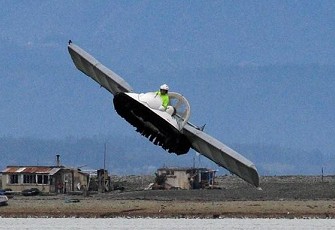
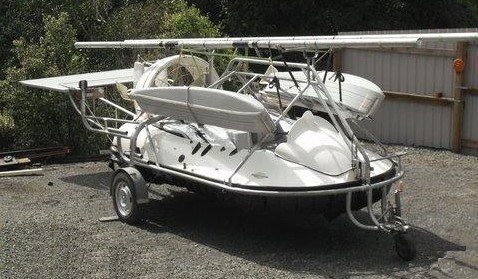
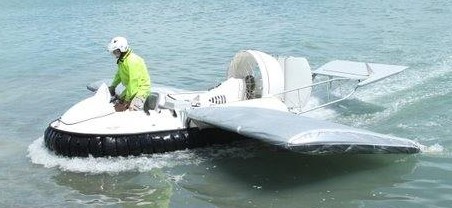
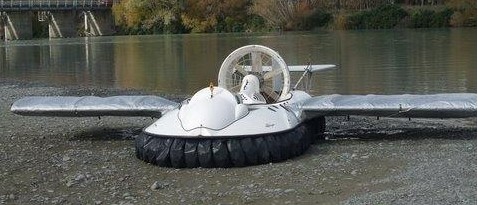
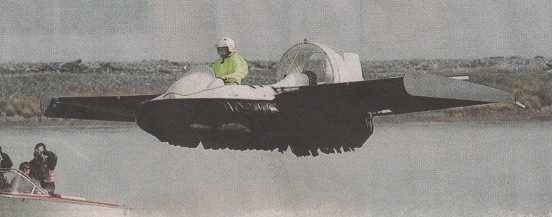
Rudy Heeman of Nelson, New Zealand, spent three years building and designing the hovercraft that can travel on water land and air.

The craft has alloy wing spars, with foam cored ribs and fabric skins. The tail unclips but stays on for trailer transport.

He wanted to develop the flying hovercraft design, but had to sell a prototype to raise enough cash to do so.
It was listed on a ‘Trademe’ website expiring on 13 March 2010 with a reserve of NZ$20,000.
Mr Heeman, a mechanic, has been making hovercraft in his spare time for more than 13 years but was his first attempt at a flying version. He had spent 75 hours flying his completed bovercraft.
With a modified 1.8 litre Subaru car engine and a range of more than 225 kilometres, the hovercraft cruises at 90 kph when flying, and has a smooth ride above the waves.

This machine is a W.I.G [wing in ground effect] in the form of a hovercraft. This machine, which is classed as a boat and comes under MSA rules, can operate as a hovercraft or, when the wings and tail put on, flying machine that can travel above the water or land. The engine is an EA81 subaru, modified with turbo, intercooler blow thru webber carb.

The construction of the hovercraft began in 2003 and conversion to WIGE began in 2007. The first flight was towards the end of 2007.
The wingtips have water skis on them so it doesn’t dig in.
The final wing shape was the third design. Skirt retraction is electric. The thrust diverter works electrically by pushing green or red buttons on the handlebars. The green button gives a 30% increase in thrust instantly by diverting lift sir to add to thrust once airborne.

Has alloy wing spars, foam cored ribs and fabric skins. The tail unclips if not required but stays on when transported. Has a retractable finger skirt, open cockpit, aerofoil wings, and thrust diverter.

The first test flight was 2007.

The WIGE was auctioned on the New Zealand Trademe website during 27 February – 13 March 2010. It was listed as designed and built by Rudy Heeman. Powered by a 100 hp inboard motor, it could operate as a hovercraft or, with the wings and tail put on, as a wing in ground effect flying machine. Built in 2003, the engine had run for 150 hours. With the 1.8 lt engine it could reach over115 kph, and a range of over 225 km cruising at 90 kph, using 30 lt of 96 octane fuel/hr.
The machine does not require any licence but must obey boat rules when on or above the water. The sale was for the machine only and did not include copyrights, intellectual properties, moulds etc.
In flying mode t could carry 160 kg (or three people as a hovercraft).
At that time it had flown over 75 hours with the Subaru EA81 engine, modified with turbo, and intercooler blowthru Webber carb.
Engine: 100 hp at 5000 rpm +7 lb boost, approx. 400 lb thrust.
The T/O distance is approximately 80m and, while it has flown in 25 kph winds, a max of 15 kph is recommended.

It was sold by Trademe auction for $27,500.

Engine: Subaru EA81, 100 hp 100HP at 5000rpm with 7 pounds boost
Wingspan: 7m
Length with tail: approx 6.3m
Length: 4 m (13 ft)
Approx weight: 320 kg + 50 kg wing and tail
Fuel capacity: 75 lt
TO speed: 70 kph
Heath 115 Special / CNA-40 / Hansen Specal

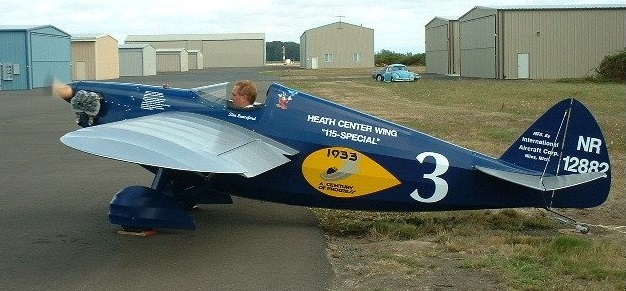
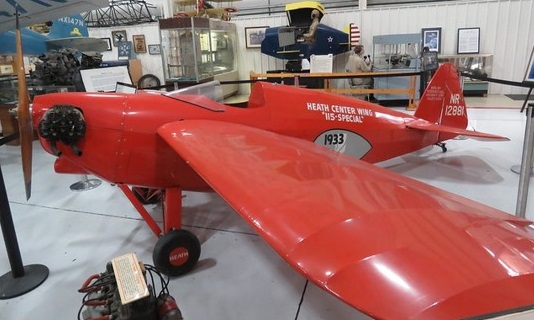
Heath CNA-40 C/N TD-3, Heath 115 Special Racer NR 12882 restored 2007

The 1933 Heath CNA 115 Special is a competition version of CNA-40 with clipped wing and bigger propeller for improved performance in races.

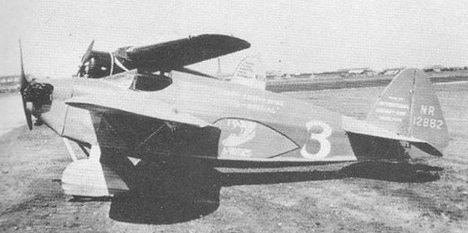
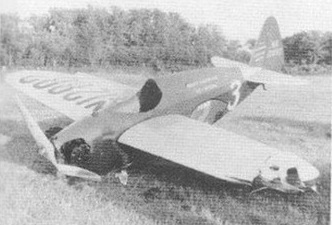
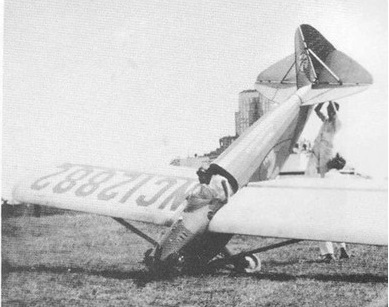
Heath CNA NC12892 was modified for racing and named the 115 Special. Higher turtledeck, shorter tapered wings, wheels pants, and general overall refining improved performance. After appearing in the 1933 races, NR12882 was returned to ATC status which included longer constant chord wing with full span ailerons. It did retain the raised turtledeck.

The first flight of NR12882, after modifications, ended with an engine failure. Pilot Bill Kysor ran out of altitude and ended in a ditch bordering Niles Airport.

Following the Chicargo races, after it was returned to ATC status, NC12882 suffered another incident.

One was built as Hansen Special, NR282W, and restored in 1965.

Gallery

Heath 115 Special
Engine: 32hp Bristol Cherub
Wing span: 18’2″
Length: 17’3″
Load: 228 lb
Max speed: 105 mph
Cruise speed: 85 mph
Stall: 60 mph

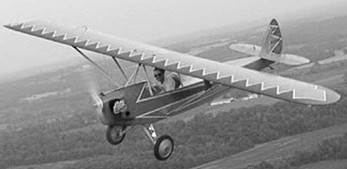
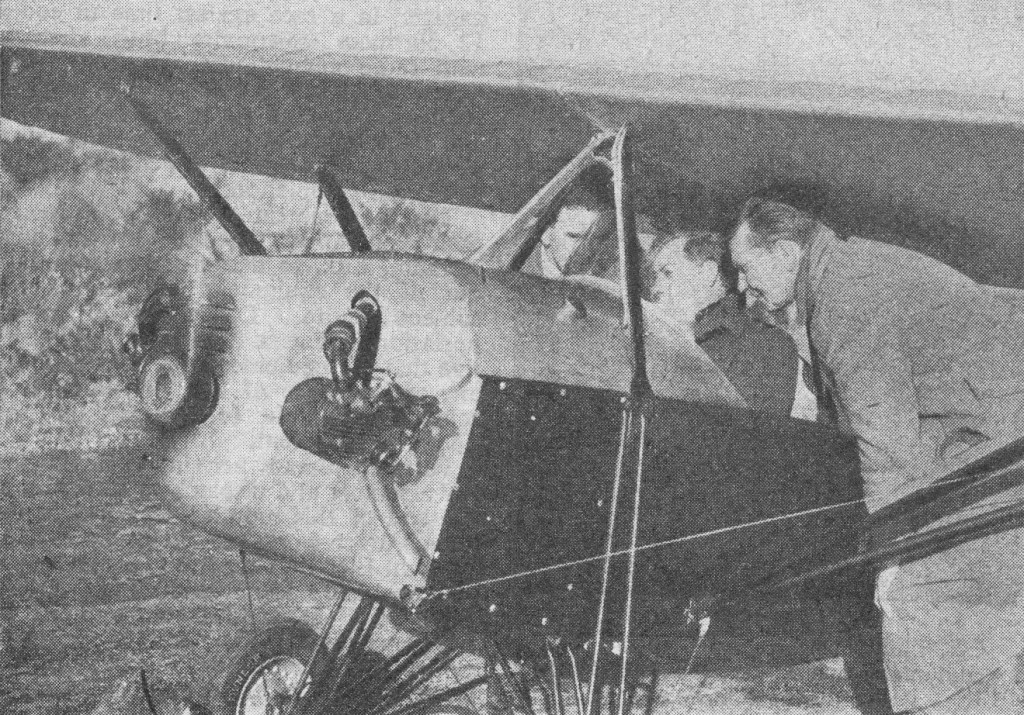
Heath LNB4 Parasol

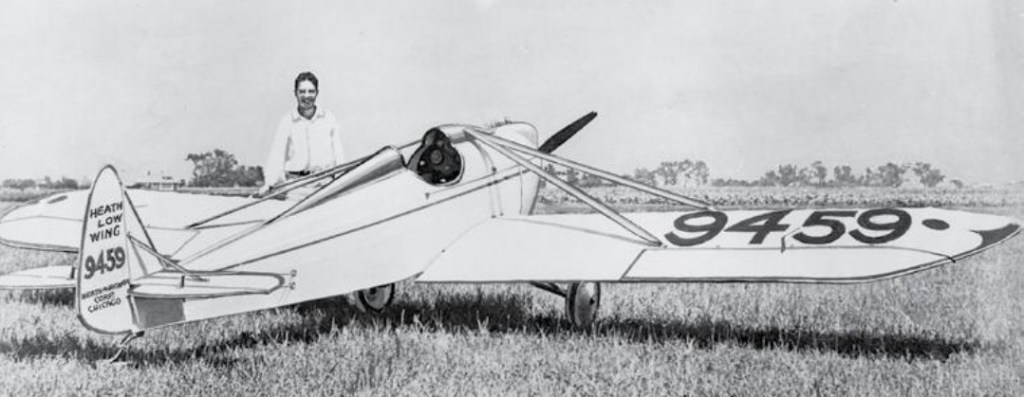
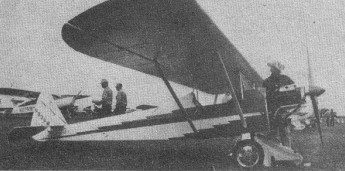
Designed and built originally in the U.S.A. by Ed. Heath during the early 1930s, this single seat sports aeroplane was built in large numbers prior to the 1939-45 War. The Parasol was powered mainly with Heath’s own conversion of the 25-hp Henderson motorcycle engine. Production was undertaken for an early version of this aircraft in Australia, as early as 1931 by the Adcock-Heath Co.

Heath LNB4 Parasol Article

Heath B-4 / OK-AT(V) Švec

The fuselage is built of welded steel tube and is fabric covered. The wings consist of two solid spruce spars, built-up wooden ribs, compression struts and internal bracing. Externally, the wings are braced by steel tubes to the fuselage. The empennage is built of wood, the fin and tailplane being externally braced. The whole aircraft is fabric covered. Two 5 Imp. gallon fuel tanks are installed at the root end of each wing half, the fuel being gravity fed to the engine.

While some were factory built, and the last model actually received an Approved Type Certificate (ATC) in 1932, the majority were homebuilt from factory-supplied kits or from magazine plans. Still being built, this single-seater is usually powered by either a Volkswagen conversion or a 65 hp Continental and is constructed of wood, fabric and tubular steel.

A Plymouth Aero Club member flew a Parasol in the UK powered by a Douglas dirt track motor cycle engine.

1949 A.B.C. Scorpion powered in the UK

Ultralight replica: Rag Wing RW 5 Heath Replica

Gallery

Engine: Continental A40
Wingspan: 31ft. 3 in
Length: 17 ft. 3 in
Wing Area: 135 sq. ft.
Empty Weight: 450 lb.
Gross weight: 700 lb
Fuel capacity: 9 USgals
Wing Loading: 5.2 lb/sq. ft.
Max. Speed: 85mph.
Top speed: 73 mph
Cruise speed: 62 mph
Stall Speed: 32mph.
Climb rate: 500 fpm.
Range: 330 miles.
Takeoff run 400 ft.
Landing roll 400 ft.