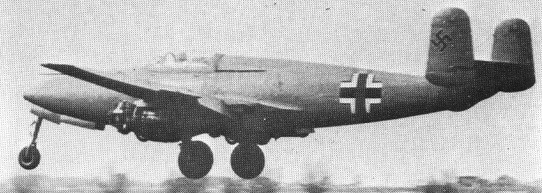
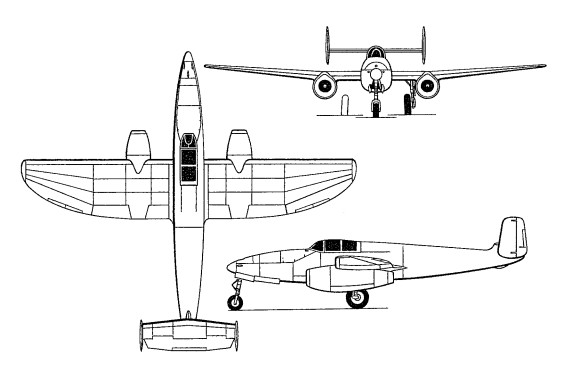
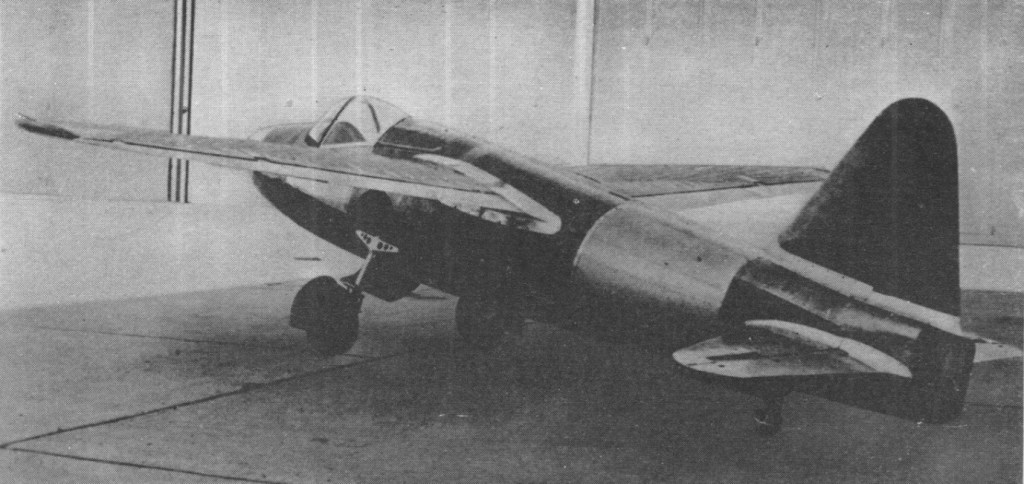
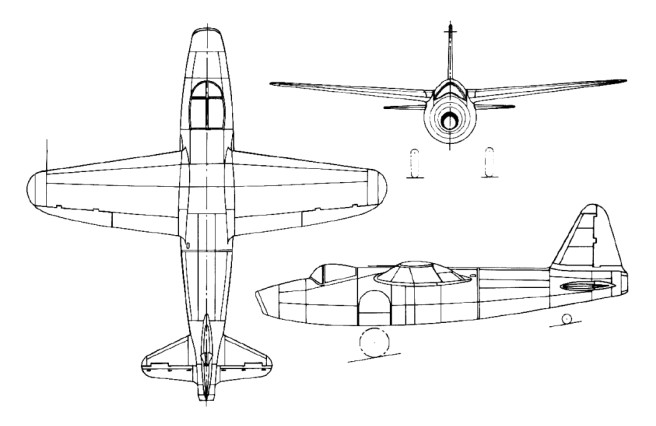
When work on the He 178 was discontinued in the autumn of 1939, effort was transferred to a more advanced twin-engined design which was to be powered by pairs of two new Heinkel turbojets, the HeS 8 and HeS 30. Design of the He 280, which started before the end of 1939, included a low wing with twin underslung turbojets tricycle landing gear and twin fins and rudders. Neither engine was ready for flight when the Heinkel He 280 prototype airframe was itself complete and first trial flights, which began on 22 September 1940, were unpowered, the aircraft being towed to release height behind a Heinkel He 111.
Despite the obvious need for low diameter engines, Dr von Ohain succeeded in developing the centrifugal flow HeS 8 (or 109 001) to produce 700 kg (1,543 1b) thrust installed in March 1941, and a pair of these engines powered the He 280 VI on its first powered flight on 2 April l941. For this first flight the engines were kept uncovered as during test runs fuel had gathered in the cowlings. Fritz Schafer piloted the first powered flight, and the engines were producing little more than 500kg thrust, however, and although available thrust had risen to some 600kg by early 1943 when the second and third prototypes were flown, in April of that year BMW 109-003 engines were adopted.
A total of nine prototypes flew, including the He 280 V2 and He 280 V3 with HeS 8 engines (the former also being re engined with Jumo 109 004s). The He 280 V4 had BMW 109 003s and later with six Argus 109 014 pulsejets. The He 280 V5 flew first with HeS 8s and later with 109 003s. The He 280 V6 (as well as the V5) with three MG 151 20 mm can¬non, the He 280 V7 with 109 004s (and later tested as a high speed glider for aerodynamic research), the He 280 V8 with 109 004s and a V type tail unit, and the He 280 V9 with 109 003s. Although production of the He 280 was planned, recurring complaints (which included structural weakness in the tail, together with tail flutter, and inadequate fuel and armament provision) caused the design to be abandoned in favour of the Messerschmitt Me 262, It was from the He 280 V1 that the first ever bale out using an ejector seat was made when Argus test pilot Schenk abandoned the aircraft on 13 January 1942 when his controls locked from icing up during a towed test flight. This seat was powered by compressed air.
He 280 V5 Engines: two 750 kg (1,653 1b) thrust HeS 8A (109 001A) turbojets Maximum short burst speed 900 kph (559 mph) at 6000 m (19,685 ft) Normal max-speed 820 km/h Initial climb rate 1145 m (3,755 ft) per minute Estimated service ceiling 11500 m (37,730ft) Range 650 km (404 miles) Empty weight 3215 kg (7,088 lb) Maximum take off weight 4310 kg (9,502 lb) Wing span 12.20 m (40 ft 0 in) Length 10.40 m (34 ft 1.5 in) Height 3.06 m (10 ft 0.5 in) Wing area 21.50 sq.m (231.5 sq ft). Armament: three nose mounted 20¬mm MG 151 cannon.
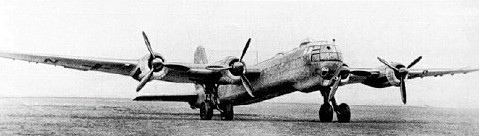
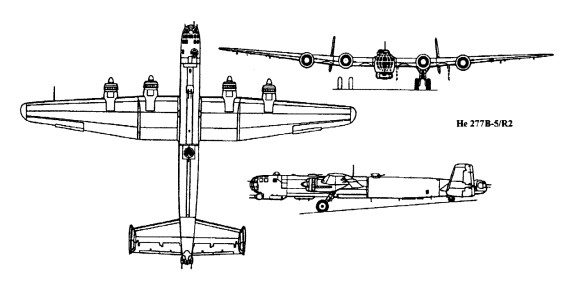
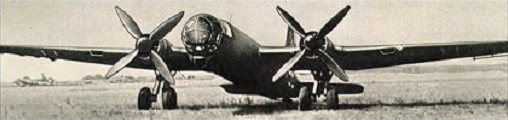
In an effort to overcome the problems being experienced with the coupled DB 606 engines of the He 177, Heinkel suggested in 1940 that four separate DB 603s should be substituted. Although the Reichsluftfahrtsinisterium rejected the plan, work continued unofficially under the designation He 177B and the design was resurrected in response to Hitler’s May 1943 demand for a heavy bomber to facilitate effective strikes on London. Converted from an He 177A-3/R2 airframe, with four DB 603A engines, the first Heinkel He 277 prototype flew at Vienna-Schwechat in the closing months of 1943, followed by the second aircraft on 28 February 1944. Directional instability resulted in the fitting of a twin fin and rudder tail unit to the third prototype. Eight 1305kW DB 603A-powered He 277B-5/R2 production models were completed before the priority given to fighter production in July 1944 brought the programme to an end.
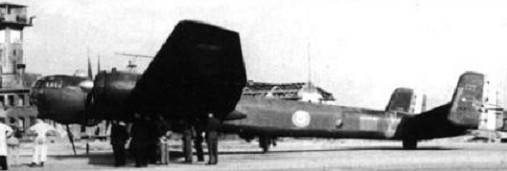
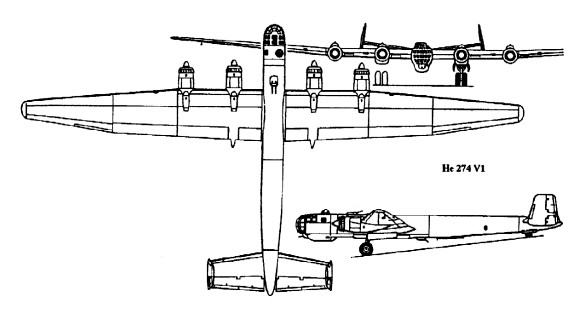
A four engine bomber, the Heinkel He 274 was the detail design responsibility of Societe Anonyme des Usines Farman’s Suresnes factory in occupied France. Fitted with a pressurised cabin in the nose, the aircraft was powered by four 1305kW Daimler-Benz DB 603A-2 engines and featured a lengthened version of the He 177A-3 fuselage, with a new high-aspect-ratio wing and twin fins and rudders.
Two prototypes were ordered in May 1943, together with four He 274A-0 pre-production examples, which were to have 1417kW DB 603G engines. Despite an unsuccessful German attempt to destroy the almost-complete first prototype when they retreated from Paris in July 1944, the aircraft was finished by the French after the liberation. The first flight was from Orleans-Bricy on 30 December 1945 as the AAS 01 A.
Two prototypes were built in France by the S.N.C.A.C.
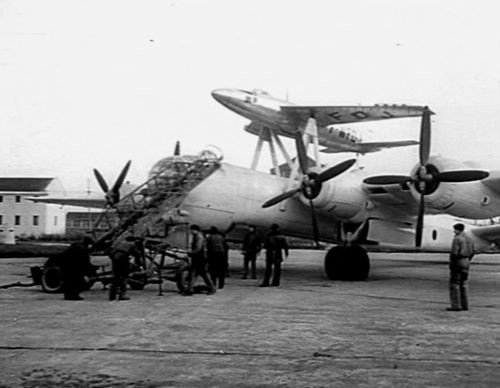
It was used later to test-fly models of such aircraft as the Aerocentre NC 270 and the Sud-Ouest SO 4000.
M.1 glider (F-WFDJ) on Heinkel He.274 V-1
He 274 Engines: 4 x Daimler-Benz DB-603A2, 1850 hp Propellers: metal three-bladed variable pitch Wingspan: 44,20 m Length: 23,80 m Height: 5,50 m Wing area: 142,00 sq.m Aspect ration: 13,2 Fuel: 10130 lt Empty weight: 21300 kg Max weight: 38000 kg Wing loading: 267,605 kg/sm.m Power loading: 5,135 kg/hp Max speed: 580 km/h Cruise speed: 180 km/h Ceiling: 14300 m Range: 4250 km Endurance: 7 hours 45 min
The He 270 was essentially a private venture improvement of the He 70, in which a 1175 hp DB 601Aa engine was installed in an He 70F airframe. It flew in the spring of 1938, but no production was under-taken.
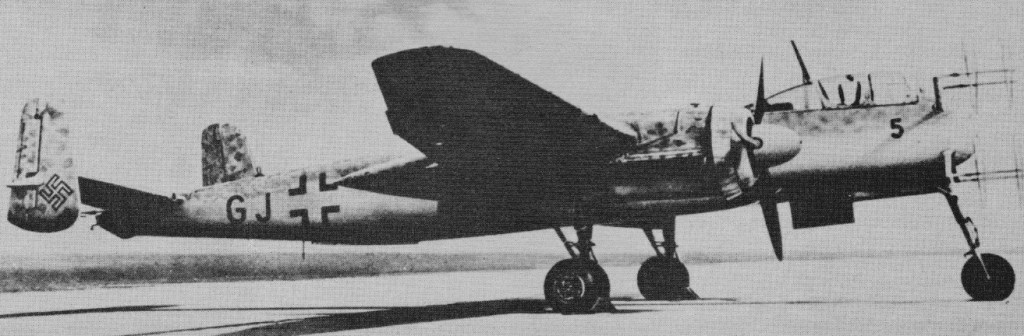
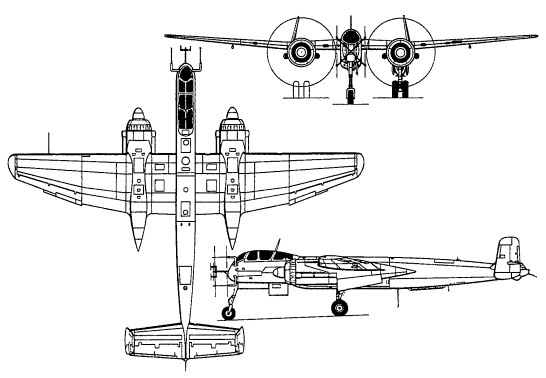
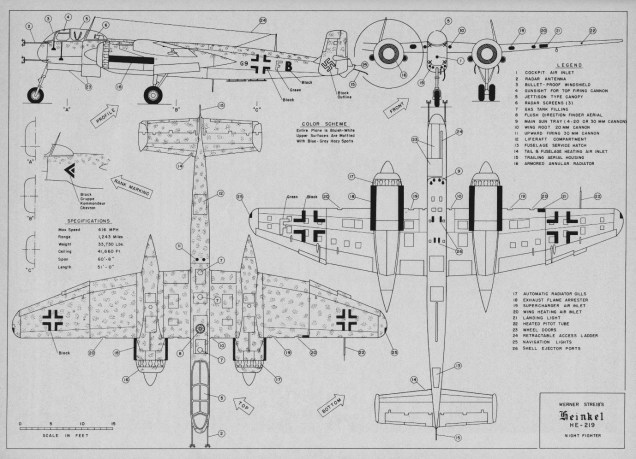
The Heinkel Projekt 1060 private venture received little response from the Reichsluftfahrtministerium (air ministry) when it was first shown to them in mid 1940. It was a multi-purpose aircraft suitable for use as a long-range fighter, dive or horizontal bomber, torpedo plane, or reconnaissance aircraft. The He 219 featured tricycle landing gear, ejector seats, and dual wheels. It was equipped with a crew dingy, cockpit heating, retractable crew access ladder, armoured radiatios, armoured curved windshields with wipers, cleaing spray, hot air defrosting, and armoured fuel tanks. It had a complete wing, fuselage, and tail de-icing system, was well as elaborate radio and radar equipment including a directional gyroscope. Originally the Luftwaffe did not consider a craft of this type necessary and buried the project.
By late 1941 they were in desperate need of a good night fighter for intercepting Allied bombing attacks. In January 1942 the design was revised for adaptation as a night fighter but then was delayed by RAF bombing which destroyed all of the engineering drawings in the Heinkel factory at Rostock-Marienehe.
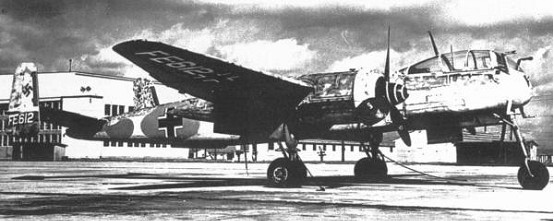
An all-metal shoulder-wing monoplane, the He 219 seated the pilot and navigator back-to-back, was the first operational aircraft in the world to introduce ejection seats, and was also the Luftwaffe’s first operational aircraft with tricycle landing gear. The first prototype, the He 219 V 1, powered by two 1305kW / 1750 hp DB 603A engines, made its first flight on November 15, 1942. The second prototype, flown in December 1942, had a different armament installation.
They proved fast and manoeuvrable, and had provision for a range of armament including two 20 mm (0.79 in) MG 151 cannon in the wings; two 30 mm (1.18 in) MK 108 cannon in a ventral tray; two oblique upward firing and fixed 30 mm (1.18 in) cannon, nicknamed ‘Schrage Musik’ (jazz music), in the rear fuselage; and a 2000-kg (4410 lb) bombload carried internally. The He 219 Uhu (owl) was a midwing monoplane and carried a crew of two.
Tests were so successful that the German Ministry ordered 130 pre-production machines in lieu of the usual ten. General Milch, in charge of Luftwaffe procurement, was unimpressed with the He 219 and favoured converting existing types such as the Junkers 88 into night fighters. To determine the most suitable machine for nocturnal interception, comparative tests were set up for 25 March 1943 between the Heinkel He 219 and the Junkers Ju 88S. During a series of mock combats between a He 219 with Werner Streib at the controls and a Ju 88S with Oberst Lossberg in its cockpit, and a Dornier Do 217N, the 219 proved superior in every way. Heinkel soon received an order for 100 aircraft, and following evaluation of one of the prototypes in mock combat, an ‘off the drawing board’ order for 100 aircraft was increased to 300 by April 1943. Twenty pre-production He 219A 0s had been delivered by that time. These had slightly differing armaments, two MG 151s in the wings, with various weapons in the central position and only one MG 131 in the rear upper position.
The V4 V10 prototypes were also fitted with FuG 212 Lichtenstein C 1 radar systems.
The He 219A 0/R1 to /R6 were similar apart from modifications by Rustsatze (field conversion kits) which provided various ventral gun packs or MK 103 or MK 108 Schrage Musik cannon installations.
From April 1943 a small number of He 219A-0 pre-production aircraft flew with 1.NJG 1 at Venlo in the Netherlands, and on the night of 11 June 1943 Major Werner Streib shot down five Avro Lancasters in a single sortie. The first six operational sorties flown by the unit resulted in claims for 20 RAF aircraft, including six de Havilland Mosquitoes. Despite cancellation of the programme in May 1944, production deliveries of a number of versions were made, principally to 1./NJG 1 and NJGr 10.
He.219A-0 G9-FK of NJG 1
The main potential of the aircraft lay in the fact that it could compete on equal terms with the RAF Mosquito intruders. In late 1943 the He 219A-1 appeared, fitted with DB 603A or E engines plus GM1 power boost. Although it was proposed as a production model, only a few were built. The next main production model was the He 219A 2 with DB 603A engines and retaining the two MG 151s in the wings and the two Schrage Musik MK 108s; two MG 151s (A 2/R1) or MK 103s (A 2/R2) were mounted in the ventral tray. Forty of these were built. A proposed A 3 (three seat fighter bomber) and A 4 (Jumo engined high altitude reconnaissance bomber) did not get beyond the drawing board.
The calibre and number of cannon varied according to the armament available when each Heinkel left the production line. As a rule four 20mm or 30mm rapid fire cannon were located under the fuselage in a ventral tray and one 30mm cannon was installed in each wing root. In addition, two 30mm cannon were utilised mid-fuselage as upward-firing Schrage Musik. About one thousand rounds of ammunition were carried. All guns were located behind the pilot so that their muzzle flash would not disturb his vision at night.
Production continued in early 1944 with the A 5 which was characterized by a modified cockpit canopy. For this too there were various Rustsatze, RI to R3 denoting alternative ventral gun selections, and R4 providing a rearward firing gun operated by a third crew member. The A 5 series were powered by DB 603E, G or Aa engines. The A 6 was similar, but was re-engined with GM 1 boosted DB 603Ls of 2100 hp to increase its value as a Mosquito intercepter. The weight was reduced by retention of the wing and ventral armament installations only. Comparatively few A 6s were delivered.
The major service variant was the He 219A 7, a high altitude type powered by 1900 hp DB 603Gs, with increased armour plating and incorporating FuG 220 Lichtenstein SN 2 and FuG 218 Neptun radar equipment. More sophisticated radio systems were also installed. Alternative powerplants were used in the A 7/R5 (Junkers Jumo 213Es) and A 7/R6 (Junkers Jumo 222s). Armament of the A 7 series remained similar to that described and interchangeable, according to availability, using Rustadtze R1 to R4.
Yet another projected high altitude model, the He 219B-1 appeared in prototype form only. Based on an A 5 airframe, it had a longer fuselage, increased wing area and modified canopy, and carried a three man crew. A few B 2 anti Mosquito intercepters did serve with the Luftwaffe they were modified A 6s and a B 3 development was begun but not completed. Prototypes were also built of the He 219C 1 and C 2 night fighter and fighter bomber respectively. They had a redesigned fuselage to carry a four man crew, and with the ventral gun tray removed the C 2 could carry three 500 kg (1100 lb) bombs in its place.
Based on the success of the 219 during June 1943, General Kammhuber demanded the production of 1200 He.219 but General Milch fought the request which further delayed mass delivery. Finally Albert Speer took over the control of aircraft procurement and the Heinkel design was given priority status in early 1944. A Fighter Emergency Program was announced in the Autumn of 1944. For reasons of economy all twin-engine fighter production was ordered halted, except for the jet powered Messerschmitt 262 and Dornier 335. Heinkel ignored the directive and continued to produce 219 until his factories in Poland and Austria were overrun by the Russian Armies.
Six final aircraft were built from spare parts by staffel maintenance crews. These were secretly operated and their existence concealed from Luftwaffe headquarters.
Total overall production of the series was 294 aircraft. Early models were fitted with Daimler-Benz 603A engines of 1750 hp but the majority were powered by the more powerful Daimler-Benz 603-Gs of 1900 hp. There is no doubt that the He 219 was one of the best armed and most effective night fighters of the Second World War. Although the 219s did remain in service with the Nachtjagdgeschwadern (night fighter groups) until the end of the war, development of the type was discontinued in favour of two other designs both failures.
The first use of an ejection seat in combat came on 11 April 1944 when the two crew ejected from a Heinkel He219.
Letov LB-79 – Czech Air Force designation for two Heinkel He 219A-5 (lehký bombardér) built from recovered components, 1951, 1 (“34”) used as jet engine testbed.
He 219 Engine: Daimler-Benz 603-G, 1900 hp Weight: 33,730 lb Fuel capacity: 293 gal Maximum speed: 416 mph at 22,965 ft Range econ cruise: 1243 miles at 335 mph Climb to 32,810 ft: 18.8 min Maximum ceiling: 41,660 ft
He 219A-0 Engines: 2 x Daimler-Benz DB 603A Wingspan: 18.5 m (60 ft 8.5 in) Length: 15.33 m (50 ft 11.75 in) Height: 4.1 m (14 ft 5.5 in) Weight empty: 11,200 kg (24,692 lb) Combat weight: 27,661 lb Max speed: 385 mph at 22,965 ft Cruise: 295 mph Ceiling: 41,660 ft Range: 1243 miles Armament: 2 x 30mm MG 151/20 cannon, 4 x 20mm MG 151/Mk 108/Mk 103 cannon, 2 x 20mm MG 151/Mk 108 cannon Radar: FuG 220 Lichtenstein SN-2
He 219A 5/R2 Span: 18.5 m (60 ft 10.25 in) Length: 15.54 m (50 ft 11.75in) Gross weight: 13150 kg (28 990 lb) Maximum speed: 630 km/h (391 mph).
He-219A-7/R1 Engine: 2 x Daimler-Benz DB 603G, 1417kW / 1874 hp Max take-off weight: 15300 kg / 33731 lb Empty weight: 11200 kg / 24692 lb Wing loading: 70.52 lb/sq.ft / 344.0 kg/sq.m Wingspan: 18.5 m / 60 ft 8 in Length: 15.54 m / 50 ft 11 in Height: 4.1 m / 13 ft 5 in Wing area: 44.5 sq.m / 478.99 sq ft Max. speed: 362 kts / 670 km/h / 416 mph Cruise speed: 340 kts / 630 km/h / 391 mph Ceiling: 12200 m / 40050 ft Range: 1080 nm / 2000 km / 1243 miles Armament: 4x MK 108 30mm, 2x MG151 20mm, 2x MK 103 30mm Crew: 2
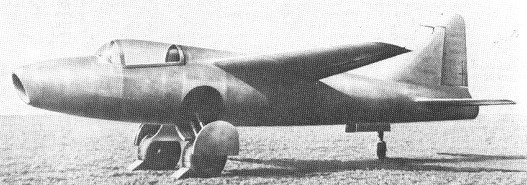
The first step in the development of this aeroplane was taken in March 1936 when Ernst Heinkel engaged the services of the German gas turbine pioneer Dr Hans Pabst von Ohain and his assistant Max Hahn. The first demonstration turbojet, the hydrogen-fuelled HeS 1, was bench running by September 1937, and a development of this engine, the HeS 3, was flight tested suspended beneath a Heinkel He 118 in 1938, using petrol as fuel, developing about 4.89kW.
By 1939, it had been decided to install a new version, the HeS 3b, in a special aircraft, the He 178, which commenced building that year; it was a shoulder wing aircraft with wings made largely of wood but with a semi-monocoque metal fuselage with fully retracting and faired in undercarriage. Tailwheel landing gear was incorporated, and the engine drew its air from an inlet in the nose and exhausted through a long jet pipe which extended to the extreme tail.
The first flight test of a jet powered aircraft took place in the morning of 27 August 1939. The Heinkel He 178 lifted off Marienche aerodrome by Flugkapitan Erich Warsitz under jet power. The jet engine: Hans von Ohain’s third prototype, the HeS 3B. In the cockpit sat Heinkel’s test pilot, Erich Warsitz. The He 178’s landing gear wasn’t retracted, so Warsitz had to keep speed down to about 200 mph. The 178 was damaged on its first flight when the engine ingested a bird which caused it to flame out, but the aircraft made a safe landing. The He 178 touched gently and rolled to stop before taxiing to where Hans and Ernst Heinkel were waiting. Hans immediately began an engine check. Heinkel watched and then announced that once the checks were complete the He 178 was to be left untouched. Heinkel’s reasoning was that the first flight was a success and, if nothing was disturbed, he’d have a functional prototype to ‘sell’ to the Berlin Air Ministry bureaucrats. The big sedan reappeared and the first jet aeroplane was towed away to storage. Then Heinkel brought out the champagne. The Heinkel flew one more time in the November of 1939 with a 590 kg (1,301 lb) thrust HeS 6 engine, but a number of airframe defects limited the speed to about 600 km/h (373 mph). It was next put in a museum in Berlin where it (and its engine) was destroyed during a bombing raid in 1943. Although two prototypes were built only the first (the V1) ever flew. Features of the design were the wooden wing (which limited high speed runs) and the angular intake (which injested FOD at a high rate from the grass at rpm above idle). Only one He 178 was built.
He-178 V1 Engine: One Heinkel HE S3B centrifugal flow turbojet, 992lb (450kg) thrust, later improved to 1,102 lb (500kg) Wing Span: 7.2m / 23 ft 7 in Length: 7.48m / 24 ft 7 in Height: 2.1 m / 6 ft 11 in Wing area: 9.1 sq.m / 97.95 sq ft Empty Weight: 1,560 kg / 3,439 lb Loaded Weight: 1950 kg / 4,400 lb Max Speed: 435 mph / 700 kph Cruise speed: 580 km/h / 360 mph Landing speed 165 km/h / 103 mph Crew: 1
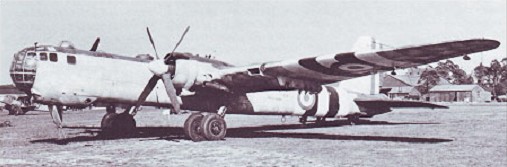
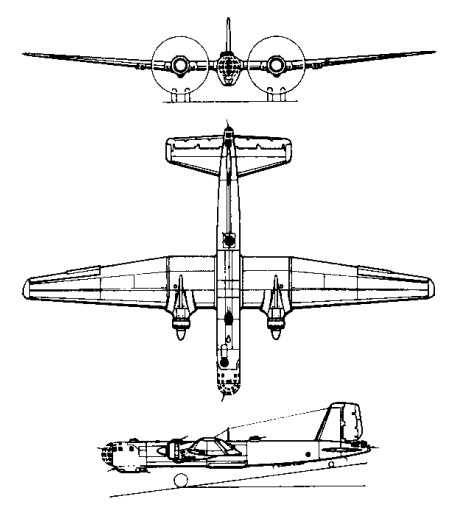
The first prototype was flown in November 1939. It was a heavy bomber, introducing a power plant in which four Daimler-Benz DB 601 12-cylinder inverted engines were grouped together in pairs to create the DB 606, each pair driving a single propeller.
Many prototypes were built, most of which displayed obvious shortcomings including dangerous diving characteristics, landing gear and structural weaknesses, and problems associated with the engines including persistent crankshaft torsional vibration, lubrication and propeller troubles: two prototypes broke up in the air and at least one caught fire.
Four years of development preceded the first production orders for the He 177.
Following a brief period of use as an emergency transport aircraft on the Eastern Front, during which time several caught fire and so earned the nickname “Flaming Coffin”. The first squadron of nine machines was sent to Stalingrad to supply the beleaguered fortress, but of the nine machines, seven caught fire and were burnt out.
The Greif began its operational career in October 1943 on anti-convoy and U-boat cooperation duties. It took part (sub-types A-3 and A-5) in attacks on England in January 1944, known as the “Little Blitz”, but as the war progressed was used to a greater extent as a missile carrier for anti-shipping duties. As the end of the war approached fewer and fewer Greifs remained operational: shortages of fuel and trouble with the engines grounding large numbers.
Although a small number of twin-finned He 177B were built in early 1944, most of the 1,160 or so Greifs produced were A-series types, although it is doubtful whether more than about 200 became fully operational in all respects. The He 177A-0 was the pilot production model, powered by two DB 606 engines (made up of four DB 601). Armament comprised two 13 mm MG 131 in dorsal and tail positions, one 7.9mm MG 81 in the nose, two 7.9mm MG 81 in a ventral position facing aft and a 20mm MG FF cannon firing forward from a “chin” position, plus 48x70kg, ten 500kg, six 1,000kg, or two 2,500kg bombs. The He 177A-1 was similar except for defensive armament, while the He 177A-3 had two DB 610 power units (four DB 603 engines), airframe changes and was equipped to carry two Hs 293 glider missiles. The final major version, the He 177A-5, was equipped to carry three Hs 293, two Hs 294 or two PC 1400 Fritz X (armour-piercing) radio-controlled missiles.
There were 40 modified He177 in Norway, May 1945 for a one way attack to USA.
A He 177 was intended for the continuance of the Me 264 steam turbine experiments. Later proposed designs had four separate engines which would have solved many of the problems, and was built as the He 277.
He 177 A Greif Length: 66.929 ft / 20.4 m Height: 20.965 ft / 6.39 m Wingspan : 103.15 ft / 31.44 m Wing area : 1097.928 sq.ft / 102.0 sq.m Max take off weight : 68355.0 lb / 31000.0 kg Weight empty : 37044.0 lb / 16800.0 kg Max. speed : 265 kts / 490 km/h Cruising speed : 224 kts / 415 km/h Service ceiling : 26247 ft / 8000 m Wing load : 62.32 lb/sq.ft / 304.0 kg/sq.m Range : 2970 nm / 5500 km Engine : 2 x Daimler Benz DB 610 A, 2910 hp Crew : 4 Armament : 3x MG 81 7,92mm, 3x MG 131 13mm, 2x MG 151 20mm, 1000kg Bomb. int., 2x HS293 Missl. ext.
He-177A-5/R-2 Engines: 2 x Daimler-Benz DB 610A/B, 2200kW Max take-off weight: 31000 kg / 68344 lb Empty weight: 16800 kg / 37038 lb Wingspan: 31.44 m / 103 ft 2 in Length: 20.40 m / 66 ft 11 in Height: 6.39 m / 21 ft 0 in Wing area: 102.0 sq.m / 1097.92 sq ft Ceiling: 8000 m / 26250 ft Range: 5500 km / 3418 miles Armament: 3 x 7.92mm machine-guns, 3 x 13mm machine-guns, 2 x 20mm cannons, 1000kg of bomb Crew: 6
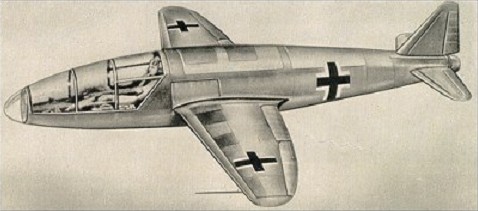
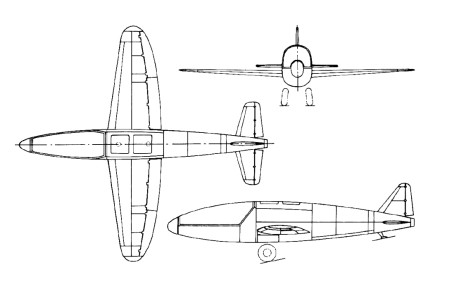
Ernst Heinkel initiated as a private venture the He 176, which was designed by Siegfried and Walter Gunter specifically for rocket propulsion. The span and area apply to the open cockpit, fixed undercarriage first prototype as originally designed; larger wings were fitted before the first flight. The speed and endurance of approx 171 mph (275 kph) and 50 sec. are those achieved on the first flight on 20 June 1939 powered by a 5.89kN Walter HWK-R1 203 liquid fuel rocket motor, although much better performances were achieved later. The He 176 was demonstrated before senior German officials early in July 1939. They remained unconvinced of the potential of rockets for aircraft propulsion. The more advanced second prototype, with enclosed cockpit and retractable landing gear was never built.
Engine: One Walter HWK R 1 203 rocket, 1,323 lb (600 kg) thrust. Wing span: 16 ft 4.75 in (5.00 m) Length: 17 ft 0.75 in (5.20 m). Height: 1.4 m / 4 ft 7 in Wing area: 58.12 sq.ft (5.40 sq.m) Gross weight: approx 3,530 lb (1600 kg). Empty weight: 900 kg / 1984 lb Max. speed: 750 km/h / 466 mph Cruise speed: 700 km/h / 435 mph Ceiling: 9000 m / 29550 ft Range: 95 km / 59 miles Crew: 1.
From the basic He 70, Heinkel evolved the He 170A in 1936. This differed chiefly in having a 910 hp Gnome Rhone 14K Mistral Major radial engine. The new engine rather spoilt the aircraft’s elegant lines, but the extra power raised the top speed by 55 km/h (34 mph), and 20 were sold to the Hungarian air force.
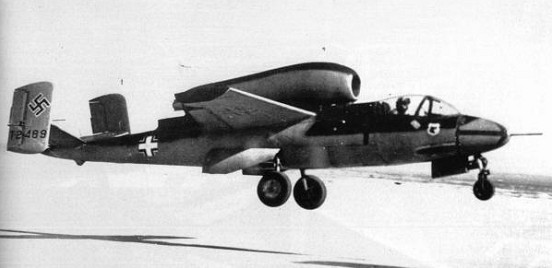
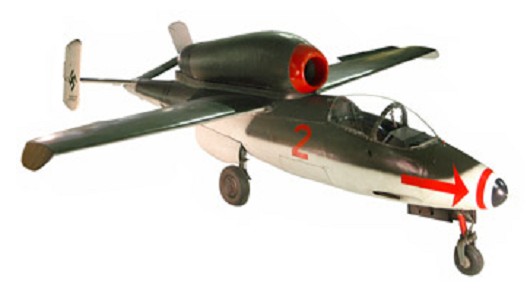
Originally scheduled for production in September, 1944, the Heinkel 162 was test flown for the first time just three months later. In such a desperate period it took just sixty nine days from the start of design work to its first flight.
The brief for the concept underlying the He 162 came from the Reichskriegsministerium (Ministry of War) who wanted fast, quantity production of a simple and effective jet interceptor as a last ditch air defence of the German homeland. Who originated the idea for what became known as the Volksjager (people’s fighter) is not clear. Albert Speer, the armament minister, is alleged to have been one of the promoters of the project, but Speer himself has said, somewhat evasively, that a proposal to establish an underground plant for the production of jet aircraft came from Fritz Sauckel, the gauleiter of Thuringen. On September 8, 1944, the brief for the Volksjager was issued to the Arado, Blohm und Voss, Fieseler, Focke Wulf, Heinkel, Messerschmitt and Junkers companies. Strong opposition to the project was voiced by aircraft designers Willi Messerschmitt and Kurt Tank and General der Jagdflieger (general of fighters) Adolf Galland. In the opinion of these critics the construction specifications and conditions were unrealistic, but despite the protests the submission date for the draft projects was brought forward by approximately a week. The specification stated that the design “had to make use of existing aircraft components, only the barest essentials to be carried in the way of equipment. The power to be supplied by a BMW 003 turbojet rated at 800 kg (1760 lb) st. Top speed to be 750 km/h (466 mph). Endurance of not less than 20 minutes at sea level. Gross weight not more than 2000 kg (4410 lb). Wing loading not more than 200 kg/sq m (41 lb/sq ft)”. These requirements were to be fulfilled with the use of readily available and, if possible, non essential mate¬rials. Unskilled and semiskilled labour was to be used on the production line. It is some indication of the desperation felt at this stage of the war that Hermann Goring, as commander in chief of the Luftwaffe, considered using Hitlerjugend (Hitler youth) members as pilots for the aircraft. Their initial flying training was to have been carried out on gliders before they converted to the jets.
A conference was held on September 15 to evaluate the submissions made by the aircraft manufacturers. Messerschmitt had refused to make a proposal, and of the others Arado’s was rejected, Focke Wulf’s was considered unrealistic (their participation had been for information purposes only), but the Blohm und Voss project was considered one of the best put forward. The Heinkel proposal was found deficient in five respects: it offered a sea level flight endurance of only 20 minutes; the unusual positioning of the engine would result in maintenance problems; the stipulated takeoff requirement had not been met; dismantling of the aircraft prior to rail transportation would take too long; and the 30 mm (1.18 in) armament specified in the brief had been changed to a 20 mm (0.79 in) cannon. After further conferences and discussions, one of which ended in a fierce quarrel between two of the participants, Heinkel were eventually authorized to produce the Volksjager and received the backing of Otto Saur, head of the war ministry’s Jagerstab (fighter staff), and Hermann Goring. Since the early summer of 1944, Siegfried Gunter and Karl Schwarzler of Heinkel had been working on a project similar to the Volksjdger a small and simple jet fighter nicknamed Spatz (sparrow). Heinkel’s qualifications for producing the He 162, or Projekt 1073 as it was initially called, were further reinforced by their work in 1939 on the He 178 experimental jet and, a little later, on the He 280.
While some of the other companies barely had time to perform basic calculations for their designs, Heinkel had been working roughly along the same lines during the summer of 1944 and had test performance data on the BMW-003, along with a full scale mock-up of their concept. There are allegations that Dr. Karl Frydag, head of the commission for airframe production and also a Heinkel company official, had not only sold the concept to Karl Saur, head of the Fighter Staff, but also may have let Heinkel know ahead of time of the upcoming specification. A curious light is thrown on the situation by a document detailing a POW interview with a Flugbaumeister Halz of the Fl.-E-2 section of the Air Ministry that purports that when the decisive report on the Volksjäger concept was being sold to Göring, certain technical documents required to support their case were lacking and Halz was ordered to have faked photos of the He-162 with the help of a cinema expert, showing an He-162 prototype executing a roll above the clouds before a prototype was even built.
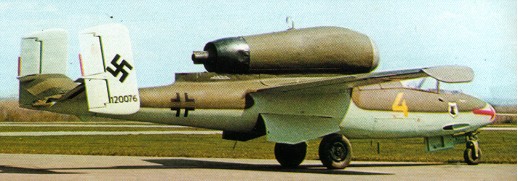
Construction of the He 162 began on September 24, 1944, with parallel work on the detailed drawings taking place. By September 30, Projekt 1073 had been ordered into quantity production with a pro¬posed monthly output of 500 to the Luftwaffe during the first thirty days of production, and eventually 1000 aircraft every month. When the drawings were completed on October 29, the first prototypes had already reached the advanced assembly stage. For the first time in aviation history, development, pre-production and series production of an aircraft occurred simultaneously. The He 162 fuselage was of light metal flush-riveted monocoque construction, and was fitted with a moulded plywood nose cap. The single piece wing was made of wood and had a plywood skin, with detachable metal wing tips. The space between the wooden spars accommodated 40-gallon fuel cells. Four bolts held the wing to the fuselage mainframes. The metal flaps, which extend along the tapered trailing edge from the fuselage to the ailerons, have a maximum depression of 45 degrees with hydraulic motivation. Tailplanes, elevators and rudder were of light metal, but the fins were wooden. The narrow track tricycle landing gear was retracted hydraulically and lowered by springs. The aircraft was powered by a BMW 003 Sturm turbojet which was attached directly to the top of the fuselage immediately behind the cockpit by two vertical bolts at the forward end, and one horizontal bolt at the rear. The cockpit was equipped with an ejection seat designed by Heinkel. The fuselage permits stowage of 168 gallons of fuel in the tail cone. After October 30, 1944, all development and factory testing had to stop and effort was concentrated on full scale production. The first flight of the prototype took place on December 6, 1944. Although a main wheel door was torn off by the slipstream, the flight was in other respects considered successful. However, at an official demonstration four days later, the pilot was killed after the starboard wing broke up in mid air. Defective bonding of the wooden components was revealed as the cause. Nevertheless, pressure was put on the company for work to continue, and up to ten prototypes (He 162A 0s) and about 20 production aircraft were tested during December 1944 February 1945. The new aircraft, which was continually compared with the Me 262, was found deficient in many respects, including bad lateral stability, sluggish controls and a high roll to yaw ratio. Enlarging the fin area alleviated the first and third problems, and although the He 162 continued to suffer from a tendency to stall, this was eventually cured by applying a pronounced anhedral to the wingtips. The facilities available for He 162 production were extraordinary, to say the least, varying from small carpentry workshops and chalk and salt mines to the renowned Sea Grotto near Vienna. There was only one main variant of the original design: the He 162A 2, armed with two 20 mm (0.79 in) MG 151 cannon positioned one on each side of the nosewheel well. The He 162A 3, like the A 1, mounted the heavier 30 mm (1.18 in) Mk 108 cannon originally specified, but this had to be abandoned since it caused too much vibration. Many other schemes included multibarrel projectile launch systems in the SGseries.
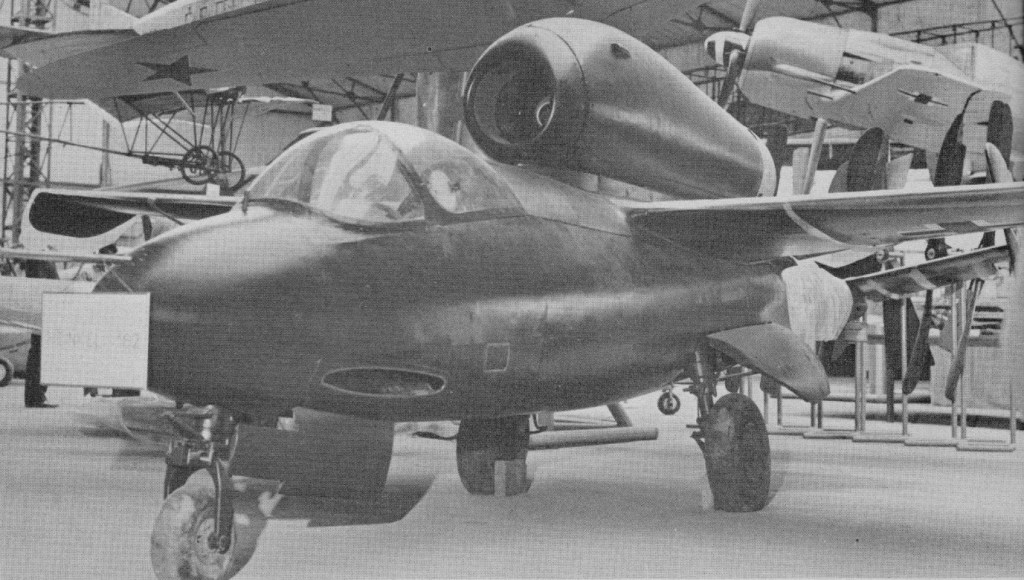
Despite the enormous numbers originally ordered, total production did not amount to more than about 275 aircraft and, so far as is known, I/JG1 was the only group to be fully equipped with the He 162 by the time Germany surrendered in 1945. During two weeks of flying ops, JG 1 (the main user of the He-162) were losing an average of one aircraft every two days due to flying accidents, pilot error, mechanical and structural failures. Operational testing had been carried out by Erprobungskorn¬mando (test detachment) 162 based at Rechlin, which after amalgamation with Adolf Galland’s famous Me 262 unit JV 44 in April 1945 was transferred to Salzburg/Maxglarn, where it was captured by the Americans on May 3. Other groups were partially equipped with the He 162 but because of lack of fuel and supplies it is unlikely that they saw any combat. The production rate for the He 162 was to be 135 per day; Rostock Marienehe and Bernburg were each to deliver 1,000 per month and the vast underground Nordhausen Mittelwerke a further 2,000. Giant salt-mines were tooled up to make the BMW 003A turbojet, which was bolted above the light alloy fuselage of streamline profile, while the woodworking industry was harnessed to make the very small high mounted wing, only the down turned tips being metal. Armament was to be two 30 mm MK 108 cannon, but because of vibration these were replaced in production by two 20 mm MG 151s. Development of the Heinkel He 162 led to the He 162C, with wing swept at 38 degrees and a butterfly tail. The He 162D was similar but featured a swept-forward wing. Neither version was built, but a model was found under construction with interchangeable wings when Schwechat was occupied by the Allies. Many variants with different powerplants and equipment were tested by Heinkel in a desperate and futile effort to produce aircraft for the defence of the Third Reich in its last days. One of the most interesting was the Mistel 5 system in which the He 162 mothercraft was to carry a jettisonable Arado ¬powered bomb beneath the fuselage but this, like the others, did not come to fruition. Only 140 had been completed by the end of the war. Only two victories were claimed for the type during its short service life and both were unconfirmed. After the end of the Second World War, He 162s were taken to Britain for study and evaluation, in the course of which another pilot lost his life in a crash landing at Farnborough. Three went to the US, and one to France where it is on display at the Musee de l’Air in Paris.
He 162 Salamander Engine: One 1,760 lb. (800 kg.) thrust BMW 003A turbojet. Wing span: 23 ft 7.75 in (7.2 m) Length: 29 ft 8.5 in (9 m) Height: 8 ft 4.5 in (2.55 m) Max TO wt: 5953 lb (2700 kg) Max level speed: 522 mph (835 kph) at 19,700 ft Ceiling 39,500 ft. (12,000 m.) Climb rate 4,200 fpm at sea level Fully loaded Range 410 miles (660 km.) Endurance: 45 min Armament 2 x 30 mm MK-108 or MG-151 cannon. Take off distance 875 yards Take off distance JATO 415 yards
He 162A 2 Engine: one 800 kg (1,764 1b) thrust BMW 109 003E 1 or E 2 turbojet. Max speed: 835 km/h (519 mph) at 6000 m (19,685 ft) Initial climb rate 1290 m (4,230 ft) per minute Service ceiling about 11000m (36,090ft) Max range 1000 km (621 miles) Empty wt: 1750kg (3,8581b) MTOW: 2700 kg (6, 952 lb) Wing span 7.20 m (23 ft 7.5 in) Length 9,05 m (29 ft 8.5 in) Height 2.55 m (8 ft 43/8 in) Wing area 11.15sq.m (120.0 sq.ft) Armament: two 30 mm MK 108 or two 20 mm MG 151 cannon in nose.
He 162 A-2 Salamander / Volksjäger Engine : BMW 003 E-1, 7848 N Length : 29.659 ft / 9.04 m Height : 8.497 ft / 2.59 m Wingspan : 23.622 ft / 7.2 m Wing area : 120.557 sq.ft / 11.2 sq.m Max take off weight : 5931.5 lb / 2690.0 kg Weight empty : 4520.3 lb / 2050.0 kg Max. speed : 452 kt / 838 km/h Service ceiling : 39370 ft / 12000 m Wing load : 49.2 lb/sq.ft / 240.0 kg/sq.m Range : 526 nm / 975 km Endurance : 1 h Crew : 1 Armament : 2 MG 151 20mm

 All Aero