William A. Baker had undertaken the construction of the six seat Henderson HSF 1 (G ABVF) and all three of the Henderson Glenny Gadfly monoplanes which were also designed by K. N. Pearson, M.C., AFRAeS.
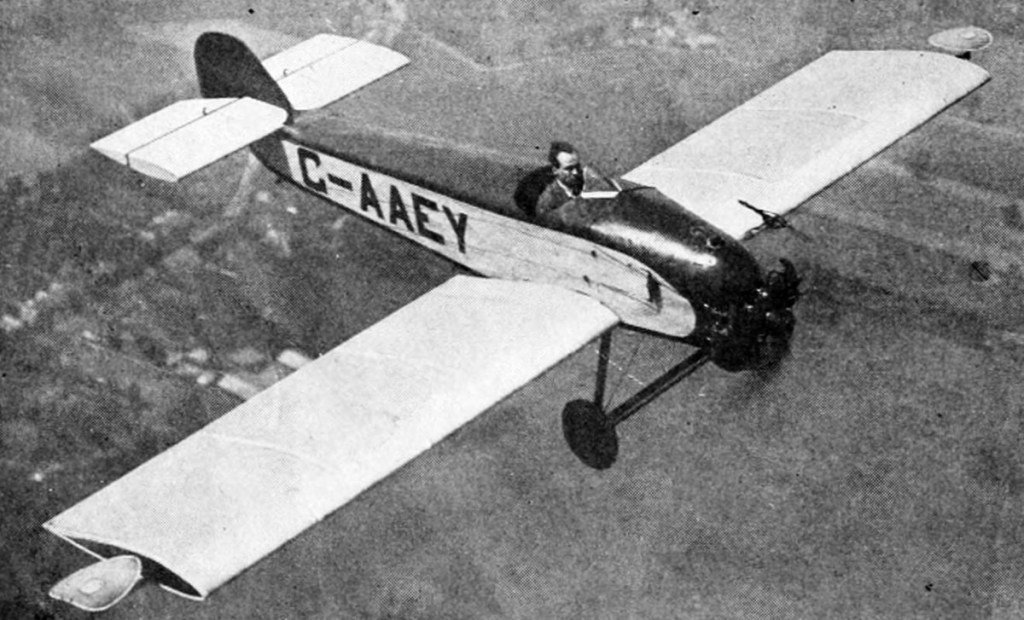
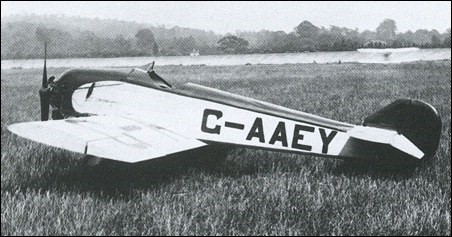
Glenny & Henderson company at Byfleet, Surrey, UK, built a Mk.I standard aircraft G-AAEY c/n 1. It was first flown in April 1929, at Brooklands. It was converted to Gadfly Mk.II statue later that year. It was scrapped in June 1934.
The second built was c/n 2 G-AARJ, built ads a Mk.II. This was as the Mk.I but fitted with Pearson rotary ailerons. It first flew in August 1929, from Brooklands. In 1930 it was sold in Canada as CF-AMG but was written off on 25 August 1931.
One aircraft was built as a Mk.III, like the Mk.II but fitted with a Salmson AD.9 radial engine. G-AARK was first flown in late 1929, at Brooklands. It was withdrawn from use in 1930 and put into storage at Brooklands until scrapped there in 1933.
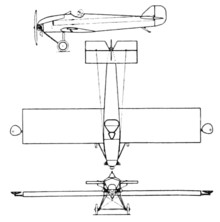
Mk.I G-AAEY c/n 1 Engine: A.B.C. Scorpion Span: 25.10 ft Length: 17.10 ft
Mk.II G-AARJ c/n 2 Engine: A.B.C. Scorpion Span: 25.10 ft Length: 17.10 ft
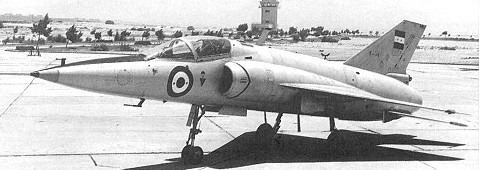
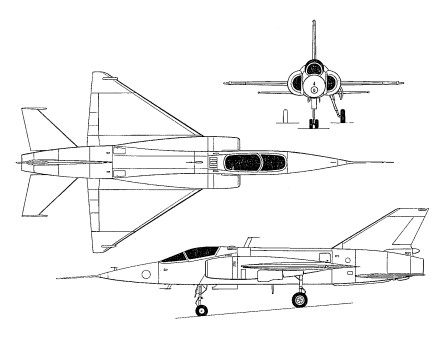
Originally conceived to meet a Spanish Ejercito del Aire requirement for a small M=1.5 interceptor and the design responsibility of a Germano-Spanish team supervised by Prof Willy Messerschmitt, the HA-300 programme was transferred to Egypt. Here development and construction was undertaken in Factory No 36 at Helwan, this being controlled by the Egyptian General Aero Organisation (EGAO). Originally designed for the proposed afterburning Orpheus BOr 12 turbojet, the HA-300 was modified for the Brandner-designed E-300 with a calculated afterburning rating of 4800kgp. The first V.1 prototype, powered by a 2200kgp Orpheus 703-S-10, was flown on 7 March 1964, a similarly-powered second V.2 prototype flying on 22 July 1965. The version flew supersonic.
The definitive third prototype with the E-300 engine commenced taxi trials in November 1969, but the HA-300 programme was then terminated without flight testing of this prototype being undertaken. It was anticipated that the E-300-powered HA-300 would be capable of attaining 12000m and M=2.0 within 2.5 min of take-off. The Orpheus-powered prototypes achieved approx M=1.13 during flight test.
Egypt’s HA-300 was test flown in the Spring of 1964 by an Indian pilot, showing no appreciable advantages over the MiG-21.
The HA-300 V.1 is displyed in the Deutsches Museum – Oberschleissheim and the Ha-300 V.2 and V.3 remained in Cairo.
Wingspan: 5.84 m / 19 ft 2 in Length: 12.40 m / 40 ft 8 in Height: 3.15 m / 10 ft 4 in Wing area: 16.70 sq.m / 179.76 sq ft Max. speed: 1490 km/h / 926 mph
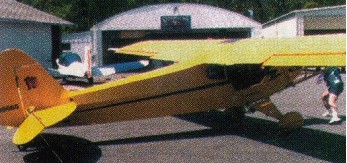
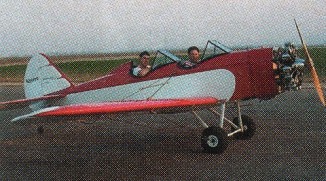
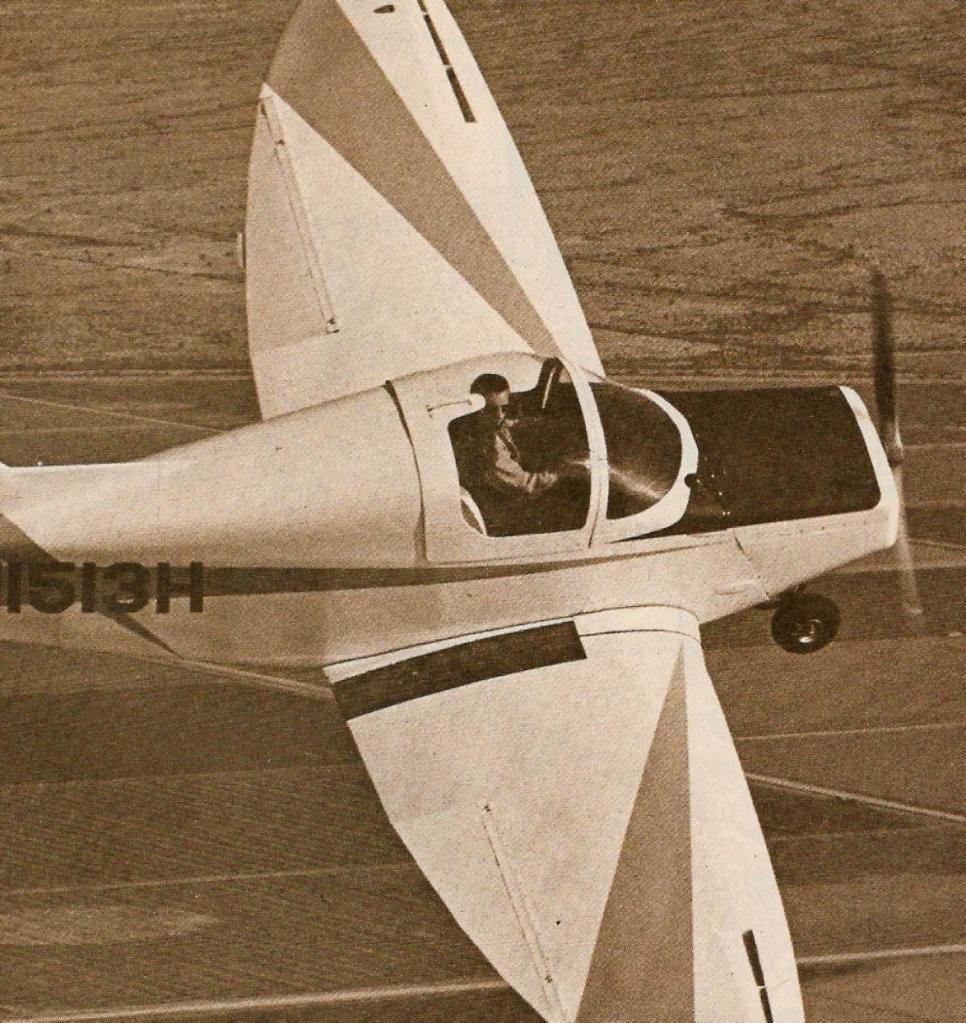
When Culver went out of business in 1946 the rights were bought by Superior Aircraft Co and then sold to California Aero Co of Tracy. They revived the model in 1966 as the Helton Lark 95 with a 90hp Continental C 90 16. Dimensions were similar to the Cadet, though the overall height was 6ft 10in due to the tricycle gear.
There is some doubt as to how many Larks were built, but seventeen constructor’s numbers were allotted and not all may have been completed. The last to be built, c/n 9517, was N5017J.
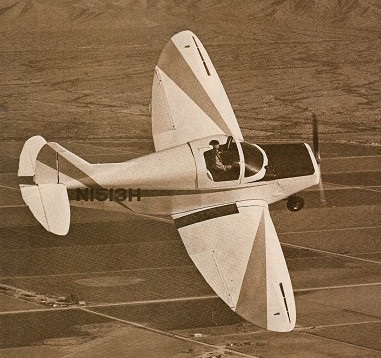
Further developments on the drone theme followed the PQ 8 and the NR D was built as the PQ 14A and PQ 14B for USAAF use and as the TD2CA for the Navy (which used a few TDCs from PQ 8 contracts). About 2,570 were built for use by the two services. Basic power was the 150hp Franklin O 300 11.
Post war limited type certificate LTC 28 was granted in December 1947 and a few were registered, there being eleven listed in the 1959 statistical survey, and one, N4744N was still in existence fairly recently There was a strong similarity with the Cadet, but the fuselage was lengthened and a larger fin and rudder fitted to counter increased power, plus tricycle undercarriage.
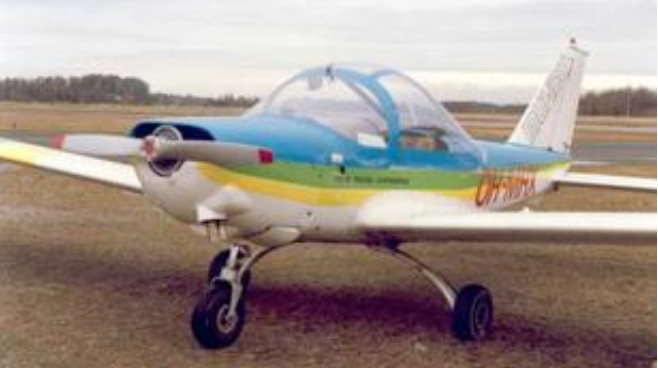
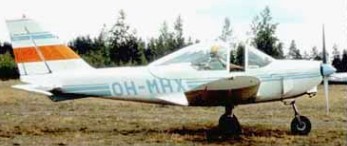
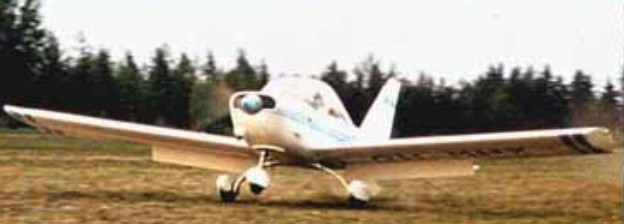
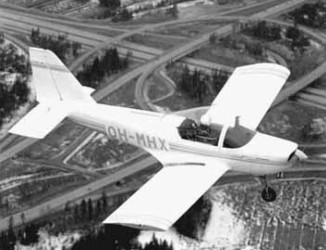
The PIK-19 Muhinu was a light aircraft developed in Finland in the early 1970s for use as a glider tug and flight trainer. It was a low-wing cantilever monoplane of conventional configuration, with an enclosed cockpit and fixed, tricycle undercarriage. Its construction was of composite materials throughout, a novel approach at the time. Some unique design details were used in the construction of the Muhinu -e.g., the wing was made of one-meter (3 ft) panels, thus avoiding big female molds for the wing. Both the fuselage and wing were made of glass-epoxy- honeycomb sandwich. The main landing gear was also made of fiberglass-epoxy by the filament winding process.
When the PIK-19 flew for the first time in 1972, it was only the fourth aircraft in the world made of these materials.
The project was undertaken as a joint venture by the Finnish government and the Helsinki University of Technology. Its “PIK” designation belongs to a sequence of designations applied to the aircraft designed and built by the university’s gliding club, Polyteknikkojen Ilmailukerho, although this was not a project by the club. Design work commenced in 1969 under the leadership of Jukka Tervamäki, Ilkka Rantasalo and Pekka Tammi and the prototype flew on 26 March 1972. This project involved many skilled young engineers and graduates from the University: Ilkka Rantasalo, Pekka Tammi, Hannu Korhonen, Markku Hiedanpää, Erkki Haapanen, Olof Lagerkrantz, etc.
In 1978 the Pik-19 was re-powered with a 180 hp Lycoming 0-360 engine.
Plans for production in series were never realised, and the single prototype (OH-MHX) was the only example ever built. Over the next 21 years, it accumulated 5217 hours of flying time and some 40,000 glider tows. It was destroyed in a crash in June 1994 when the engine failed at low altitude.
Engine: 1 × Lycoming O-320-B2BC, 120 kW (160 hp) Propellers: 2-bladed McCauley1A-175/GM-8241 for towing and 1C-172/MGM-7657 for other tasks, Both fixed pitch, metal blades. Length: 6.90 m (22 ft 8 in) Wingspan: 10.00 m (32 ft 10 in) Height: 2.60 m (8 ft 6 in) Wing area: 14.00 sq.m (150.7 sq ft) Aspect ratio: 7.14 Airfoil: NACA 632415 Empty weight: 560 kg (1,235 lb) equipped Max takeoff weight: 840 kg (1,852 lb) Fuel capacity: 150 L (33 Imp gal; 40 US gal) Maximum speed: 240 km/h (149 mph; 130 kn) Cruising speed: 220 km/h (137 mph; 119 kn) maximum, 75% power Stall speed: 83 km/h (52 mph; 45 kn) flaps down Never exceed speed: 310 km/h (193 mph; 167 kn) Range: 950 km (590 mi; 513 nmi) maximum fuel, no reserves, 65% power Rate of climb: 7.00 m/s (1,378 ft/min) Wing loading: 60.0 kg/sq.m (12.3 lb/sq ft) Take-off to 15 m (50 ft): 240 m (787 ft) Landing from 15 m (50 ft): 220 m (722 ft Crew: Two
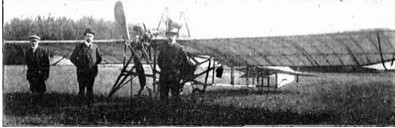
This monoplane had a 25 hp Hilz engine, a span of 10 m and an overall length of 9 m. It made jumps of 100 m in 1911, but the builder, Theodor Hellmund of Siegburg, Germany, considered fitting a more powerful engine.
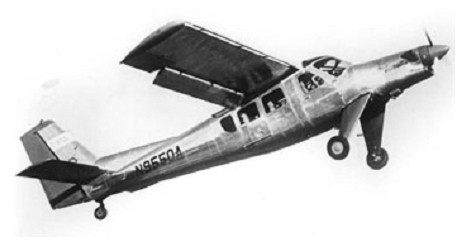
The Stallion is specifically designed for operation from unprepared fields and is equipped with a full complement of STOL devices. Design of the Stallion began in 1963, and the first models were produced in 1966. The Stallion is powered by a single 680-ehp turboprop engine driving a three blade reversible-pitch prop and fed by wing tanks with a capacity of 120 gallons. Its all-metal cantilevered wings are equipped with high lift slotted all-metal flaps, fabric-covered balanced ailerons, and full-span automatic leading-edge slats. The tail unit features a one-piece horizontal surface with combined trim and antibalance tab. The cabin is protected by a crash-resistant tubular frame. The Stallion’s accommodations provide for a pilot and copilot up front with either eight passengers on bench seats or six passengers seated individually. Access is made through a door on the port side near the pilot, an optional starboard door, and a double cargo door on the port side. The double door is in two sections—the forward half hinges and the rear half slides. The rear half can be opened during flight for cargo drops or parachutists.
THE Credible Chase programme, an off shoot of Pave Coin, in which a number of aircraft were evaluated by the USAAF at Eglin AFB in order to come up with a new light-strike attack aircraft for the South Vietnamese Air Force, resulted in a 15 each order for the Helio Stallion and Fairchild Peacemaker. These aircraft, carrying the designations AU 24 and AU 23 respectively, are militarised versions of their commercial counterparts, but have increased gross weights, underwing and fuselage hardpoints and Gatling guns firing from the cabin doors. In the case of the Helio AU 24 the prototype was modified and tested by Kaman Aerospace under contract from Helio, although Helio supplied the test pilot. Kaman has stressed the aircraft to a new gross weight of 6,300lb, 2,860kg as well as adding two hardpoints under each wing and one fuselage centreline point. The AU 24 can carry 300lb, 135kg on the outboard pylons and 600lb, 270kg inboard, plus 500lb, 225kg on the fuselage centreline. Ordnance can include single bombs, cluster bombs, FFAR launchers and machine gun pods. The AU 24 is powered by a UAC PT6A 27 of 680 shp, 508kW. The AU 24 has a speed range of from 42 mph, 68km/hr to over 200 mph, 320km/hr. The Stallion is basically the same aircraft as the Courier the wing planform is identical but span is increased from 39ft, 11.9m to 41ft, 12.5m.
H-550A Stallion Engine: P&WAC PT6A-27, 680 hp. Seats: 10. Wing loading: 21.1 lb/sq.ft. Pwr loading: 7.5 lb/hp. Gross wt: 5100 lb. Empty wt: 2860 lb. Equipped useful load: 2090 lb. Payload max fuel: 1280 lb. Range max fuel/cruise: 360 nm/1.9 hr. Range max fuel / range: 483 nm/ 3.5 hr. Service ceiling: 25,000 ft. Max cruise: 179 kt. Max range cruise: 140 kt. Stall: 36-41 kt. 1.3 Vso: 47 kt. ROC: 2200 fpm. Min field length: 750 ft. Takeoff distance (50′) 660 ft Landing distance (50′) 750 ft Fuel cap: 810 lb. Ceiling 25,000 ft
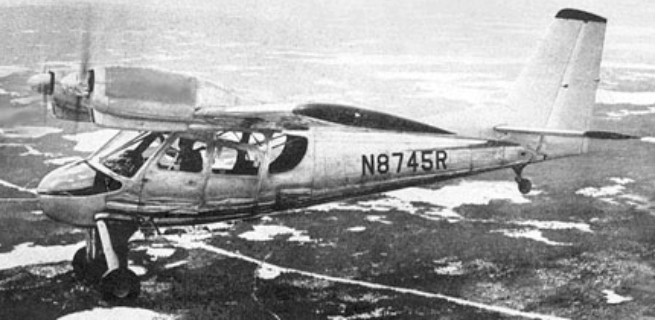
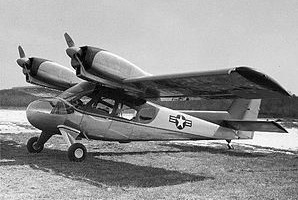
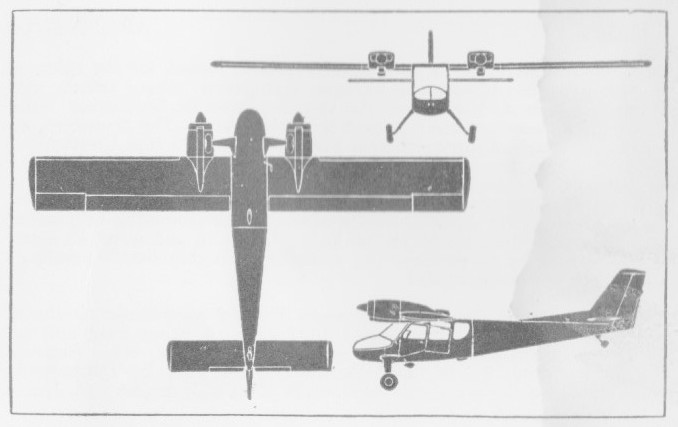
Known by Helio as the model H-500 this STOL aircraft mounted twin Lycoming engines on top of the high-set wing, close to the fuselage. With the engines mounted in this manner, lateral and over-the-nose visibility were much improved while the propellers were kept clear of cabin doors and away from possible debris damage during rough field operations. This was a tail-wheel design, so the vertical component of propeller thrust assisted STOL take-off performance from rough fields. Fully automatic full-span, leading-edge slats were fitted along with high-lift flaps.
Full span automatic leading slots are monocoque and hollow. Spoilers or “interceptor” blades protrude through upper surface of the wing, forward of main spar. They are interconnected with the ailerons and rise only when aileron is deflected more than 4 degrees. Magnesium is usd as a weight saver n the rudder and horizontal tail in the skins aft of the main spar on each surface. Horizontal tail is one piece all-flying type with anti-balance and trim tab. Vertical stabiliser is sweptback 25.5 degrees.
Flown for the first time in 1960, Faa certification was obtained late in 1963.
In 1964 the USAF Air Commandos were testing the Helio U-5A at Hurlburt AFB (Fla). The USAF ordered seven for tests.
In 1967 or 68, work was started on a redesign of the Twin Courier in a tricycle-gear configuration for the commercial market, since many firms which desired STOL capability had regulations which required multi-engine aircraft. The company ran out of money and the project was terminated.
The aircraft structure of the Helio Stallion, a single-engine turboprop version of the more successful Helio Courier, was based on the design of the Twin Courier.
The Twin Courier could seat six and first flew in April 1960, being awarded FAA certification on June 11, 1963. (The Twin Courier met FAA requirements marginally and was certificated to meet immediate needs for service in Vietnam, on the understanding that the design would not be marketed commercially. Thus, the redesign.) Only seven examples were built, these receiving the United States Armed Forces designation U-5A. One was reported to have been evaluated by US Army Special Forces.
U-5A Twin Courier
Official Air America records preserved at the Air America Archives do not mention such an aircraft, but there are three ways to explain why Twin Couriers were mentioned to have been in service with Air America: In the summer of 1965, Air America pilot William Andresevic, who had flown the regular Helio extensively in Laos, was ordered to fly a Helio Twin Courier to Bolivia for evaluation by the US Embassy. After some operational use in Bolivia, it was returned to an airstrip in Virginia. In 1962, the USAF evaluated 2 U-5A Twin Couriers, 59-5955 and 59-5956, at Hulburt for use by the air commandos. “90336” is possibly a fake serial for 59-5956.
Operators were Aviation Research Centre, India, Indian Intelligence Bureau, Air America, CIA and United States Air Force.
U-5A Twin Courier Powerplant: 2 × Lycoming O-540-A2B or -C2C air-cooled flat-six, 250 hp (190 kW) each Propellers: 2-bladed Hartzell, 7 ft 0 in (2.13 m) diameter Length: 32 ft 0 in (9.75 m) Wingspan: 41 ft 0 in (12.50 m) Height: 8 ft 10 in (2.69 m) Wing area: 242 sq ft (22.5 m2) Empty weight: 3,126 lb (1,418 kg) Max takeoff weight: 5,850 lb (2,654 kg) Maximum speed: 185 mph (298 km/h; 161 kn) at sea level Cruise speed: 166 mph (144 kn; 267 km/h) (econ cruise, 60% power) at 10,000 ft (3,050 m) Range: 1,500 mi (1,303 nmi; 2,414 km) (max fuel) Service ceiling: 19,500 ft (5,944 m) Rate of climb: 1,640 ft/min (8.3 m/s) Crew: 1 Capacity: 5 passengers

 All Aero