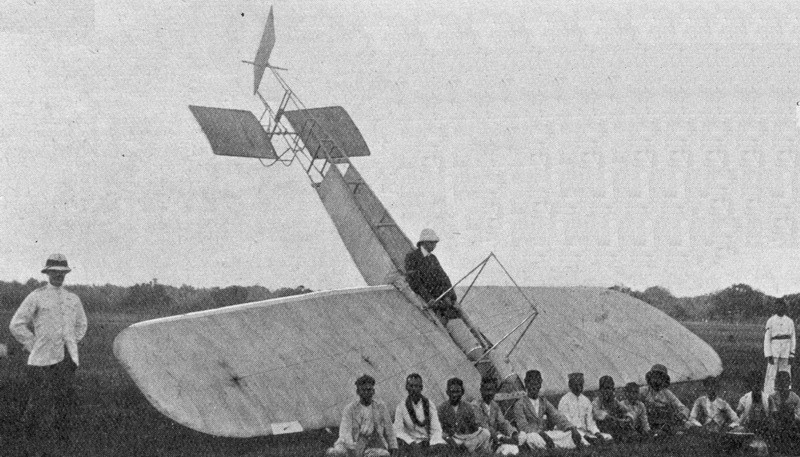
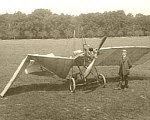
Wilfred Wills, motor engineer of Messrs Addison and Co., Madras, India, built a Blériot-inspired monoplane, powered by a 20 hp Ford engine, in four weeks. It was tried out on 2 November 1910 on the Island at Madras.
Although there was a strong wind blowing Wills succeeded in making three very short flights. During the last one the machine was somewhat damaged, but the repairs were put in hand at once and two days later a further trial was made with the result that a flight of 30 yards at the rate of 35 to 49 miles an hour.
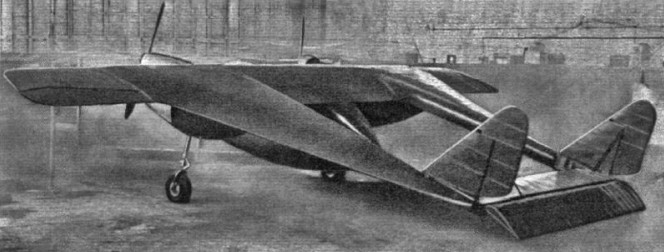
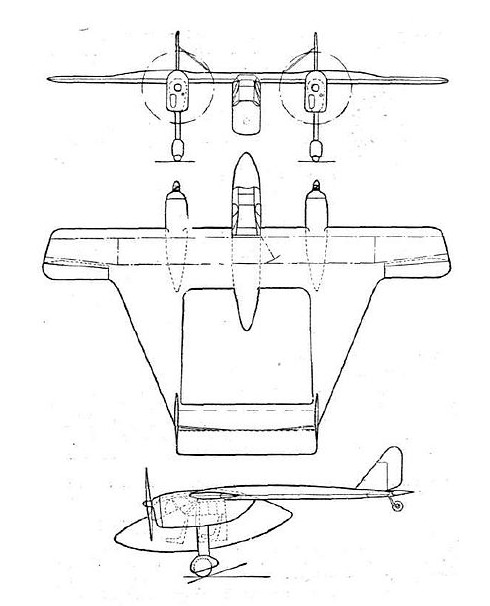
From about 1937, the London-based Willoughby Delta Company was considering the construction of a flying wing airliner. Early in 1939, the Delta 9 was to be a tri-motor monoplane with a span of over 100 ft (30 m) with a thick and wide chord centre section, outboard of which the wing was thicker and much greater in chord, in part forming one of a pair of tail booms that carried the double finned empennage. Its trailing edge was at about 20° to the centre line, continuing forwards then turning through 70° to produce the trailing dge of the outer wing section. This was narrower in chord than the centre section. The Delta 9 was seen as a realistic approximation to a true flying wing, with its advantage of a well-distributed load because of the absence of parts like a fuselage which did not contribute to lift. There was also the intention of producing an aircraft that was essentially stall-free.
The unusual design called for a lot of preparatory wind tunnel work, carried out in the UK at the National Physical Laboratory, the City & Guilds, Farnborough and Queen Mary College, London. Valuable pressure distribution measurements were made in the United States at the Guggenheim Institute of New York University. The results were encouraging, producing for example curves of lift coefficient versus angle of incidence that increased linearly in the normal way and then flattened without the usual decrease in lift associated with the stall. It appeared that, at high speed and low angles the forward part of the wing provided most of the lift, but as the stall approached the rear part contributed more. These results encouraged the company to build the Willoughby Delta 8 to investigate the general aerodynamics of the layout with a smaller aeroplane. The exact name seems to be uncertain: the contemporary (February 1939) Flight article calls it Delta 8, in line with the airliner named as Delta 9, but the registration documents from that January refer to the Delta F and the latter name has been widely used. The design had first been announced in Flight in 1937 as the Delta F. The Delta 8 was not a scale model of the proposed airliner, but the arrangement of its lifting surfaces was similar.
A twin-engined aircraft constructed of wood, the Delta 8 was a twin boom machine. It had a central nacelle, almost elliptical in profile, suspended beneath the wing and containing the glazed cabin. This had tandem seats, accessed via a starboard side door. The wings were built around two conventional transverse spars, unusual only in becoming deeper between the outer boundary of the centre section and the inboard limit of the narrow chord outer sections. The latter carried ailerons over the whole of its trailing edges. The longitudinal spars of the “side wings”, acting as booms, slipped into slots cut into the transverse wing spars. On each side, three longitudinal and very long chord ribs, plus a stiffening diagonal rib that ran to the rear end of the side wing, formed the aerofoil section of these wings. The transverse section of the side wings was also aerofoil shaped, blunt on the inner edge and fine outboard.
Two 125 hp (93 kW) Menasco Pirate C.4 four-cylinder air-cooled inline engines driving two-bladed propellers were mounted against the underside of the wing in steel cradles, at the points where the wing thickness increased. There was a wooden fairing behind, through which ran, to the front spar, the cantilever fixed main undercarriage legs, faired and spatted. The tailplane joined the rearmost inner edges of the side wings, carrying the tailwheel at its centre, and a broad elevator hinged clear of the rest of the structure. Small fins mounted over the tailplane carried balanced rudders, their overall profile almost triangular. The fins were externally braced to the tailplane.
The Delta 9 as described in Flight was expected to carry 36 passengers in two side wing cabins for a gross weight of 38,000 lb on three 1,000 hp engines. The cabins were expected to be have at least a 6 foot headroom but lacked side windows.
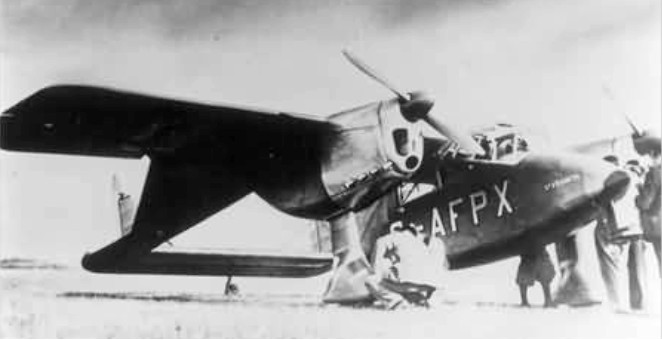
The design was constructed at Minster Lovell between Witney and Burford, and first flew on 11 March 1939 at Witney, registered as G-AFPX and named “St Francis”. On 14 May 1939, piloted by A.N. Kingwill, it was demonstrated at the Royal Aeronautical Society’s garden party fly-in at Great West Aerodrome, also at Heston Aerodrome. On 10 July 1939, it crashed near Bicester, killing the pilot Hugh Olley and the Delta’s designer, Percival Willoughby. The crash was not attributed to the novel configuration but to an ill-designed elevator trim tab that sent the Delta into a dive. With the death of the designer and the coming of war, no more was heard of this type of flying wing.
Delta 8 Engines: 2 × Menasco Pirate C.4, 125 hp (93 kW) Wingspan: 34 ft 6 in (10.52 m) Length: 26 ft 1 in (7.95 m) Empty weight: 1,585 lb (719 kg) Gross weight: 2,350 lb (1,066 kg) Maximum speed: 183 mph (295 km/h; 159 kn) Cruise speed: 165 mph (143 kn; 266 km/h) Stall speed: 60 mph (52 kn; 97 km/h) Range: 340 mi (295 nmi; 547 km) Crew: 2
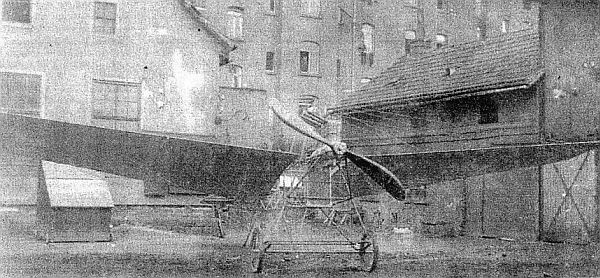
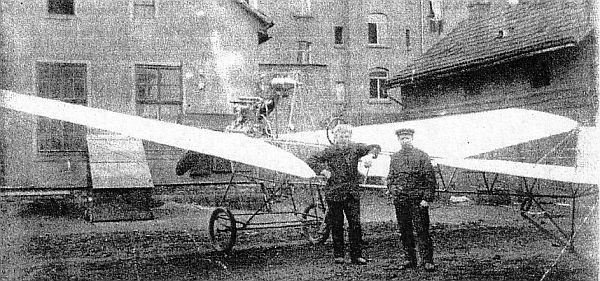
Karl Willing’s third monoplane and first Gotha aeroplane. Willing had already built two monoplanes, when in 1912, lacking money for further work, asked for help from the Gothaer Waggonfabrik (Thüringen). This third monoplane was built in the old Gothaer Waggonfabrik shops and was powered by a 70 hp RAW engine. The machine was offered to the army but refused before it was ever flown, and apparently it never was.
In 1936, Paul Williams built the single place open cockpit monoplane racer 750-PW. Powered by a 300hp Lycoming and registered N15781 c/n WX-21R, it first flew on 9 May 1936. The registration was cancelled on 1 June 1937.
In 1928 Geo. Williams Airplane & Manufacturing Co built the C-4, featuring four passengers in an enclosed cabin, and pilot in an open cockpit behind the wing.
A high wing monoplane, the first flight was in October 1928.
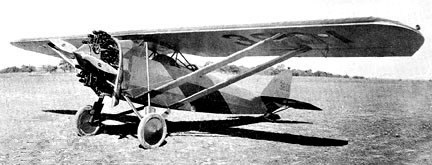
In 1926 a prototype of the Commercial-Wing was designed by George Carroll and George Williams and built. A single place, open cockpit, high wing monoplane, it was powered by an 80hp (later 120hp) LeRhône rotary engine.
Designed by George Carroll and George Williams, four planes were made with the Wright engine (c/n 101 registration NC173, c/n 102 registration NC2506, c/n 104 registration NC5185, c/n 105 registration NC138N), one with a Hisso (c/n 103 – registration NC3801), and one with a 100 hp Curtis OXX-6. This later one could be a Sportsman or the NC6525 registration aircraft.
The 1927 Texas-Temple Commercial-Wing cost $10,500 with an inertia starter, brakes and metal prop.
The 1928 Speed-Wing carried 1 passenger and was a Commercial-Wing for carrying mail. It took a 500 lb payload over a 500-mile range. The plane cost $9,500. It was advertised as a 1 or 2 person sportplane. The first plane was powered by a 150 hp Hisso A engine and had a 39’4″ wingspan. No registration found, but it could be the Commercial-Wing registration NC3801.
Continental Airways of Cincinnati used the Temple Company’s Commercial-wing model almost exclusively. Other models followed, including the much-ballyhooed Sportsman. The Sportsman was touted by British aviation enthusiast Lady Mary Heath as “the best performing airplane its class today.” Her endorsement might mean more to history if Lady Heath had ever met an airplane she didn’t like. During her stay in America, she declared every plane she flew to be a marvel of aviation engineering.
A contract that might have saved the company – delivering air mail between Dallas and Fort Worth and San Antonio and Houston — was awarded instead to Bowen Air Transport. Bowen then took over a hangar at Meacham Field in Fort Worth, a hangar Temple Aero had bought.
The Depression hit the aviation industry early and hard. Companies that had signed contracts with Texas Aero were hard-pressed to honour those contracts.
Operating exclusively out of Temple, Aero scaled back its operation to concentrate exclusively on production of the Sportsman model and the training of student pilots. Three 1929 Sport / Sportsman were built: prototype N480 c/n 1, N852H, and N987N c/n 107.
Commercial-Wing Engine: 220 hp Wright J-5 Wing span: 39’4″ Length: 25’10” Useful load: 950 lb Max speed: 130 mph Cruise speed: 112 mph Stall: 35 mph Range: 550 mi Ceiling: 18,500 ft Seats: 2-3
Sport / Sportsman Engine: Cirrus Mk III, 100hp Seats: 2
Speed-Wing Engine: Hisso A, 150hp Wingspan: 39’4″ Useful load: 1055 lb Payload: 500 lb Max speed: 135 mph Cruise speed: 120 mph Stall: 42 mph Range: 500 mi Seats: 1-2
 All Aero