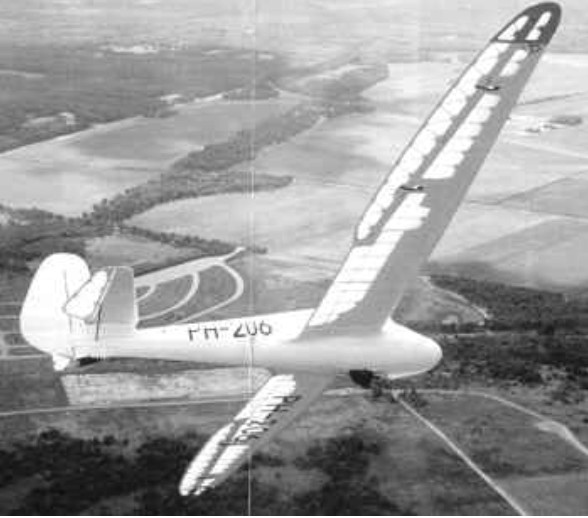
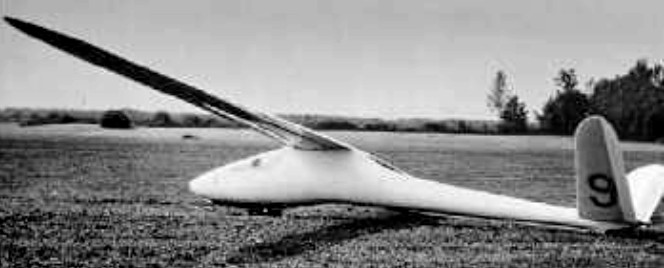
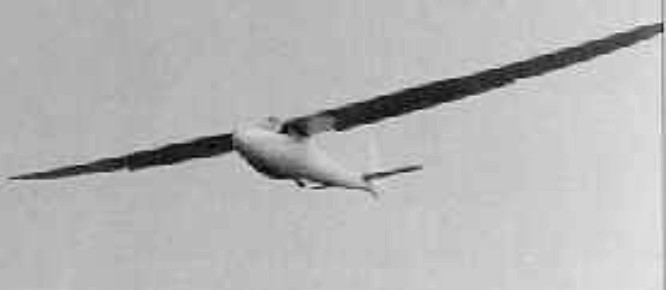
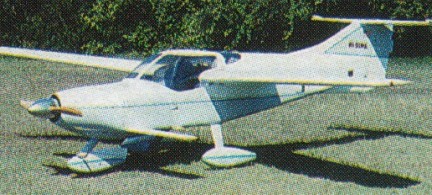
A development of the 10m straight wing LO-100 aerobatic glider, the LO-150 features a two- piece, plywood covered, single spar wing and uses flaps for glidepath control. Designed by Alfred Vogt, the fuselage is a wooden monocoque with a cantilever tail. Early models had a skid and jettisonable dolly instead of a fixed main wheel. A.J. Smith won the 1961 Nationals in a LO-150 and Harold Jensen flew another 700 km/ 435 miles to win the 1962 Barringer Trophy.
Wing span: 15 m / 49.2 ft Wing area: 10.9 sq.m /117 sq.ft Aspect ratio: 20.6 Airfoil: Clark Y Empty Weight: 100 kg / 441 lb Payload: 110 kg / 242 lb Gross Weight: 310 kg / 683 lb Wing Load: 28.44 kg/sq.m /5.8 lb/sq.ft L/DMax: 34 105 kph / 57 kt / 65 mph MinSink: 0.68 m/s / 2.2 fps / 1.24 kt No. Built: 15 Seats: 1
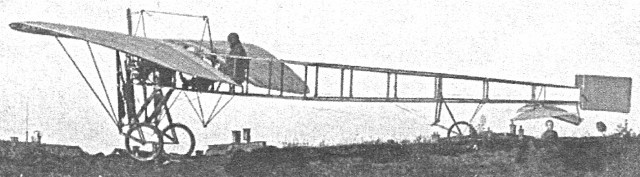
Hellmuth Hirth worked for a short time as a foreman at aviation pioneer August Euler in Darmstadt. However, since Euler had difficulties with his Voisin-type flying machine, Hirth returned to Stuttgart to build himself a Blériot machine in 1909. Because of the too weak engine, this did not go beyond small aerial jumps, causing Hirth to go to Vienna to fly the Etrich Taube together with Illner.
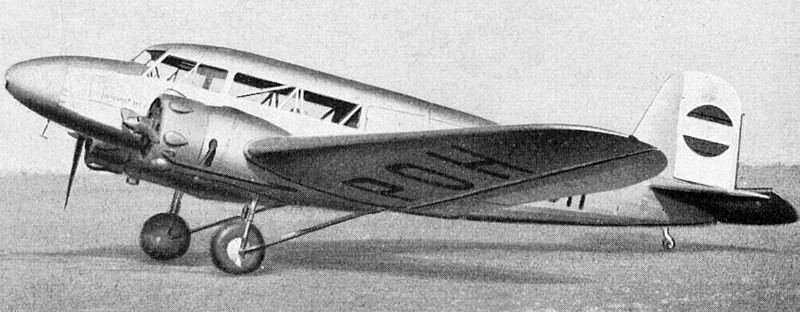
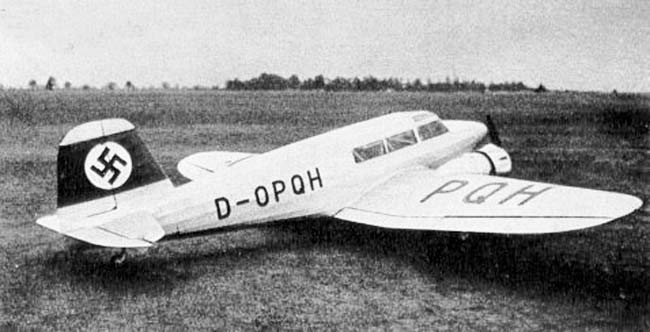
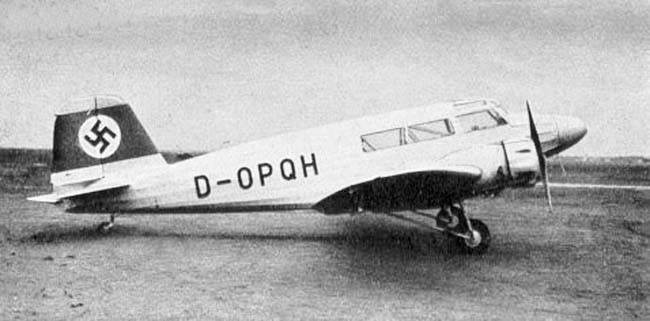
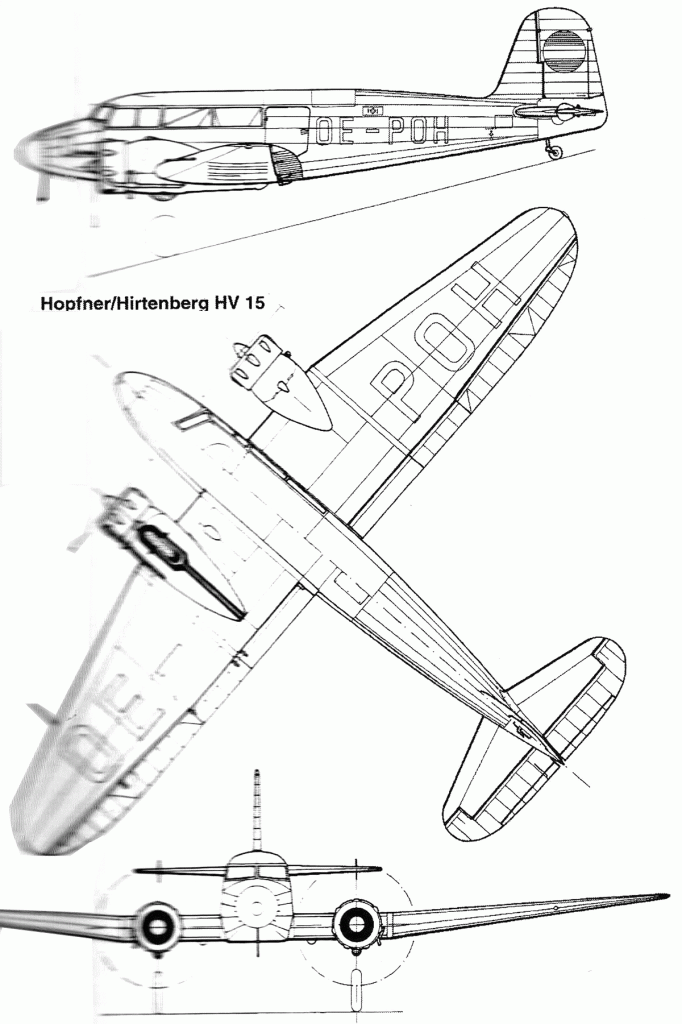
In 1935, the management of the Austrian company Hirtenberger Patronen, Zundhutchen und Metallwarenfabrik AG decided to expand the production of aircraft of its own design and bought the aircraft company Flugzeugbau Hopfner GmbH. The first aircraft, accepted for serial production, was a small twin-engine monoplane, designed for the carriage of passengers or the transport of small loads. The design of the new Hopfner / Hirtenberg HV.15 machine was based on the elements of the previous Hopfner HR.14 / 34 aircraft, developed by the engineer Lumpich in 1934 at Flugzeugbau Hopfner GmbH.
It was a low-wing with a glazed, six-seat, cabin and retractable landing gear. The wing had a wooden structure, and the fuselage was steel tube, fabric covered.
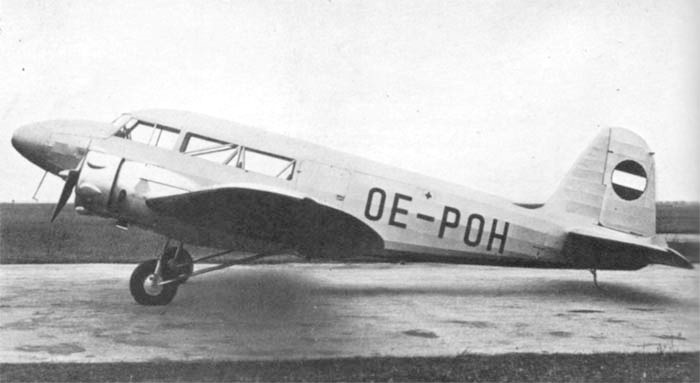
The prototype HV-15 (OE-POH) made its first flight on March 8, 1936. The aircraft was equipped with Austrian-produced Siemens Sh-14a motors (160 hp / 119 kW). Serial production were supposed to get English de Havilland “Gipsy Six” II (204 hp).
Austrian designers planned the release of the military version of NM.15, equipped with French engines of Renault “Bengali Six”, radio navigation equipment and defensive weapons, consisting of 2-3 moving machine guns placed in the fuselage. Suspension of small bombs with a total mass of up to 300 kg was envisaged. The main purpose of NM.15 was the training of pilots and navigators (including for night flights), and also considered the option of using it as a light bomber.
Serial production of HV.15 and NM.15 aircraft did not take place. After the annexation of Austria, its aviation industry underwent a reorganization, and the merger of Hirtenberg became part of the new Wiener-Neustadter Flugzeugwerke GmbH (abbreviated to WNF).
According to the new notation system, HV.15 was renamed to WN-15 (sometimes called WNF 15) and assigned the German registration D-OPQH. The prototype was then transferred to the use of the Austrian police. After flying about three years in Austria, the Wn.15 aircraft was given in 1942/1943 to the German administration of the Croatian Air Force and used some time for transport purposes, bearing a new tactical number 2101. Nothing is known about the future fate of Wn.15.
Engines: 2 × Siemens-Halske Sh 14A, 120 kW (160 hp) each Wingspan: 15 m (49 ft 3 in) Wing area: 33 m2 (360 sq ft) Length: 10.65 m (34 ft 11 in) Height: 2.9 m (9 ft 6 in) Empty weight: 1,550 kg (3,417 lb) Gross weight: 2,200 kg (4,850 lb) Maximum speed: 235 km/h (146 mph; 127 kn) Cruise speed: 198 km/h (123 mph; 107 kn) Range: 900 km (559 mi; 486 nmi) Service ceiling: 5,200 m (17,100 ft) Crew: 2 Capacity: 4 passengers
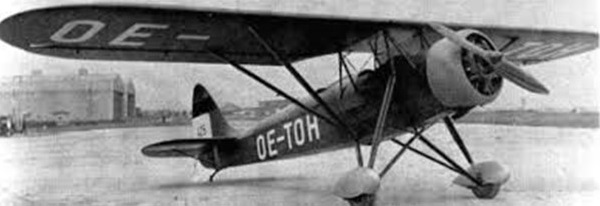
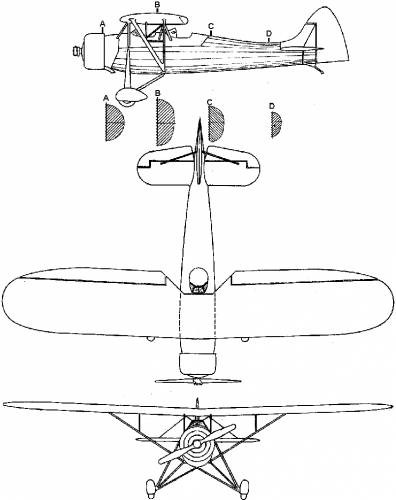
A derivative of the Hopfner HS-5/28 via the Hopfner HS-8/29, the Hirtenberg HS.9 two-seat touring or training aircraft of the late 1920s and early 1930s was an Austrian parasol wing monoplane with a fixed tailskid landing gear and room for two occupants in tandem open cockpits.
Designed by Theodor Hopfner, it had a metal fuselage (front covered with duralumin sheets, the rest – with a cloth) and a wooden wing lined with linen. In the center section there was a fuel tank for 132 liters. The wing consoles, for more convenient storage in the hangar, could be folded along the fuselage.
HS.932
It first flew as the Hopfner HS-9/32 in 1932, powered by a 120 hp de Havilland Gipsy Major I engine. Prototypes HS-9 had civil registration codes A-124 (then changed to OE-ANA) and A-144 (OE-DJH). Later the second prototype was sent to the UK and received the G-AGAK registration there.
Production versions were produced under the designation HS-9/32 (sometimes called the HS-932) and had 150 hp Siemens Sh 14 engines with NACA cowlings and two-bladed screws. As Hopfner’s production facilities were insufficient, HS-9/32 was produced by Hirtenberg Patronen (Hirtenberg), where 9 aircraft were built.
In 1935, four were transferred to the Austrian Air Force for use as training. They were given military registration codes OE-TOH, OE-TUH, OE-TAO and OE-TEO and numbers (Dienst Nummer, DNr.) 426 – 429.
After the annexation of Austria in 1938, several aircraft were still in service. The Germans included captured aircraft in their own air force and left them on Austrian territory, where they were handed over to Nationalsozialistisches Fliegerkorps (NSFK). As of 1939, Gruppe 17 still had five machines of two types: four HS-9/35 with numbers 425-428 and one HS-9 with number 434. As for HS 8/29 (number 412), this aircraft was destroyed in Zeugamt Erding.
A single example of a refined version with an uncowled 125 hp Siemens engine was flown in 1935 as the Hopfner HS-9/35, shortly before the Hopfner company went bankrupt.
HS.9
When Hopfner’s assets were purchased by Otto Eberhardt Patronenfabrik, production continued of both de Havilland- and Siemens-powered (designated HS-9A) aircraft under the Hirtenberg brand.
Hirtenburg HS.9A
Twelve Hopfner HS.932 (HS.9/32) were built from 1932 (2 prototypes + 10 series), including one aircraft with modified ailerons and undercarriage designated as HS.935 / HS.9/35.
In 1935, a significantly modified version of HS-9 \ 35 then in the Fliegertruppen des Osterreichischen Bundesheeres received the code OE-TAR (DNr. 434). With an uncooled Siemens engine it was flown shortly before the Hopfner company went bankrupt.
About 40 were built in total. They were operated by the Austrian Air Force during 1927-1938.
Variants HS-9/32 – Original version by Hopfner HS-9/35 – developed version of HS-9/32 HS.9 – Production aircraft with a Siemens Sh 14a piston engine. HS.9A – Production aircraft with a de Havilland Gipsy Major piston engine. HS.16 – military trainer version of HS.9
HS.9A Engine: 1 × de Havilland Gipsy Major, 90 kW (120 hp) Length: 8.05 m (26 ft 5 in) Wingspan: 10.972 m (36 ft 0 in) Empty weight: 568.8 kg (1254 lb) Gross weight: 948 kg (2090 lb) Maximum speed: 190 km/h (118 mph) Crew: 2
HS.932 Engine: Siemens Sh 14A, 150 hp Wing span: 10.96 m Length: 8.02 m Height: 2.39 m Wing area: 18.00 sq.m Empty weight: 570 kg Maximum take-off weight: 860 kg Maximum speed: 190 km / h Cruising speed: 170 km / h Practical range: 400 km Service ceiling: 4400 m Crew: 2
Hopfner HS-9\35 Engine: Siemens Sh.9, 150 hp Prop: two-bladed wooden Wingspan: 10.96 m Length: 8,02 m Wing area: 18,00 sq.m Height: 2.39 m Empty weight: 570 kg Takeoff weight: 860 kg Maximum speed: 190 km / h Range: 400 km Ceiling: 4400 m Crew: 2




 All Aero