Holcomb Perigee

Due to other events, notably the Bullet 2100 project and Molt’s declining health, the Micro-IMP was not developed further. Jerry Holcomb went on however to develop, build and fly a refinement of the Micro-IMP design which he named the “Perigee”.
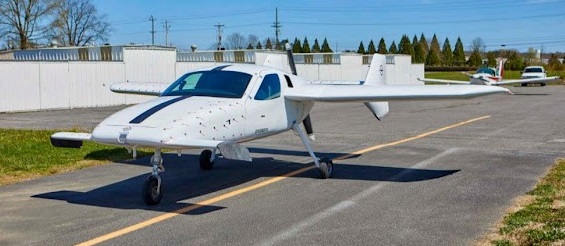
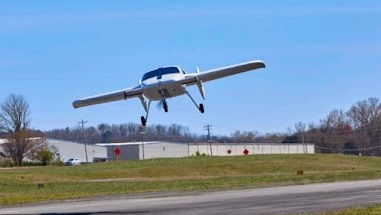
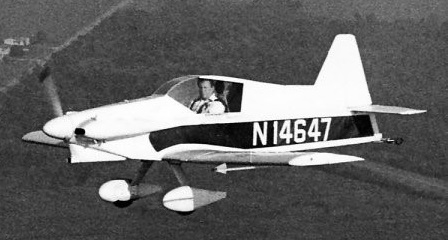
The Perigee, which was designed by Jerry Holcomb of Perigee Associates and initially called the Ultra Imp, first flew in April 1987 and is based on the TPG form of construction pioneered on the Aerocar Micro-Imp. This is a version of the same company’s Mini-Imp, which clearly provided the conceptual starting point for the Perigee.
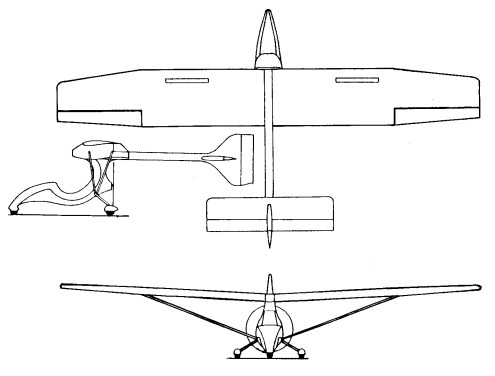
The TPG (Taylor Paper Glass) form of construction was developed by Moulton B. Taylor, president and general manager of Aerocar, which was created in 1948 to develop Mr Taylor’s extraordinary flying car concept. TPG is a paper core (with metal inlays to accommodate compression loads) covered in glassfibre in a matrix of polyester resin and covered with ripstop Dacron fabric. The Mini-Imp and Micro-Imp both have retractable tricycle landing gear, but the Perigee uses fixed tailwheel landing gear with cantilever main legs ending in elegant speed fairing round the wheels. The need to accommodate a tailwheel led to an alteration of the Y-shape tail unit by comparison with the Aerocar types: in the Perigee it is turned through 1800 so that the vertical surface is at the bottom with the tailwheel attached to its lower edge.
The streamlined fuselaqe is of composite construction with spruce longerons, TPG bulkheads, cockpit floor, tailcone and side skins, a glassfibre nose and some aluminium alloy components. The braced high-set wing has an aluminium alloy/TPG main spar, a spruce/TPG rear spar, wood main ribs, TPG nose ribs, a glassfibre leading edge and fabric covering aft of the main spar. The full-span flaperons are of aluminium alloy sheet over polystyrene foam. The three tail surfaces are similar to the wing in basic construction, but have no wood in them. Propulsion is the task of a twin-blade pusher propeller behind the tail unit, and this is driven by an extension shaft running aft from the engine located behind the cockpit.
Fixed-gear, strut-based monoplane with Y tail, pusher engine. Wings fold for towing on highway. Optional retractable gear, cantilever wing. Powerplant: Cuyuna 430 drives controllable pusher prop. Landing gear: Fixed taildragger.
Information packages were sold but plans and kits never materialized.

Type: sport lightplane
Seats: one.
Powerplant: one 35-hp (26-kW) Cuyuna 430
Maximum speed 120 mph (193 km/h)
Initial climb rate 700 ft (213 m) per minute
Service ceiling 12,500 ft (3810 m)
Range 200 miles (322 km)
Empty weight 380 lb (172 kg)
Maximum take-off 720 lb (326 kg)
Wingspan 28 ft (8.53 m)
Length 15 ft 8 in (4.78 m)
Height 5 ft 2 in (1.57 m)
Wing area 81 sq.ft (7.53 sq.m).
Aspect Ratio 10:1.
Stall speed 40 mph.
Vmax 140 mph.
Takeoff run 300 ft. Landing roll 300 ft.
Fuel capacity 8+ USG.

Hohl H1 / H2 / H3 / H4 / H5 / Eindecker

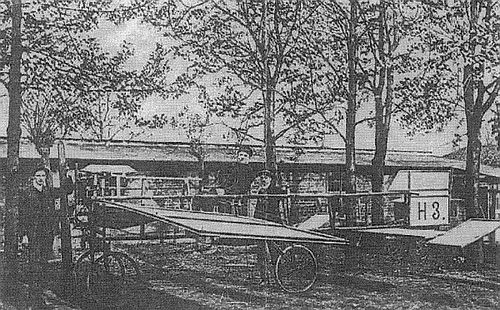
Hohl 1910 Eindecker H 3

Electrician Hans Hohl was not a successful aviator and little is recorded of his designs. None of his machines is known to have flown; the main criticism of Hohl always given to his non-existent airfoil. Even in 1912, when the army allowed the use the Exerzierplatz at Halle-Beesen – 10 or so miles from Merseburg, south of Berlin – the last-known of his monoplanes, “Hohl-5”, failed to make a sustained test flight.

Holbrook 1910 Aeroplane

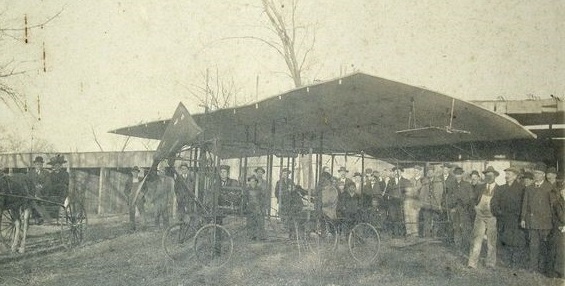
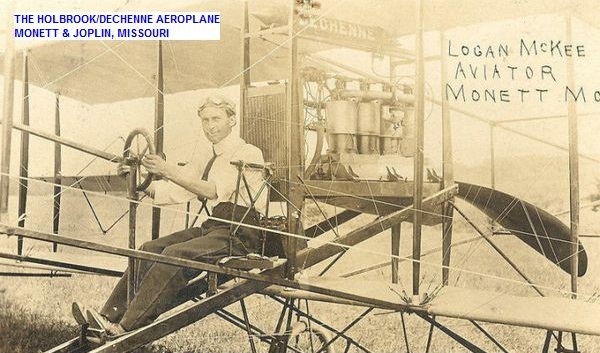
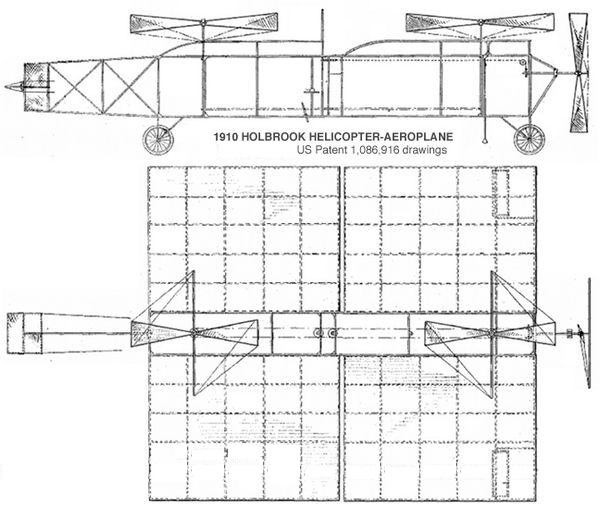
High-wing monoplane designed by Arthur Erritt Holbrook and built by the Holbrook Helicopter Aeroplane Co. in Joplin, Missouri. At around the time of the founding of his company, Holbrook also filed (January 19, 1910) to patent an Aeroplane; rather a tandem wing monoplane fitted with both tractor propeller and vertical rotors – hence the name of the firm. Four years later, on February 10, 1914, Holbrook was finally granted US Patent 1,086,916 for his invention. It is reasonable to assume that this photographed machine, with shafts protruding above the wing, was a “first draft” to be augmented to a form visible in the patent of Holbrook, where two rotary propellers are visible. After its appearance in 1910, Holbrook’s aeroplane was never heard from again.

Höhenflug HFL

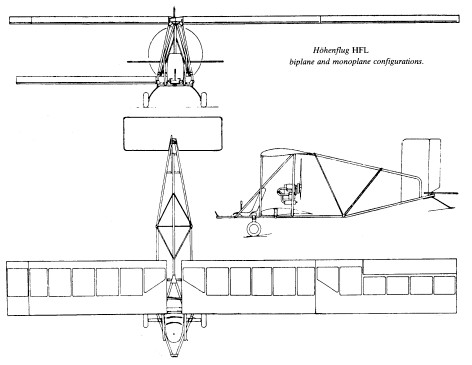
Single seat single engined high wing monoplane or biplane with conventional three axis control. Wing has unswept leading and trailing edges, and constant chord; conventional tail. Pitch control by fully flying tail; yaw control by fin mounted rudder; roll control by ailerons; control inputs through stick for pitch/roll and pedals for yaw. Cantilever wing; wing profile Worthmann FX63 137; double-surface. Undercarriage has two wheels side-by side with tailskid; suspension on both wheels. No ground steering. No brakes. Aluminium tube framework, without pod. Engine driving pusher propeller. Wings made from carbon fibre and unidirectional glass fibre.
This single seater is unusual in that it can be used either as a monoplane or a biplane. Its wing is in effect made up of four half wings, of which two form a high wing attached to the top of the tubular framework. The remaining two wings can either be joined to those of the top wing in a monoplane configuration or fitted to the bottom of the framework to make a biplane. These two ‘wandering’ wings are fitted with ailerons. As the four wing elements are of equal span, chord and area and the framework is wider at the bottom than the top, the biplane thus produced has a lower wing of greater span than the top. To avoid such aerodynamic nonsense, Hohenflug adds two wing tip sections to the upper wing to give it a slightly greater span than the bottom. In either configuration the wings are of cantilever construction with neither rigging wires nor interplane struts.
This Hohenflug bird was announced as due to make its first flights during summer 1983 and no information on its marketing strategy has so far been received. It is also not yet known which motor will be used, but the calculations have been based on a power range of 20 28 hp. The engine is fitted behind the pilot above the lower wing and drives a three blade pusher propeller.

Monoplane
Length overall 16.4 ft, 5.00 m.
Height overall 5.9ft, 1.80m.
Wing span 38.7 ft, 11.80m.
Chord at root 3.6 ft, 1.10m.
Sweepback 0 deg.
Total wing area 140sq.ft, 13sq.m.
Wing aspect ratio 10.74.
Wheel track 3.9 ft, 1.20 m.
Engine: 28hp.
Propeller diameter 45 inch, 1.13 m (three blade).
Power per unit area 0.20 hp/sq.ft
Fuel capacity 5.3 US gal, 4.4 Imp gal, 20.0 litre.
Empty weight 199 lb, 90kg.
Max take off weight 442 lb, 200kg.
Payload 243 lb, 110 kg.
Max wing loading 3.15 lb/sq.ft, 15.4 kg/sq.m.
Max power loading 15.8 lb/hp, 7.1 kg/hp.
Load factors; +4.9, 2.5 ultimate.
Never exceed speed 81 mph, 130 kph.
Max cruising speed 50 mph, 80kph.
Stalling speed 27mph, 43kph.
Max climb rate at sea level 400ft/min, 2.0m/s.
Range at average cruising speed 124 mile, 200 km.

Biplane
Length overall 16.4 ft, 5.00 m.
Height overall 5.9ft, 1.80m.
Wing span 22.6 ft, 6.90m.
Chord at root 3.6ft, 1.10m.
Sweepback 0 degs.
Total wing area 151 sq.ft, 14 sq.m.
Wing aspect ratio 6.311 top wing.
Wheel track 3.9 ft, 1.20 m.
Engine: 28hp.
Propeller diameter 45 inch, 1. 13 m (three blade).
Power per unit area 0.19 hp/sq.ft,
Fuel capacity 5.3 US gal, 4.4 Imp gal, 20.0 litre.
Empty weight 203 lb, 92kg.
Max take off weight 442lb, 200kg.
Payload 239 lb, 108 kg.
Max wing loading 2.92 lb/sq.ft, 14.3 kg/sq.m.
Max power loading 15.8 lb/hp, 7.1 kg/hp.
Load factors; +4.9, 2.5 ultimate.
Never exceed speed 81 mph, 130 kph.
Max cruising speed 50 mph, 80kph.
Stalling speed 27mph, 43kph.
Max climb rate at sea level 400ft/min, 2.0m/s.
Range at average cruising speed 124 mile, 200 km.

Hogan Innovator

The composite construction Hogan Innovator was a two-place, twin-tailboom, rear-engine, pusher-propeller amateur built airplane, powered by a Continental Titan IOX-370-CLD1T4 engine.

Registered N257AR s/n 002, the Experimental (Special) Airplane had accrued about 12 hours on the Hobbs meter, of which about 0.3 hours was actual flight time.

In a written statement, the pilot who performed the initial test flight of the accident airplane provided a detailed description of what he observed and experienced on that flight. He said:

As soon as I came off the ground the plane went into a wild oscillation of both pitch and roll. I ran out of elevator up trim within the first few seconds of that flight and then had a lot of control pressure involved to keep it flying around the pattern. At that point I realized I needed altitude to sort out the control ability of the aircraft… During the flight I actually bumped off the elevator stop at least three times. I don’t know how many times during that flight the aircraft departed straight and level flight, all uncommanded, however I would guess it to be around a dozen times. At one point I considered bailing out of the plane but realized I had enough control to try to line up with the airport runway and attempt a controlled landing, or at least get it back to the airport where help could be given if the landing didn’t go well. As it turned out once I reduced the throttle for the final approach I was able to let off some of my control pressure for the elevator and make a very nice controlled descent… In my opinion: the aircraft demonstrated a static stability that was divergent and unstable. While dynamic stability was just barely on the stable side of neutral. These two factors obviously fought each other in the stability of the aircraft.

Video of the first half of the test flight, which was captured by an onboard camera mounted on the copilot’s window, provided a cross-cockpit view of the pilot and views outside his window and part of the windscreen. Audio of ambient noise in the cockpit as well as radio communications was heard throughout. The video viewed was consistent with the narrative description provided by the test pilot.

The camera’s battery lost its charge mid-flight and the video ended abruptly on the upwind leg over the runway.

The airplane was the prototype for an airplane kit that was planned for mass production.

The airplane was disassembled, returned to the factory, modified at the accident pilot/builder’s direction based on captured data and test-pilot observations, and then brought back to CLZ, reassembled, and taxi-tested on 22 March 2019.

On March 23, 2019, at 1535 eastern daylight time, an experimental amateur-built Commuter Craft Innovator, N257AR, was destroyed by collision with terrain during an uncontrolled descent after takeoff from Thomas B. David Field (CZL), Calhoun, Georgia. The pilot/owner/designer/builder was fatally injured. Accident Number: ERA19FA134

On the day of the accident, the pilot asked his assistant to fly in a “chase plane” with a camera and photograph the airplane “in case it takes off.” The pilot said he did not intend to fly, would land if the airplane lifted off, and would only fly if “he had no other choice.” According to his assistant, she watched from the chase plane as the airplane departed “barely above the trees,” turned in the traffic pattern, and then descended from view.

According to the chase pilot, the accident pilot/owner instructed him to depart ahead of N257AR. The pilot/owner said he would takeoff, enter the downwind leg, “verify the plane was flying satisfactorily” and then climb the airplane to 3,000 ft. Once at altitude, the two planes would join up to capture footage of the prototype airplane in flight. Footage of the accident flight was not captured, but the chase pilot witnessed the accident flight from about 2,500 ft.

The chase pilot watched the accident airplane take off and turn to the crosswind and downwind legs of the traffic pattern. He estimated the airplane never climbed more than 200 feet above ground level (agl), and that the airplane struggled “to maintain airspeed or a nose-up attitude.” The chase pilot heard the accident pilot announce his intention to return to the airport, though a reason was not specified. He said the airplane was “porpoising” in flight before the nose “dipped down” and the airplane collided with trees and terrain.

Another pilot witnessed the accident flight from his car as he approached the airport. Immediately after takeoff, the airplane was “pitching and rolling and appeared unstable.” He estimated the pitch and roll excursions were about 20° left and right, and nose-up and nose-down. The witness described the crosswind turn as “steep” and estimated the bank angle at 45°. He also stated the airplane was “very low” and estimated it was about 150 ft agl in the turn when it disappeared behind trees due to “distance and low altitude.” The witness said he could not hear the engine sound from inside his car.

In a telephone interview, another witness said that he was inside his workshop when the airplane flew “low” overhead. He said the sound of the engine was loud, smooth, and continuous until the sounds of impact were heard. The witness left his shop to discover the airplane had crashed on his property.

The pilot held a private pilot certificate with a rating for airplane single engine land. His most recent FAA third-class medical certificate was issued December 6, 1999. Preliminary review of FAA records revealed the pilot did not hold a valid medical certificate nor had he completed a BasicMed course. A review of his logbook revealed the pilot had logged 334 total hours of flight experience. He logged 4.7 total hours of flight experience in 2018. His most recent flight was 1.1 hours in duration on April 27, 2018 in a Flight Design CTLS airplane. According to employees of Commuter Craft and the pilot’s logbook, the pilot had no experience in the Innovator airplane as either a pilot or passenger.

According to a Commuter Craft employee, the airplane had accrued about 12 hours on the hobbs meter, of which about .3 hours was actual flight time.

The wreckage was destroyed by impact and displayed no evidence of pre- or post-impact fire. Ground scars and fragmentation of the wreckage were consistent with ground contact in a steep, nose-down attitude at high speed. The wreckage path was about 90 feet long and oriented 132 degrees magnetic. The initial ground scar was in an open field and the main wreckage came to rest inside a narrow wood line between two fields. Flight control continuity could not be confirmed due to multiple cable breaks and fractures. All breaks and fractures exhibited signatures consistent with overload failure.

The engine was separated from its mounts but entangled with the main wreckage. Engine control continuity was established from the engine to its control quadrant, which remained attached to the engine. The two composite propeller blades of the constant-speed propeller were both uniformly fractured at their respective hubs and displayed chordwise scratching.
Hoffmann H.39 Diana

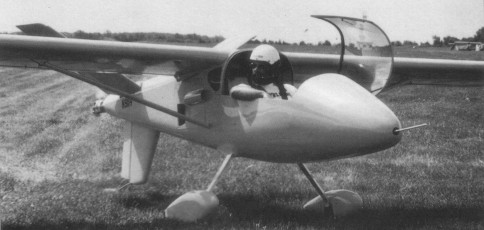
Single seat single engined high wing mono¬plane with conventional three axis control. Cruciform tail. Pitch control by elevator on tail; yaw control by fin mounted rudder; roll control by half span ailerons; control inputs through stick for pitch/roll and pedals for yaw. Wing braced from below by struts; wing profile Worth¬mann FX63 137; double surface. Undercar¬riage has three wheels in tricycle formation; suspension on nosewheel and glass fibre suspension on main wheels. Push right go-¬right nosewheel steering connected to yaw control. Brake on nosewheel. Glass fibre/ carbon fibre fuselage, partially enclosed. Engine mounted below wing driving pusher propeller.
Having already built a conventional motor glider with two seats side by side, the H36 Dimona of 1980 which has been on sale since summer 1981, aeronautical engineer Wolf Hoffrnarm has expanded his range with a single seater microlight, the H39 Diana. He used the experience gained in building the motor glider to help his design for a microlight, which uses similar manufacturing techniques and the same wing profile, the Worthmann FX63 137.
The high wing of the H 39 is carried by two airfoil section struts forming a V under each wing. As with the horizontal empennage, these are mounted by two bolts which allows rapid rigging and derigging, the Diana being trans¬portable on a trailer. The wing has air brakes on the upper surface and is of constant chord for the centre section with tapering outboard sections. A wide track tricycle undercarriage gives this ultralight motor glider great stability on the ground and encourages its use on all terrain.
The prototype was shown for the first time in public at the Aero 83 salon at Friedrich¬shafen on static display. The motor used is the Konig SD570 four cylinder radial, limited to 3500rpm (26hp) instead of the normal 4000rpm (28hp), since the Diana uses it in direct drive form.

Length overall 18.4 ft, 5. 60 m.
Height overall 5.7ft, 1.75m.
Wing span 32.8ft, 10.00m.
Chord at root 4.4ft, 1.33m.
Chord at tip 3.1ft, 0.93m.
Dihedral 4 deg.
Sweepback 0 deg.
Tailplane span 9.8 ft, 3. 00 m.
Fin height 3.9 ft, 1.20 m.
Total wing area 135 sq.ft, 12.5 sq.m.
Total aileron area 12.1 sq.ft, 1.12 sq.m.
Fin area 6.2 sq.ft, 0.58 sq.m.
Rudder area 4.1 sq.ft, 0.38 sq.m.
Tail¬plane area 18.1 sq.ft, 1.68 sq.m.
Total elevator area 7.8 sq.ft, 0.72sq.m.
Wing aspect ratio 8/1.
Wheel track 4.9ft, 1.50m.
Wheelbase 7.0ft, 2.13m.
Nosewheel diameter overall 10 inch, 26 cm.
Main wheels diameter overall 13 inch, 32 cm.
Engine: Konig SD570, hp at 3500 rpm.
Propeller diameter 42 inch, 1.07 m.
No reduction.
Max static thrust 132 lb, 60 kg.
Power per unit area 0.19 hp/sq.ft, 2.1 hp/sq.m.
Fuel capacity 5.3 US gal, 4.4 Imp gal, 20.0 litre.
Empty weight 2101b, 95kg.
Max take off weight 4751b, 215kg.
Payload 2651b, 120kg.
Max wing loading 3.52 lb/sq.ft, 17.2 kg/sq.m
Max power loading 18.31b/hp, 8.3kg/hp.
Load factors; +6.0, 3.0 ultimate.
Max level speed 62 mph, 100 kph.
Never exceed speed 84 mph, 135 kph.
Max cruising speed 62 mph, 100 kph.
Economic cruising speed 44 mph, 70 kph.
Stalling speed 24 mph, 38 kph.
Max climb rate at sea level 590ft/min, 3.0m/s.
Min sink rate 240 ft/min at 28 mph, 1.20 m/s at 45 kph.
Best glide ratio with power off 15/1 at 40 mph, 65 kph.
Take off distance 130 ft, 40 m.
Land¬ing distance 115 ft, 35 m.
Service ceiling 14,400 ft, 4400 m.
Range at average cruising speed 93 mile, 150 km.

Hoffman X-2

Hoffman X-2 (N1736 c/n 2)

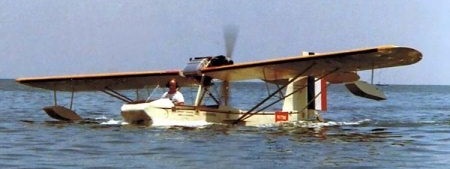
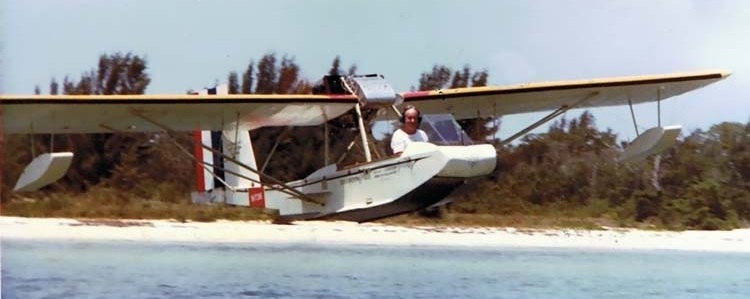
The X-2 designation was used for two light flying boats designed by Edward C. Hoffman. The first X-2 (registered N9159R and first flown 1962) was named Little Orphan Annie and was built by Hoffman. Engine was a 75 hp Continental A75 and in the construction the wings of a Taylorcraft BC-12D were used.

The second X-2 (N1736 and known as the PBY) was in 1964 completed by another amateur constructor and had a 108 hp Lycoming O-235 engine. Other changes were new built wings and a slightly taller vertical tail. The PBY was later also acquired by Hoffman, but it was lost in an accident.”

Hoffman X-1 Sweet Patootie

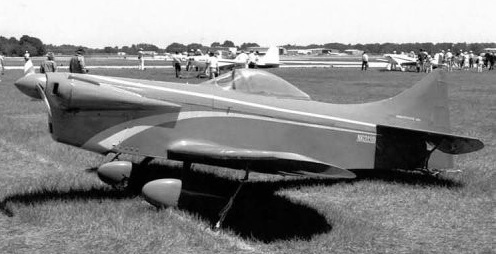
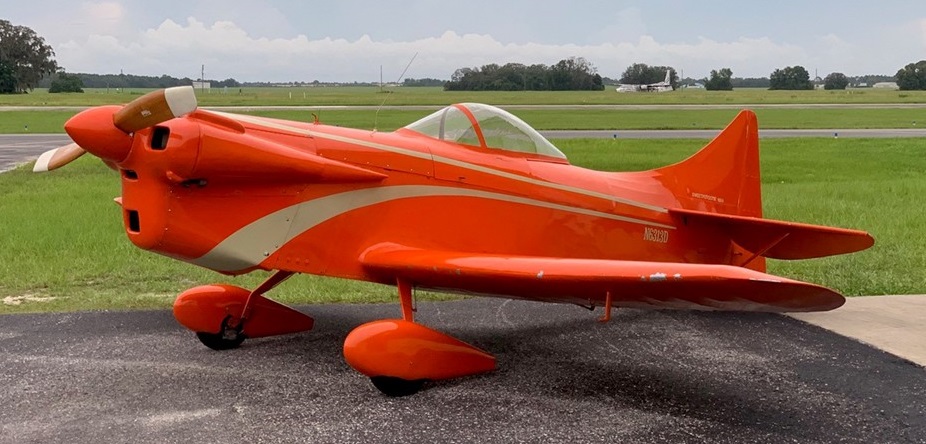
Built by Edward C. Hoffman, the X-1 Sweet Patootie was first flown on 24 February 1960 and initially fitted with a 65hp Continental A65 engine. The following year N6313D was re-engined with a 90hp Continental C90 and it also received some modifications such as a tear drop canopy.

Ed inherited his love for aviation from his father, Edward C. Hoffman II. Edward. In 1970 the original design, the Hoffman X-1, nicknamed Sweetpotootie, was flown to the Oshkosh fly-in.

Sweetpotootie was built in an open barn by Lake Tarpon that was tucked away by the orange groves. The airplane took one year and four days to build from beginning to first flight. The prop was built by well-known EAA member Ray Hegy. About 2007, Ed stopped flying Sweetpotootie due to an issue with fuel starvation and rough flight. When EAA reached out to him this March about bringing the airplane back for the 50th celebration, Ed realized that the plan he had to rebuild it after he retired would need to start early.

The restoration for Sweetpotootie started in March 2019, and on July 6, 2019, it was airborne once again. The all-wood airplane built with Weldwood glue needed a new carburetor, restored brakes, fresh spark plugs, and some cosmetic work. One thousand hours of restoration work has been put into the aircraft to make it flyable again. This uniquely designed airplane has a 90-hp Continental engine and is iconic in the southern United States.

With only a few months before the 50th consecutive fly-in, the priority of the restoration was making the airplane airworthy and less on cosmetic work.

“It looks like a 60-year-old plane. It has all the battle scars, but that makes it sentimental,” Ed said. He plans to find his father’s logbook from his first flight to Oshkosh and make the same trip. “I want to make the same fuel stops, same flight path. I want this flight to be a tribute to my father,” Ed said.