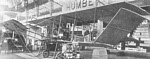
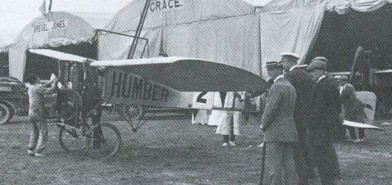
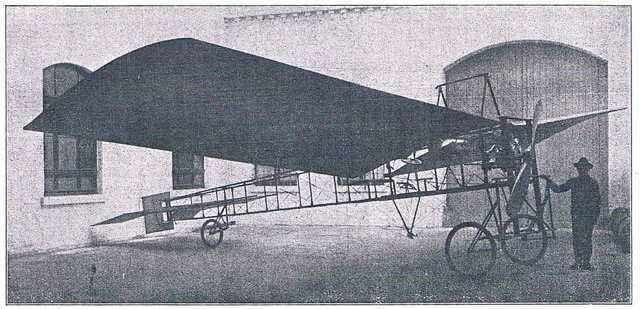
At the 1910 Olympia Aero Show Humber exhibited a single-seat monoplane designed by aviator Hubert Le Blon. Powered by a three-cylinder Humber engine, it had variable-camber wings and a small diameter tapering wooden boom served as the fuselage.
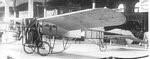
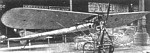
The Humber Motor Company Ltd. manufactured a British version of the Bleriot XI in 1910, known as the Humber- Bleriot Monoplane. Two further Bleriot modifications were built to the design of Captain T. T. Lovelace.
Built by Jean Hugot in Germany and patterned on a Bleriot XI, the aircraft was powered by a Delfosse three-cylinder engine. During a take-off attempt on 24 July 1911, the aircraft was destroyed by fire, the pilot escaping without injury.
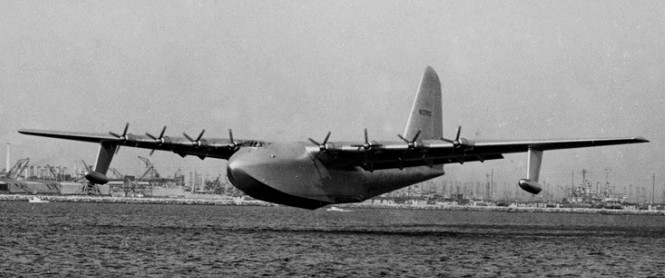
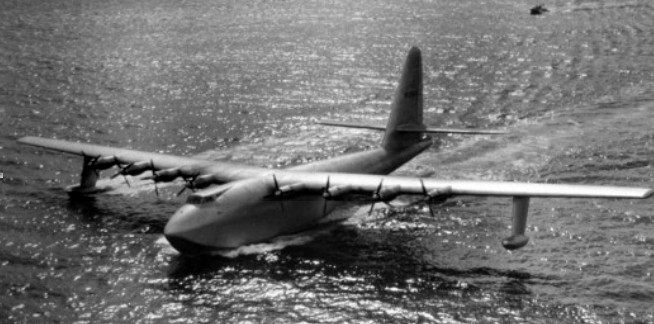
American shipbuilder Henry Kaiser introduced the Liberty ship but the vessels were being sunk prompting him to think of a massive cargo aircraft. Initially rebuffed by the US Government, Kaiser sought a partnership that would lend credence to his plan. That partner was Howard Hughes. Howard Hughes sponsored the Hughes H-4 Hercules. Made entirely of wood, almost entirely of laminated birch, this eight-engined flying-boat had the greatest wingspan (320 ft; 97.54 m) of any aircraft built to date. The aircraft was not completed until September 1945. The design problems which Hughes and his team encountered in creating a 183 tonne (180 ton) aircraft from non strategic materials delayed the project until after the war, assembly began in June 1946. House movers being engaged to transport its 66.75 m (219 m) laminated plywood hull along specially laid roads from Culver City, California to Terminal Island, Long Beach where final assembly began.
On 2 November 1947 Hughes boarded the Hercules, started the eight 3000 hp Pratt & Whitney Wasp Major engines and taxied out into the bay, ostensibly for water handling tests. Once on the open water, however, Hughes opened up the Spruce Goose’s and took off, flying for about 0.6 km (1 mile), for less than a minute, at a height of 70 feet (21 m) at a speed of 80 mph (128 kph).
The Hercules never flew again. It was stored in a specially constructed hangar at Long Beach, where it remains today, heavily guarded by Hughes employees, the largest aircraft ever to fly. Some say that having proved his point that the machine could fly, Hughes simply lost interest; others claim that even in those few brief moments of flight the Hercules creaked and groaned and handled so badly that Hughes never dared fly it again.
Engines: 8 x 3,000 h.p. Pratt & Whitney R-4360-4A radial. Replaced in 1951 by P&W Wasp Major TS13-3Gs. Propellers: 8 x Hamilton Standard 24F60-35s Prop diameter: 17ft 2in diameter (Engine No 4 had a 16ft 2in-diameter) Wingspan: 320ft 0in Tailplane span: 113ft 6in Wing area: 11,430 sq.ft Maximum wing thickness: 11ft 6in Length: 218ft 6.25in Height overall: 79ft 3 3/8in Fuselage height 30ft 0in Payload: 180,0001b Maximum weight: 400,0001b Internal fuel: 14,000 USgal Maximum speed: 218 m.p.h. Cruising speed: 175 m.p.h. Alighting speed: 78 m.p.h. Maximum range: 3,500 miles Service ceiling: 24,000ft (300,0001b gross weight) Rate of climb: 700ft/min to 1,000ft/min, depending on weight
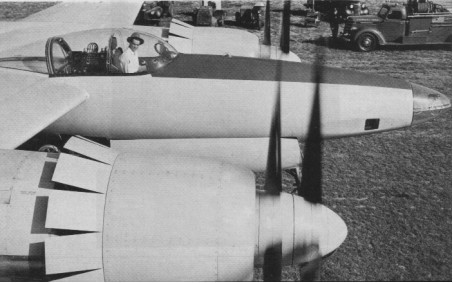
The Hughes XF-11 experimental twin-engined, twin-boom photo-reconnaissance aircraft, which had contrarotating propellers, crashed on its maiden flight, seriously injuring Hughes. The XF 11 was a candidate for a military contract. On July 7,1946, Hughes took his XF 11 reconnaissance airplane on its first flight. Though photographed in the plane just before the test, he intended the flight to be secret. The contra-rotating props developed problems, and the plane crashed, seriously injuring Hughes. Full power. Release brakes. Rolling. Lifting off. Climbing. Everything perfect. Power reduction. Right props slip into reverse pitch. Fierce asymmetric thrust (one second). Feathering in-op (two seconds). Try to hold heading (three seconds). Back on right, full power on left (four seconds). No good, back on both (five seconds). Crash. On April 15, 1947, Hughes successfully test flew a second version of the XF 11, this one with single rotation airscrews, and personally conducted most of the test program.
Hughes Aircraft Co was founded in 1935 by businessman/film magnate Howard Hughes to produce the Hughes H-1 racing aeroplane, in which Hughes established a world landplane speed record of 352.46mph (567.23kmh).


 All Aero