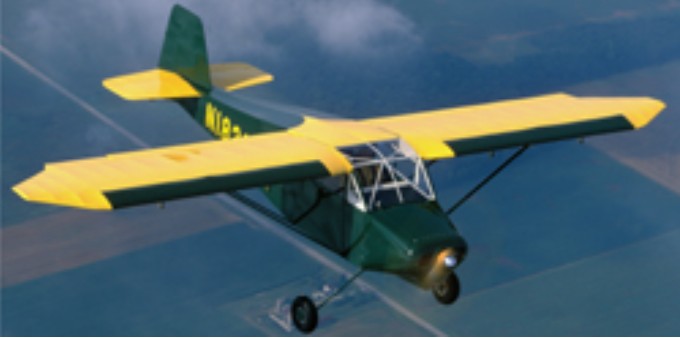
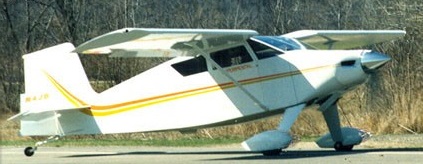
Built in 1986, this was a two-seat high-wing aircraft, N41SW, which appeared like an oversize Tailwind. It was specifically designed for fast cross-country travel between Wittman’s two homes in Oshkosh and Ocala, Florida (that’s where the O & O designation came from).
It was in this aircraft that crashed on 27 April 1995 and Steve and Paula were killed.
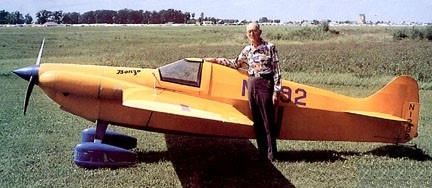
Steve Wittman designed and built two Goodyear racers, Buster and Little Bonzo, named after two comic strip characters he had enjoyed in the 1930s. Goodyear rules specified a minimum weight of 500 pounds, and Little Bonzo came out at 508 pounds. Being the stickler he always was for simplicity and lightweight, Steve begrudged the unnecessary eight pounds. Steve’s guiding principle of aircraft design was “keep it simple, stupid.”
Steve flew Little Bonzo, N1292, for the first time on July 16, 1948 and logged just under ten hours on the airplane before entering a race. Little Bonzo’s first race was the second annual Goodyear Trophy race in which Steve placed second, kicking off a 40 year racing and air show career for Little Bonzo in which the racer would win a room full of plaques and trophies, not to mention pay for itself many times over.
Some of the highlights of Little Bonzo’s career include winning the Continental Trophy races in 1949, 1950, and 1952, winning the Rebat Trophy in 1950 and 1951, and winning his own race at Oshkosh in 1956 and 1957 as well as the Lowers-Baker-Falck cross-country races. Little Bonzo won scores of small races around the country, so many in fact, that Steve lost count.
Unlike modern racers that are disassembled and towed to races, Little Bonzo flew to every event it participated in. In fact, Little Bonzo was not just a racer, but also an avid air show performer. Steve was in big demand during the postwar years as an air show performer, and he used Little Bonzo to put on demonstrations of high-speed aerobatics. With the lighter wing loading of his racer, however, Steve could do continuous loops right off the deck, with snaps on the top. Amazingly, Steve often performed his air show routine between heat races.
In 1968, the Goodyear rules were changed to allow use of the Continental O-200 engine, and in August of the following year, Steve removed the original Continental C-85 and replaced it with an O-200.
Little Bonzo participated in its last Goodyear race on July 8, 1973 at Du Page, Illinois. The racer was not flown again until Memorial Day weekend to participate in an air show. Steve flew Little Bonzo a couple of hours over Independence Day weekend and then parked the airplane for four years, though the little racer was kept in license. In 1978, Steve dusted off Little Bonzo and began winning races again.
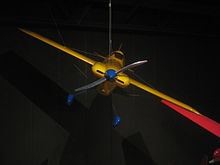
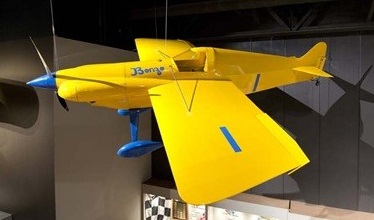
Finally, in 1987, Little Bonzo was in need of a rebuild, its first major work since the airplane was constructed. After the rebuild, Steve flew the airplane for two fifteen-minute test flights before he decided to donate Little Bonzo. Steve restored his racer to its original configuration by installing a Continental C-85 and Little Bonzo was officially donated to EAA at a ceremony during the Oshkosh Fly-In in 1994. Little Bonzo now hangs alongside its namesake, Big Bonzo on display in the EAA AirVenture Museum Racing Gallery.
Engine: Continental C-85 Wing Span: 15 ft. 4 in. Length: 19 ft. Height: 4 ft. 9 in. Empty Weight: 508 lbs. Fuel Capacity: 15 gal.
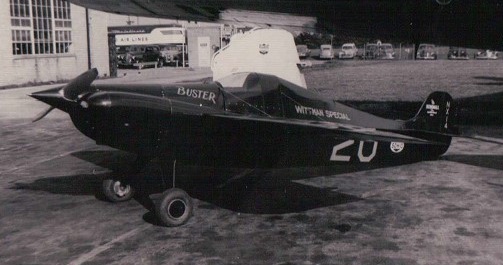
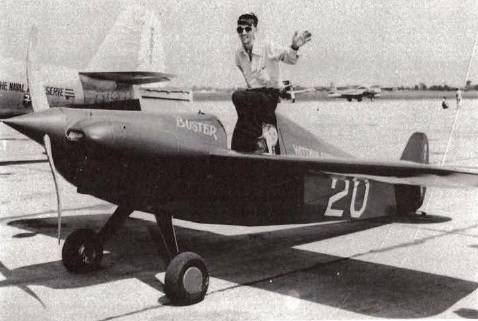
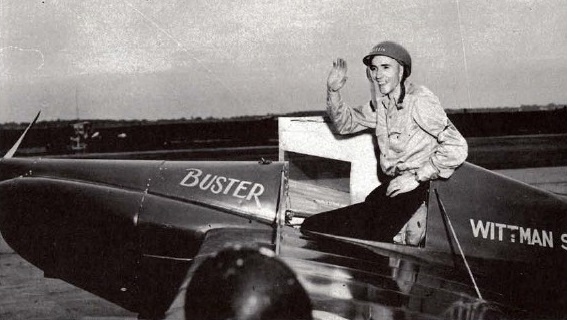
The Buster R/NX14855 (rebuilt from the fuselage of ‘Chief Oshkosh’) was Steve’s first Goodyear raceplane. Built in 1946, raced 1947-54. Piloted by Bill Brennand, Bob Porter, and others, it was retired from racing in 1954.
Winner Bill Brennand and Buster
Bill Brennand won in Buster, the next year took fourth place, and the next year top prize and the Goodyear Trophy.
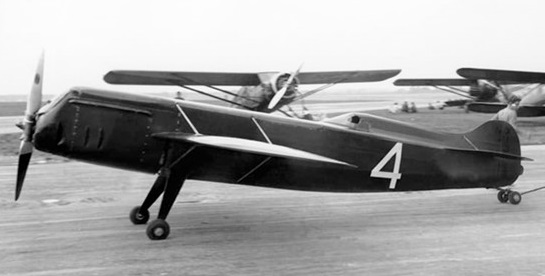
The Wittman D.12 Bonzo NX13688 was designed and built by Steve Wittman as a contender for the prestigous Thompson Trophy, built in 1934, raced 1935-39, the last to use a water-cooled engine. It was ultimately capable of over 325 mph.
The bright red Bonzo, fully restored, graces the EAA AirVenture Museum in Oshkosh.
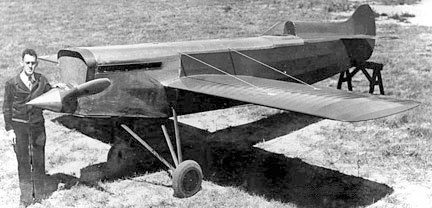
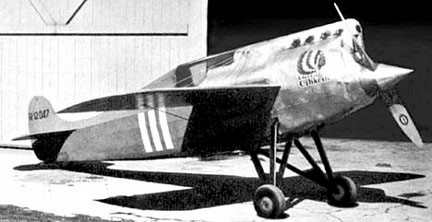
Steve Wittman’s first racing plane, Chief Oshkosh NR12047 and NR14855, was built in 1931 for the Nationals. Powered by a 90hp Cirrus, it was repowered with a 115hp Cirrus Hermes in 1932, and 125hp Menasco C-4 c.1935. Published plans shown many variations, typical of racing aircraft—1931: span: 18’9″ length: 17’9″; 1933: span: 15’6″ length: 18’4″; 1935: span: 14’6″ length: 19’4″; 1937: span: 12’6″ length: 19’6″.
It crashed in 1938 and was rebuilt in 1947 as midget racer Buster.
A midwing single-seat open, monoplane powered by a Henderson motorcycle engine, and capable of short hops only. Steve Wittman built it when he was 19 years of age (in 1923) and tried to teach himself to fly. It was not able to clear the barbed-wire fence around the field.
Sylvester “Steve” Wittman built two types of airplanes: Racing machines and Travel machines. The ancestors of these two blood lines were Chief Oshkosh and Buttercup. The Buttercup was built as a utility hauler, and there was only one made, in 1937, NX/N18268. Initially powered by a 50hp Lycoming O-145, then an 85hp Continental A-85, he flew it all over the western hemisphere, from Alaska to Bermuda, Florida to Oregon. The Buttercup almost made it into production (cancelled due to WWII) coming to the interest of Fairchild as a four-place project, called the ‘Big X.’ One plane was built for them by “Witt” – a 4-place, 6 cylinder, 130 HP Franklin powered prototype.
The real genius of the Buttercup design is Wittman’s claim of 38-40 mph (indicated) slow-flight speed and a near 150 mph top speed, and all on 85 hp! The high speed is vintage Wittman, the low speed is due to an ingenius flap-coupled, retracting lead edge design (seen in today’s airliners). Earl Luce of LuceAir, Inc. has ‘revived’ the Buttercup, featured in the April 2003 issue of Sport Aviation. Kits and fabricated assemblies for the Buttercup are available from Aircraft Spruce.
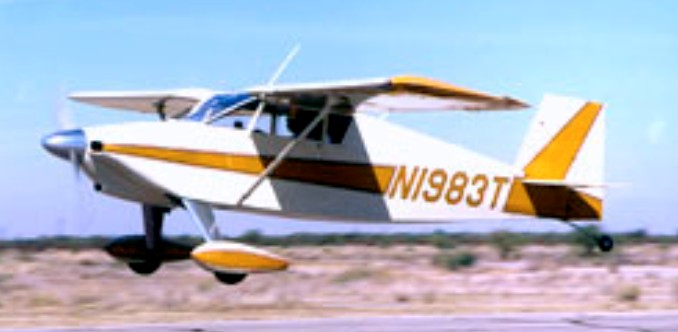
The Tailwind (prototype) W-8C, a two-seat high wing monoplane, built and first flew in 1953. So suc-cessful was this aircraft that plans were made available to amateur builders.
The Tailwind is a side by side, two seat, high wing, strut-braced, cabin monoplane. The wing consists of two separate panels, each incorporating wooden spars and ribs, internal wire bracing and plywood covering. An NACA 4309 aerofoil section is used. The ailerons and flaps are of steel tube construction, and are fabric covered. The fuselage is a chrome molybdenum steel tube structure, and is fabric covered. A cabin door is incor¬porated in each side. The empennage, like the fuselage, is built up of welded steel tube, and is fabric covered. The main undercarriage incorporates round spring steel main legs, and 500 x 5” wheels. The wheel track is 5’ 5”. A 20 Imp. gallon fuel tank is installed in the fuselage behind the firewall.
The W-8L Tailwind, powered by a Lycoming engine, was built in 1954. Revisions have been made to allow the use of the 150-hp Lycoming, 145-hp Continental and the Olds/Buick 215-cu.in. V-8s. The Oldsmobile Tailwind was built in 1974.
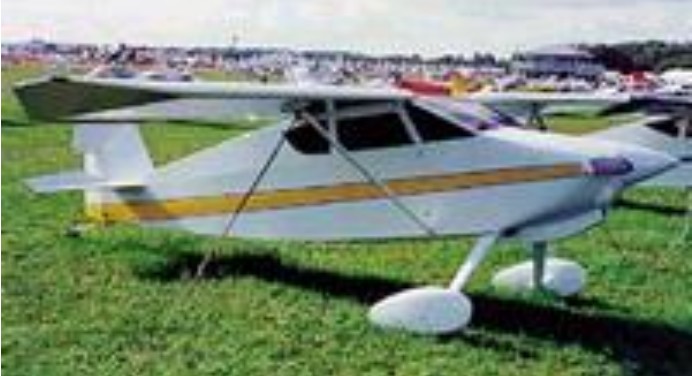
Wittman W-10 Tailwind built by Jim Clement
Wittman W-9 N4JB
The W-9L Tailwind, with a tricycle landing gear, was built in 1958. Based on the W-8, the prototype N374 was powered by a 160hp Lycoming O-320-B1A.
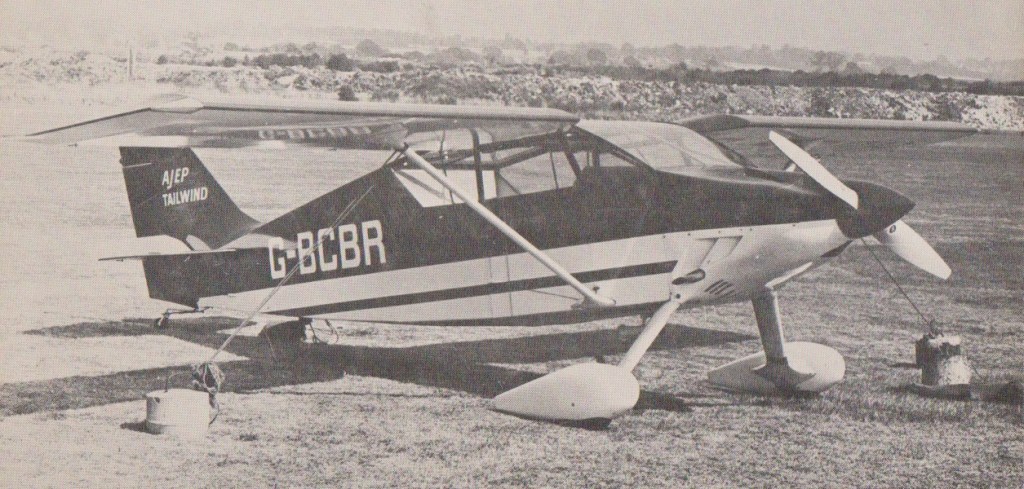
In 2009 available as kit or plans from Aircraft Spruce & Specialty Co. Plan Price $180.00. AJEP Developments in the UK offered kits to construct modified version of Whittman Tailwind homebuilt aircraft.
AJEP Tailwind G-BCBR September 1975 at Luton
Aircraft Spruce acquired the rights to the Tailwind in January 1996 and is became the exclusive distributor for plans and materials kits, the W-10 replacing the W-8.
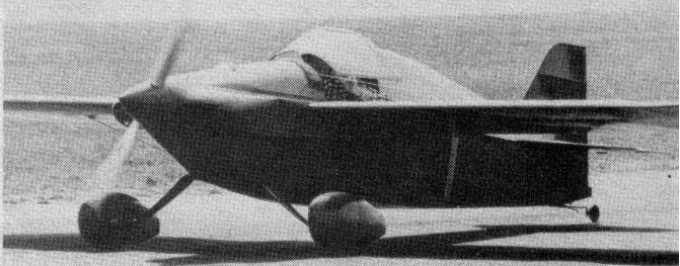
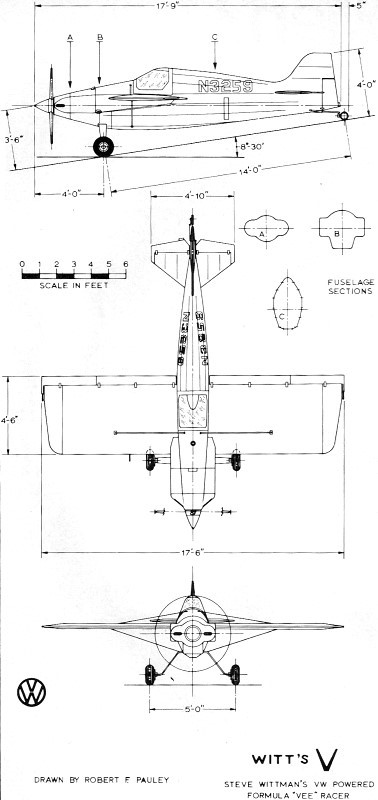
This was a single-seat mid-wing monoplane powered by a 96 cu.in. converted Volkswagen engine, for Formula V air racing. N3259 was built in 1970 and raced 1971-1989. Wittman has had it up to 170-mph.
Steve sold blueprints for this design and about 10 have been built. Aircraft Spruce & Specialty was planning to put the Witt’s V blueprints back on the market.
Engine: VW 1600cc, 60-65hp Wingspan 16’8” Length 18’2” Gross Wt. 700 lb Empty Wt 430 lb Fuel capacity 10 USG Top speed 170 mph Cruise 150 mph Stall 48 mph Climb rate 1000 fpm Takeoff run 800 ft Range 400 sm Seats: 1
Designed by Mike Wittaker in 1974, the MW-2B Special, nick-named Buzzabout, was a single-seat all metal low wing monoplane with a twin boom tail and tricycle undercarriage.
To be powered by a VW engine driving a pusher propeller fitted into a ducted shroud, designed by Dowty-Rotol.
Backed by Charles Robertson (Developments) Ltd, the prototype, G-BDDX. c/n 001, PFA.41-10106, was being built at Bodmin, UK, in August 1975 with a first flight expected in early 1976.

 All Aero