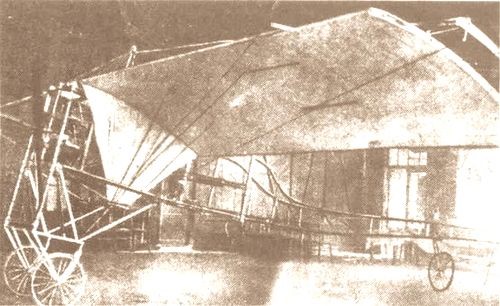
W. Klemperer and a group of friends had built around 90 flying models since high school years in Germany, several of them canards, powered by compressed gas engines. In 1911 they started on a full-scale machine with 22 sq.m of wing area. Construction was started at the “Schiffswerft” in Uebigau a.d. Elbe and completed in Chemnitz and Altchemnitz. At Christmas 1913 it was ready to roll and after various ground tests it was flown in the spring of 1914 by LVG pilot E. Kunze. Problems with the quickly wearing 55 hp Haacke engine and high weeds on the airfield caused difficulties, but finally some flights confirmed the designers’ expectations of stability, ease of control, pleasant flight characteristics and extremely easy landing. Just after these first encouraging successes, the outbreak of war put an end to their experiments.
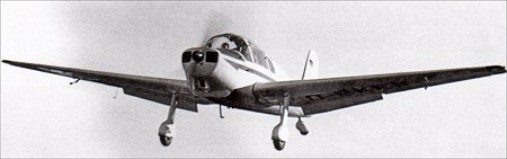
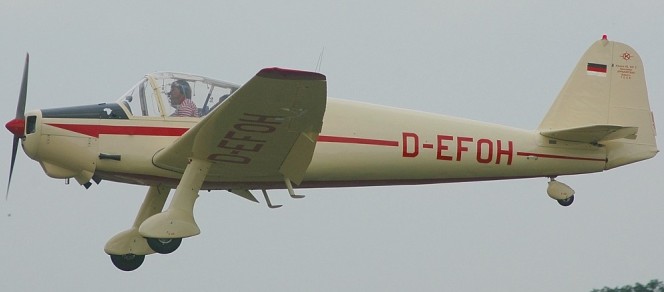
The Kl.107 low-wing, wooden-framed monoplane trainer was designed in Germany during World War II. Early versions were powered by the Hirth HM 500 100hp engine, and only a small number were completed before the factory was erased by Allied bombing. In 1956 it was decided to reintroduce the Kl-107 as a civil training/touring type, initially as the Kl-107B, but then as the three-seat Kl-107C. Rights to the design were acquired by what became the MBB consortium, and the final version became the Bo.207.
Klemm Kl-107C
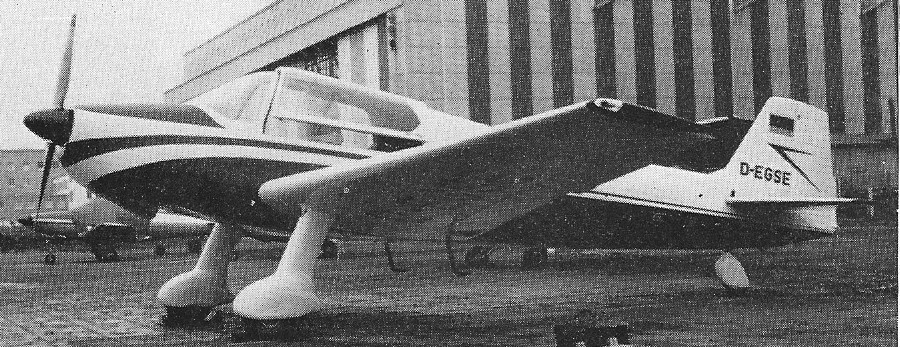
The Bolkow F.207 second prototype development of the Kl107C, originally called the Klemm Kl 107D, first flew on 21 April 1961, from Stuttgart-Echterdingen airport.
Bolkow F.207
Kl.107C Engine: 1 x 150hp Continental O-320 Wingspan: 10.80 m / 35 ft 5 in Length: 8.30 m / 27 ft 3 in Max. speed: 234 km/h / 145 mph Range: 820 km / 510 miles
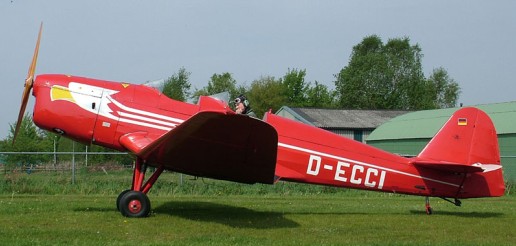
From its beginning in 1926 Klemm produced only cantilever monoplanes, and first flown February 1935 as a civil prototype, the Kl 35a was powered by a 60-kW (80-hp) Hirth HM 60R inline. The Klemm 35 entered production the same year. The Kl 35b second prototype featured the 78-kW (105-hp) HM 504A-2, and this engine was retained for the Kl 35B initial production variant. From this the company developed a primary trainer for the Luftwaffe as the Kl 35D, and this first flew in 1938. By comparison with the Kl 35B the wheel spats were omitted, and the landing gear was beefed up for wheels, floats or even skis. The Kl35 was generally similar in appearance, but instead of a straight wing, it had a gull wing. The Klemm Kl35D differed in being powered by a 105hp Hirth HM504 A-02 engine and it had a braced and strengthened undercarriage with spats removed. The Luftwaffe also used the type for liaison, courier and postal work, and the type was exported to Czechoslovakia, Hungary, Lithuania, Romania and Sweden, the last also producing the type under licence. The Klemm Kl.35 remained in production until 1941. About 2000 airframes were built.
Kl 35a Engine: Hirth HM 60R, 60-kW (80-hp).
Kl 35b Engine: Hirth HM 504A-2, 78-kW (105-hp).
Kl 35B XIV Engine: BMW Bramo (Siemens) Sh 14A seven cylinder radial, 160 hp. Prop: 2 blade. Wing span: 39 ft 4.5 in (12.00 m). Length: 23 ft 7.5 in (7.20 m). Wing area: 183 sq ft (17.00 sq.m). Gross weight: 2,094 lb (950 kg). Max speed: 130 mph (210kph) at S/L. Typical range: 495 miles (800 km). Seats: 3.
Kl 35D Engine: 1 x Hirth HM 6CR, 60kW (80 hp). Span: 10.40m (34ft 1.5in). Length: 7.50m (24ft 7.25 in). Armament: none. Max T/O weight: 750kg (1,654lb). Max speed: 132 mph at sea level. Operational range: 413 miles. Seats: 2
A low wing, 4 seat cabin tourer. The Klemm KI 32 appeared in two major versions: the A XII with a 150 hp Hirth HIM 150 in line engine, and the Sh 14A radial engined B XIV. A version redesigned in England by G H Handasyde was built in the UK by the British Klemm Aeroplane Co (later renamed British Aircraft Manufacturing Co) under the name Eagle; this was powered by a 130 hp de Havilland Gipsy Major engine.
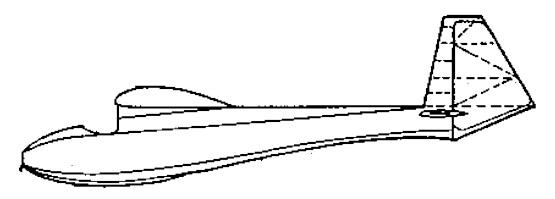
Designed from the Hans Klemm powered glider design, the L.25, one prototype was built in 1928, plus several registered as Leicht-flugzeugbau L-25.
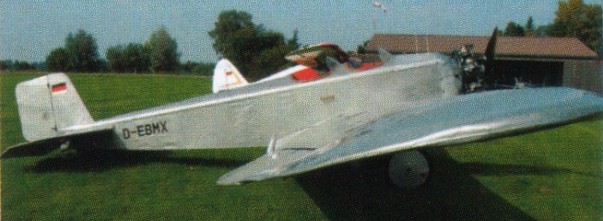
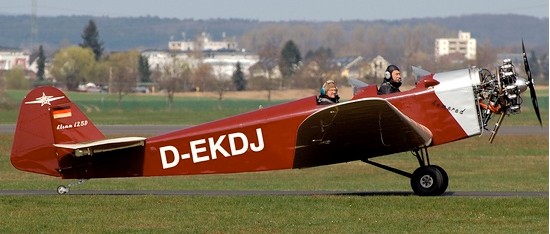
The 2 seat sport L 25 was produced from 1927 with many types of engine. The L 25a was built in 1927 with the BMW Xa, 68 hp radial engine. The AKL-25 made its public debut at the 1928 Nationals where, with its gliderlike characteristics, it won the dead-stick landing contests.
Boland Aeroplane Co was formed in 1928 as a component of Aeromarine Plane & Motor Co Inc. to begin aircraft production. They acquired manufacturing rights to Klemm L.25 and the name, Aeromarine-Klemm, came into use. The design became production Aeromarine-Klemm AKL-25A. About 60 of the AKL-25, AKL-25A aka L-25A were built, of which some were converted to AKL-26A. Production was superseded by the AKL-26.
L-25A also known as AKL-40 or AKL-25A; Salmson engine (formerly under Type 2-47) (1928) ; EDO twin-float version (1929)
L-25A-1 undocumented version (3 built)
Klemm Kl-25D
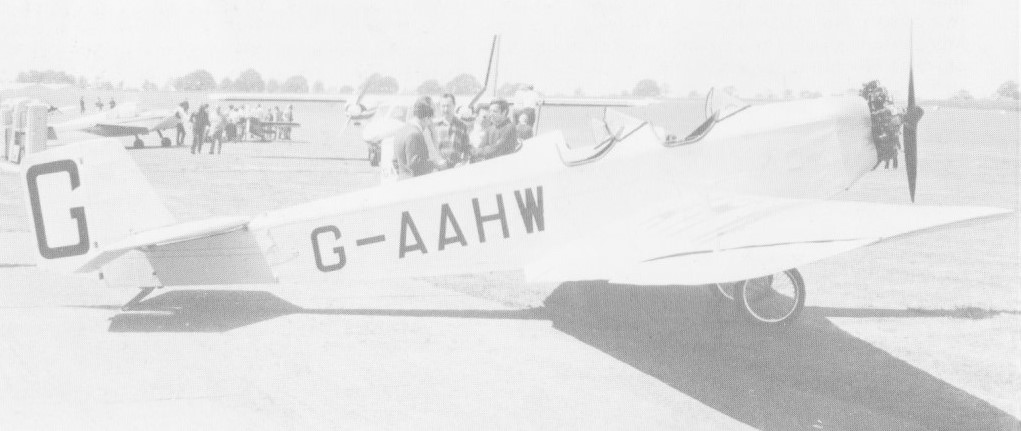
In 1929 the UK sales agency was acquired S.T.Lea at Croydon, and in the following five years thirteen L25s joined the British register. A modification to the UK aircraft was the change in location and size of the tailplane and the rounding and balancing of the rudder, to improve control. Only three survived the war.
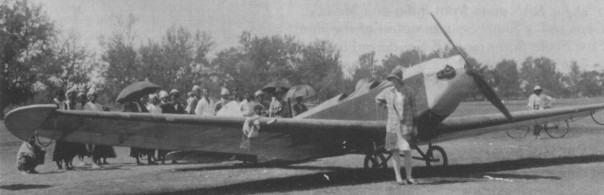
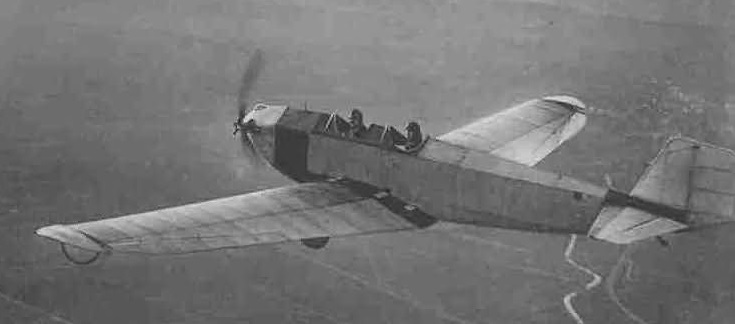
Hans Klemm’s first light aircraft was the Daimler L15 and the L20 had much in common with it. Both were cantilever monoplanes with twin open, tandem cockpits and engines of very low power. The L20’s low wing distinguished it from its predecessor and had the advantage of providing a low centre of gravity and better view during the landing approach as well as better protection for occupants in case of crash landings. The low-set wing also allowed a shorter undercarriage on the L20, which was otherwise like that of the L15 with the wheels independently mounted on pairs of centrally hinged V-struts and with vertical shock absorbing legs to the wing underside. Wheels were sometimes replaced by floats. Intended from the start for serial production, the L20’s structure was simplified, with a pentagonal cross-section fuselage lacking the L15’s rounded upper and lower surfaces. The fuselage was wooden framed with canvas covering. The overall strength of the structure, which had a safety factor of 12, was emphasised.
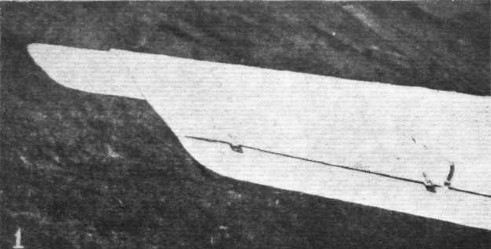
The wing was tapered in planform and was built around two spars, though there were two variants of the internal wing structure. The first three aircraft, type L20 A1, had wings stiffened against torsion by internal wire bracing but later aircraft, type L20 B1, used a torsion box formed by plywood skin ahead of the rear spar. Like the later version of the L15, the L20 used a combination of conventional ailerons and unusual wingtip flaps, rotating about an axis well ahead of mid-chord.
Wingtip, aileron-linked “flap” on early L20
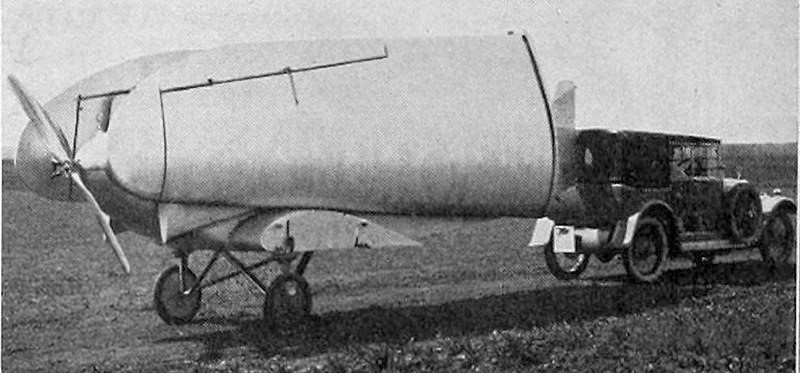
The ailerons were directly controlled from the cockpit as normal and the tip flaps were linked to them with external rods and cranks. On early examples these flaps were roughly square, with a side less than a half of the chord at the tip, but at some later time they were reshaped to produce wing curved tips. The wings could be detached at the root in about five minutes, reducing the width of the L20 to 1.7 m (67 in) for road transport on a trailer pulled by a car.
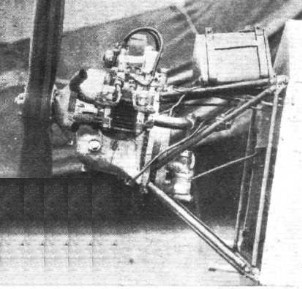
At the beginning of the design and testing period the absence of a suitable, serially produced light aircraft engine was a concern and the wing was therefore mounted so that it could be moved fore and aft to allow for the varying centre of gravity positions resulting from engines of different weight. A glider version was contemplated though not finally used. Instead, the flight programme began with the L20 powered by the 9 kW (12.5 hp) Harley-Davidson motor cycle engine used in the L15. By mid-1925 this had been replaced with a new engine, the 15 kW (20 hp) air-cooled, flat twin Mercedes F7502a, which Klemm had persuaded Daimler’s engine group to design and build for the light aircraft market. The cost of flying the L20 was low as its cruise fuel consumption was only 63 mL/km (45 mpg). From 1926 the uprated 15 kW (20 hp) Mercedes F7502b was fitted. The F7502 was central to the success of the L20, though it suffered from repeated rocker arm failures.
The Mercedes F7502 engine installation
Having failed to persuade the Daimler management to undertake series production of the L20 despite its early successes, in 1927 Klemm left to set up his own company, Klemm Light Aircraft in Sindelfingen, later moving to Böblingen. Thereafter the L20 was often known as the Klemm-Daimler L20 or sometimes the Daimler-Klemm L20.
The 1925 Round Germany Flight involved five circuits over a total distance of 5,262 km (3,270 mi). Two early L20s and the twin-engined L21 competed against many aircraft from other German manufacturers. All three Daimler aircraft were very successful in the under 40 hp (30 kW) class, with the L21 the overall winner, receiving 25,000 Goldmarks (worth £1,250 in 1925) and the two L20’s coming second and third and winning another 25,000 Goldmark between them. They also contributed to the award of first prize in the contest between German engined aircraft to Mercedes.
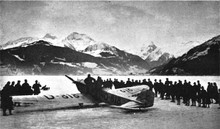
The best known and most significant flight by the L20 was the wintertime crossing of the Alps in early 1926. Flight Magazine hailed this as the “Vindication of the Light ‘Plane”, in the sense that it showed small aircraft to be a practical vehicle for travel over difficult terrain and in uncertain weather. The pilot was Guritzer and the navigator/engineer von Lansdorff, both from Daimler. The flight began at Daimler’s Sindelfingen base on 16 February. No special preparation such as fuel dumps were made in advance and carefully prepared maps were lost overboard early in the flight. The weather frustrated several attempts to cross the Alps but at last the L20 landed in 300 mm (1 ft) of snow near Zeller See. The return journey reached eastwards, skirting the Alps via Budapest and Vienna and arriving home at Sindelfingen on 16 March.
L 20 at Zeller See after crossing the Alps in winter
During 1927 the L20 continued to contest competitions such as the Lilienthal Prize, winning most of the prizes in the lightplane class and making overseas visits such as the one to the UK in July. Private owners also took them on long tours, such as the 1927 North European flights of Anton Riediger but no-one went further with their L20 than Baron Freidrich Carl von König-Warthausen, who set off on 11 August 1928 on a world tour, beginning with a flight to Moscow, then on to Tehran, Calcutta and Singapore. From there he and the L20 crossed to North America by sea but flew across the United States, arriving in New York City on 3 September 1929 after travelling 36,000 km (22,369 mi) from Berlin.
One L-20 was built in 1928 by Aeromarine for evaluation. Others registered under the Klemm title, eg: N4919 and N4920, with Mercedes motors, are probably German imports of an earlier date.
The Klemm L25 was evolved from the all-wooden construction Klemm-Daimler-Leichtflugzeug L20 from 1924.
Klemm-Daimler-Leichtflugzeug L20 Engine: 1 × Mercedes F7502a 885 cc, air-cooled flat twin, 15 kW (20 hp) 20 PS Propeller: 2-bladed Wingspan: 13.0 m (42 ft 8 in) Wing area: 20.0 sq.m (215 sq ft) Empty weight: 265 kg (584 lb) Gross weight: 450 kg (992 lb) Wing loading: 22.5 kg/sq.m (4.60 lb/sq.ft) Power loading: 30 kg/kW (50 lb/hp) Maximum speed: 105 km/h (65 mph; 57 kn) Range: 480 km (298 mi; 259 nmi) Service ceiling: 4,100 m (13,500 ft) Time to altitude: 12.6 min to 1,000 m (3,281 ft) Landing speed: 42 km/h (26 mph) Crew: two
Aeromarine Boland L-20 Engine: Mercedes, 20 hp Wing span: 38 ft 0 in Max speed: 80 mph Cruise speed: 66 mph Stall speed: 20 mph Seats: 2
Inventor J.H. Klassen of California built this design in 1910. The machine had four large umbrella-like lifting surfaces. Klassen – who was Vice president of the Aero Club of California – expected much from this design which was shown at the Los Angeles Air Meet in January 1910.
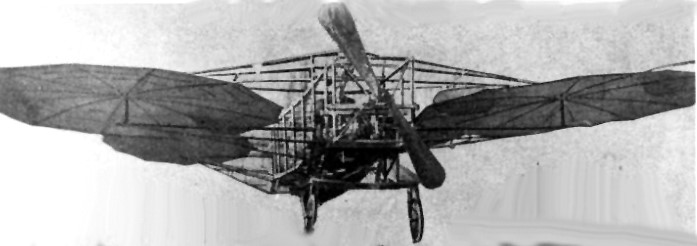
Slovenian aviation pioneer Alphonse Kjuder and Ivan Renčelj were self-taught in the field of aviation. The head and financing of the project was Kjuder, while Renčelj was the main designer and builder. The plane was powered by a five-cylinder Anzani and embodied some unusual solutions – the wing could be moved sideways to achieve lateral control and in case of an accident it could be turned perpendicular to brake the plane. It was exhibited in mid-October 1911 in Ljubljana. It apparently never flew.

 All Aero