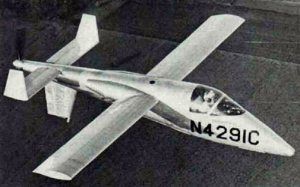
Lesher Teal

The Lesher Teal, registered N4291C, was explicitly designed to break records in the Fédération Aéronautique Internationale Class C1a, for propeller-driven aircraft of less than 500-kg (1102-lb.) gross weight.

The Teal retained the Nomad’s Continental O-200A power and all-aluminum pusher configuration, this time in a single-seat layout. Its wingspan is a diminutive 23 ft. 10 in. (by contrast, a Piper J3’s span is 35 ft. 3 in.).

At one point of the Teal’s design, Ed, who weighed well over 200 lb., considered using a jockey pilot. Instead, not wanting to miss the fun, he decided this was a good incentive to lose some weight.

The Teal first flew in April 1965.

In August 1965, Lesher piloted it to the EAA Fly-In in Rockford, Illinois, where he was honored for his achievements. Then he began attacking the FAI records.

In 1967, Lesher and his Teal set a Class C1a speed record for a 500-km closed course at 181.55 mph. Later that year, he flew the Teal at 169.20 mph for a new 1000-km closed-course record. Before the year ended, Lesher and the Teal averaged 141.84 mph for a new closed-course record of 2000 km.

In 1968, a loss of power brought the Teal to an emergency landing, and considerable damage, in a Michigan field. After a rebuild, Lesher and his Teal set another FAI record in 1970, this one for a closed-circuit distance of 1554.29 miles. In 1973, he and the Teal set a 3-km speed record of 173.101 mph as well as a 15-25-km record of 169.134 mph. Finally, the pair set an FAI C1a record for straight-line distance, officially 1835.459 miles, by traveling from Florida to Arizona.

For these record-breaking achievements, Lesher earned the FAI’s Louis Blériot Medal four times, in 1967, 1970, 1973 and 1975. He was inducted into the Michigan Aviation Hall of Fame in 1988.

The Lesher Teal has resided in the EAA Adventure Museum since 2002.
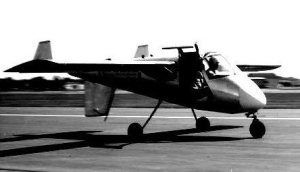
Lesher SN-1 Nomad

The 1946 Stinson 106 Skycoach, one of Stinson’s products during Lesher’s time with this Wayne, Michigan, company. The Skycoach’s pusher propulsion, though, intrigued Lesher and he incorporated this feature into his home-built aircraft.

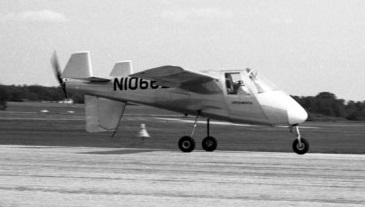
The Nomad was an all-aluminum side-by-side two-place pusher. Powered by a 100-hp Continental O-200A air-cooled flat-four placed immediately behind the cockpit, fed with air intakes at the wing roots, the Nomad made innovative use of a Dodge Flexidyne Coupling to dampen torsional vibration.

The wing was built as a single assembly with a very simple profile and no dihedral. The vee-tailed empennage and vertical fin in low position was meant to impair the Hartzell propeller’s efficiency as little as possible, while the vertical fin placed below helped to keep the propeller clear from the ground.

Construction began in 1959 and the Nomad, registered N1066Z, flew in October 1961 after 5000 hours of construction. Lesher and the plane took Grand Prize at the 1964 AC Spark Plug Rally.

The Nomad was followed by the better-known Lesher Teal, which also remained a prototype.

Lesher SN-1 Nomad N1066Z

Leonard Motorless Aircraft Glider

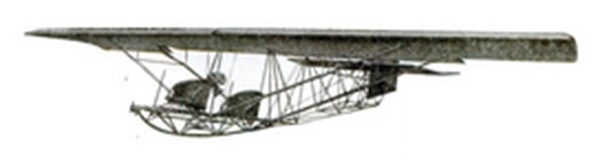
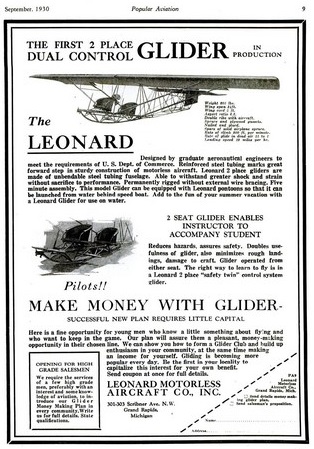
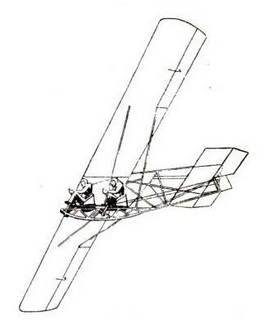
Billed as the first two seat glider to enter production, the 1930 Leonard Motorless Aircraft Company glider of 1930 was designed by graduate aeronautical engineers to meet the requirements of the US Dept of Conmmerce.

The entire fuselage is constructed of steel tubing, welded at all joints and with bals wood inside. The wings are cloth covered and braced with spruce ribs.

Able to be flown from either seat with dual controls fitted, the glider was for sale in 1930 for $550.

Wingspan: 34 ft
Wing chord: 5 ft
Aspect ratio: 6.8
Empty weight: 210 lb
Landing speed: 19 mph
Auto tow ROC: 800 fpm
Glide ratio: 15-1

Lendner 1912 Monoplane

Leo Lendner (Würzburg) built several flying machines in Germany during 1911-1913. This photograph was taken during a visit of k.u.k. military cadets at Würzburg in September 1912. It was sent as postcard to a girl of the family by that boy sitting in the 2nd cockpit – Max Graf von Tauffkirchen zu Guttenburg auf Ybm. Max was the lucky one to fly with Lendner on that machine, as he told.

Lelièvre 1912 monoplane

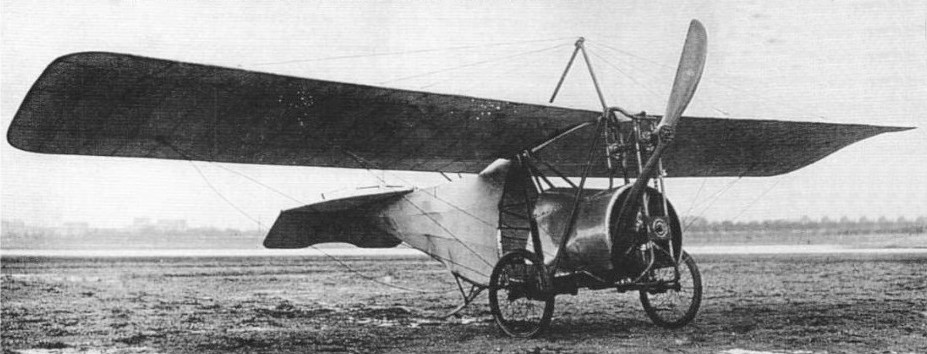
This stubby monoplane was designed by Lt Lelievre and built by Vendome in 1912 at Le Havre, France. The wing was mounted on the top of the short, covered fuselage, with the engine set almost at ground level, driving through a chain the tractor propeller that was mounted slightly forward of the leading edge. The pilot sat inside the fuselage under the wing, entering through one of the side doors.

It first flew on 18 July 1913, at Issy-les-Moulineaux. It was destroyed when it crashed in August during test flights, slightly injuring Lt Lelievre.

Engine: Gnome 50 hp

Leleu 1913 monoplane

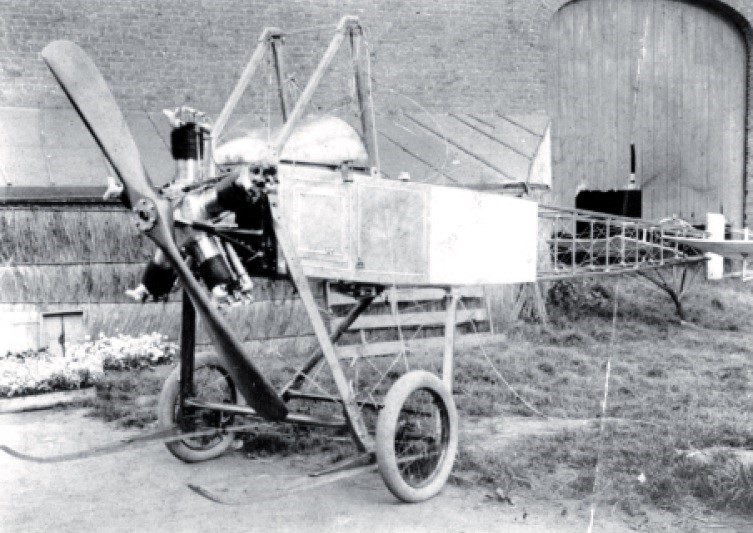
Arthur Leleu, carpenter and father of 18 children, designed and built this somewhat Deperdussin-inspired monoplane, which was powered by a five-cylinder Anzani. It was tested at the La Briquette field outside Valencienne, France, by a pilot by the name of Boutaric. The first flight, on 18 May 1913, was successful, but on the next day the pilot was disturbed by some cattle, landed on a marker stone and broke the wheel axle. That was apparently the last that was heard of the machine.

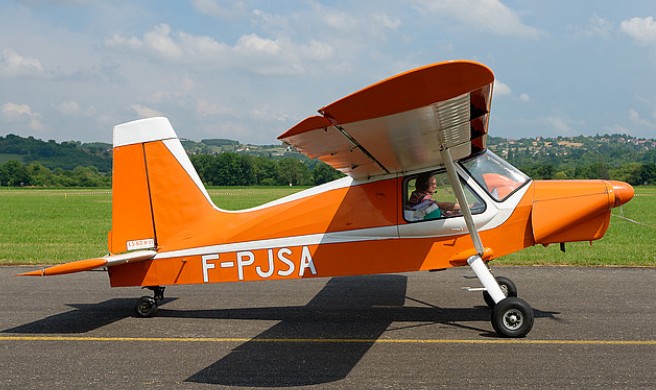
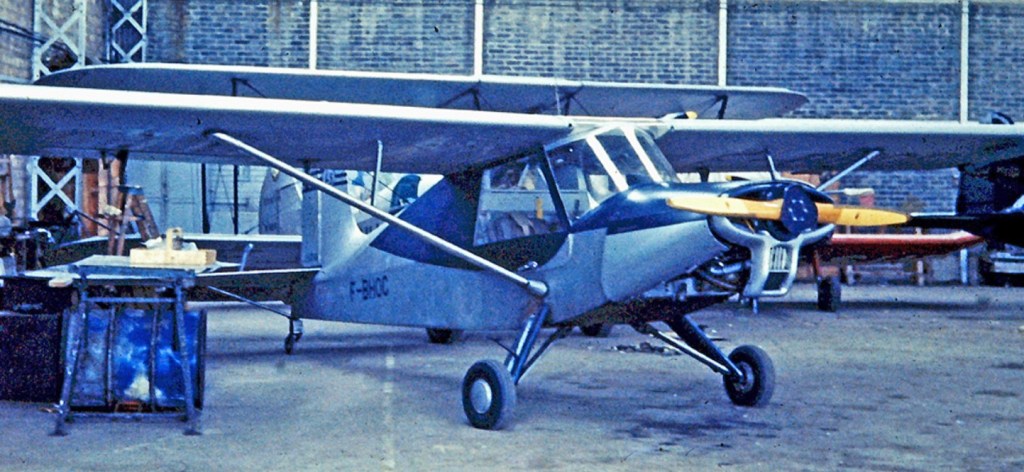
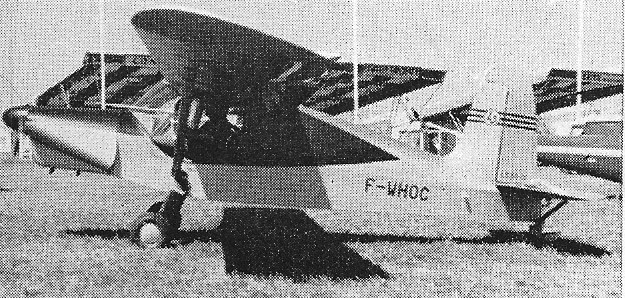
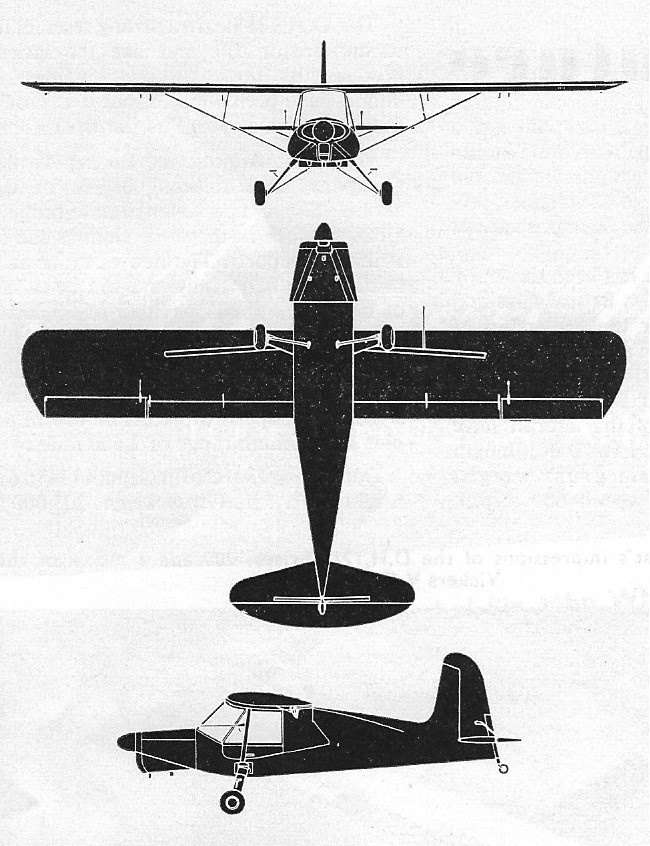
Legrand-Simon LS 50

The LS 50 was designed to be suitable for touring, training, or towing. The craft is of mixed wood construction allowing sub-contracting and prefabrication.

On the prototype several components, such as cowling panels, wheel discs, spinner and door sills, had been made of fibreglass. The fuselage is basically rectangular, rigid wood box built up on four longerons. At the sear is a post for the rudder.

At the front a metal frame unites the cabin and wing supporting structure, the two side-by-side seats, the control column and its mechanism, and the undercarriage and shock absorbers. This welded steel structure supports the controls, flap mechanism, radio, doors and instrument panel. Full dual controls are fitted as standard, and the various trim controls are placed on the centrally mounted flap lever in the cabin roof, accessible to both seats.

The wing is built up on a single spar at 25% chord, and forward of this spar is plywood covered, forming a torsion box. The ailerons are cable-operated, the flaps by torsion tube. Ribs are built up of wood and the whole wing, braced by a single strut each side, is fabric covered. The tail unit is constructed of welded steel tube with a fabric cover.

Only the one was built.

Engine: 90 hp
Wingspan: 31 ft 6 in
Length: 21 ft 0 in
Height: 6 ft 6 in
Empty weight: 979 lb
Loaded weight: 1527 lb
Max speed at 3000ft: 118 mph
Cruise at 3000ft: 104 mph
Landing speed: 41 mph
Range: 620 mi
ROC: 700 fpm
Seats: 2