In 1963 the USAF’s Military Air Transport Service issued a require¬ment for a very large logistics transport aircraft. Finally, this and other requirements evolved into specification CX HLS (Cargo. Experimental Heavy Logistics System) which demanded an aircraft capable of carry¬ing a payload of 56 700 kg (125 000 lb) over a range of 12 875 km (8000 miles) and twice that weight over shorter distances. It also had to be able to take off from the same runways as the smaller C 141 StarLifter and have the capacity to land on roughly prepared strips in combat areas. In May 1964 the Boeing, Douglas and Lockheed companies were asked to develop their submitted designs further. The gross weight requirement had by then been increased to 317 500 kg (700 000 lb), and General Electric and Pratt & Whitney were invited to design a suitable powerplant. Towards the end of the following year the choice was made in favour of a Lockheed/General Electric partnership, and the aircraft was officially designated C-5A Galaxy.
Eight test and evaluation machines were built, beginning in August 1966, the first C-5A Galaxy (#66-8303) was “rolled out” on 2 March 1968.
On June 30th 1968 Lockheed-Georgia Co. began flight testing with the aircraft’s first flight taking to the air under the call-sign “Allen-zero-three-heavy”, upon completion of testing the first C-5A was transferred to the Transitional Training Unit at Altus Air Force Base, OK, in December 1969.
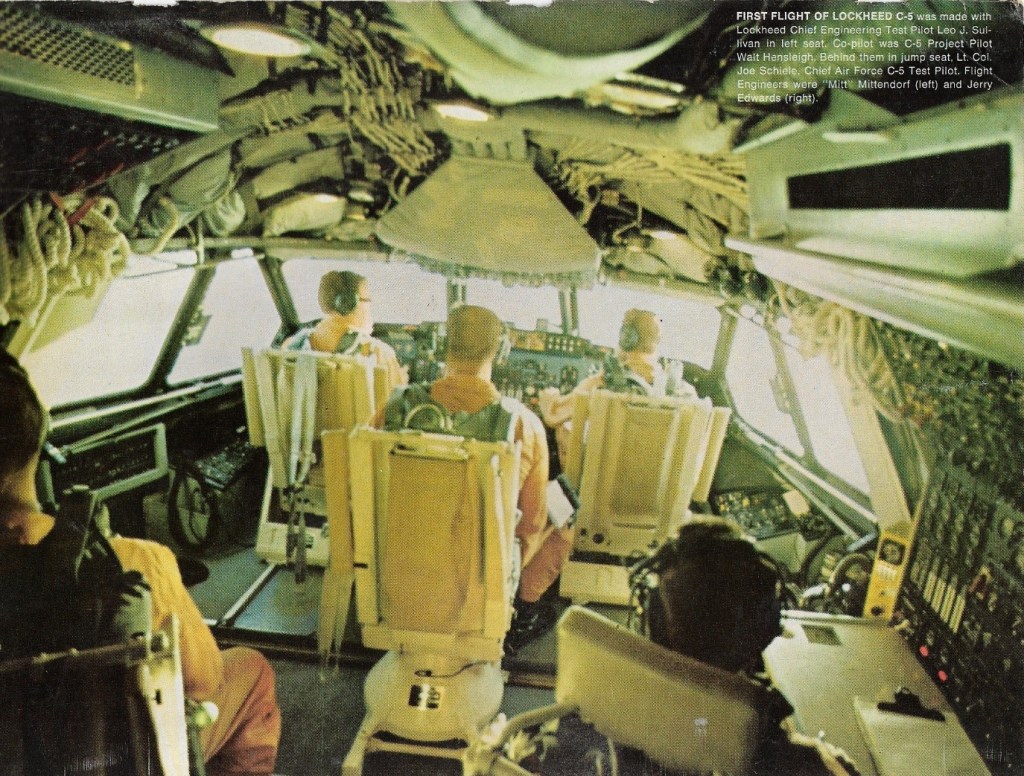
The first flight crew were Lockheed Chief Engineering Test Pilot Leo J. Sullivan in left seat. Co-pilot was C-5 Project Pilot Walt Hensleigh. Behind them in jump seat, Lt. Col. Joe Schiele, Chief Air Force C-5 Test Pilot. Flight Engineers were “Mitt” Mittendorf (left) and Jerry Edwards (right).
C-5 first flight
It is a high wing cantilever monoplane, with a semi monocoque two deck fuselage of aluminium and titanium alloy construction and a cantilever all metal ‘T’ tail. The nosewheel unit retracts rearward hydraulic¬ally, as do the four main undercarriage bogies, each consisting of two sets of wheels in tandem on each side of the fuselage. Powered by four General Electric TF39 GE 1 turbofan engines, each rated at 18600 kg (41005 lb) thrust at sea level, the Galaxy carries a maximum usable fuel load of 185 480 litres (40 800 Imp gal) and can be refuelled in flight from a KC 135 tanker via an inlet in a fairing on top of the forward fuselage, just aft of the flight deck. For takeoff, a fully loaded Galaxy needs 2135 m (7004 ft) of runway, but can land in 680 m (2230 ft).
A crew of five is normally carried, includ¬ing a loadmaster, and there is a forward rest area on the upper deck for 15 persons (relief crew, etc). Although intended primarily as a freighter, the basic version can carry 75 troops at the rear of the upper deck and 270 on the lower deck. Loads lifted have included a 35380 kg (78000 1b) Minuteman ICBM and its 3175 kg (7000 1b) launching cradle; two 44 905 kg (99 000 1b) M 48 tanks; or three Boeing Vertol Chinook heavy lift helicopters. Loading can be done from front or rear, or from both ends simultaneously. There is an upward hinged nose door and loading ramp at the front; the rear straight in loading ramp, when closed, forms part of the undersurface of the rear fuselage.
Flight testing of the Galaxy continued until the summer of 1971. Deliveries of production aircraft to Military Airlift Command began on December 17, 1971, (to the 437th Airlift Wing, Charleston Air Force Base, SC) and were completed in May 1973. The C 5A became operational in 1970, and from July of that year was flying regular trips to Southeast Asia and Europe; it was utilized extensively during the Vietnam war for rapid transport of heavy equipment. In 1978, a total of 77 still remained in the MAC inventory of the 81 aircraft built. These were in service with the 60th, 436th, 437th, and 443rd Military Airlift Wings, based at Travis Air Force Base, California; Dover, Delaware; Charles¬ton, South Carolina; and Altus, Oklahoma.
Throughout the 1970s, the Galaxy remained the world’s largest military transport aircraft, being almost as large and heavy as the later model Boeing 747 Jumbo jets. Lockheed has calculated that, if required by the USAF, it is capable of being optimized for payloads even greater than the present 100227 kg (220964 1b) maximum, without increasing the maximum takeoff weight.
These aircraft have been put to invaluable use on non military mercy missions to disaster stricken areas such as the floods in Chile in 1974 and those in Pakistan. Much needed equipment and supplies were taken to earthquake ravaged Nicaragua by Galaxy aircraft, and in early 1977 and 1978 they were used to ferry snow¬clearing equipment to several areas within the United States.
In the mid-1970s, wing cracks were found throughout the fleet. Consequently, all C-5A aircraft were restricted to a maximum of 50,000 pounds (22,680kg) of cargo each. To increase their lifting capability and service life, 77 C-5As underwent a re-winging program from 1981 to 1987. (In the redesigned wing, a new aluminum alloy was used that didn’t exist ten years prior.) The final re-winged C-5A was delivered in July 1986.
In January 1981 a C-5A at snow covered Griffiss Air Force Base a C-5A performed more exhaustive ground maneuvers on unprepared ‘off-runway’ surfaces, including taxiing, towing and cargo off-loading at gross weights from 425,000 to 665,000 lb. The tests were conducted by the Air Force Test and Evaluation Center, Kirkland AFB, New Mexico.
Some C-5s were transferred to the Air Reserve components starting with Kelly AFB, Texas, in 1985; followed by Stewart Air National Guard Base, NY; and Westover Air Reserve Base, MA.
In December 1985 Lockheed was awarded a contract to design a new wing for the Galaxy, increasing maximum take-off weight from 348,810kg to 379,660kg. By the end of 1986, 68 rewinged C-5As had been returned to service, and the 77-strong fleet was scheduled for completion by mid-1987. C-5Bs have the same wing, improved General Electric TF39 turbofans, updated avionics, and better fatigue and corrosion resistance.
C-5B
Two C-5As modified to carry outsized space cargoes as C-5Cs.
On 17 April 1989 Lockheed delivered its final C-5B to the USAF.
C-5 engines were upgraded as C-5M, from four General Electric TF-39 engines to General Electric CF6-80C2-L1F (F-138) commercial engines, which have 22 percent more thrust, a 30 percent shorter takeoff roll, and a 58 percent faster climb rate. June 2006 saw the first flight of the C-5M ‘Super Galaxy’ with a digital glass cockpit.
C-5A Galaxy Engines: 4 x GE TF-39-GE-1, 182.9kN / 41,000 lb Wing span: 222 ft 8.5 in (67.88 m) Wing area: 576.0 sq.m / 6200.01 sq ft Length: 247 ft 10 in (75.54 m) Height: 65 ft 1.5 in (19.85 m) Max TO wt: 764,500 lb (346,770 kg) Payload: 73pax, max 130950kg Max level speed: 571 mph (919 kph) Cruise speed: 871 km/h / 541 mph Service ceiling: 33802 ft / 10303 m Range w/max.fuel: 13472 km / 8371 miles Range w/max.payload: 5600 km / 3480 miles Take off distance : 12129 ft / 3697 m Landing distance : 4872 ft / 1485 m Crew: 6
C-5B Galaxy Engine: 4 x GE TF39 turbofan Installed thrust: 765 kN Wingspan: 67.9 m / 222 ft 9 in Height: 19.8 m / 65 ft 0 in Length: 75.5 m Wing area: 576.0 sq.m / 6200.01 sq ft Empty wt: 169,645 kg MTOW: 379,660 kg MLW: 288,630 kg Payload: 118,390 kg Max. speed: 920 km/h / 572 mph Cruise speed: 835 kph Initial ROC: 440 m / min Ceiling: 10,895 m T/O run: 2125 m Ldg run: 720 m Fuel internal: 193,640 lt Range with 118,390 kg payload: 5470 km Capacity: 75 pax Air refuel: Yes.
C-5M Super Galaxy Engines: 4 x GE CF6-80C2 turbofan Wingspan: 222.8 feet Length: 247.8 feet Height: 65.1 feet Empty weight: 400,000 lb Cargo capacity: 281,001 lb Cruise speed: Mach 0.77 Un-refuelled range: 5,524 sm (4,800 nm) with 120,000 lb of cargo Un-refuelled range: 7,000 nm no cargo
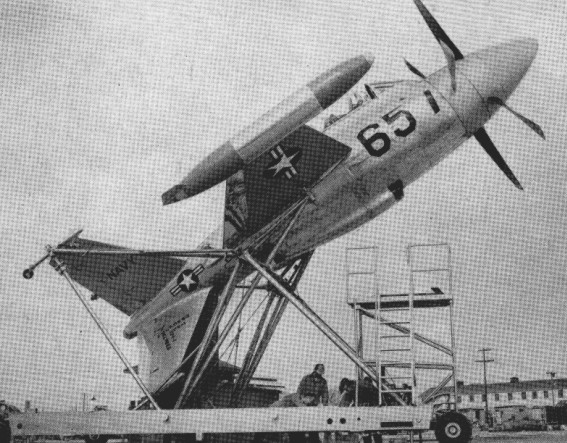
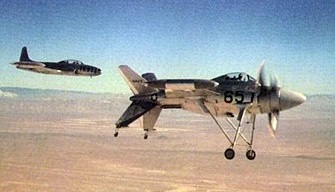
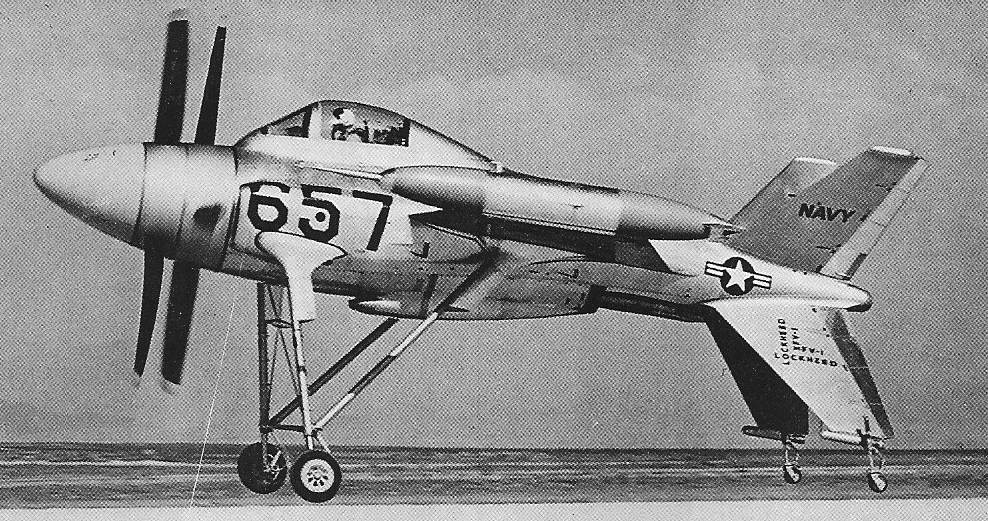
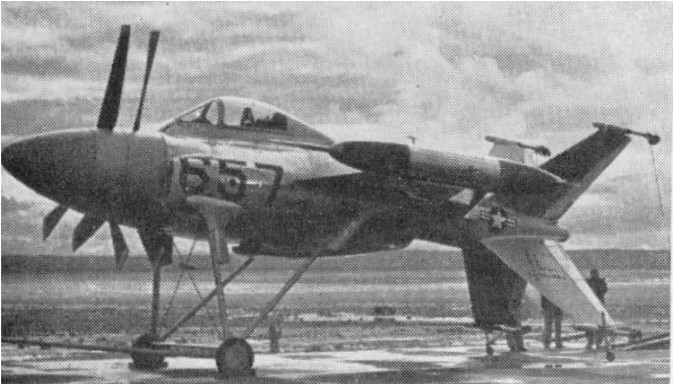
From 1949 the US Navy actively pursued a policy of VTOL research. The results were two prototypes, the Lockheed XFV-1 and the Convair XFY-1 Pogo. Both aircraft were of the ‘tail-sitter’ concept and powered by the 5500-shp (4101-kW) Allison T40-A-6 turboprop driving large contra-rotating propeller units. These provided more thrust than the weight of the aircraft, making possible VTOL operation.
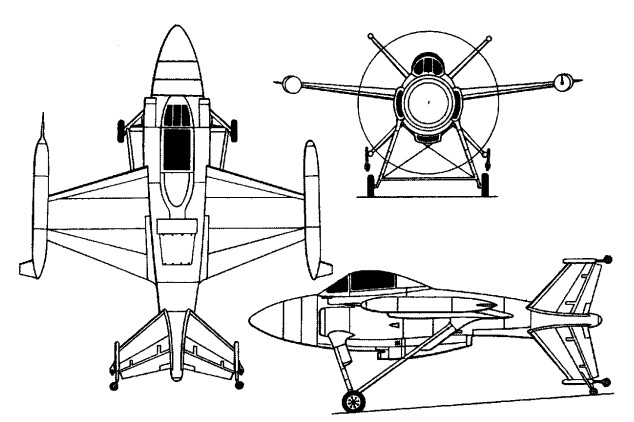
The XVF-1 was the more conventionally configured of the two types, with a mid-set wing of low aspect ratio, but for VTOL capability had a cruciform arrangement of tail surfaces indexed at 45 degrees to the wings. Each fitted with a small castoring wheel on the outboard end of its trailing edge. For flight trials with an engine not cleared for VTOL operation the type was fitted with a lightweight but very stalky fixed landing gear arrangement to permit conventional rolling take-off and landing, and in this guise first flew in June 1954. The aeroplane flew 22 times, in the process recording 32 operations in the vertical mode, when variation of the engine power made possible descending, hovering and ascending flight. No pure VTOL operations were undertaken with the only one of the two XFV-ls that flew.
The performance was similar to the P-80 Shooting Star.
The whole programme was cancelled in June 1955 and construction of the second prototype abandoned.
A contract for two prototypes of a new type VTOL aircraft was placed with the Lockheed company’s Georgia factory by the U.S. Army in June 1961. This followed more than two years of privately financed development of the jet ejector augmentation principle by Lockheed, including wind tunnel and test rig work.
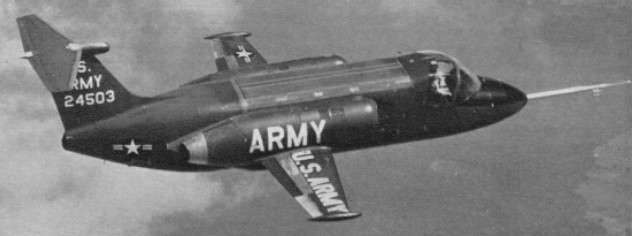
The Army contract was for the Lockheed Model 330 Humming Bird, a research vehicle which was to be capable of development for use in the battlefield surveillance and Army support role.
Basis of the Lockheed concept is to augment the thrust of a jet engine by ducting its exhaust through a large diameter tube so that a large volume of cold air is drawn through it by friction and vacuum effect. This can augment the basic thrust of the engine by as much as 40 per cent.
In the VZ 10 which was re designated XV4A in July 1962 two 3,000 lb.s.t. Pratt & Whitney JT12A 3s are located each side of the fuselage above the wing root. For vertical operations, their exhaust jet is turned through 180 degrees and ejected downwards through a series of nozzles into a duct or mixing area in the centre fuselage. Doors covering this duct, top and bottom, are opened. To convert from vertical to horizontal flight, the VZ 10 is first tilted slightly nose down to obtain a small thrust component from the jet exhaust from the fuselage duct. As speed builds up the wings begin to contribute lift and the thrust of one engine is then deflected from vertical to horizontal. This increases the speed still more and the second engine can then be deflected, too, and the duct doors are closed.
The first VZ 10 (62 4503) made its first flight at Marietta on July 7th, 1962, taking off conventionally. Hovering trials began in 1963. On 20 November 1963 the first successful flight involving transitions from vertical to horizontal flight, and vice versa, was completed.
The second VZ 10 was tested in the 40 ft by 80 ft low speed tunnel at Ames Research Center before joining the flight test programme.
By then, redesignated XV-4A, the two prototypes were handed over to the US Army. In late 1966 Lockheed modified one of the XV-4As to a new XV-4B configuration, the major change being replacement of the XV-4A’s two 1361kg thrust engines by four each of 1368kg thrust. Testing began in August 1968, but when the aircraft was destroyed in an accident in early 1969 further development was abandoned.
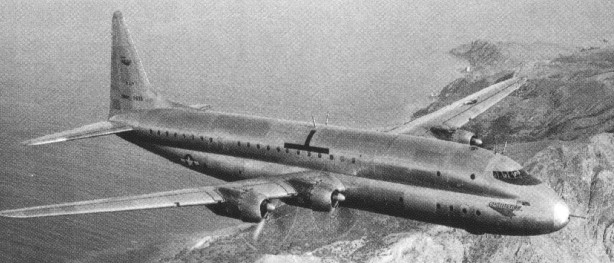
The Constitution design effort began during the war to provide an airplane capable of carrying more payload farther than could contemporary types. Pan American engineers assisted Lockheed in the initial development of the Constitution, officially sponsored by the US Navy. It was slightly larger than the DC-7, both dimensionally and in weight, and was powered by four 3,500hp (2,600kW) Pratt & Whitney Wasp Major engines. The pressurized fuselage would have provided accommodation for as many as 92 passengers on the upper deck and 76 on the lower deck.
Because of greater wartime priorities, the first of two military Model 89 Constitutions did not fly until November 9, 1946. By that time, both Pan American and the Navy had lost interest. The airplanes were delivered to the Navy in 1949 with the military model designation XR6O-1.
Later designated XR6V-1s, both Constitutions were sold by the US Navy in 1958 after less than 2,000 flying hours each. The first ended its days at Opa-locka, Florida, in the 1970s, while the second was scrapped at Las Vegas, Nevada, in 1969.
Engines: 4 x Pratt & Whitney Wasp Major, 3,500hp (2,600kW) Wingspan: 57.63m Crew: 12 Pax capacity: 168
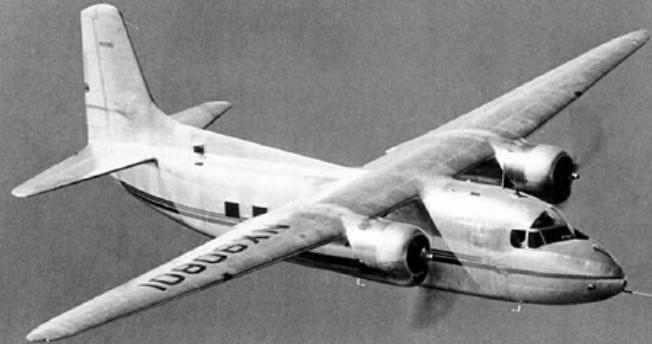
Before the war, Lockheed was very successful in providing airliners for routes that did not generate quite enough traffic for the larger DC-3s. By the end of the war, it was firmly committed to do battle with Douglas for the long-range, high-volume routes, but it did not lose sight of the less-traveled ones on which its prewar designs served so well. Lockheed’s entry in that market was the unpressurized, 14-passenger Saturn. The prototype first flew on June 17, 1946, with two 600hp (450kW) Continental GR9A engines. Difficulties were experienced with these powerplants and consequently 700hp (520kW) Wright C7BA Cyclone engines were substituted shortly thereafter. Like the others who offered new designs for this market, Lockheed found there were just too many military-surplus DC-3s available at bargain prices. The Saturn program was terminated and the two prototypes were scrapped in 1948 for tax purposes.
Engines: 2 x 700hp Wright 744C-7BA-1 7-cylinder radial Wingspan: 22.56 m / 74 ft 0 in Length: 15.69 m / 52 ft 6 in Height: 6.05 m / 20 ft 10 in Loaded weight: 7257 kg / 15999 lb Empty weight: 5153 kg / 11360 lb Max. speed: 367 km/h / 228 mph Cruise: 187 mph Range: 600 miles (960 km)
In early 1940, the US Army reserved for itself the right to refuse permission for its American military aircraft suppliers to export these aircraft to overseas customers. This was particularly true if the Army felt that the foreign order might possibly result in undue delays in deliveries of these aircraft to its own squadrons. Consequently, when Britain and France wanted to purchase the Model 322 Lightning from Lockheed, the Army was reluctant to give its approval since it had already ordered YP-38 Lightnings for its own use. However, the USAAC finally did grant authorization to export the un-turbosupercharged Lightning to Britain and France, but only under the condition that Lockheed agree to develop and produce at no cost to the U.S. government a prototype of an advanced version of the Lightning. The formal agreement was signed on April 12, 1940.
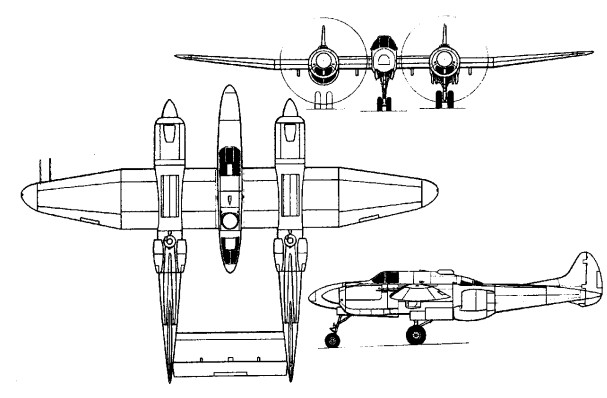
This advanced Lightning was given the company designation of L-121, and James Gerschler was named as project engineer. The L-121 was to be powered by a pair of turbo-supercharged Continental IV-1430 liquid-cooled engines. It was to be offered in two versions, a single- seater and a two-seater. The single-seat version was to retain the standard P-38 armament of one 20-mm cannon and four 0.50-inch machine guns. The two-seat version was to have an additional armament of a single 0.50-inch machine gun mounted in a remotely-controlled barbette situated at the end of each tail boom. Gross weight was estimated at 16,500 pounds, and the aircraft was expected to attain 450 mph at 25,000 feet.
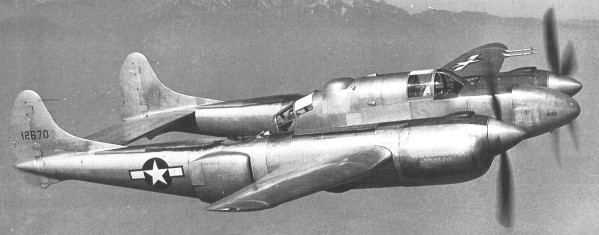
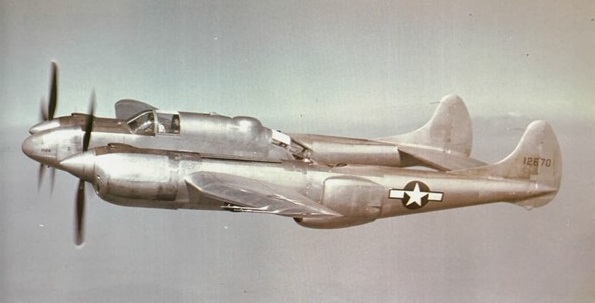
During a meeting at Wright Field in May 1940, it was decided to drop the single-seater and proceed with the two-seat version, which was assigned the designation XP-58. In July 1940, it was concluded that the XP-58 would be underpowered with the Continental engines, and the decision was made to switch to a pair of 1800 hp Pratt & Whitney XH-2600-9/11 liquid-cooled engines. The re-engined XP-58 was given the company designation of Model 20-14, and revised specifications were issued by Lockheed on September 10, 1940. A second 20-mm cannon was added to the forward-firing armament. The tail boom guns were deemed to be highly impractical, and were replaced by a single remotely-controlled dorsal turret containing a pair of 0.50-inch machine guns. The serial number 41-2670 was assigned to the prototype. Estimated gross weight had crawled upward to 24,000 pounds, and estimated top speed had fallen to 402 mph. Range on internal fuel was anticipated to be 1600 miles.
Scarcely a month after these revised specifications had been issued, Lockheed’s new project engineer, Neil Harrison, was told that Pratt & Whitney was suspending development of the XH-2600 engine. The XP-58 was without an engine and attention focused on the XH-2470, the Continental XH-2860, and on the Pratt & Whitney R-2800, as possible choices for the XP-58 power plants.
Lockheed preferred the Pratt & Whitney R-2800 radial engine, and estimated that with these power plants the XP-58 would have a a loaded weight of 26,000 pounds and a maximum speed of 418 mph at 25,000 feet. However, the USAAC considered this performance to be inadequate, and suggested that Lockheed turn to the experimental Wright XR-2160 Tornado forty-two cylinder, six-row engine offering a power output of 2350 hp. This engine had an extremely small frontal area but the Tornado engine development was fraught with problems from the start. Still, in March of 1941 the USAAC announced that it was going to go with the Tornado for the XP-58.
Two months later, the USAAC issued a change order for the installation of cabin pressurization for the pilot and the aft-facing gunner, and for the addition of a remotely-controlled ventral turret to supplement the dorsal turret. These changes caused the estimated gross weight upward to 34,242 pounds. Estimated range had dropped to 1300 miles. Nevertheless, the top speed of the Tornado-powered XP-58 was estimated to be no less than 450 mph.
The XP-58 was scheduled for delivery to the USAAF in August of 1942, and to meet this deadline the project team grew to a peak of 187 people by October of 1941. However, following Pearl Harbor, the XP-58 was assigned a lower priority and most of the engineering staff were moved off to other more pressing projects. By early 1942, the XP-58 staff was down to twelve people.
In March of 1942, Lockheed suggested that the USAAF order a second XP-58 prototype using Government funds. Since the Tornado engines were already experiencing serious delays and were now not expected to be delivered until the spring of 1943, Lockheed felt that there was sufficient time to redesign the second XP-58 machine in order to provide it with enough fuel capacity to increase the range to 3000 miles. The USAAF agreed to this request and placed the order in May of 1942.
Shortly after, the USAAF began to rethink the ultimate mission for the XP-58. First, the USAAF suggested that the nose-mounted forward-firing armament should be changed to a 75-mm cannon with a 20-round automatic feeder plus a pair of 0.50-inch machine guns as a ground attack aircraft. This led to considerations of several different alternative configurations, including a two-seat attack aircraft with six forward-firing 20-mm cannon and a three-seat bomber with a bombardier in the nose, an enlarged central nacelle containing an internal bomb bay, and with or without the 75-mm nose cannon. In both the attack and bomber versions, the dorsal and ventral turrets were to be deleted, and un-supercharged engines were to be used.
With the Douglas A-26 Invader in production as an attack bomber, and the experimental Beech XA-38 Grizzly then under development as a low-altitude tank buster and ground attack aircraft. Consequently, the XP-58 program was then re-oriented back to its original role as a high-altitude aircraft, as a bomber destroyer rather than an escort fighter. The turbo-superchargers and the dorsal and ventral turrets were put back on.
The first prototype was to have four forward-firing 37-mm cannon, whereas the second was to have a 75-mm cannon and two 0.50-inch machine guns. Gross weight was now up to 38,275 pounds, and top speed was down to 414 mph at 25,000 feet. Range was only 1150 miles.
By early 1943, the XP-58 program was in chaos because of the constantly changing Army requirements. In desperation, Lockheed recommended in January 1943 that only one prototype actually be built, and that it have interchangeable noses that would permit the fitting of either type of forward-firing armament.
The trouble-ridden Tornado engine program finally collapsed in February 1943, leaving the XP-58 without engines once again. Lockheed and the USAAF both agreed to switch to a pair of turbo-supercharged Allison V-3420-11/13 twenty-four cylinder liquid-cooled engines, rated at 2600 hp for takeoff and 3000 hp at 28,000 feet.
The US Army contract, of 27 April 1943, tasked Lockheed to build ‘one (1) airplane, pursuit, fighter, two-engine, two-place, known as the XP-58, complete and conforming to the contractor’s specifications’. In the final configuration, the aircraft had two crewmen; a pilot and a rear-gunner operating two power turrets although the turrets and the forward firing armament was never actually installed.
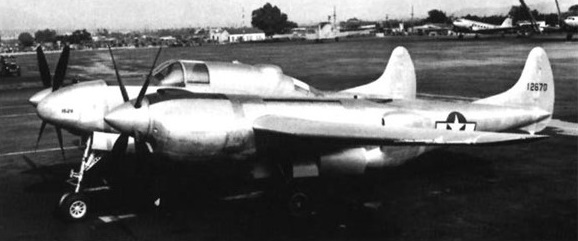
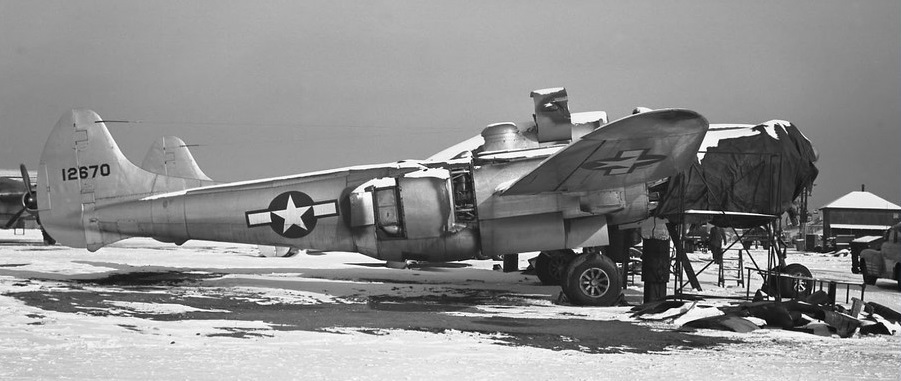
With these Allison engines, the XP-58 (serial number 41-2670) was finally completed in June of 1944, more than four years after its design had begun. Its company designation was now Model 20-86. When the XP-58 rolled out of the factory it was really only half-finished. No cabin pressurisation equipment was provided, no forward-firing armament was installed, and dummy dorsal and ventral turrets were fitted in place of the real things. It made its initial flight from Lockheed Air Terminal at Burban on June 6, 1944, piloted by test pilot Joe Towle. Its first flight was a 50-minute shakedown which took the XP-58 from the manufacturer’s Burbank plant to Muroc AAF. Twenty-five flights totalling 19.3 hours were made at Muroc prior to the delivery of the XP-58 to Wright Field in Ohio on October 22, 1944. These flights were marred by turbo-supercharger problems.
The second airframe was never fully completed but was trucked in parts to Muroc Dry Lake. Because of the cost of continuing a marginal programme with a ‘one-off’ machine, even with a second for spare parts, the programme was terminated in 1945 and it was transferred for use as a non-flying instructional airframe. Derelict at Wright Field as late as January 1946, the Chain Lightning was scrapped in 1947.
The XP-58 project, which started off its career as having absolutely no cost to the US government, ended up costing the taxpayer over two million dollars. $400,000 of this money covered the USAAF requested changes to the first prototype, and the rest of the money covered the government-ordered, but then cancelled, second prototype.
XP-58 Engines: Two turbo-supercharged Allison V-3420-11/13, 2,600 hp / 1950kW Span: 70 ft 0 in / 21.33 m Length: 49 ft 3 in Height: 16 ft 0 in / 4.88 m Wing area: 600 sq. ft / 55.74 sq.m Empty weight: 31,306- lb Gross weight: 38,874 – 42990 lb Maximum speed: 436 mph / 700 km/h at 25,000 ft. Cruising speed: 274 mph at 25,000 ft Service ceiling: 38,400 ft Initial climb rate: 2660 fpm Normal range: 1250 miles / 2000 km Maximum range: 2650 miles
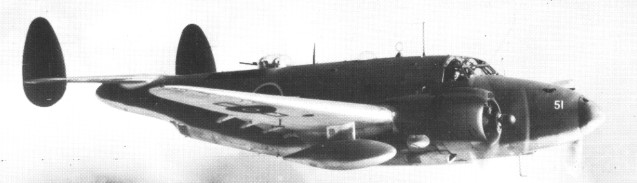
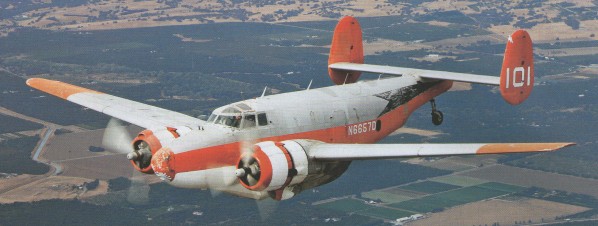
The success of the Hudson in RAF service led Lockheed to propose a military version of the larger Lockheed 18 Lodestar and resulting British interest led to development of the Lockheed 37. Based on the existing Lodestar, the modifications were to provide increased power and an added lift capability of three tons, on the same wings and flaps, and the fuselage was to be re-designed to accommodate bombs, gun positions and other military equipment. The entire Lodestar double tail was retained along with its tendency to be blanketed out in certain landing attitudes by the large and effective Fowler wing flaps. As a replacement for the Hudson, and the Venture promised a 300mph top speed, an eight machine gun armament, twice the bomb load, and a range of up to 500 miles from base.
In February 1940 a proposal submitted by Lockheed for a Blenheim replacement was accepted by the Air Ministry. The aircraft was basically a military version of the Lockheed 18 Lodestar transport.
Lightning and Ventura
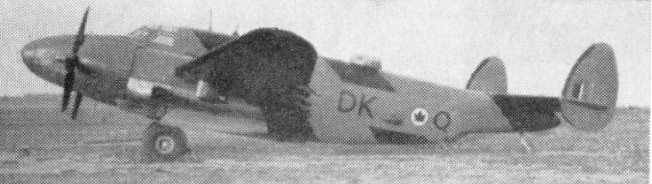
A direct purchase order was placed for 300 aircraft in May 1940, followed by a further order for 375. There were considerable delays in producing the first machine, which first flew on 31st July 1941, and it was not until April 1942 that the first Venturas arrived at Lockheed’s facility at Speke, Liverpool, from the Vega aircraft plant at Burbank, California. In the event, only 394 of the initial orders for Ventura Mk.Is and Mk.IIs (the latter having uprated engines) were delivered.
First used operationally by the RAF on 3 November 1942, the type was soon found to be unsuited to daylight operations and was transferred to Coastal Command.
In 1943 the GR.V version entered service. These machines were supplied under Lease Lend and were patrol aircraft based on the U.S. Navy PV 1. They had modified bomb bays to accommodate six depth -charges. A large proportion of the GR.Vs were delivered direct to the Middle East, South Africa, New Zea-land, Australia and Canada. In Britain No.519 Squadron was the first to receive the GR.V, replacing Hudsons and Hampdens at Wick, followed shortly afterwards by No. 521 Squadron at Docking, both squadrons being engaged in Meteorological flights. These two squadrons reverted to Hudsons the following year when the Venturas were required elsewhere.
By November 1942 the US Navy had taken over the patrolling of the US coastal water from the USAAF and had ordered their own version of the Ventura, the PV-1, for the role. The Vega production line was easily converted to this model from the previous B-34 variant in production for the USAAF. The PV-1 differed primarily from the B-34 Ventura in having two underwing stations capable of holding one 1,000lb bomb or one 155 US gallon drop tank. The streamlined Martin 250 electric turret, first fitted to the USAAF B-34, was retained. The most significant difference internally was the installation of the advanced ASD radar in the nose of the aircraft behind an opaque plastic nose cap. Indicators (or screens) were provided for the navigator in the nose compartment, and for the radio operator stationed behind the pilot. A new under-nose gun pack equipped with 3 x .50 Brownings was developed to replace the original nose mounted depress¬able guns fitted to earlier Venturas.
PV-2
Venturas served with all the Commonwealth nations, the Free French and with the Brazilian air force. A long-range version, the PV-2, had been ordered by the US Navy in June 1943 and, differing in several respects from the Ventura, was named the Harpoon; Ventura and Harpoon production totalled 3,028 in September 1945. Post-war surplus PV-2 aircraft were supplied to Italy, Japan, the Netherlands, Peru and Portugal.
PV-2
A few Ventura 5s had been modified for target towing duties with the RCAF and were still operating in 1955. Powered by two 2,000 h.p. Pratt & Whitney R2800-31 engines, they carry sleeve targets in their bomb-bay.
Ventura 5
California-based Oakland Airmotive specialized in civilian executive transport conversions of surplus U.S. Navy Lockheed PV-2 Harpoon patrol bombers. The resultant Oakland Centaurus seated 8/14 passengers and was offered as a high speed corporate transport in the late 1950s and early 1960s.
Engines: 2 x Pratt & Whitney GR2800-¬S1A4 G, 2,000 h.p. Span: 65 ft. 6 in. Length 51 ft. 2.5 in. Height: 11 ft. 10.5 in. Weight loaded: 26,000 lb. Max. speed: 300 m.p.h. Cruising speed: 260 m.p.h. Range: 1,000 miles. Service ceiling: 25,000 ft. Armament: Two fixed 0.50 in. machine guns and two depressable 0.303 in. guns in nose, two or four 0.303 in. guns in dorsal turret, two 0.303 in. guns in ventral position; bomb load 2,500 lb. Crew 5.
PV-1 Engines: 2 x Pratt & Whitney R2800-31 Twin Wasps, 2000 hp / 1491kW. Max take-off weight: 14096 kg / 31077 lb Empty weight: 9161 kg / 20197 lb Wingspan: 19.96 m / 65 ft 6 in Length: 15.77 m / 51 ft 9 in Height: 3.63 m / 11 ft 11 in Wing area: 51.19 sq.m / 551.00 sq ft Max. speed: 518 km/h / 322 mph Cruising speed: 200 kts / 370 kph Service ceiling : 24,000 ft / 7315 m Ceiling: 8015 m / 26300 ft Range: 2189 km / 1360 miles Bomb load: 2500 lb. Armament: 2 x .5 in & 8 x .303 in mg, 1134kg Bomb Crew: 5.
Ventura 5 Engines: two 2,000 h.p. Pratt & Whitney R2800-31 Span: 65 ft. 6 in Weight: 26,500 lb Max. Speed: over 300 mph
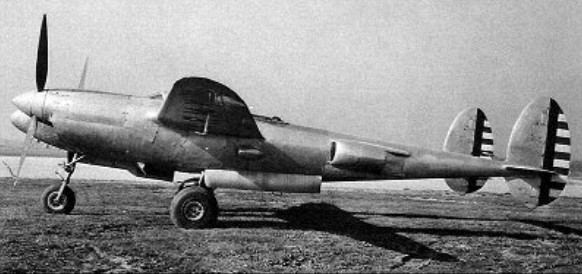
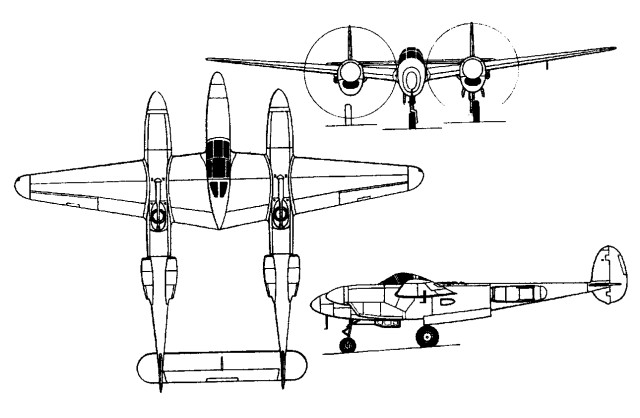
A conception of pre-war years, the Lockheed XP-49, was designed in 1939 with the goal of attaining 761km/h in level flight at 4572m. The XP-49 was to be armed with two 20mm cannon and four 12.7mm machine-guns. The XP-49 was an outgrowth of the P-38 Lightning but in most respects was an entirely new design by the Lockheed-Burbank fighter team under H. L. Hibbard and Clarence (Kelly) Johnson. Ordered by the US Army on 3 August 1939 to meet a twin-engine fighter requirement (which also produced the Grumman XP-50) the sole XP-49 was expected to attain unprecedented performance by mating the Lightning’s familiar twin-boom layout with two 1715kW Pratt & Whitney X-1800 24-cylinder inline engines. When plans to develop the powerplant proved too ambitious, twin 1006kW Continental XIV-1430-1 engines had to be substituted, reducing speed to 737km/h, although this was reached because the test ship lacked the added weight of protective armour which would have been fitted on a production variant. “We still felt we had a winner,” says a Lockheed engineer. “We had a roomy, pressurised cabin, good handling characteristics and, eventually, good manoeuvrability.” The XP-49 first flew 11 November 1942 at Burbank. When it became necessary to increase the vertical fin area to improve yaw characteristics, the result was an unusual set of markings: Army directives called for 13 alternating red and white horizontal stripes on the rudder, symbolic of the original 13 American colonies. When the tail was heightened, painters simply added non-regulation extra stripes. repaired, and was ferried to Wright Field, Ohio, on 25 June 1943. Though it was a clear improvement over the P-38, able to “fly rings around the Lightning” in the words of one pilot, minor but troublesome fuel leakage problems led to XP-49 tests being discontinued and the airframe being scrapped, just when Mustangs with long-range drop tanks were appearing over Berlin.
XP-49 Engine: 2 x Continental XIV-1430-13/15, 1010kW Max take-off weight: 9047-9977 kg / 19945 – 21996 lb Empty weight: 7013 kg / 15461 lb Wingspan: 15.85 m / 52 ft 0 in Length: 12.22 m / 40 ft 1 in Height: 2.98 m / 9 ft 9 in Wing area: 30.42 sq.m / 327.44 sq ft Max. speed: 650 km/h / 404 mph Cruise speed: 600 km/h / 373 mph Ceiling: 11400 m / 37400 ft Range: 1095 km / 680 miles Crew: 1
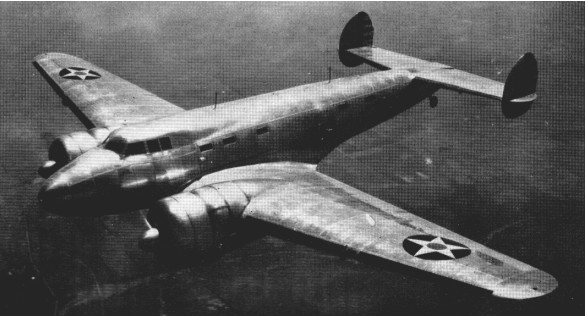
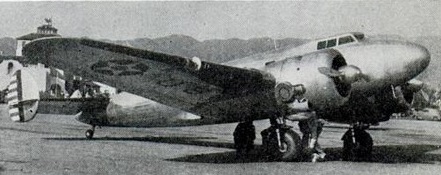
The Lockheed XLR20-1 prototype led to the C-35 (pressurised), and the C-36 / 10A. The XC-3 was a high altitude research aircraft built with a pressurised cabin.
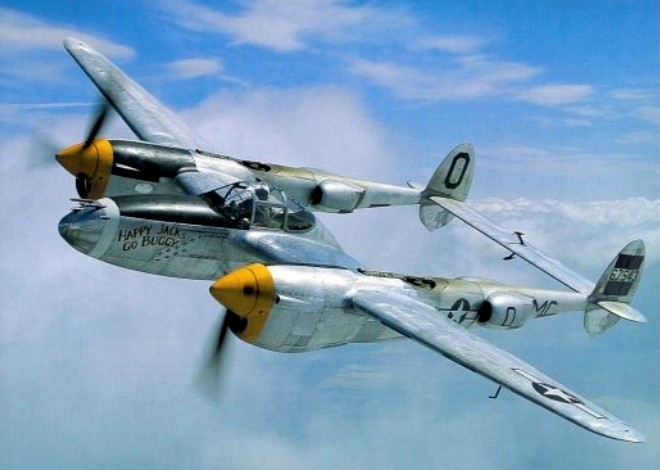
The first aeroplane developed from the start as a military type by Lockheed, the P-38 was designed to meet an Air Corps specification issued in February 1937.
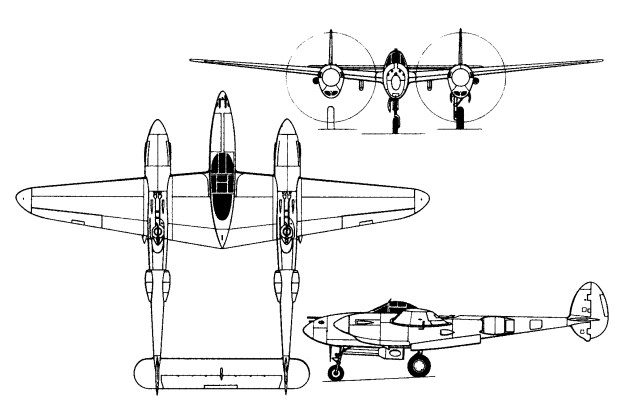
The P-38 was powered by two Allison engines with GEC turbochargers recessed into the tops of the tail booms, tricycle landing gear, small central nacelle mounting a 23mm Madsen cannon and four 0.5in Brownings, twin fins, Fowler flaps, radiators on the booms, and induction intercoolers in the wing leading edges.
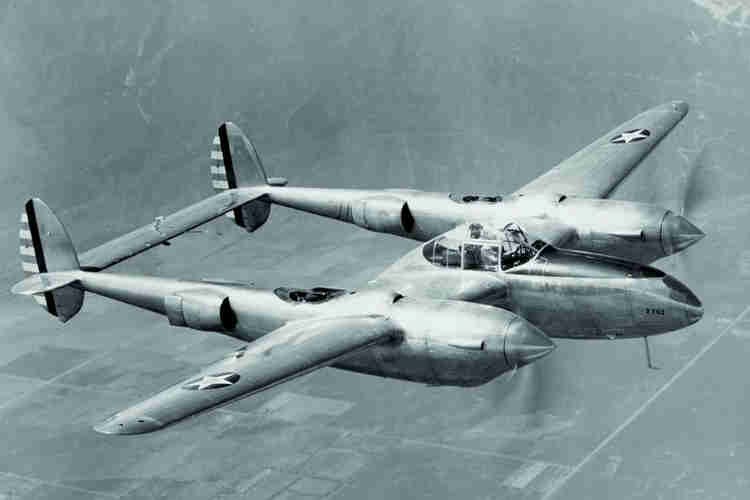
The XP-38 prototype flew for the first time on 27 January 1939 and the XP-38 had run into a ditch on its first taxi test and two weeks after the first flight undershot at Michell Field, NY, and was demolished. The XP-38 had flown to New York in 7 hr 2 min, with two refuelling stops.
The first YP-38 service-evaluation aircraft (first flown on 16 September 1940) of a limited procurement order for 13 was delivered to the USAAF in March 1941. By 1941 the first YP-38 was being tested, with a 37 mm Oldsmobile cannon, two 0.5s and two Colt 0.3s.
XP-38
It utilised a unique fuel system with separate fuel tanks for each engine. Each tank was divided into three cells, all self-sealing. Two main tanks were in the centre fuselage and one tank was in each leading wing edge. The entire system was interconnected so that fuel from any tank, except the outer wing tanks, could be routed to either engine. The Lightning’s armament included one 20mm cannon and four .50-caliber machine guns in the nose along with racks to carry up to 1,600 pounds of bombs.
Thirteen YP-38s were followed by 20 P-38s, with one 37mm and four 0.5in, plus armour and, in 36 D models, self-sealing tanks.
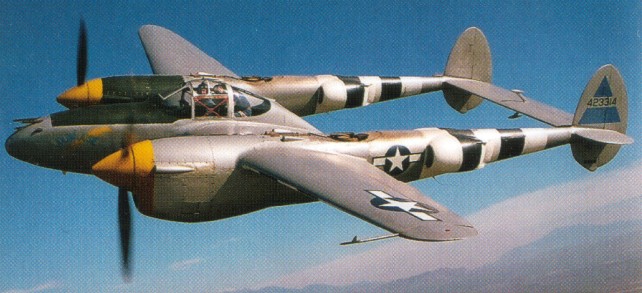
P-38D in US service differed from the original P-38 by introducing self-sealing tanks and tail-unit revisions to overcome buffeting. The first service delivery was on 8 June 1941 and the he P-38D was the first version of the Lightning to go into service in the war – an aircraft of this mark was the first American fighter to shoot down an enemy aeroplane, flying over Iceland a few minutes after the US declared war on Germany.
In March 1940 the British Purchasing Commission had ordered 143 of the type, similar to the P-38D which followed the P-38 into production, with the 37mm replaced by a 20mm Hispano and far greater ammunition capacity. The State Department prohibited export of the F2 Allison engine and the RAF aircraft, called Lightning I, had early 775kW Allison V-1710-33 engines without turbochargers, both having right hand rotation. The result was poor and the RAF rejected these machines, which were later brought up to US standard.
The P-38E adopted the British name Lightning and the Hispano gun and were followed by the P-38F with more powerful engines and underwing racks (between engines and fuselage nacelle) for drop-tanks or weapons: late production examples introduced Fowler-type flaps which had a ‘droop’ setting to enhance manoeuvrability.
Within minutes of the US declaration of war, on 7 December 1941, an E shot down a FW 200C near Iceland.
The F model was the first to have inner wing pylons, with 1000 lb capacity.
P-38F on test from Burbank 1942
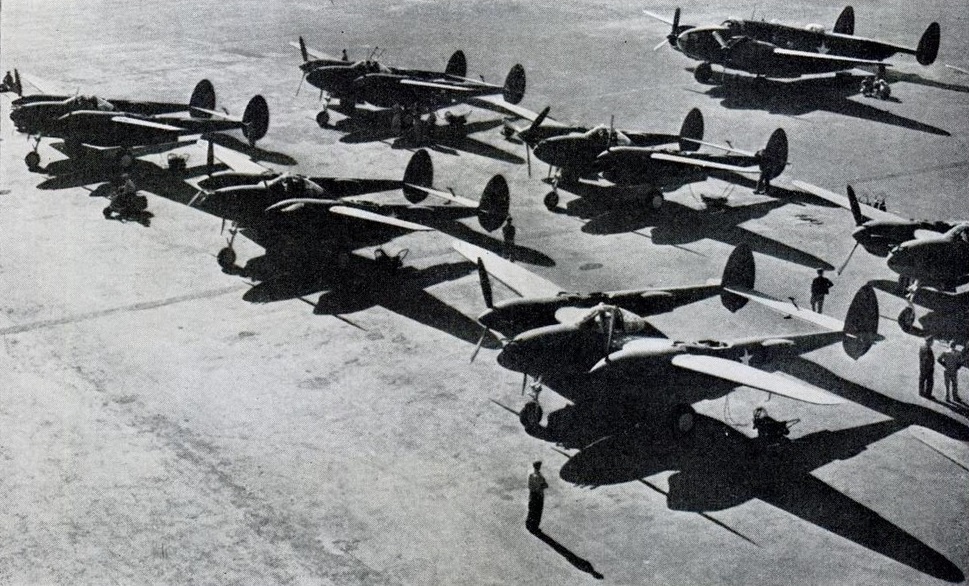
Production of the P-38 Lightning accelerated steadily at Lockheed’s principal plant in Burbank, California, rising from 207 in 1941 to 1,478 in 1942, the year in which the P-38 entered service in the European and Pacific arenas. Lockheed also modified 200 P-38Fs, providing a pair of 165-US gal (625-lt) drop tanks for each aircraft plus two pairs for each for initial combat use. The F-4 service delivery began in Mach 1942 and P-38F in September 1942.
On Sunday 8 October 1939: During a patrol flight over the North Sea, a Lockheed Hudson coastal reconnaissance plane of 224 Sqn became the first English aircraft to shoot down a German plane, a Dornier Do.18 flying boat.
While the Lightning had been receiving its combat initiation in Europe, North Africa and the Pacific, Lockheed had been at work to overcome the remaining basic flaws in the P-38 design – the inadequate engine cooling and the compressibility “tuck” problem. The first of these was attributable to the fixed space available in the wing leading edges for the intercoolers; sized to cope with the engines first used in the P-38, these were inadequate for the uprated V-1710s that had been introduced in successive models of the fighter to take advantage of Allison’s own development work. The intercoolers received supercharged air from the turbo-compressors in the tailbooms and reduced its temperature before supplying it to the carburettor; however, the inlet temperature actually achieved at the carburettor imposed restrictions on usable manifold pressures, in turn reducing the maximum power that could be extracted from the engines, particularly in the P-38H. The only solution to this was to move the intercoolers to a chin position in each engine nacelle, where they could be sized for the engine powers now available.
Using substantially the same nacelle shape that was already flying on the Curtiss P-40F Warhawk, a P-38E was tested in the summer of 1942 with the new cooling system, which was found to bestow major improvements on the high altitude performance of the Lightning, without any adverse effects. To establish a production standard, this prototype was subsequently fitted with redesigned air intakes for the Prestone coolant radiators on each side of the tailbooms, which although wider than the original type had less drag. Coupled with the use of the same V-1710-89/91 engines already powering the P-38H, these modifications marked the P-38J model of the Lightning – the first to differ significantly in outward appearance from the YP-38. The J model had intercoolers moved under the wings, providing room for 55 extra gallons of fuel in the outer wings. Later J models had hydraulicly boosted ailerons, but retained the wheel-type lateral control instead of a stick. Thanks to the new cooling system, the engines could now be cruised at 1,100 hp at 32,500 ft (9 906 m) and deliver a war emergency rating of 1,600 hp at 26,500 ft (8 077 m). Flying at a combat weight of 16,450 lb (7 468 kg), without drop tanks, the P-38J achieved 413 mph (665 km/h) at 30,000 ft (9 145 m), to become the fastest of all Lightning service versions, and with the big 300 US gal (1136 1) drop tanks, it could cruise for more than 2,000 mls (3 218 km).
Production up to the end of 1942 had been entirely of the earlier P-38 versions, and some 1,400 P-38Gs and Hs were still on order at the beginning of 1943. To handle an increased volume of output, a mechanised moving production line was put in at Burbank, and a major modification centre was established at Dallas, Texas, to prevent constant interruption in the main production progress to accommodate small changes. As a result of these measures, and the use of 22 major sub-contractors to feed components to the Burbank line, the production rate eventually peaked at 432 a month in January 1945.
Production of the P-38J itself totalled 2,970
With effect from the P-38J-15-LO the space in the leading edges previously occupied by the inter-coolers was taken up by two bladder fuel tanks, increasing overall capacity by 110 US gal (416 lt); all but the earliest aircraft also introduced a flat-panel front windshield, and the P-38J-25 and subsequent blocks incorporated the electrically-operated dive flaps that finally cured the compressibility problem. These small flaps, just outboard of the tailbooms, had a span of 4ft 10 in (1,47 m) each, and could be deflected 35 deg in 1 sec; they changed the wing airflow characteristics in such a way as to make recovery from the steepest dive possible. A further contribution to the fighting capability of the P-38J was made by the adoption of hydraulic boosters in the aileron circuits, making the Lightning the first fighter in the world to feature powered flight controls.
The final stage in the evolution of the P-38 was the introduction of Allison V-1710-111/113 engines, with similar ratings to the engines of the P-38J but potential for further development. This model was produced as the P-38L. The L with higher war emergency power, could carry 4000 lb of bombs or ten rockets. Lockheed built 3,810 at Burbank and a second production source for Lightning manufacture was established at Nashville under the direction of Consolidated-Vultee, this unit turning out 113 P-38Ls up to V-J Day, of 2,000 on order, the balance being cancelled.
The P-38L was the last fighter version to see combat service, which took in the final stages of the Pacific War. Two P-38L Lightnings escorting a Boeing Fortress were actually the first Allied fighters to land on Japanese soil after the surrender.
More than 700 P-38J/L Lightnings were converted at Dallas to F-5E photo reconnaissance configuration; the F-5F and F-5G were similar apart from the camera installations. The P-38K designation had been intended for another variant with more powerful V-171075/77 engines and Hamilton Standard high-activity paddle-bladed propellers, but to accommodate the latter the engine thrust line needed to be raised one degree and this would have caused a major interruption in the production flow, so the P38K was abandoned after one prototype had been flown.
Experimentally, Lockheed had tested a P-38G with retractable Federal skis at Ladd Field, Alaska, in 1943/44 and USAAF then ordered the conversion of one of the first P-38Js for similar testing in March 1944. The need for a ski-equipped operational variant did not materialise, however. Among trial armament installations made on P-38Ls at Wright Field were three machine guns of 0.60-in (15,24-mm) calibre, with long barrels projecting out of the nose, and eight of the standard 0.50-in (12,7-mm) guns in the nose plus a twin-gun pod beneath each wing, outboard of the engines. Of more importance operationally was the addition of rockets to the Lightning’s armament. In 1943, the early “bazooka” launching tubes were attached to P-38Fs and P-38Gs, in triple packs beneath the outboard wings or close in alongside the fuselage. With the advent of the zero-length launcher, Lockheed tried a 14-rocket installation, seven under each outer wing, but the final standard on the P-38L was a five-rocket “Christmas Tree” pack under each wing.
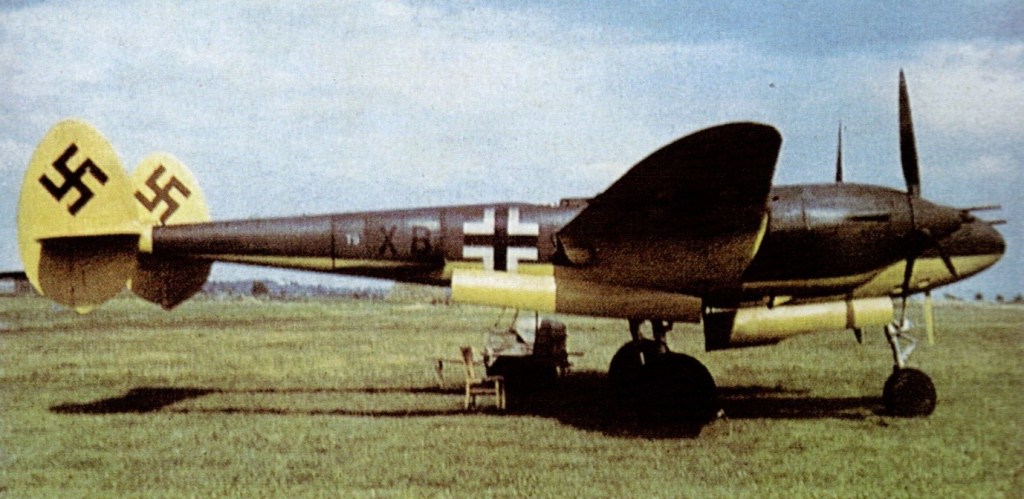
A captured P-38G was operated by the Luftwaffe 2./Versuchsverband Ob.d.L as T9+XB
P-38G T9+XB
Lockheed built 2,497 P-38s in 1943, of which about 1,000 were the new P-38Js, with the first P-38J-10s coming off the line in October.
The P-38 groups became involved in bombing missions, aided by the P-38J Droop Snoot variant evolved in Britain to serve as a navigation bomb-aiming lead ship. The conversions, engineered by Lockheed Overseas Corporation at Langford Lodge, near Belfast, comprised a Plexiglas nose fairing, replacing all the Lightning’s armament, in which was located a seat for the navigator/bombardier, plus a Norden bombsight and a navigation table, with necessary instruments and controls. With an empty weight of 14,206 lb (6 450 kg) and grossing 19,291 lb (8 758 kg) with two 165-US gal (625-1) drop tanks, the first P-38J Droop Snoot flew at Belfast in late February 1944, and about 25 are believed to have been converted for the Eighth Air Force P-38 groups.
P-38J “Droop-snoot”
Also during 1944, Lockheed developed a two-seat P-38 variant with AN/APS-15 radar bombsight in a lengthened nose together with an operator. The bomb-through-overcast (BTO) radar was usually known as Mickey and small numbers of P-38Ls were converted, seeing service in both the European and CBI theatres.
The most numerous model was the P-38L (3,923 built) powered by the same 1,425-hp engine as the P-38H, but with improved performance ratings. When needed, the engine could produce a “war emergency” 1,600 hp. A bulletproof window was installed, the radiators in the twin tailbooms were increased in capacity, and fuel tanks were placed in the leading-wing edges.
The ability of the P-38L to carry rocket projectiles (10, beneath the centre section), gave these units an added punch during the last year of the war, and some Lightnings were also adapted to carry the early-style rocket launching tubes alongside the fuselage nose, leaving the wing pylons available for fuel tanks.
The P-38s continued operating in this theatre right up to the end of the war, and these units included among their pilots two of the leading USAAF fighter aces – Richard Bong, with 40 confirmed victories, and Tommy MeGuire, with 38.
Pilot Steve Hinton
Adaptation of the Lightning as a night fighter, to fill the gap in the USAAF inventory caused by late delivery of the Northrop P-61, accounted for the last-designated variant of the Lockheed twin, the P-38M, although the use of Lightnings in the nocturnal role actually originated at squadron level rather than as a factory-designed innovation. Detachments of the 6th Fighter Squadron flying Douglas P-70s in New Guinea and at Guadalcanal, both operated P-38Gs in this role, and the New Guinea detachment actually converted two Lightnings to two-seaters, carrying SCR-540 radar in a drop tank; the unit was, however, disbanded before these aircraft could be tested in combat.
To permit rapid evacuation of casualties from forward bases, this modified fuel tank was developed in Hawaii, for carriage by the P-38. It had portholes, air vents and earphones, and could accommodate a standard stretcher. While these operational innovations had been going on, a P-38J had been adapted at Wright Field to serve as a test-bed for AN/APS-4 radar, installed in the first instance in a pod under the fuselage behind the nose wheel. As it was struck by cartridges ejected when the nose guns were fired, this pod was later moved to an underwing position, outboard of the starboard engine. Several similar radar conversions of P-38Js, including “piggy-back” two-seaters (known, probably unofficially, as TP-38Js) were then made for the 481st NF Operational Training Group, which conducted field trials, and the USAAF then contracted with Lockheed, in late 1944, to convert a P-38L as a night fighter, carrying a radar operator in a second cockpit behind and above the pilot, and radar in a long pod under the nose ahead of the nosewheel doors. The first flight with all modifications in place was made on 5 February 1945, and although only six flights were made before this aircraft was destroyed, the USAAF then ordered 75 similar P-38L conversions, to be redesignated P-38Ms. Testing of the first P-38Ms began in July 1945, and five of these aircraft arrived at the training establishment at Hammer Field, California, in the same month. Found to have a better overall performance than the P-61B but to suffer some operational limitations, the P-38M saw brief service in Japan in late 1945 and early 1946, being flown by the 418th and 421st Night Fighter Squadrons.
Some P-38J were converted to serve as two-seat ‘Pathfinders’; some P-38L as TP-38L two-seat trainers; and other versions included F-4 and F-5 photo-reconnaissance aircraft.
Total production was 9942. The final delivery was in September 1945. After the end of the war, the P-38 was rapidly withdrawn from USAF service, and as a consequence it did not see such wide use in other air forces as did its principal contemporaries. A small number of P-38Ls was supplied to Honduras in 1947 as part of American aid under the terms of the Rio Pact, but the only significant quantity of Lightnings delivered overseas after 1945 comprised a batch of 50 P-38Js for Italy. These were supplied in 1949 immediately following Italy’s signature of the North Atlantic Pact, but were used only briefly, pending the introduction of the AMI’s first jet equipment in the shape of the de Havilland Vampire.
In the USAF itself, a few Lightnings survived long enough to be redesignated F-38J and F-38L when the “fighter” category replaced “pursuit” in 1948; the type was finally declared surplus in 1949.
The Lightning is remembered for the long-range interception and destruction of the Mitsubishi G4M1 (Betty) bomber carrying Japan’s Admiral Isoroku Yamamoto.
XP-38 prototype Engines: 2 x Allison V-1710-27/29, 1150 hp Wingspan: 52 ft / 15.86 m Length: 37 ft 10 in / 11.53 m Height: 12 ft 10 in / 3.9 m
YP-38 Engines: 2 x Allison V-1710 Wingspan: 52 ft / 15.86 m Length: 37 ft 10 in / 11.53 m Height: 12 ft 10 in / 3.9 m Empty weight: 11,000 lb / 4990 kg MAUW: 14,348 lb / 6508 kg
P-38D Engines: 2 x Allison V-1710 Wingspan: 52 ft / 15.86 m Length: 37 ft 10 in / 11.53 m Height: 12 ft 10 in / 3.9 m MAUW: 15,500 lb Service ceiling: 38,000-40,000 ft
P-38 (RAF) Engines: 2 x unsupercharged 775kW Allison V-1710-33
P-38E Engines: 2 x Allison V-1710-49/52 or – 51/55, 1325 hp Wingspan: 52 ft / 15.86 m Length: 37 ft 10 in / 11.53 m Height: 12 ft 10 in / 3.9 m MAUW: 15,482 lb Service ceiling: 38,000-40,000 ft
P-38F Engines: 2 x Allison V-1710-49/52 or – 51/55, 1325 hp Wingspan: 52 ft / 15.86 m Length: 37 ft 10 in / 11.53 m Height: 12 ft 10 in / 3.9 m MAUW: 18,000 lb Service ceiling: 38,000-40,000 ft
P-38G Engines: 2 x Allison V-1710-49/52 or – 51/55, 1325 hp Wingspan: 52 ft / 15.86 m Length: 37 ft 10 in / 11.53 m Height: 12 ft 10 in / 3.9 m MAUW: 19,800 lb Service ceiling: 38,000-40,000 ft
P-38H Engines: 2 x Allison V-1710-89/91, 1,100 hp at 32,500 ft (9 906 m) / emergency 1,600 hp at 26,500 ft (8 077 m) Wingspan: 52 ft / 15.86 m Length: 37 ft 10 in / 11.53 m Height: 12 ft 10 in / 3.9 m MAUW: 20,300 lb Service ceiling: 44,000 ft / 13,410 m
P-38J Engines: 2 x Allison V-1710-89/91, 1,100 hp at 32,500 ft (9 906 m) / emergency 1,600 hp at 26,500 ft (8 077 m) Length: 37.828 ft / 11.53 m Height: 9.843 ft / 3.0 m Wingspan: 52.001 ft / 15.85 m Wing area: 327.441 sq.ft / 30.42 sq.m Max take off weight: 21604.6 lb / 9798.0 kg Weight empty: 12782.4 lb / 5797.0 kg Combat weight: 16,450 lb (7 468 kg) Max speed: 360 kts / 413 mph / 665 km/h at 30,000 ft (9 145 m) Cruising speed: 252 kts / 467 km/h Service ceiling: 43996 ft / 13410 m Wing loading: 66.01 lb/sq.ft / 322.0 kg/sq.m Range: 413 nm / 764 km Range 300 US gal (1136 1) drop tanks: 2,000 mls (3 218 km). Crew: 1 Armament: 4x .50 MG (12,7mm), 1x 20mm MG, 1451kg Bomb
P-38J-10
P-38J-15-LO Increased fuel capacity by 110 US gal (416 lt)
P-38J-25-LO Engines: 2 x Allison V-1710-89/91, 1,425 hp for take-off at sea level; military rating, 1,425 hp at 26,500 ft (8 077 m); war emergency rating, 1,600 hp at 26,500 ft (8 077 m); continuous rating, 1,100 hp at 32,500 ft (9 906 m). Curtiss Electric three-bladed fully-feathering propellers, diameter 11 ft 6 in (3,51 m). Fuel capacity, 300 US gal (1136 lt) in two main and two reserve wing tanks plus 110 US gal (416 lt) in two leading edge tanks; two 75-, 150-, 165- or 300-US gal (284-, 568-, 625- or 1136-lt) drop tanks. Max speeds (clean), 360 mph (579 km/h) at 5,000 ft (1525 m), 390 mph (628 km/h) at 15,000 ft (4 575 m) and 414 mph (666 km/h) at 25,000 ft (7 625 m) Rate of climb, 3,670 ft/min (18,6 m/sec) at 5,000 ft (1525 m) Time to climb to 30,000 ft (9 150 m), 12 min Range (clean) at max cruise at 25,000 ft (7 625 m), 840 mls (1352 km) Range (max fuel) at max cruise at 25,000 ft (7 625 m), 1,880 mls (3 025 km) Range with two 1,600-1b (726-kg) bombs, 725 mls (1167 km). Basic weight, 14,100 lb (6401 kg) Combat weight (clean), 17,500 lb (7 945 kg) Max take-off weight (max fuel), 21,600 lb (9 806 kg). Wing span, 52 ft 0 in (15,85 m) Length, 37 ft 10 in (11,53 m) Height, 12 ft 10 in (3,91 m) Undercarriage track, 16 ft 6 in (5,03 m) Wing area, 328 sq ft (30,5sq.m) Armament: One 20-mm Type AN-M2 “C” 20-mm cannon with 150 rounds and four 0.50-in (12,7-mm) machine guns, with 500 rpg, all in nose. Provision for two bombs of up to 1,600 lb (726 kg) each under wing centre section. Dive flap span: 4ft 10 in (1,47 m) Dive flap deflection: 35 deg in 1 sec
P-38J Droop Snoot Empty weight: 14,206 lb (6 450 kg) Gross weight: 19,291 lb (8 758 kg) with two 165-US gal (625-1) drop tanks Armament: none. Seats: 2. Equipment: Navigator/bombardier, Norden bombsight and a navigation table Fuel cap: + 2 x 165-US gal (625-lt) drop tanks.
TP-38J Crew: 2
P-38K Engines: 2 x Allison V-171075/77 Props: Hamilton Standard high-activity paddle-bladed
P-38L Engines: 2 x Allison V-1710-111/113 , 1,100 hp at 32,500 ft (9 906 m) / emergency 1,600 hp at 26,500 ft (8 077 m) Max take-off weight: 9798 kg / 21601 lb Empty weight: 5806 kg / 12800 lb Wingspan: 15.85 m / 52 ft 0 in Length: 11.53 m / 37 ft 10 in Height: 3.91 m / 12 ft 10 in Wing area: 30.47 sq.m / 327.98 sq ft Max. speed: 666 km/h / 414 mph Service ceiling: 44,000 ft / 13,410 m Range: 724 km / 450 miles Range w/max.fuel: 3640 km / 2262 miles Armament: 1 x 20mm cannon, 4 x 12.7mm machine-guns, 1451kg of bombs Crew: 1
TP-38L Engines: 2 x Allison V-1710-111/113, 1,100 hp at 32,500 ft (9 906 m) / emergency 1,600 hp at 26,500 ft (8 077 m) Wingspan: 15.85 m / 52 ft 0 in Length: 11.53 m / 37 ft 10 in Height: 3.91 m / 12 ft 10 in Wing area: 30.47 sq.m / 327.98 sq ft Crew: 2
P-38M Engines: 2 x Allison V-1710-111/113, 1,100 hp at 32,500 ft (9 906 m) / emergency 1,600 hp at 26,500 ft (8 077 m) Wingspan: 52 ft / 15.86 m Length: 37 ft 10 in / 11.53 m Height: 12 ft 10 in / 3.9 m MAUW: 21,600 lb / 9798 kg Crew: 2
F-5E Engines: 2 x Allison V-1710-111/113, 1,100 hp at 32,500 ft (9 906 m) / emergency 1,600 hp at 26,500 ft (8 077 m)
F-5F Engines: 2 x Allison V-1710-111/113, 1,100 hp at 32,500 ft (9 906 m) / emergency 1,600 hp at 26,500 ft (8 077 m)
F-5G Engines: 2 x Allison V-1710-111/113, 1,100 hp at 32,500 ft (9 906 m) / emergency 1,600 hp at 26,500 ft (8 077 m)








 All Aero