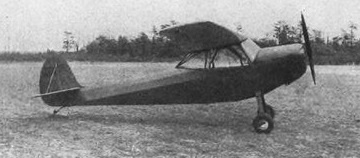
Evolved from the 1926 Driggs Dart I, the Jack McRae Super Dart had one seat and Cessna single strut landing gear.
Engine: Lycoming: 55 hp
Wing span: 27 ft 6 in
MTOW: 750 lb
Fuel capacity: 10 USG
Top speed: 125 mph
Range: 300 mi
Evolved from the 1926 Driggs Dart I, the Jack McRae Super Dart had one seat and Cessna single strut landing gear.
Engine: Lycoming: 55 hp
Wing span: 27 ft 6 in
MTOW: 750 lb
Fuel capacity: 10 USG
Top speed: 125 mph
Range: 300 mi
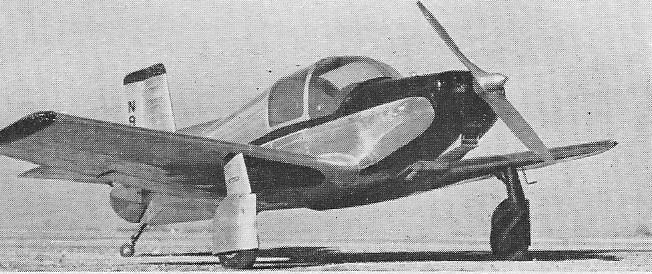
Transocean Air Lines subsidiary, Mckinnie Aircraft, developed the all-metal two-seat side-by-side McKinnie 165 with Franklin engine, first flown August 10,1952.
All structural components are of full cantilever construction and are fabricated from aluminium-clad sheet. The McKinnie 165 is fully aerobatic and dual controls are fitted.
Engine: 165 hp Franklin 6A4-165-B3
Wingspan: 23 ft 6 in
Length: 18 ft 3 in
Height: 7 ft
Empty weight: 1200 lb
Loaded weight: 1840 lb
Max speed: 175 mph at SL
Cruise: 160 mph
ROC: 1550 fpm
Range: 720 mi at 170mph at 8000 ft
Range: 1050 mi at 150mph
Patterned after the Piper PA-11 and J-3 series, the XPA-11 was designed by C. L. “Bud” McHolland.
Engine options include: Continental A-75, C-85 and 0-200
Registrations known: N11XP, N13XP and N14XP
The 1909 McDowell monoplane was designed and built by McDowell, possibly in Canada.
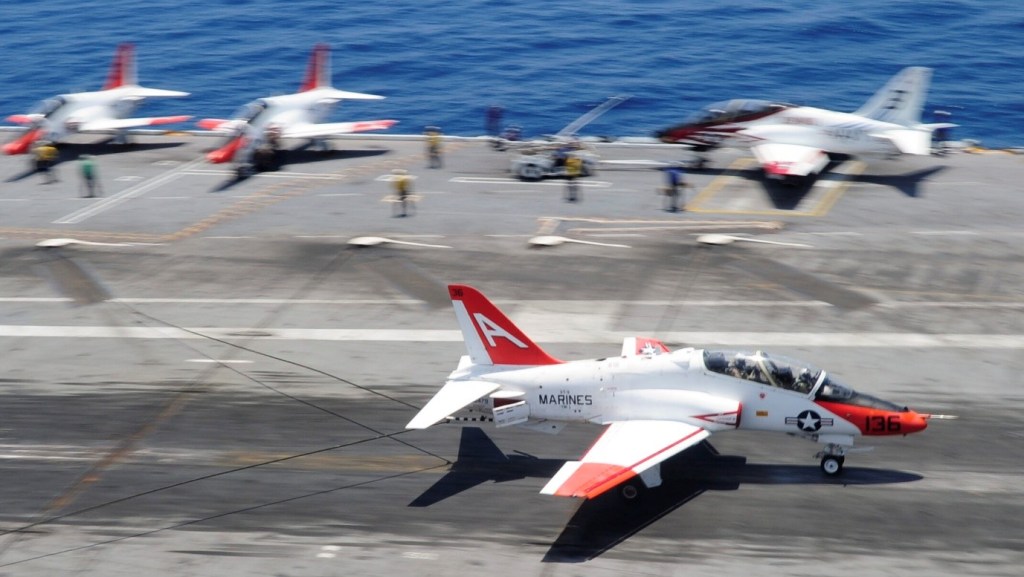
Derived from the British Aerospace Hawk advanced trainer, the US Navy’s carrier-capable T-45A Goshawk prototype was scheduled to fly before the end of 1987, with service entry due in 1990. The Hawk was selected in 1981 as the aircraft element of the new VTX-TS training system, and a fixed-price contract covering the first three production lots and 15 simulators was signed in May 1986. Total cost of the T-45TS package, including 300 production aircraft, two prototypes, simulators, computerised instruction and integration system, and logistics support is estimated at $4,500 million. British Aerospace is the principal airframe subcontractor, building the wings, rear fuselage, canopy, and flight controls, although final assembly and some component manufacture will be undertaken by McDonnell Douglas in the USA.
McDonnell-Douglas / BAe T-45 Goshawk Article
Changes from the basic Hawk design include a twin-wheel nose gear for catapult launching, a strengthened maingear to allow high-sink-rate landings, an arrester hook, rear side-fuselage airbrakes, and a cockpit modified to USN requirements. The empty weight of the T-45A will be 4,261kg, and maximum take-off weight 5,787kg, with an internal fuel load of 1,363kg. Approach speed will be 222km/hr (121 kt), maximum level speed Mach 0.85, and average fuel consumption 620kg/hr on a typical training sortie. Weapons delivery capability for armament training were be incorporated.
The T-45 Goshawk, of which the Navy owns 193 aircraft, is a jet trainer fleet used by the Navy and Marine Corps to qualify new pilots. Originally produced by what is now Boeing and derived from an earlier British aircraft made by BAE Systems, its first iterations joined the US Navy’s fleet in the 1990s.
BAe / Boeing T 45 C Goshawk
Engine: Rolls Royce/Turboméca F 405-RR401 (Adour Mk. 871), 25977 N / 2648 kp
Length: 39.272 ft / 11.97 m
Height: 13.419 ft / 4.09 m
Wingspan: 30.807 ft / 9.39 m
Wing area: 179.651 sq.ft / 16.69 sq.m
Max take off weight: 14083.3 lb / 6387.0 kg
Weight empty: 9399.9 lb / 4263.0 kg
Max. speed: 543 kts / 1006 km/h
Initial climb rate: 6982.28 ft/min / 35.47 m/s
Service ceiling: 42503 ft / 12955 m
Wing load: 78.52 lb/sq.ft / 383.0 kg/sq.m
Range: 999 nm / 1850 km
Crew: 2
Hardpoints: 3
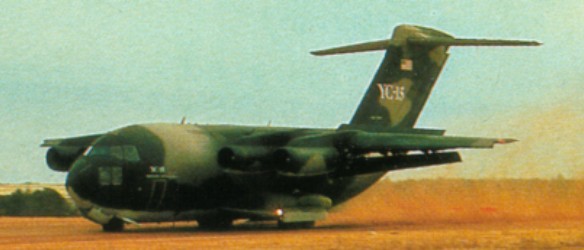
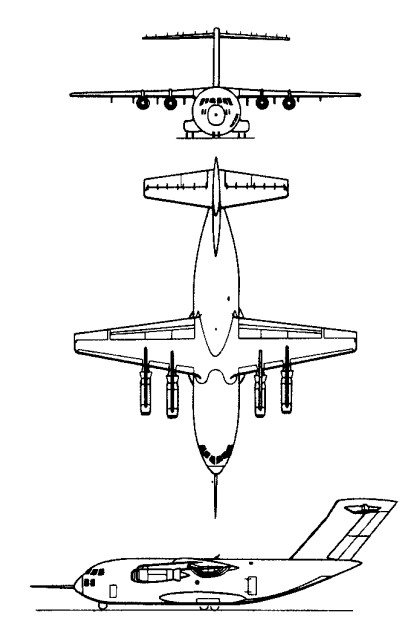
The McDonnell Douglas YC 15 first prototype (72 1875), an advanced military STOL transport, made the type’s maiden flight on 26 August 1975. Designed to contend against Boeing YC 14 pro¬totypes for the USAF’s advanced medium short take off and landing transport (AMST) requirement, it had an externally blown flap system that depended on the slipstream from four turbofan engines. The first flight was made three months ahead of schedule and the two YC-15 prototypes flew for three years before the test program ended.
YC-15
Engines: 4 x Pratt & Whitney JT-8D-17, 71.1kN
Max take-off weight: 68000 kg / 149915 lb
Wingspan: 33.6 m / 110 ft 3 in
Length: 37.9 m / 124 ft 4 in
Height: 13.2 m / 43 ft 4 in
Wing area: 161.7 sq.m / 1740.52 sq ft
Max. speed: 805 km/h / 500 mph
Range w/max.fuel: 4800 km / 2983 miles
Crew: 2-3

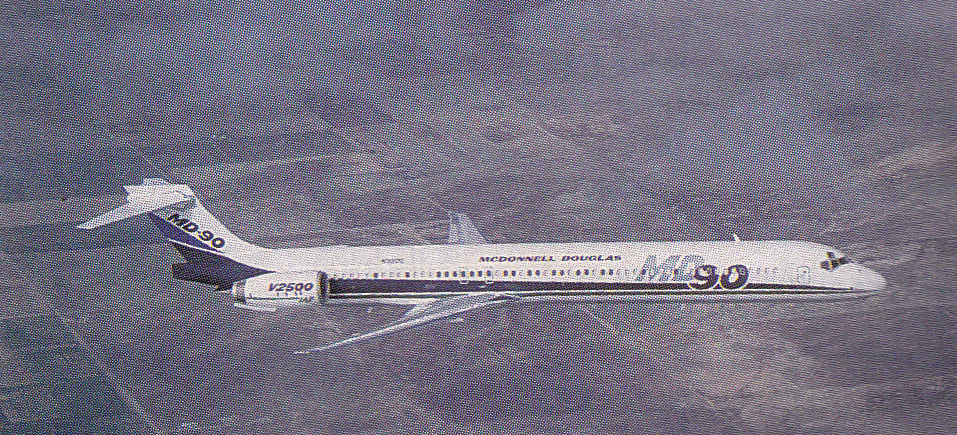
The advanced technical successor to both the DC 9 and MD 80, the MD 90, was launched in 1989 and entered passenger service with Delta Air Lines in April, 1995. Four and a half feet longer than the MD-88, it allowed for ten more passenger seats. Unlike any of its forebears the MD 90 is powered by International Aero Engines V2500 turbofans rated at 11.1 kN (2,500 lb) take off thrust and has a non stop range of 3,862km (2,082nm) with full payload.
The MD-90 made its first flight on 22 February 1993, three days ahead of schedule. The aircraft took off from the main runway at Long Beach Municipal Airport at 9.44am for a 4 hr 56 min flight.
During 1991, McDonnell Douglas received 27 MD-80/90 orders.
McDonnell-Douglas MD-90 Article
The MD 90 was selected in 1992 as the China Trunkliner for domestic and regional routes. In 1994, an amended co production agreement for 40 aircraft was signed by McDonnell Douglas and the China National Aero Technology Import and Export Corporation. This agreement called for the production of 20 MD 90s in Shanghai and the direct sale of 20 aircraft from Douglas Aircraft in Long Beach. With the merger of Boeing and McDonnell Douglas the co production agreement was cancelled.
Boeing announced that it will discontinue both the MD-80 and MD-90 series in January 2000. The MD series of aircraft evolved into what became the Boeing 717.
MD-90
Engines two 25,000- lb. International Aero V2525D5 turbofans
Gross wt. 156,000 lb
Empty wt. 88,000 lb
Cruise speed 437 kts
Range 2,085- 3,022 nm
Seats 141-187
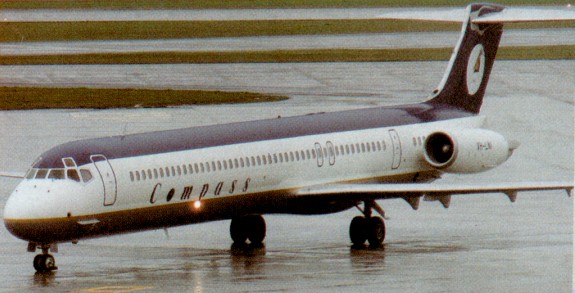
The MD-80 series of aircraft were a stretched improvement of the DC-9. The first version of the jet was literally a re-engined DC-9. McDonnell Douglas launched the MD 80 in October 1977, as an advanced, quieter and more fuel efficient successor to the DC 9. Three years later on October 5, 1980, it entered airline service. Like the venerable DC 9, the new aircraft was offered to the market in a choice of passenger configurations and operating ranges. It was designated MD 80 to reflect its ability to meet the needs of the 1980s and beyond.
McDonnell-Douglas MD-80 Article
The aircraft was offered in five versions the standard size MD 81, MD 82, MD 83 and MD 88, plus the smaller MD 87. A blend of new and mature technology, the MD 80s were the first aircraft in their class to meet the stringent US FAA Stage III noise regulations for new designs, operating costs were among the lowest in commercial aviation and fuel consumption per passenger was up to 30% lower than the commercial jets they replaced. Thus, the three ‘E’s design objectives environment, economy and energy were satisfied.
In 1983 Douglas abandoned the famed ‘DC’ and adopted ‘MD’ for its designations, the DC-9 family becoming the MD-80 series. It proved to be by far the most successful of all versions, combining high capacity with good operating economy and very competitive first cost.
Pratt & Whitney JT8D 200 series turbofans power the MD 80. The MD 81 is certified with 209 engines, but higher thrust 217A and 217C plants are available for aircraft operating from high altitude, high temperature airports. The smaller MD 87 uses the 217C or 219 for short field operations and extended range flights.
The MD 80 retains many of its predecessor’s features. For example, the airframe is basically the same as that of the DC 9 except that the MD-80 incorporates greater use of composites and has increased fuselage length and wingspan. By the autumn of 1997 the combined total of DC-9s and MD 80s in airline service exceeded 2,000 aircraft.
The MD-80 entered service with Swissair on 5 October 1980, at a weight of 140,000lb. This soon became the MD-81, the baseline version for a growing family. The MD-82, announced in April 1979, introduced -217 engines of 20,000-lb thrust, giving better performance from difficult airports, and 25 have been assembled in China.
The MD-83 is a longer-range model, with 21,000-lb -219 engines making possible a weight of 160,000lb, mainly accounted for by two extra fuel tanks in the underfloor area in place of cargo.
The MD-87, announced in January 1985, is odd man out, with a shorter fuselage seating up to 130; it also introduces aerodynamic improvements and a taller vertical tail, one of its features, a rear knife -edge instead of a tailcone, now being standard on all models.
The MD-88 version, announced in January 1986, combines most of the new features and adds a modern cock¬pit and improved cabin.
During 1991, McDonnell Douglas received 27 MD-80/90 orders.
Boeing announced that it would discontinue both the MD-80 and MD-90 series in January 2000.
MD-80
Max wt: 140,000 lb
Max speed: 498kts (925km/h)
MD-81
Engines 2 x 18,550-lb. s.t. Pratt & Whitney JT8D turbofans.
Non stop range: 2,900km (1,560nm)
Max speed: 498kts (925km/h)
Seats 142-172
Gross wt. 140,000 lb
Empty wt. 78,420 lb
Fuel capacity 4,812 gal
Max cruise 500 kts
Long range cruise 440 kts
Ceiling 35,000+ ft
Range 1,563-2,630 nm
Takeoff distance 7,250 ft
Landing distance 4,860 ft
MD-82
Engine: 2 x Pratt & Whitney JT8D-217, 20,000 lb st
Pax seats: 172
Crew: 2
Length: 45.06m
Height: 9.04m
Wingspan: 32.87m
Max speed: 498kts (925km/h)
Max range: 3798 km
MD-83
Engine: 2 x -219, 21,000 lb st
Max wt: 160,000 lb
Non stop range: 4,635km (2,498nm)
Max speed: 498kts (925km/h)
MD-87
Pax seats: 130
Non stop range: 4,400km (2,372nm)
Optional range: 5,250km (2,830nm)
Max speed: 498kts (925km/h)
MD-88
Non stop range: 3,780km (2,037nm)
Max speed: 498kts (925km/h)
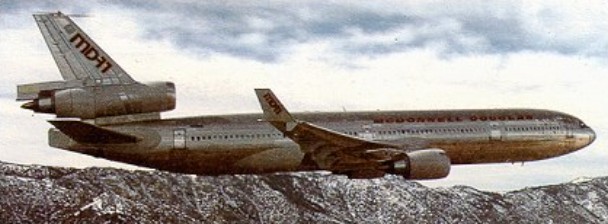
The MD-11 is a direct descendent from the DC-10, revealed at Paris Air Show 1985. British Caledonian ordered nine on 3 December 1986 and the official programme launch was on 30 December 1986.
McDonnell-Douglas MD-11 Article
The McDonnell Douglas MD-11 is an advanced-technology tri-jet designed to fulfil many airlines needs into the ‘90’s and beyond. After obtaining commitments for 92 aircraft from customers, the McDonnell Douglas board of directors gave the go-ahead for the MD-11 and the program was launched on the 30th of December 1986. On the 4th of March 1987 McDonnell Douglas saw the fabrication of the first parts for the MD-11 and the assembly of the first MD-11 began with the riveting of a portion of the nose on the 9th of March 1988 at Long Beach, California.
The MD-11 was very much an international aircraft with components being manufactured in many parts of the world. These included the vertical stabiliser, rudder and winglets from ‘Aeritalia’ in Italy, the wing and fuselage fillets from ‘Korean Air’ in Korea, the overwing fuel tanks, horizontal stabilizer and elevators from ‘Casa’, in Spain, and the outboard flaps from ‘Embraer’, in Brazil. One of the most noticeable differences between the DC-10 and the MD-11, has been the addition of winglets. These are seven feet high and have a lower segment of 2 feet 6 inches with an overall area of 40 square feet each side.
The advanced flight deck is designed for a two man flight deck crew using the latest digital technology to automate systems management via six, eight inch Cathode Ray Tube (CRT) displays.
The MD-11 flight deck concept was developed by a combined team of pilots, flight engineers and human factor experts, and operates on the ‘dark cockpit’ philosophy, that is. 99 percent of the time all light switches, warnings, and other devices are off. A light only goes on to alert, this assuring prompt pilot attention.
All alert information is displayed on the engine ‘CRT’ and action is taken by activating the switches on the overhead panels. The six ‘CRTs’ are used to display primary flight deck informa¬tion – two are to provide primary flight data; two are for naviga¬tion; one is for engine/alert displays, and the remaining one for systems. The ‘Honeywell/McDonnell Douglas’ designed flight deck also has a dual advanced flight management system, a dual advanced digital flight control system, wind shear detection and guidance devices.
The MD-11 had normal, abnormal and emergency checklist functions performed automatically rather than simply being displayed to the crew. No other new generation aircraft had the same level of automated systems management as the MD-11, however actions such as dumping fuel, or shutting down engines, were still left to the crew.
The MD-11 had been ordered by 29 customers and 312 commitments in all. The McDonnell Douglas MD-11 took off for its first flight from Long Beach ‘ California on 10 January 1990 (N111MD).
During the flight, the aircraft, which was powered by General Electric CF6-80C2 high bypass turbofan engines, reached altitudes of 25,000 ft and speeds of up to 300 knots. It is designed for a maximum level flight speed of 588 mph at altitudes of up to 43,000 ft. Other powerplants offered were the Pratt & Whitney PW4460 and Rolls-Royce Trent 650.
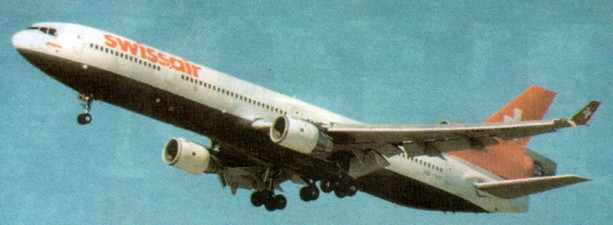
Of the five aircraft in the flight test programme (four with GE engines, one with P&W), the first flight of third prototype powered by P&W PW4460s, was on 26 April 1990
A fifth MD-11 brought the total test programme hours to 2,000.
Certification came on 8 November 1990 and deliveries began the same year. The first-three MD-11 off the production line were delivered to Federal Express, while American Airlines were the first passenger airline to receive the MD-11 (at the end of 1990). The 100th MD-11 was delivered on 30 June 1993. As of November 1996, McDonnell Douglas had made 146 sales of the MD-11 aircraft.
Several variants included long range MD-11ER, the MD11CF freighter and two combination freighter/passenger aircraft. Certification with the R-R Trent 650 was discontinued, and the fuselage production line was moved from San Diego to Long Beach during early 1996.

Boeing elected to cease production of the MD-11 in February 2000, after the delivery of the 200th aircraft (D-ALCN) which was delivered to Lufthansa Cargo on 22 February 2000.
MD-11
Engines: 3 x General Electric CF6-80C2D1F turbofans, 61,500 lb
MTOW: 273.28 tonne
MLW: 195.04 tonne
Wing span: 169 ft 6 in (51.7m)
Wing area: 3,648 sq.ft (339 sq.m)
Length: 200 ft 10 in (61.2m)
Fuel cap: 117.468 tonnes
Range: 12,741 km
Pax cap: 293.
MD-11
Seats 315-400
Gross wt. 602,500 lb
Empty wt. 277,000 lb
Fuel capacity 32,185 USG
Engines 3 x 58,000-lb. s.t. Pratt & Whitney PW4358 turbofans
Top speed 644 mph
Cruise 588 mph
Ceiling 45,000+ ft
Range 5,010 miles
Takeoff distance 10,100 ft
Landing distance 6,470 ft
MD-11P
Engines: 3 x General Electric CF6-80C2D1F turbofans, 273kN
Max take-off weight: 273300 kg / 602527 lb
Empty weight: 125870 kg / 277497 lb
Wingspan: 51.6 m / 169 ft 3 in
Length: 61.2 m / 200 ft 9 in
Height: 17.6 m / 57 ft 9 in
Wing area: 338.9 sq.m / 3647.89 sq ft
Max. speed: 962 km/h / 598 mph
Cruise speed: 876 km/h / 544 mph
Ceiling: 11000 m / 36100 ft
Range w/max.fuel: 11000 km / 6835 miles
Range w/max.payload: 9270 km / 5760 miles
Crew: 2
Passengers: 293-405

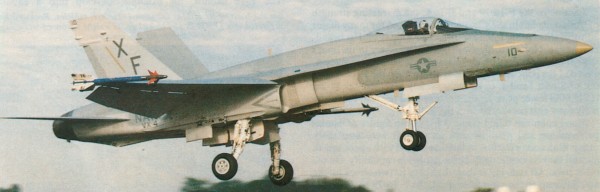
The McDonnell Douglas F/A-18 Hornet is a twin-engine carrier-based attack fighter derived from the YF-17 Cobra attempt at a new USAF lightweight fighter, on which the USN was a minor partner (the F-17 lost out to the YF-16).
The Navy preferred the YF-17 over the winning F-16 Fighting Falcon, because of its twin-engine design. For the Navy version, Northrop teamed with McDonnell Douglas and when the two services ended up choosing different aircraft, McDonnell Douglas became the primary contractor for the Navy design (McDonnell Douglas merged with Boeing in 1997).
The Navy’s design concept originated from Vice Admiral Kent Lee. An experienced naval aviator in WWII, he and his supporters pushed for a cheap and lightweight strike fighter, to complement the F-14 Tomcat which had become operational and was just being introduced to the carrier air wings in 1973.
The F/A-18 has a digital fly-by-wire flight control system, the cockpit equipped with three multi function displays. The entire avionics suite is digital. The F-18 is powered by two 71 2kN General Electric F404 reheated turbofans, and equipment includes a Hughes APG-65 radar with air-to-air and air-to-surface modes giving intercept and attack capabilities, a Ferranti/Bendix headup display, Kaiser multifunction displays, and Litton INS. Other externally carried sensors include laser tracker and Flir pods. As a carrier-capable platform, the F/A-18 maintains folding wings. The Hornet is capable of air-to-air refuelling.
The first of 11 full-scale development (FSD) Hornets flew on November 18, 1978, and was followed by the first production aircraft in April 1980. F/A-18 Hornets (A and B variants) entered service in 1983, replacing the F-4 Phantom II and the A-7 Corsair II. F/A-18A/B were single and two seat aircraft. The F-18B two-seat trainer retains full operational capability with only a six per cent reduction in internal fuel capacity.
McDonnell-Douglas F-18 Hornet Article
FY1986 and subsequent purchases are of the upgraded F-18C/D variants, which have AIM-120 Amraam and infrared Maverick compatibility, airborne self-protection jammers, Naces ejection seats, and improved computers. The first F-18C flight occurred in mid-1986. After a production run of 371 F/A-18As, manufacture shifted to the F/A-18C/D single and two seat variants in September 1987. Seventy-seven F-18A single-seaters and eight F-18B two-seaters delivered during 1986, including 24 for the USMC.

MDC handed over the 500th F-18 Hornet, an A model for the USMC, in May 1987.
Although the single seat variants, A and C, were first equipped with the AN/APG-65 radar, since 1994 all US Hornets feature the improved AN/APG-73 radar. The second seat of the B and D models is often manned by a weapon system operator or instructor.
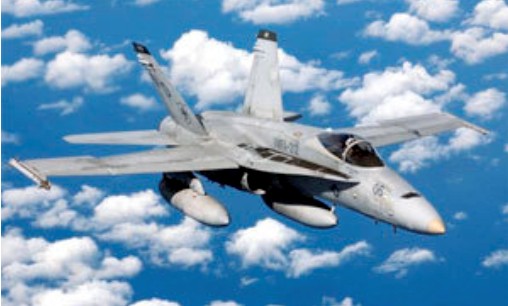
Test¬ing of a reconnaissance version, the US Navy F-18(R) continued. The nose-mounted 20mm rotary cannon was replaced by a sensor pallet with panoramic camera and infrared linscan. The aircraft can be reconfigured overnight for strike missions.
Licence-assembly of Hornets continued in Australia in 1987, where GAF has deliv¬ered more than 20 to the Royal Australian Air Force.
The CF-18 is the designation used for the Canadian licensed built aircraft. The Canadian Armed Forces purchased 138 examples of the CF-18 including 24 CF-18B two-seaters.
The first prototype F/A-18E Super Hornet flew on November 29, 1995.
The F/A-18E/F “Super Hornet” arrived in 2002 and represented an aircraft that was 20 percent larger and more powerful than the base Hornets. The Super Hornet is produced by a consortium of contractors that includes Boeing and Northrop Grumman. The tandem-seat Super Hornet was designed to be ultra-capable in both strike and interceptor roles and squadrons are already operating on various USN carrier battle groups. The Super Hornet is built on the F414-GE-400 series of powerplants, which stands as a highly advanced modified version of the original F404 turbofans, bigger air intakes, and the airframe itself is longer. A 33% larger internal fuel capacity and larger ordnance carrying capacity improves the range significantly. As a whole, the Super Hornets, despite their advanced infrastructure, is compiled of less parts than the original Hornets making the Super Hornet that much easier to maintain. Additional hardpoints make the Super Hornet a viable replacement to the F-14 Tomcat and A-6 Intruders.
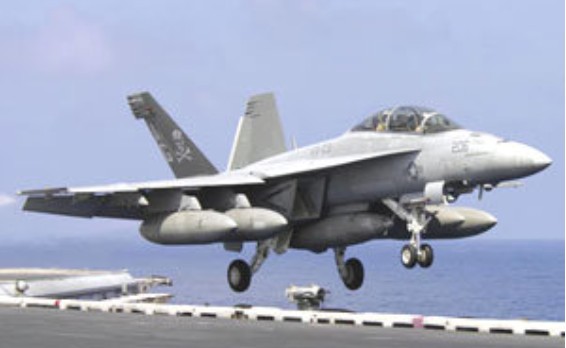
The F/A-18E (single seat) and F/A-18F (two seat) Super Hornets provides increased range and improved combat mission endurance. The Super Hornet also makes use of an increased payload. F/A-18F Super Hornets with a WSO in the rear seat are replacing the F-14 Tomcat.
The US Navy took delivery of its first Super Hornet in 1999. Super Hornets are larger than the original models with many detail improvements. Their increased wing area allows them to carry more stores further on their extra hardpoints. They are most easily recognised by their rectangular engine air intakes.
The Royal Australian Air Force was to obtain 24 Boeing F/A-18F Super Hornets by 2010, until the full introduction into service of the F-35 Lightning Joint Strike Fighter. Twenty-four F/A-18F Super Hornets were to replace the F-111s at Nos 1 and 6 Squadrons at RAAF Base Amberley from 2010.
Boeing modified an F/A-18 Super Hornet as the EA-18 airborne electronic attack (concept) aircraft, carrying three ALQ-99 jamming pods.
The EF-18 designation is also used for Spanish F/A-18A/B Hornets (EF-18A and EF-18B) where the E stands for Espanga.
The RF-18 which is a dedicated reconnaissance version.
The Boeing EA-18G Growler electronic warfare variant, to replace the EA-6B Prowler, differs from the F/A-18F in several areas. It is wired in production differently with additional wiring and databuses from the wing stations and various fuselage antennae points. The nose gun is replaced with additional avionics for jamming missions, and carries two ALQ-218 tactical jamming receivers pods on the wingtips, and between one and five AN/ALQ-99 jammers on centreline and wing stations. There remains two wing and two should stations. It is also equipped with the APG-79 AESA radar.
The F/A-18 first saw combat action in 1986, when Hornets from the USS Coral Sea (CV-43) flew SEAD missions against Libyan air defenses during the attack on Benghazi.
Ten F/A-18’s were lost in the Gulf War, most to surface to air missiles although one was alleged to have been shot down by an Iraqi MiG-25PD in the first hours of the air campaign. F/A-18’s were credited with two kills, both of MiG-21’s, during that conflict.
Operators: US Navy, US Marine Corps, Australia, Canada, Finland, Kuwait, Malaysia, Spain, Switzerland.
Variants:
F/A-18A
Engine: 2 x General Electric F404-400 turbofan, 7258 kg / 16,000 lb
Wingspan: 11.43m / 37 ft 6 in
Length: 17.07 m / 56 ft 0 in
Wing area: 37.2 sq.m
Empty wt: 10,460 kg
MTOW: 21,887 kg / 48,253 lb
Fuel internal: 6140 lt
Max speed: 1912 kph / 1188 mph / 1.8 Mach
Initial ROC: 45,000 ft / min
Ceiling: 15,240 m
TO run: 425 m
Ldg run: 850 m
Range: 3706 km / 2303 sm
Combat radius: 740+ km
Armament: 1 x 20 mm / 570 rds
Hard points: 7 + 2 wing tips
Max external load: 17,000 lb / 7711 kg
Air refuel: Yes
F/A-18A (from early 1992)
Engine: 2 x General Electric F404-GE-402 turbofans, 78.73 kN (17,700 lb st) with afterburning.
Length 17.07m (56 ft 0 in)
Height 4.66m (15 ft 3 in)
Wing span 11.43m (37ft 6 in)
Take-off weight (clean) 10.455 kg (23,050 lb)
Max Take-Off Weight 25.401 kg (56,000 lb)
Max level speed at altitude Mach 1.8+ / 1.915+ km/h / 1,190+ mph)
Combat ceiling about 15,240m (50,000 ft)
Armament: one 20mm M61A1 Vulcan six-barrel cannon with 570 rounds
Disposable stores: 7031 kg (15,500 lb)
Hardpoints 9
F/A-18B
Engines: 2 x General Electric F404-GE-400 turbofan, 16,000lb / 7,258kg thrust
Length: 17.1 m
Wingspan: 12.4 m
Height: 4.7 m
Empty Weight: 23,049lbs (10,455kg)
Maximum Take-Off Weight: 55,997lbs (25,400kg)
Maximum Speed: Mach 1.8 / 2200 kph
Maximum Range: 2,073miles (3,336km)
Combat radius: 740km
Rate-of-Climb: 45,000ft/min (13,716m/min)
Service Ceiling: 50,033ft (15,250m; 9.5miles)
Armament: 1 x M61 20mm cannon
Hardpoints: 9 (including wingtip mounts)
Seats: 2
F/A-18C
F/A-18D
Seats: 2
F/A-18E
Engines: 2 x General Electric F414-GE-400, 10000kg / 72.5kN
Max take-off weight: 29937 kg / 66000 lb
Empty weight: 13387 kg / 29513 lb
Wingspan: 11.43 m / 37 ft 6 in
Length: 18.31 m / 60 ft 1 in
Height: 4.88 m / 16 ft 0 in
Wing area: 46.45 sq.m / 499.98 sq ft
Max take-off weight: 20000 kg / 44093 lb
Max. speed: 1.8M
Ceiling: 15240 m / 50000 ft
Range: 1500 km / 932 miles
Crew: 1
F/A-18F Super Hornet
Engines: 2 x General Electric F414-GE-400 turbofan, 9,800kg. 22,000lbs thrust with afterburner.
Length: 60.07ft (18.31m)
Width: 44.69ft (13.62m)
Height: 16.01ft (4.88m)
Wing area: 46.45 sq.m / 499.98 sq ft
Empty Weight: 30,565lbs (13,864kg)
Maximum Take-Off Weight: 47,003lbs (21,320kg)
Maximum Speed: Mach 1.6 / 1,960 kph
Ferrying range: 2,700km
Combat radius 740km
Service Ceiling: 49,213ft (15,000m; 9.3miles)
Armament: 1 x M61 20mm cannon
Hardpoints: 11
Ordnance: 17,750 lb
Crew: 2
CF-18
EF-18A
RF-18
EA-18G Growler

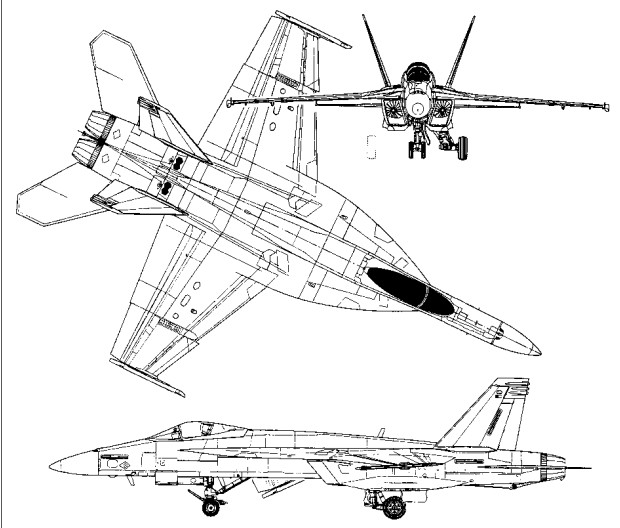
 All Aero