Circa 1932 George Yates built the single-place, open cockpit, midwing monoplane Oregon O. Powered by a 40hp Salmson AD-9, it had wooden geodetic basket-weave construction. One was built, N15508, and possibly one other.
Monoplane
Yates Stiper

The two-place Yates Stiper of 1930 was built for Elmer Stipe. Registered N10657, it was originally powered by a 125hp Martin 333 and later refitted with a 90hp Cirrus.
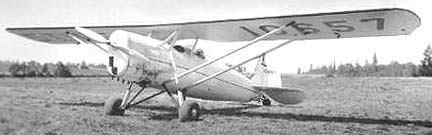
The plane had two seats and a parasol wing.

It eventually flew 4,000 hours, carrying passengers.

Yakolev Yak-141
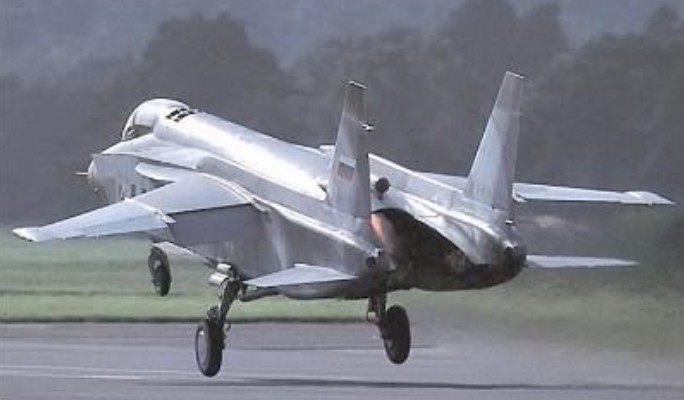
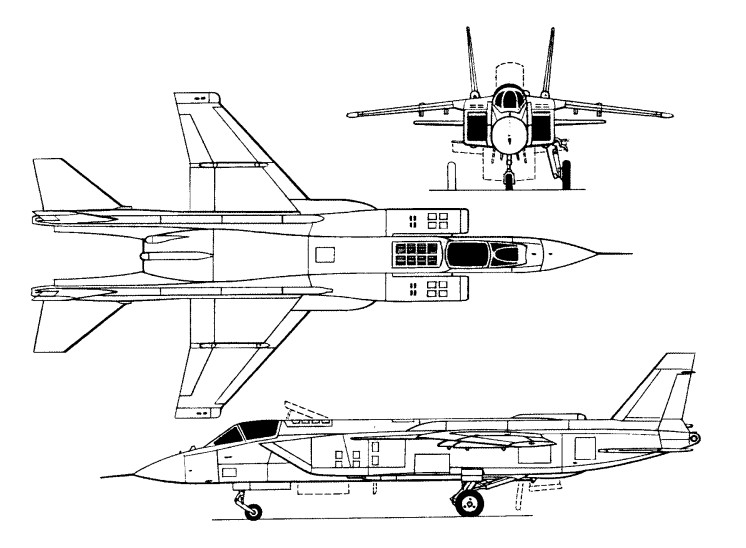
The Yak-141, being the world’s first supersonic STOVL (short take-off/vertical landing) aircraft, has three engines: one lift-cruise R-79 with a thrust of 15500kg and two small-sized RD-41 of 4100kg each. The powerplant allows the plane to lift off vertically with a weight of up to 15,800kg. Alternatively, the Yak-141 can perform short take-offs (60-120m) with a weight of up to 19,500kg. In the latter case the combat radius increases by 1.5-2 times and patrol time in the combat zone by two times. The pilot can use afterburner even when the nozzles are deflected. The Yak-141’s integral flight-control system sets power and deflection of the nozzles so as to optimise making vertical/short take-offs and landings.
The Yak-141 first flew in March 1989, piloted by Andrei Sinitsin.
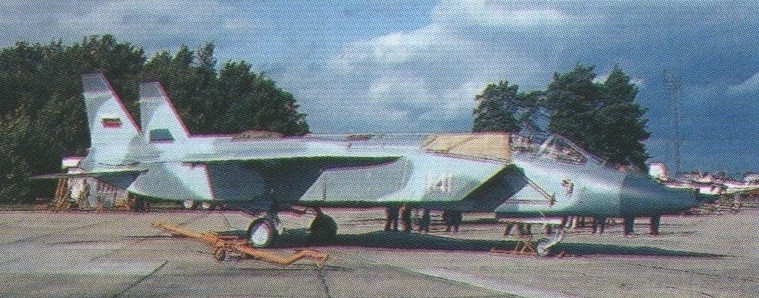
The Yak-141M was meant primarily for ground-basing. Introduction of new flight regimes, as well as new take-off/landing techniques, has entailed changes in the airframe, leading to a new design, the Yak-141M.
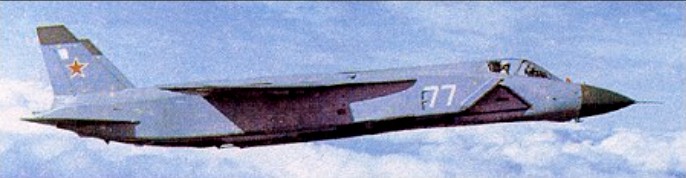
Engine: 1 x R-79V-300, 152.0 kN , 2 x RD-41, 41.8 kN
Max take-off weight: 19500 kg / 42990 lb
Empty weight: 11650 kg / 25684 lb
Wingspan: 10.1 m / 33 ft 2 in
Length: 18.3 m / 60 ft 0 in
Height: 5.0 m / 16 ft 5 in
Wing area: 31.7 sq.m / 341.22 sq ft
Max. speed: 1850 km/h / 1150 mph
Ceiling: 15500 m / 50850 ft
Range w/max.fuel: 2100 km / 1305 miles
Range w/max.payload: 1400 km / 870 miles
Crew: 1
Armament: 1 x 30mm cannon, 1000kg (VTOL) or 2650kg (STOL)
Hardpoints: six
Yakolev Yak-130 / AEM-130

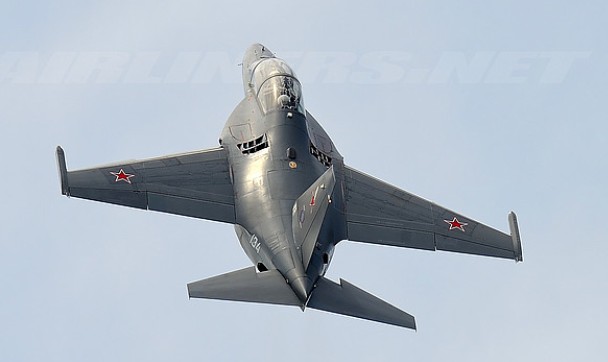
Through a joint programme with Yakolev of Russia, Aermacchi is assisting in developing the Yak/AEM-130 to meet the Russian Air Force’s requirement to replace the L-29 and L-39. The aircraft is equipped with a quadruplex fly-by-wire flight control system and will be required to fulfil a broad range of tasks: from basic flying training to weapons training and aircraft carrier deck training. The aircraft are equipped with wingtip- and pylon mounted AAMs with a roulette and sensor pod also fitted.

The joint Italian/Russian Yak 130 technology development programme ran from April 1996 to December 1999, accumulating some 300hr flying. The two seat Yak-130 fighter/trainer was exported as the AEM-130.
The Yak-130 became all Italian in 1998 and served as a basis for the Aermacchi M-346.
Engine: 2 x Klimov RD-35, 22kN
Max take-off weight: 5400-6200 kg / 11905 – 13669 lb
Wingspan: 10.6 m / 35 ft 9 in
Length: 11.3 m / 37 ft 1 in
Height: 4.8 m / 16 ft 9 in
Wing area: 17.6 sq.m / 189.44 sq ft
Max. speed: 1000 km/h / 621 mph
Ceiling: 12500 m / 41000 ft
Range: 1850 km / 1150 miles
Crew: 2

Yakolev Yak-58
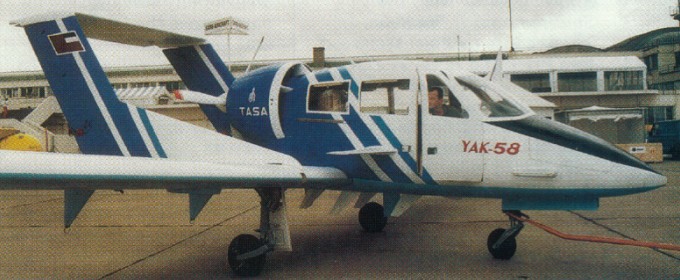
A six-seat business transport with a pusher piston engine (first flown April 1994)
Engines: 1
Seats: 6
Yakolev Yak-55M
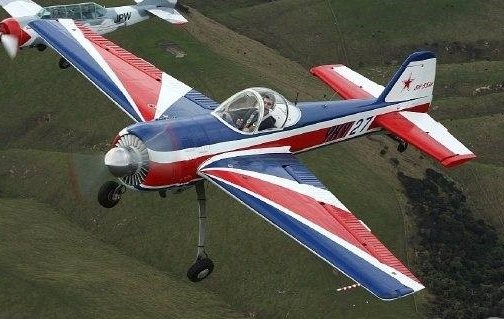
A single-seat aerobatic aircraft (first flown 1989).
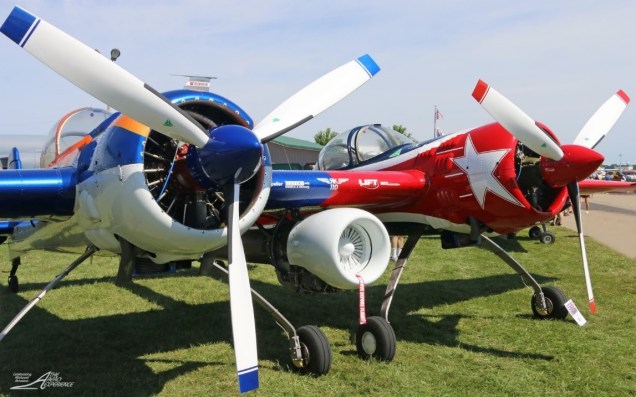
A team from Arizona led by mechanic and restorer Dall Koller and aerobatic flight champion Jeff Buerbon built two Yak-55M as Siamese twins.

As well as two M-14P engines of 360 hp, a TRD GE J-85 (in the variant GE CJ610) was installed.
For the first time it took to the air in June 2018, still without a jet, and flew normally. By October it flew with three engines. It flew and flew well.
Yakolev Yak-54
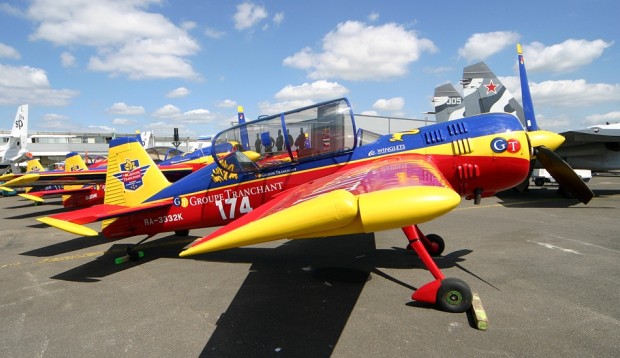
The Yak-54 was designed in the 1990s as an improved two seat version of the Yak-55. Featuring a new landing gear that is raked forward, three blade propeller, and larger tail surfaces, the Yak-54 was first flown in December 1993. The airframe is built to 7G.
Publicy introduced at the 1994 Paris Air Show, manufacture came to a stop, after one production aircraft, in 1998, pending certification. Some modifications were made to improve stability, aerodynamics and aerobatic performance, plus the M-14 engine was not certified.
The production aircraft was purchased by Jim Bourke and after two years of inactivity was restored to flight in 1996.
The Yak-54 did eventually receive full certification and a series of five was under construction.
Yakolev Yak-52
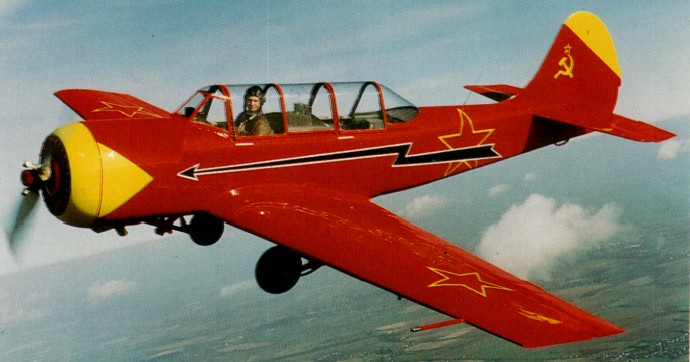
The Yakolev Yak-52 is a two-seater tandem low wing civil and military aerobatic trainer aircraft with semi-retractable tricycled landinggear. Development of the Yakolev Yak-52, originally known Yak-50U, started in 1973 as a successor of the Yakolev Yak-18 training aircraft. The Yakolev 52 was designed by the Yakolev Design Bureau as a trainer version of the single-seat Yak-50. The prototype was flown first in 1974. Production was initiated in 1976 at the Intreprinderea de Avioane Bacau factory in Bacau, Romania and production of the Yak-52 started in 1977.
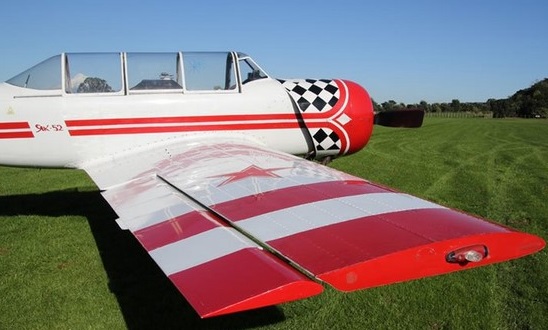
The Romanian prototype Yak-52 was flown first in May 1978 and deliveries started the same year. The IAK-52 airplane is equipped with a 360 hp Ivchenko Vedeneyev M-14P nine cylinder, air-cooled radial piston engine. The 400 hp M14PF can also be fitted. The Yak is all-metal, fully aerobatic machine with an inverted fuel system, and features semi retractable tricycle landing gear. As an aircraft with excellent performance and +7/-5 G limits with two pilots and full fuel, the Yak-52 enables training from basic to unlimited level.
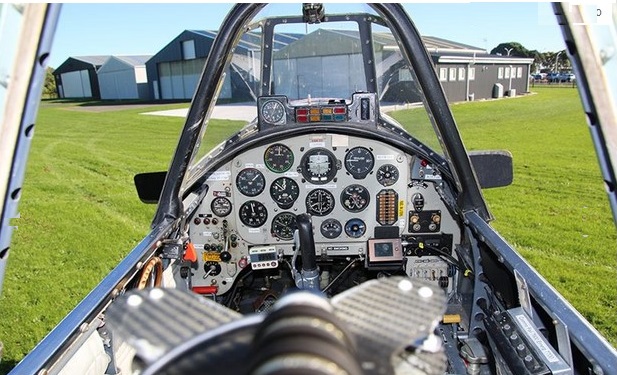
The Yak-52 was used in the Soviet Union as a basic military trainer as well as primary and advanced aerobatic trainer. A vast majority is in use with the Russian DOSAAF Clubs. The I.Av. Bacau was renamed Aerostar S.A. in 1991. Over 1800 have been produced starting with series-production in 1979. At the peak of production 150 aircraft were manufactured per year. Aerostar in Bacau, Romania as of 2009, was still producing the Yak-52 in limited numbers on request. The models were the Yak-52W, an upgraded derivative with Western instruments, radio, electrical etc. and the tail wheel version Yak-52TW.
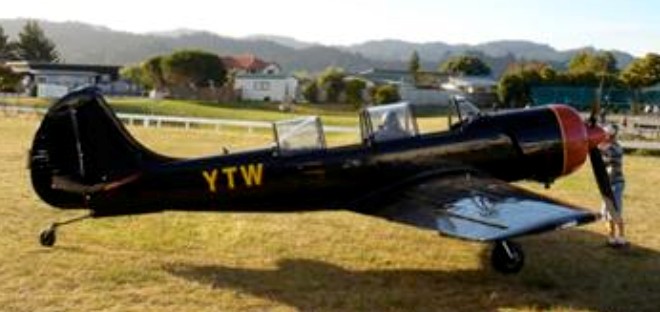
The 2025 developed Yak-52B2 variant is tailored for counter-drone operations. It features a 90 kg payload capacity under each wing. One pylon mounts a circular-view radar capable of air-to-air, air-to-ground, and weather tracking. The other currently carries a 12-gauge semi-automatic carbine.
The aircraft is further equipped with a weapon aiming subsystem and modern flight control and navigation systems, enabling reliable operations in all weather conditions.
Motor-Sich developed an upgraded version of this aircraft, which received a AІ-450S turboprop engine with 5-blade variable-pitch propeller MTV-5, as well as a number of other new systems. Also, the upgraded version received a new instrument panel with liquid crystal indicators.
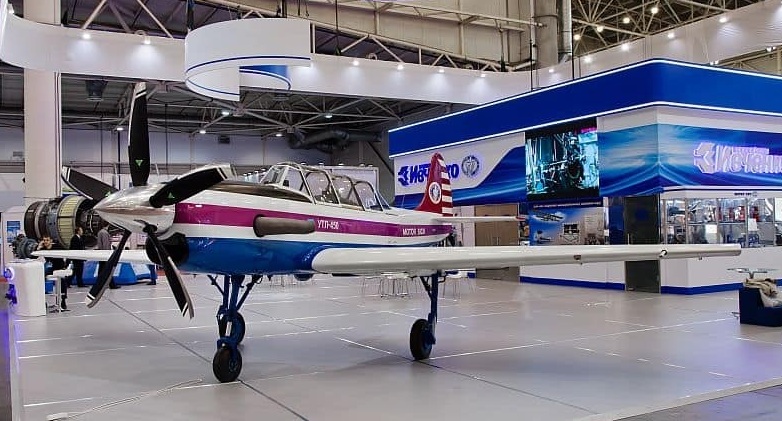
Engine: Vedeneyev Ivchyenko M-14P, 360 hp
Crew: 2
Height: 2.7 m
Length: 7.745 m
Wing span: 9.3 m
Wing area: 15 sq. m
Dihedral: 2 degrees
Wing incidence: 2 degrees
Propeller diameter: 2.4 m (V530TA-D35 constant speed propeller)
Wheel track: 2.715 m
Dry weight: 1035 kg
Maximum takeoff weight: 1315 kg
Maximum landing weight: 1315 kg
Weight of crew with parachutes: 180 kg
Fuel weight: 90 kg
Oil weight: 10 kg
Maximum fuel load: 120 L
Maximum oil load: 16 L
C of G limits (%): 17.5 – 27.0
Maximum level airspeed (at altitude 1000 m): 270 km/h
Range (10% fuel reserve at 190 km/h): 465 km (2 h 30 min)
Takeoff roll: 180 – 200 m
Landing roll: 330 m
Stall speed, engine at idle – erect flight, clean: 120 km/h
Stall speed, engine at idle – flaps, gear down: 110 km/h
Stall speed, engine at idle – inverted: 150 km/h
Approach speed: 160 km/h
Cruise 70%: 130 kt / 60 lt/hr.
Touchdown speed: 115 – 120 km/h
Takeoff speed: 120 km/h
Climb speed: 170 km/h
ROC: 1800 fpm.
Never exceed speed (VNE): 420 km/h
Maximum manoeuvring speed: 360 km/h
G limits: +7/-5
Maximum gear extended speed: 200 km/h
Maximum flaps extended speed: 170 km/h
Minimum fuel qty for aerobatics: 24 L
Maximum inverted flight time: 2 min (followed by at least 3 min of erect flight)
Maximum oil load for cross-country: 16 L
Maximum oil load for aerobatics: 10 L
Minimum oil load: 8 L
Yak 52TW
Engine: 400 HP
Prop: MTV-9-B/260-29
Motor-Sich UTL-450
Engine: AІ-450S turboprop
Propeller: MTV-5 5-blade variable-pitch
Empty aircraft weight: 900 kg
Maximum take-off weight: 1315/1500 kg (pilot/multi-purpose category)
Maximum horizontal flight speed: 350 km/h
Maximum flight range with 10% fuel reserve: 650 km
Maximum flight range with additional fuel reserve: 2890 km
Practical ceiling: 9000 m
Yakolev Yak-50

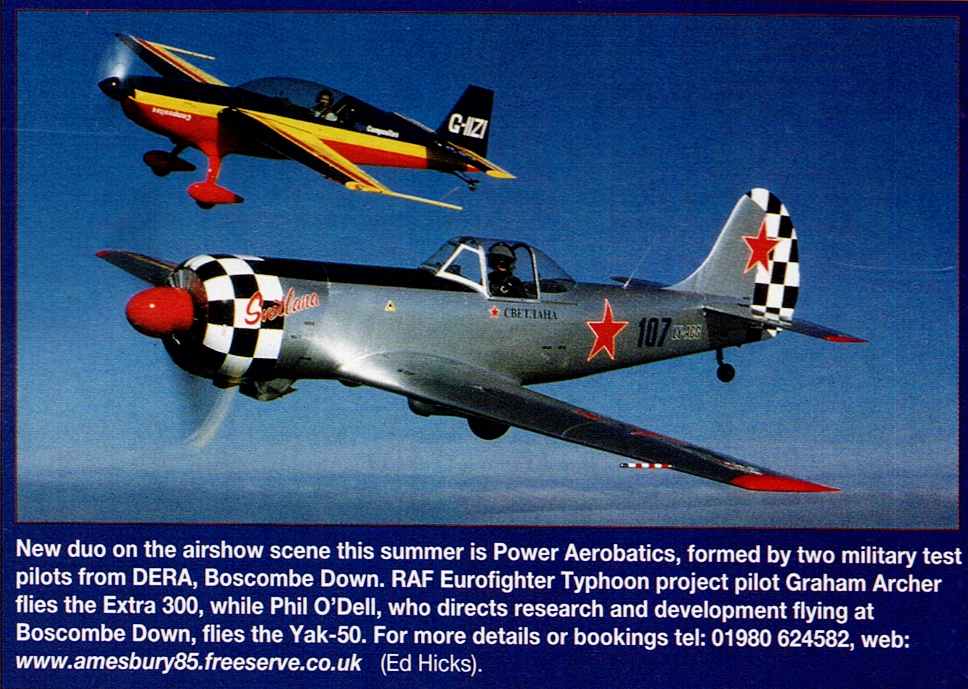
The Yakolev Yak-50 is a single-seater aerobatic low wing monoplane with retractable landing gear with tail wheel. Development of the Yakolev Yak-50 started in 1972 based on the single-seat Yak-18PS. With a new wing planform and more power, the Yakolev Yak 50 provides more performance than its predecessor.
The center spar box appeared to have been removed and the wing panels, with squared tips, now join the fuselage directly, with very little dihedral. Both the 18PM and 18PC had 300 hp Ivchenko AI14RF engines, whereas the 50 uses a 360 hp M 14P radial that looks quite similar as it is installed; it drives two large, constant speed, paddle like propeller blades that are geared down.
Gross weight of 900 kg or 1,980 pounds and the span is down, from 10.6 meters to 9.5, which means they’ve clipped between a foot and a half and two feet from each wing, and the wing area is correspondingly reduced nearly 12 percent. The airplane is also shorter than the 18s by a bit less than a meter. Its gear is fully retractable. The pilot sits near the trailing edge of the wing, which affords a fairly good view of the ground in vertical maneuvers, when such views are most needed.
The first of two prototypes built was flown first in 1972. After a series of modifications and a considerable amount of testing the Yak-50 was put into production at Arsenyiev in the Russian Federation as a duraluminium skinned semi monocoque airframe and deliveries started early 1975.
The Yak-50 proved its aerobatic versatility and worth at the 8th World Aerobatic Championships in 1976. Yak-50’s ended first, second and third in the men’s championships, took the top five places in the women’s competition and the overall men’s and women’s team prizes. The Yak-50 airplane is equipped with a 360 hp Ivchenko Vedeneyev M-14P nine cylinder, air-cooled radial piston engine.
When production ended in 1985 a total of 312 were built, of which the vast majority were for the Russian DOSAAF Clubs. With the introduction of the Yak-55, Moscow instructed all DOSAAF Clubs to scrap the Yak–50s and return the logbooks to Moscow, with the result that there are less than sixty Yak-50s left in the world.
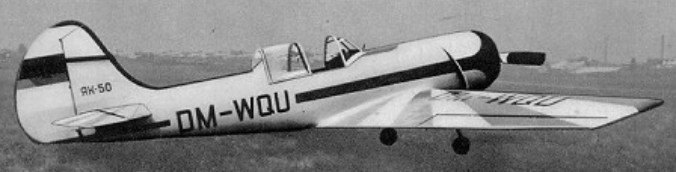
Engine: Vedeneyev Ivchyenko M-14P radial, 360hp / 265kW
Max take-off weight: 900 kg / 1984 lb
Empty weight: 765 kg / 1687 lb
Wingspan: 9.5 m / 31 ft 2 in
Length: 7.8 m / 26 ft 7 in
Height: 3.2 m / 11 ft 6 in
Wing area: 15.0 sq.m / 161.46 sq ft
Max. speed: 320 km/h / 199 mph
Cruise speed: 240 km/h / 149 mph
Ceiling: 6000 m / 19700 ft
Range: 550 km / 342 miles
Crew: 1

Yakolev Yak-50 [1949]
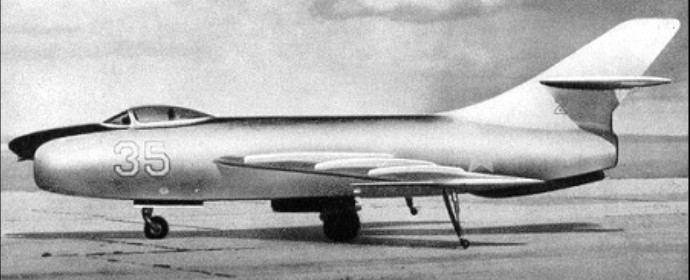
With V-VS formulation of a requirement for a single-seat limited all-weather fighter, the Yakolev OKB developed the Yak-50 in competition with the MiG-15Pbis. The wing, mounted in full mid position, was a two-spar structure of constant 12% thickness sweptback 45 degree at quarter chord. The OKB used magnesium alloys in the structure for the first time to any great extent as a contribution to weight reduction, a further weight-saving measure being the adoption of a velosipedno tipa, or “bicycle type” undercarriage. This zero-track arrangement, earlier tested by the Yak-25, comprised a single nosewheel member and a twin-wheel main unit, the latter taking 85% of the total aircraft weight; in addition, small outrigger stabilising wheels retracted into wingtip fairings. Power was provided by a single 2700kg Klimov VK-1 turbojet, armament consisted of two 23mm NR-23 cannon and provision was made for the installation of a single-antenna, fixed-scan, manually-tracked Korshun (Kite) AI radar in a housing above the nose air intake splitter. The first of three Yak-50 prototypes was flown on 15 July 1949, several months before the first radar-equipped MiG-15Pbis (SP-1), and demonstrated an outstanding speed performance, exceeding Mach=1.01 in a shallow dive on several occasions during manufacturer’s trials and Mach=1.048 during State Acceptance testing. It could take-off within 578m and land within 965m, but in more than a 18km/h crosswind, the Yak-50 tended to swerve from the runway, and it was barely controllable on a wet surface. In level flight at speeds between Mach=0.92 and 0.97, the Yak-50 suffered lateral oscillation preventing gun aiming. These shortcomings, coupled with the fact that the Mikoyan-Gurevich OKB was offering the potentially superior Izumrud radar-equipped MiG-17P, led to termination on 30 May 1950.
Max take-off weight: 4155 kg / 9160 lb
Empty weight: 3125 kg / 6889 lb
Wingspan: 7.98 m / 26 ft 2 in
Length: 11.20 m / 37 ft 9 in
Wing area: 16.00 sq.m / 172.22 sq ft
Max. speed: 1170 km/h / 727 mph
Range: 1100 km / 684 miles

 All Aero