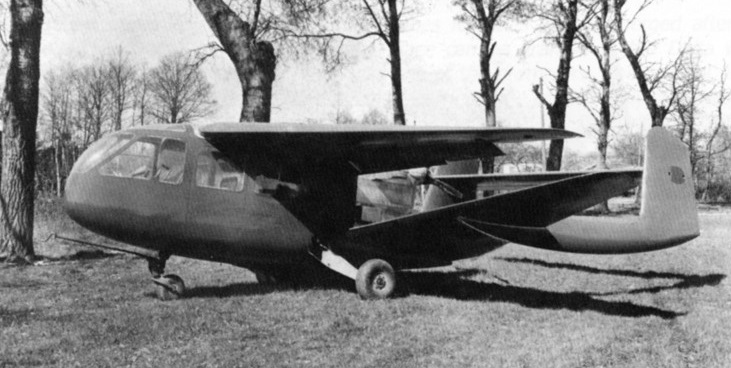
A twin-boom, heavily-staggered biplane four-seater, powered by 180 hp Regnier engine and first flown 1949.
A twin-boom, heavily-staggered biplane four-seater, powered by 180 hp Regnier engine and first flown 1949.
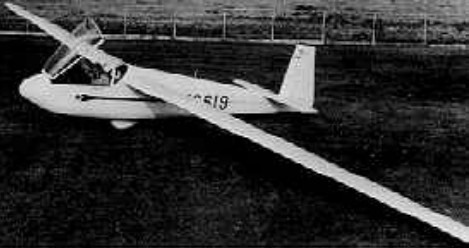
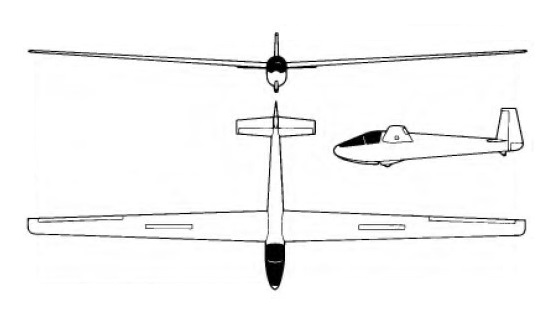
The Tern high perfomance single-seater was designed by Mr W. Terry Miller of Furlong, Pennsylvania, for amateur construction and the prototype, which was built in a total of 1,180 working hours, made its first flight in September 1965.
An improved version, known as the Tern II, made its first flight in August 1968; this featured a wing span increased by 4 ft 6 in to 55 ft 6 in, increasing the aspect ratio from 20 to 22, and giving an improved best glide ratio and minimum sinking speed. During 1968 brake parachutes were fitted to the prototype Tern, and two types of these were later made available for installation in both versions of the Tern in the base of the rudder, namely a 6 ft diameter cross parachute or a 5 ft diameter guide surface parachute.
By May 1970 nearly 100 Terns and 12 Tern IIs were under construction not only in the USA, but by amateurs in Africa, Australia, South America and Canada.
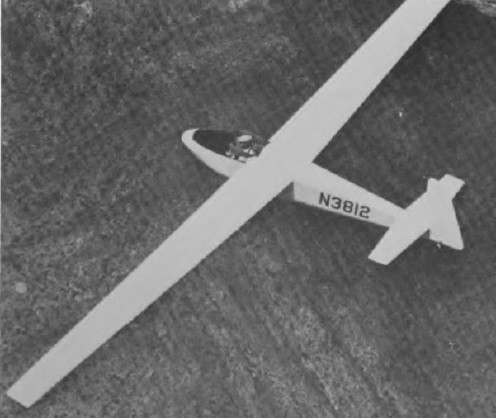
Of conventional all-wood construction, the Tern has unswept cantilever shoulder wings which are two piece two-spar spruce structures, entirely plywood covered. There are no flaps and the plain ailerons are also all wood; there are wooden spoilers in the wing lower surface used for approach and glide slope control. The semi-monocoque wooden fuselage has a plastic-reinforced glassfibre nose and plywood skinning aft of the cockpit. The cantilever all-wood tail unit has modified NACA laminar flow sections and special hinge-line contours to reduce drag and increase control effectiveness at large angles of deflection; there are no elevator or rudder tabs. Landing gear consists of a non-retractable monowheel forward of the eg housed in a streamlined pod, and skids under the nose and tail; there is a brake lever for applying pressure directly to the tyre. The pilot sits in a semi-reclining seat under a three piece canopy, the centre portion of which hinges sideways for entrance and exit, and radio can be fitted.
One Tern belongs to the National Soaring Museum.
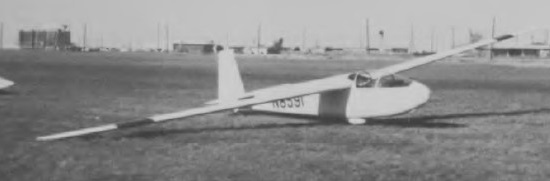
Tern
Wing span: 15.54 m / 51 ft
Wing area: 12.08 sq.m / 130 sq.ft
Empty Weight: 215 kg / 475 lb
Payload: 102 kg / 225 lb
Gross Weight: 317 kg / 700 lb
Wing Load: 26.24 kg/sq.m / 5.4 lb/sq.ft
L/DMax: 34 93 kph / 50 kt / 58 mph
MinSink: 0.64 m/s / 2.1 fps / 1.24 kt
Aspect ratio: 20
Airfoil: Wortmann 61 Series
Seats: 1
Tern II
Span: 15.56 m / 55 ft 6 in
Length: 6.49 m / 21 ft 3.5 in
Height: 1.52 m / 5 ft 0 in
Wing area 13.01 sq.m / 140 sq ft
Aspect ratio: 22.0
Wing section: Wortmann 61 Series
Empty weight: 249 kg / 550 lb
Max weight: 363 kg / 800 1b
Water ballast: None
Max speed: 120 mph / 104 kt / 193 km/h (smooth air)
Stalling speed: 34.5 kt / 64 km/h
Max aero-tow speed: 88 mph
Max rough air speed: 76.5 kt / 142 km/h
Min sinking speed: 1.95 ft/sec / 0.59 m/sec at 48 mph / 41.5 kt / 77 km/h
Best glide ratio: 38:1 at 60 mph / 52 kt / 97 km/h
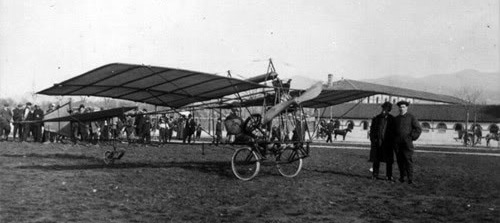
The third and final aeroplane designed and constructed by Franz Miller of Turin, Italy.
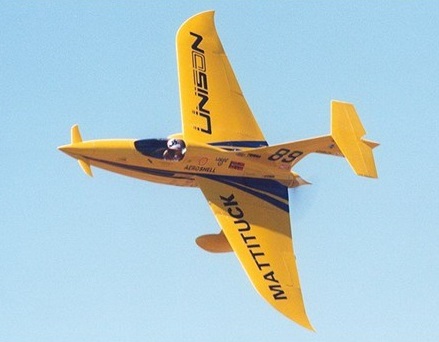
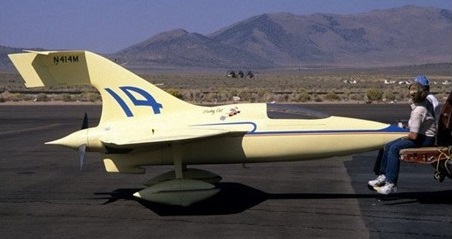
The Miller-Bohannon JM-2 Special, named Pushy Galore, is a one-of-a-kind American homebuilt Formula One racing and record-setting aircraft, based on Jim W Miller’s Miller JM-2 design, but highly modified by Bruce Bohannon.
Bohannon began construction of Pushy Galore in 1988 and first flew it in the early part of 1989, first entering it in a race in June 1989.
The aircraft features a cantilever mid-wing, a single-seat enclosed cockpit under a bubble canopy, fixed main tricycle landing gear with a retractable nose wheel, a t-tail, nose mounted canard and a single engine in pusher configuration.
The aircraft is made from welded steel tubing covered in molded carbon fiber. As required by the Formula One rules, its engine is a 100 hp (75 kW) Continental O-200A.
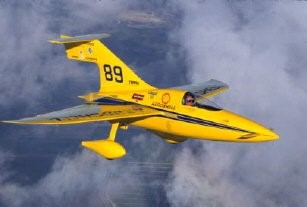
Only one example was ever built, N189BB.
Bohannan entered the aircraft in the Reno Air Races in 1994, qualifying in third place in the Formula One class, with a speed of 236.153 mph (380.051 km/h).
In 1995 Bohannan flew the aircraft to second place in the Formula One Gold championship race at Reno, Nevada.
Bohannan also used the aircraft to set world time-to-climb records in the Fédération Aéronautique Internationale (FAI) C-1.A class. At AirVenture 1994 Bohannan set a new world time-to-climb record, climbing to 6,000 m (19,685 ft) in 12 minutes and 50 seconds. In January 1996, Bohannan climbed the aircraft to 9,000 m (29,528 ft) in 41 minutes and 35 seconds, setting class world time-to-climb, absolute altitude and altitude in horizontal flight records. In July 1996 at AirVenture in Oshkosh, Bohannan set a third FAI class time-to-climb record of 3,000 m (9,843 ft) in three minutes and eight seconds.
After the climb records were set in 1996 Bohannan retired the aircraft and in 1998 donated it to the AirVenture Museum.

JM-2 Special Pushy Galore
Engine: 1 × Continental O-200A, 100 hp (75 kW)
Wingspan: 18 ft 5 in (5.61 m)
Length: 17 ft 2 in (5.23 m)
Height: 6 ft 3 in (1.91 m)
Maximum speed: 250 mph (402 km/h; 217 kn)
Crew: one
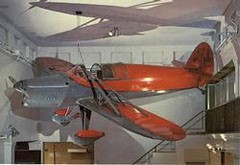
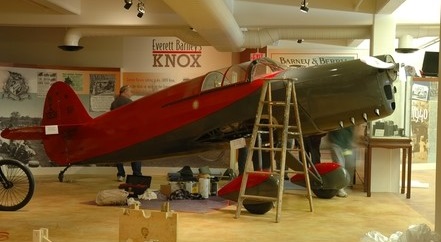
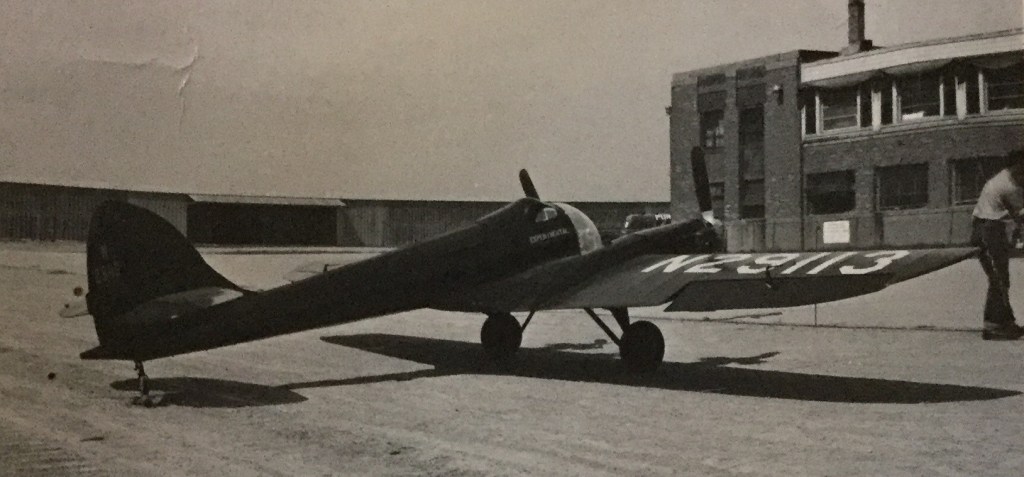
In 1936 Miller Aircraft Corporation built a side-by-side sport plane (NX1331) with a 125 hp Menasco C-4 engine. Designed by Howell “Pete” Miller, Granville Brothers’ chief engineer, and built by Mark Granville. It was named “Zeta” because Miller’s fraternity at NYU was Zeta Psi.
The plane’s first flight was made on 11 December 1937.
No market was found, so Mark Granville and his wife used it for short pleasure trips until W.W.II restrictions on private aircraft forced the plane into retirement with only 200 hours logged.
The dismantled plane was found in a barn, refurbished and donated to the Springfield Science Museum in 1978.
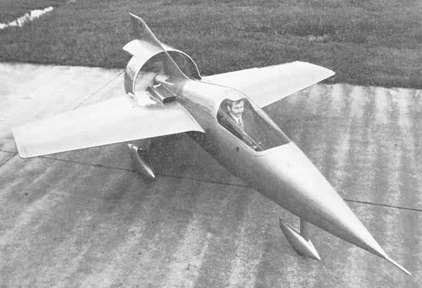
Designed by J.W. Miller, the JM-2 takes a different approach to Formula One racing. Both the engine and main wings are set aft of the pilot’s enclosed cockpit. The Continental O-200A drives a pusher prop with its spinner taking the place of the tailcone. The two sections of the vertical propeller shroud act as the vertical stabilizer, and the elevators are placed in T-tail fashion. The wings are covered with honeycomb material reinforced by fiberglass and resin. The fuselage is constructed of a welded steel tube load bearing structure encased in four fiberglass panels.
Variation:
Miller-Bohannon JM-2 Pushy Galore
The nose gear was both steer-able and retractable
Gross Wt. 1100 lb
Empty Wt. 630 lb
Fuel capacity 12 USG
Wingspan 15 ft
Length 19 ft
Engine 100-hp Continental O-200
Prop: 4-blade
Top speed 235 mph
Cruise 190 mph
Stall 70 mph
Climb rate 1600 fpm
Takeoff run 1500 ft
Landing roll 2000 ft
Range 300 nm
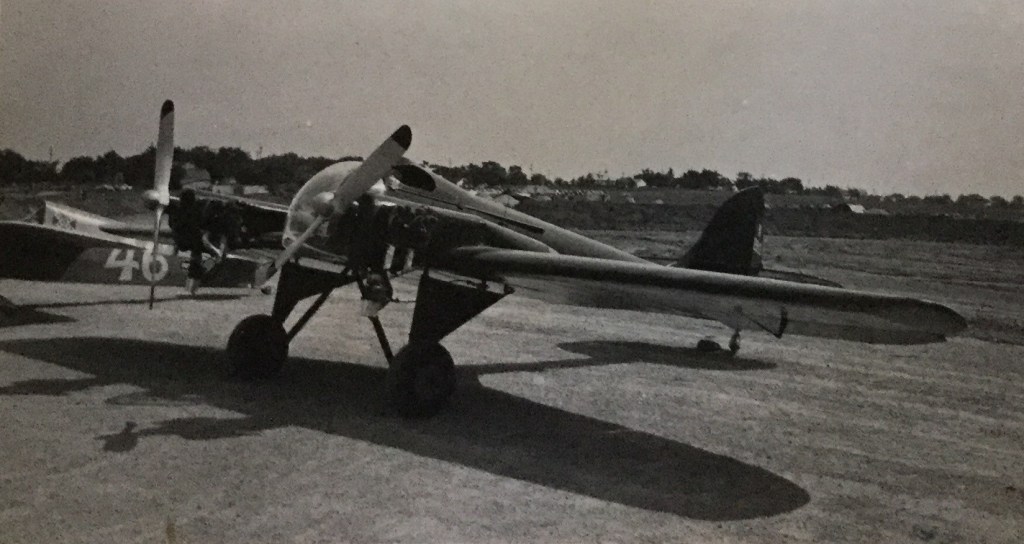
Jim Miller built his first airplane, a formula one racer, in 1949, and flew it in the Cleveland Air Races that year.
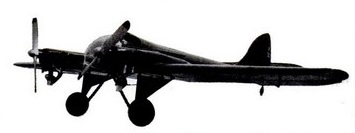
The “Belly Flopper” was built by Irven Miller of Milwaukee about 1953. Flown in the prone position, it has a top speed of 150 mph, powered by two 40 hp Continentals.
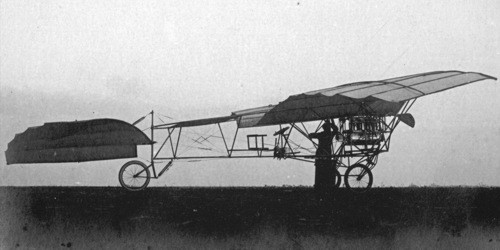
Sometimes called Ponzelli-Miller. It was equipped with a 100 hp Miller engine and tried unsuccessfully to fly in the hands of Leonino da Zara at the 1909 Brescia meeting in Italy.
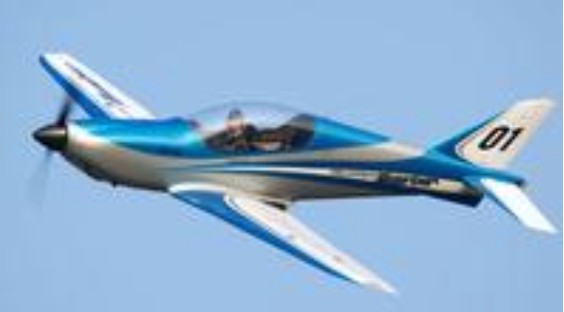
Stall: 33 kt / 39 mph / 62 kmh
Cruise: 140 kt / 162 mph / 260 kmh
VNE: 211 kt / 242 mph / 390 kmh
Empty Weight: 285 kg / 628 lbs
MTOW Weight: 450 kg / 992 lbs
Take-off distance (50ft obstacle): 490 ft / 150 m
Landing distance (50ft obstacle): 490 ft / 150 m
 All Aero