As he worked on the Dragonfly, Mitchell set out on his own to build a new flying wing glider, which he called the Osprey, a single seat machine fitted with stabilators. Mitchell tested his flying wing several times near Oakland, in 1950. Unfortunately, the building in which the glider was stored burned to the ground and the flying wing was destroyed.
Monoplane
Mitchell Superwing
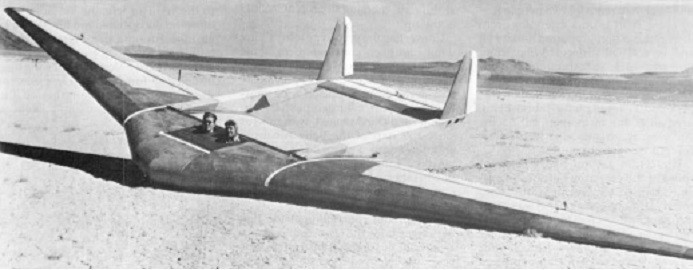
During WW II, Don Mitchell became responsible for the construction of the wings of the CG-4A. In 1943 he had responsibility for the building of the XCG-16 prototype. At the same time he was working on his own flying wing, model 278.
One of Don Mitchells projects was the conversion of a 1/2 scale XCG-16 which he converted into a flying wing using external stabilators for control and stability. He, along with Hawley Bowlus and Paul Tuntland, flew the wing many times at the various dry lakes. They towed with both auto and airplane with no major problems.
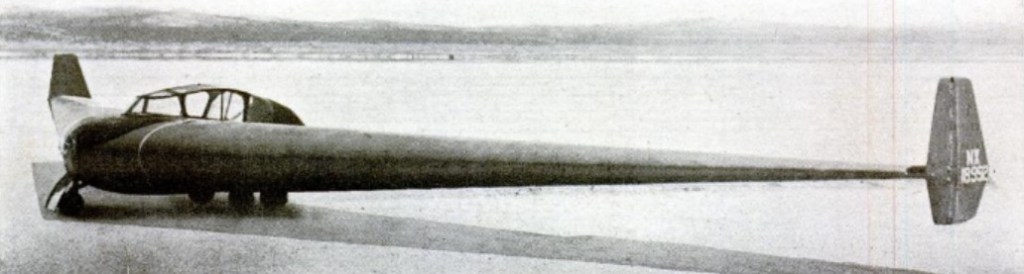
Later it had an engine attached.
Side-by-side two seater.
Wingspan: 50 ft
Glide ratio: 38-1
Engine: 1
Cruise: 79 mph
Landing speed: 28 mph
Mitchell U-2
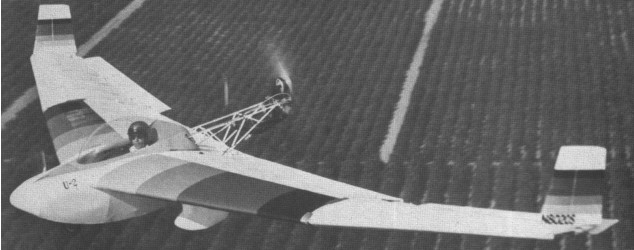
With the Zenoah engine and a considerable evolution in the wing itself Mitchell produced the self-launching U-2 with a fuselage of welded steel tube, and wing of composite structure. The spar is wood, with foam nose ribs and a plywood skin forming a D- tube. Tip rudders provide yaw control. Single seat single engined mid wing monoplane with conventional three axis control. Wing has swept back leading and trailing edges, and tapering chord; no tail. Pitch/roll control by stabilators; yaw control by tip rudders; control inputs through stick for pitch/roll and pedals for yaw. Cantilever wing; wing profile modified Worthmann; double ¬surface. Undercarriage has three wheels in tricycle formation; suspension on main wheels. Push right go right nosewheel steering connected to yaw control. Brake on nosewheel. Wood/steel tube fuselage totally enclosed. Engine mounted above wing driving pusher propeller.
One belongs to the National Soaring Museum.
The Super U-2 is a flying wing with three-axis controls featuring winglet-type hinged rudders for yaw control and stabilators for pitch and roll control. Control surfaces are operated separately, and rudders can be simultaneously deflected. Construction is of chromomoly tubing with Douglas fir and birch plywood. Foam is used for the leading edge ribs and nose cone. Wings are covered with 1 mm birch plywood and ceconite. Tail surfaces and fuselage are covered with ceconite. POWERPLANT: Zenoah G25B-1 in a pusher position above the wing. A 2.25:1 reduction unit turns a two blade wooden propeller made by Woody’s Prop Shop. Fuel is carried in a polypropylene tank installed in the wing. LANDING GEAR: Solid tricycle gear with a steerable nosewheel and a nosewheel friction brake. Main and nose wheels are 10½-inch. OPTIONS: Cuyuna 430R Power Pack, Blueprint plans.
The prototype of the U 2 Super Wing made its first flight in the Spring of 1980 and was presented more as a powered glider with soaring capability than as an ultralight. Initially this flying wing was even envisaged as having a retractable tricycle undercarriage, although this was dropped in favour of having com¬pletely faired in main gear.
With a glide angle of 20/1 at 45 mph (72 kph) the U 2 is perfectly happy with a low powered engine like the single cylinder McCulloch Mc101 derated to 10hp, however, the aircraft was designed to be powered by engines up to 30 hp and Mitchell Aircraft have offered a kit since 1981 with, as an option, either Zenoah G25B 20hp or Cuyuna 430R 30 hp engines. The design philosophy remains very close to that of the B 10 Mitchell Wing but is applied to a more complex machine, so the amount of time for assembly is considerably more, around 250 h for the major fabrication and 100 h for finishing off. It is classified as an experimental home¬built and not an ultralight in the USA, requiring the pilot to have at least a private pilot’s licence.
Prototype
Engine: McCulloch 125cc, 10 hp
Gross wt: 450 lbs
Empty wt: 225 lbs
Max pilot wt: 250 lbs
First year built: 1979
U-2
Engine: Zenoah
Wing span: 10.36m / 34ft
Wing area: 12.63sq.m / 136sq.ft
Empty Weight: 109kg / 240lb
Payload: 154kg / 340lb
Gross Weight: 263kg / 580lb
Wing Load: 20.82kg/sq.m / 4.62lb/sq.ft
L/DMax: 20
Aspect ratio: 8
Seats: 1
Airfoil: Wortmann mod.
Structure: wood, steel tube, foam and resin, fabric cover.
Super U-2
Engine: Zenoah G25B, 20 hp at 6300rpm
Propeller diameter and pitch 52 x 27 inch, 1.32×0.69m
Belt reduction, ratio 10/1
Power per unit area 0.14hp/sq.ft, 1.6 hp/sq.m
Fuel capacity 3.0 US gal, 2.5 Imp gal, 11.4 litre
Length overall 9.0ft, 2.74m
Height overall 3.0ft, 0.91m
Wing span 34.0ft, 10.36m
Chord at root 6.2ft, 1.87m
Chord at tip 2.0ft, 0.61m
Dihedral 6 deg
Sweepback 12 deg
Total wing area 136 sq.ft, 12.6 sq.m
Wing aspect ratio 8.5/1
Nosewheel diameter overall 10 inch, 25 cm
Main wheels diameter overall 10 inch, 25 cm
Empty weight 240 lb, 109 kg
Max take off weight 550 lb, 249 kg
Payload 310 lb, 141 kg
Max wing loading 4.04 lb/sq.ft, 19.7 kg/sq.m
Max power loading 27.5 lb/hp, 12.5 kg/hp
Max cruising speed 60 mph, 97 kph
Stalling speed 26 mph, 42 kph
Max climb rate at sea level 400 ft/min, 2.0 m/s
Take off distance 200ft, 61m
Landing distance 200ft, 61m
Range at average cruising speed 180 mile, 290 km
Super U-2
Engine: Cuyuna 430R, 30 hp
Belt reduction
Power per unit area 0.22hp/sq.ft, 2.4 hp/sq.m
Fuel capacity 3.0 US gal, 2.5 Imp gal, 11.4 litre
Length overall 9.0ft, 2.74m
Height overall 3.0ft, 0.91m
Wing span 34.0ft, 10.36m
Chord at root 6.2ft, 1.87m
Chord at tip 2.0ft, 0.61m
Dihedral 6 deg
Sweepback 12 deg
Total wing area 136 sq.ft, 12.6 sq.m
Wing aspect ratio 8.5/1
Nosewheel diameter overall 10 inch, 25 cm
Main wheels diameter overall 10 inch, 25 cm
Empty weight 300 lb, 136 kg
Max take off weight 550 lb, 249 kg
Payload 250 lb, 113 kg
Max wing loading 4.04 lb/sq.ft, 19.7 kg/sq.m
Max power loading 18.3 lb/hp, 8.3 kg/hp
Load factors; +7.8, 7.8 ultimate
Max level speed 100mph, 161kph
Max cruising speed 70 mph, 113 kph
Stalling speed 37 mph, 60 kph
Max climb rate at sea level 750 ft/min, 3.8 m/s
Min sink rate 180ft/min at 45mph, 0.9 m/s at 72 kph
Best glide ratio with power off 23/1 at 49mph, 79kph
Take off distance 210ft, 64m
Landing distance 250ft, 76m
Service ceiling 12,000ft, 3660 m
Range at average cruising speed 80 mile, 129 km
Mitchell T-10
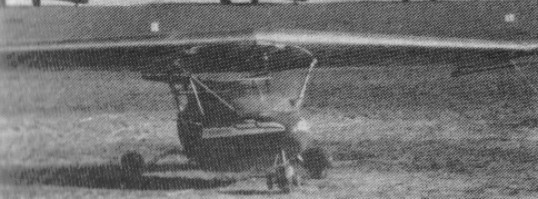
A fully cantilevered aluminium wing folding for towing. HP range: 40-50.
The TU-10 Twin Eagle is a two-place ultralight trainer, semi-enclosed cockpit, high wing monoplane with Whitcomb winglets, 3-axis controls, trailing elevons. POWERPLANT: Rotax 447, reduction ratio 2.12:1, 52-inch prop. LANDING GEAR: Chrome moly aluminum tricycle. 1984 PRICE: $10,500.
In 1997 the Higher Planes T-10 kit price was US$11,500.
T-10
Engine: Rotax 447
Empty wt: 350 lbs
Max wt: 850 lbs
Wing span: 37ft 4in
Wing area: 176 sq.ft
Wing loading: 4.1 lbs/sq.ft
Power loading: 17.8 lbs/hp
Max speed: 63 mph
Cruise: 58 mph
Stall: 30 mph
Vne: 110 mph
Seats: 2
Engine: Rotax 503SC, 46 hp
Speed max: 78 mph
Cruise: 62 mph
Range: 200 sm
Stall: 35 mph
ROC: 650 fpm
Take-off dist: 190 ft
Landing dist: 200 ft
Service ceiling: 12,000 ft
Fuel cap: 6.5 USG
Weight empty: 400 lbs
Gross: 875 lbs
Height: 7.33 ft
Length: 9 ft
Wing span: 37.33 ft
Wing area: 170 sq.ft
Seats: 2
Landing gear: nose wheel
Glide ratio: 14-1
TU-10 Twin Eagle
Wingspan 37’4”
Wing area 170 sq.ft
Empty wt. 350 lbs
Gross weight 900 lbs
Cruise speed 60 mph
Stall speed 31 mph
Vmax 63 mph
Climb 500 fpm
Takeoff run 325 ft
Land¬ing roll 300 ft
Higher Planes Mitchell Wing T-10
Top speed: 78 mph
Cruise: 62 mph
Stall: 35 mph
Range: 200 sm
Rate of climb: 650 fpm
Takeoff dist: 190 ft
Landing dist: 200 ft
Service ceiling: 12,000 ft
Engine: Rotax 503-SC, 46 hp
HP range: 40-50
Fuel capacity: 6.5 USG
Empty weight: 400 lb
Gross weight: 875 lb
Height: 7.3 ft
Length: 9 ft
Wing span: 37.3 ft
Wing area: 170 sq.ft
Seats: 2
Landing gear: nose wheel
Glide ratio: 14-1
Mitchell P-38 / AG-38
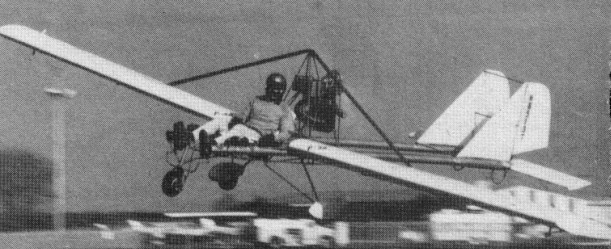
Single seat single engined mid wing monoplane with conventional three axis control. Wing has unswept leading and trailing edges, and constant chord; two fin tail. Pitch control by fully flying tail; yaw control by fin mounted rudders; roll control by full span ailerons also usable as flaps; control inputs through stick for pitch/roll and pedals for yaw. Wing braced from above by struts, wing profile NACA 23015; double surface. Undercarriage has three wheels in tricycle formation, with addi¬tional tailskids; steel spring suspension on nosewheel and glass fibre suspension on main wheels. Push right go right nosewheel steering connected to yaw control. Brake on nosewheel. Aluminium tube/wood/steel tube framework, with optional pod. Engine mounted above wing driving pusher propeller.
The P 38 was designed by Jim Meade and christened Lightning after the famous twin boom fighter of the Second World War. The prototype appeared at the end of 1980 and the first P 38 was sold during the second quarter of 1981. The prototype was fitted with a 26.0ft (7.92m) span wing having a 4.0ft (1.22m) chord, giving 104sq.ft (9.7 sq.m) of wing area using the same NACA 23015 profile as the B 10. With 200 lb (91 kg) empty weight and 450 lb (204 kg) maximum gross weight, this machine carried 250 lb (113 kg) useful load with a wing loading of 4.32 lb/sq.ft (21.1 kg/sq.m).
On the production models, the wing span was increased to 28.0ft (8.53m) and the chord also increased.
Initially fitted with a Honda Odyssey engine of 250 cc giving 20 hp, or as an option a Zenoah G25B also of 20 hp, the P 38 was in 1983 powered by the twin cylinder Cuyuna 430RR 30 hp engine. Its characteristics and performance figures do not allow its classification as an ultralight, so it is therefore necessary to hold at least a private pilot’s licence to fly the Lightning in the US.
The complete kit, requiring 80 h for assembly, has less than 200 pieces, the principal components being prefabricated and partly assembled. The wing ribs are wood, bonded with epoxy to the tubular Duralumin spar, while the leading edges are of polyurethane foam shaped and then covered with birch plywood. On the P 38, the ‘flaperons’ a combination of flap and aileron are made with ribs every 6 inch (15 cm). Like the other Mitchell models, this one is also available as an economy kit or as plans only.
Units delivered by June 1981 35 kits and plans.
The AG 38 is the crop spraying version of the P 38 Lightning, to which it is very similar except a pod is fitted. The prototype AG 38 was shown to the public during the EAA Convention at Oshkosh in August 1982. This aircraft is fitted with Micron X15 100 variable speed rotating nozzles, which are said to control droplet size and so reduce the amounts of chemical and water required. They are supplied from a shaped tank which carries 14.0 US gal (11.7 Imp gal, 53.0litre) of spray chemical. The tank is fitted under the seat and central wing section, between the legs of the main landing gear. An electric pump feeds the spray booms which are fitted with 19 fan nozzles across the full wing span. For a better spread, the two spray bars are placed at not the trailing edge as is usual, but 9.5 inch (24 cm) below the level of the wing.
At 50mph (80kph) the AG 38 spray swath varies from 20ft (6m) wide at 6ft (2m) altitude to 45 ft (14 m) wide at 15 ft (5 m) altitude. With the equipment set for maximum delivery, the AG 38 can deliver 48oz/acre (3.4 litre/hectare) and can treat 37 acre (15 hectare) per load. Reloading is required every 30 min, allowing an average coverage of 60 acre/h (24 hectare/h). At the other end of the scale, the machine can be set up for maximum acreage, when it will deliver 6oz/acre (0.42 litre/hectare) and treat 300 acre (120 hectare) per load. Reloading is required approximately every 2h, giving an average coverage of 140 acre/h (56 hectare/h).
P-38
Engine: Cuyuna 430RR, 35 hp at 5500 rpm
Power per unit area 0.29 hp/sq.ft, 3.1 hp/sq.m
Length overall 17.0ft, 5.18 m
Height overall 5.0ft, 1.52m
Wing span 28.0ft, 8.53m
Constant chord 4.3 ft, 1.29 m
Sweep forward 5 deg
Total wing area 120 sq.ft, 11.2 sq.m
Wing aspect ratio 6.5/1
Wheel track 5.0 ft, 1.52 m
Nosewheel diameter overall 10 inch, 25 cm
Main wheels diameter overall 10 inch, 25 cm
Empty weight 305 lb, 138kg
Max take off weight 700 lb, 317kg
Payload 395 lb, 179kg
Max wing loading 5.83 lb/sq.ft, 28.4 kg/sq.m
Max power loading 20.0 lb/hp, 9.lkg/hp
Load factors; +4.0, 4.0 ultimate
Max level speed 65 mph, 105 kph
Max cruising speed 55 mph, 88 kph
Stalling speed 32 mph, 51 kph
Max climb rate at sea level 500 ft/min, 2.5 m/s
Min sink rate 400 ft/min, 2.0 m/s
Best Wide ratio with power off 7/1
Take off distance 210ft, 64m
Landing distance 250ft, 76m
Service ceiling 12,000ft, 3660m
Range at average cruising speed 110 mile, 177 km
AG-38
Engine: Cuyuna 430RR, 35 hp at 5500 rpm
Power per unit area 0.29 hp/sq.ft, 3.1 hp/sq.m
Length overall 17.0ft, 5.18 m
Height overall 5.0ft, 1.52m
Wing span 28.0ft, 8.53m
Constant chord 4.3 ft, 1.29 m
Sweep forward 5 deg
Total wing area 120 sq.ft, 11.2 sq.m
Wing aspect ratio 6.5/1
Wheel track 5.0 ft, 1.52 m
Nosewheel diameter overall 10 inch, 25 cm
Main wheels diameter overall 10 inch, 25 cm
Empty weight 325 lb, 147kg
Max take off weight 700 lb, 317kg
Payload 375 lb, 170kg
Max wing loading 5.83 lb/sq.ft, 28.4 kg/sq.m
Max power loading 20.0 lb/hp, 9.lkg/hp
Load factors; +4.0, 4.0 ultimate
Max level speed 65mph, 105kph
Stalling speed 35mph, 56kph
Max climb rate at sea level 500ft/min, 2.5 m/s
Take off distance 275 ft, 85 m
Landing distance 325 ft, 100 m
Mitchell A-10
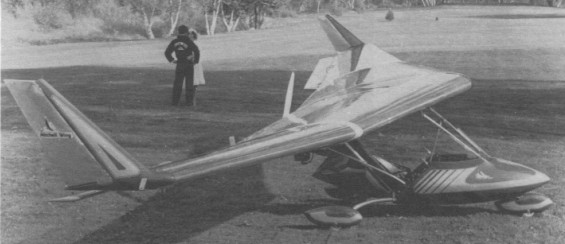
Single seat single engined high wing monoplane with conventional three axis control. Wing has swept back leading and trailing edges, and tapering chord; no tail. Pitch/roll control by stabilators; yaw control by tip rudders; control inputs through stick for pitch/roll and pedals for yaw. Cantilever wing; wing profile; double surface. Undercarriage has three wheels in tricycle formation. Push right go right nosewheel steering connected to yaw control. Aluminium tube framework, with pod. Engine mounted below wing driving pusher propeller.
Shown in December 1982, the A 10 Silver Eagle is an updated version of the B 10 Mitchell Wing, not only as regards detail improvements, but in the technology and type of manufacture. Don Mitchell has abandoned the overhead stick, which comes down from the high wing on the B 10, to replace it with a conventional stick between the pilot’s knees. Materials (wood and fabric) used for the B 10 wing have been superseded by aluminium and a foam developed by NASA called honeyfoam and designated SR 502B, the final B indicating the use of boron.
The A 10 Silver Eagle was sold ready to fly and includes a fairing for the cockpit, wheel fairings on the main wheels, an upholstered seat with shoulder harness and an instrument panel. The price in April 1983 was $5995.
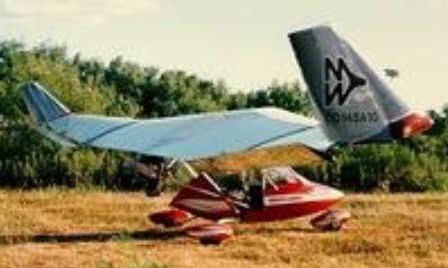
Ameriplanes Inc sold the Mitchell Wing A-10 described as a unique, ultralight motorglder for intermediate and advanced pilots based on Don Mitchell’s Mitchell Wing B-10 hang glider. It is a flying wing design from aluminium. It utilzes a Rotax 277/28 hp engine and was available in kit form for $9400 (does not include engine). Price completed in 2009: 11700 USD
The A-10 was available with a 2SI, A-20 engine and when equiped with same it comes in at 254lbs (the 103 UL limit). Other engines, like the Zenoah G25B-1 were also available.
The Higher Planes A-10 is stressed to +6 and –5.5 G, and the wings fold for transport. The kit price in 1997, without engine, was US$7900.
A-10
Engine: Zenoah 250 (242cc) 23hp
Static thrust: 160 lbs
Empty wt: 250 lbs
Wing span: 34’4”
Wing area: 134 sq.ft
Height: 6’2”
Length: 8’6”
Fuel cap; 3 USG
Construction: Aluminium, Boron, Foam
Max wt: 553 lbs
Stall speed: 27 mph
Max speed: 63 mph
Vne: 63 mph
Climb rate: 640 fpm @ 41 mph
Design limit: +5.5, -5.5g
Glide ratio: 15-1
Wing loading: 4.13 lbs/sq.ft
Power loading: 24.04 lbs/hp
Engine: Rotax 277, 26 hp
Speed max: 70 mph
Cruise: 55 mph
Range: 200 sm
Stall: 28 mph
ROC: 800 fpm
Take-off dist: 200 ft
Landing dist: 200 ft
Service ceiling: 12,000 ft
Fuel cap: 2.5 USG
Weight empty: 280 lbs
Gross: 553 lbs
Height: 7.33 ft
Length: 9.33 ft
Wing span: 34.33 ft
Wing area: 134 sq.ft
Seats: 1
Landing gear: nose wheel
A-10 Silver Eagle
Engine: Zenoah G2SB 1, 20 hp at 6500 rpm
Toothed belt reduction
Max static thrust 165 lb, 75 kg
Power per unit area 0.14 hp/sq.ft, 1.58 hp/sq.m
Fuel capacity 3.0 US gal, 2.5 Imp gal, 11.4 litre
Length overall 8.0ft, 2.43m
Height overall 5.6 ft, 1.67m
Wing span 34.4ft, 10.46m
Chord at root 6.0ft, 1.83m
Chord at tip 2.0ft, 0.61m
Dihedral 6 deg at tip
Sweepback 12 deg
Total wing area 136 sq.ft, 12.6sq.m
Wing aspect ratio 8.6/1
Nosewheel diameter overall 10 inch, 25 cm
Main wheels diameter overall 10 inch, 25 cm
Empty weight 250 lb, 113kg
Max take off weight 553 lb, 251 kg
Payload 303 lb, 138 kg
Max wing loading 4.06 lb/sq.ft, 19.8 kg/sq.m
Max power loading 27.6 lb/hp, 12.5 kg/hp
Load factors +6.0, 6.0 design
Max level speed 63 mph, 101 kph
Max cruising speed 58 mph, 93 kph
Stalling speed 26 mph, 42 kph
Max climb rate at sea level 650 ft/min, 3.3 m/s
Best glide ratio with power off 18/1
Take off distance 200ft, 60m
Landing dis¬tance 200 ft, 60 m
Ameriplanes Mitchell Wing A-10
Engine: Rotax 277, 28 hp
Wing span: 34.33 ft
Wing area: 156 sq.ft
Empty Weight: 115 kg / 254 lbs
MTOW Weight: 249 kg / 550 lbs
Stall: 24 kt / 28 mph / 45 kmh
Cruise: 52 kt / 60 mph / 97 kmh
VNE: 66 kt / 76 mph / 122 kmh
L/D: 16:1
Sink rate: 240ft/min.
Higher Planes Mitchell Wing A-10
Engine: Rotax 277, 26 hp
HP range: 22-26 hp
Top speed: 70 mph
Cruise: 55 mph
Stall: 28 mph
Range: 200 sm
Rate of climb: 800 fpm
Takeoff dist: 200 ft
Landing dist: 200 ft
Service ceiling: 12,000 ft
Fuel capacity: 2.5 USG
Empty weight: 280 lb
Gross weight: 553 lb
Height: 7.3 ft
Length: 9.3 ft
Wing span: 34.3 ft
Wing area: 134 sq.ft
Seats: 1
Landing gear: nose wheel
Mitchell B40F
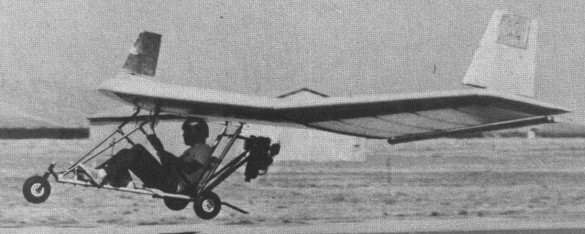
A hang gliding fanatic, Dr H Long, gave Don Mitchell control of a high performance wing. By 1975 this same wing had become the B 10. The first powered version now carries the designation of B40F (F for foot launch).
The aircraft is in effect a wing, supporting beneath its lower surface a rigid frame formed by two sets of struts in the shape of an N, at the back of which is mounted a McCulloch Mc101 12hp engine with direct drive to a two blade pusher propeller.
The addition of a go-kart engine and streamlined pilot pod has turned the design into a high-performance ultralight. It is fast, sensitive and very maneuverable. The wing is wooden and built up in a typical “D” Section cantilever, with pilot cage attached underneath and a pusher prop in the rear. Top speed is about 55 mph, and climbout is around 350 fpm. It can be foot-launched, but the added weight of an engine and its accessories make it wise to consider tricycle gear. A Mac 101 engine swings a 42-inch prop and sips two gallons of gas in two hours.
Mitchell B-10 / XF-10
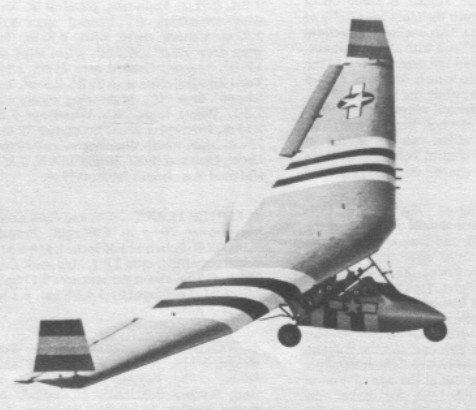
Single seat single engined high wing mono¬plane with conventional three axis control. Wing has swept back leading and trailing edges, and tapering chord; no tall. Pitch/roll control by stabilators; yaw control by tip rudders; control inputs through stick for pitch/roll and pedals for yaw. Cantilever wing: wing profile NACA 23015; double surface. Undercarriage has three wheels in tricycle formation; suspension on all wheels. Push right go right nosewheel steering con¬nected to yaw control. Optional brake on nosewheel.
Aluminium tube/wood/steel tube framework, with optional pod. Engine mounted below wing driving pusher propeller.
A hang gliding fanatic, Dr H Long, gave Don Mitchell control of a high performance wing. By 1975 this same wing had become the B 10. The first powered version now carries the designation of B40F (F for foot launch).
The aircraft is in effect a wing, supporting beneath its lower surface a rigid frame formed by two sets of struts in the shape of an N, at the back of which is mounted a McCulloch Mc101 12hp engine with direct drive to a two blade pusher propeller.
Very quickly Don Mitchell fitted the framework with a tricycle undercarriage with a nosewheel steered by the rudder bar, while a more elaborate version of the B 10 was shown at Oshkosh in August 1981, fitted with a glass fibre fairing and main wheel spats. By 1980, more than 500 sets of plans or kits for the B 10 had been sold. Previously only sold as sets of plans or as a kit, the B 10 Mitchell Wing has been offered factory built, since September 1982.
The structure of each wing has five central ribs in a wooden lattice with six ribs on either side, all of quite conventional construction. The thick plywood spar has D shaped pieces of polyurethene foam resting on it every 4.3 inch (11 cm), which are then covered in 0.04 inch (l mm) thick sheets of plywood to form the leading edge. The control surfaces are made in the same way except for the rudders which have a tubular metallic spar. The covering is of Dacron or aviation quality Ceconite.
Due to the absence of a tail, roll and pitch control are both provided by stabilators, which span most of each half wing. Controlled from the stick, these stabilators act differentially like ailerons and together as elevators, while the rudders can also act as air brakes. The B 10 Mitchell Wing has dropped the Mc101 engine in favour of the Zenoah G25B. According to Mitchell Aircraft, con¬struction requires 250h of work. The 1983 prices are $6995 ready built, economy kit $1995 (without engine, instru¬ments and undercarriage), homebuilder’s kit $1295 (including raw materials and all hard¬ware but without engine, undercarriage, paint or glue), power pack $1595, tricycle undercarriage $495 and plans $125.
Units and plans delivered by June 1981 1,200 + kits.
Basically a strengthened B 10, the 1981 prototype of the XF 10 was originally shown by Mitchell Aircraft under the name of SR 10 and is a modified version of the B 10 Mitchell Wing, intended for the military market. This machine is today offered as a kit for an extra $1100 on top of the price of a B 10, compared with which the XF 10 is structurally reinforced and has a faired cockpit as standard. Like the standard B 10, the XF 10 uses the single cylinder Zenoah G2513 1.
Plans for the Mitchell wing B-10 became available from Richard Avalon at US Pacific, 892 Jenevein Ave., San Bruno, CA 94066. The B-10 has held world records by George Worthington. Richard worked with Don just before Don’s death and was not able to carry forward with some planned designs, but Richard is offering Don’s plans.

The Mitchell B-10J is a package available from Jim Gordon’s Micro Aviation. The US$5200 package includes a Garrett JFS100-13 originally used as a starter for the TF-41 engine in the A-7 Corsair. Including throttle package, lubrication and tailpipe assembly, the engine weight is 53 lb, and replaces the Zenoah. First flights were in February 1996, with 80 lb thrust.
Variation:
Bremner Mitchell B10 Wing Special
B-10
Engine: Zenoah G2SB 1, 23 hp at 6500 rpm
Propeller diameter 44 inch, 1.11 m
Toothed belt reduction, ratio 3.0/1
Max static thrust 165 lb, 75 kg
Power per unit area 0.17hp/sq.ft, 1.8hp/sq.m
Fuel capacity 3.0 US gal, 2.5 Imp gal, 11.4 litre
Length overall 6.0ft, 1.83 m
Height overall 4.0ft, 1.21m
Wing span 34.0ft, 10.36m
Chord at root 6.0ft, 1.83 m
Chord at tip 2.0 ft, 0.61 m
Dihedral (On outboard part of wing) 6 deg
Sweepback 12 deg
Total wing area 136 sq.ft, 12.6 sq.m
Wing aspect ratio 8.5/1
Nosewheel diameter overall 10 inch, 25 cm
Main wheels diameter overall 10 inch, 25cm
Empty weight 185 lb, 84kg
Max take off weight 525 lb, 238kg
Payload 340 lb, 154kg
Max wing loading 3.86 lb/sq.ft, 18.8kg/sq.m
Max power loading 22.8 lb/hp, 10.3kg/hp
Load factors; +4.2 ultimate
Max level speed 55 mph, 88 kph
Max cruising speed 45 mph, 72kph
Stalling speed 25mph, 40kph
Max climb rate at sea level 300 ft/min, 1.5 m/s
Min sink rate 225ft/min at 35mph, 1.1m/s at 56 kph
Best glide ratio with power off 16/1
Take off distance 175ft, 53m
Landing distance 175 ft, 53 m
Service ceiling 12,000 ft, 3648 m
Range at average cruising speed 135 mile, 217 km
XF 10
Engine: Zenoah G2SB 1, 23 hp at 6500 rpm
Propeller diameter 44 inch, 1.11 m
Toothed belt reduction, ratio 3.0/1
Max static thrust 165 lb, 75 kg
Power per unit area 0.17hp/sq.ft, 1.8hp/sq.m
Fuel capacity 6.0 US gal, 5.0 Imp gal, 22.7 litre
Length overall 6.0ft, 1.83 m
Height overall 4.0ft, 1.21m
Wing span 34.0ft, 10.36m
Chord at root 6.0ft, 1.83 m
Chord at tip 2.0 ft, 0.61 m
Dihedral (On outboard part of wing) 6 deg
Sweepback 12 deg
Total wing area 136 sq.ft, 12.6 sq.m
Wing aspect ratio 8.5/1
Nosewheel diameter overall 10 inch, 25 cm
Main wheels diameter overall 10 inch, 25cm
Empty weight 200 lb, 91kg
Max take off weight 600 lb, 272kg
Payload 400 lb, 181kg
Max wing loading 4.41 lb/sq.ft, 21.5 kg/sq.m
Max power loading 26.1 lb/hp, 11.8kg/hp
Never exceed speed 50mph, 80kph
Stalling speed 25mph. 40 kph
B-10J
Engine: Garrett JFS100-13, 80 lb thrust
Fuel burn: 10 USGPH
Fuel capacity: 3.5 USG
Endurance: 20-30 min
Mitchell Wing

A hang gliding fanatic, Dr H Long, gave Don Mitchell control of a high performance wing. It has aerodynamic control of external “stabilator” surfaces about all three axises through the use of a joystick. No weight shift is required. Spoilers are used to initiate a turn or to steepen the glide path for landing. Its extremely flat glide and low sink rate allow it to takeoff and land in almost ‘no wind’ conditions.
The wing is an all-wood structure with foam leading edge ribs. It has a single built-up C-spar with aircraft birch plywood torsion proof leading edge. The built-up truss ribs aft of the spar ar covered with seconite fabric.
The 8 ft 6 in outboard wing panels fold up over on top of the centre section for transportation. They may be removed as three pins connect outboard panels to the centre section.
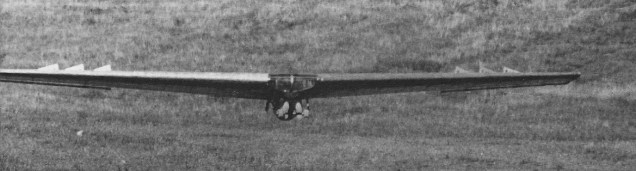
The pilot is housed in a metal cage below the wing. Spoiler control is on the left, the control stick on the right. In flight the pilot goes into the supine position. A large clear mylar covering on the trailing edge above the pilot gives visibility overhead. The pilots cage folds up for ease in transportation.
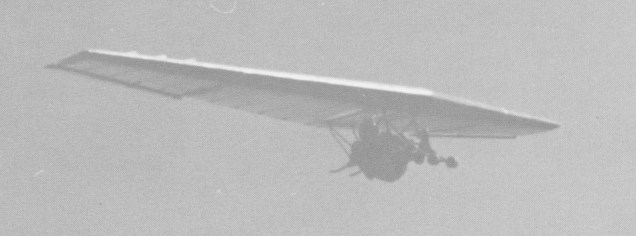
In 1977 George Worthington flew an unpowered Mitchell Wing a straight distance of 107.8 miles.
By 1975 this same wing had become the B 10. The first powered version now carries the designation of B40F (F for foot launch).
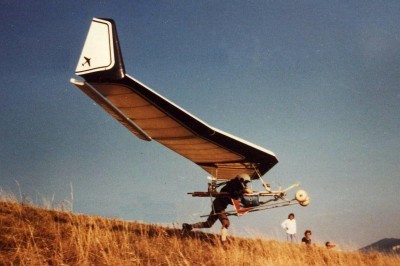
The Mitchell was a rigid hang glider in wood, sold in plans. Two American companies were selling the rigid Mitchell. U.S Pacific sells plans and wood kits while Ameriplanes sells aluminium kits.
The 1976 wing was for advanced pilots. At lrast 20 service bulletins were to be applied to be safe.
Very pleasant in flight despite the strong reverse yaw but stable. The first 2 minutes are crucial because you have to understand everything quickly, the reverse yaw, the use of the rudders and the sensitivity of the handle on the pitch.
Wing area: 12.64 m²
Wing span: 10.2 m
Aspect ratio: 8.4
Hang glider weight: 35 kg
Minimum speed: 30 km/h
Maximum speed: 120 km/h
Max glide ratio (L/H): 16
Max glide ratio speed: 55 km/h
Minimum sink rate: 0.6 m/s
Wingspan: 10.36m
Wing area: 12.63m²
Weight: 37 kg – 39 with updates
VNE 120 km / h
Max. 100 km / h
Min speed: approx 30 Km / h
Max glide ratio (L/H): 16-18
Load: +6 -6G in free flight version (+4 -4 in ULM version)
Min fall rate: 0.6 – 0.8 m / sec
Wing span: 34 ft
Wing area: 136 sq,ft
Aspect ratio: 8.4
Weight: 68 lb
Takeoff speed: 14 mph
Stall speed: 11 mph
Max speed: 50 mph
Best glide ratio (L/D): 18-1
Best L/D speed: 32 mph
Min sink: 108 fpm
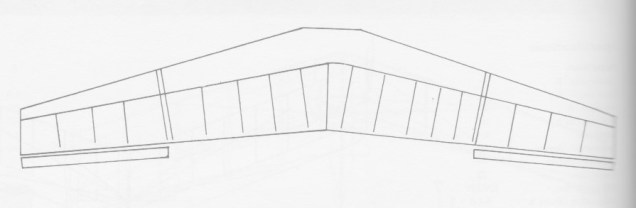
Mitchell Nimbus
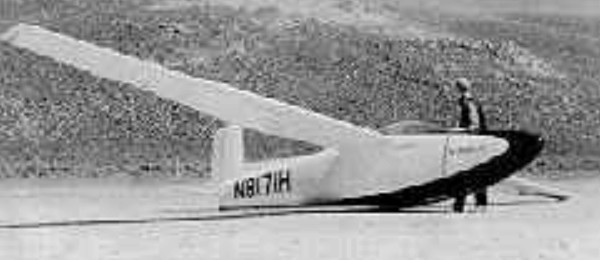
The Nimbus III was developed in 1956 by Don Mitchell from the earlier I and II models. Mitchell produced nine kits, of which four were completed. The prototype Nimbus III has a Gottingen airfoil and considerably less performance.
Nimbus III
Wing span: 12.19 m / 40 ft
Wing area: 9.85 sq.m / 106 sq.ft
Empty Weight: 204 kg / 450 lb
Payload: 100 kg / 220 lb
Gross Weight: 304 kg / 670 lb
Wing Load: 30.86 kg/sq.m / 6.4 lb/sq.ft
Aspect ratio: 14.7
Airfoil: Wortmann FX-05-191
L/DMax: 39 106 kph / 57 kt / 66 mph
MinSink: 0.73 m/s /2.4 fps / 1.42 kt
Seats: 1
Structure: all-wood, 3-piece wing
 All Aero