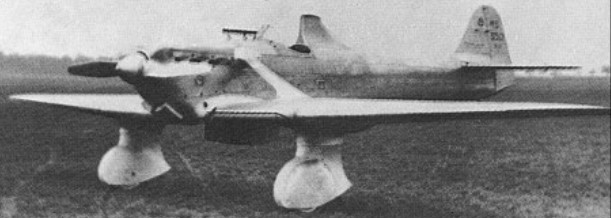
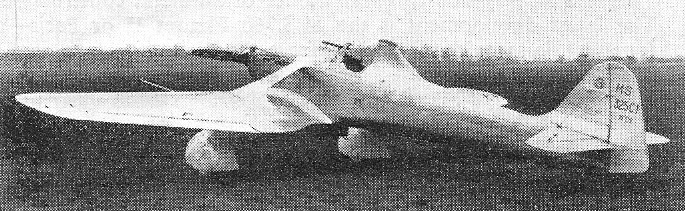
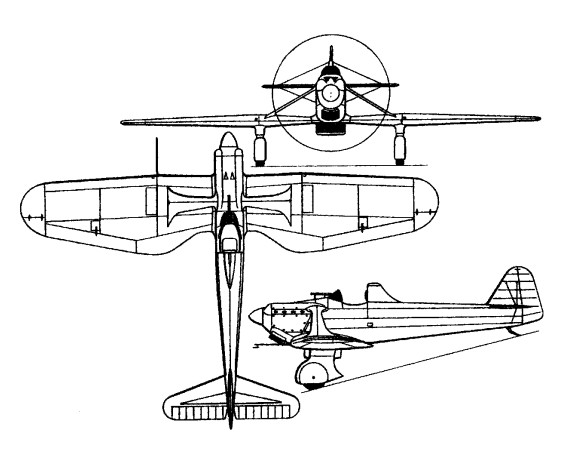
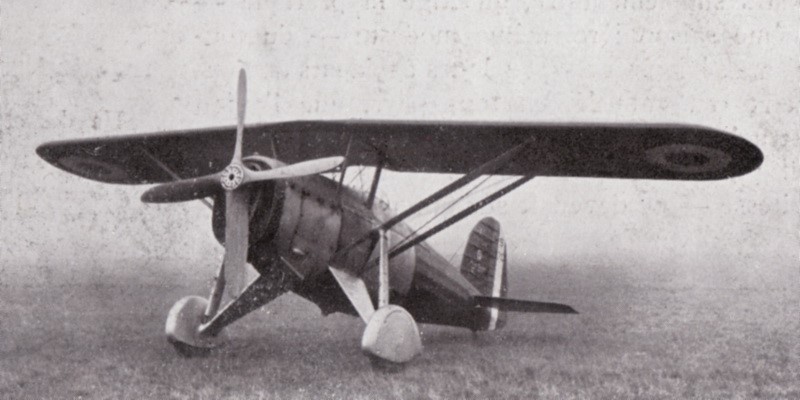
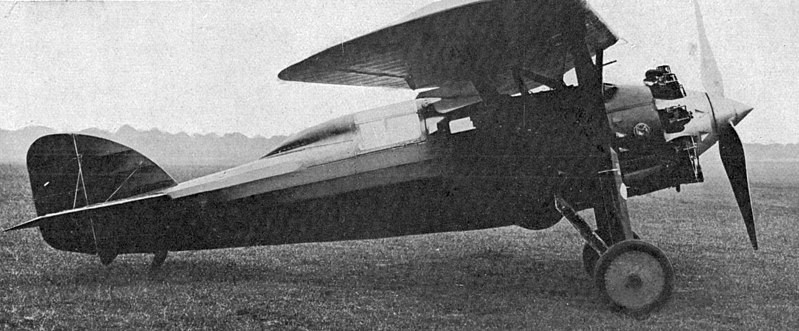
To meet the same C1 requirement as the M.S.275, Morane-Saulnier developed in parallel the M.S.325. This, for the first time since the company resumed single-seat fighter development in 1926, discarded the classic parasol wing configuration in favour of a low-mounted wing. Flown for the first time early in 1933, the prototype M.S.325 was powered by an Hispano- Suiza 12Xbrs engine rated at 690hp and was an all-metal dural-skinned braced low-wing monoplane with an armament of two wing-mounted 7.7mm guns. Initial flight testing dictated lowering of the tailplane and introduction of wing root fairings in an attempt to eradicate a serious buffet problem. Trials continued to suffer aerodynamic difficulties, and, in 1934, further development was discontinued. Full performance trials were never concluded.
Manufacturer’s estimates Max take-off weight: 1789 kg / 3944 lb Empty weight: 1354 kg / 2985 lb Wingspan: 11.80 m / 38 ft 9 in Length: 8.25 m / 27 ft 1 in Height: 3.70 m / 12 ft 2 in Wing area: 19.73 sq.m / 212.37 sq ft Max. speed: 365 km/h / 227 mph Ceiling: 12000 m / 39350 ft
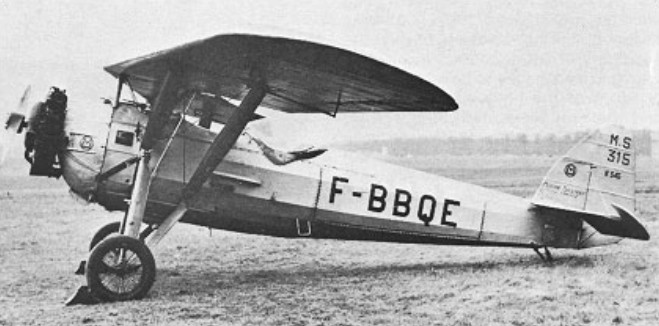
Developed from the M.S.300 primary trainer prototype of 1930, and its M.S.301 and M.S.302 variants, the Morane-Saulnier M.S.315 flew for the first time in October 1932. Of parasol high-wing configuration, it was of mixed construction with divided main landing gear, powered by a 135hp Salmson 9 Nc engine. Four prototypes were followed by 346 series aircraft for the French Air Force, 33 of them built post-war.
In addition, five higher-powered M.S.315/2 aircraft were built for civil use, plus a single M.S.316 with a Regnier inverted-vee engine. The type became the workhorse of the French Armee de I’Air and served also with the Aeronavale and various civil flying schools. It was a favourite at many pre-war airshows flown by such notables as Thoret, Fleurquin and Detroyat.
Next to the Air Force the Navy operated the M.S.315 as a military trainer and as a glider tug.
Produced in substantial quantities pre-war, production was resumed after the war by SNCA du Centre, thirty-three being built.
MS.315E
Between 1960 and 1962 the type was withdrawn from military use, 40 M.S.315s then in use as civil glider tugs were re-engined with the 220 hp / 164kW war-surplus Continental W-670K radial, being redesignated M.S.317.
About ten MS.317 were still in flying condition in 2008.
Engine: 1 x Salmson 9Nc radial, 101kW Max take-off weight: 860 kg / 1896 lb Loaded weight: 548 kg / 1208 lb Wingspan: 12.00 m / 39 ft 4 in Length: 7.60 m / 24 ft 11 in Height: 2.80 m / 9 ft 2 in Wing area: 21.60 sq.m / 232.50 sq ft Max. speed: 170 km/h / 106 mph Ceiling: 5500 m / 18050 ft
The C1 (monoplace de chasse) requirement first issued by the Service Technique Aeronautique in 1930 – when it was finally conceded that the Jockey programme had failed – and upgraded on 26 January 1931, resulted in no fewer than 10 designs being awarded prototype contracts. These included two Morane-Saulnier proposals.
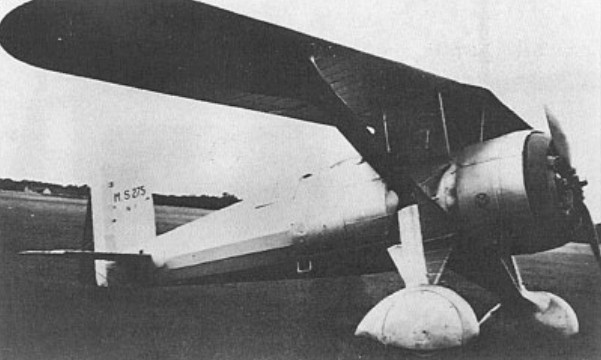
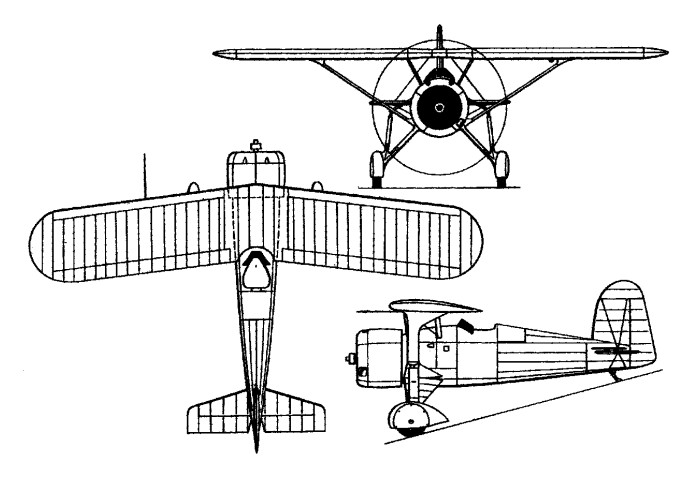
The first, the M.S.275, retained the classic parasol monoplane configuration of preceding Morane-Saulnier fighters and was flown in 1934. A version of the MS.225 with a modified aerofoil and empennage, powered by a Gnome-Rhone 9Krse nine-cylinder radial rated at 600hp at 4000m and armed with two synchronised 7.7mm guns, the M.S.275 proved exceptionally manoeuvrable and offered a very respectable performance. It found little favour, however, owing to its dated concept, development being discontinued, together with that of the more innovative M.S.325, in favour of the more promising M.S.405 then in preliminary design.
Max take-off weight: 1724 kg / 3801 lb Empty weight: 1361 kg / 3001 lb Wingspan: 10.56 m / 34 ft 8 in Length: 7.24 m / 23 ft 9 in Height: 3.29 m / 10 ft 10 in Wing area: 17.20 sq.m / 185.14 sq ft Max. speed: 363 km/h / 226 mph Ceiling: 10700 m / 35100 ft Range: 1150 km / 715 miles
In the inter-war period, Morane Saulnier started its series of high-wing parasol types. The parasol-wing MS.230 that was flown first in February 1929 was the most successful and became a prominent trainer during the 1930’s.
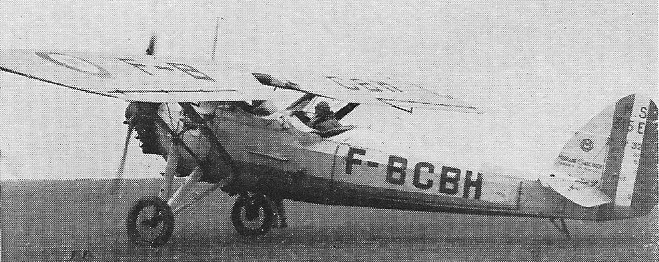
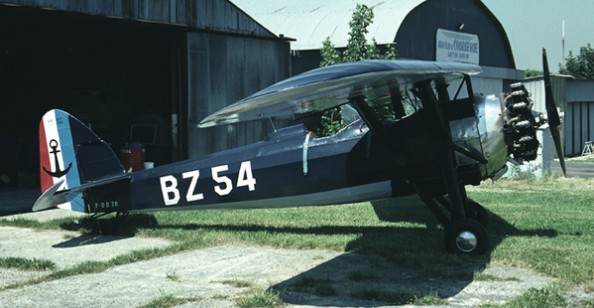
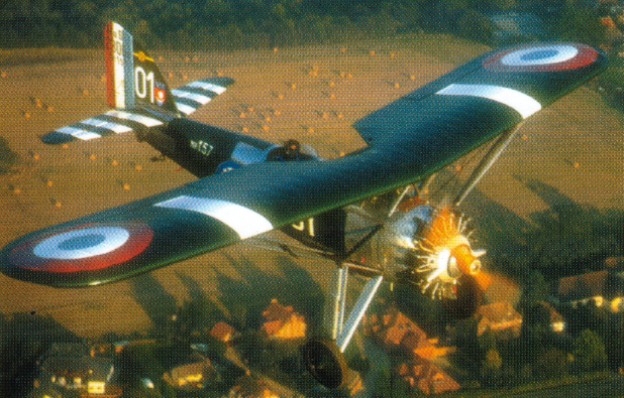
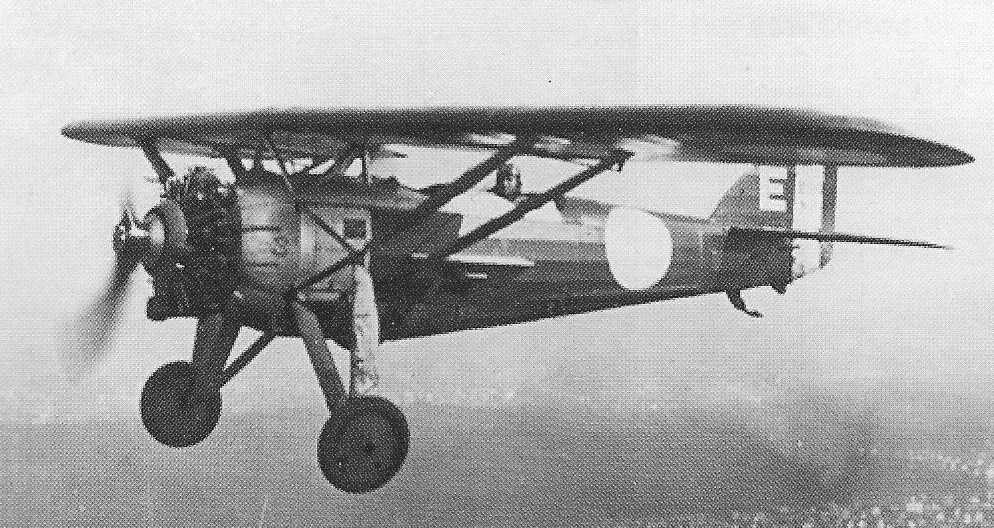
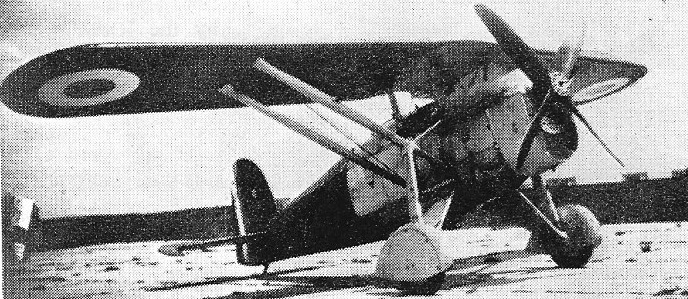
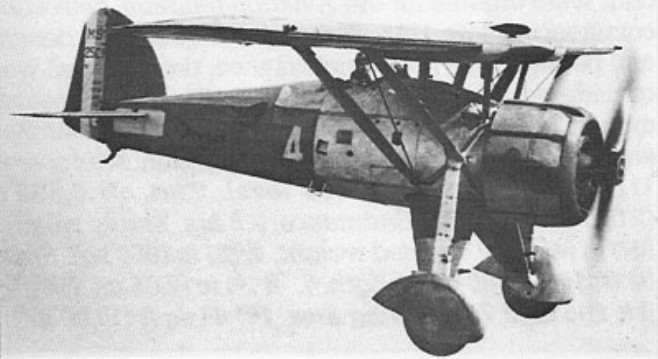
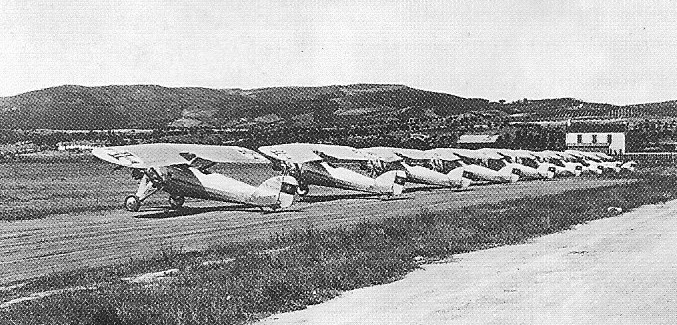
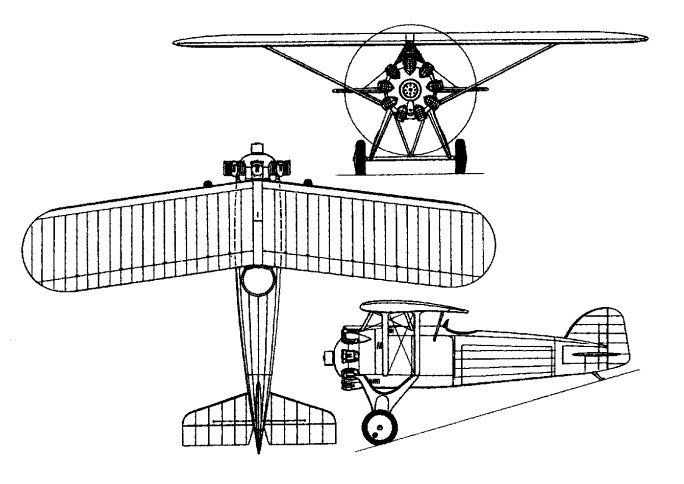
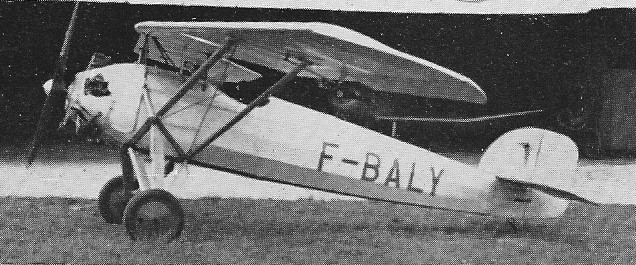
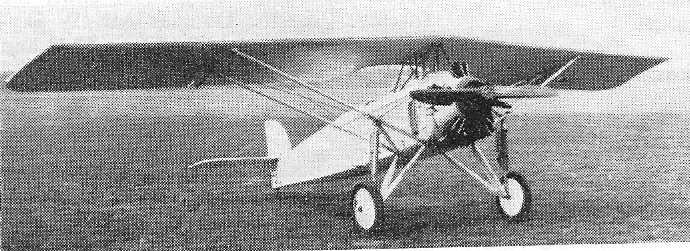
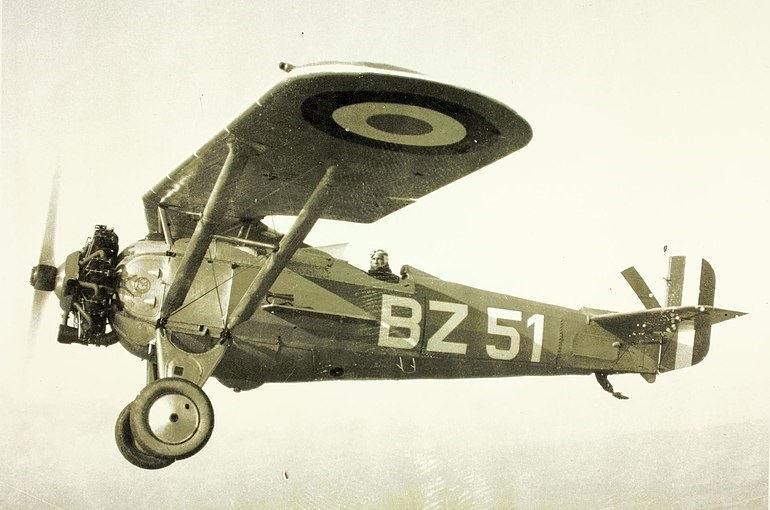
The Morane-Saulnier M.S.225 was a French fighter aircraft of the 1930s. It was produced in limited quantities to be used as a transitional aircraft between the last of the biplanes and the first monoplane fighters.
The M.S.225 was a parasol monoplane, with a wide fixed landing gear, and powered by a Gnome-Rhône 9Krsd radial engine, and having a circular fuselage.
The Morane-Saulnier M.S.225 was first shown in the form of a model at the Paris Air Show of 1932. After successful flight tests of the prototype in 1932, series production started at once.
Classified in the category C.1 (single-seat fighter), 75 aircraft were produced. A total of 53 aircraft were delivered to the Air Force in November 1933. The M.S.225s of the Armée de l’Air served in the 7e Escadre de Chasse (7th Fighter Wing) at Dijon, and in two escadrilles of the 42e Escadre (42nd Wing), based at Rheims. They were withdrawn from front-line service between 1936 and 1937.
The Aéronavale received the first of the 16 aircraft it had ordered in February 1934. The aircraft also flew with the Aéronavale l’Escadrille 3C1, established in Marignane, this formation later transferring to the Air Force at the beginning of 1936, where it became Le Groupe de Chasse II/8.
Three were also sold to China.
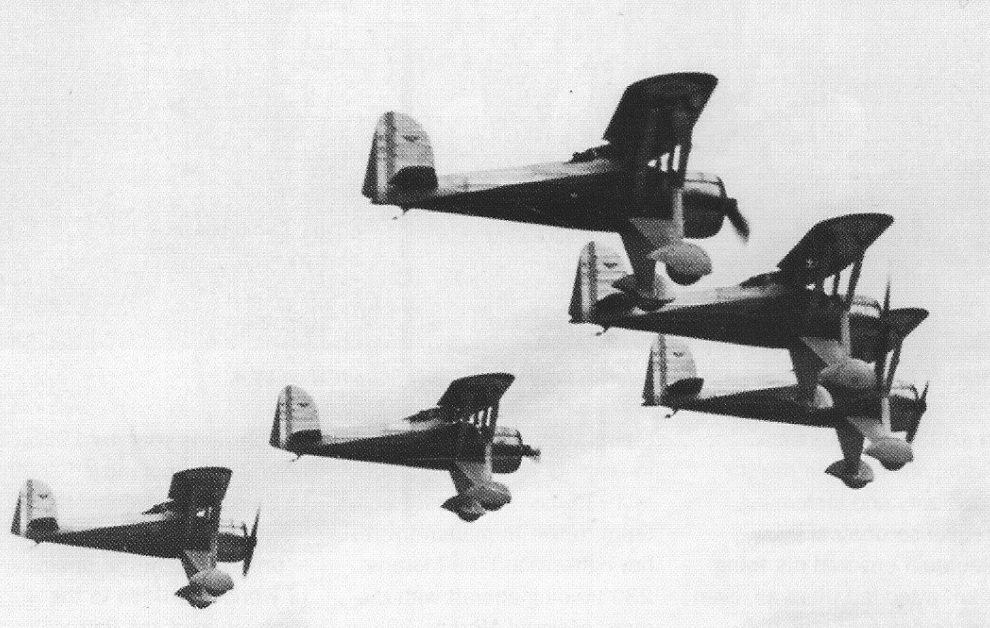
The Air Force Aerobatic Squadron based at Étampes used five modified M.S.225s, with a larger vertical stabilizer, while the last unit of the Air Force to operate this aircraft was the flying school based at Salon-de-Provence.
MS.226
In 1932, Morane-Saulnier initiated study of a dedicated shipboard version of the M.S.225 fighter. Designated M.S.226 and powered by a similar Gnome-Rhone 9Kdrs to that of the shore-based fighter, the shipboard aircraft differed initially in having some structural strengthening, an arrester hook and naval equipment. Three prototypes were ordered in 1933, the first two being completed as M.S.226s and the third as the M.S.226bis which differed in having aft-folding wings. No series production of the M.S.226 was undertaken as the Marine Nationale considered the type to be conceptually obsolescent.
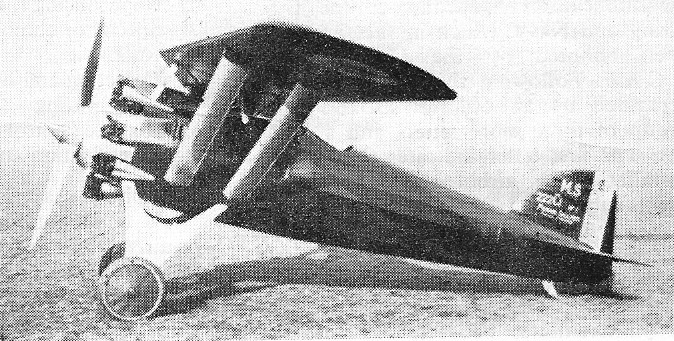
A variant used as test bench for the 515 kW (690 hp) Hispano-Suiza 12Xcrs engine, with a four-bladed propeller was designated M.S.227.
MS.227
At the outbreak of World War II, only 20 M.S.225s were still in flying condition, the majority of them being scrapped in mid-1940.
Variants:
M.S.225 Production variant Engine: Gnome-Rhone 9Kdrs, 373 kW (500 hp) Propeller: 2-bladed fixed-pitch wooden Wingspan: 10.56 m (34 ft 8 in) Wing area: 17.2 m2 (185 sq ft) Length: 7.25 m (23 ft 9 in) Height: 3.26 m (10 ft 8 in) Empty weight: 1,154 kg (2,544 lb) Gross weight: 1,590 kg (3,505 lb) Maximum speed: 334 km/h (208 mph, 180 kn) at 3,850 m (12,631 ft) Range: 700 km (430 mi, 380 nmi) Service ceiling: 10,000 m (33,000 ft) Rate of climb: 6.12 m/s (1,205 ft/min) Time to altitude: 3,000 m (9,843 ft) in 5 minutes 42 seconds Armament: 2 × 7.7 mm (.303 in) Vickers machine guns 75 built Crew: 1
M.S.226 1933 arrestor hook Engine: Gnome & Rhône 9Kdr Wingspan: 10.56 m / 34 ft 8 in Wing area: 17.20 sq.m / 185.14 sq ft Length: 7.25 m / 23 ft 9 in Height: 3.26 m / 10 ft 8 in Max take-off weight: 1640 kg Max. speed: 277 km/h / 172 mph Ceiling: 7500 m / 24600 ft
M.S.226bis 1934 226 with folding wings
M.S.227 test bench for the 515 kW (690 hp) Hispano-Suiza 12Xcrs engine four-bladed propeller.
M.S.278 Conversion of the M.S.225 Engine: 388 kW (520 hp) Clerget 14Fcs diesel
Shortly after the initiation of M.S.223 flight testing, the entire Jockey fighter concept was adjudged a failure and, with the inhibitions imposed by the chasseur leger programme removed, Morane-Saulnier developed a larger and heavier fighter, the M.S.224, which entered flight test in 1931. Based on experience with the preceding prototypes, the M.S.224 retained the mixed structure (dural spars and wooden ribs) of the earlier aircraft for the wing, mating this with a metal-and fabric covered dural fuselage, the ovoid cross section of which was widened to the near-circular. Wing area was increased by 1.00sq.m to 17.00sq.m, and loaded weight was raised to 1400kg. Powered by a Gnome-Rhone 9Asb, the M.S.224 attained 303km/h during trials.
MS. 225 1939
A modified version, the M.S.225, was adopted by the Aviation Militaire (to become the Armee de l’Air in 1934) as an interim fighter pending availability of more advanced aircraft meanwhile called for by the 1931 C1 programme. The M.S.225 differed from the M.S.224 primarily in having a fully-cowled Gnome-Rhone 9Kdrs engine of 500hp. Armed with two 7.7mm guns, 74 M.S.225s were delivered during 1933-34. Of these, 55 were supplied to the Aviation Militaire (one being fitted with a 690hp Hispano-Suiza 12Xcrs engine with a 20mm cannon mounted between the cylinder banks and flown as a test-bed under the designation M.S.227), 16 to the Marine Nationale and three were exported to China. The last M.S.225 fighters were phased out of first-line service during 1938.
M.S.225 Max take-off weight: 1590 kg / 3505 lb Empty weight: 1154 kg / 2544 lb Wingspan: 10.56 m / 34 ft 8 in Length: 7.25 m / 23 ft 9 in Height: 3.26 m / 10 ft 8 in Wing area: 17.20 sq.m / 185.14 sq ft Max. speed: 334 km/h / 208 mph Range: 700 km / 435 miles Ceiling: 9500 m
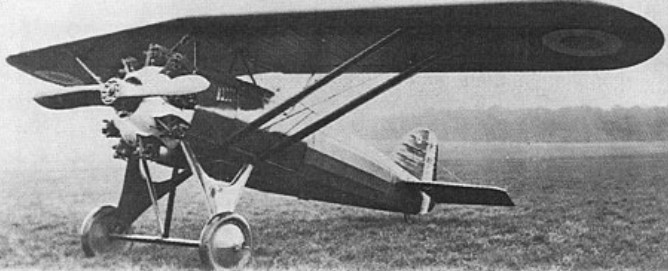
Retaining the basic airframe of the M.S.121, the M.S.221, which appeared in 1928 as a replacement contender in the Jockey programme, carried a similar twin-7.7mm gun armament, but was powered by the Gnome-Rhone 9Ae Jupiter nine-cylinder radial rated at 600hp, and weighed 46kg less. Both lighter and more powerful than competing Jockey entries, the M.S.221 was nevertheless at a disadvantage in level speed, which proved appreciably lower than those of other contenders. One of the two prototypes of the M.S.221 was accordingly fitted with a turbo-supercharged G-R 9As Jupiter developing its full 600hp at 3800m. At the same time, an attempt was made to reduce aerodynamic drag by redesigning the wing bracing. Redesignated M.S.222, this prototype was 25kg heavier, but climbed to 7000m in 12 min.
MS.222
The maximum speed of 267km/h at 3650m remained inadequate, however, and in a further attempt to reduce drag, the cross-axle type undercarriage was replaced by one of split-axle type, the modified aircraft flying in 1930 as the M.S.223.
Orders for the MS.233 came from 14 countries between 1934 and 1940.
MS.233s in Portugal
In the meantime, Morane-Saulnier had initiated a more fundamental redesign of the fighter as the M.S.224, and, in consequence, further development of the M.S.223 was discontinued.
M.S.221 Max take-off weight: 1230 kg / 2712 lb Empty weight: 915 kg / 2017 lb Wingspan: 9.80 m / 32 ft 2 in Height: 2.98 m / 9 ft 9 in Wing area: 16.00 sq.m / 172.22 sq ft Max. speed: 268 km/h / 167 mph
The MS.180 and more powerful MS.181 were produced by Morane-Saulnier in 1930 for the flying schools of the Cie Francais d’Aviation. They were standard equipment for CFA flying schools for several years.
MS.181
The MS.185 is generally similar to the MS.181.
MS.181
MS.180 Engine: Salmson 9Ad, 40 hp
MS.181 Engine: Salmson 5Ac, 60 hp Wingspan: 29 ft 6 in Length: 19 ft 10 in Empty weight: 630 lb Loaded weight: 960 lb Max speed: 88 mph Cruise: 72 mph ROC: 630 fpm Range: 365 mi
The Morane-Saulnier MS.129 and its derivatives in the MS.130 series were a family of military trainer aircraft produced in France in the 1920s. They were conventional, parasol-wing monoplanes with open cockpits in tandem and fixed tailskid undercarriage. The initial version, the MS.129, was produced in small numbers for the Romanian Air Force and civil users, but the major production version was the MS.130, which equipped the French Navy and a number of foreign air arms.
The second MS.130 prototype won the 1929 Coupe Michelin, flown by Michel Detroyat with an average speed of 190 km/h (120 mph)
Morane-Saulnier MS.130 flown in the 1929 Coupe Michelin by Michel Détroyat.
MS.130
The MS.130 was further developed as the MS.230, and at least two MS.130s were later rebuilt to this new standard.
Operators of the MS.140 were Aéronavale and Aéronautique Militaire, Brazilian Air Force and Varig (15), Belgium (2), China, Guatemala, and Turkey. Romania operated MS.129, and the Portuguese Air Force operated 1 x MS.130 and 4 x MS.133.
Variants:
MS.129 initial production version Engine: Hispano-Suiza 8Ab
MS.130 major production version Engine: Salmson 9AB, 170 kW (230 hp) Wingspan: 10.70 m (35 ft 1 in) Wing area: 19.7 m2 (212 sq ft) Length: 6.97 m (22 ft 10 in) Height: 2.85 m (9 ft 4 in) Empty weight: 793 kg (1,740 lb) Gross weight: 1,149 kg (2,528 lb) Maximum speed: 208 km/h (130 mph, 110 kn) Range: 510 km (320 mi, 280 nmi) Service ceiling: 5,000 m (16,000 ft) Crew: Two, pilot and instructor 146 built
MS.130 Coupe Michelin single aircraft for Coupe Michelin 1929
MS.131 MS.130 converted for US military attaché in Paris Engine: 230 hp (170 kW) Lorraine 7Me I converted
MS.132 for French Navy Engine: Salmson 7Ac 5 built
MS.133 Engine conversion Engine: Gnome-Rhône 5Kc 3 from MS.129, 1 from MS.130






 All Aero