This single-seater sailplane was designed and built to Standard Class specifications by Otto Zauner of Vineland, New Jersey, who had previously built from kits and/or plans a Schweizer SGS 1-26, a Briegleb BG 12, a Bryan HP-14 and a Thorpe T-18 ultra-light. The OZ-5’s fuselage and tail unit are of Mr Zauner’s own design but the wings of a Bryan HP-15 are fitted in the shoulder position. The forward fuselage and cockpit tapers to a slim boom carrying the tail, the former being of glassfibre construction to about one-third back along the tail boom; the rest of the boom and the cantilever T-tail are all-metal, the fin and rudder being swept back. There is a retractable monowheel and the pilot sits under a one-piece flush-fitting cockpit canopy. The wings are the same structurally as the HP-15 and of high aspect ratio; they are two-spar all-metal structures with metal skinning and plastic leading edges, and only three ribs in each wing, the spaces between the ribs being filled with plastic foam. Metal fixed hinge flaps are fitted, the ailerons drooping in conjunction with them. Flight testing of the OZ-5 began in 1975.
Span: 49 ft 2.5 in Length: 22 ft 0 in Height: 4 ft 0 in Max pilot weight: 234 lb Max weight: 669.5 lb Max speed: Approx 18 0mph (in smooth air) Max aero-tow speed: 120 mph
A number of significantly modified HP Aircraft RS-15s have been built including Otto Zauner’s One Yankee with his own design of fuselage and tailplane.
As with many homebuilts, a number of builders have made design changes to their HP Aircraft HP-14. In some cases these have been substantial. Otto Zauner constructed an 18 m. model (called the Zauner OZ- 4) which has been modified substantially to have tip extensions with winglets to give a span of 19.2 m. / 63 ft, and a gross weight of 386 kg./ 850 lb.
The Specter was designed during 1994-96, to build a glider that delivers much better performance than delta wings in fall and finesse rates, with good performance in the high-speed (up to 100 km / h) range.
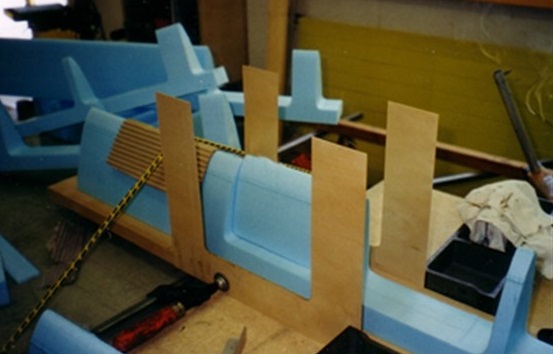
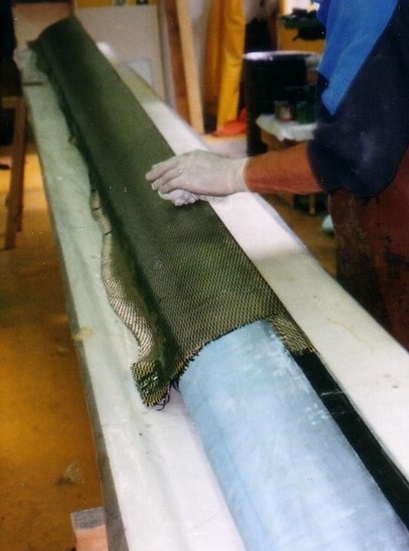
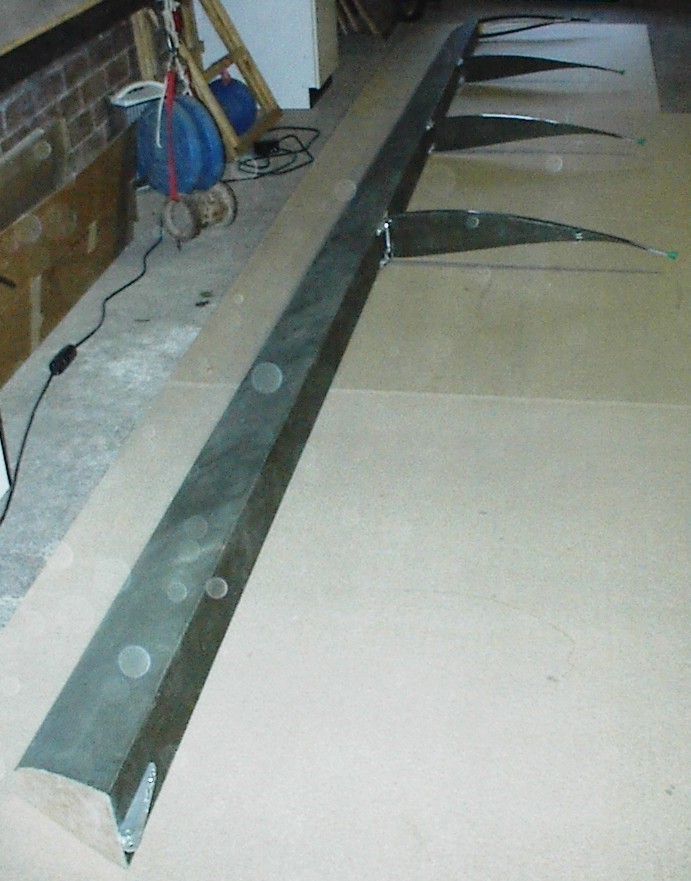
The D-tubes cover 20% of the profile. They were made of carbon / kevlar 200 gr / sq.m, directly on core of foamed 30kg / cu.m hollow, cut with hot wire. Unidirectional carbon beams have been inserted, as well as aluminum plates for riveting / screwing the various fixings: root, ribbed and cable ties.
The wingspan was set at 12.4 m, with a length of 12.4 m. The Worthmann FX 63-137 was designed to take advantage of take-off and low-speed behavior, and for the simplicity of the flaps. This profile has a maximum Cz of 1.7, and good stall characteristics. It equipped pedal-powered planes, but also motor-gliders. The wing tip of 3 degrees is obtained by modifying the back of the profile from half the wingspan of the wing.
To maintain the unique feel of the delta wing, as well as transport and simple assembly, the pilot is installed in a harness. Therefore, a trapezoid and the minimum of aerodynamic controls are required: only spoilers to turn, the rest will be done by displacement of the weight.
Spoilers: Axis is at 50% of the wing. They deploy almost vertically.
The trapeze will be used as an attachment to the lateral structural cables and will not be able, like on the rigid wings, to actuate the spoilers. Handles sliding on the speedbar will control them, using cords passing inside the uprights.
The ribs were also built with a foam-carbon / kevlar sandwich. They are connected to the D-tubes by aluminum fasteners, which also serve to fix the main cables for the median rib. Incident-maintaining cables are attached to the back of the rib by stainless steel fasteners. The ribs are extended with an aluminum tube for the tension of the sail.
Sail work is dacron 160 gr / sq.m, more than 1km of polyester yarn. The empennage was manufactured in a very classic way, in wood covered with a heat-shrinking filament (Oracover). It is very solid and was a bit heavy: 3.6 kg. The drift consists of fabrics stretched over an aluminum frame and carbon.
The calculations (unfortunately inevitably somewhat imprecise) give a fineness of 18 to 48 km / h and a drop rate of 0.65 m / s to 40 km / h.
In 2002, the prototype was ready for its first tests.
There were various revisions, and the big flight came on October 12th. The rolling behavior was very pleasant, but there is too much stability in pitch.
Zahn renounced the formula of the flying wing, despite its great advantage in free flight: allow an easy takeoff. The formula, which subjects an aerodynamic element (the wing) to perform two distinct functions (ensuring the stability of the aircraft and lift with minimum drag) is a delicate compromise to design and calculate. It imposes profiles with little variation of moments, unsuitable for gliding, and an important twist which makes them work at unfavorable impacts at the tip of the wing.
Wing area: 12.4 m² Wing span: 12.4 m Wing profile: Worthmann FX 63-137 Tail surface: 1.5 m² Hang glider weight: 45 kg Minimum pilot weight: 60 kg Maximum pilot weight: 80 kg Minimum speed: 36 km/h Maximum speed: 90 km/h Max glide ratio (L/H): 18 Max glide ratio speed: 48 km/h Minimum sink rate: 0.75 m/s Packed length: 6.2 m Nose angle: 180°
The Yuneec EViva was originally designed by Martin Wezel in conjunction with the Czech company Composit and initially intended to be powered by a 50 hp (37 kW) Rotax 503 two-stroke or 60 hp (45 kW) HKS 700E four-stroke powerplant.
The aircraft was designed to comply with the Fédération Aéronautique Internationale microlight rules. It features a cantilever wing, a T-tail, a two-seats-in-side-by-side configuration enclosed cockpit under a bubble canopy, retractable monowheel gear with wing tip and tail casters, and a single electric motor in tractor configuration driving a folding propeller.
The design was purchased by Yuneec, development shifted to China and the aircraft was adapted for electric power.
The aircraft is made from composites. Its 17 m (55.8 ft) span wing has an area of 14.2 m2 (153 sq ft) and upper wing telescopic air brakes as well as flaps. The wing is derived from the Wezel Apis 2 wing. The standard engine fitted is the 40 kW (54 hp) Yuneec Power Drive 40 electric motor, controlled by a Yuneec Power Block 40 400 Amp power controller and powered by two Kokam Lithium polymer battery packs of 31 Ampere-hours (Ah) each (62 Ah total). The engine weighs 23 kg (51 lb), the controller 7 kg (15 lb) and the batteries weigh 67 kg (148 lb) in total. The propeller folds aft into the engine cooling vents when not in use and deploys automatically on engine start. The batteries are charged by a Yuneec E-Charger that can run on 110-240 volts and charge in 3–4 hours.
First flown in 2012, the projected price in 2011 was €91,000.
Powerplant: 1 × Yuneec Power Drive 40 electric motor, 40 kW (54 hp) Battery packs: two Kokam Lithium polymer packs of 31 Ah each (62 Ah total) Propeller: 2-bladed folding carbon fibre Prop diameter: 1.60 m (5 ft 3 in) Wingspan: 17 m (55 ft 9 in) / 11.6 m with wing tips removed Wing area: 14.2 m2 (153 sq ft) Length: 6.9 m (22 ft 8 in) Height: 2.65 m (8 ft 8 in) Empty weight: 225 kg (496 lb) Gross weight: 472.5 kg (1,042 lb) Maximum speed: 180 km/h (112 mph; 97 kn) Cruise speed: 160 km/h (99 mph; 86 kn) Stall speed: 65 km/h (40 mph; 35 kn) flaps down Never exceed speed: 230 km/h (143 mph; 124 kn) Endurance: 1.3 hours on batteries Maximum glide ratio: 38:1 Rate of sink: 0.65 m/s (128 ft/min) at 85 km/h (53 mph) Wing loading: 33.3 kg/m2 (6.8 lb/sq ft) Crew: one Capacity: one passenger
The Yuneec International E430 is a Chinese two-seat electric aircraft designed for commercial production by electric model aircraft manufacturer Yuneec International.
The E430 is a two-seat, V tailed, composite aircraft with a high-aspect ratio wing. Take-off speed is 40 mph, cruise speed is 60 mph, and max speed is 95 mph.
The company claims that the battery packs have an expected lifespan of 1500 hours and cost US$7000 each, with the aircraft carrying 3-5 battery packs, giving two to two and half hours endurance. The batteries can be recharged in 3–4 hours from a 220v outlet.
The aircraft was being developed as a kit aircraft for the US market. The development of the E430 was being funded entirely by Yuneec CEO Tian Yu.
The aircraft was first flown on 12 June 2009 from the Yuneec factory near Shanghai, China, and then shipped for further testing to Camarillo, California. On 14 July 2009 the prototype aircraft was registered in the USA as N386CX and on 18 July 2009 it was given a Certificate of Airworthiness by the Federal Aviation Administration and further test flights were carried out, totalling 22 hours. The prototype E430 was then shipped by truck to Wisconsin and displayed at EAA AirVenture Oshkosh in July 2009. It was also on display at that venue in summer of 2010.
In July 2009 the company estimated that the price for a commercially available light sport aircraft production version of the E430 would be US$89,000.
At AirVenture 2010 the company announced that it would start accepting orders for the aircraft after the show. At that date the aircraft was advertised as having an endurance of 2.25 to 2.5 hours with a useful load of 390 lb (177 kg). The E430 was named the winner of the Lindberg prize for electric aircraft at AirVenture in 2010. The Lindbergh Electric Aircraft Prize (LEAP) was awarded by Erik Lindbergh, the grandson of Charles A. Lindbergh and Anne Morrow Lindbergh. In the same year it was named Brit Insurance Design of the Year in the transport category. Deliveries were initially scheduled for late 2011, but by the end of 2012 there was no indication that more than prototypes had been completed.
Yuneec International, created GreenWing International and in June 2013 it was announced that their GW280 (eSypder) and GW430 (e430) airplanes will be produced, marketed and supported by GreenWing International, however that company went out of business in about 2014.
By December 2012 a total of two examples had been registered in the United States with the Federal Aviation Administration. The first one was the initial prototype shipped to the US, registered in the Experimental – Exhibition category on 14 July 2009, although its registration expired on 31 March 2012. The second was registered in the Experimental – Research and Development category on 26 January 2011 to Flying Tian of Monterey Park, California.
E430 Engine: 1 × Yuneec Power Drive 40, 40 kW (54 hp) Batteries: Yuneec OEM Lithium Polymer, 13 kg (28.6 lbs), 66.6V (30 Ah) each Propeller: 2-bladed fixed pitch Length: 6.98 m (22 ft 11 in) Wingspan: 13.8 m (45 ft 3 in) Wing area: 11.37 sq.m (122.4 sq ft) Empty weight: 250 kg (551 lb) with batteries Gross weight: 470 kg (1,036 lb) Maximum speed: 150 km/h (93 mph; 81 kn) Cruising speed: 90 km/h (56 mph; 49 kn) Stall speed: 70 km/h (43 mph; 38 kn) Range: 227 km (141 mi; 123 nmi) Maximum glide ratio: 25:1 Rate of climb: 3.5 m/s (690 ft/min) Wing loading: 41.3 kg/sq.m (8.5 lb/sq ft) Seats: 2
The Flightstar is a large family of single and two-seat, high wing, single engined kit aircraft that was produced by Flightstar Sportplanes of South Woodstock, Connecticut. In 2009 the rights, tooling and parts inventory were sold to Yuneec International of China when Flightstar Sportplanes’ business was wound up.
In April 2014 Yuneec International of China debuted its eSpyder electric at the AERO event in Germany. The eSpyder is a reworked Flightstar ultralight from the 1980s. Flight Design USA’s Tom Peghiny, producer of the Flightstar for many years, sold the design to Yuneec but continued helping with development. The eSpyder, has completed Germany’s DULV aviation standard.
In July 2009 a new single seat model was exhibited at EAA AirVenture Oshkosh. The aircraft is intended to be developed into a commercially available kit and forecast to be available for under US$25,000.
The e-Spyder is an electric-powered and beefing up (enlarging and strengthening) version of the Flightstar Spyder. The aircraft replaces the Spyder’s two-stroke engine with a Yuneec Power Drive 20 20 kW / 27 hp electric motor and two 28 lb (13 kg) Lithium polymer battery packs which provide a 40-minute endurance.
e-Spyder
The E-Spyder, a single seat electric powered aircraft featuring the PowerDrive 24 propulsion system integrating the Motor, Motor Controller, 75 Volt Battery, and Charger, received the world’s first type certification for an electric aircraft from Deutschen Ultraleichtflugverbandes (DULV) E.V in 2013.
Yuneec International created GreenWing International to further develop and market their GW280 (eSypder) and GW430 (e430) airplanes. GreenWing International went out of business in about 2014.
GreenWing International had announced the release of its first 50 eSpyder single-seat electric planes, which were to be sold as build-it-yourself kits for for under US$40,000. The company was to ship 25 eSpyders in the United States at a cost of US$39,990. Another 25 were to be sold in Europe for €34,990 each.
Power: PowerDrive 24, 24 kW / 32 hp Battery: 75 Volt, 13-kWh lithium Wingspan: 10.1 m / 33.1 ft Length: 5.9 m / 19.4 ft Height: 2.4 m / 7.9 ft Empty weight: 186 kg / 410 lb Max cruise: 68 mph / 109 km/h Economy cruise: 38 mph / 61 km/h Standard flight time: 60 – 90 min Battery recharging: 2 – 3 hr
AB Yumashiev built the Yu-1 glider in Kiev in 1925. Designed as a training glider, it was developed with a view to participating in the competitions that year in Crimea.
The Yumashiev Yu-1 (Russian: Юмашев Ю-1) was conceived as a single-seat training glider. It was conceived as a high-wing cantilever monoplane. The wing, with the Pr-426 profile, had a double spar structure and a trapezoidal shape in the plane.
The fuselage was built with a plywood frame structure and had an aerodynamic wing profile shape (curved at the top and flat at the bottom). The front 2/3s were covered in sheets of plywood. The tail section was covered with fabric.
The Yu-1’s offset rudders featured a rounded shape.
The landing gear featured a conventional wheeled structure, but for record flights they could be concealed within the fuselage. For training flights they were kept exposed.
First flying in September 1925, the Yu-1 glider was entered in the III National Sailing Competitions held in Koktebel in 1925. On September 30, Yumashiev managed to stay in the air in this glider for 1 hour and 30 minutes, which was a national record.
A day later, on October 1, Yumashiev at the controls of the Yu-1 would achieve for the first time in the USSR, a long-distance flight taking advantage of thermal currents. This flight recorded 4800 meters and was considered a national record, because in the competitions the longest flight value would be 24.4 km, reached by the German Nering on his “Consul” glider. For this flight Yumashiev would receive the award for second place in the competition.
Yumashiev Yu-1 Wingspan: 12.20 m Wing area: 17.20 m² Length: 5.70 m Empty weight: 83 kg Wing loading: 9.5 kg / m² Rudder surface area: 2.00 m² Ailerons surface: 3.00 m² Wing elongation ratio: 8.7 Accommodation: 1




 All Aero