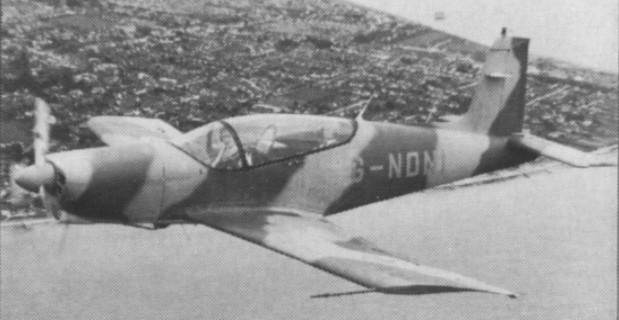
Designed by N.D. Norman, formerly of the Britten Norman Company, the prototype of the NDN 1 Fire-cracker (G NDNI) two seat civil and military training and sports aircraft made its maiden flight on 26 May 1977.
Desmond Norman designed, built and flew the prototype of a high performance piston single, the NDN1 Firecracker. Its origin can be traced to the day a friend of his thought he’d buy a Siai-Marchetti SF.260; Norman decided to build you a better airplane. Norman aimed to neither build nor market the Firecracker himself but to sell the whole manufacturing project to a smaller country that perhaps had never even built aircraft before. Intended as a primary military trainer, the Firecracker is designed to + 9 and -6 Gs, and the prototype has full inverted fuel and oil, controllable three blade Hoffrnan prop, pushrod ailerons and elevators and a rate of roll that should exceed 200 degrees a second. Range is 1,390 nautical miles to dry tanks, 75 percent cruise 175 knots on a 260 horsepower Lycoming. Gross is 2,650 pounds, or 2,150 pounds for advanced aerobatics. It can operate to 50 feet inside 1,200 feet of run. The tall gear is designed to allow under wing weapon pods, and there is an under fuselage air brake to steady the machine on a diving at-tack run, and to keep it below Vne.
The cabin is wide and deep, to allow occupants to wear full military flying gear, and its layout is very military. The rear seat is substantially raised above the front one, to give the observer/instructor a remarkable view of what is happening. That straight, low aspect ratio wing looks odd on such a high performance design, but it is easier to build than a tapered wing.
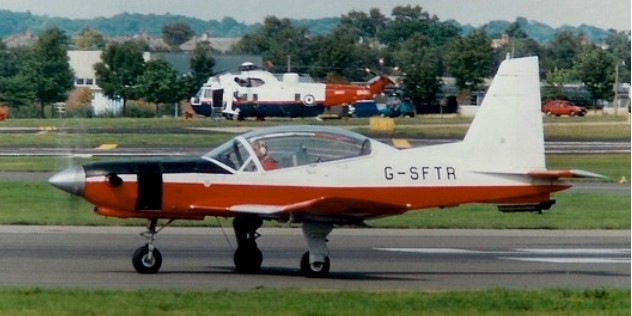
From this aircraft has been developed the turboprop powered NDN-1T Turbo Firecracker, the first flown on 1 September 1983.
Norman NDN-1T Turbo Firecracker
NDN-1T Turbo-Firecracker Engine: 1 x P&WAC PT6A turboprop, 410 kW Span: 7.9 m Length: 8.3 m Wing area: 11.9 sq.m Empty wt: 1210 kg MTOW: 1830 kg Max speed: 375 kph Initial ROC: 628 m / min Ceiling: 8260 m T/O run (to 15m): 530 m Ldg run (from 15m): 760 m Fuel internal: 405 lt Range: 1120 miles
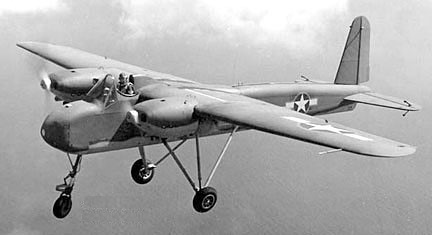
The 1943 NAF TDN was a maned or unmanned, radio-controlled, tv-directed torpedo drone. They carried ordnance loads up to a ton of bombs or torpedoes and was controlled from a “mother” aircraft in its vicinity or from ships at sea. It was able to release its weapons or be flown directly into the target.
In 1936, Lieutenant Commander Delmar S. Fahrney proposed that unpiloted, remotely controlled aircraft had potential for use by the United States Navy in combat operations. Due to the limitations of the technology of the time, development of the “assault drone” project was given a low priority, but by the early 1940s the development of the radar altimeter and television made the project more feasible, and following trials using converted manned aircraft, the first operational test of a drone against a naval target was conducted in April 1942. That same month, following trials of the Naval Aircraft Factory TDN assault drone, Interstate Aircraft received a contract from the Navy for two prototype and 100 production aircraft to a simplified and improved design, to be designated TDR-1.
Control of the TDR-1 would be conducted from either a control aircraft, usually a Grumman TBF Avenger, with the operator viewing a tv screen showing the view from a camera mounted aboard the drone along with the radar altimeter’s readout, or via a pilot on board the TDR-1 for test flights. Powered by two Lycoming O-435 engines of 220 horsepower (160 kW) each, the TDR-1 used a remarkably simple design, with a steel-tube frame constructed by the Schwinn bicycle company covered with a molded wood skin, thus making little use of strategic materials so as not to impede production of higher priority aircraft. Capable of being optionally piloted for test flights, an aerodynamic fairing was used to cover the cockpit area during operational missions. The TDR-1 was equipped with a fixed tricycle landing gear that would be jettisoned in operation after takeoff for improved performance.
In September 1942, the U.S. Navy chose DeKalb, Illinois to be the site for the manufacture of the drone TDR-1 aircraft, and built an airport on the city’s east side. This early airport consisted of an airfield and a large hangar that were fenced and guarded around the clock. DeKalb was chosen because Wurlizter, manufacturer of pianos, and known for its expertise in the production of wood products, was located there. Interstate Aircraft and Engineering Corporation (based in El Segundo, CA) assembled the planes at the new airport in DeKalb. About two hundred drones were built, tested, and boxed at the DeKalb Airport and were shipped to the South Pacific, where they were used against the enemy during World War II.
Under the code-named Operation Option, the U.S. Navy projected that up to 18 squadrons of assault drones would be formed, with 162 Grumman TBF Avenger control aircraft and 1000 assault drones being ordered. However technical difficulties in the development of the TDR-1, combined with a continued low priority given to the project, saw the contract modified with the order reduced to only around 300 aircraft. A single TDR-1 was tested by the U.S. Army Air Forces as the XBQ-4, however no production contract resulted from this testing. In 1944, under the control of the Special Air Task Force (SATFOR), the TDR-1 was deployed operationally to the South Pacific for operations against the Japanese. Additional testing was conducted by SATFOR in July, complete with a strike against a previously beached Japanese freighter, Yumasuki Maru, including management of the flight from a 7 miles (11 km) distant TBM Avenger control aircraft, which could monitor the view from the TDRs via early television technology.
SATFOR equipped a single mixed squadron, Special Task Air Group 1 (STAG-1), with TDR-1 aircraft and TBM Avenger control aircraft; the first operational mission took place on September 27, conducting bombing operations against Japanese ships. Despite this success, the assault drone program had already been canceled after the production of 189 TDR-1 aircraft, due to a combination of continued technical problems, the aircraft failing to live up to expectations, and the fact that more conventional weaponry was proving adequate for the defeat of Japan. The final mission was flown on October 27, with 50 drones having been expended on operations, 31 aircraft successfully striking their targets, without loss to the pilots of STAG-1.
Following the war, some TDR-1s were converted for operation as private sportsplanes.
Engines: two Lycoming XA-435-4 Wingspan: approx. 50’0″ Length: approx. 36’0″
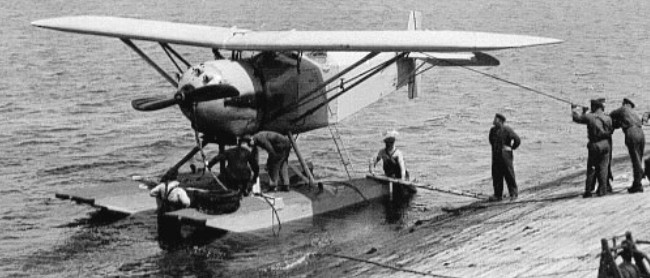
The sole XN5N-1 (1521) of 1941 was a two place, open cockpit, low wing monoplane advanced trainer, with retractable undercarriage. A cockpit canopy was added later.
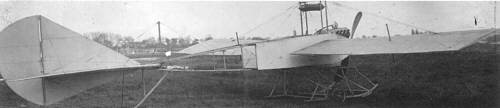
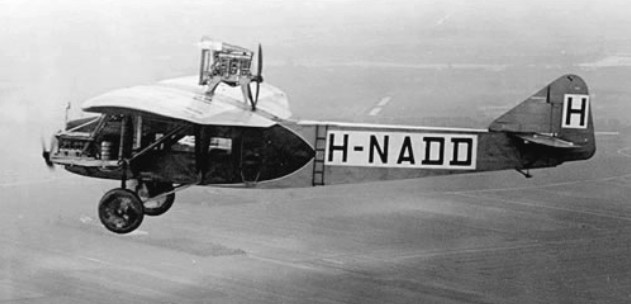
Robert Nau, a French sculptor, had constructed an earlier monoplane in 1909. The photo was taken by French press photographer Louis Branger on May 13th, 1910 on the flying field Port-Aviation at Juvisy-sur-Orge. The Nau Monoplane (1910) was a big machine, with a span of 13 meters and a length of 17 meters, wing area was 24 square meters. The fuselage was half covered. Engine was a 60 hp Renault V-8. After the photo session, which delivered at least two photos, flying was started by Mr. Nau. On May 18th flying ended when the machine with Nau as pilot crashed (it is reported as “falling down”) from a height of 4 meters. Nau was lightly innjured. The machine did not fly after this event.
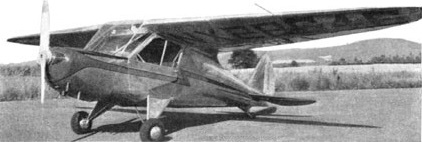
The Mercury N-1 of 1940 was a two place all-metal monoplane featuring a unique X-spar, slotted cantilever wing with interchangeable front and rear spars. Only the one was built, NX28646, and retractable landing gear was planned for production models, of which none were built. The N-2 designation was apparently for this one, and specs were the same except for higher speeds (projected: Maximum 155 mph / Cruise 138 mph / Stall 55mph).
Production was curtailed by the war but the design reappeared in 1947 as the Midwest Mercury.
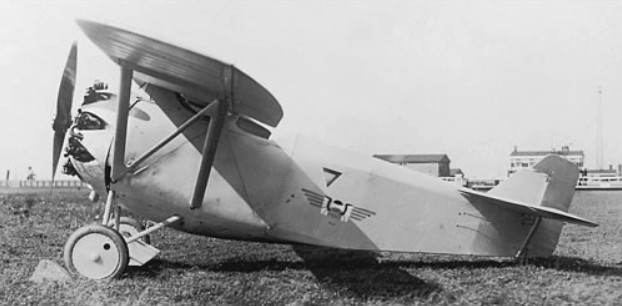
A fighter/reconnaissance aircraft, this biplane was designed by Fre¬derik Koothoven in the early 1920s for the NV (Nationale Vliegtuigindustrie, national aircraft industry), a small number being pro¬duced in 1924 25. Powered by a 400 hp Bris¬tol Jupiter radial engine, it seated a pilot and observer/gunner in tandem open cockpits, operating respectively two fixed, forward ¬firing machine guns and two ring mounted.
Reconnaissance versions sometimes carried a fifth gun, firing downward through the floor of the rear cockpit. Performance was not up to LVA (Luchtvaartafdeling, army air service) requirements, but the F.K.31 was used until about 1930 by the Netherlands East Indies army air service as a fighter trainer.
The Finnish air force operated 12 over a similar period, four of them built in Finland under licence. Louis de Monge in France also built a few, with Gnome Rhone (Bristol) Jupiter engines.
Gross weight: 1760 kg (3880 lb) Maximum speed: 235 km/h (146 mph)
 All Aero