Nord N-500 / Aerospatiale N 500

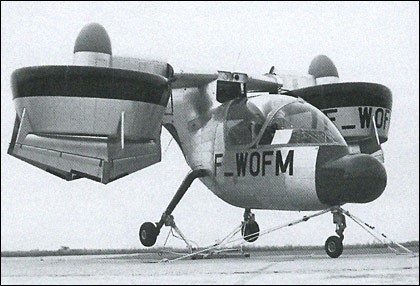
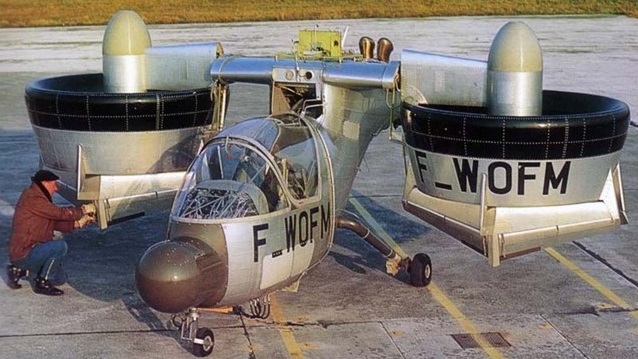
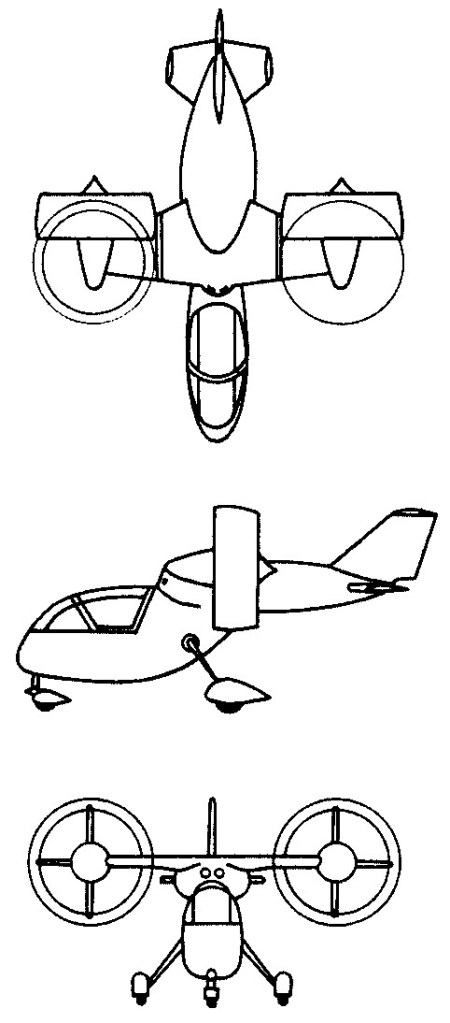
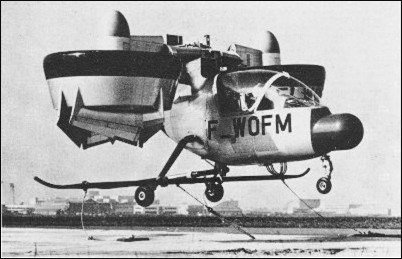
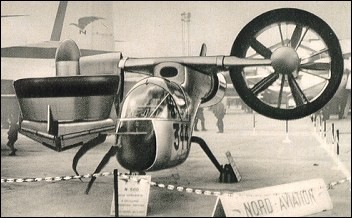
The Nord 500 was a single seat, company funded research aircraft. Its mission was to evaluate principles of the Tilt Duct propulsion concept for VTOL aircraft. The enclosed cabin contained an ejection seat. Two 317hp Allison T63-A-5A (or Allison T63-A5T, or 250-C18, depending on the source) turboshaft engines were located side by side in the rear part of the fuselage. They drove two 1.5m diameter props through interconnected shafts. Moveable vanes in the propeller slipstream controlled the duct positions aerodynamically. There were no other mechanical controls for rotating the ducts. The ducts tilted, along with a short section of wing. During hover, control in roll was by differential thrust, while control in pitch was by collective tilting of the ducts. There was no provision for attitude control of the fuselage because the ducts pivoted freely. The intended top speed was 218 miles per hour.

The first prototype was completed in Spring 1967 and was used for mechanical and ground tests. The second prototype made its first tethered flight during July 1968.

Nord merged with the Aerospatiale Corporation in about 1970, and the aircraft became known as the Aerospatiale N 500. Although a more sophisticated and more powerful version was in planning, all efforts on the Nord 500 appear to have stopped by 1971.

Nord-500
Engine: 2 x Allison T-63-A-5A turboshaft, 233kW
Wingspan: 6.1m
Length: 6.6m
Height: 3.1m
Max take-off weight: 1200kg
Max speed: 350km/h

Nord 1601

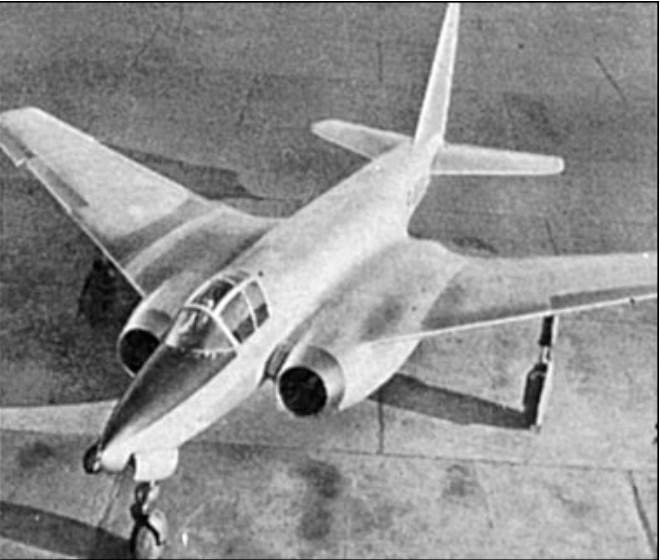
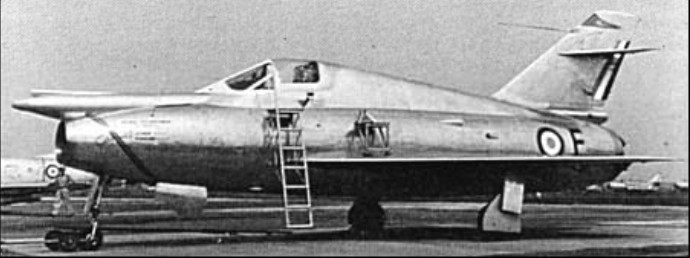
Under the designation Nord 1601, Nord designed a single-seat twin turbojet-powered aircraft to investigate the aerodynamic capability and efficiency of swept wings and related high-lift devices. A cantilever mid-wing monoplane with 33° of sweepback on the wing leading edges, the N 1601 had a wing incorporating ailerons, spoilers, leading-edge slats and trailing-edge flaps. The configuration included swept tail surfaces, and there were retractable tricycle landing gear and two 1814kg thrust Rolls-Royce Derwent 5 turbojet engines in underslung wing-mounted nacelles on each side of the fuselage. The pilot was accommodated on a Martin-Baker ejector seat in a cockpit enclosed by a jettisonable canopy. The aircraft was first flown on 24 January 1950, and the research programme of the 12.46m span N 1601, which had a maximum speed of 1000km/h and a ceiling of 12000m, provided valuable design information. An all-weather fighter version of this aircraft was allocated the project number N 1600 but was not built.

Nord 1601
Engines: 2 x Rolls-Royce Derwent 5 turbojets, 1814kg
Wingspan: 12.46 m / 41 ft 11 in
Max. speed: 1000 km/h / 621 mph
Ceiling: 12000 m / 39350 ft

Nord N.1500 Griffon

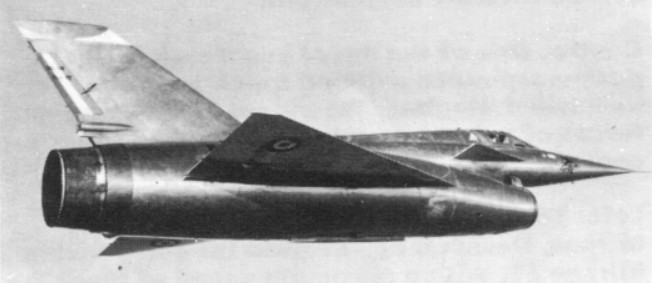
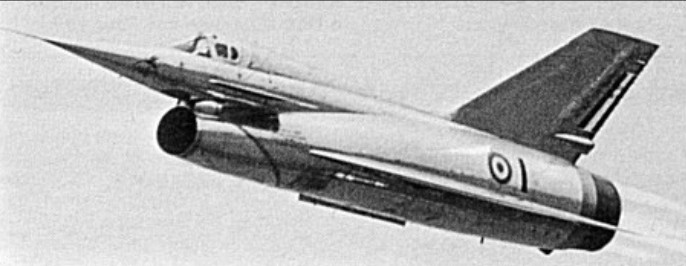
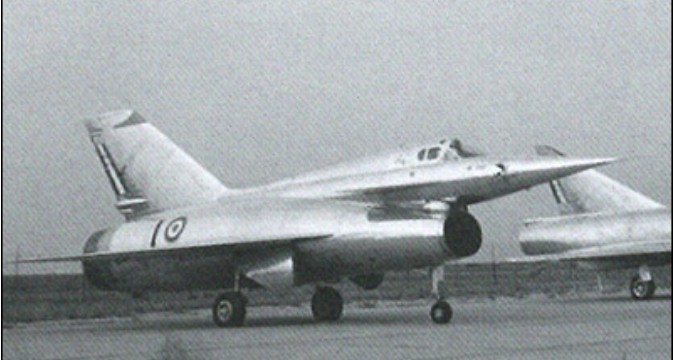
The Gerfaut lB and Gerfaut II prototypes paved the way for the N.1500 Griffon prototype of interceptor potential. After early tests of the Gerfaut la, Nord designed and built the Nord 1500-01 Griffon I research aircraft, which was intended to flight-test a combined turbojet-ramjet power unit. A delta wing aircraft with 60 degrees of sweepback on the leading edge, the N 1500 had elevons for control in pitch and roll. Thus the tail unit comprised only swept vertical surfaces, and fixed foreplanes were mounted on each side of the forward fuselage.

This flew on 20 September 1955 with a 4100kg thrust SNECMA Atar 101G21 afterburning turbojet, but was soon fitted with the planned combination powerplant comprising a 3800kg thrust Atar 101F turbojet and a Nord ramjet to produce the Griffon II and achieved Mach 1.85 in 1957. This was capable of supersonic performance on its ramjet, but was not developed into an operational type.

At the completion of initial testing the airframe was modified to accept a 3500kg thrust Atar 101E3 turbojet within the ducting of an integral ramjet of Nord design, the turbojet being located just forward of the ramjet burners. Then redesignated N 1500-02 Griffon II, it was flown first on 23 January 1957, completing more than 200 test flights before the Nord research programme ended in 1959.

27 October 1958 pilot Andre Turcat set closed circuit speed record of 1,638 kmh. On 25 February 1959 it set a 1018 mph, world speed record over a 100 km closed course and 13 October 1949 saw 1448 mph at 50,000 ft.

Some testing was carried out under USAF research contract.

Gallery

Wingspan: 26.6 ft
Length: 47.75 ft

Nord N.1402 Gerfaut / 1405 Gerfaut II

N.1402 Gerfaut I

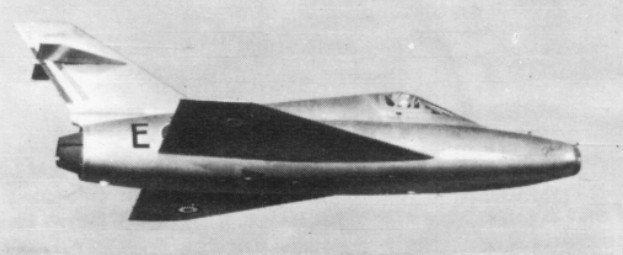
Nord was another protagonist of the tailless delta configuration, and on 3 August 1954 is N.1402 Gerfaut I prototype with the Atar 101D3 turbojet became the first aeroplane to exceed Mach 1 in level flight without an afterburner or a supplementary rocket motor. Gerfaut IB and Gerfaut II prototypes were also produced, and these paved the way for the N.1500 Griffon prototype of interceptor potential.

Nord N.1402 Gerfaut / 1405 Gerfaut II Article

The Gerfaut II was a development of the Gerfaut 1A, which was the first high-powered jet delta-wing aircraft to fly in France (15 January 1954), powered by a 43.15kN SNECMA Atar 101G turbojet with afterburner. The Gerfaut II first flew on 17 April 1956 and on 16 February 1957 established a number of time-to-height records from a standing start, including a climb to a height of 6,000m in 1 minute 17 seconds and to 9,000m in 1 minute 34 seconds. The Gerfauts were used to collect data for a high-speed fighter design.

Nord 1400 Noroit

Nord 1402

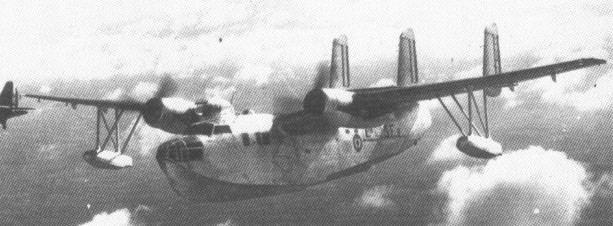
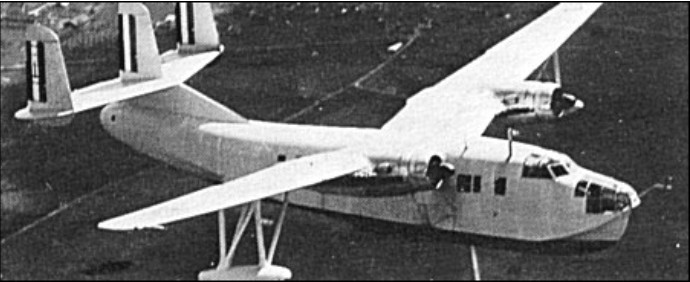
Despite the decline of the seaplane’s importance after the Second World War, France still saw a limited future for the type and commissioned from the Societe Nationale de Constructions Aéronautiques du Nord (generally known as SNCAN or Nord) a flying boat for the reconnais¬sance and air/sea rescue roles.

This was an all-metal monoplane with a gulled wing and a two ¬step hull, and had accommodation for a crew of seven, plus a roomy rear cabin with a large sliding door on the port side for rescue operations. It first flew on 6 January 1949 as the N.1400.01 Noroit prototype (F-WFDL) with 1,600-hp (1,193-kW) Gnome-Rhone 14R radials. The N.1400.02 second prototype introduced retractable tailwheel landing gear to provide an amphibious capability. Retractable tailwheel landing gear was installed on the N 1400-01 at a later date. There followed a pair of N.1401 pre-production machines with two 1,800-hp (1,342-kW) SNECMA-built Junkers Jumo inlines and annular radiators. The N 1401 Noroit (F-WFKU) was flown on 6 August 1949, the second example (F-SFKN) being flown later, and both were tested in 1950 with two Bristol Hercules radial engines. Finally there came 21 N.1402 Noroit (North-West Wind) production aircraft, the last of them delivered in 1956. Together with the two N.1401s modified to the same standard, these served with Flottille 5F.

Nord N. 1402 Noroit
Engines: two 2,100-hp (1,566-kW) SNECMA 12H.00 (Junkers Jumo 213A) inline piston
Maximum speed 230 mph (370 km/h) at 8,695 ft (2,650 m)
Initial climb rate 984 ft (300 m) per minute
Range 2,610 miles (4,200 km)
Empty weight 28,660 lb (13,000 kg)
Maximum take-off weight 45,040 lb (20,430 kg)
Wingspan 103 ft 8 in (31.60 m)
Length 72 ft 4 in (22.05 m)
Height 22 ft 5.5 in (6.85 m)
Wing area 1,076.43 sq ft (100.00 sq.m)
Armament: six 20-mm cannon in two-gun nose, dorsal, and tail positions, and bombs carried in nacelle bays plus provision for eight rockets on the hull sides.
Crew: 7

Nord 1200 / 1201 / 1203 / 1204 Norecrin

1203/II Norécrin II

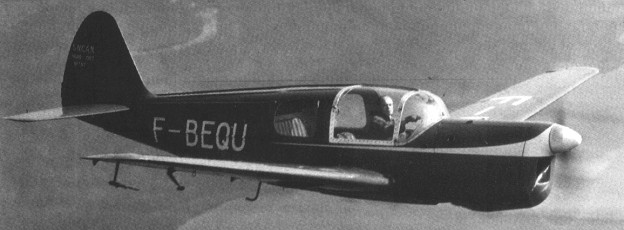
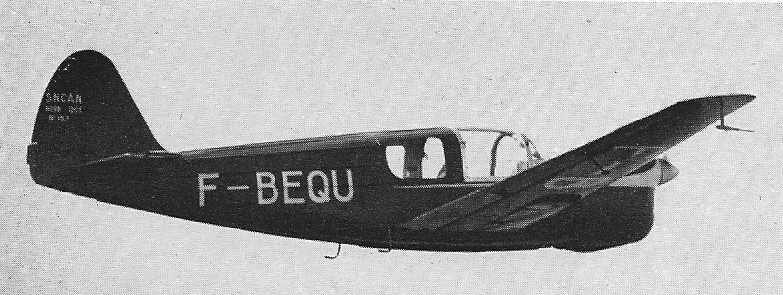
Using the same basic configuration as the Messerschmitt Bf 108, Nord developed the three-seat Nord 1200 with fixed tricycle landing gear, whose prototype flew on 15 December 1945 with a 75-kW (100-hp) Mathis G4R engine.

There were several military and civil variants, the main versions to enter civil service being the three-seat Nord 1201 Norécrin I with the 104-kW (140-hp) Renault 4Pei engine.

The four-seat Nord 1203/II Norécrin II was powered with the 101-kW (135-hp) Regnier 4L00 engine. In 1948 the Nord 1203/II was placed in production.

Nord 1203/II Norécrin II

The Nord 1203/III Norecrin III had a modified landing gear.

The Nord 1203/lV Norecrin IV had the 127-kW (170-hp) Regnier 4L02 engine.

The Nord 1203/Vl Norécrin VI had the 108-kW (145-hp) Regnier 4L14 engine, and the final Nord 1204 and the experimental Nord 1204/II models of 1959 with the 93- and 108-kW (125- and 145-hp) Continental C125 and C145 engines respectively.

A total of 380 had been built when production was suspended, being resumed in 1955 with an order for another 90.

Nord 1200
Engine: Mathis G4R, 75-kW (100-hp)
U/C: fixed

Nord 1201 Norécrin I
Engine: Renault 4Pei, 104-kW (140-hp)
Seats: 3

Nord 1203/II Norécrin II
Powerplant: l x Regnier 4L00, 101 kW (135hp)
Span: 10.22m (33ft 6.25 in)
Wing area: 410 sq.ft
Length: 7.21 m (23ft 8in)
Empty weight: 1437 lb
Max T/O weight: 1050kg (2,315Ib)
Max speed: 174 mph
Cruise speed: 137 mph at sea level
Operational range: 559 miles
ROC: 985 fpm
Seats: 4

Nord 1203/III Norecrin III

Nord 1203/lV Norecrin IV
Engine: Regnier 4L02, 127-kW (170-hp)

Nord 1203/Vl Norécrin VI
Engine: Regnier 4L14, 108-kW (145-hp)
Length: 23.163 ft / 7.06 m
Height: 9.088 ft / 2.77 m
Wingspan: 33.465 ft / 10.2 m
Wing area: 140.685 sqft / 13.07 sq.m
Max take off weight: 1730.9 lb / 785.0 kg
Weight empty: 1080.5 lb / 490.0 kg
Max. weight carried: 650.5 lb / 295.0 kg
Max. speed: 133 kts / 246 km/h
Initial climb rate: 708.66 ft/min / 3.60 m/s
Service ceiling: 16404 ft / 5000 m
Wing load: 12.3 lb/sq.ft / 60.0 kg/sq.m
Range: 486 nm / 900 km
Endurance: 5 h
Crew: 2

Nord 1203/II Norécrin II

Nord 1100 Srs / Messerschmitt 208

1101 Noralpha

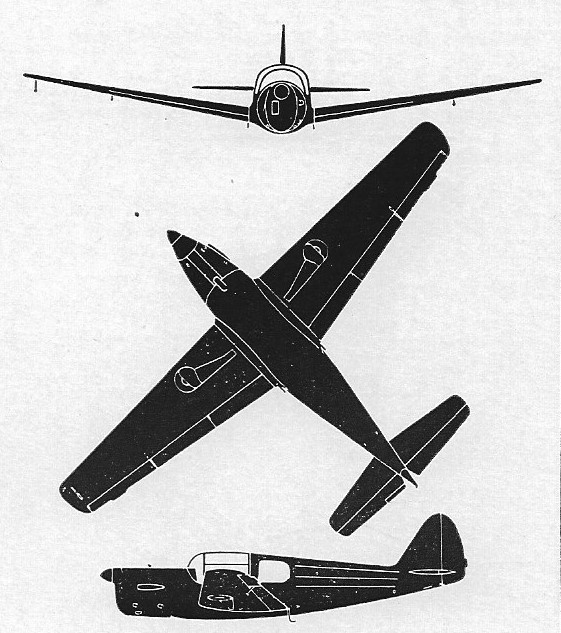
The four seat Nord 1101 Noralpha was developed by the French company SNCAN post war from the Messerschmitt 208.

Nord 1101 Ramier

Two prototype Me 208s, powered by Argus 10c engines, were built at Les Mureaux in occupied France during 1943 44, one being destroyed in an Allied bombing raid. The surviving aircraft was redesignated Nord 1100 after the Liberation, and production versions were fitted with the Renault 6Q engine as Nord 1101s.

Two hundred were built, many serving with French forces on communications, training and liaison duties.

Nord NC.856 Norvigie / SNCA du Centre NC.856

NC.856N

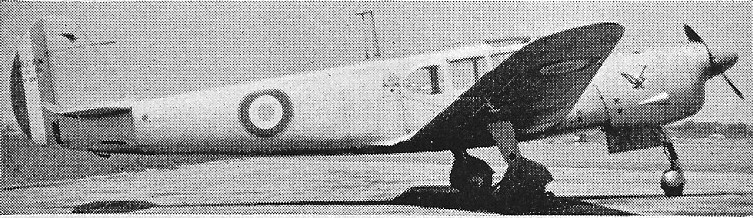
The SNCA du Centre NC.856 tourer first flew on 12 March 1949, powered by a 105 hp Walter Minor 4-III, but development ceased with the liquidation of SNCA du Centre.

A second prototype, modified for use as an air observation post, was built by SNCA du Nord, and first flown on 15 March 1951.

An order for 112, designated NC.856A Norvigie, was placed for the French Army, the first production Norvigie flying on 12 March 1953.

NC.856A Norvigie

Derived from the NC.856A Norvigie, the NC.856N is a four-seat cabin monoplane. Powered by a 160 hp SNECMA-Regnier 4LO-8 engine, the NC.856N is generally similar to the three-seat NC.856H twin-float seaplane variant.

The wing is a single spar metal structure with fabric covering, and the fuselage is welded steel tube with fabric covering over light wooden formers.

Gallery

NC.856 Tourer
Engine: 105 hp Walter Minor 4-III

NC.856A Norvigie
Engine: 140 hp Regnier 4 LO.4
Wingspan: 41 ft
Wing area: 183 sq.ft
Length: 25 ft 3 in
Height: 7 ft 4.5 in
Empty weight: 1432 lb
Loaded weight: 1984 lb
Max speed: 118 mph
Cruise: 105 mph
Endurance – AOP: 1 hr
Endurance – Liaison: 3 hr
ROC: 984 fpm
Seats: 2

NC.856H
Twin floats
Seats: 3

NC.856N
Engine: 160 hp SNECMA-Regnier 4LO-8
Wing span: 41 ft
Wing area: 183 sq.ft
Length: 25 ft 3.25 in
Height: 7 ft 6 in
Empty weight: 1389 lb
Loaded weight: 2447 lb
Max speed: 127 mph
Cruise: 112 mph
ROC: 689 fpm
Ceiling: 18,040 ft
Range: 360 mi
Seats: 4

Nogrady Avionette AN2

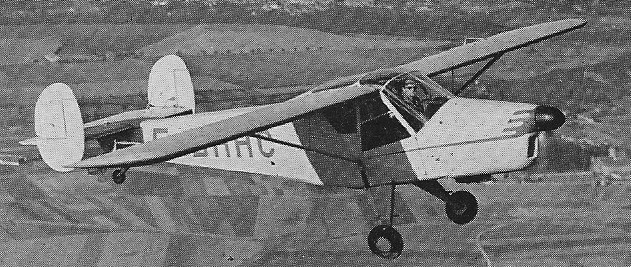
Designer Bela Nogrady started prototype 01 of the AN 2 in 1982 and it made its first flights in July 1982. The Avionnette had a conventional empennage at first, with quar¬ter span spoilers, after which a V tail was tried with fully flying elevons. This butterfly ¬tail configuration with 110 degrees between the two surfaces was adopted for prototype 02, which made its first flights at the end of April 1983, but the elevons are no longer fully flying, hingeing instead from inclined fixed surfaces, this tail being a NACA 0015 profile.

Production Avionnettes retain the constant ¬chord wing without leading edge sweepback, as used on the first prototype, but will be fitted with ailerons and flaps as tried on 02. With a total surface area of 15.1 sq.ft (1.40sq.m), these flaps have three positions: 15, 30 and 55 degrees. The wing tips now have semi elliptic end plates and the profile used on 01, the Worthmann FX S02 184, set at 6 degrees without washout and with 3 degrees of dihedral, has been replaced by an FX 66S-171, set at 6 degrees incidence with the same dihedral and still without washout.

Production was programmed to get up to six machines a month before the end of 1983. The AN 2 comes as standard with dual controls and a retractable main wheel with wheel well door and drum brake; under development is a tail dragger version with laminated carbon ¬fibre main gear. The wings and tail surfaces are easily de mountable and the AN 2 is trailer transportable.

The standard model comes with a three blade propeller, ground adjustable for pitch.

Side by side two seat single engined mid wing monoplane with conventional three axis con¬trol. Wing has unswept leading and trailing edges, and constant chord; V tail. Pitch/yaw control by elevon; roll control by one third ¬span ailerons; control inputs through stick for pitch/roll and pedals for yaw. Cantilever wing of Worthmann FX66 S 171 profile; double surface. Undercarriage has two wheels in tandem with skid under each wing; rubber suspension on main wheel. Push right go right tailwheel steering connected to yaw control. Brake on main wheel. Glass fibre fuselage totally enclosed. Engine mounted at wing height driving tractor propeller. Carbon fibre wing spar with Kevlar, aluminium ribs, Dacron covering and plastic leading edge.

This microlight offers a maximum level speed of 106 mph (170 kph) take off at 23mph (38kph) and cruise be¬tween 56 and 93 mph (90 150 kph) with 43 hp thrust and a gross weight of 662 lb (300 kg). The AN 2 could be mistaken for a modern motor glider, with its composite construction, glide ratio of 26.4/1 and aspect ratio of almost 12/1.

Engine: Hirth 2701R 53, 43 hp at 6750 rpm
Propeller diameter and pitch: 51 x 45 inch, 1.30 x 1.15 m
V belt reduction ratio: 2.21
Power per unit area 0.28 hp/sq.ft, 3.0hp/sq.m
Fuel capacity 10.6 US gal, 8.8 Imp gal, 40.0 litre
Length overall 21.1 ft, 6.38 m
Height overall 5.1ft, 1.80m
Wing span 42.8ft, 13.00m
Constant chord 3.7 ft, 1.10m
Dihedral 3 degrees
Sweepback 0 degrees
Tailplane span 12.2 ft, 3.70 m
Total wing area 152 sq.ft, 14.1 sq.m
Total aileron area 8.6 sq.ft, 0.80sq.m
Tailplane area 22.8 sq.ft, 2.12 sq.m
Total elevon area 11.6 sq.ft, 1.08 sq.m
Wing aspect ratio 2.1/1
Wheelbase 16.1ft, 4.90m
Tailwheel diameter overall: 6 inch, 16 cm
Main wheels diameter overall 19 inch, 48 cm
Empty weight 2651b, 120kg
Max take off weight 6621b, 300kg
Payload 397 lb, 180 kg
Max wing loading 4.351b/sq.ft, 21.3 kg/sq.m
Max power loading 15.41b/hp, 7.0kg/hp
Load factors; +8.0, 4.0 ultimate
Max level speed 106mph, 170kph
Never exceed speed 117mph, 189kph
Max cruising speed 93mph, 150kph
Economic cruising speed 56mph, 90kph
Stalling speed 23mph, 38 kph
Max climb rate at sea level: 600 ft/min, 3.1 m/s
Min sink rate 138ft/min at 30mph, 0.7 m/s at 48 kph
Best glide ratio with power off: 26.4/1 at 45 mph, 72 kph
Take off distance 193 ft, 59m
Landing distance 213 ft, 65 m
Service ceiling 23,000ft, 7000m
Range at average cruising speed: 497 mile, 800km
Noël J. N. Type 3

J. N. Type 3

Jules Noël qualified for French license No. 322 on a Sommer and was then employed by Sommer. Before, he had built at least three aeroplanes of his home town Carignan, in the northeast of France. The third was a monoplane with an uncovered rear fuselage and Bleriot-style kingposts. Its empty weight was 210 kg and the machine was powered by a 25 hp Anzani. Noël and an Italian passenger were killed in a testing accident at the Sommer airfield in Douzy on 9 February 1911.