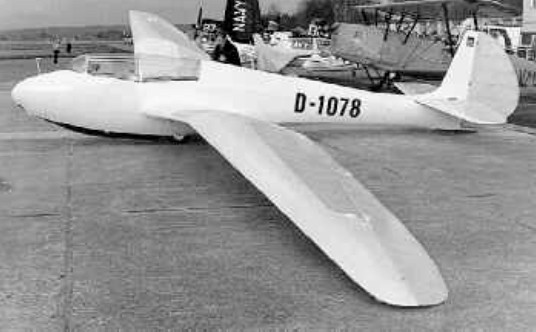
Oberlerchner MG-23

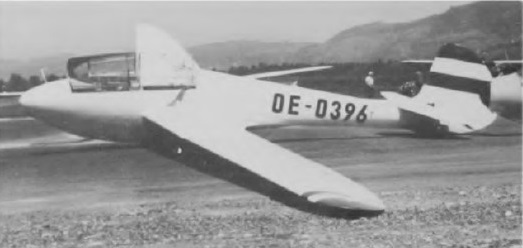
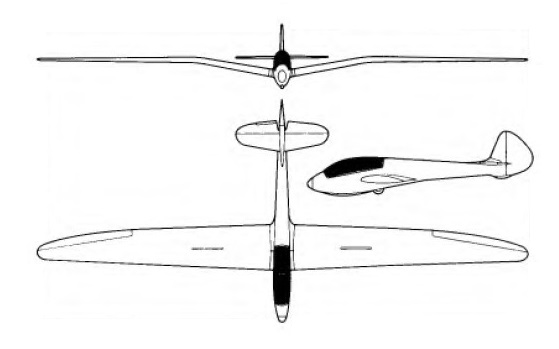
The Mg 23 high performance single-seater was the last of the Mg series designed by Erwin Musger. Of conventional wood and fabric construction, the Mg 23 has cantilever single-spar shoulder wings with no flaps and wooden fabric-covered inset-hinge ailerons. Wooden Schempp-Hirth air brakes are fitted, and there are layers of plywood stiffening forward of the spar which, combined with a close rib spacing, make easier the production of a smooth polished wing surface. The semi-monocoque plywood fuselage is of oval section and the wooden tail unit has fabric covered rudder and elevators, and a Flettner-type tab in the starboard elevator. The landing gear consists of a non-retractable monowheel behind the eg, with a brake but with no shock absorber, plus a nose skid partly shock-absorbed by rubber, and a bow-shaped tailskid. The pilot sits under a jettisonable Plexiglas canopy which slides forward to open; the seat back and rudder pedals are adjustable and the cockpit is ventilated.

The MG-23 first flew on 25 June 1955. That was the year in which Austria had signed its State Treaty with the Allied occupying powers, and Soviet and Western troops withdrew from the country. With normal peacetime conditions returning for the first time since 1938, Austrian gliding amongst other activities began a resurgence and the Mg 23, as the Mg 19 had done before it, won the Austrian State Championships and set a number of new national records; it also equipped the country’s national gliding team which began to re-establish Austria’s prewar position in competition flying.

The Mg 23 was followed by the production Mg 23SL, which flew for the first time on 1 April 1962, and had a number of refinements including a longer, flush fitting cockpit canopy, larger fin and rudder and a lowered monowheel. It is cleared for cloud flying and spinning, but is not acrobatic; it was awarded type approval by the US FAA, as well as by the Austrian authorities, and examples have been exported to the USA and Canada.

Approximately 90 were built when production ceased in 1967.
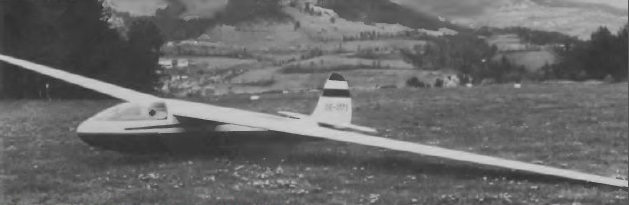
Mg 23 SL
Wing span: 16.4 m / 53 ft 9.5 in
Wing area: 14.21 sq.m / 153 sq.ft
Length: 7.11 m / 23 ft 4 in
Height: 4 ft 10.75 in
Empty Weight: 240 kg / 530 lb
Payload: 120 kg / 263 lb
Gross Weight: 360 kg / 793 lb
Water ballast: None
Max speed: 137 mph / 119 kt / 220 km/h (in smooth air)
Stalling speed: 32.5 kt / 60 km/h
Max aero-tow speed: 80 mph / 70 kt / 130 km/h
Wing Load: 25.33 kg/sq.m / 5.2 lb/sq.ft
L/DMax: 33 at 85 kph / 46 kt / 53 mph
MinSink: 0.64 m/s / 2.1 fps / 1.24 kt at 48.5 mph / 37 kt / 68 km/h
Aspect ratio: 18.54
Airfoil: NACA 63-315
Seats: 1

Oberlerchner Mg-19 Steinadler

Mg-19a Steinadler

The Mg 19, which made its first flight in November 1951, is a development of the prewar Mg 9, of conventional wood and fabric construction and distinguished by a laminar flow gull wing in the low/mid-set position, of Gottingen 549/676 section.

There are air brakes in the wing upper surfaces and the two pilots sit in tandem under a sideways hinging cockpit canopy.

The Mg 19 proved to be popular as a training sailplane and examples of the type competed in the 1954 and 1956 World Gliding Championships.

Oberlerchner Mg 19

Gallery

Mg-19a Steinadler
Wing span: 17.6 m / 57 ft 9 in
Wing area: 21.0 sq.m / 226.1 sqft
Wing section: Gottingen 549/676
Length: 8.04 m / 26 ft 4.5 in
Height: 1.65 m / 5 ft 6 in
Empty Weight: 303 kg / 657 lb
Gross Weight: 476 kg / 1,058 lb
Water ballast: None
Wing Load: 22.7 kg/sq.m / 4.69 lb/sq ft
Aspect ratio: 14.75
Max speed: 112 mph / 97 kt / 180 km/h
Max rough air speed: 70 kt / 130 km/h
Stalling speed: 27 kt / 50 km/h
L/DMax: 26 75 kph
Best glide ratio: 27.8:1 at 42 mph / 36 kt / 67 km/h
MinSink: 0.63 m/s / 2.1 ft/sec at 62 kph / 38.5 mph / 33.5 kt
No. of Seats: 2
No. Built: 1
Structure: wood

Oberlerchner Mg 9

The two-seater Mg 9 was designed by Erwin Musger in 1935, and in this Musger himself set up an Austrian duration record of 8.09 hours in 1936. This was followed by a world duration record of 40 hours 51 minutes set up on 10 September 1938, also in an Mg 9; six months before Austria had been annexed by Nazi Germany under the Anschluss.

Nyuxtikov N-1 Kachiniets

The Nyuxtikov N-1 Kachiniets (Russian: Нюхтиков Н-1 Качинец) was the irst glider developed by Mikhail Nyuxtikov at the Kacha flight school in 1929.

Its construction began in 1929. Its wings were obtained from the Pegas glider, which was destroyed two years earlier. The landing ski, the empennage, and the elevator and steering rudders were designed by Nyuxtikov. The tail cone and another set of pieces were taken from an un-used Fokker, the seat and the control lever of a Morane O.

The glider was built under the direction of Nyuxtikov with extensive participation from PM Stefanovski, instructor pilot M Moiseyev, technician Butovsky and G Gribakin.

The glider received the name “Kachiniets” and was used as a trainer at the Kacha Military Pilot School, characterized by being a difficult glider, capricious and little tolerant of pilots’ mistakes.

NWT Spruce Coupe

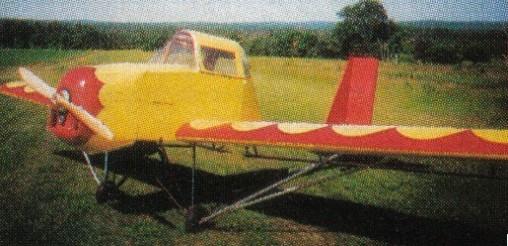
Fits Rotax or Kawasaki engines, and two wing lengths were available.

Top speed: 75 mph
Cruise: 60 mph
Stall: 35mph
Range: 80 sm
Rate of climb: 1200 fpm
Takeoff dist: 75 ft
Landing dist: 100 ft
Engine: Zenoah, 42 hp
HP range: 22-50
Fuel capacity: 6 USG
Empty weight: 300 lb
Gross weight: 600 lb
Height: 6 ft 3 in
Length: 16.9 ft
Wing span: 22 ft
Wing area: 88 sq.ft
Seats: 1
Landing gear: tailwheel