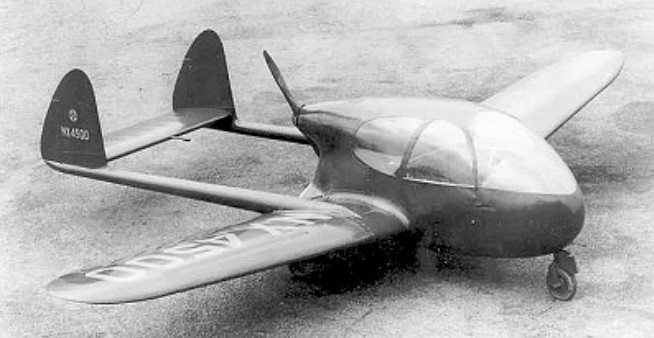
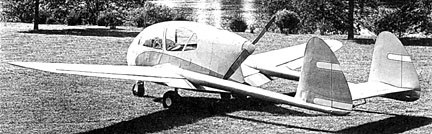
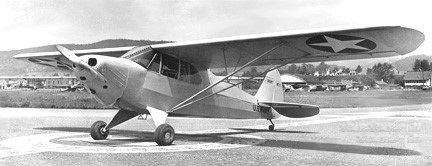
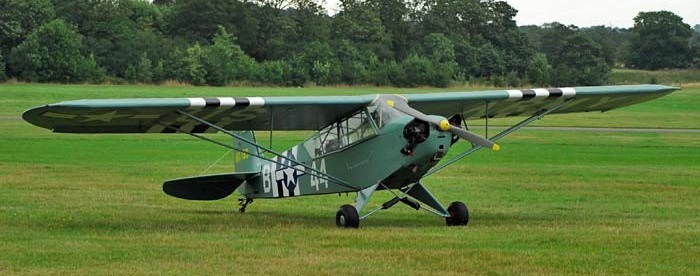
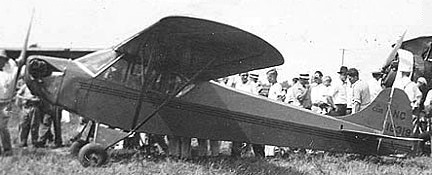
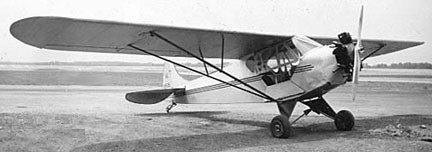
The only prototype of the PA-7 Sky Coupe / PWA-1 (Bradford) built, NX4500, flew for the first time in 1945.
Engine: 1 x Franklin 4ACG, 113hp Max take-off weight: 764 kg / 1684 lb Empty weight: 346 kg / 763 lb Wingspan: 9.14 m / 30 ft 0 in Length: 6.98 m / 23 ft 11 in Height: 2.12 m / 7 ft 11 in Wing area: 16.43 sq.m / 176.85 sq ft Max. speed: 177 km/h / 110 mph Cruise: 100 mph Stall: 48 mph Ceiling: 4120 m / 13500 ft Range: 856 km / 532 miles Crew: 1 Passengers: 2
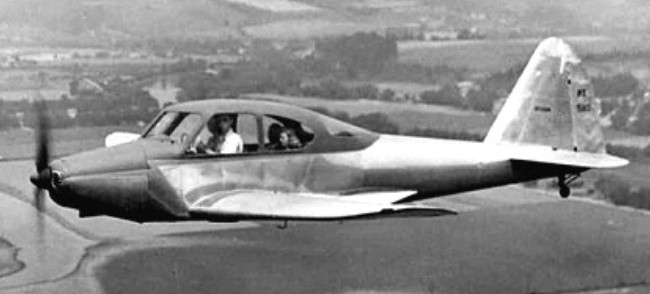
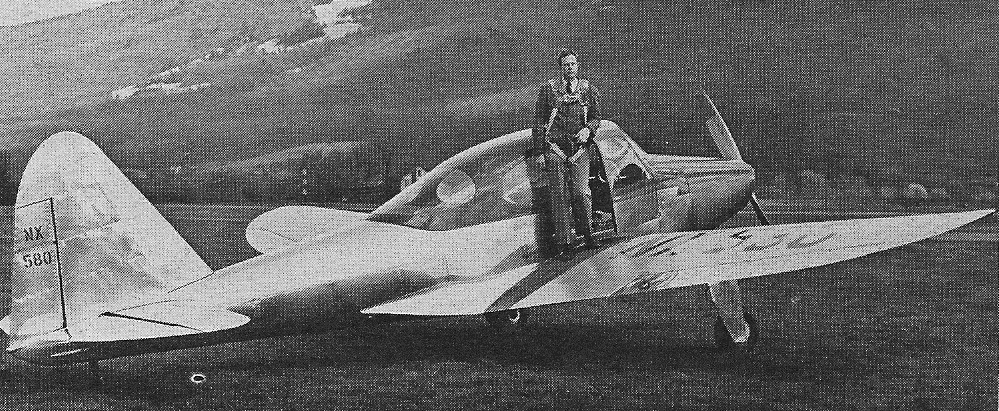
The prototype of the PA-6 NX580 flew in March 1947. All-metal; monocoque fuselage, cantilever wing with trailing-edge flaps. Also tried with 165hp Franklin.
A second all metal aircraft was built and scrapped after the undercarriage failed. The tail from the second aircraft was fitted to the PA-23 experimental aircraft. The Sky Sedan was cancelled although six Schweizer-built production fuselages had been delivered.
Market decline forced cancellation and only one was built. At the beginning of 2010, this plane still sat in a hanger in Michigan.
Engine: 1 x Continental E-165, 165hp Wingspan: 10.56 m / 35 ft 8 in Length: 7.92 m / 26 ft 0 in Height: 2.48 m / 8 ft 2 in Wing area: 18.63 sq.m / 200.53 sq ft Max take-off weight: 896 kg / 1975 lb Empty weight: 471 kg / 1038 lb Max. speed: 225 km/h / 140 mph Cruise speed: 201 km/h / 125 mph Ceiling: 4270 m / 14000 ft Range: 805 km / 500 miles Crew: 3
In 1943 the Piper Aircraft Company undertook to design and build for the United States Army Air Force (USAAF) an aircraft ambulance.
After studying the specification it was decided to base the design on an existing model, the Piper J-5C, the first prototype was built using an existing Piper J-5CO (O for Observation), this first aircraft being given the serial number (SN) 5-1387 and the registration: NX41552.
The most noticeable change being the reconstructed upper fuselage, a large dorsal addition to cater for stretchers. Otherwise the aircraft was unchanged, including the engine which remained as in the Piper J-5C, the Lycoming O-235 producing 100 hp.
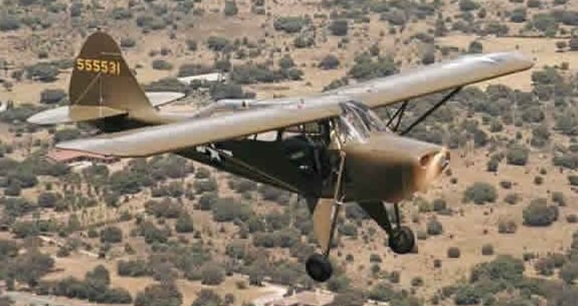
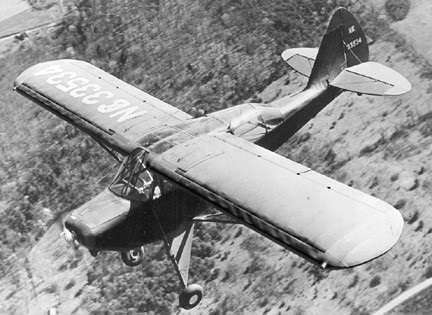
Piper YL-14 NX33534
First flight was on the 16th June 1943 and after satisfactory flight trials from October of that year and into 1944 major modifications were made including larger windscreen and glazed areas, long landing gear shock absorbers, increased fin height and size, and a first for Piper, full span slots on the wing leading edges, generous flaps were also incorporated, another first. This aircraft was now designated the Piper J-5D.
In 1944 a second prototype was converted from another J-5C, registration NX33529, now designated as a Piper L-4X, in line with the military series of ‘L’, with the SN 5-3001, the first flight being on the 9th September 1944. All the changes were incorporated into this aircraft along with a larger engine, Lycoming O-290-A giving increased power.
The Approved Type Certificate for the new Model: Piper L-14 was issued 31st July 1945 (ATC 760) to the Piper Aircraft Company, Lock Haven, Pennsylvania.
The definitive and complete Piper L-14 incorporating all the changes including large glazed area, turtle deck, slots and flaps, and undercarriage shock absorbers was SN 5-3002, registered NX-33534 which flew on the 29th February 1945.
The production of five examples was completed for service evaluation, these aircraft were designated YL-14 with the serial numbers from 5-3001 to 5-3005.
The two original prototypes were modified to the same standard as the production examples, YL-14, and the service trails commenced in May 1945, the newly built Piper YL-14 were delivered in June of the same year, these last with the recessed slots, flaps and glazed, removable turtle deck which permitted a stretcher to be loaded, similar to the Naval models designated HE-1/AE-1.
The USAAF issued an order to build 850 examples of the Piper L-14 Army Cruiser.
Piper YL-14 NX33534
Howard Piper was the engineer for this project, Dave Long the chief of design and Tom Piper the chief flight test pilot with Clyde Smith Senior, the pilot involved with the test flying and evaluation during the whole production run. It was found necessary to increase the wingspan by three feet outboard of the leading edge slots to improve flight handling.
The construction and dimensions for the L-14, now named ‘Army Cruiser’ was very similar to the Cub Cruiser or Super Cruiser, except for the larger engine and the changed interior to accommodate the stretcher. Alloy steel tube fuselage, aluminium alloy spars with aluminium ribs, fabric covered, wing struts, bracing wires for the tail surfaces, all standard for the pre-War Piper models.
The one big difference of this model was that this was the first model to incorporate flaps, up to 40% being available which when used with some power from the engine resulted in an airspeed of less than 20 Knots, these combined with the slots gave full control which was demonstrated on the first flight.
At the express wish of the USAAF, the capability to operate safely from rough and unprepared fields large balloon tyres were tested, (size 600 X 6) and a robust skid made by R.C.A. Scott.
The electrical system was the normal military specification: 28 Volts along with a voltage regulator using an engine driven generator, and a powerful starter motor.
In the cockpit the panel instruments were provided with lighting for night flying, a landing light was positioned on the left wing powered by a 24-volt battery. Two pilots in front, dual controls, and an observer’s seat in the rear that swivelled for viewing out the back or for writing at a built-in desk.
A full flying panel was installed, including, left to right: clock, air speed indicator, turn and slip, vertical speed indicator, compass, altimeter, engine rpm gauge, oil temperature and pressure, ammeter.
The engine fitted was a Lycoming O-290-1 (O-290-C) producing 130 hp at 2,600 rpm and a wooden Sensenich propeller, 76JB44, allowing for a maximum speed of 115 mph (190 km). Maximum take off weight of 1,800 lbs (820 kg).
This definitive model of the Piper L-14 Army Cruiser never went into production as in August 1945, right at the end of the Second World War, the USAAF ceased to have an interest in this model or a need for it.
The five initial aircraft, YL-14, and the other nine L-14 comprised the total production run for this aircraft, in all only fourteen were completed.
At the end of the War the USAAF authorised the Piper Aircraft Company to sell these aircraft into the civilian market.
The 14 aircraft produced:
Piper YL-14 5-3001 last reported in the Philippines: 22 July 1945 5-3002 last reported in Japan: 3 May 1948 5-3003 sold to the Philippines as P1-C159, never officially registered. 5-3004 sold within the USA as NC-66526, never officially registered. 5-3005 sold within the USA NC-69225, reregistered as N14YL, still airworthy.
Piper L-14 Army Cruiser 5-3006 sold within the USA NC-41399, reregistered as CU-P19. No records since 1946. 5-3007 sold within the USA NC-41594, exported to Cuba, CU-P18, CU-N18 then to Spain as EC-AAP. Now airworthy, May 2003. 5-3008 sold within the USA NC-41598, exported to Venezuela, no records since 1946. 5-3009 sold within the USA NX-41352, sold to Mexico XB-COP, no records since 1946. 5-3010 sold within the USA NC-41593, to Mexico as XB-CAQ, no records since 1946. 5-3011 sold within the USA NC-41595, to Uruguay as CX-AFX destroyed in a fire. 5-3012 sold within the USA NC-41596, to Argentina LV-NCM not officially registered.
The J-5 Cruiser which, although basically similar to the J-3, had a minimal increase in fuselage width to provide three-seat accommodation.
Piper J-5A NC28123
After two prototypes, NX24573 and NX26071, they were first seen in early 1940 as the J-5A Cruiser (ATC 725) with a 56kW Continental A75-8 engine sold for $1,833, it became available subsequently as the J-5B (ATC 725) with a similarly powered Avco Lycoming GO-145-C2 engine for $1,995, then being designated J-5C (ATC 2-563) with the installation of a 75kW Avco Lycoming O-235-C.
The one J-5D of 1946, NC91902, had a 125hp Lycoming engine.
Civil J-5A and J-5B aircraft were impressed for service with the US Army during World War II under the designations L-4F and L-4G respectively. Four J-5A impressed in 1942, 42-79551 to 4279554, were designated UC-83, becoming L-4F in 1943.
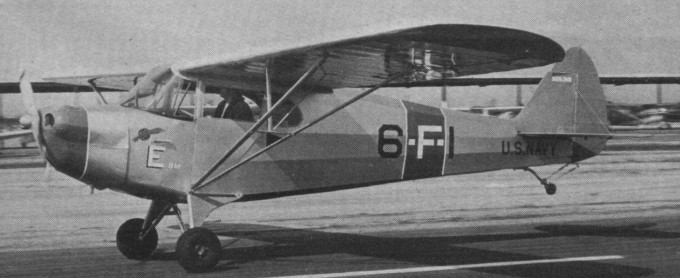
The US Navy procured 100 aircraft, 30197 to 30296, similar to the J-5C under the designation HE-1. These had the 75kW Avco Lycoming O-235-2, and a hinged top decking to the rear fuselage to allow the loading and unloading of a stretcher; when, in 1943, the designation letter H was allocated to identify helicopters, the HE-1s were redesignated AE-1 in 1943.
Piper HE-1 30197
When production ended a total of 1,404 J-5 Cruisers had been built.
A modified Piper Cub Cruiser used for aerial photography by George Gruenberger around 1954. Wing tip plates were added to shortened wings and the aft section of the fuselage was cut down.
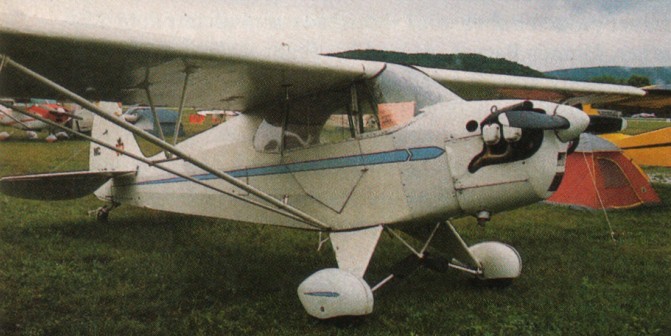
Piper introduced the Cub Coupe in 1938 and it went into production the next year, gaining immediate popularity, particularly with pilot sports who liked to take their gals for a ride and hold hands side-by-side. It came out with, wheel pants, full-swivel tailwheel, oleo gear in the under-carriage, and even an airspeed indicator. It had a small increase in wing span and introduced improved landing gear with a fully-castoring tailwheel, and hydraulic brakes. As powered initially by a 37kW Continental A50-1 it had the designation J-4.
The J-4 Coupe was developed and introduced shortly after Taylor brought out his highly successful Taylorcraft Model B side-by-side two seater. Taylor had designed the Piper Cub, and when he split with Piper he decided to offer an airplane better than the Cub was. Piper engineers countered with the J-4 and the market was offered the choice between two airplanes of generally similar configuration.
The initial J-4 Cub Coupes (ATC 703) designed by Walter Jamouneau and Hanford Eckman, were plush inside, upholstered in suede cloth and leather. Elevator tab control and indicator were put up in the ceiling, in front of the pilot’s head where you could see whether you were winding the nose up or down. They were priced at $1,995, with exposed engine cylinders.
The 1938 J-4A (703) was powered by a 65hp Continental A-65 engine with enclosed cowl.
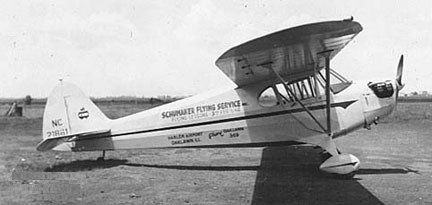
In 1939 Piper introduced the J-4B (ATC 708), differing only in powerplant which initially, was a 45kW Franklin 4AC-171, but that was soon replaced by the 48kW Franklin 4AC-176-B2 without any change in designation. Priced at $1,935, nineteen J-4A and -4B in England were impressed by RAF.
Piper J-4B NC21861
Introduction of the 56kW Continental A75-9 in 1941 brought redesignation as the J-4E (ATC 740), priced at $2,395.
Last of the J-4s was the version powered by Avco Lycoming engines, the 41kW O-145-A1 or -A2, or 48kW O-145-B1, both of these Cub Coupes having the designation J-4F, priced at $1,910.
Piper J-4 Peruvian AF 1950
One J-4, NX21599, was experimental fitted with 60hp Milwaukee Tank engine.
Powered by a 75hp Continental engine, the J-4RX [NX22941 of 1939 tested an experimental William Rose wing with slats, slotted ailerons, and flaps.
By 1941, with production rolling on the Coupe, Piper’s 70-horsepower version came out with. increased speed, range, and altitude, and sold at $2,395, only $799 down, with a free flying course including eight hours of dual time thrown in so you could fly your toy home from Lock Haven all by yourself – hopefully.
This was a step forward from originally published claims for the Cub Coupe, which sold in 1938 for $1,995, only $665 down with a free catalog thrown in. Announced Piper: “Get this luxurious 1939 Cub Coupe and you’ve got everything! Here’s a plane that’s complete in every detail. Nothing more to buy!”
Production of J-4s reached 1,250 by 1942, and during World War II 17 J-4Es were impressed for service with the USAAF under the designation L-4E. 1942 impressed J-4E 42-79555 was first designated UC-83B, later becoming L-4E.
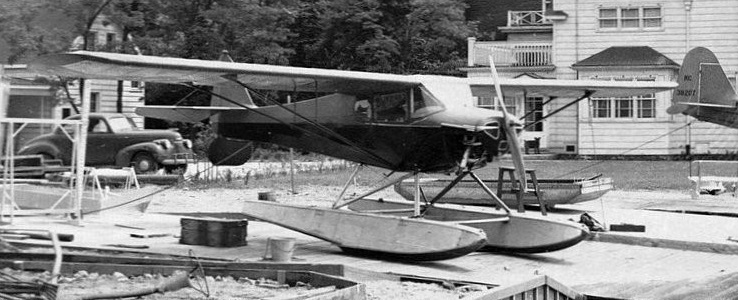
Harry Garland’s J-4A Cub NC30815 on the Garland’s Seaplane Base ramps facing the Detroit River 1946
J-4 Engine: Continental A-50, 50 hp Span: 36 ft 7 in Length: 22 ft 6 in Height: 6 ft 10 in Empty wt: 710 lb Gross weight: 1,200 lb Useful load: 590 lb Top speed: 93 mph Cruising speed: 83 mph Landing speed: 35 mph Cruising range: 340 miles Climb first minute: 500 fpm Service ceiling: 12,000 ft Range: 325 mi Seats: 2
J-4A Engine: 65hp Continental A-65
J4A 65 Cub Coupe Engine: Continental A65-8, 65 hp
J-4B Engine: 60hp Franklin 4AC Useful load: load: 520 lb Max speed: 96 mph Cruise: 85 mph Stall: 36 mph Range: 340 mi
Piper J-4F Engine: 1 x Avco Lycoming O-145-B1, 48kW / 60 hp Wingspan: 11.02 m / 36 ft 2 in Length: 6.86 m / 23 ft 6 in Height: 2.08 m / 7 ft 10 in Wing area: 17.00 sq.m / 182.99 sq ft Max take-off weight: 590 kg / 1301 lb Empty weight: 336 kg / 741 lb Useful load: 480 lb Max. speed: 161 km/h / 100 mph Cruise: 85 mph Stall: 35 mph Ceiling: 3660 m / 12000 ft Range: 547 km / 340 miles
J-4F Engine: 65hp Lycoming O-145 Wingspan: 11.02 m / 36 ft 2 in
J-4F Engine: 60hp Milwaukee Tank Wingspan: 11.02 m / 36 ft 2 in
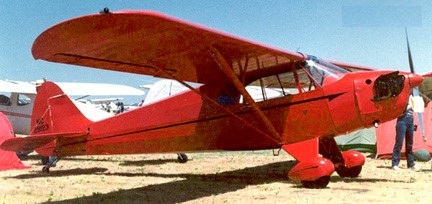
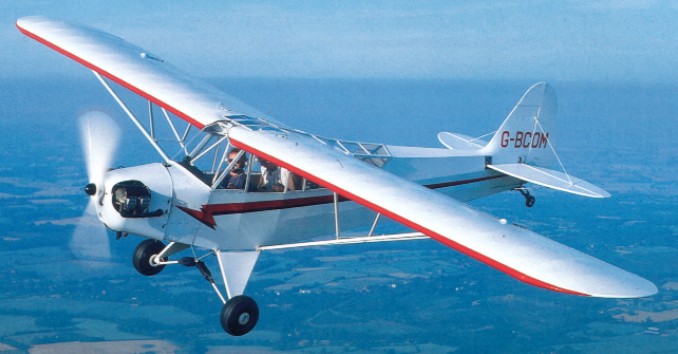
ln 1938 Piper introduced the improved J-3 Cub. Powered by 40-hp Continental, Lycoming or Franklin engines, the J-3 sold for $1,300. Engine horsepower was soon raised to fifty and reached sixty-five by 1940. Piper also standardized a color scheme; just as Henry Fords Model T’s were all black so Wiliiam Piper’s Cubs were all bright yellow with black trim.
The lightly loaded USA 35 B airfoil, a new aileron shape, modification of the wing interior for durability and ease of manufacture wheel brakes, tail wheel and larger seats, slightly reshaped tail surfaces and an aerodynamically balanced rudder were the only air frame differences between it and the J 2. Though it was initially powered by the same A 40, optional engines for the J 2 were soon offered as other manufacturers began to see a future in general aviation. Fifty hp Continental, Lycoming and Franklin models as well as the three cylinder Aeromarine Lenape radial were available, although only a few of the last were ever installed as the engine/ airframe combination resulted in excessive vibration. In 1938, the 65 hp Continental, Lycoming and Franklin were added to the list even though some felt the plane overpowered with that staggering amount of thrust.
1938 Piper J-3 “Sport” NC26792
The J 3 had a balanced rudder and a modified vertical stabilizer, upholstered chair type seats (instead of plywood chair frames), and such other refinements as a tailwheel and brakes items that remained essentially unchanged as the J 3 evolved into the Super Cub 12 years later.
In the J 3, yellow was established as the standard Cub colour; earlier models could be purchased with solid blue, red or green paint schemes.
J-3C
When first produced by Piper in 1937 under ATC 660, the Piper J-3 Cub was powered by a 30kW Continental A40-4 flat-four engine, but it was not long before the 37kW A50-4 or alternative A50-5 with dual ignition system was introduced on the J-3C-50 Cub. The resulting improvement in performance made this already attractive lightplane an extremely marketable commodity and during 1938, which was the new company’s first full year of production, 737 Cubs were built. The Cubs initially sold for $1,249, then $1,098 in 1939, and $995 in 1940. The Continental A50 was a new engine, early experience proving that it was reliable and had development potential, and it was later re-rated at 48kW at a higher engine speed. Its introduction by competitors meant that Piper had to follow suit, and in 1940 the J-3C-65 Cub appeared with the Continental A65 engine. With alternative Franklin flat-four engines, the 37kW 4AC-150 or 48kW 4AC-176, the Cub was designated J-3F-50 and J-3F-65 respectively and, similarly, with the Avco Lycoming 37kW O-145-A1 or 48kW O-145-B the Cub had the respective designations J-3L-50 and J-3L-65. Also built in comparatively small numbers was a version designated J-3P-50, powered by a 37kW Lenape Papoose 3-cylinder radial engine. The higher-powered Continentals and Franklins Cubs were Group 2 (ATC 691, 692, 695, 698).
Piper J-3C Spirit of N76 NC88657
All models of the Cub carried large loads for their horsepower and were excellent short field airplanes. With the standard 8:00 x 4 doughnut tires and rugged shock cord damped gear, the plane really didn’t care whether it was on an airport or a pasture. With a stall¬ing speed of 35 mph, any little field would do. It was not unusual in the 1930s and ’40s to see a Cub land in a meadow or on a road near a gas station to refuel on a long cross country. And any cross country was long; speed was not among the airplane’s virtues. The 65 hp J¬3 cruised in the high 70s on a good day.
Sales began to soar, and then in 1941 the US Army selected this aircraft for evaluation in artillery spotting/direction roles. Four were obtained, 42-460 to 42-463, as YO-59, powered by the 65hp Continental C-65/O-170.
Shortly afterwards ordered 40 similar aircraft, including 42-7813 to 42-7852, under the designation O-59, all redesignated, briefly as L-59, finally L-4. These aircraft were used by the US Army under virtually operational conditions during annual manoeuvres at the end of 1941, and it was very soon discovered that the little Cub had far wider applications than at first anticipated.
One had the distinction of the final WW2 aerial victory in Europe, as the war there was ending, when a rather slow and ungainly dogfight—more of an aerial ballet—between an L-4 and a German Fieseler Fi.156 observation plane took place. USAF Lts Duane Francis and Bill Martin fired their .45 pistols at the German, convincing him to land and surrender.
Six Mutual Defense exports were obtained in 1951; 51-16086 to 51-16091.
This practical experience enabled the US Army to obtain an improved O-59A which, powered by a 48kW Continental O-170-3 flat-four engine, had better accommodation for the pilot and observer with an enhanced all-round view. Orders for O-59As totalled 950 (41-15159 to 41-15329, 42-36325 to 42-36824, 42-38380 to 42-38457, and 43-29048 to 43-29246), but as a result of designation changes they entered service as L-4A aircraft, the earlier YO-59 and O-59 aircraft then being redesignated L-4, and the type later received the name Grasshopper.
Subsequent procurements covered 980 of the L-4B version (43-0491 to 43-1470) with reduced radio equipment.
Civil-Cubs impressed for Army service at the beginning of World War II included eight J-3C-65s and five J-3F-65s which were designated L-4C and L-4D respectively. Two impressed J-3C in 1942 (42-79557 and 42-79558) were designated UC-83A, and later became L-4C.
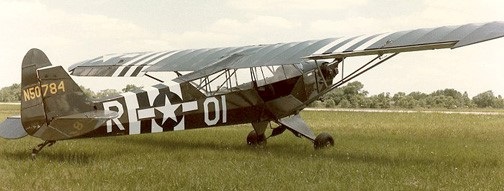
Piper L-4C N50784
Total L-4C impressment was 111, plus 5 more lost in the records somewhere.
The 1943 L-4D were five impressed J-3F.
The 1943 L-4E were one impressed J-4E, plus 1 redesignated from UC-83B, 42-79555.
L-4F were 45 impressed J-5A. plus 42-57505 and five redesignated from UC-83 (42-79551/79554, -107424).
The 41 L-4G were impressed J-5B in 1943.
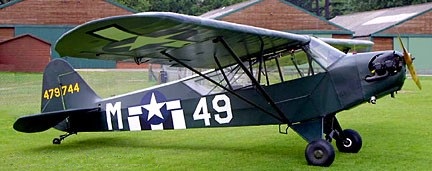
Piper L-4H 44-79744
There were 1,801 of the L-4H variant (43-29247 to 43-30547, and 44-79545 to 44-80044), with only detail changes, and 1,680 of the L-4J (J-3C) model with 65hp Continental which introduced a variable-pitch propeller.
Piper was then requested to develop a training glider from the L-4 design and this, with powerplant removed and the forward fuselage redesigned to accommodate an instructor and two pupils, was built to a total of 250 for the US Army under the designation TG-8. Three of these gliders were acquired for evaluation by the US Navy under the designation XLNP-1.
The US Navy also procured 230 NE-1 aircraft, 26196 to 26425, which, basically similar to the US Army’s L-4s, were used as primary trainers; 20 similar aircraft procured at a later date were designated NE-2, 29669 to 29688. One ship was used for experiments as a potential carry-on by blimps (like a mini-version of the Curtiss Sparrowhawk and USS Akron merger) for long-range sub spotting, but with PBY and PB4Y fitting that role better, the plan was never fully implemented.
When, in 1949, production was switched to the improved Cub J-4 Coupe, Piper had built a total of 14,125 civil and 5,703 military.
Very important to the airplane’s popularity was Pip¬er’s aggressive marketing and pricing. A 1940 brochure lists the 40 hp version of the J 3 for $995, $333 down. And they even threw in a free 12¬month subscription to Air Facts. With a 65 hp Continen¬tal, the price of the J 3 was $1,598.
There were 105 recorded exports to the Turkish AF.
Production increased by leaps and bounds – nearly 600 in 1938, 1100 in 1939, 1800 in 1940. A total of 19,888 were built at Lock Haven and another 150 in Canada. Some were built as L-4 Grasshoppers for the United States military before production ended in 1947.
Certification of the J3C-50 and -65 is under FAA A-691.
The 1944 J-3X was built with a cantilever wing.
Modified lift struts increase the MAUW from 1100 lbs to 1220 lbs.
In 1978 PATTS College of Aeronautics in the Philippines assembled a modified L-4J Piper Cub and flew using 100% alcogas as fuel. In May 1988 a modified version of an L-4J, RPX-25, built by PATTS College of Aeronautics flew.
Piper J-3C-65 Cub Engine: 1 x Continental A65-8, 48kW / 64 hp at 2350 rpm Max take-off weight: 499 kg / 1100 lb Empty weight: 290 kg / 639 lb Fuel cap: 11 USgal Wingspan: 10.73 m / 35 ft 2 in Length: 6.78 m / 22 ft 3 in Height: 2.03 m / 7 ft 8 in Max. speed: 148 km/h / 92 mph Ceiling: 3660 m / 12000 ft Range: 402 km / 250 miles Take-off distance (50ft obstacle): 730 ft / 223 m Landing distance (50ft obstacle): 470 ft / 143 m Climb Rate: 450 ft/min / 2 m/s Crew: 2
J-3F 1938 Engine: 1 x 40, 50, 60, or 65hp Franklin 4AC
J-3L 1938 Engine: 1 x 50, 55, or 65hp Lycoming O-145
J-3P 1938 Engine: 1 x 50hp Lenape Papoose No built: 27
J-3R 1939 Engine: 1 x 65hp Lenape Papoose No built: 1 (NX21806)
J-3X 1944 Engine: 1 x 65hp Continental Speed: 111 mph No built: 1 (NX42111)
NE Engine: 65hp Continental O-170 Wingspan: 35’3″ Length: 22’3″
The company was always sensitive to customer desires, and in 1936, Taylor introduced a refined Cub in order to incorporate design improvements as well as suggestions from the field. Walter Jamouneau was given the job of improving the E 2. He rounded off the wingtips and tail, widened the landing gear tread and moved the axles forward a few inches for better ground handling, improved the fuel system, redesigned the ailerons and got to put his initial into the new type designator, J 2. Aerodynamically, the plane remained virtually the same, but Jamouneau believes that directional and roll control were improved in the J 2. It retained the E 2’s tandem, two place seating but added sliding windows on the left and a clamshell arrangement on the right (the window folded up and the door down), actually a late model E 2 improvement that is still used on the Super Cub. The J 2’s engine remained the reliable A 40-3 or -4.
The sale price in 1936 was $1,470 and $1,270 in 1938. 550 were built by the end of 1936. ATC 2-533 was superseded by ATC 595.
Taylor J-2
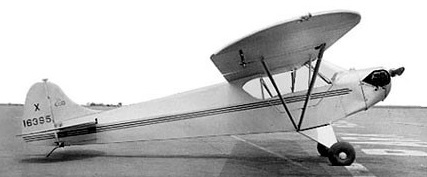
NX16395 J-2S was the prototype with EDO pontoons.
Taylor J-2S minus its floats NX16395
In early 1938, the Ilmavoimat / Maavoimat test team evaluated the Piper J-2. The J-2 had excellent STOL capability, able to take off in less than 300 feet by firewalling the throttle, lifting the tail immediately, pulling full flaps at 45 knots and levering the stick back into the pilots lap. The J-3 was near stallproof, with a stall speed of 34 knots, and short field approaches were easy with full flaps.
Although sales were initially slow, about 1,200 J-2s were produced before a fire in the Piper factory in March 1937. Only 658 Cubs were built that year; total more than 1,200 built by July 1937, at which time production was taken over by Piper Aircraft and the name changed. William Piper relocated his manufacturing operation and several hundred employees to Lock Haven, Pennsylvania, and the Piper Aircraft Corporation was born. By year’s end, it had built 687 Piper airplanes.
Production began in February 1936 and 1207 were built in total until production ended in 1938.
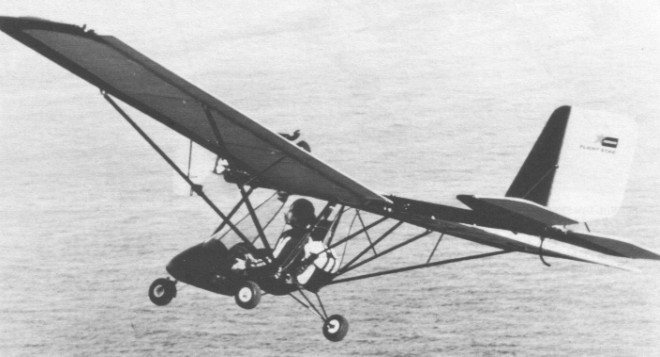
The machine has been developed by Flight Designs, an associate of Pioneer International Corporation and the firm which builds and sells the single seat Jetwing ATV, as well as conducting a research programme on a prototype single seat three axis machine designated 440ST However, at the start of 1983, Andrew N Bohjalian, group president, announced that production and sales of the FlightStar would be taken over by a new associate company called Pioneer International Aircraft. The Pioneer group is well known for its activities in aerospace industry, and includes the Pioneer Parachute Company, which is one of the world leaders in its field. So it is not surprising to find that the FlightStar has been designed from the start to accommodate an emergency 29.0 ft diameter (8.84 m) parachute, which is deployed ballistically and fitted behind the pilot at the rear of the frame.
The aircraft is sold as a complete kit requiring 20 h for assembly and at a price of $7495 in 1983. Apart from the parachute, options offered are floats, skis, wheel fairings, electric starter for the Kawasaki TA440A engine, larger diameter wheels (16 and 20 inch, 41 and 51 cm), transport covers and an instrument panel.
The Flight Designs 440 ST was a single seat single engined high wing monoplane with conventional three axis control. Wing has unswept leading edge, swept forward trailing edge and tapering chord; two fin tail. Pitch control by elevator on tail; yaw control by fin mounted rudders; roll control by spoilers; control inputs through stick for pitch/roll and pedals for yaw. Wing braced from above by kingpost and cables, from below by cables. Undercarriage has three wheels in tricycle formation. Aluminium tube framework, without pod. Engine mounted at wing height driving pusher propeller.
This single seat twin¬-boom, twin rudder aircraft exists only as a prototype in 1982, and was being used at Flight Designs to study the flight envelope of such machines.
Single seat single engined high wing mono¬plane with conventional three axis control. Wing has unswept leading edge, swept for¬ward trailing edge and tapering chord; conventional tail. Pitch control by elevator on tail; yaw control by fin mounted rudder; roll control by full span ailerons; control inputs through stick for pitch/roll and pedals for yaw. Wing braced from below by struts; wing profile; double surface. Undercarriage has three wheels in tricycle formation, with additional tailskid; bungee suspension on all wheels. Flush right go right nosewheel steering connected to yaw control. Aluminium tube framework, with optional pod. Engine mounted at wing height driving tractor propeller.
Shown at Oshkosh in August 1982, the prototype FlightStar made its first flights during that summer. It carried trapezoidal planform ailerons, whose chord tapered toward the wing tips and which covered a little less than the full span of each wing, but these have been replaced for the production machines by full span ailerons. In addition, the production FlightStar, on show at Sun ‘n’ Fun in Lakeland, Florida in March 1983, was fitted with a glass fibre pod with a windscreen mounted on top and going right up to the strut carrying the wing.
440 ST Engine: Kawasaki TA440A, 38.5 hp at 6000 rpm Power per unit area 0.26hp/sq.ft, 2.9hp/sq.m Fuel capacity 5.0 US gal, 4.2 Imp gal, 18.9 litre Length overall 18.8 ft, 5.69 m Height overall 8.3ft, 2.51m Wing span 34.0ft, 10.36m Sweepback 0 deg Total wing area 144 sq.ft, 13.4 sq.m Wing aspect ratio 8.0/1 Empty weight 218 lb, 99kg Max take off weight 529 lb, 240 kg Payload 311 lb, 141 kg Max wing loading 3.67 lb/sq.ft, 17.9 kg/sq.m Max power loading 13.7 lb/hp, 6.2kg/hp Load factors; +6.0, 4.0 ultimate Max level speed 60 mph, 97 kph Max cruising speed 50 mph, 80kph Stalling speed 22mph, 35kph Max climb rate at sea level 950ft/min, 4.8m/s Take off distance 60ft, 18m Landing dis¬tance 50ft, 15m Range at average cruising speed 240 mile, 386 km
FlightStar Engine: Kawasaki TA440A, 38.5hp at 6000rpm Propeller diameter and pitch 58×27 inch, 1.47 x 0.68 m Belt reduction, ratio 2.0/1 Max static thrust 270 lb, 122kg Power per unit area 0.25hp/sq.ft, 2.9hp/sq.m Fuel capacity 5.0 US gal, 4.2 Imp gal, 18.9 litre Length overall 16.5 ft, 5.03 m Height overall 7.5ft, 2.29m Wing span 30.0ft, 9.14m Chord at root 4.8ft, 1.46m Chord at tip 4.5ft, 1.37m Dihedral 2.5 deg Sweepback 0 deg Tailplane span 8.2 ft, 2.50 m Fin height 4.0 ft, 1.22 m Total wing area 144 sq.ft, 13.4 sq.m Total aileron area 26.0 sq.ft, 2.41 sq.m Fin area 5.0sq.ft, 0.46 sq.m Rudder area 7.0 sq.ft, 0.65 sq.m Tail¬plane area 10.0sq.ft, 0.93sq.m Total elevator area 11.0sq.ft, 1.02 sq.m Wing aspect ratio 6.3/1 Wheel track 5.1 ft, 1.55 m Wheelbase 6.0 ft, 1.83 m Nosewheel diameter overall 10 inch, 25 cm Main wheels diameter overall 10 inch, 25 cm Empty weight 247 lb, 112kg Max take off weight 500 lb, 227kg Payload 253 lb, 115kg Max wing loading 3.47 lb/sq.ft, 16.9kg/sq.m Max power loading 13.0 lb/hp, 5.9kg/hp Load factors +6.0, 4.0 design; +7.8, ulti¬mate Max level speed 64 mph, 103 kph Never exceed speed 75 mph, 121 kph Max cruising speed 55 mph, 88 kph Economic cruising speed 50 mph, 80 kph Stalling speed 25 mph, 40 kph Max climb rate at sea level 850 ft/min, 4.3 m/s Min sink rate 350 ft/min at 30 mph, 1.7 m/s at 48 kph Best glide ratio with power off 7.1/1 at 35mph, 56 kph Take off distance 100 ft, 30 m Land¬ing distance 100ft, 30m Service ceiling 10,000ft, 3050 m Range at average cruising speed 50 mile, 80 km
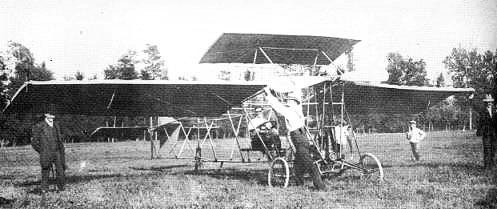
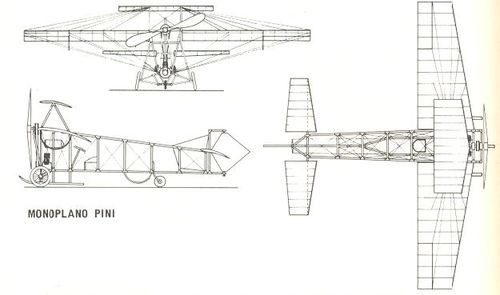
In 1908 Enrico Pini (born in Milan in January 1889), was in Paris during time when Wilbur Wright presented their airplanes. He became excited and remained influenced by aviation. He abandoned his normal activities and followed the American aviator, with such interest as to attract attention and sympathy of Wilbur Wright, who wanted to reward him by taking him as a passenger in a short flight. Then Pini decided to build himself an airplane, he designed one, a monoplane-biplane that best met his needs for aesthetics rather than technical ones.
In Milan, Enrico Pini had a brother, engineer Adolfo Pini, who was five years elder, he was an electrical engineer and occupied a responsible position at the Edison Electric Company. Bothe brothers started to build a full size machine according to Enricos drawing and with help of Adolfos fundings (this sum was to be used for the expenses of his marriage, which was therefore postponed), Adolfo even resigned from Edison`s company to dedicate himself fully to the project.
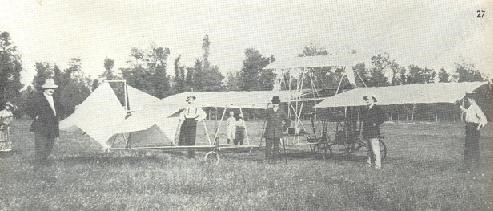
The brothers built the machine at the Bezzi`s factory, he was an industrialist, who owned an electric motor factory. Designed Enrico Pini, its planes were so arranged as to widely separate a large rectangular monoplane wing, then to add a small horizontal plane above the gap. All year 1909 was dedicated to the creation of the airplane, the assembly of which took place in the hangar of Societa Restelli, which built the Rebus engines, located in Piazza d’Armi nuova. In turn, the uncle and godfather of the two brothers Adollo, wanted to help them by providing them with the engine unit, a three-cylinder fan-type Anzani fan of about 25 HP, the kind used by Bleriot in his famous crossing of the Channel.
At the end of 1909, on 15th November, it was inaugurated in Milan the first exhibition of Italian Air Force “1a Esposizione Italiana d’Aviazione” organized by the Gazzetta dello Sport, at the vast halls of the Splendido Corso Hotel. The Pini brothers exhibited the model of their aircraft that was awarded by the jury with a bachelor’s bronze medal. In the spring of 1910 finally they began testing, pilot was Enrico, but at first the machine rarely reached the desired speed, it was only taxiing, the engine was underpowered. They made some improvement of undercarriage. With the daily trials and modifications aimed at improving the performance of complex propulsion and weight reduction, the device gradually lengthened its hops up to make small flight in height ranging between 50 and 80 cm from grass surface and a length variation from 200 to 500 meters.
Unfortunately the financial means of the two brothers were soon at the end, in view of their uncle would not hear of poor results to come to the aid; they tried to borrow, but even this was limited by the lack of trust that was fed to the success of the company (Bezzi was the same creditor to over six thousand liras) and therefore the tests had to be suspended and the two unfortunate inventors, despite all the sacrifices and renunciations that were subjected to succeed in their intent, reluctantly abandoned their aviation activities. The autumn saw the device removed and deposited in a cellar and was eventually sold as scrap.
A manufacturer from Milan, Ercole Marelli, which had seen the equipment of the Pini brothers had been appreciated, rather than the qualities of the aircraft itself, the brilliant and original construction, the engineer then offered a job in his company. Enrico Pini, after the bitter disappointment, continued in his business with bold new initiatives, and finally, helped by luck managed to form a solid financial position.