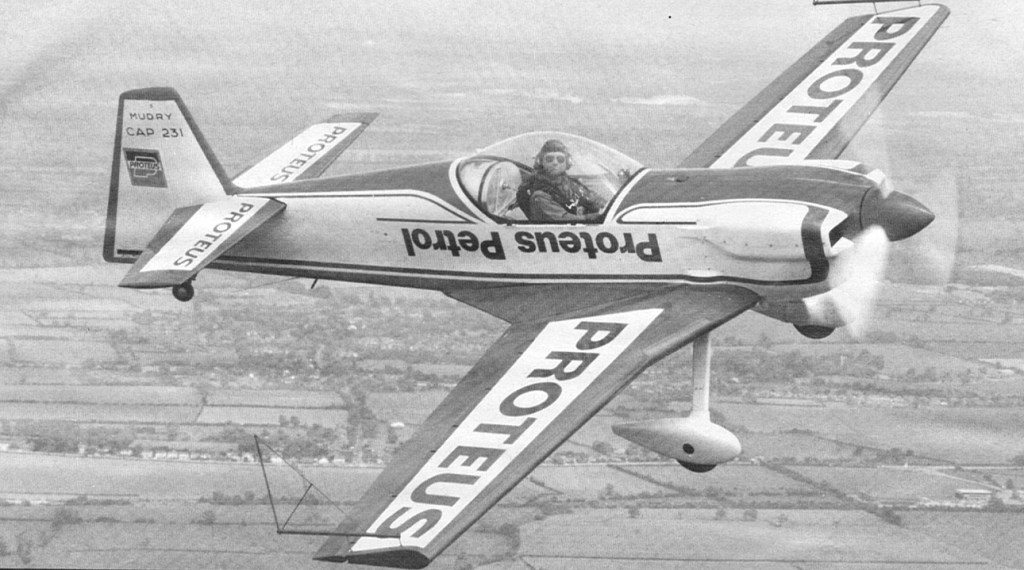
The CAP 231 differs from the CAP21/230 by its new wing leading edge fillets where the wing joins the fuselage.
The CAP 231 is stressed to +/- 10g and has a Vne of 250 mph.
The 231 has taken part in the 1990 WAC at Yverden, Switzerland.
The CAP 231 differs from the CAP21/230 by its new wing leading edge fillets where the wing joins the fuselage.
The CAP 231 is stressed to +/- 10g and has a Vne of 250 mph.
The 231 has taken part in the 1990 WAC at Yverden, Switzerland.
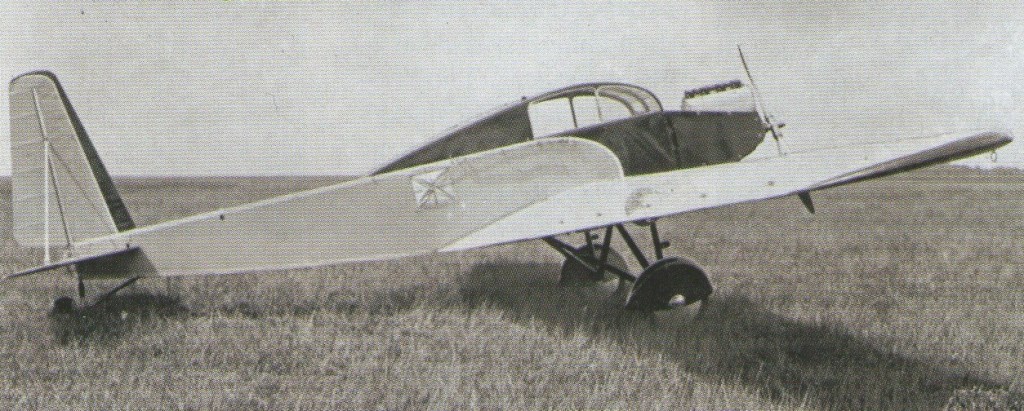
This cabin monoplane, possibly a homebuilt job, looks like it was scaled up from a flying model. It is all straight lines and simplicity, but its fixed taildragger undercarriage has a tailwheel, and spats cover the mainwheels, The tall narrow-chord fin and rudder is strut-braced, and the aerofoil-shaped cockpit cover sits atop a squaresection fuselage. The upright four-cylinder inline air-cooled piston engine in the nose drives an adjustable-pitch two bladed metal propeller. Although the aircraft is finished in a two-tone scheme it carries no markings to reveal either maker or registration, apart from an indecipherable emblem in a square on the fuselage side, in line with the wing trailing edge, and another small and even more indistinct logo on the rudder. The flat grassland offers no clues at all as to whereabouts, and it is even difficult to date the picture, which is just as likely to have been taken in the 1930s as the 1950s.
AEROPLANE NOVEMBER 2006
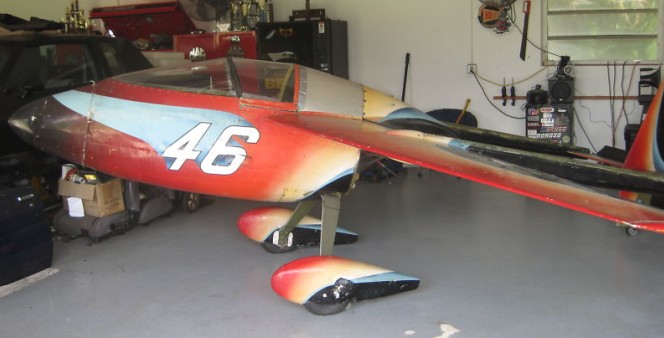
1966 Formula 1 Racer Pusher Type Experimental
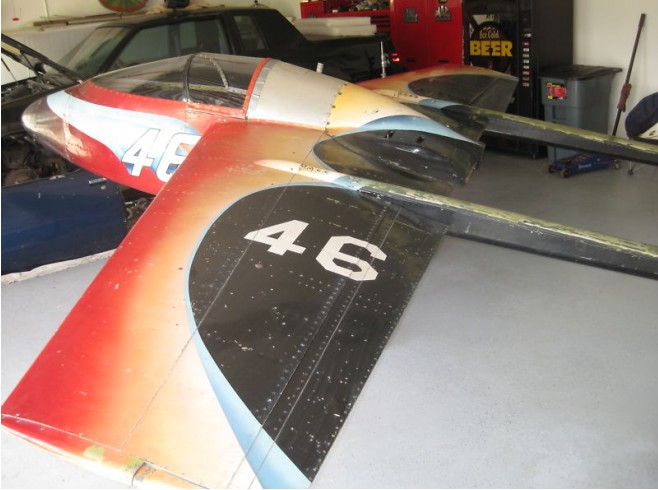
This is a 1966 formula 1 racer pusher type experimental, the aircraft is a stressed skin design with cantilever wing construction and twin booms to accomodate pusher engine and conventional landing gear. The entire airframe components, internal structure, and all skin surfaces are made from 2024-T3 alclad aluminum, wingspars are of 2024 -T3 aluminum web with extruded spar cap top to bottom.The cockpit area is formed of half hard aluminum.The canopy is formed of plexiglass, all fittings are welded chromoly, all flight controls are cable operated except ailerons these are push type controlled.Engine is a O-200 or C-85.
It was built for the Goodyear races, by three engineers who passed away together in an airline accident and the aircraft was never finished or flown.
Henry Guantt later purchased this aircraft from a Mr. Watts in 1973.
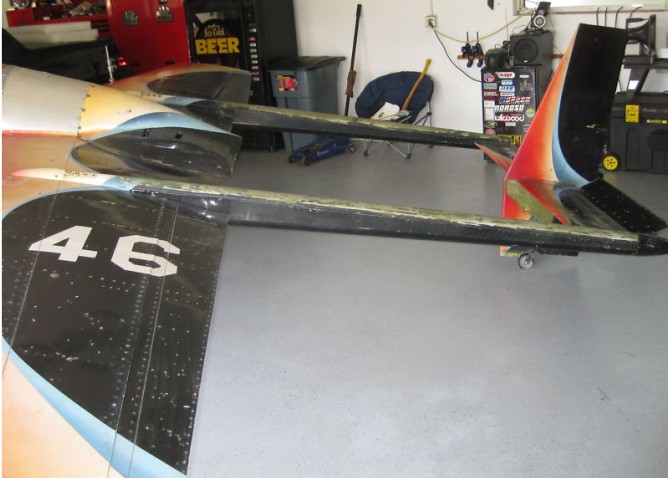
This aircraft was then aquired by a father and son team around 2006 for the purpose of fixing and flying the aircraft but that never came to be because the father passed and they never got to finish this project. Around 2012 the craft was again on the market, hoping someone could dedicate the time to it and fly it. This included all of its documentation and specs and all of the parts to complete it except the engine but including the pusher type propeller.
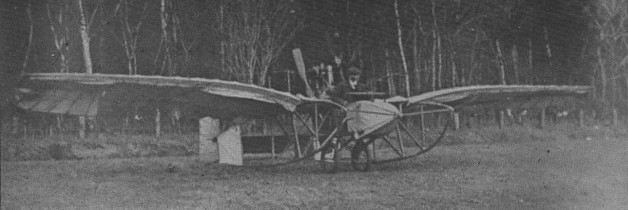
The machine is a monoplane with arched wings. Its cloth-capped pilot is seated in a faired central nacelle, immediately in front of a large vertical piston engine, possibly with four cylinders, driving a two-bladed wooden pusher propeller. The nacelle is supported on a twin-wheel undercarriage, and a few feet out on either side are open frames extending rearwards to carry the tall surfaces. The rear ends of these frames are covered in to serve as fins There appears to be a monoplane tailplane, possibly with an elevator, plus twin rudders behind the tailplane. The wings appear to be double-surfaced only along their leading edges, back to the front spar, and single surfaced aft of the front spar, and their fabric covering is clearly poorly applied, as it may be seen hanging down beneath the inboard leading edges. Inset ailerons are fitted at the wingtips. It is extremely difficult to date it any more precisely than 1909-13.
Aeroplane Monthly August 2006
Morane-Saulnier Type H13 replica
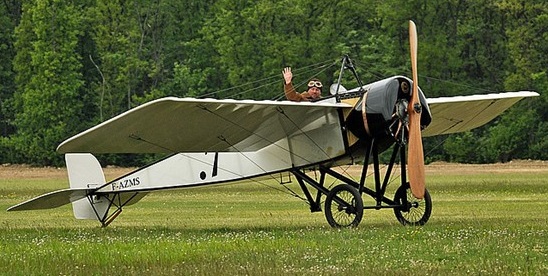
La Ferte-Alais, France, May 18, 2013
F-AZMS (cn SAMS 22.01) M
Aerobat glider
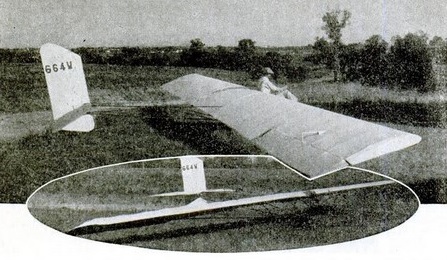
Built in 1930 in Oklahoma City, the Aerobat glider was made entirely of aircraft steel dural and hib-lum covered with flightex fabric. It had an adjustable seat to provide balance for and weight pilot.
In its trial flight this primary glider gained over 300 feet altitude with 4 minutes 30 seconds duration, taking off at 12 mph by auto-tow.
The glider was priced at $395 and pontoon equipment was optional at $100 extra.
Wingspan: 42 ft
Wing chord: 5 ft 6 in
Length: 16 ft 6 in
Glide ratio: 16-1
Landing speed: 15 mph
Cologne Eindecker of 1911
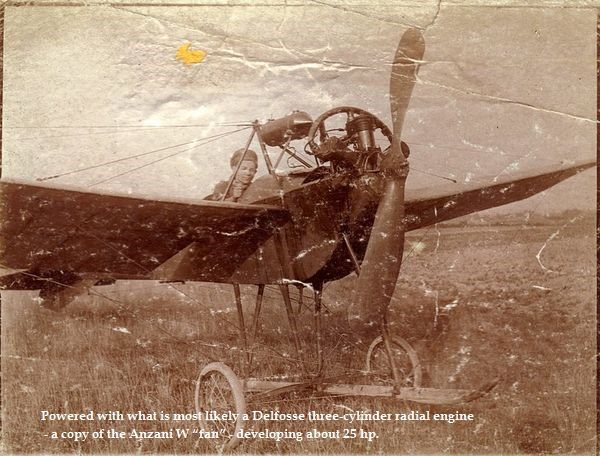
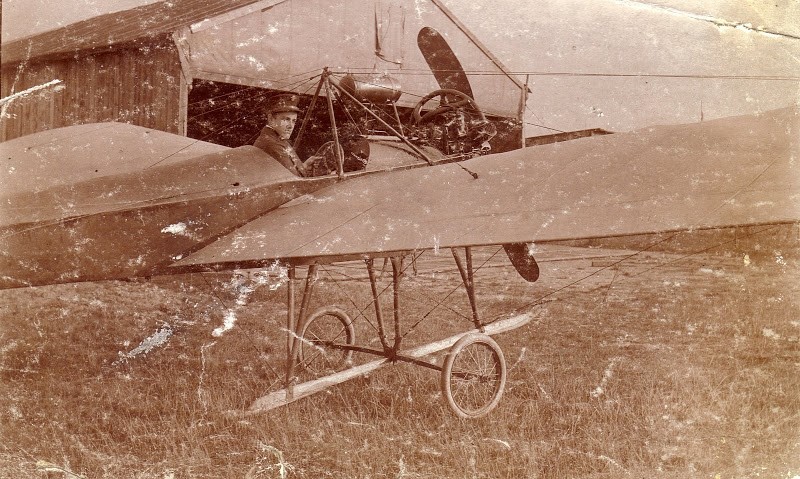
An unidentified Eindecker of 1911 at Cologne. Probably photographed at the Butzweiler farm airfield, what is almost certainly a machine by Jean Hugot or Bruno Werntgen, to name but two possibles among a small group of very early Kölner aviators. Powered with what is most likely a Delfosse three-cylinder radial engine – a copy of the Anzani W “fan” – developing about 25 hp.
Suzuka 24
By 1945 a new threat emerged to Japan, American strategic bombing raids. The introduction and use of the Boeing B-29 Superfortress posed a substantial threat to Japanese aircraft. To remedy this issue, development of new more powerful fighters took place. Correspondence with Germany resulted in sharing of rocket and jet engine information to Japan.
Rocket development became heavy in Japan, with multiple designs being built. It was decided to redesign the Ohka for a new role – bomber interception. The Ohka-based interceptor would be lighter in weight, smaller armament, and a small silhouette. The Ohka was designed by the Japanese Naval Air Service, however the change to use a land-based interceptor was developed by either the Navy or Army air serviced, currently unknown.
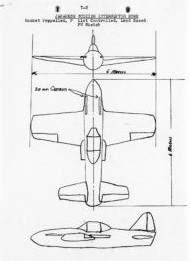
The Ohka 43B and Suzuka are two completely different machines. The new design removed the use of a warhead entirely. Instead, a fuel tank and two 20mm cannons were placed in the nose of the design. With only a length of 6 meters, the 20mm cannons take up a considerable worth of space to fit the gun and munition belts properly. The design of the aircraft was significantly altered to account for its new use. A changed tail design, now introducing a general vertical and horizontal rudder and elevator, allowing better control of the aircraft in flight. Along with this a longer wingspan, being 0.5 meters longer on each side of the aircraft and thicker support. The new design of the Ohka-interceptor allowed for ease of maneuverability in flight. It is speculated to have been powered by a Toko Ro.2 (KR-10) rocket. The engines for the Suzuka was one of the most important changes. The Suzuka would be powered by a single Toko Ro.2 (KR-10) rocket (Japanese copy of the Walter HWK 509A rocket used in the J8M/Ki-200 interceptors) producing around 14.7 kN (3007 lbf) of thrust. The fuel capacity accommodated an estimated 7 minutes worth of fuel.
The KR-10 by April 3rd were highly experimental. Even when mounted on the J8M prototype months later, the KR-10’s operated poorly and even resulted in exploding due to the rocket mixtures.
The interceptor was produced in a handful of models. By the time the war ended in 1945, most of the vehicles were kept at Suzuka (a single example), Yokosuka, and Kanoya airfields.
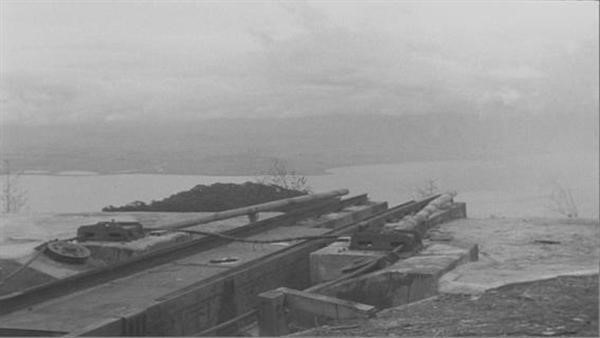
The Suzuka 24 would have been launched from a ramp, and is unknown whether or not it had landing gear.
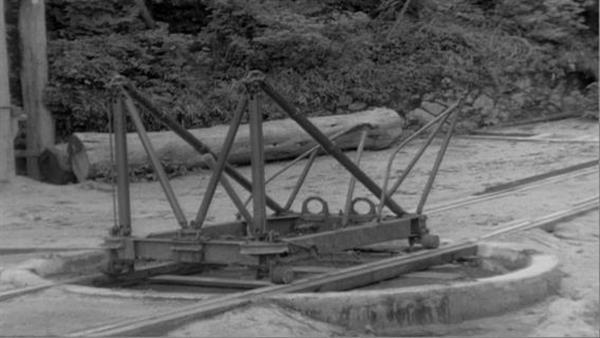
It was allegedly seen in action 3 times near the end of the Pacific War by B-29 bomber crews, but did not inflict damage and retreated shortly afterwards.
The first encounter occurred on April 3rd of 1945 during a B-29 raid on the Tachikawa Aircraft Factory. A B-29 crew reported seeing a “ball of fire” at their 5 o’clock closing in behind them. The B-29 pulled quick evasive turning maneuvers while lowering their altitude. The “ball of fire” quickly closed in on the lost distance, but suddenly turned back a few seconds later. One of the crew members reported that he saw a stream of fire following the object, and faded when the object turned. The blister gunner reported seeing a wing attached to the object, and what seemed to be a navigational light burning on the wing’s left tip.
The second encounter occurred during a raid near Tokyo Bay. A B-29 crew member reported seeing a “ball of fire” following it at approximately 4,000ft (1,220m) while the bomber was at approximately 7,000ft (2,130m). The B-29 began evasive maneuvers right away, gaining and losing 500ft (152m) quickly. It also changed its course by 35 degrees, and increased the airspeed from 205mph (330km/h) to 250mph (402km/h). The B-29 crew lost sight of the “ball of fire” three times as it was flying through the clouds but to their surprise, found it sitting on their tail when the B-29 came out of the clouds. The “ball of fire” followed the B-29 for approximately 5 miles (8km) across Tokyo bay before turning around.
The third encounter supposedly happened at night, a waist gunner of a B-29 at 8,000ft (2,440m) reported seeing what was thought at first to be light from an amber colored searchlight. The light gained altitude and followed the B-29. The pilots then climbed to 12,000ft (3,660m) and then came down to 10,000ft (3,050m) but the light followed. The radar operator then picked up an object trailing behind the B-29 at approximately 1 mile (1.6km) behind. Shortly afterwards, the tail gunner reported seeing a stream of fire emanating from the pursuing object. The fire appeared to be coming out in bursts, with each burst measuring approximately 24 inches (61cm) with a 6 inch (15cm) break between each burst from the gunner’s perspective. The fire kept emanating for about 7 minutes before ceasing for good. The B-29 continued through evasive maneuvers, but the object kept on following. The object was last seen about 30 miles beyond the coast line above the ocean.
United States Intelligence discovered one model at Suzuka, and labeled the aircraft as the Suzuka-24 as the official designation was not known. The first such discovery was made by AC/AS intelligence when they photographed Suzuka Airfield.
Soon afterwards, XXI Bomber Command discovered four more models of the Suzuka-24 were discovered at Kanoya airfield. At Yokosuka, another model was found along with a pilot belonging to the airfield captured. The pilot listed details of the aircraft, its designated use being bomber intercepting, and measurements of the aircraft. Photographs were mentioned as being taken, however at this time none have been found. The machine was further described in detail in a prisoner of war interrogation with two Japanese petty-officers.
In an interview conducted post-war of two Japanese petty officers confirmed the existence of the Suzuka. One of the interrogates described seeing the Suzuka at Yokosuka airfield in October of 1944. He described it as a “ground-launched, rocket-propelled, interceptor bomb”. The primary target seems to be Boeing B-29 Superfortresses.
Reports on the Suzuka 24’s spotted from aerial photos, as well as information collected from POWs.

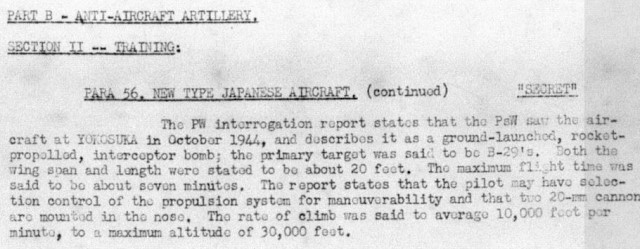

After the war, the United States encountered many different aircraft. Multiple variations of the Ohka were made and left over in mixed conditions. Because of this, the Suzuka-24 is confused to be an identical Ohka with a warhead, the Model 43B. The Model 43B was similarly designed to hold two 20mm cannons. However the fuselage was extended to carry both the cannons and warhead with fuel for a Ne20 jet engine.

Suzuka 24
Powerplant: 1x Toko Ro.2 (KR-10) rocket – 3,307 lbs / 1,500kg thrust (presumed)
Wingspan: 20 ft aprox. (6.097 m)
Length: 20 ft aprox. (6.097 m)
Maximum Glide Speed: 840 kmh (520 mph)
Rate of Climb: 10,000 feet per minute (3,050 meters per minute)
Range: 7 minutes of fuel
Service ceiling: 32,000 feet (9,755 meters)
Crew: 1
Armament: 2 x 20mm Cannons (60 or 150 shells per gun) (Unknown Ho-5 or Type99)
Bombs: None

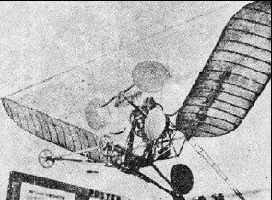
A 1914 VTOL machine
1910 Monoplane

Present but not flown at the Los Angeles Aviation Meet at Dominguez in January 1910, its actual identity is not determinable at this time.
 All Aero