Pottier P.130 Coccinelle / Bleu Citron

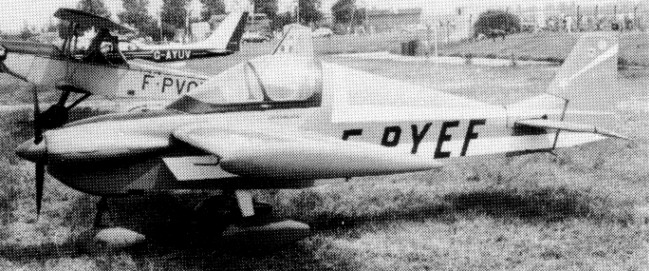
In 1966 Jean Pottier designed the P.30 Pétrel. It would have been a single engine, small, shoulder wing monoplane, but it was never built. Thirty years later Pottier produced a revised version seating two side-by-side and designated the P.130 Coccinelle. This venture was supported by the RSA’s Bleu Citron (English: Blue lemon) programme and the P.130 has sometimes been referred to as the Pottier Bleu Citron.

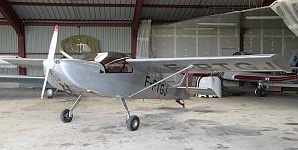
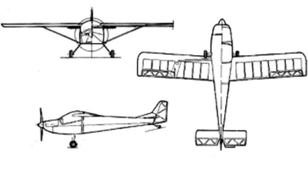
The Coccinelle is a simple wood framed, fabric covered monoplane, with shoulder mounted wings braced by a single strut each side from the lower fuselage longerons. The wings are essentially rectangular in plan, though with blunted forward tips, and have significant forward sweep. The balanced rudder is almost without a fin, though there is a shallow, triangular fillet in front of the rudder, which is large, straight edged and extends to the keel. The rectangular tailplane, mounted at the top of the fuselage, carries full span, rectangular plan elevators with a central cut-out to allow rudder movement.

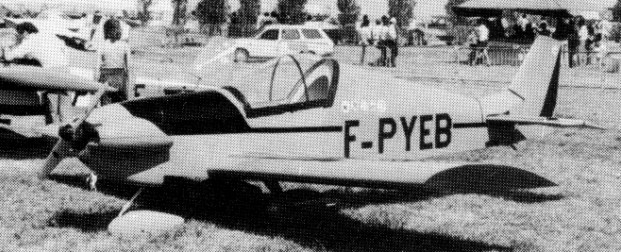
The Coccinelle’s fuselage has a rectangular section throughout and its profile is straight edged except under the engine, where it curves upwards. The side-by-side seats are ahead of the wing leading edge and largely enclosed under a one piece, rear hinged, part bubble type canopy. Behind this are further transparencies which can vary from builder to builder but extend rearwards a little way into the wing. Most Coccinelles have a tail wheel undercarriage with front wheels on thin, steel cantilever legs, though a tricycle undercarriage is an option. Some builders have added spats.
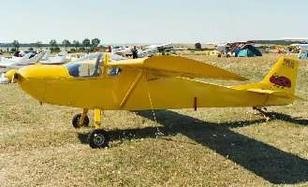
The Coccinelle was intended for home building from his plans. These allow a choice between the P.130UL, meeting the ultralight certification requirements, or the normal P.130L. The 2014 French register shows that the latter is usually preferred. A variety of engines are suitable, including the Volkswagen air-cooled flat four with powers between 48–75 kW (65–100 hp) and the 60 kW (80 hp) JPX.

The prototype first flew in 1998 and by 2001 more than 60 were under construction in France. The European 2014 civil aircraft registers show 23 P.130s, 21 in France and 2 in Spain.
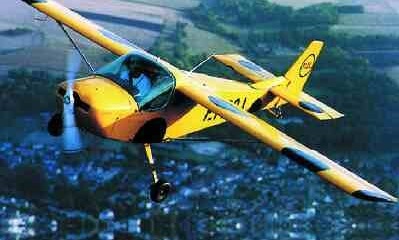
Gallery

Variants:

P.130L Coccinelle
meeting normal light aircraft certification requirements

P.130UL Coccinelle
meeting ultralight requirements

Specifications:

Engine: 1 × 1600 cc Volkswagen, 48 kW (65 hp)
Propeller: 2-blade
Wingspan: 5.28 m (17 ft 4 in)
Length: 6.9 m (22 ft 8 in)
Height: 1.98 m (6 ft 6 in)
Gross weight: 500 kg (1,102 lb)
Empty weight: 260 kg (573 lb)
Fuel capacity: 60 lt
Maximum speed: 195 km/h (121 mph; 105 kn)
Cruising speed: 181 km/h (112 mph; 98 kn)
Stall speed: 85 kph
Range: 480 km (298 mi; 259 nmi)
Rate of climb: 4 m/s (790 ft/min) initial
Seats: 2
Certification: CNRA
Potez-Heinkel CM 191 / C.M.192

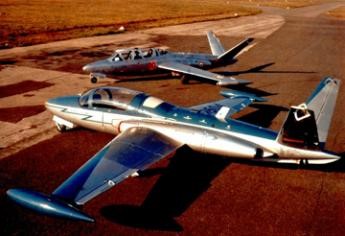
A new Heinkel company (mid of fifties) began by forming the Flugzeug Union-Süd Group, in collaboration with Messerchmitt AG., to produce 210 Fouga Magister for the new German air force. In cooperation with Potez, it developped from the Magister a new four seat executive, training and liaison aircraft known as the Potez-Heinkel CM-191. Heinkel was entirely responsible of the production.

The prototype of the four-seat Potez-Heinkel CM191 was flown for the first time at Toulouse on 19 March 1962. Jacques Grangette, Potez’s chief pilot was at the controls, with P.Caneill. The CM 191 first flight lasted forty minutes and a second flight of one hour and ten minutes duration was made on the same day.

Two prototypes were built. They were for many years as experimental aircraft to test various equipment or as liaison aircraft

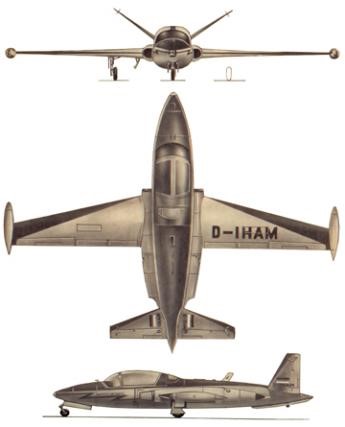
Potez – Heinkel CM191 # 1 received a double registration from the beginning as D- 9504 and D- IHAM. It made its first flight in Toulouse March 19, 1962 and after 109 hr of manufacturer flight testing it was issued to the CEV Istres for testing .

It was subsequently delivered to Germany where it finished its career with 61 Erprobungsstelle Manching. This aircraft was registered in the United States, where it has changed ownership in 2008, to be based in Elk Grove, Illinois.

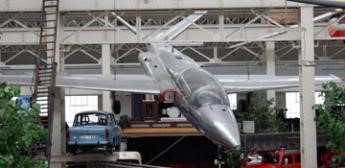
Potez – Heinkel CM191 # 2 received the registration D- 9532 and completed its career with 61 Erprobungsstelle Manching. This aircraft is now preserved and exhibited at the Am Technik Museum, Speyer, Germany.

Potez – Heinkel CM- 191 # 2 D- 9532

Variants:

CM.191 – 1956 4-seat corporate jet deriv. of CM.170, 2 x Marboré IV, 2 built
CM.191: aka Potez-Heinkel C.M.191, aka Heinkel P.191, first flown 1962

CM.192 – Messier project nos. 48046/48007 and 27457/48008
CM.192: Flight 1 June 1961 ident. Potez-Heinkel C.M.192 as per C.M.191

Gallery

Specifications:

Engines: 2 x Marboré IV
Span, without tip-tanks: 12,02 m (39 ft. 5 in)
Span, with tip-tanks: 12,70 m (41 ft. 8 in)
Length: 9,93 m (32 ft. 7 in.)
Height: 3,20 m (10 ft. 6 in.)
Weigth empty: 2 391 Kg (5,271 lb.)
Max Payload: 380 kg (838 lb.)
Max TO weight: 4 350 Kg (9,590 lb.)
Max 0 fuel weight: 3 005 Kg (6,625 lb.)
Max wing loading: 231 Kg/m² (47.3 lb/sq ft)
Max. Speed: 710 kmh (441 mph)
Max. Permissible speed: 740 kmh (460 mph)
Max. Crusing speed: 605 kmh (376 mph)
Stalling speed: 148 kmh (92 mph)
Max rate of climb: 906 m/mn (2970 ft/mn)
Service ceiling: 12 000 m (39,370 ft)
TO. Run: 900 m (3,250 ft)
TO. Run dist. to 15m: 1 180 m (3,870 ft)
Range with max fuel: 1860 km (1,150 miles)

Potez 840

Prototype 2 F-WJSU

The first prototype of the Potez 840 executive transport made its initial flight on 29 April 1961. An all-metal low-wing cantilever monoplane, it was powered by four 328kW Turbomeca Astazou II turboprops, had fully retractable tricycle landing gear, and carried a crew of three with cabin accommodation for up to 18 passengers. A second prototype, F-WJSU, was flown in June 1962, had Astazou XII engines of 447kW each.

F-WJSU was ferried to the USA as N840HP for use by the Ameriican distributors Turbo-Flight. In 1964 N840HP returned to Frane and became F-BMCY.

After a sales tour in North America by the P-840.02, plans were made for a production batch of 25 Potez 840s, but in fact only two more prototypes were built, one of these being reserved for static testing. Two Potez 841 aircraft followed, powered by 417kW Pratt & Whitney Aircraft of Canada PT6A-6 turboprops. Finally, the modified Potez 842 appeared in 1965, a second aircraft, also powerd by Astazou XIIs following two years later.

These eight light transports were the last aircraft of the Potez marque to be built; one is now exhibited at the Musee de I’Air, Paris, and a second has been restored and is flown under the auspices of the French Association Aeromedicale.

Engines: 4 x Turbomeca Astazou turboprop
Max take-off weight: 7800 kg / 17196 lb
Wingspan: 19.33 m / 63 ft 5 in
Max. speed: 540 km/h / 336 mph
Pax cap: 16

Potez 670 / 671

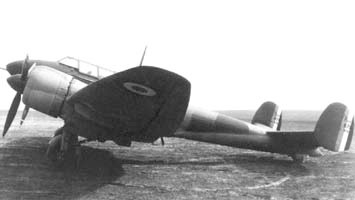
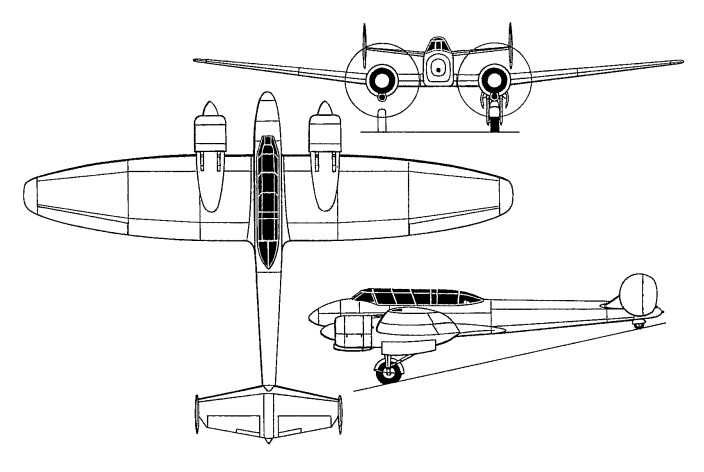
Designed to meet a requirement for a three-seat fighter with an endurance of three hours at 90% max speed, the Potez 670 was configurationally similar to the Potez 630 and 631. Flown for the first time on 30 March 1939, the Potez 670 had meanwhile been modified as a two-seat long-range escort fighter and bomber destroyer.

Potez 670

Initially powered by two 700hp Gnome- Rhone 14M radials, it was re-engined after initial flight trials with two 800hp Hispano-Suiza 14AB 12/13 radials, with which it resumed flight tests in July 1939 as the Potez 671.

Potez 671

Several production variants were proposed, but flight trials were incomplete at the time of the French collapse and the sole prototype was destroyed during the German onslaught. At the time, work had begun on an initial batch of 40 Potez 671 C2 fighters.

Potez 670
Engines: 2 x Gnome & Rhone 14M-3, 700 hp
Wingspan: 15.10 m
Wing area: 32.50 sq.m
Length: 10.80 m
Height: 3.27 m
Empty weight: 3120 kg
Maximum take-off weight: 4680 kg
Maximum speed: 460 km / h
Cruising speed: 412 km / h
Practical range: 1800 km
Service ceiling: 10,000 m
Crew: 2
Armament: 2 x 20-mm cannon Hispano-Suiza HS-404 front, 2 x 7.5-mm machine guns MAC 1934, 1 x 20-mm cannon Hispano-Suiza HS-404 rear-firing turret

Potez 671
Engines: 2 x Hispano-Suiza 14AC, 800 hp
Wingspan: 15.10 m / 50 ft 6 in
Wing area: 32.50 sq.m / 349.83 sq ft
Length: 10.80 m / 35 ft 5 in
Height: 3.27 m / 11 ft 9 in
Max take-off weight: 4726 kg / 10419 lb
Empty weight: 3186 kg / 7024 lb
Max. speed: 500 km/h / 311 mph
Cruising speed: 445 km / h
Maximum rate of climb: 876 m / min
Service ceiling: 10,500 m
Range: 2000 km / 1243 miles
Crew: 2
Armament: 2 x 20-mm cannon Hispano-Suiza HS-404 front, 2 x 7.5-mm machine guns MAC 1934, 1 x 20-mm cannon Hispano-Suiza HS-404 rear-firing turret

Potez 670 / 671