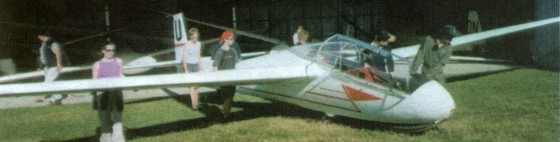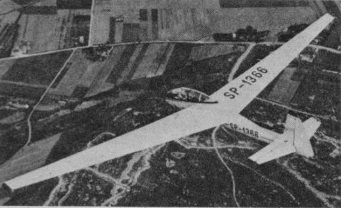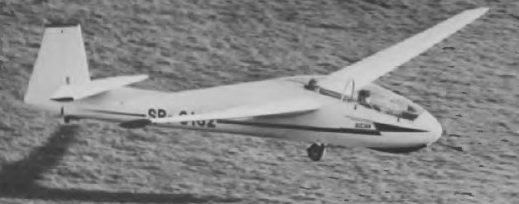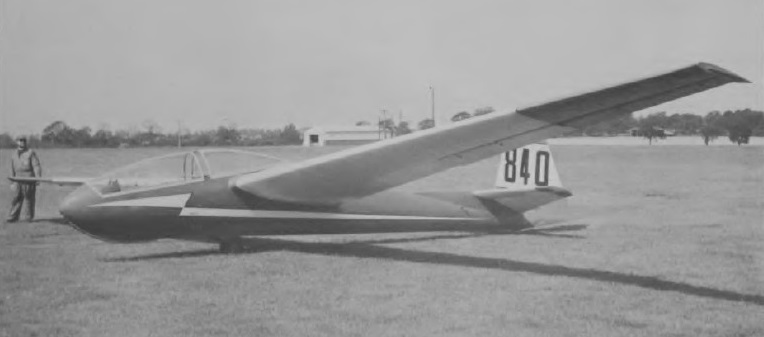
PZL Bielsko SZD-19 Zefir 1 / Zefir 2

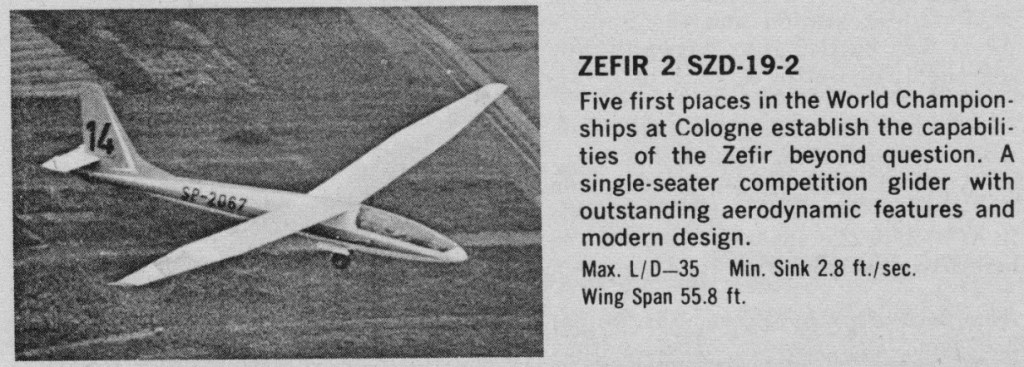
Zefir 2 SZD-19-2

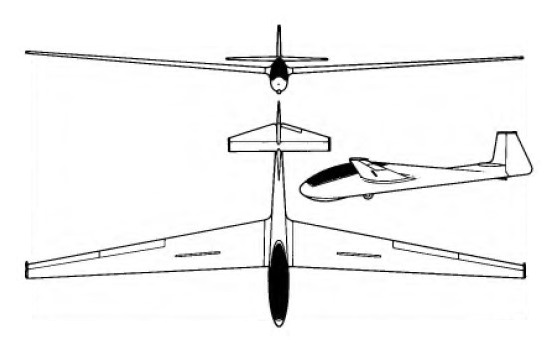
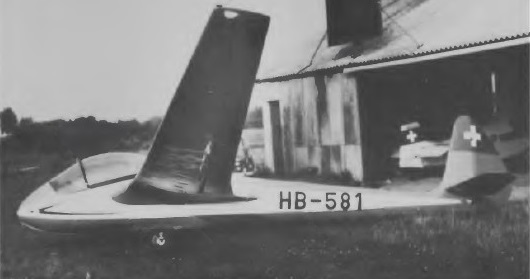
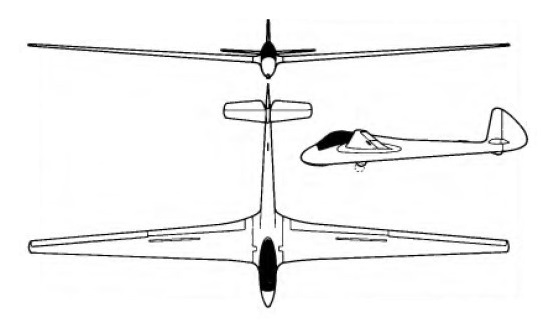
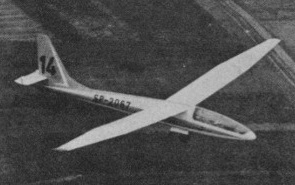
The Zefirs resulted from work done by a team under Dipl-lng B.Szuba and the SZD-19X Zefir 1 prototype, designed by B. Szuba, made its first flight on 4 January 1959 as an Open Class single-seater and this was followed by the SZD-19-2 Zefir 2, which first flew in March 1960. The first two examples of this version, flown by the Polish pilots Makula and Popiel, took 2nd and 3rd places in the Open Class in that year’s World Championships in Germany.

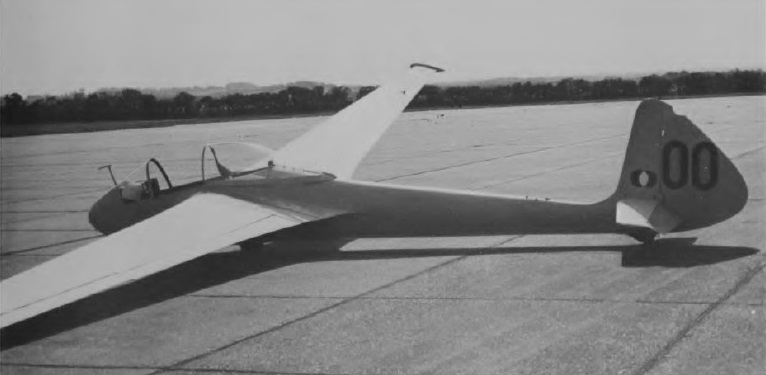
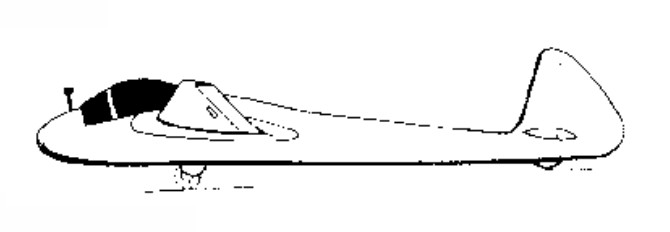
The Zefir aroused great interest here because of its advanced design features, in particular the reclining pilot’s position that made possible such a well streamlined fuselage of low cross sectional area, slotted flaps, the tail braking parachture, the towing hook unit combined in the retractable monowheel, and the swept back fin and rudder with the one-piece tailplane and elevator slotting into the tail cone below the rudder.

The Zefir 2 was rolled out in January 1961 and Polish pilots flying this type were placed first and second in the 1963 World Championships in Argentina. The Zefir 2 went into limited production during 1963-64 and three improved Zefir 2As took part in the 1963 World Championships in Argentina; this time their pilots Makula and Popiel came 1st and 2nd in the Open Class and the Argentine pilot Rudolfo Hossinger, who had won the 1960 World contest in a Skylark 3, was placed 5th in a Zefir 2A. The cantilever shoulder wings were of 17m (55ft 9.5 in) span and 20.7 aspect ratio, with an NACA 65-series laminar flow section; each wing has a central plywood torsion box with a plywood/plastic core sandwich skin, a D-section leading edge and a plywood-covered trailing edge. The wooden ailerons are fabric-covered and the VZLU mechanically-operated slotted flaps are in six sections covering 35% of the chord; there are no dive brakes. The wooden fuselage has the monocoque nose section covered with glassfibre, the centre section and tail cone being ply-covered semi-monocoque structures, the drag parachute being housed in the tail cone. The tail surfaces have laminar flow sections, the fin and tailplane being covered with a sandwich skin and the rudder and elevators fabric covered, with a trim tab in the elevator. The long flush-fitting cockpit canopy slides forwards about 3in and then is opened by hinging upwards from the tip of the nose cone; radio, oxygen and blind flying instruments for the pilot are standard, and a thermal detector can be fitted as an optional ‘extra’.
Jan 1965

The SZD-29 Zefir 3 was a much improved version of the SZD-19-2 Mk 2. Efforts to raise the best glide ratio resulted in the 19 metre Zefir 3 with longer fuselage and full-span flaps.

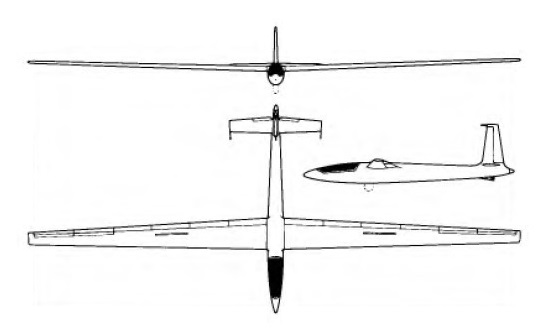
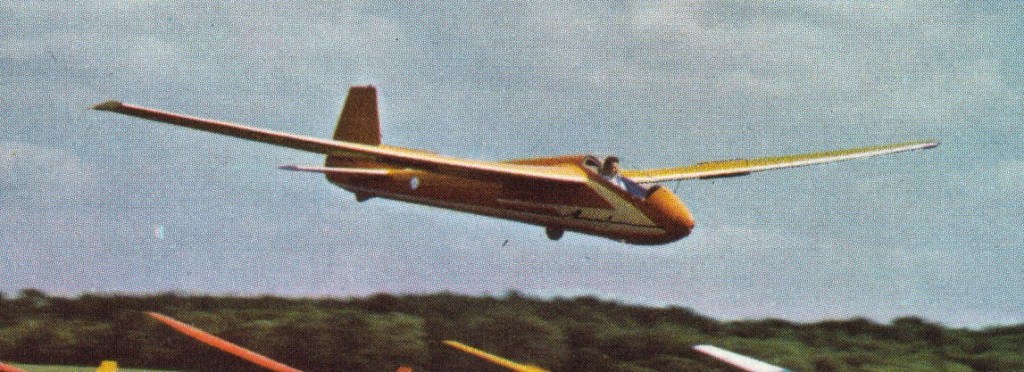
The Zefir 4 was the last of the wood and fabric built Zefir series. Developed for the 1968 World Championships, the Zefir 4 first flew in December 1967. The tail unit had been entirely redesigned without the sweepback of previous models. The wings feature full-span Fowler flaps, the outer sections of which act as ailerons.

Zefir 2 SZD-19-2
Wingspan: 55.8 ft
L/D max: 35
Min sink: 2.8 ft/sec

Zefir 4
Wing span: 19.0 m (62 ft 4 in)
Length: 8.0 m (26 ft 3 in)
Wing area: 15.7 sq.m (169 sq.ft)
Wing section: NACA 66-215-416
Aspect ratio: 23.0
Empty weight: 350 kg (772 lb)
Max weight 440 kg (970 lb)
Water ballast: None
Max wing loading: 28.0 kg/sq.m (5.73 lb/sq.ft)
Max speed: 129 kt (240 km/h)
Stalling speed: 36 kt (67 km/h)
Min sinking speed: 0.6 m/sec (1.97 ft/sec) at 50 kt (92 km/h)
Max rough air speed: 108 kt (200 km/h)
Best glide ratio: 42 at 51 kt (94 km/h)
Zefir 4

PZL Bielsko SZD-15 Cobra

Soaring Plane, Poland, 1969

PZL Bielsko / SZD SZD 15 Cobra
Length: 22.9 ft / 6.98 m
Wingspan: 49.213 ft / 15.0 m
Aspect ratio: 19.40
Wing area: 124.862 sqft / 11.6 sq.m
Max take off weight: 848.9 lb / 385.0 kg
Weight empty: 566.7 lb / 257.0 kg
Payload: 286.7 lb / 130.0 kg
Max. speed: 135 kts / 250 km/h
Landing speed: 36 kts / 67 km/h
Cruising speed: 52 kts / 97 km/h
Wing loading: 6.77 lb/sq.ft / 33.00 kg/sq.m
Glide ratio: 38.0
Crew: 1

PZL Bielsko SZD-12 Mucha Sto

Mucha Standard

The IS-2 Mucha had a single-spar high wing with an aspect ratio of 15, and was fitted with dive brakes and spoilers; the fuselage was of elliptical cross-section. The Mucha-ter was developed into the SZD-12 Mucha 100 of 1953, this single-seater being used for training. It was of all-wood construction, the cantilever high wings having a single main spar and an oblique auxiliary spar, with a plywood-covered leading edge torsion box; air brakes were fitted and the ailerons were aerodynamically and mass balanced. The oval-section fuselage was plywood-covered and the pilot sat under a one piece Plexiglas canopy. Landing gear consisted of a monowheel and short front and rear skids sprung with rudder pads.

PZL Bielsko / SZD 12 Mucha Sto (100)
Length: 22.966 ft / 7.0 m
Wingspan: 49.213 ft / 15.0 m
Aspect ratio: 15.0
Wing area: 161.46 sq.ft / 15.0 sq.m
Max take off weight: 639.5 lb / 290.0 kg
Weight empty: 430.0 lb / 195.0 kg
Max. weight carried: 209.5 lb / 95.0 kg
Max. speed: 119 kts / 220 km/h
Landing speed: 30 kts / 55 km/h
Cruising speed: 38 kts / 70 km/h
Wing loading: 3.90 lb/sq.ft / 19.0 kg/sq.m
Glide ratio: 24.0
Crew: 1

PZL Bielsko SZD-10 Czapla

PZL-Bielsko SZD-10bis Czapla

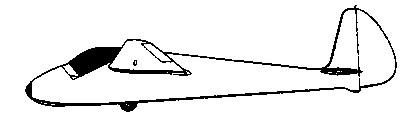
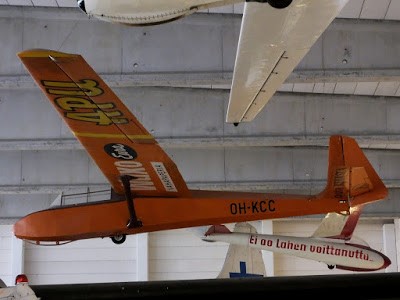
The Czapla (Heron) was a tandem two-seat training glider, with a strut- supported, forward-swept, high-set wing and a welded steel tube fuselage with fabric covering. Design of the Czapla commenced in 1952 to the order of the Soldier’s Friends’ League paramilitary organization, to enable aeroclubs to train glider pilots in a two-seat trainee/instructor system. Main designers were Roman Zatwarnicki, Irena Kaniewska and Marian Gracz. The Czapla was designed to be launched by bungee, winch or aero-tow, and the prototype first flew on 23 November 1953, demonstrating the need for several improvements, which were introduced in the second prototype (flown on 26 March 1954) and the production model SZD-10bis Czapla.

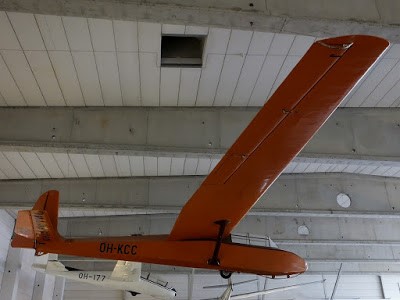
PZL-Bielsko SZD-10bis Czapla OH-204 / OH-KCC

Production was carried out from 1955 at ZSLS (ZSLS – sport aviation equipment workshops) in Krosno, Wrocław, Bielsko and Poznań and the Military Repair workshop at Łódź, with Czapla being used for everyday club flying up to the early 1980s, and exported to Finland and Turkey. A total of 157 were built.

SZD-10bis

Variants:

SZD-10-2 Czapla – two prototypes

SZD-10bis Czapla – 19 production aircraft
Wingspan: 16 m (52 ft 6 in)
Wing area: 24 m2 (258 ft2)
Wing profile: Göttingen 549
Aspect ratio: 10.67
Length: 8.7 m (28 ft 7 in)
Height: 1.98 m (6 ft 6 in)
Empty weight: 280 kg (617 lb)
Gross weight: 435 kg (959 lb)
Maximum speed: 160 km/h (99 mph)
Stall speed: 48 km/h (30 mph)
Maximum glide ratio: 17 @ 64 km/h (40 mph/35 kts)
Rate of sink: 0.96 m/s (189 ft/min)
Crew: 1 pilot
Capacity: 1 passenger

SZD-10bis A Czapla
136 production aircraft, first flew in June 1958

PZL Bielsko SZD-9 Bocian

SZD-9 bis 1E Bocian

The Bocian (or Stork) tandem two-seater sporting and training sailplane prototype SZD-9 flew for the first time on 11 March 1952.

The Bocian is cleared for cloud flying, spinning and basic aerobatics and was one of the few two-seaters to be stressed for aerobatics, including inverted flight; controls and instrumentation have, from the start, been intended to be suitable for sporting flying as well as training.

Bocian 1D SZD-9bis

Of conventional all-wood construction, the Bocian is distinguished by its mid-set wing swept forward, in the Mk 1E version, by 1°30′ at the quarter-chord line and with 4° dihedral. The first production Bocian flew in March 1953 and the type went through several versions; the Bocian 1C first flew in February 1954, the Mk 1D in 1958 and the final version, the Mk 1E, on 6 December 1966. The early versions featured several differences in the tail, and especially the rudder.

SZD-9bis Bocian 1E

Within a few years of first going into production, the type had set several world speed records over 200 and 300km closed circuits, and in 1962 Franciszek Kepka set a world record for a goal flight distance by flying 401 miles (636.6km) in a Bocian. On 5 November 1966 a Bocian 1D flown by the Polish pilots S. Josefczak and J. Tarczon set an international gain of height record for multi-seaters of 38,320ft, while the corresponding ladies’ record was set in another Bocian on 17 October 1967 by Adela Dankowska and M. Mateliska, who achieved a height gain of 27,657ft.

An experimental verison of the Bocian was being modified during 1964 for flights at up to 15,000m (49,200ft); this was to be flown as a single-seater with the pilot wearing a special WUK type pressure suit with advanced oxygen equipment. Eight 4-litre (0.87 Imp gal) oxygen bottles, sufficient for up to four hours’ flight, were carried in the fuselage, and the cockpit was heat-sealed and provided with R/T radio. At a later stage it was intended to provide heating, double glazing for the canopy and de-frosting of the canopy glass, amongst other improvements, for this special Bocian, and a high altitude pressurized variant with a crew of two was also studied for a time.

The Bocian 1D’s wings are of slightly larger span than the Mk 1 E’s (59ft 5.5in instead of 58ft 4.75in) and have 3° 30′ of forward sweep; the Mk 1D is also 9.75in shorter in overall length than the 1E, and its rudder contours are slightly different to the 1E’s. In both versions the wings are two-spar structures with a plywood D-section leading edge and fabric covering; the slotted ailerons are each in two parts, which are separately controlled. No flaps are fitted but there are SZD air brakes inboard of the ailerons. The oval section fuselage is plywood-covered on both versions and the two tandem seats, under a long two-piece blown Plexiglas canopy, are so positioned that the rear seat is over the cg and there is no need to carry ballast when the aircraft is flown as a single seater. There is a non-retractable monowheel with a brake and a shock absorber fitted, and a short nose skid, plus a tailskid. The cantilever wooden tail unit has a trim tab in the port elevator.

The Bocian was to have one of the longest production runs of any sailplane, a total of 620 having been built when production ended at the end of 1977. The type was exported to 33 countries, including the Chinese People’s Republic, where licence production of Bocians and several other Polish sailplanes commenced at the Glider Manufacturing Centre at Tchan-Tia-Kou during 1955-56.

Gallery

PZL Bielsko / SZD 9 Bocian
Length: 26.903 ft / 8.2 m
Wingspan: 59.383 ft / 18.1 m
Aspect ratio: 16.38
Wing area: 215.28 sqft / 20.0 sq.m
Max take off weight: 1157.6 lb / 525.0 kg
Weight empty: 718.8 lb / 326.0 kg
Max. weight carried: 374.9 lb / 170.0 kg
Max. speed: 97 kts / 180 km/h
Landing speed: 32 kts / 60 km/h
Cruising speed: 43 kts / 80 km/h
Wing loading: 5.33 lb/sq.ft / 26.0 kg/sq.m
Glide ratio: 26.0
MinSink: 0.82 m/s 71 kph
L/DMax: 26 @ 80 kph
Airfoil: NACA 43018A
Crew: 2

PZL Bielsko / SZD 9 bis Bocian 1 E
Length: 26 ft 10.75 in / 8.2 m
Wingspan: 58 ft 4.75 in / 17.81 m
Aspect ratio: 15.85.2
Wing area: 215.28 sqft / 20.0 sq.m
Wing section: NACA 43018A/43012A
Height: 1.2m / 4 ft 0.25 in (excluding wheel)
Max take off weight: 1190.7 lb / 540.0 kg
Weight empty: 793.8 lb / 360.0 kg
Max. weight carried: 396.9 lb / 180.0 kg
Max. speed: 108 kts / 200 km/h / 124 mph (in smooth air)
Max aero-tow speed: 87 mph / 81 kt / 150 km/h)
Stalling speed: 32.5 kt / 60 km/h
Landing speed: 32 kts / 60 km/h
Cruising speed: 43 kts / 80 km/h
Wing loading: 5.54 lbs/sq.ft / 27.0 kg/sq.m
Min sinking speed: 0.82 m/sec / 2.69 ft/sec at 44 mph / 38.5 kt / 71 km/h
Best glide ratio: 26:1 at 50 mph / 43 kt / 80 km/h
Crew: 2

PZL Bielsko SZD-8 Jaskolka

The SZD-8 Jaskolka (or Swallow) high performance single-seater first appeared in 1951, two prototypes being rolled out in September and December that year; in prototype form it had a fuselage length of 22ft 1.5in but in the production version, which started coming off the line in 1954, the length was increased to 24ft 4.25in.
The Jaskolka soon began to make its mark in contest flying, and between May 1954 and May 1960 the type held no fewer than 15 world records for speed and distance.

The SZD-8L was a special version for the 1956 World Championships at St Van, France, in which one, flown by Gorzelak, took 3rd place; this version had a wing of laminar flow section, a ‘butterfly’-type V-tail and wing tip end plates which had the effect of increasing the wing span as well as acting as ‘bumpers’. The SZD-8L also carried 100 litres (22 Imp gal) of water ballast to permit maximum performance in varying weather conditions, and was one of the first sailplanes to employ this form of ballast.

Of conventional wooden construction, the Jaskolka has two-piece cantilever mid-set wings with single spars and fabric covering; the Fowler flaps can be lowered to 12° or 25° and air brakes are fitted in the upper surfaces. The wings are quickly detachable and the ailerons are aerodynamically balanced.

The fuselage is plywood-covered and the pilot sits over the wing leading edge, rather than in front of it, thus giving him an excellent view; the cockpit is enclosed by a moulded two-piece Plexiglas canopy the rear section of which slides back for exit and entry. A novel feature of the rear fuselage is a built-in recessed handle each side for ease of handling the Jaskolka on the ground. A semiretractable monowheel with a mechanical brake is fitted, plus a short nose skid and a tail bumper.

Altogether 127 Jaskolkas had been built when production ended in 1961.

PZL Bielsko / SZD 8 bis Jaskolka
Length: 24.344 ft / 7.42 m
Wingspan: 52.493 ft / 16.0 m
Aspect ratio: 18.8
Wing area: 146.39 sq.ft / 13.6 sq.m
Max take off weight: 782.8 lb / 355.0 kg
Weight empty: 562.3 lb / 255.0 kg
Max. weight carried: 220.5 lb / 100.0 kg
Max. speed: 108 kts / 200 km/h
Landing speed: 32 kts / 60 km/h
Cruising speed: 37 kts / 68 km/h
Wing loading: 5.33 lb/sq.ft / 26.0 kg/sq.m
Glide ratio: 26.0
Crew: 1

Jaskolka-Z
Span: 16.0 m / 52 ft 6 in
Length: 7.42 m / 22 ft 11 l/2 in
Height: 4 ft 7.5 in
Wing area: 13.6 sq.m / 146.4 sq ft
Aspect ratio: 18.8
Wing section: NACA 230 12A
Empty weight: 270 kg / 595 lb
Max weight: 370 kg / 816 lb
Water ballast: 95 kg / 209 lb
Max wing loading: 27.2 kg/sq.m / 5.57 /b/sq ft
Max speed: 155 mph / 135 kt / 250 km/h (in smooth air)
Max rough air speed: 65 kt / 120 km/h
Stalling speed: 27 kt / 50 km/h
Min sinking speed: 0.75 m/sec / 2.5 ft/sec at 46 mph / 40 kt / 74 km/h
Best glide ratio: 28.5:1 at 51.5 mph / 44.5 kt / 83 km/h

PZL P.50 Jastrzab

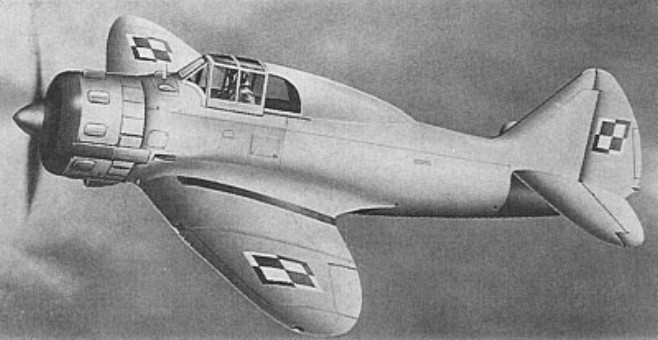
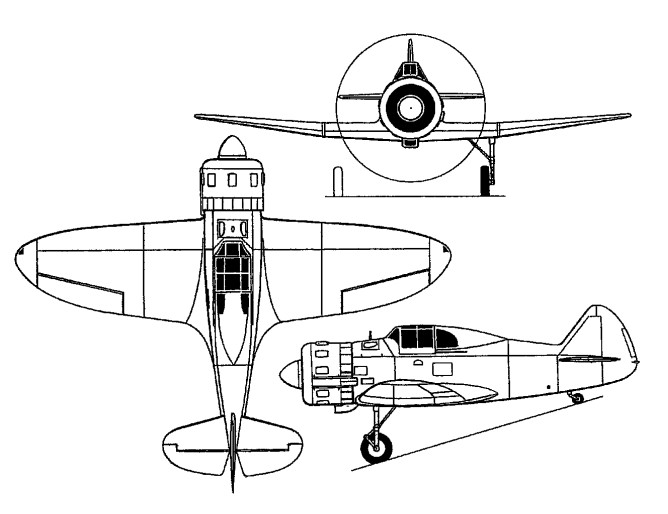
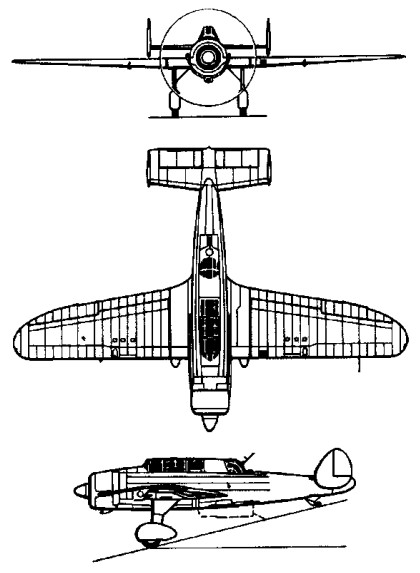
Intended as a successor in Lotnictwo Wojskowe service to the P.11, the P.50 Jastrzab (Hawk) was designed under the leadership of Wsiewolod Jakimiuk. The first of two prototypes, the P.50/I, was flown in February 1939 with an 840hp Bristol Mercury VIII nine-cylinder radial. Of all-metal stressed-skin monocoque construction, the P.50 was armed with four wing-mounted 7.92mm Wz 36 machine guns.

The Mercury-engined model was referred to as the Jastrzab A, an initial batch of 30 of this version being under construction at the time of the German invasion. The second prototype, the P. 50/II, was intended to serve as a development aircraft for the more advanced Jastrzab II. This featured a revised rear fuselage, armament augmented by two 20mm cannon and pilot armour, the engine being a 1375hp Bristol Hercules to be replaced in the series model by the 1200hp P.Z.L. Waran radial. The P.50/II was still awaiting its power plant at the time of the German assault. The first pre-series Jastrzab A was to be fitted with an 870hp Gnome-Rhone 14Kirs as a development aircraft for the Jastrzab B, and this was almost ready for flight test in September 1939.

Engine: Mercury VIII
Max take-off weight: 2500 kg / 5512 lb
Empty weight: 1700 kg / 3748 lb
Wingspan: 9.70 m / 32 ft 10 in
Length: 7.70 m / 25 ft 3 in
Height: 2.70 m / 9 ft 10 in
Wing area: 19.40 sq.m / 208.82 sq ft
Max. speed: 500 km/h / 311 mph
Range: 750 km / 466 miles

PZL P.50 Jastrzab

PZL P.46 Sum

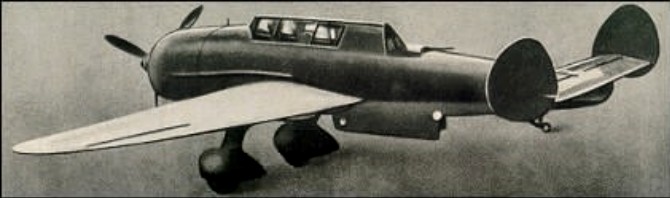
In 1936 Stanislav Prauss (later replaced by Tadeusz Soltyk) began work on a project reconnaissance bomber, which is, in essence, the development of “Carp”, which received later the name PZL P-46 Sum.

One P-23B Karas was modified to serve as a development aircraft for the improved P.46 Sum, with a twin fin/rudder tail unit and a retractable ventral gondola. However, the P.46 did not materialise beyond the prototype stage and the P.42 was subsequently converted back to Karas B standard. The first P.46 Sum light bomber prototype flew in October 1938. Two built.

PZL-46 Sum A
Engine: 1 x Bristol “Pegasus XX”, 675kW
Wingspan: 14.6 m / 48 ft 11 in
Length: 10.5 m / 34 ft 5 in
Height: 3.3 m / 11 ft 10 in
Wing area: 31.5 sq.m / 339.06 sq ft
Max take-off weight: 3550 kg / 7826 lb
Empty weight: 1995 kg / 4398 lb
Max. speed: 425 km/h / 264 mph
Cruise speed: 350 km/h / 217 mph
Ceiling: 7700 m / 25250 ft
Range w/max.fuel: 1300 km / 808 miles
Crew: 3
Armament: 6 x 7.7mm machine-guns
Bombload: 600kg

PZL-46 Sum B
Engine: 1 x Bristol “Pegasus XX”, 675kW
Wingspan: 14.6 m / 48 ft 11 in
Length: 10.5 m / 34 ft 5 in
Height: 3.3 m / 11 ft 10 in
Wing area: 31.5 sq.m / 339.06 sq ft
Max take-off weight: 3550 kg / 7826 lb
Empty weight: 1995 kg / 4398 lb
Max. speed: 460 km/h
Cruise speed: 350 km/h / 217 mph
Ceiling: 8700 m
Range w/max.fuel: 1150 km
Crew: 3
Armament: 6 x 7.9mm machine-guns vz.36/37
Bombload: 1000kg

PZL P.46 Sum

PZL P.44 Wicher

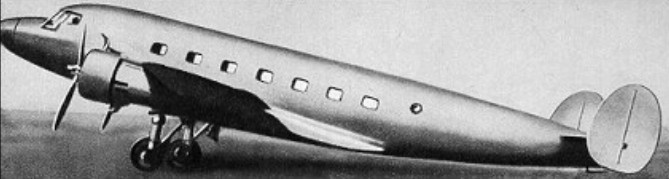
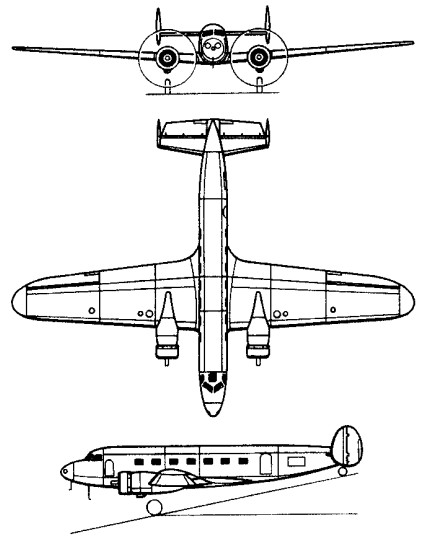
The PZL-44 Wicher (Tempest or Storm) was intended as a replacement for the DC-2 and Lockheed 12A and 14 Super Electra operated by LOT pre-WW2. LOT issued a specification calling for a fourteen-passenger airliner which resulted in the Wicher designed by W.Jakmuk and bult at the PZL-WP.NI works at Okecie, near Warsaw.

The first prototype flew on March 20, 1937 and subsequent flight evaluation was carried out at the I.B.T.L. establishment in Warsaw during the later half of 1938.

Of all-metal construction, the sole prototype, PZL-44, later registered SP-WNR, was powered by two 850 hp Skoda-Wright Cyclones, although for the production models the 1000 hp Wright GR-1820-G2 had been planned. Every modern flying and navigational aid and passenger-comfort device was installed, including de-icing, hydraulic dual controls, Sperry auto-pilot and ‘climatised’ cabin conditions.

When war broke out on 1 September 1939 the evaluation testing ceased after the prototype had logged around 200 hrs, latterly by Polish airline pilots.

P.44
Engines: 2 x Wright Cyclone GR-1820, 735kW
Wingspan: 23.8 m / 78 ft 1 in
Length: 18.5 m / 60 ft 7 in
Height: 4.8 m / 15 ft 8 in
Wing area: 75.0 sq.m / 807.29 sq ft
Max take-off weight: 9500 kg / 20944 lb
Empty weight: 5990 kg / 13206 lb
Max. speed: 374 km/h / 232 mph
Cruise speed: 316 km/h / 196 mph
Ceiling: 6000 m / 19700 ft
Range w/max.fuel: 2200 km / 1367 miles
Range w/max.payload: 1840 km / 1143 miles
Endurance: 5 hr
Crew: 2
Passengers: 15

PZL P.44 Wicher