Tipsy M / Fairey Primer

Tipsy M

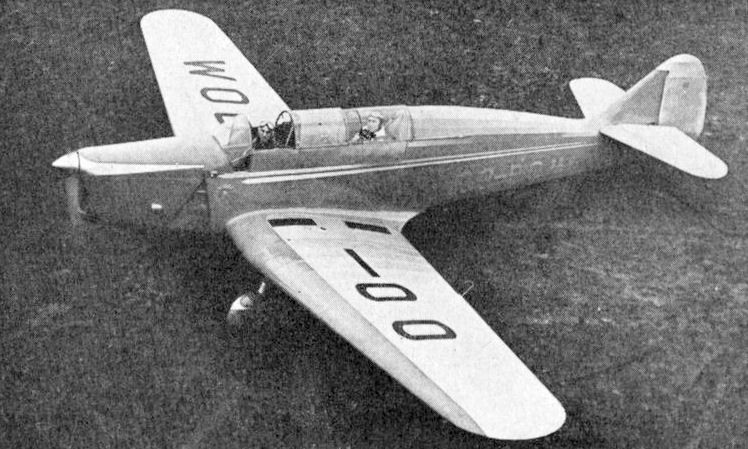
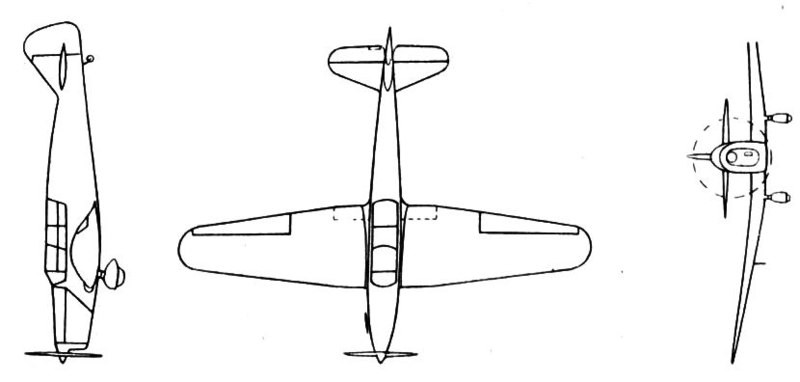
In the 1930s, designer Ernest Oscar Tips of Fairey Aviation’s Belgian subsidiary, Avions Fairey produced a series of light aircraft named after him, starting with the Tipsy S. These aircraft were not built by Fairey Aviation. The last to emerge before the Occupation of Belgium in 1940 was the Tipsy M ab initio trainer. Post war, the parent company decided, uniquely to produce this aircraft, calling it the Fairey Primer. Only one Tipsy M had been produced in Belgium and this became the Primer prototype.
The Primer was a conventional single-engined, low-winged monoplane, constructed of welded metal tubes with wood in subsidiary structures like ribs and stringers, all fabric covered. The wings were quite symmetrically tapered and carried manually operated flaps across the centre section. Mild dihedral began outside the centre section. Each mainwheel, equipped with brakes was mounted on a single leg fixed at the end of the centre section. On the prototype the wheels were spatted, but these were removed on production aircraft. There was a small tailwheel below the fin. The rudder was horn balanced and the starboard elevator carried a trim tab.
The enclosed tandem dual control cockpits merged into a raised decking behind them, giving the aircraft a smooth but slightly humped look. Both cockpits were over the wing. The engines used by Primers, the 145 hp (108 kW) de Havilland Gipsy Major 10 and the 155 hp (116 kW) Blackburn Cirrus Major 3 were inverted in-line engines and ran in similar cowlings.

The Tipsy M, registered OO-POM and Gipsy powered, first flew at Avions Fairey’s works at Gosselies about 1938 and it visited the parent company’s works in England in June 1939. The Gosselies factory was destroyed by bombing on 5 May 1940 and at about that time all drawings and jigs for the aircraft were destroyed, deliberately or not. Before the German invasion in May 1940 the machine was taken apart and shipped to England, probably in September or October 1939; certainly it flew from Fairey Aviation’s Great West Aerodrome (the site now covered by London Heathrow Airport) for five months after November 1940. It was then used as a company hack until September 1941, when it was put into store. Shortly after the war OO-POM went back to Belgium for small modifications at Fairey’s suggestion; they then took over the Tipsy M with the aim of producing it under licence. Early in 1948, it was flying from White Waltham, still bearing its Belgian registration. The following year it received a UK registration (G-AKSX), but seems only to have flown with the experimental number G-6-1. It spent a period of assessment with service pilots at the Aeroplane and Armament Experimental Establishment, Boscombe Down.
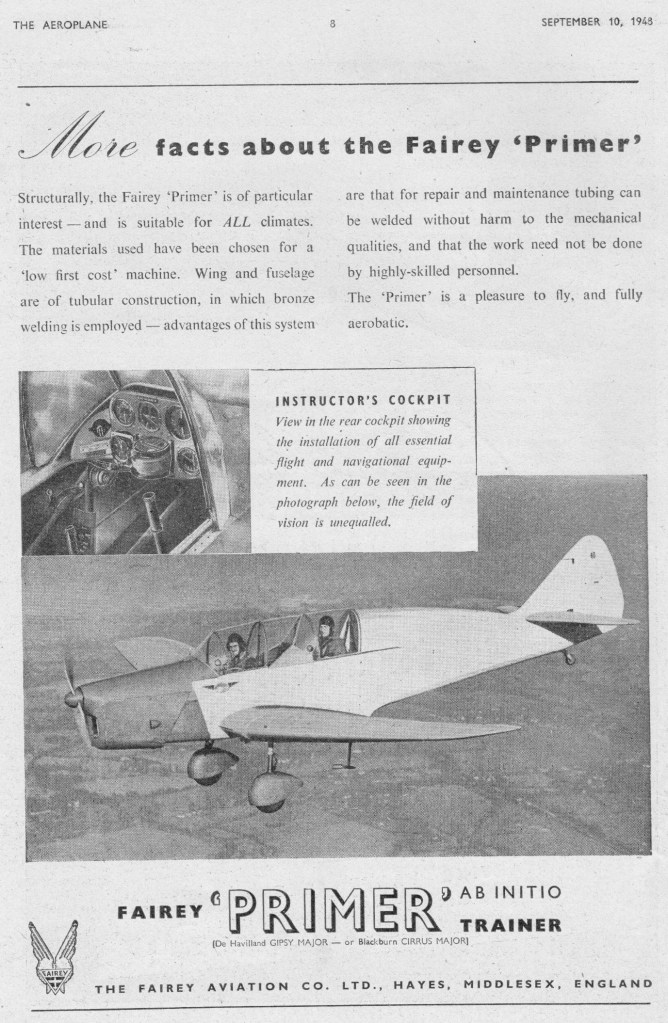
When returned from Boscombe Down, the Primer prototype had to be stripped down in order to recreate the lost drawings and jigs. The engine and some other parts were used to build the first production aircraft, though the CAA records G-AKSX as being sold abroad in Aug 1948; whether in flying condition or not is not noted. Fairey had intended to produce a run of ten, but only built two. The first of these, G-ALBL, gained its certificate of airworthiness in October 1948. Initially it had the Gipsy engine but this was later replaced by the Cirrus. It was dismantled in 1949; the CAA records it as destroyed in 1953. The second production aircraft, G-ALEW used this powerplant from the start, and was assessed against the de Havilland Chipmunk at Boscombe Down. The last of the line, it was dismantled in 1951.
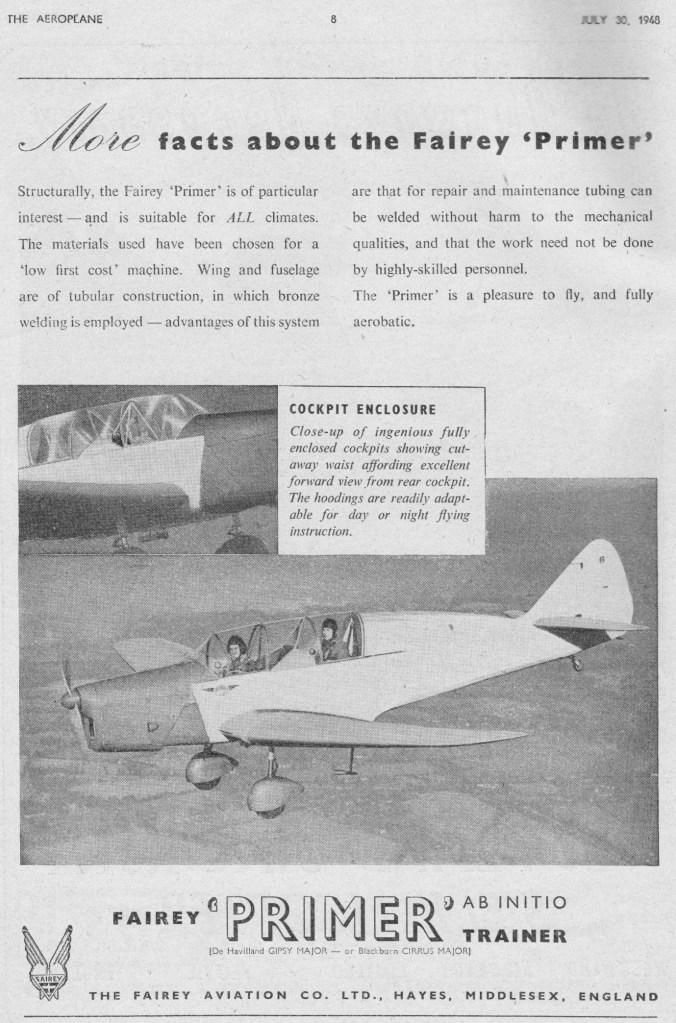
September 1948

Powerplant: 1 × de Havilland Gipsy Major 10, 145 hp (108 kW)
Wingspan: 32 ft 10 in (10.0 m)
Wing area: 154.5 sq ft (14.36 sq.m)
Length: 27 ft 6 in (8.38 m)
Height: 6 ft 10 in (2.08 m)
Empty weight: 1,360 lb (617 kg)
Gross weight: 1,960 lb (890 kg)
Maximum speed: 134 mph (215 km/h, 116 kn) at sea level
Cruise speed: 122 mph (196 km/h, 106 kn) at 2,300 rpm
Range: 383 mi (616 km, 333 nmi)
Service ceiling: 19,500 ft (5,900 m)
Rate of climb: 900 ft/min (4.57 m/s) at sea level
Crew: 2
BAe Tempest

UK’s concept model of “Tempest”, which was unveiled by Defence Secretary, at Farnborough International Air Show 2018.

The UK’s Ministry of Defence was pioneering an approach to building its next-generation Tempest fighter—by recycling retired Tornado jets. Instead of sourcing expensive foreign materials, old fighter jet parts are ground into a titanium-rich powder used for 3D printing new aircraft components.
Rolls-Royce has successfully tested these parts in an Orpheus engine, proving their viability. This initiative not only reduces costs but also strengthens supply chain resilience. With Italy and Japan also involved, the Tempest program is set to revolutionize sustainable aircraft manufacturing, with a planned first flight in 2026 and entry into service by 2035.
While this approach might sound crazy, it actually reduces the country’s reliance on foreign-sourced materials and points toward some incredible new ways to recycle old aircraft.
Introduced as a response to lingering concerns about how the global market for vital materials could be impacted by large-scale war between great powers, this is an area of increasing focus for the Future Combat Air Systems (FCAS) program. The FCAS is Britain’s overarching effort that includes the development of the crewed Tempest fighter.
“Through the expected lifecycle of the U.K.’s FCAS, we expect access to critical materials to be challenged, as global supply chains become increasingly disrupted and competitive. In parallel, there is a societal need to make the best use of the raw materials we already have,” explained the Future Combat Air System’s Sustainability Requirements Manager, identified only as “Squadron Leader Rob.”
To achieve this, rather than just scrapping old Tornado GR4s that were retired from active service in 2019 and then sourcing all the high-quality raw materials needed for the new Tempest fighter program from foreign countries, the U.K. will simply yank parts off of those old Tornados and feed them into an industrial grinder to produce a powder, called “feedstock.” This powder can then be used by industrial 3D printers to produce new components for new fighters.
The British Ministry of Defense, is collaborating with Rolls Royce in the effort.
In testing so far, Tornado engine compressor blades, which include a high quantity of titanium, were cleaned, ground up, and then used to 3D print a new nosecone and compressor blades for “Orpheus” the small engine Rolls Royce has in testing to mature technologies for the Tempest program.
With its new 3D-printed component, the Orpheus engine was then put through the wringer and managed to pass all suitability and safety tests.

“Tornado 2 Tempest is a bold, exciting and innovative project and a demonstration of how excellent collaboration between the MOD, industry and SME can deliver sustainable and technologically advanced solutions,” said Andrew Eady, Rolls-Royce Vice President for FCAS Sustainability.
This same recycling and 3D-printing process can be used for steel and aluminum components as well, which would further reduce waste, and allow the U.K. to have to mine and process fewer raw materials in the future.
“Not only can this solution reduce the costs and burden of sourcing critical and high-value metals, but it can also produce components that are lighter, strong and longer lasting than those made through traditional forging techniques, thereby further enhancing the MOD’s overall sustainability and effectiveness,” Thomas Powell, DRDT’s Strategic & Submarine Recycling Senior Commercial Manager, said in a Rolls Royce press release.
Construction of the first Tempest technology demonstrator began 2024, and the U.K., Italy, and Japan, which are also partner countries in the program, are hoping to see the aircraft make its first test flight in 2026, with the goal of getting these fighters into service by 2035.

AMA Minx Capon

The 1938 A M A / Aircraft Mechanics Association Minx Capon NX18983 was designed by Claude Flagg.

The project was stored during WW2, and damaged in a warehouse fire. It was located in 1956 and restored.

engine: 40hp Continental A-40
Wingspan: 25’9″
Length: 16’6″
Useful load: 276 lb
Max speed: 95 mph
Cruise: 85 mph
Stall: 38 mph
Range: 400 mi
Seats: 1

Alvarez Polliwagen

Alvarez Polliwagen

The Alvarez Polliwagen was designed by Joseph Alvarez and Henry Arnace and built in 1977 at Chino CA.

A low-wing cabin monoplane, side-by-side, fibreglass composite construction, it featured retractable tricycle landing gear and was registered N176PW. It first flew in July 1977.

Engine: 90hp Revmaster VW 2100cc
Wingspan: 26’0″
Length: 15’0″
Useful load: 600 lb
Cruise: 230 mph
Stall: 45 mph
Range: 1000 mi
Seats: 2