Schempp-Hirth Mini-Moazagotl / Minimoa Goppingen GÖ-3

In 1938 the company moved to Kirchheim/Teck and employed more than 300 people during the war time.
The first serial gliders were the aerobatic single seat trainer GÖ-1 ‘Wolf’ from Wolf Hirth and the renown GÖ-3 ‘Minimoa’ as well as the two seat GÖ-4 from Wolfgang Hütter.

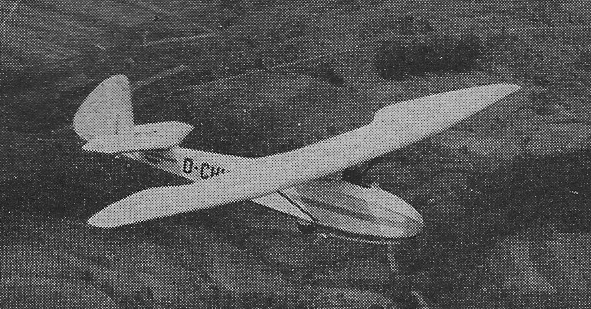
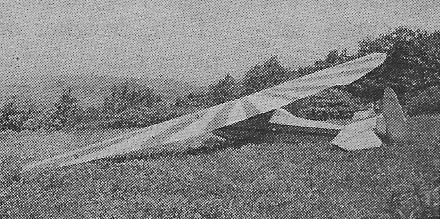
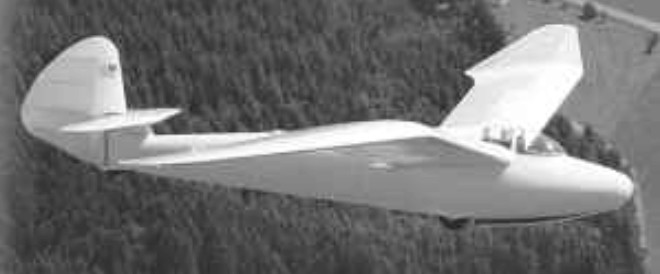
One of Germany’s leading high performance single seaters before the war, this gull-winged glider was designed by two of Germany’s leading sailplane pilots, Martin Schempp and Wolf Hirth. They designed and developed the Minimoa from the 20m span Moazagotl, and the name Minimoa is a contraction of miniature Moazagotl, although the design was also known as the Goppingen 3.
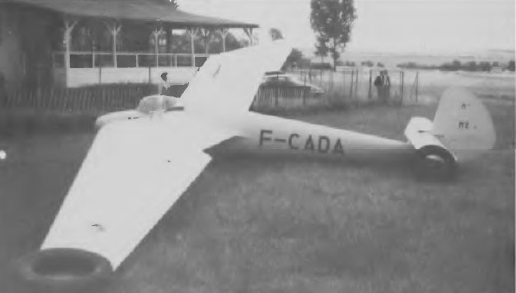
In its original form it had cantilever shoulder-mounted gull wings, and it was built by Wolf Hirth and Dipl-lng Wolfgang Mutter. Of conventional wood and fabric construction, the Minimoa is characterised by swept back wing outer panel leading edges and large ailerons with trailing edges projecting beyond those of the wing itself; air brakes of the same basic Schempp-Hirth type later to be featured on many other sailplanes are fitted. The tailplane is mounted ahead of the fin and is raised above the fuselage top line. The pilot sits under a one-piece hinged cockpit canopy that opens to starboard, and by prewar standards the cockpit was roomy. Landing gear consists of a non-retractable monowheel and a skid under the nose, plus a small tailskid. By 1938 the Minimoa 3B was introduced with the gull wings now in the mid position with a modified aerofoil section, and reduced weight. From July 1935 to 1939 a total of 110 Minimoas were built, of which 13 were sold abroad to Britain, France, the USA, Argentina, South Africa and Japan; a few survived the war and are still flying.
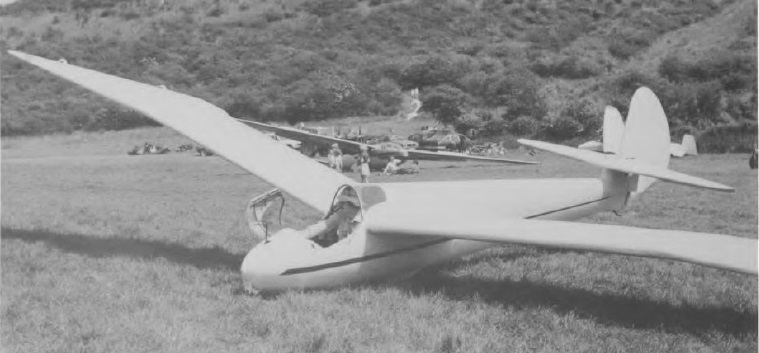
First flown in 1935, the Minimoa made its mark in contest flying, taking third place at the 1937 International Competition at the Wasserkuppe in Germany flown by Wolfgang Spate. Richard du Pont and Chet Decker flew Minimoas to win the U.S. Championships in 1937 and 1939. The Minimoa established a number of records, including the world altitude record in 1938 (using lift in cumulo nimbus cloud) of 6,687 m/ 21,939 ft. The name was an abbreviation of its original nickname, Mini- Moazagotl, as it was a smaller successor of Hirth’s earlier 20 m. Moazagotl.

Distinctive in many respects, the Minimoa was stable, but with poor roll control by later standards. It was the first sailplane to carry water ballast, in a tank behind the cockpit. Structure: wood/ fabric wings and tail, wood fuselage

Gallery

Göppingen Gö 3 Minimoa
Wing span: 17m /55.7ft
Wing area: 19.05sq.m / 205sq.ft
Length: 23.261 ft / 7.09 m
Empty Weight: 200kg
Payload: 105kg / 230lb
Gross Weight: 275kg
Wing Load: 14.5kg/sq.m
Length: 6,9 m
Wing chord: 1,3 m
Aspect ratio: 16
Airfoil: Go 681, 693
L/DMax: 28 @ 72 kph / 39 kt / 45 mph
MinSink: 0.61 m/s / 2.0 fps / 1.18 kt
Seats: 1

Schempp-Hirth Minimoa
Span: 17.0 m / 55 ft 9.25 in
Length: 7.0 m / 22 ft 11.5 in
Wing area: 19.0 sq.m / 204.5 sq ft
Wing section: Gottingen 681
Aspect ratio: 15.2
Empty weight: 216 kg / 476 lb
Max weight: 350 kg / 772 lb
Water ballast: None
Max wing loading: 18.42 kg/sq.m / 3.77 lb/sq ft
Max speed: 136 mph / 119 kt / 220 km/h
Stalling speed: 32.5 kt / 60 km/h
Min sinking speed: 0.65 m/sec / 2.1 ft/sec at 39.5 mph / 34 kt / 63 km/h
Best glide ratio: 26:1 at 53 mph / 46 kt / 85 km/h
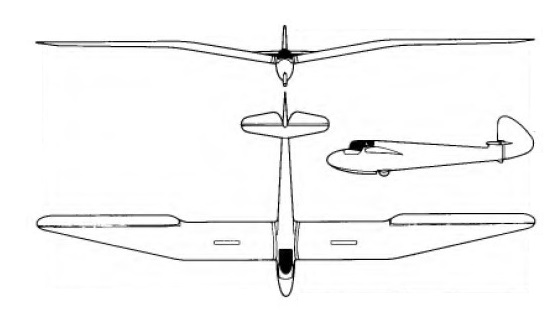
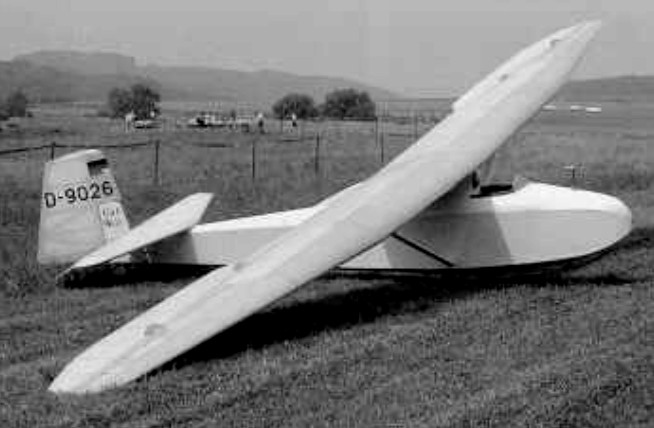
Goppingen GÖ-1 Wolf 1

The Wolf was named after Wolf Hirth, partner with Martin Schempp in the then new firm of Sportflugzeugbau Goppingen (now Schempp-Hirth). It was produced in 1935 as a rival to the Schneider Grunau Baby as a utility (rather than a high performance) sailplane. It lacks any approach control devices but has a built-in wheel, an unusual feature for the time. It was used widely for aerobatic displays, for which it could be fitted with an extra strut (making a V- strut) to permit inverted maneuvers.

It had poor spinning characteristics, and in 1938 all those flying in Germany were grounded until modifications were incorporated in the wingtip and ailerons.

Structure: I-strut-braced wood/ fabric wings and tail, wood fuselage.

Göppingen Gö 1 Wolf
Wing span: 14m / 45ft
Wing area: 14.5sq.m
Length: 20.669 ft / 6.3 m
Empty Weight: 145kg / 330lb
Max Payload:100kg
Gross Weight: 220kg
Wing Load: 14.6kg/sq.m
Aspect ratio:13.1
Airfoil: Gottingen 535
Seats: 1
L/DMax: 17 @72 kph / 39 kt / 45 mph
MinSink: 0.91 m/s /3.0 fps / 1.78 kt
Crew: 1

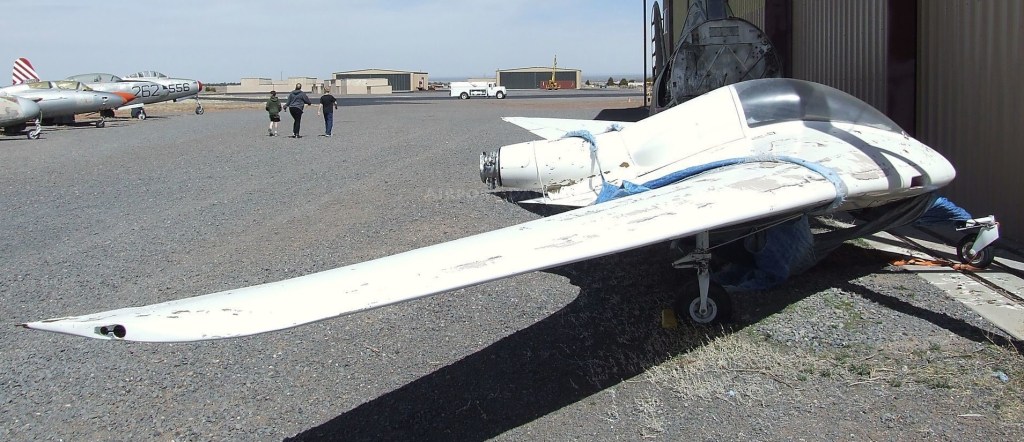
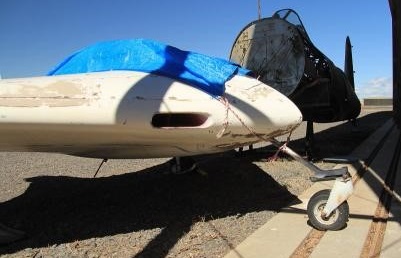
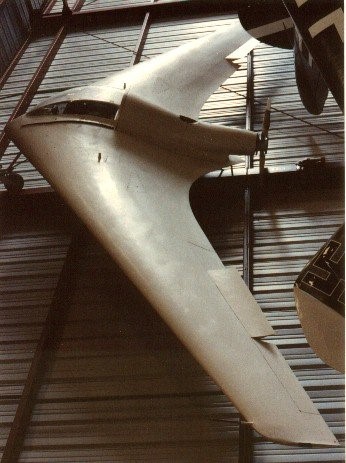
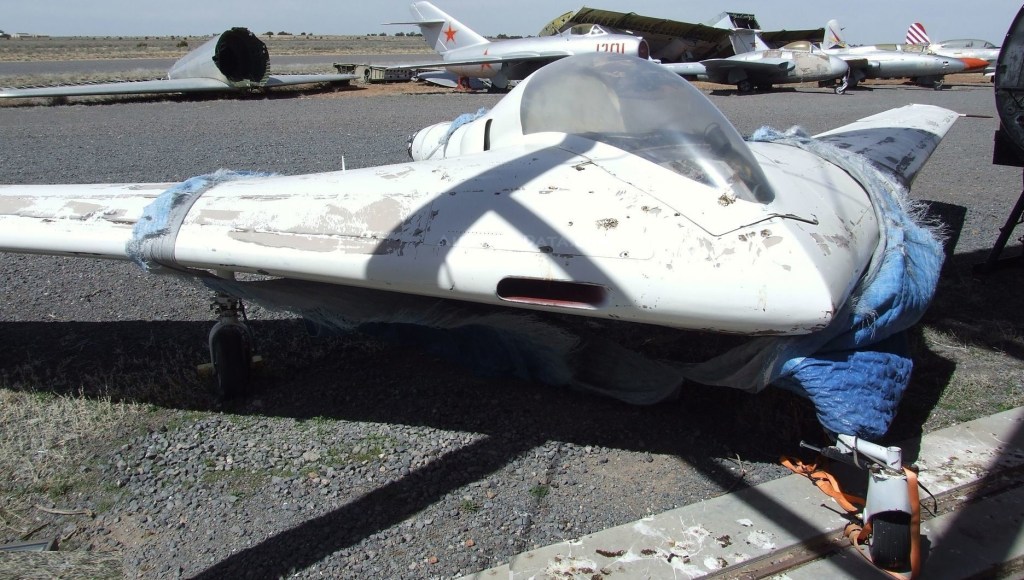
Schapel SA-882 Flying Wing

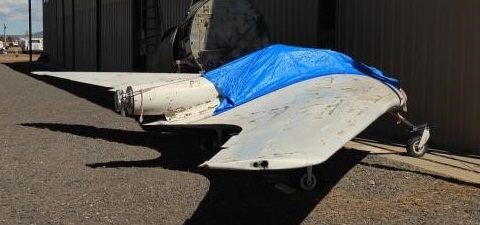
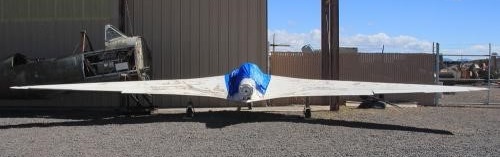
The SA-882 is a flying wing which was designed and built to research the overall aerodynamics, control and flying characteristics of a tailless airplane configuration.

The Schapel Wing is powered by a turbo-charged Mazda, 2 chamber, rotary engine. The 3-bladed propeller is ground adjustable and is driven by a 40-inch long drive shaft. Propeller 2:1 speed reduction is accomplished by a helical gear speed reducer. The engine gave them some problems during the dyno testing phase, but a successful combination was finally developed.

The aircraft was built in female molds using an epoxy system, vaccumed, and cured at 240 degrees F. in an oven. The upper and lower surfaces are a foam sandwich with a three spar system out to the landing gear position and then two spars out to the tip. The wing has five ribs per side and uses a non-laminar flow airfoil of his own design with a very low pitching moment. The wing has a lot of twist between the root and tip, with about 9 degrees negative by the time you reach the tip. This was designed to achieve a zero pitching moment, which has since been confirmed through the flight testing. Max CL came out to about .85, and was driven by all the actuation mechanisms had to be enclosed.

The actual construction involved using unidirectional material, laid up at different angles as required by the results of a computer analysis. They built a male plug, a set of one piece female molds for everything and, then the PVC sandwiched skins constructed. This type of construction gave it about a 1300 lb. empty weight, with a fuel capacity of 57 gallons right at the CG. The spars were made up separately, then added to the laminated lower skins along with the ribs and then bonded all together. The upper skins, in their molds, were then bolted on-top of the low portion so a spar cap could be cast to measure the thickness between the spar and upper skin. Once the skin was constructed, the whole thing was bolted together and put in the oven for curing.

It should have had a steerable nose gear, which it did not. Low speed controllability during the initial phases of takeoff required using a lot of brakes, since the drag rudders were ineffective. This was due to them being at the MAC rather than the wingtips so the pitching moments wouldn’t be changed during flight.

A single-place monoplane, powered by a 180hp turbo Mazda rotary pusher, one was built to full scale circa 1985 and registered N882SA. The SA-882 was flight-tested in 1984 and is now preserved by the Planes of Fame Museum, Chino, Nevada.

Several things the builder said he would change if he did it again were: put the drag rudders out at the wingtips; instead of having separate elevator and ailerons he would combine the two, and; he felt it would be much simpler to put a jet engine (about 400 lbs thrust) in it versus the rotary.

Engine: Mazda rotary, 180 hp
Wing Span: 34 feet
Wing Area: 160 sq. ft.
Aspect Ratio: 7.23
Gross Weight: 1960 lb
Empty Weight: 1372 lb
Useful Load: 612 lb
Maximum Fuel: 57 USgal
Seats: 1

Schädler Brothers Human-powered

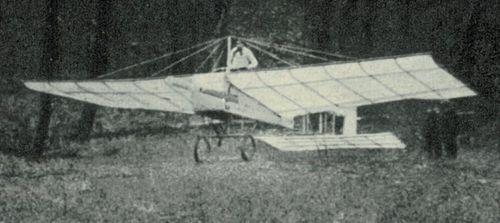
The three Schädler brothers in Landstuhl in Pfaltz had already in 1912 had begun the construction of a human powered aircraft. With the assistance of a teacher living locally, they began work began in their father’s carpentry workshop. The resulting machine was a light monoplane of 12.50m span and 5.50m length. The fuselage had a big nose, and a large propeller of approx. 1.8m, made of alder wood, driven by pedals connected to a gearbox. In the autumn of 1912, the first rolling tests, in order to test the traction of the propeller, were carried out. Since these proved satisfactory, they moved on to actual flight testing. The youngest of three brothers, Eugen Schädler, succeeded in making a flight at a height of approximately 1 – 1.50m above the ground, and flying for a distance of 70m. On landing, the right wheel of the undercarriage broke. According to reports by Anton Schädler, further tests were to be carried out, but the advent of the war meant those plans had to be cancelled. The first pilot of a human powered aircraft died as a soldier in France on 28.6.1916.

Scheibe Sperber

The third postwar design of Scheibe-Flugzeugbau GmbH, following the Mu-13E Bergfalke and the Spatz, was the Specht (or Woodpecker) tandem two-seater training glider, which was completed in prototype form in March 1953.
This featured the usual Scheibe construction of fabric-covered steel tube fuselage and two-spar braced wooden wings, which had a span of 44 ft 3.5 in and an aspect ratio of 11.

The Specht was developed into the Sperber (or Sparrowhawk), also a two-seat trainer but with enclosed side-by-side instead of tandem seating, and this first flew on 7 March 1956, later going into small-scale production. It also had a fabric-covered steel tube fuselage and braced fabric-covered wooden wings of 14% Mȕ section. The landing gear consists of a fixed monowheel and a spring steel tailskid.

Span: 46 ft 7 in
Length: 24 ft 3 in
Height: 4 ft 7 in
Wing area: 187.3 sq ft
Aspect ratio: 11.6
Empty weight: 485 lb
Max weight: 882 lb
Max speed: 106 mph
Min sinking speed: 3.05 ft/sec
Best glide ratio: 19:1

Scheibe Uli II

Tandem two seat single engined high wing mono¬plane with conventional three axis control. Wing has unswept leading and trailing edges and constant chord; conventional tail. Pitch control by fully flying tail; yaw control by fully flying rudder; roll control by half span ailer¬ons; control inputs through stick for pitch/roll and pedals for yaw. Wing braced from above by kingpost and cables; wing profile double surface. Steel tube framework, with optional pod. Engine mounted below wing driving pusher propeller. Wings use two aluminium tubes as spars, with ribs in foam, capped top and bottom with wood; all flying surfaces covered in Ceconite.

This tandem two seater version of the Uli made its first flights in February 1983 and by 1983 two prototypes had been built, which were undergoing certification. The aircraft is fitted with the four cylinder Konig 570cc engine and uses either a two blade or a three blade design of 51 inch (1.30 m) dia¬meter.

Length overall 18.1ft, 5.52m
Wing span 35.4 ft, 10.80 m
Constant chord 4.4 ft, 1.33 m
Sweepback 0 deg
Tailplane span 7.2 ft, 2.20 m
Total wing area 161 sq.ft, 15.0 sq.m
Wing aspect ratio 7.8/1
Wheel track 4.6 ft, 1.40 m
Engine: Konig SD570, 28 hp at 4200 rpm
Propeller diameter 58 inch, 1.47 m. 2-blade
Belt reduction, ratio 1.8/1
Max static thrust 177 lb, 80 kg
Power per unit area 0. 17 hp/sq.ft, 1.9hp/sq.m
Fuel capacity 5.3 US gal, 4.4 Imp gal, 20.0 litre
Empty weight 221 lb, 100kg
Max take off weight 618 lb, 280kg
Payload 397 lb, 180kg
Max wing loading 3.81 lb/sq.ft, 18.7 kg/sq.m
Max power loading 22.1 lb/hp, 10.0kg/hp
Load factors; +6.0, 3.0 ultimate
Economic cruising speed 37 mph, 60 kph
Stalling speed 28 mph, 45 kph
Best glide ratio with power off: 9/1
Take off distance 260 ft, 80 m