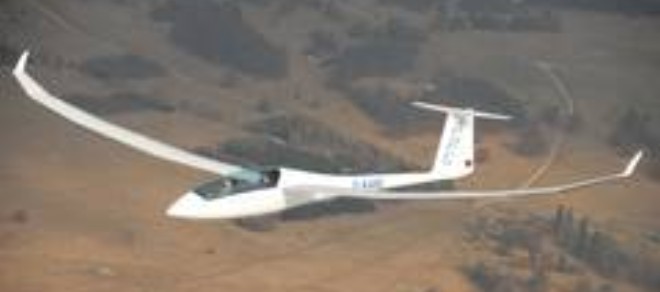
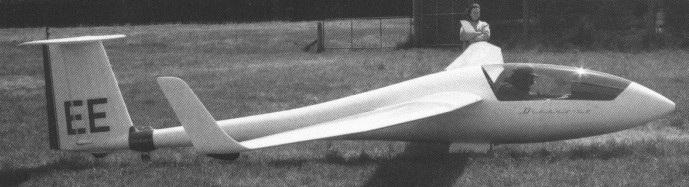
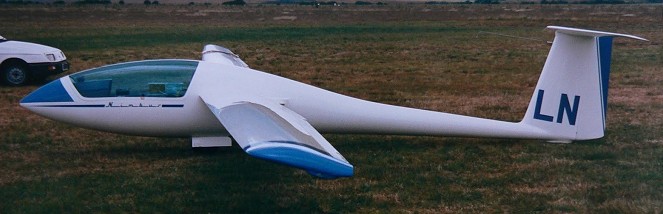
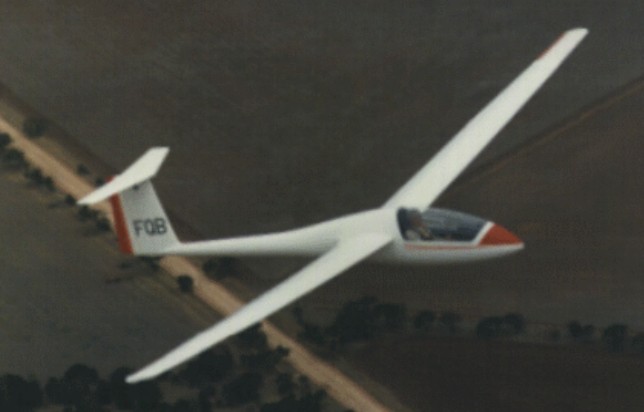
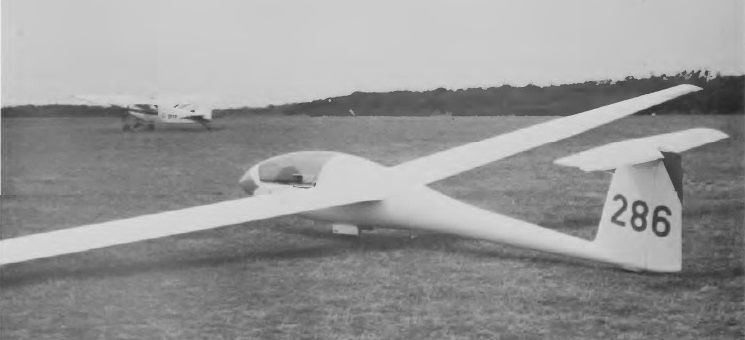
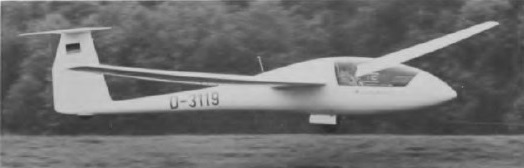
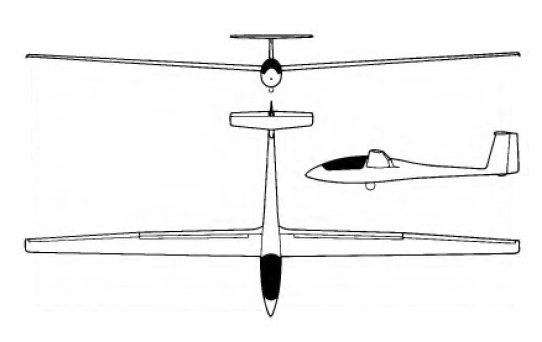
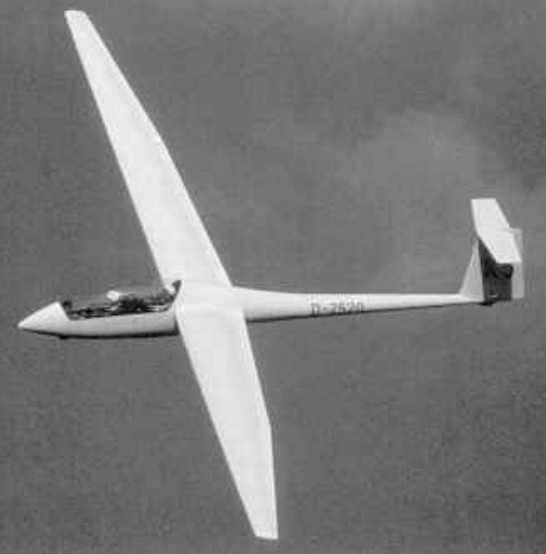
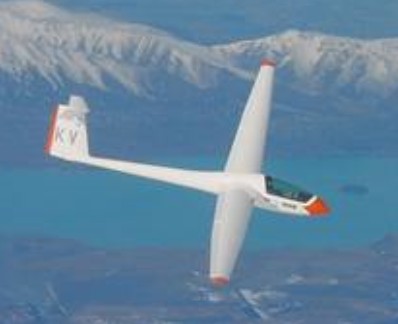
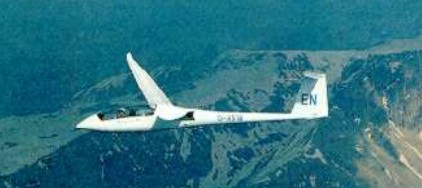
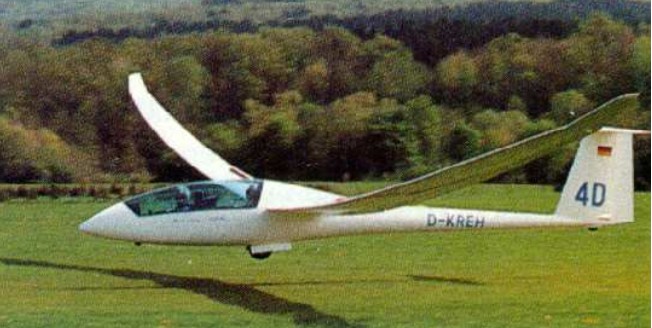
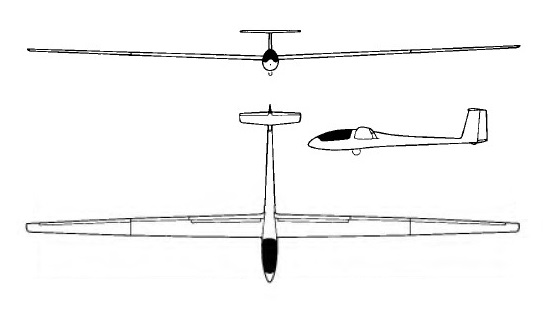
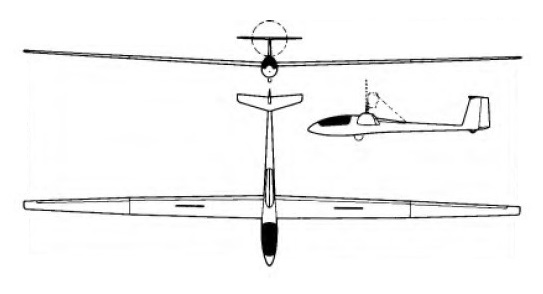
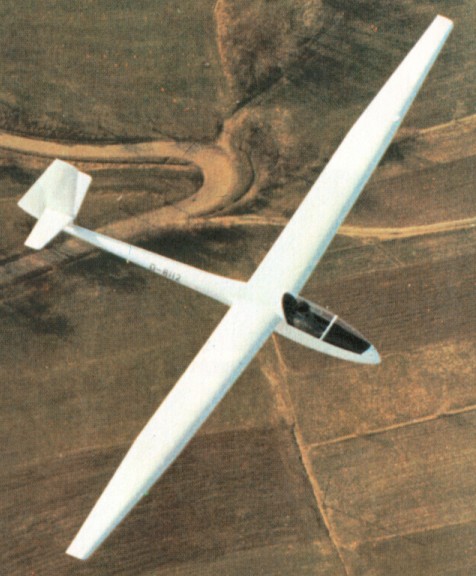
The Arcus was developed using an all-new wing design with full-span flaperons mated to the “L” cockpit design, as used on the Duo Discus XL. Designed by Tilo Holighaus and Christoph Wannenmacher, the Arcus first flew on 7 April 2009 at the Hahnweide airfield.
The Schempp-Hirth Arcus is a flapped two-seat 20m racing class glider of all composite construction, with optional water ballast. This two seater is as agile as a single seater and equipped with flaps.
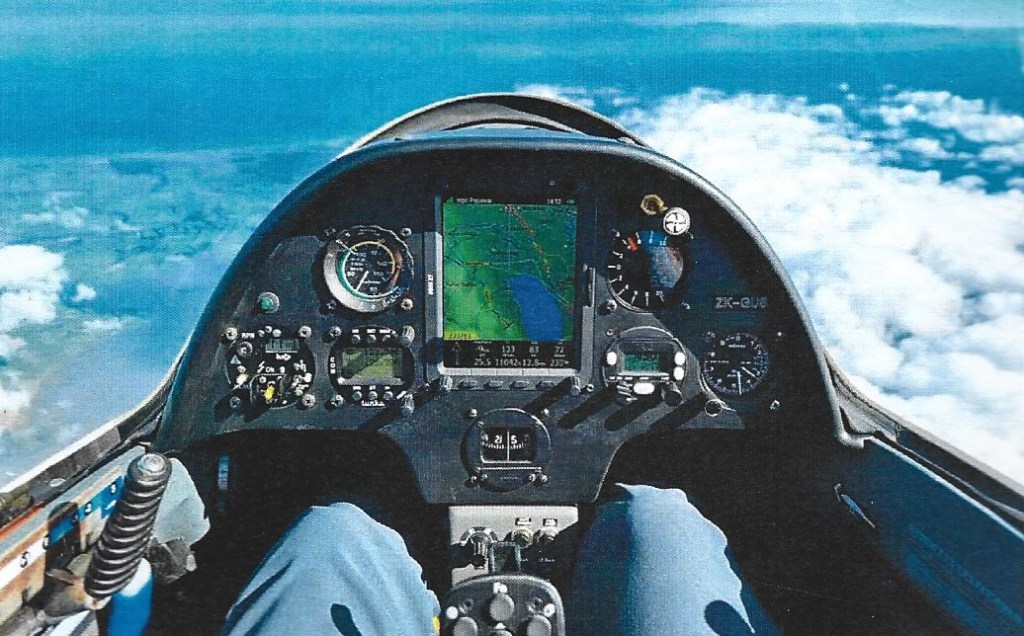
Schempp-Hirth Arcus T ZK-GUS
It is available as a pure glider, a sustainer version Arcus T using the retractable Oehler-Turbo (Solo 2350) engine, and as a self-launching glider Arcus M using the Binder (Solo 2625) powerplant system.
Type certificate: EASA Type Certificate Data Sheet EASA.A.532 Issue 04 dated 08 October 2014 – Arcus T approved 17 May 2011 – Arcus M approved 20 June 2013 – Arcus approved 31 July 2014
Arcus MCTOW 750 kg [1653 lb.] – with Water Ballast Max. No. of Seats: 2
Arcus T Engine: Solo 2350 D Propeller: OE-FL 5.110/83 av MCTOW 800 kg [1763 lb.] – with Water Ballast Max. No. of Seats: 2
Model: Arcus M Engine: Solo 2625-02 (modified per SB 4600-3) Propeller: Technoflug KS-1G-160-R-120 MCTOW 800 kg [1763 lb.] – with Water Ballast Max. No. of Seats: 2
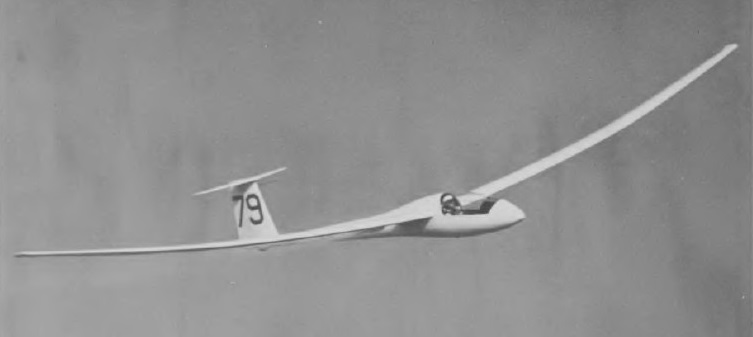
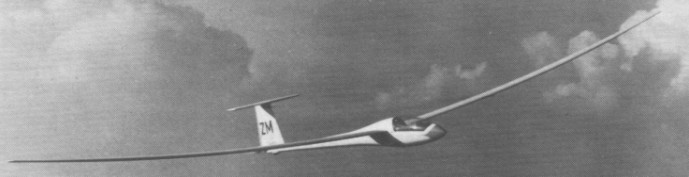
The 15-meter Ventus (Latin for ‘wind’) designed by Holighaus, Schott, Treiber and Schuo, (not to be confused with the later completely redesigned Ventus 2) has all-carbon fiber wings. The Ventus high performance single-seater is the first of a new generation of racing and competition 15m Class sailplanes featuring carbon-fibre in their structures; the mid-set wings are specially designed to take full advantage of this material’s lightness and extra stiffness. The strength of this material permitted use of a very thin and more laminar airfoil developed by F.X. Wortmann, Dieter Althaus and Ventus designer Klaus Holighaus, thinner than previous Wortmann profiles. The stiffness of carbon fiber prevents wing twist at high speeds such as often occurs with fiberglass. A special characteristic of this new section is that at low-drag speeds, stall warning buffeting occurs when the angle of attack must increase over 10° before the stall itself actually occurs, this giving a previously unknown safety margin in narrow thermals, in ridge or mountain flying and in landing. The wing and its skin are made entirely of carbon-fibre, which gives increased torsional stiffness and reduces by over two-thirds the negative tip twist experienced with thin glassfibre wings, and the resulting lift penalties; the wing skin is made of specially developed extrafine-weave carbon cloth, and has high stiffness to maintain the wing profile.
The same new air brake/flap system as on the Nimbus 2C is featured, the air brakes being behind the 70% chord line outside the wing’s laminar flow area, and this system gives an unusually short and slow landing. The two-piece ailerons feature Grob elastic flap-type joints on the lower wing surfaces to make the aileron/wing joint gapless and reduce drag, while enabling the upper surface gap to be kept very small. Tail surfaces are similar to those of the Nimbus, with a fixed incidence tailplane and elevator.
The prototype Ventus first flew on 3 May 1980 and was offered with an A model for shorter pilots, and a slightly wider and longer B model. There are two fuselage sizes, the normal version (the Ventus B) being big enough for pilots from 5ft 9in to 6ft 5in tall, this fuselage being 24.75in wide, 32.75in high and 21ft 4.47in long. The smaller fuselage (the Ventus A) is designed so that pilots up to 5ft 9in tall will not feel ‘lost’ in a cockpit designed to accommodate six-footers, and is 21.25in wide x 29.5 in high x 20ft 9.5 in long; its smaller size results in a slight performance bonus.
In both versions the pilot sits under a one-piece sideways-hinging cockpit canopy which is easily jettisonable; the canopy frame is of carbon-fibre and there is provision for a variety of instrumentation. Both fuselage sizes have a steel mid-fuselage frame on which is mounted the retractable monowheel, the flap and aileron drives and the wing lift-pin sockets; this frame takes the stresses from the landing gear directly through to the wings, and there is also a tail bumper fairing under the fin. The rudder sizes are slightly different for each fuselage size, and there is provision for over 330lb of water ballast in integral fuselage tanks.The Ventus has trailing-edge combination flaps and dive brakes, and aileron control mixers which reduce aileron deflection when extreme positve or negative flap is selected.
The B model had optional 16.6 m. tip extensions, while the C model offered 15 m winglets tip extensions increasing the span to 16.6 or 17.6 m, and a 5 kg /11 lb fin ballast tank. Dick Johnson tested a modified Ventus A with 16.5 m. tip extensions to give a demonstrated best L/D of 50 at 78 kph/ 42 kt/ 48 mph and a minimum sink rate of 0.43 m/s/ 1.42 fps/ 0.84 kt.
Ventus B/16.6
The sustainer Ventus bT had 16.6 m wings and a retractable 15 kW/ 20 bhp Oehler Solo turbo engine.
Constant refinement was also the key for the success of the Racing Class glider Ventus which debuted in spring 1986 as the model Ventus-c (on request with wing tip extensions for 17,6 m wingspan). In 1986 Klaus Holighaus, sole owner and designer of Schempp-Hirth, displayed new 17.6m tips for the Ventus.
These tips are swept back, with a second stage sweep (backwards and upwards). Holighaus declared that they would add another 2.5 to the L/D taking it to 49:1.
The new improved Ventus had a new aileron control system, “two-story” Schempp-Hirth airbrakes, drag reducing wing-fuselage fairings, and automatic hook-up of all controls.
Production of this model was ceased in 1994 after over 600 examples were produced (including self launchers and turbos).
The cT had 17.6 m wings and a Solo engine uprated to 22 kW/ 30 bhp.
A Ventus won the 15 m class at the 1983 World Championships at Hobbs, NM, and others took 10 of the first 15 places. R.L. Robertson of Great Britain, along with others, won the world triangle distance record of 1,363 km./ 846.9 miles in 1986 in a Ventus A.
The Ventus 2, despite its names, is substantially changed from its similarly named predecessor. It has a complely new Discus planform wing and comes in a number of different configurations.
The unpowered sailplane comes in three different varieties, the short fuselage 15 m Ventus 2a, the larger fuselage 15 m -2b, and the convertible tip 2c (which has the larger -2b fuselage) with a choice of 15 m or 18 m outer wing panels.
On the 31.03.94, the first flight of the “new Ventus generation’ took to the air. A concept still realized by Klaus Holighaus and advanced with energy, but he however could not bring to conclusion as he lost his life in a flight accident on the 09.08.1994.
He had still flown the variants Ventus-2a and Ventus-2b and had also witnessed the double victory of the Ventus-2 at the European Championships in Rieti in 1994 as a testament to his wing shape concepts. His last design also followed on to win the World Championships in New Zealand as well as in France in 1997. The 18m version of the Ventus-2 which was designed by Klaus Holighaus was first flown on the 30th March 1995 by his son Tilo for the time. It is produced as the Ventus-2c, as the Ventus-2cT with the “Turbo” and as the self launcher Ventus-2cM.
The sustainer engined 2cT comes with 18 m span, while the self-launching 2cM has the 15 m or 18 m wingtip option with an empty weight of approximately 350 kg / 772 lb. The liquid cooled Solo engine remains in the fuselage when the mast mounted propeller is raised. This has folding blades which reduce the size of the cutout required in the fuselage to accommodate the mast. As a flapped sailplane, the 15 m versions comply with 15 m racing class at the 1995 World Championships at Omarama, New Zealand.
Until spring 1998, 100 examples were delivered. As of the summer of 1998, the self launcher was being produced with an even more powerful SOLO engine.
The World Championships were successful in Mafeking 2001, with a renewed title for the Ventus-2ax in the 15m class, a variant sporting a drag reduced tail section and Maughmer winglets. These modifications (which improved the flight characteristics at lower speeds and higher wing loadings) were carried through to the Ventus2-bx, along with a newly designed outer contour and cockpit area shape.
The Ventus-2cT won the 18m class at the FAI World Air Games in Lillo/Spain. Mid May 2002 saw the delivery of the first ballistic chute “total recovery system“ fitted to a Ventus-2bxR which was designed by the neighbouring company Glasfaser-Flugzeug-Service GmbH in Grabenstetten and tested in a Discus. 2002 saw the delivery of the 1000th Discus (all variants) as well as the completion of the 1000th Ventus (all variants).
In 2003 a fire broke out in one of the buildings delaying production by several months. Affected were the fuselage moulds for the new Ventus-2cxT (a structurally strengthened version with optimised tail unit, improved outer wings and Maughmer winglets for increased roll rate at even higher wing loadings). These changes, including strengthening in the cockpit area, have been incorporated into the Ventus-2cx glider and the motorglider Ventus-2cxM as standard equipment and have the title of “New Ventus Generation“.
The European Gliding Championships in Lithuania 2004 confirmed the performance of the new Schempp-Hirth aircraft, with the the double win of the Ventus-2cx, and in the racing class with the bronze title from Axel Horn in a Ventus-2ax (behind two Ventus-2a).
A one-off sailplane known as the Lentus, which consists of a Ventus A fuselage fitted with Nimbus C wings, was used for performance comparison trials with the Ventus.
Ventus a Span: 49 ft 2.5 in Length: 20 ft 9.5 in Wing area: 102.4 sqft Aspect ratio: 23.7 Empty weight: 474 lb Max weight: 949 lb Max speed: 155 mph Min sinking speed: 2.17 ft/sec at 9.2 lb/sq ft wing loading Best glide ratio: 44:1 at 74.6 mph
Ventus a Wing span: 16.6m
Ventus b Span 15 m / 49 ft 2.5 in Wing area 9.51 sq.m / 102.4 sqft Aspect ratio 23,7 Fuselage length 6.58 m / 21 ft 4.75 in Unloaded weight approx. 225 kg / 486 lb Gross weight 525 kg / 949 lb Wing loading 31,5-55,2 kg/sq.m Water ballast 168 lt Maximum speed: 250 km/h / 155 mph Maneuver speed 200 km/h Min sink: 0.58 m/s / 2.17 ft/sec at 9.2 lb/sq ft wing loading Best glide ratio: 44:1 at 74.6 mph
The Schempp-Hirth Standard Class Discus was the successor to the Standard Cirrus, and dominated numerous World Championships between 1985 and 1995 (6 world titles in succession). The Standard Class Discus A first flew in 1984 using the fuselage and tail unit of the original Ventus with a new unflapped wing. The wing planform is noteworthy as being the first production sailplane to have the now common distictive shape where the leading edge sweepback increases towards the tip, establishing a worldwide trend in wing planforms.
Approach control is by top surface double panel schempp- hirth airbrakes. There is a 5kg / 11 lb water ballast tank in the fin for trimming purposes when the main wing mounted ballast tanks are used.
The Discus B incorporates the longer fuselage (about 23 cm/ 9 in) and roomier cockpit of the Ventus B.
The sustainer engined Discus bT, which first flew in 1988, has a retractable mast mounted15kW/ 21 bhp Solo engine with a Oehler folding prop. The T (for Turbo) model incorporates an engine, with no starter, choke and throttle. It is started by wind-milling the multi-blade folding prop. Once started, the engine runs at full power until switched off and then is automatically retracted. Over 150 of the Discus bT were built. The turbo-drive system also equips a successor the Nimbus-4DM.
Whilst the production of the single seat Nimbus-3 had to be discontinued after a fire in one of the production halls, this enabled the production of the Racing Class glider Ventus to be increased, allowing the increase in demand for its motorized variant Ventus-bT to be satisfied.
The self-launching Discus bM has a Rotax engine in the fusealage (in co-operation with Walter Binder) with a retractable mast mounted prop and was manufactured only in small numbers.
The Discus won the first three places in the Standard Class at the 1985 World Championships at Rieti, Italy, 12 out of the first 15 at the 1987 Worlds at Benalla, Austria, and again the first three places at the 1989 Worlds at Wiener Neustadt, Austria. Up to 1995 the Discus won all first places in the world championships.
The Discus CS is built under license in the Czech Republic by Orlican. The winglets (WL) is an option that was developed for further improvement of the climb performance.
After approximately 570 copies weere manufactured in Kirchheim/Teck (including Discus bT and Discus CBM), the Discus A and Discus b production stopped now in favour of the Discus-2. The design Discus CS, identical in constructed with the Discus b, was produced by Schempp Hirth vyroba letadel, at Chocen, CR.
The Discus 2 airfoil is thin (about 14.5 percent), incorporating studies by K.H. Horstmann and Dr. Wuerz (wing) and Luc Boermans (tail). The 5″ wheel with a hydraulic brake keeps the fuselage far away from the ground. The tail and cockpit are completely new designs. Empty weight of the prototype is about 240 kg. There is a tail ballast tank.
During stalls in clean configuration (flaps and gear not extended) buffetings on the airspeed indicator begins at about 77 km/h IAS (vortices of the upper fuselage hitting the airspeed probe that was mounted on the vertical tail), followed by a slight vibration at about 73 km/h IAS. The stall ocurred at less than 70 km/h IAS, the airplane vibrating and the airspeed indicator trembling between 65 and 80 km/h.
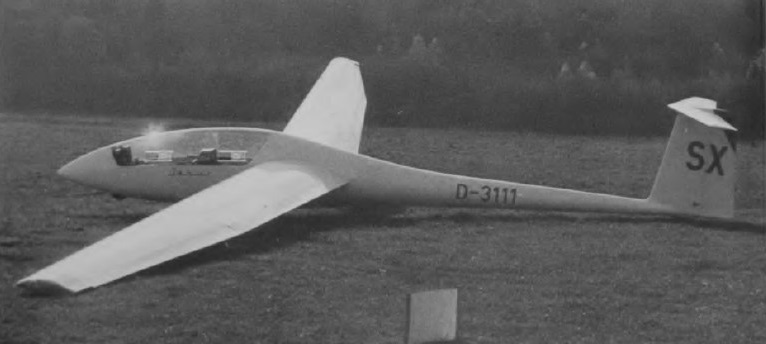
The Duo-Discus was designed specifically by Klaus Holighaus for two seat high performance flight. With its wingspan of 20m, the two seat fixed profile glider first flew on the 11.03.1993 on the Hahnweide. Despite limited production opportunities, over 150 aircraft were already in service around the world by the end of 1997.
In April 1998, the maiden flight of the first prototype of the Discus 2, registrated D-6111, took place. In 1998 the Discus-2 gained first place in the Hahnweide competition and also National Championships in Germany and England. In late summer 1998, the 250th Discus-CS delievered from Chocen.
1999 brought the maiden flight of the “Duo-Discus-Turbo” and Gunther Stahl became the “Junior World Champion” in the Standard Class with a “Discus-2b”.
The Duo Discus was conceived as an advanced trainer with good cross country ability. It has a four piece unflapped wing with a modified Discus wing. The fuselage is derived from that of the two-place Janus. Approach control is by top surface airbrakes.
With the title of European Champion in all three classes, in 2000 two new motor gliders were announced. The Discus-2T, and the Nimbus-4M with an internal lying Solo 2625-02 engine as copied from the Nimbus-4DM.
The World Championships were successful in Mafeking 2001, with a renewed title for the Discus-2 and the Ventus-2ax in the 15m class, a variant sporting a drag reduced tail section and Maughmer winglets. These modifications (which improved the flight characteristics at lower speeds and higher wing loadings) were carried through to the Ventus2-bx, along with a newly designed outer contour and cockpit area shape.
Additionally, the Ventus-2cT won the 18m class at the FAI World Air Games in Lillo/Spain. Mid May 2002 saw the delivery of the first ballistic chute “total recovery system“ fitted to a Ventus-2bxR which was designed by the neighbouring company Glasfaser-Flugzeug-Service GmbH in Grabenstetten and tested in a Discus.
2002 saw the delivery of the 1000th Discus (all variants) as well as the completion of the 1000th Ventus (all variants).
The 18m Discus-2C, first flown on the 16.09.2004, integrates of the “Turbo“ sustainer and shorter outer panels, allowing the Discus-2C to be used in standard class competitions.
Discus b Span 15.0 m Wing area 10.58 sq.m Wing aspect ratio 21,3 Fuselage length 6.58 m Unloaded weight approx. 230 kg Gross weight 525 kg Wing loading 29.5-49.6 kg/sq.m Max water ballast 180 lt Maximum speed 250 km/h Maneuver speed 200 km/h Leastst sink approx. 0.59 m/s Best lift/drag ratio 43
The Nimbus 2’s performance had made it a leading contender in Open Class competition flying, in which it had twice won the World championships, and so there were obvious possibilities in a Standard Class version of this type with a shorter 15m span wing with camber-changing trailing edge flaps/air brakes and designed to meet the new FAI regulations for Standard Class 15-metre sailplanes. The Mini Nimbus (HS 7) of 1976 was the first of Klaus Holighaus for the FAI-15m class. A single-seat, 15 metre wingspan sailplane with a new wing with both dive brakes and flaps, series one manufacture started in 1977 with fibre-glass. The wings stem from the Glasflugel Mosquito as well as most of the mechanics. Equipped with a trim system in which the pilot adjusts trim according to their weight and sets the flaps for the desired flying speed.
Water ballast is carried in sealed tanks lying along the spar. All controls connect automatically as the flying surfaces are installed, and the trim lever needs to be set only once per flight; thereafter changes in flap setting (-7 to +10 degree) automatically cause trim compensation.
The HS-7 Mini-Nimbus, designed by Dipl-Ing Klaus Holighaus, first flew in prototype form on 18 September 1976, and a total of 200 had been ordered by February 1977; altogether 155 Mini-Nimbuses of all versions had been delivered by the beginning of 1980.
As with the Nimbus 2, the T tailplane was an all-moving surface on initial production aircraft, but from March 1978 a fixed incidence tailplane was offered as an option for customers, the type being known as the Mini-Nimbus B with this tailplane.
The Mini-Nimbus C is offered with either carbon-fibre wings and tailplane or those of glassfibre construction and the same new features as on the Nimbus 2C. Of the same glassfibre/foam sandwich construction as the Nimbus 2, the cantilever mid wings have flaps that incorporate the wing root fairings and glassfibre air brakes in the wing upper surface immediately ahead of them. The flaps can be selected to five positions between -7° and +10°, and when they are lowered the trim lever operates the all-moving tailplane at the same time so as to give an automatic flap/trim system. Up to 265lb of water ballast can be carried, or 419lb in the carbon-fibre-winged Mini-Nimbus C. The glassfibre fuselage shell is stiffened with bonded foam rings and has a central tubular steel framework like that of the Nimbus 2; the fin is integral with the fuselage and the tailplane is of glassfibre/foam sandwich. Landing gear consists of a manually-retractable rubber-sprung monowheel with a drum brake. The pilot sits under a large one-piece flush-fitting canopy in a semi-reclining position.
Schempp-Hirth SH-7 Mini-Nimbus C
The original version has an all-moving horizontal tail, but the C model is made with a fixed horizontal stabiliser, optional carbon fiber wings and tail (which reduce the empty weight by 20 kg /44 lb) and a modified trim system.
Serial introduction of carbon fiber was first included on the Nimbus-2C, Mini-Nimbus-C, Janus-C and Janus-CM.The “C” has a carbon fiber wing and horizontal tail unit. A rear edge turning flap (a combination of spoiler and curving flaps) is common to all models, which lends unusual short landing characteristics to the Mini Nimbus. The Mini Nimbus elevator trim overlaid by the curving flap and the retractable landing gear was manufactured from GRP.
After 159 were built, manufacturing switched to the Ventus in 1980.
Schempp Hirth Mini Nimbus Length: 21.03 ft / 6.41 m Wingspan: 49.213 ft / 15.0 m Aspect ratio: 23.00 Airfoil: Wortmann FX 67-K-1 50 Wing area: 106.133 sq.ft / 9.86 sq.m Max take off weight: 992.3 lb / 450.0 kg Weight empty: 518.2 lb / 235.0 kg Max. weight carried: 319.7 lb / 145.0 kg Water ballast: 265 lb Max. speed: 135 kts / 250 km/h Wing Load: 45.64kg/sq.m / 9.35lb/sq.ft Glide ratio: 42.0 at 106 kph / 57 kt / 66 mph MinSink: 0.58 m/s / 1.90 fps / 1.13 kt at 80 kph Crew: 1
Mini-Nimbus C (carbon-fibre wings) Span: 15.0 m / 49 ft 2.5 in Length: 6.41 m / 21 ft 0.5 in Height: 4 ft 4 in Wing area: 9.86 sq.m / 106.1 sq.ft Wing section: Wortmann FX-67-K-150 Aspect ratio: 23.0 Empty weight: 215 kg / 474 lb Max weight: 500 kg / 1,102 lb Water ballast: 190 kg / 419 lb Max wing loading: 51.0 kg/sq.m / 10.45 lb/sq.ft Max speed: 155 mph / 135 kt / 250 km/h Stalling speed: 33 kt / 61 km/h Max rough air speed: 135 kt / 250 km/h Min sinking speed: 0.53 m/sec / 1.74 ft/sec at 48.5 mph / 42 kt / 78 km/h Best glide ratio: 42:1 at 65 mph / 57 kt / 106 km/h
Design work on the Janus was begun by Dipl-lng Klaus Holighaus in 1969, was continued from early 1972 onwards and the prototype first flew in May 1974. Production began with the second aircraft, incorporating several improvements, in January 1975.
The Janus seats two in tandem with the rear seat occupant positioned near the center of gravity. The original Janus and Janus B (first built in 1978) models had an 18.2 m. wingspan, fixed landing gear and a gross weight of 621 kg / 1,370 lb. The Janus B became available to customers in March 1978, seating for two and provision is made for up to 200 lb of water ballast in the wings but use is not recommended unless lift is expected to exceed 3.3 ft/sec. The flaps adjust from -7 o to +10 o. The glider is fitted with airbrake and tail parachute. The Janus B this having a fixed incidence tailplane instead of the all-moving type previously fitted.
The Janus has a glassfibre monocoque fuselage with bonded in foam bulkheads, and this is similar to the Nimbus 2’s but the cockpit section is lengthened to accommodate the two pilots in tandem with dual controls under a hinged one-piece canopy. Landing gear consists of a non-retractable monowheel with a drum brake, and a nosewheel; there is also a bumper under the rear fuselage. The two-piece cantilever mid wings have 2° forward sweep on the leading edge, and are of glassfibre/foam sandwich construction, with glassfibre monocoque ailerons, flaps and Schempp-Hirth air brakes in the wing upper surfaces; the camber-changing flaps are operated between +12° and -7°. The tailplane is also of glassfibre/foam sandwich construction.
The Janus C first built in 1979 has a 20-meter span with carbon wings and a carbonfibre tailplane, seating for two, and competition-type performance. The Janus CM, with a 20-meter span, is a two-place motorglider with carbon wings and fully retractable engine. The Janus C incorporated carbon fiber components, retractable gear, and a gross weight of 700 kg./ 1,543 lb. Camber-changing flaps (+12 to -7 degree), top surface-only airbrakes and a tail drag chute provide options for approach control. In all versions a small fixed wheel between the main gear ant the nose allows strong braking without scraping the nose.
The Janus M prototype, D-KIBO, first flew in 1978 and is a motorised version with a 55hp Hirth 0-28 engine mounted on a pylon aft of the cockpit end retracting into the fuselage. Motorised versions are the Janus CM self-launcher with retractable mast mounted Rotax two cycle engine, and the sustainer Janus CT with a 15 kW/ 21 bhp Oehler Solo 2350 turbo engine.
The self-starting version, the JANUS cm, flew for the first time 1978 and to it in several dozen copies to all world was supplied, at first with an Hirth engine, later then with a Rotax engine type 535. One hundred examples of all versions of the Janus had been delivered by early 1980 plus three motorised Janus CMs.
The Royal Air Force acquired 2 Janus C’s for its air cadet program.
No. of aircraft built to 10/15/81 120 (all versions).
The Janus has set several speed and distance records for two-seaters, including a 100km triangular closed circuit speed of 88.8mph in Switzerland flown by Klaus Holighaus and U. Plarre on 15 August 1974, a women’s goal and return flight record of 339 miles in Italy in April 1976, flown by Adele Orsi and M. Monti, and further speed records over 100km, 300km and 500km triangular closed circuits in South Africa in November 1977.
In 1996 two variants were being built when the Janus was retired from production. The Janus Ce and/or Janus CT were both equipped with 20 m carbon fiber wings, absorbed horizontal tail unit, larger vertical stabilizer and more effective airs brake. Earlier designs had the GRP wing with 18,2 m span – however the JANUS von Anbeginn had curving flaps.
A French development of the Janus is the SCAP-Lanaverre SL-2 all-plastics sailplane created by SCAP-Societede Commercialisation Aeronautique du Plessis, SàRL and Lanaverre Industries, the latter building the Standard Cirrus under licence from Schempp-Hirth. First flown on 15 October 1977, the SL-2 differs from the Janus chiefly in having provision for 30.8 Imp gallons (140 litres) of water ballast in the wings and a fixed tailplane with elevators instead of a one-piece all-moving tailplane; a more comfortable cockpit for the two pilots is provided, with provision for back-type parachutes.
Janus Span: 59 ft 8.5 in / 18.2m Length: 28 ft 3.25 in / 8.62 m Height: 4 ft 9 in / 1.45 m Wing area: 178.5 sq.ft / 16.6 sq.m Aspect ratio: 19.97 Wing section: Wortmann FX-67-K-170/15 Empty weight: 370 kg / 816 lb Max weight: 1,366 lb / 620 kg Max ballast: 200 lb Water ballast: None Max wing loading: 37.4 kg/sq.m/ 7.66 lb/sq ft Vne: 119 kts / 220 km/h Max speed: 136 mph (in smooth air) Stall 10 deg flap: 38 kt / 67 km/h Max aero-tow speed: 105 mph Max rough air speed: 119 kt / 220 km/h Min sinking speed: 2.30 ft/sec / 0.61 m/sec at 56 mph / 40.5 kt / 75 km/h Best glide ratio: 39.5:1 at 68.5 mph / 59 kt / 95 km/h
Janus B Seats: 2 Length: 28.3 ft Height: 3.3 ft Wing span: 60 ft Wing area: 179 sq. ft Wing aspect ratio: 20 Max wt: 1366 lb Standard empty wt: 838 lb Max useful load: 528 lb Water ballast: 440 lb Wing loading: 7.6 lbs/sq.ft Min sink: 132 fpm @ 43 kt Max speed: 119 kt Stall speed: 35 kt Glide ratio: 39-1 @ 54 kt Rough air airspeed: 119 kt
Janus C Seats: 2 Length: 28.3 ft / 8.62 m Height: 3.28 ft Wingspan: 65.6 ft / 20.0 m Wing area: 187.3 sq.ft / 17.3 sq.m Wing aspect ration: 23 Max wt: 1543 lb Standard empty wt: 782 lb Max useful load: 761 lb Wing loading: 8.2 lbs/sq.ft Min sink: 118.1 fpm @ 49 kt Max speed: 135 kt Stall speed: 37.8 kt Glide ratio: 43-1 @ 59 kt
Janus CM Engine: 45 kW/ 60 bhp Rotax 535 C L/DMax: 43 110 kph / 59 kt / 68 mph MinSink: 0.60 m/s / 1.97 fps / 1.17 kt Wing span: 20 m / 65.6 ft Wing area: 17.4 sq.m / 187.3 sq.ft Empty Weight: 365 kg / 805 lb Payload: 345 kg / 761 lb Gross Weight: 700 kg / 1543 lb Wing Load: 40 kg/sq.m / 8.2 lb/sq.ft Water Ballast: 200 kg / 440 lb Aspect ratio: 23 Airfoil: Wormann FX-67-K-170 Seats: 2
The HS-3 Nimbus high performance single-seater was designed and built in his spare time by Dipl-lng Klaus Holighaus, with the aid of Schempp-Hirth. It had the same fuselage as the Open Class Cirrus married to a new high-set three-piece wing of 22m (72ft 2.5in) span and the high aspect ratio of 30.6; the tail unit was similar to that of the Cirrus.
The HS-3 Nimbus was of glassfibre/foam sandwich construction, the fuselage having a steel tube frame for the attachment of wings and landing gear, and the manually-retracted monowheel had a drum brake. No air brakes were fitted, and the pilot sat under a long two-piece canopy. The Nimbus had an exceptionally high performance, with a best glide ratio of 51:1 at 56 mph and a minimum sinking speed of only 1.44ft/sec, and this performance would ensure its sales prospects.
In January 1969 Klaus Holighaus flew his first “Super Orchid”, the Nimbus-1. With this glider George Moffat won the 1970 World Championships in Marfa/Texas, USA.
Design work on the Nimbus 2 began in January 1970 and the prototype, construction of which began in April that year. The Nimbus 2 was developed from the 1969 22 m Nimbus which George Moffat won the Open Class World Championships at Marfa, Texas in 1970, and first flew in 1971. The four piece wing has flaps interconnected with the ailerons with settings which range from +6 to -8 degrees, with 20 degrees for landing. Later -2B and -2C developments carry more ballast with higher gross weight. The 2C replaced the all moving tailplane with a conventional fixed horizontal and moving.
Nimbus 2
With the Nimbus-2C the inner wings were GRP and the combined curve/air brake system of the Mini Nimbus was provided. The first flight of this variant took place in October 1978, the type certification in February 1979.
The HS 3 Nimbus is a high performance Open Class sailplane, and was designed by Dipl Ing Klaus Holighaus and first flew in January 1969. Construction is almost entirely of glass fibre, with a foam sandwich structure for the wings and tail unit. A single-seat midwing monoplane in carbon fibre, the four or six-part wing, has flaps, and air brake. Separate water tanks are in the outer and inner wing panels.
The Nimbus 2 is the production version, differing from the HS-3 in having the same fuselage as the Standard Cirrus married to a wing of shorter span (20.3m) and built in four sections to limit weight and dimensions for ease of rigging, storage and trailer transport. The glassfibre/foam sandwich wing structure was stiffened to eliminate the bending experienced with the earlier Nimbus wing, and glassfibre Schempp-Hirth air brakes are fitted in the upper surfaces; there is also a tail braking parachute. The ailerons and interconnected flaps are glassfibre shells, the flap settings ranging from -8° for high speed flight to +6° for soaring in thermals and 20° for landing; the flaps of the earlier Nimbus drooped to 90° for landing. Up to 353lb of water ballast can be carried.
The glassfibre fuselage shell is stiffened with bonded-in foam bulkheads and there is a central tubular steel framework for attaching the wings and landing gear. The Nimbus 2 also differs from the earlier version in having a glassfibre/foam sandwich T-tail very similar to that of the Standard Cirrus; the first 132 Nimbus 2s havean all-moving tailplane, but 133rd and later aircraft known as the Nimbus 2B have a fixed incidence T-tailplane and elevator. The retractable rubber-sprung monowheel has a drum brake. The pilot sits in a semi-reclining seat under a long flush-fitting hinged canopy.
Successes followed in 1972 and 1974 when Göran Ax in Yugoslavia and George Moffat in Australia became World Champions in the Open Class flying the Nimbus-2 (the production version of the Nimbus-1).
Three New Zealand pilots, B.L. Drake, Don Speight and S.H. Georgeson, jointly won the World goal/ distance record of 1,254 km./ 779 miles in 1978 flying Nimbus 2’s. Women pilots have also gained the following records flying Nimbus 2’s: Doris Grove of the U.S., goal/ return distance of 1,127 km /700.2 miles in 1981, Y. Loader of New Zealand, height gain of 10,212 m /33.504 ft in 1988, and Joan Shaw of the U.S., goal/ distance of 951.43 km / 591.2 miles in 1990.
In 1974, there was the maiden flight of the single seat motorglider Nimbus-2M. Not only were the first experiences with retractable engines achieved, but also numerous world records were set, from the limited series production.
The Nimbus 2C has a higher gross weight, is fitted with new brake type flaps instead of upper surface air brakes, and is available to customers with wings and tailplane built of carbon-fibre as an alternative to glassfibre construction; with the former up to 550 lb of water ballast can be carried.
A new material had found its way, however, into the Kirchheimer production halls: the carbon fiber. What was included into the Nimbus-2C in a rather inconspicuous manner, proved itself to be the start of, at that time not appreciative of how large, an effective future in the production of high performance gliders. The thin wing profiles of the succeeding developments would not have been possible without the higher strength and stiffness of the carbon fiber.
The lengthening of the lifespan for fiberglass constructed gliders from 3000 to 6000 hours was for example, proven with a Nimbus-2 inner wing.
Serial introduction of carbon fiber was first included on the Nimbus-2C, Mini-Nimbus-C, Janus-C and Janus-CM. the optimal qualities of this new material were only utilized fully later on in the Ventus and Nimbus-3, in the production of the long and thin wings of these models.
By 1 January 1979 a total of 185 Nimbus 2s, 2Bs and 2Cs had been delivered, and the type has an outstanding competition record. It has twice won the Open Class in World Championships, in 1972 at Vrsac, Yugoslavia, flown by Goran Ax of Sweden and in 1974 at Waikerie, Australia, flown by George Moffat of the USA; in the 1976 World Championships in Finland, Nimbus 2s took no less than 14 of the first 25 places.
On 15 February 1977 a Nimbus 2 flown by R.J. Rowe of Australia set a speed record of 83.264mph over a 750km course, and a similar record over 500km was set up by Edward Pearson of Rhodesia in another Nimbus 2 on 27 November 1976. The world distance record to a goal, for single-seaters, was set up by a group of three Nimbus 2s which covered 779.36 miles in New Zealand on 14 January 1978. The Nimbus 2CS that won the 1980 German National championships was modified to have extra wing panels to increase the span to 23.5m (77ft 0in). This preceded the Nimbus 3 which has a four-piece carbon-fibre wing of 22.9m span, and which was first flown in prototype form on 21 February 1981 by its designer Klaus Holighaus.
The Nimbus 2M, or Motor Nimbus, was developed under the direction of Dipl-lng Klaus Holighaus and is fitted with a 50hp Hirth two cylinder two-stroke engine. This drives a two-bladed fixed-pitch wooden propeller and is completely retractable, being lowered when stopped behind closed doors in the centre fuselage, the propeller being stopped so as to lie on the fuselage centreline. The powerplant is raised and lowered electrically, using the motor and rack-and-pinion gearing from a Bosch car sun roof installation, and since the engine weight is less than that of the water ballast carried by the unpowered Nimbus 2, its effect on performance when retracted is very slight. Up to 88lb of fuel can be carried in wing tanks and the take-off run with engine on is 1,310ft; rate of climb is 395ft/min and the range is 310 miles. The prototype Nimbus 2M first flew in June 1974, and made its debut at the First International Motor Glider Competition at Burg Feuerstein, West Germany, that same month. Apart from the engine installation, the Nimbus2M is the same as the unpowered Nimbus2.
HS-5 Nimbus III
Schempp-Hirth’s replacement for the Nimbus 2 was the Nimbus 3. The original version, which first flew in 1981, has a 22.9 m wing, which may be increased to 24.5 m. with tip extensions. The wing is in four pieces plus the tip extensions, and is equipped with flaps interconnected with upper surface trailing edge airbrakes. The wing division is moved opposite the Nimbus-2, further inward, so that the heaviest end of each wing for assembly is under 40 kg. The assembly takes place via a tongue fork connection with one main pin each in the trunk and at the interfaces, as with the Nimbus-2. Approach control is assisted by top surface double segment airbrakes. The 24.5 m tips have spoiler flaps incorporated at the trailing edge. When rolling at large aileron deflection, the spoiler flap deploys to compensate for lack of rudder to permit coordinated flight. The curving flap operation is coupled with the trim. The absorbed horizontal tail unit has a span of 2,5 m and an area of 1,25 sq.m.
The GRP /Dural air brakes with springy cover plates are in the inner wing, so that separate attaching is not necessary when the assembling of the outerwing. The wings consist of a KFK box spar in the interior and a KFK double T cross-beam in the outerwing. The curving flaps and ailerons are manufactured in KFK /Kevlar building method. The spar boom is about 42% depth of profile directly under the reinforced outer skin of the wing, in order to obtain the highest possible flexural rigidity for a slim, thin and long wing.
The Nimbus 3 makes extensive use of carbon-fibre in its structure, only the forward fuselage being of glassfibre. The three part ailerons droop in conjunction with the flaps, and over 80 gallons of water ballast can be carried. The Nimbus 3 is probably the first sailplane to achieve a glide angle of better than 1 in 50, a figure of 55:1 being claimed, and Mk 3s took the first three Open Class places in the 1981 World Gliding Championships.
The Nimbus-3 did not become only world champion in 1981 at Paderborn, West Germany, at the first attempt, but also won the first 6 places in the Open Class at the 1983 World Soaring Championships at Hobbs, NM, as well as taking 9 of the next 12 places. It also won the first 8 places in the Open Class at the 1985 Worlds at Rieti, Italy. Flight testing by Dick Johnson measured the L/D max of the 22.9 version (which has an increased gross weight 750 kg /1,654 lb) to be substantially less at about 50 : 1. Tom Knauff of the U.S. won the world goal/ out and return distance record of 1,647 km / 1,023.4 miles in a Nimbus 3 in 1983. He also won, jointly, the world triangle record at 1,363 km. / 846.9 miles in a Nimbus 3 in 1986. A world record for 100 km and 300 km speed triangles were also made by pilots flying Nimbus 3’s.
Nimbus 3DM
The vertical stabilizer gained increased area after the testing of the pre-production aircrafts and with an optional water ballast tank.
On both seats take additional load, to between 100 and 110 kg. Backrest and rudder control pedals are the front and back are flight adjustable.
Whilst the production of the single seat Nimbus-3 had to be discontinued after a fire in one of the production halls, this enabled the production of the Racing Class glider Ventus to be increased.
Development of the Nimbus-3D was in response to the appearance of a new (third) generation of high speed single-seaters of the open class with a far higher performance level.
Investigations resulted in the a plan to revise the trunk of the Janus and to combine the 24.5 m and/or 25.5 m carbon fiber wings of the Nimbus-3. New wing attachments for the slim wing geometry, and reinforcement of the basic wing structure around to 60% due to the substantially higher additional load than with the single-seater.
The Nimbus 3D, which first flew in 1986, combined a modified Janus C fuselage with 24.5 Nimbus 3 wings. In addition to the unpowered sailplane, it was produced with as a sustainer (3DT) with a 19 kW/ 26 bhp Oehler Solo 2350 engine and a self-launcher (3DM) with a retractable mast mounted Rotax Rotax 535 C engine of 44 KW (60 HP) at 7200 rpm.
ICAO Type Certificate Manufacturer: Schempp-Hirth Flugzeugbau GmbH Type Certificate: Musterzulassungsschein Nr. 04-373 Issued by: Luftfahrt-Bundesamt, Bundesrepublik Deutschland Date of Issue 20 January 1989 LBA Type Certificate Data Sheet No.373 – Nimbus-3D – Issue 3, dated 03.12.1992 Model(s): Nimbus-3D MCTOW 750 kg [1653 lb.] Max. No. of Seats: 2
Including the use of flexible tanks in the inner wings the maximum fuel capacity is 50 litres and is enough for nearly two hours flying time during climb.
A Nimbus 3D took third place in the Open Class of the 1989 World Championships at Wiener Neustadt, Austria. A Nimbus 3DM flown by Theo Newfield and Michael Oakley of New Zealand won the world two seat motorglider out and return record of 841.17 km./ 522.7 miles in 1995.
The sustainer version (Nimbus 3t) has a 15 kW/ 21 bhp Oehler Solo 2350 turbo engine.
Altogether nearly one hundred copies were manufactured, of it are approximately a third with the ‘ Turbo’. The ‘Way home’ assistance equipped (Nimbus-3T) and one was developed further in a private initiative as a self-starter (Nimbus-3MR).
The Nimbus 4, increased span replacement of the single place Open Class Nimbus 3 first flew in May 1990. The six piece wing has a multi-stage Discus style leading edge sweepback. When the double panel top surface airbrakes are opened, the flaps lower automatically to the landing position (approximately 40 degrees). There is a fin mounted trim ballast tank. It comes ununpowered and sustainer versions, the latter powered 19 kW/ 26 bhp Oehler Solo 2350 turbo engine and with a max gross of 750 kg / 1,764 lb. Nimbus 4’s took 3rd, 4th and 5th places in the Open Class in the 1991 World Championships at Uvalde, TX
As already successfully proven with the two seat Nimbus 3D, the Nimbus 4D is also based on a single seat version, the Nimbus 4. The Nimbus 4D is the successor to the earlier 24.6 m Nimbus 3D. The six piece Discus planform wing has full span camber changing flaperons. Approach control is by double segment top surface Schempp-Hirth airbrakes which are interconnected with the inboard sections of the flaps. There is an optional fin ballast tank for trimming purposes. The sustainer model (4DT) has a 20 kW/ 26 bhp Oehler Solo 2350 Turbo engine which is started by windmilling the propeller. The blades fold up automatically when the engine stops.
With the title of European Champion in all three classes, in 2000 two new motor gliders were announced. The Discus-2T, and the Nimbus-4M with an internal lying Solo 2625-02 engine as copied from the Nimbus-4DM. The self-launching Nimbus 4DM has the engine buried in the fuselage with only the radiator, propeller and its drive system on the electrically actuated retractable mast which is raised into the airflow.
Nimbus 4DM
Nimbus 2 Span: 20.30 m Length: 7.33 m Wing area: 14.4 sq.m Empty weight equipped: 315 kg Flying weight: 650 kg Wingloading: 27-45 kg/sq.m Least sink: 0.49 at 75 km/h Best lift/drag ratio: 47,5 at 95 km/h
Nimbus II Wing span: 66.6 ft Wing area: 155 sq.ft Wing aspect ratio: 28.6 Length: 23.9 ft Height: 5 ft Wing loading 7.54 lbs/sq ft Gross 1,168 lb Empty 749 lb Useful 419 lb Water ballast: 333 lb Minimum sink: 94 fpm at 41 kt Max speed: 146 kt Rough air speed 135 kt Stalling speed: 35 kt Max wt: 1,278 lb Glide ratio (L/D): 49:1 at 48 kt Standard empty wt: 770 lb Rough-air airspeed: 146 kt Seats: 1
Nimbus 2C (carbon-fibre wings) Span: 20.3 m / 66 ft 7.25 in Length: 7.33 m / 24 ft 0.5 in Height: 1.45 m / 4 ft 9 in Wing area: 14.4 sq.m / 155.0 sq ft Wing section: Wortmann FX-67-K-170 Aspect ratio: 28.62 Empty weight: 315 kg / 694 lb Max weight: 650 kg / 1,433 lb Water ballast: 250 kg / 551 lb Max wing loading: 45.0 kg/sq.m / 9.2 lb/sq ft Max speed: 168 mph / 146 kt / 270 km/h (in smooth air) Stalling speed: 32 kt / 60 km/h Max aero-tow speed / rough air speed: 99 mph / 146 kt / 270 km/h Min sinking speed: 0.47 m/sec / 1.5 ft/sec at 50 mph / 43 kt / 80 km/h Best glide ratio: 49:1 at 65 mph / 56.5 kt / 105 km/h
Schempp-Hirth Nimbus 2M Engine: Hirth 0.28, 37.3 kW / 50 hp Span: 66 ft 7.25 in / 20.3 m Length: 24 ft 0.5 in / 7.33 m Height: 4 ft 9 in / 1.45 m Wing area: 155.0 sq.ft / 14.4 sq.m Aspect ratio: 28.62 Wing section: Wortmann FX-67-K-170 Empty weight: 970 lb / 440 kg Max weight: 1,279 lb / 580 kg Water ballast: None Fuel capacity: 40 kg / 88 lb wing tanks Max wing loading: 40.28 kg/sq.m / 8.25 lb/sq.ft Max speed: 155 mph / 135 kt / 250 km/h Stalling speed: 37.5 kt / 70 km/h Min sinking speed: 1.8 ft/sec / 0.54 m/sec at 53 mph / 46 kt / 85 km/h Best glide ratio: 47:1 at 62 mph / 54 kt / 100 km/h Take-off run: 350 m / 1,148 ft Rate of climb: 120 m/min / 395 ft/min Range: 500 km / 269 nm
Nimbus-3 Wing span: 72 ft 2 in (22.00m) Wing aspect ratio: 30.6 Length: 23 ft 11.5in (7.30 m) Gross weight: 1102 lb (500 kg) Max speed: 137 mph (220 km/h) in rough or smooth air Best glide ratio: 51/1 at 56 mph (90 km/h) Accommodation: 1
Nimbus-3 Span: 25,5 m Wing area: 16,9 sq.m Aspect ratio: 38,4 Length: 7,63 m Empty weight: 408 kg Max weight: 750 kg Wing loading: 28-44 kg/sq.m Water ballast: 338 lt Maximum speed: 270 km/h Maneuver speed: 190 km/h Least sinking: 0.40 m/s Best lift/drag ratio: 58,5
This high performance single-seater is Schempp-Hirth KG’s first sailplane of glassfibre construction and was designed and test flown by Dipl-lng Klaus Holighaus, who became a 50% shareholder in Schempp-Hirth in 1970 and five years later became co-owner of the reorganised Glasflűgel firm.
The cantilever mid wings have an all-glassfibre box spar and the wing shell is of glassfibre/foam sandwich construction; the hinged ailerons are of glassfibre/balsa sandwich, and the Schempp-Hirth air brakes on both upper and lower wing surfaces are of aluminium alloy, a tail braking parachute also being fitted into a little box on the bottom of the rudder. To achieve good low speed and climb characteristics the new thick Wortmann FX 66 series wing section was used, the stalling characteristics being better and weight saved by comparison with a thinner wing of similar span and aspect ratio with flaps, the slight disadvantage this thick section has compared with the thinner wings being overcome by provision for water ballast, up to 216 lb of which can be carried. There are no flaps.
The fuselage is a glassfibre shell, 1.5mm thick, stiffened with foam rings, and secured with resin. The cantilever tail unit is a glassfibre/foam sandwich structure. Landing gear consists of a manually-retractable monowheel with an annular rubber-sprung shock absorber and a drum brake. The pilot sits on a semi-reclining adjustable seat under a one-piece Plexiglas canopy.
The prototype Cirrus made its first flight in January 1967 with an all-moving V-tail unit, but the second prototype and production aircraft had a conventional tail with the tailplane mounted part-way up the fin.
The original Open Class Cirrus flown by Harro Wodl of Austria was first in the Open Class in the 1968 World Championships at Leszno in Poland.
Cirrus Open
Designed by Dipl-lng Klaus Holighaus, although the Standard Cirrus was a follow-on to the original Open Class Cirrus design, it was a completely different aircraft, with a 15 m wing of different Wortmann aerofoil section with the same root thickness/chord ratio of 19.6% as on the Cirrus and also without flaps, with airbrakes on the top surface only, an all-moving T-tail and a steel tube skeleton in the wing-fuselage center section. The Standard Class has a long flush-fitting one-piece Plexiglas canopy hinged at the starboard side.
The prototype Standard Cirrus first flew in March 1969 and production began in the summer of that year. The type proved to have very docile and pleasant handling qualities and soon made its mark in competition flying, winning the Standard Class at the International Soaring Competition at Hahnweide in 1969 and going on to win many national gliding contests.
Despite a claimed L/D ratio of 38, measured performance by both Paul Bikle and Ricard H. Johnson demonstrated less than 36.
A ‘B’ model was produced that had 16m tips to further improve L/D and minimum sink values (to 38:1 and 118 ft/s respectively). Only 11 B models were produced.
In 1975 an improved to the original Standard Cirrus 15 m version called the Cirrus 75 was introduced with redesigned wing fairings, larger top-surface airbrakes airbrakes, redesigned wing fairings, a longer nose, jettison valves for the wing water ballast tanks repositioned to behind the monowheel, and a new type of easy-to-rig tailplane fitting. The cantilever mid wings and the ailerons are glassfibre/foam sandwich structures, and there are Schempp-Hirth glassfibre air brakes in the wing upper surfaces; unlike the Cirrus, there are no lower surface air brakes. The fuselage is a glassfibre shell, 1.5mm thick, stiffened with bonded-in foam rings, and the T-tail unit is of glassfibre/foam sandwich, the tailplane being an all-moving surface. The standard landing gear is a manually-retractable monowheel, but a non-retractable faired monowheel is optional for the customer; in both cases there is a drum brake. The pilot sits in a semireclining seat and has adjustable rudder pedals.
176 were manufactured under license by Burkhart Grob in Mindelheim, Germany. These changes resulted in a slightly improved L/D (37 vs 36) and minimum sink rate (124 ft/s vs. 128 ft/s).
By April 1977, when production by Schempp-Hirth ended, a total of 700 Standard Cirruses had been built, including 200 built under licence by Grob Flugzeugbau, makers of the Astir series of sailplanes, between 1972 and July 1975. The Standard Cirrus was Schempp-Hirth’s second most successful aircraft in produced units.
After production in Germany ceased in 1971, the Standard Cirrus (Cirrus-VTC) was manufactured from 1972 in Vrsac, Serbia by Vazduhoplovno Tehnicki Centar (later Jastreb Fabrika Aviona Jedrilica) until 1977, first the Cirrus 75 and 75B version, and subsequently a modified Cirrus 81 with roomier cockpit and variable incidence tailplane. VTC had built about 60 by early 1975 under licence and production continued. VTC had built 14 Standard Cirrus 75-VTCs by early 1979.
Between 1977 and 1978, the French company Lanaverre Industrie, formed at Bordeaux in 1977 by Morin SA and the boatbuilding concern Yachting France; built 35 ships designated CS 11/75 L St. and CS 11/78 L St. These ships overlap the German serial numbers with serial numbers beginning at one. 30 had been completed by 1 January 1979 as the Lanaverre Standard Cirrus, also known as the SCAP Cirrus 78L.
Cirrus Open Wing span: 17.74 m / 58.2 ft 2.5 in Wing area: 12.6 sq.m / 135.6 sq.ft Aspect ratio: 25 Airfoil: Wortmann FX 66-196/161 Length: 23 ft 7.25 in Height: 5 ft 0 in Empty Weight: 260 kg / 573 lb Payload: 140 kg / 309 lb Gross Weight: 460 kg / 1014 lb Wing Load: 36.51 kg/sq.m / 7.48 lb/sq.ft Water Ballast: 98 kg / 216 lb Max speed: 137 mph (in smooth air) Max aero-tow speed: 87 mph L/DMax: 44 at 85 kph / 46 kt / 53 mph MinSink: 0.50 m/s / 1.64 fps / 0.97 kt at 45 mph Seats: 1 No. Built: 183
Cirrus 75 Wing span: 15 m Length: 6,35 m Wing area: 10 sq.m Empty weight: 215 kg Max all-up weight: 390 kg Wing loading: 28,5-39,0 kg/sq.m Min.sink rate: 0,63 m/s at 78 km/h Max. L/D: 37 at 93 km/h
Schempp-Hirth Cirrus Wing span: 17.74 m / 58 ft 2.5 in Length: 7.20 m / 23 ft 7 in Height: 1.56m / 5ft 0 in Wing area: 12.6 sq.m / 135.6 sq ft Wing section: Wortmann FX-66-196/161 Aspect ratio: 25.0 Empty weight: 260 kg / 573 lb Max weight: 460 kg / 1,014 lb Water ballast: 98 kg / 216 lb Max wing loading: 36.5 kg/sq.m / 7.47 lb/sq.ft Max speed: 119 kt / 220 km/h Stalling speed: 38.5 kt / 62 km/h Min sinking speed: 0.5 m/sec / 1.6 ft/sec at 39.5 kt / 73 km/h Max rough air speed: 119 kt / 220 km/h Best glide ratio: 44 at 46 kt / 85 km/h
Standard Cirrus 75 Wing span: 49 ft 3 in / 17,74 m Wing area: 12,60 sq.m Wing loading: 8 lb/sq.ft / 26,6-36,5 kg/sq.m Aspect ratio: 22.5 Length: 20 ft 8 in / 7,20 m Max TO wt: 860 lb / 460 kg Empty wt: 487 lb / 260 kg Useful load: 393 lb Water ballast: 139 lb Max speed: 119 kt Rough air speed: 119 kt Stall: 38 kt Lift to drag: 35 @ 51 kt Sink: 2.2 fps @ 42.5 kt / 0,59 m/s @ 79 km/h Max. L/D: 44 @ 85 km/h Seats: 1
Standard Cirrus 75 Wing span: 15.0 m (49 ft 2.5 in) Length: 6.35 m (20 ft 9 in) Height: 1.32m (4ft 4 in) Wing area: 10.0 sq.m (107.7 sq ft) Wing section: Wortmann FXS-02-196 mod. Aspect ratio: 22.5 Empty weight: 215 kg (474 lb) Max weight: 390 kg (860 lb) Water ballast: 80 kg (176 lb) Max wing loading: 39.0 kg/sq.m (7.98 lb/sq ft) Max speed: 119 kt (220 km/h) Stalling speed: 33.5 kt (62 km/h) Min sinking speed: 0.6 m (2 ft)/sec at 40.5 kt (75 km/h) Max rough air speed: 119 kt (220 km/h) Best glide ratio: (90 km/h) 38.5 at 48.5 kt
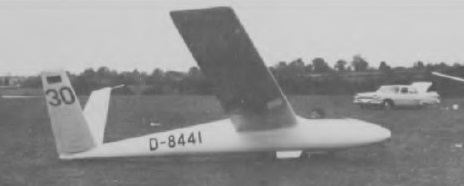
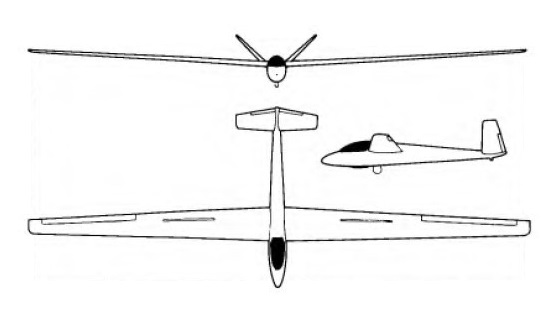
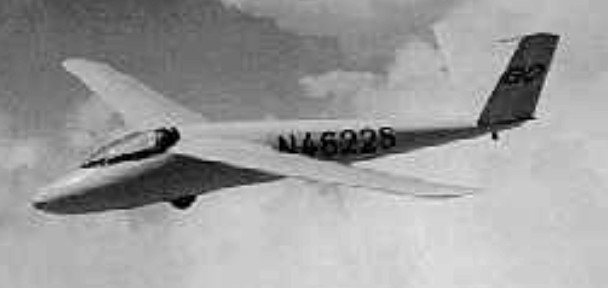
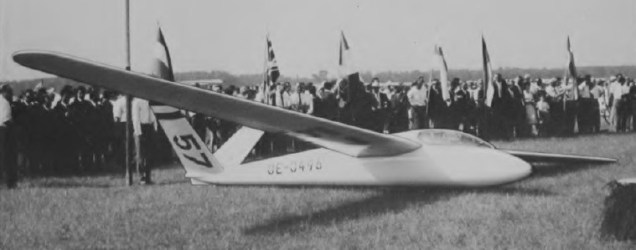
Designed by R.Kunz and M.Schempp, the SHK 17m, Open Class sailplane was developed in 1965 from the 15m Standard Austria/ SH-1, with V-tail surfaces 50 % larger and other improvements. It has a mass balanced all moving tailplane with aerodynamic trim tabs. Schempp-Hirth had built the Standard Austria under licence from March 1962 to 1965.
The SHK’s 17m span (55ft 9.25in) wings are based on those of the Standard Austria, like them with an Eppler 266 laminar flow aerofoil section, and have been redesigned by the Akaflieg Darmstadt. They gave the SHK a performance that was among the best of the last generation of wooden sailplanes, enabling it to win several World and National championships. Like the Standard Austria, the SHK has a V-tail, but this is 50% larger than that of the earlier design and its fuselage is longer, with a roomier cockpit; the pilot’s seat and rudder pedals are adjustable.
The SHK prototype, flown by Rolf Kuntz of Germany, took third place in the Open Class of the 1965 World Championships at South Cerney in England, and once in production the SHK sold steadily, between 40 and 50 a year being built; type certification was granted by the UK and USA as well as Germany.
In 1967 an improved model was introduced (most of the emphasis being directed toward increasing cockpit comfort) and a tail chute was made available. The SHK may have been the ultimate development of the conventional wooden sailplane before composite ships became widely available. The 1968 model SHK had a fully faired-in Plexiglas cockpit canopy. The two-piece shoulder wings have main spars of birch laminate covered with plywood and fabric; Schempp-Hirth air brakes are fitted and later production aircraft had a tail braking parachute. The tail unit itself consists of two all-moving tailplanes mass-balanced and fitted with trim tabs. The fuselage is mainly of wooden construction, the centre portion being a plywood monocoque structure with internal wooden stiffening, containing the retractable monowheel and the main wing attachments. The nose, cockpit section and tail cone are of glassfibre construction.
Structure: standard wood contruction, except for molded fiberglass for the wing leading edge and the forward fuselage.
Span: 17m / 55 ft 9.25 in Length: 6.32 m / 20 ft 3 in Wing area: 14.68 sq.m / 158.2 sq.ft Aspect ratio: 20.2 Airfoil: Eppler 266 Empty weight: 260kg / 573 lb Payload: 110kg / 243lb Gross Weight: 370kg / 816 lb Water ballast: None Wing Load: 25.2 kg/sq.m / 5.2 lb/sq.ft Max speed: 108 kt / 200 km/h / 124 mph (in smooth air) Max rough air speed: 76 kt (140 km/h) Stalling speed: 34 kt / 63 km/h Max aero-tow speed: 87 mph Min sinking speed: 0.61 m /s / 1.97 ft/sec / 1.18 kt at 43.5 mph / 75 km/h / 37.5 kt Best glide ratio: 38:1 at 56 mph / 48.5 kt / 90 km/h L/DMax: 39 87 kph / 47 kt / 54 mph Seats: 1 No. Built: 59
This high performance Standard Class single-seater was the result of a commission by the Austrian Aero Club (Osterreichischer Aero-Club) to Ing Rudinger Kunz to design them a sailplane in this category; the prototype first flew in July 1959, and the design duly won the OSTIV Trophy in 1960 for the best Standard Class type in the World Championships at Koln-Butzwelerhof in Germany.
In designing the Standard Austria Rudinger Kunz sought to combine a high lift/drag ratio and a relatively low wing loading, and the type’s great strength and excellent flying characteristics made it suitable for cloud flying and spinning, although it is not aerobatic. The cantilever shoulder wings are of wooden construction and are unusual in having no spars; they are fabric-covered from the 65% chord line to the trailing edge and there are air brakes in the upper surfaces. The circular section monocoque fuselage has a glassfibre nose section, pilot’s seat and rear fuselage, the centre portion being of wood. The ‘butterfly’ V-tail surfaces are all-moving wood and fabric structures with an included angle of 90°, and each surface has a geared tab. There is a fixed monowheel forward of the cg, with a disc brake, and a small tailwheel. The pilot sits in an adjustable seat under a blown plastic canopy, and there is provision for radio, an oxygen system and full blind-flying instrumentation.
14 were built in Austria before production was licensed and transferred to Schempp-Hirth in Germany in March 1962. Schempp-Hirth produced 30 Austrias and 5 improved and slightly heavier Austria SH’s.
The 1964 model of the type, the Standard Austria SH, had an Eppler 266 laminar flow wing section instead of the previous NACA 65(2)-415 aerofoil, giving an improved performance at lower speeds; the SH also had a retractable monowheel as an optional feature, and this version was developed into the Schempp-Hirth SHK.
Standard Austria SH
In 1964 a modified version appeared with an Eppler 266 airfoil to improve low-speed performance. A retractable gear was optional (making it a SH-I), giving much improved ground clearance. The Standard Austria has an all- moving V-tail and airbrakes.
Standard Austrias held the world goal record of 737 km./ 458 miles and the world goal-and-return record of 698 km./ 434 miles.
Standard Austria Span: 15.0 m / 49 ft 2.5 in Length: 6.2 m / 20 ft 4 in Wing area: 13.5 sq.m / 145.3 sqft Aspect ratio: 16.7 Wing section: NACA 652415 Empty weight: 205 kg / 452 lb Max weight: 323 kg / 712 lb Water ballast: None Max wing loading: 23.93 kg/sq.m / 4.9 lb/sq.ft Max speed: 155 mph / 135 kt / 250 km/h (in smooth air) Stalling speed: 30 kt / 55 km/h Max aero-tow speed: 87 mph / 75.5 kt / 140 km/h Min sinking speed: 0.7 m/sec / 2.3 ft/sec at 43.5 mph / 37.5 kt / 70 km/h Best glide ratio: 34:1 at 65 mph / 56.5 kt / 105 km/h
Standard Austria S Wing span: 15 m Length: 6,30 m Wing area: 13,50 sq.m Empty weight: ca. 245 kg Max all-up weight: 350 kg Wing loading: 25,9 kg/ m² Min.sink rate: 0,65 m/s Max.L/D: 34
In 1938 the company moved to Kirchheim/Teck and employed more than 300 people during the war time. The first serial gliders were the aerobatic single seat trainer GÖ-1 ‘Wolf’ from Wolf Hirth and the renown GÖ-3 ‘Minimoa’ as well as the two seat GÖ-4 from Wolfgang Hütter.
Wing span: 14,8 m Length: 6,74 m Wing area: 19 sq.m Empty weight: 180 kg Max AUW: 350 kg Wing load: 18,4 kg/m² Min. sink rate: 1 m/sec max L/D: 1:19

 All Aero