Schweizer SGS 2-8 / TG-2 / LNS-1

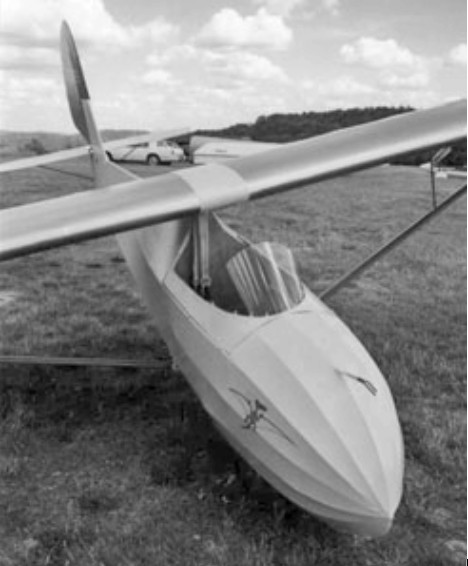
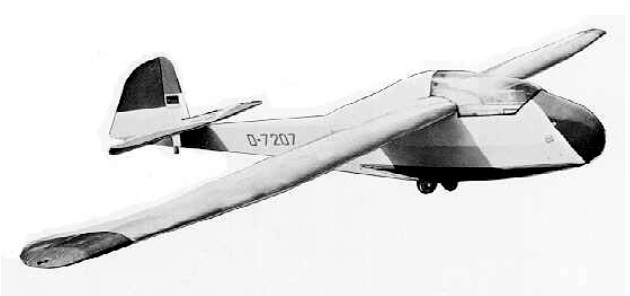
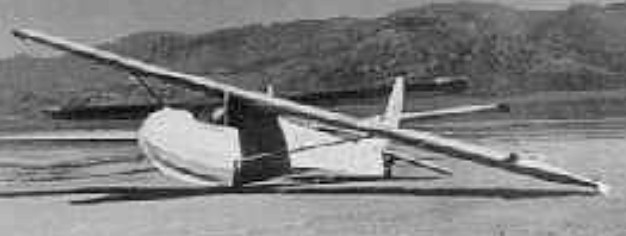
Ernest and Paul Schweizers 2-8 two-place was the first large scale production Schweizer design and the first dozen were built for private owners and clubs.

An all metal glider has a strut braced wing with upper surface spoilers for glidepath control.

A batch was built for the U.S. Army Air Corps for the intial instructor training class at Elmira and subsequently more were ordered as the TG-2. Production was limited by the availability of aluminum. The U.S. Navy and Marines ordered 2-8’s which were designated LNS- 1. Pre World War II civilian gliders were impressed into the USAAC as the TG-2A. After the war. TG-2’s were sought after as they were light, rugged and all metal, despite a low 116 kph/ 63 kt/ 72 mph redline.

Even so, Bob Stanley and Ernie Schweizer made a goal flight from Elmira Washington, D.C. (373 km / 232 miles) and Dick Johnson set a 499 km./ 310 mile multi-place distance record, both in 2-8’s.

The ship is unusual in that it is mainly fastened with PK self-tapping sheet metal screws and there are very few rivets. The empty weight of 204 kg / 450 lb is the original published figure. 2-8’s which remain active have empty weights in the 236-263 kg / 520- 580 lb range. The sturcture is metal/ fabric, 1-spar, 1-strut-braced wings; metal/ fabric tail; steel-tube/ fabric fuselage.

An example of a LNS-1 belongs to the National Museum of Naval Aviation at Pensavola, FL.

The Vintage Sailplane Association has copies of the military manuals, drawings of the color schemes and paint chips available.

Wing span: 15.84 m / 52 ft
Wing area: 19.88 sq.m / 214 sq.ft
Aspect ratio: 12.6
Airfoil: NACA 4412
Empty Weight: 204 kg / 450 lb
Payload: 186 kg / 410 lb
Gross Weight: 390 kg / 860 lb
Wing Load: 19.62 kg/sq.m / 4.02 lb/sq.ft
MinSink: 0.84 m/s / 2.75 fps / 1.63 kt
L/DMax: 23 68 kph / 36 kt / 42 mph
Seats: 2
No. Built: 57

Schweizer SGU 1-7

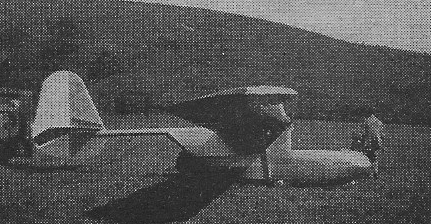
Designed by Ernest and Paul Schweizer, the 1-7, which first flew in 1937, was the first Schweizer design of which more than one ship was produced. The sturctue is metal/ fabric, 1-spar, constant chord, 1-strut-braced wings; metal/ fabric tail, steel-tube/ fabric fuselage.

1938 SGU-1

Wing span: 10.97 m / 36 ft
Wing area: 12.4 sq.m / 133.5 sq.ft
Aspect ratio: 9.6
Airfoil: NACA 2415
MinSink: 1.07 m/s / 3.5 fps / 2.07 kt
L/DMax: 17 72 kph / 39 kt / 45 mph
Empty Weight: 110 kg / 243 lb
Payload: 82 kg / 180 lb
Gross Weight: 192 kg / 423 lb
Wing Load: 15.89 kg/sq.m / 3.2 lb/sq.ft
Seats: 1

1938 SGU-1
Wing span: 38 ft
Length: 20 ft
Wing area: 170 sq.ft
Aspect ratio: 8.5
Empty Weight: 293 lb
Gross Weight: 473 lb
MinSink: 3 fps
L/DMax: 17

Schweizer SGP 1-1 / SGU 1-1

In 1928 J.C. Penney III, son of founder of the J. C. Penney department store chain, provided financial backing for a glider pilot training school run by the American Motorless Aviation Corporation. In order to gain publicity AMAC sponsored some soaring flights at Corn Hill, Truro, Massachusetts, Highland Light, Massachusetts and South Wellfleet, Massachusetts on Cape Cod. AMAC’s chief pilot, Peter Hesselbach made the first flight on 28 July 1928 in the Darmstadt I glider. This flight was of 57 minutes duration and bettered Orville Wright’s record duration flight by a factor of five. Hesselbach flew again on 31 July 1928 from Corn Hill, Massachusetts and flew for more than four hours, soaring in the winds that flowed up over the dunes. This flight was given front-page coverage in the New York Times.

The New York Times story greatly impressed the members of the Mercury Model Airplane Club including Atlee Hauck, Ernie Whidden, Robert Yellow and brothers Paul, Ernest and Bill Schweizer. As a result, they decided to convert the model club to a gliding club and build a primary glider. The club charged a US$5 membership fee. This rather substantial amount caused only those serious about glider flying to remain to build the aircraft, led by the Schweizer brothers.

Ernst Schweizer designed the then-unnamed primary glider, drawing inspiration from photographs of German designs then in use. The teenagers estimated that the glider would cost US$100 to complete and saved their busfare money by walking to and from school. They were not permitted to own bicycles or to hitchhike, as their father considered those methods of transportation too dangerous. They hid the glider construction project from him, even though it was built in the Schweizer’s barn.

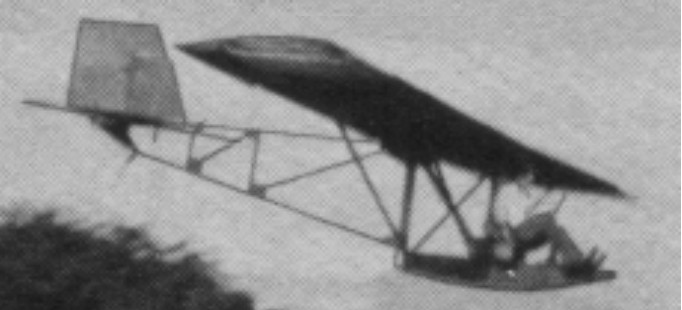
The glider was built with a wooden structure and steel fittings. The wings and tail surfaces were covered in fabric. Typical of the primary gliders of its day, the fuselage was open and featured an open seat with stick and rudder three-axis controls. The aircraft was designed to be bungee launched with an elastic shock cord and had a single skid for landing gear.

Ernest Schweizer recognized the need to ensure that the glider was designed properly and so, even though he was still in high school, he conducted a stress analysis of the design.

The Schweizer brothers were concerned that their father might not let them fly the glider when it was completed and so they built it in secret. Their father worked in New York City during the week and would only enter his barn on weekends. The glider was constructed during weekdays and dismantled and hidden on the weekends. At the point in construction when the aircraft parts had become too large to hide, the brothers decided to assemble the aircraft as far as they could and show their father. He saw that they had done too much work to be stopped at that point and did not object to the completion of the glider.

The glider first flew on 19 June 1930, when Ernest Schweizer was 18 years old, Paul was 17 and Bill was 12. The final cost of the aircraft was US$135.

The club members taught themselves to fly using the glider launched by shock cord. They enlisted the aid of local children to pull the shock cord, but after the novelty appeal wore off, they had difficulties finding sufficient people for bungee launching. They switched to auto-tow using a Ford Model A to pull the shock cord. This method allowed higher flights.

The SGP 1-1 was flown extensively during the summer of 1930, although the total flying time for the year was less than one hour.

The SGP 1-1 has also been referred to as the SGU 1-1.

The success of the 1-1 led the Schweizer brothers to continue on to design the Schweizer SGU 1-2 and to form the Schweizer Metal Aircraft Company. The 1-1 became the first in a line of 38 glider designs that the Schweizers created and the first of over 5700 aircraft built by them.

A replica of the original 1-1 was constructed by a group of Schweizer Aircraft volunteers under the direction of Ernst Schweizer. The glider was completed, registered as N50SZ and flown in 1989 to celebrate 50 years of Schweizer sailplanes. The aircraft was flown by each of the Schweizer brothers and was donated to the National Soaring Museum where it remains on display.

Wingspan: 32 ft 0 in (9.8 m)
Aspect ratio: 8
Airfoil: Clark Y
Length: 15 ft 0 in (4.6 m)
Crew: One
Schultz FS3 Besenstiel

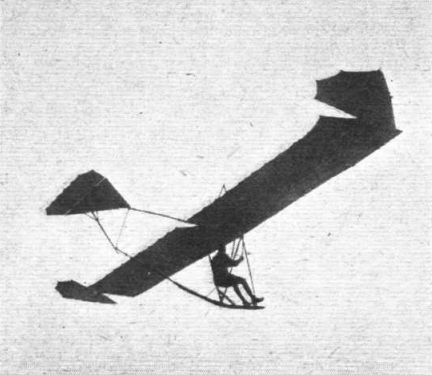
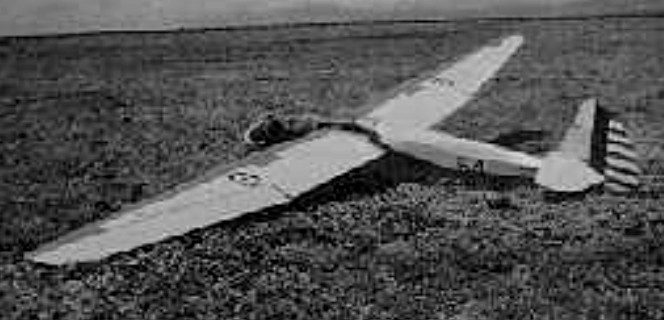
The F.S.3 sailplane was designed and built by Ferdinand Schulz, and also bore the nickname “broomstick”. The high-wing has a two-slatted wing with a modified Joukowski profile by Schulz. The roof beams are formed by two spars. The F.S.3 was exclusively made of fir and door hinges, the cover consisting of old army bed covers. The control was by two flaps at the wing tips.

Klaus Heyn built the original FS3, supported by Erich Kristan, 1924 technical assistant with F. Schulz. In 1924 the F.S.3 was not allowed by the Technical Commission (Teko) at the Rhönwettbewerb because of lack of construction strength.

Although of classic formula (horizontal and vertical empennage) the tail plates are fixed. The steering and roll controls are controlled by two triangles at the end of the wing, operated by two independent handles. The structure is wood (round section), in the form of “N”.

The glider was tested in secret. On May 11, 1924, Ferdinand Schulz remained in the air during the second German coastal flight competition on the Curonian Spit near Rossitten with his “Broomstick” 8 hours and 42 minutes by using the slope upwind, thus setting a world record.

Length: 4,8 m
Wing span: 12,5 m
Wing area: 18,4 m²
Aspect ratio: 9,8
Empty weight: 47,3 kg
TO weight: 123 kg
Maximum pilot weight: 80 kg
Wing loading: 7,2 kg/m²
Seats: 1

Schultz Nucleon

The Nucleon designed by Art Schultz, which first flew in 1954, has a wing bult of Styrofoam around a spar and convered with a fiberglass shell. To save weight, struts were used with cuffs at both ends. It has full span flaps, with drooping ailerons, and a horizontal tail which folds up for trailing.

The structure was I-strut braced all-wood wings, steel-tube/ fabric wings and braced tail.

Wing span: 14 m / 46 ft
Wing area: 12.17 sq.m / 131 sq.ft
Aspect ratio: 16
Airfoil: NACA 65 (2)-415
Empty Weight: 156 kg / 345 lb
Payload: 86 kg / 190 lb
Gross Weight: 242 kg / 535 lb
Wing Load: 19.88 kg/sq.m / 4.1 lb/sq.ft
L/DMax: 22 76 kph / 41 kt / 47 mph
MinSink: 1.00 m/s / 3.3 fps / 1.96 kt
Seats: 1

Schultz ABC / TG-16

The ABC, an Art Schultz development of the simpler, shorter span Midwest MU-1 designed three years earlier, won the 1937 Eaton design competition. The result was due largely to its design and ease of construction, while the much higher performing Ross-Stephens RS-1 Zanonia placed second due to complicated construction and emphasis on ground tow capability. The first all-metal Schweizer sailplane, the SGU-1-6, was third.

The structure was steel tube fuselage and tail, two-spar two-strut wood wing, all fabric coverd. The ABC was offered in plan form and a few were built prior to World War II. After the outbreak of war, one was used as the TG-16 at the USAAC glider training school in Mobile, Alabama.

Wing span: 14.78 m / 48.5 ft
Wing area: 16.26 sq.m / 175 sq.ft
Aspect ratio: 13.2
Airfoil: NACA 6212
Empty Weight: 136 kg / 300 lb
Payload: 77 kg / 170 lb
Gross Weight: 213 kg / 470 lb
Wing Load: 13.1 kg/sq.m / 2.69 lb/sq.ft
L/DMax: 18
MinSink: 0.85 m/s / 2.8 fps / 1.66 kt
Seats: 1
Number built: 4