The 1929 S-1 monoplane was built by Boyd J Shores of Pasadena CA., USA, and first flown about the 30 May 1929.
The registration N717K c/n 5 was cancelled on 14 July 1930.
Engine: LeRhône, 80hp
Wingspan: 32’0″
Length: 25’0″
The 1929 S-1 monoplane was built by Boyd J Shores of Pasadena CA., USA, and first flown about the 30 May 1929.
The registration N717K c/n 5 was cancelled on 14 July 1930.
Engine: LeRhône, 80hp
Wingspan: 32’0″
Length: 25’0″
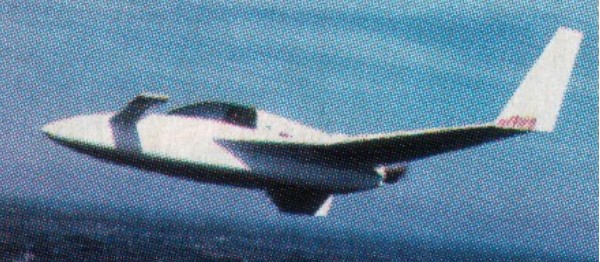
A derivative of the Rutan Long EZ, the E-Racer has retractable undercarriage. There were various options including the Mk.1 (auto engine), Mk.2 (aero engine), and the King Racer (enlarged cockpit).
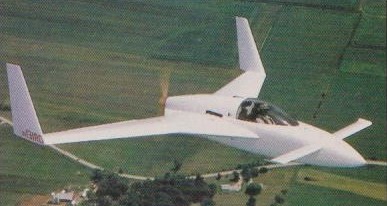
Five were flying by 1998.

Mk.1
Engine: Buick V8, 240 hp
HP range: 160-250
Height: 7.8 ft
Length: 17 ft
Wing span: 26.2 ft
Wing area: 94 sq.ft
Weight empty: 1000 lb
Gross: 1800 lb
Fuel cap: 46 USG
Speed max: 240 mph
Cruise: 220 mph
Range: 1000 sm
ROC: 2500 fpm
Take-off dist: 1200 ft
Landing dist: 1500 ft
Service ceiling: 25,000 ft
Seats: 2
Landing gear: retractable nose wheel
Engine: Lycoming/Buick, 240 hp
Wing span: 7.99 m
Wing area: 8.65 sq.m
MAUW: 816 kg
Empty weight: 454 kg
Fuel capacity: 174 lt
Max speed: 386 kph
Cruise speed: 354 kph
Climb rate: 12.5 m/s
Seats: 2
Plan price (1998): $250
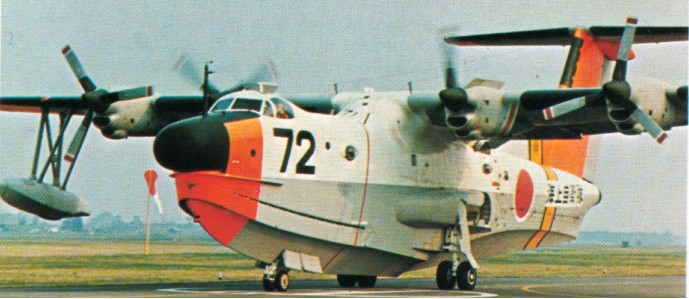
After January 1966, directed attention was put into a new marine aircraft. A Grumman Albatross was rebuilt as a dynamically similar flying model for a projected very large STOL ASW flying-boat for the Japanese Maritime Self Defense Force. The type was developed as the four-turboprop PS-1, but later as the US-1 amphibious search-and-rescue aircraft.
The Shinn Meiwa PS 1, a four turboprop STOL amphibian with an auxiliary engine driving a boundary -layer control pump, has a speed range from 295 knots maximum to a 40 knot stall. PS 1s carry search radar, sonobuoys, MAD and ECM equipment to aid in the search for submarines, and against which they can deploy anti submarine bombs, homing torpedoes, and rockets for surface attack.
Shinn Meiwa PS-1 / US-1 Article
Designed for long-range ASW, the four-turboprop PS-1 flying boat first flew in October 1967, entered service in 1973, and was followed by the US-1 amphibious variant in October 1974.
The first prototype PS-1 was converted later as waterbombing test vehicle.
Production of the PS-¬1 was completed with the 23rd aircraft in 1979. The seventh and subsequent US-1s are fitted with uprated T-64 IHI-10J turboprops and are designated US-lAs. Earlier aircraft are being progressively retrofitted with these engines.
The JMSDF intended to purchase one US-1A SAR amphibian every two years, the next funding was being sought in FY1988.
PS-1
Engines: 4 x T64-IHI-10 turboprop, 3060 shp
Wing span: 108 ft 8.75 in (33.14 m)
Max speed 340 mph (547 km/h)
Crew: 10
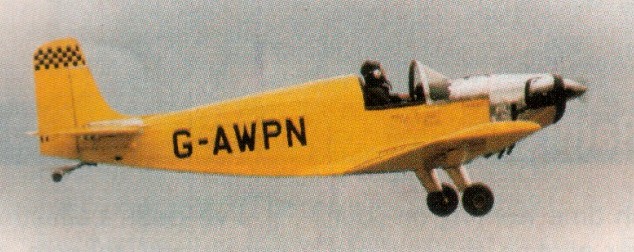
George William Shield of Conisbrough, Yorkshire, UK, was Headmaster of the Grammar School at nearby Mexborough, where this large wooden single-seater was built as a school project. The Xyla (Greek for wood) was registered as G-AWPN c/n 2 PFA.1320 on September 13, 1968 whereafter construction was started.
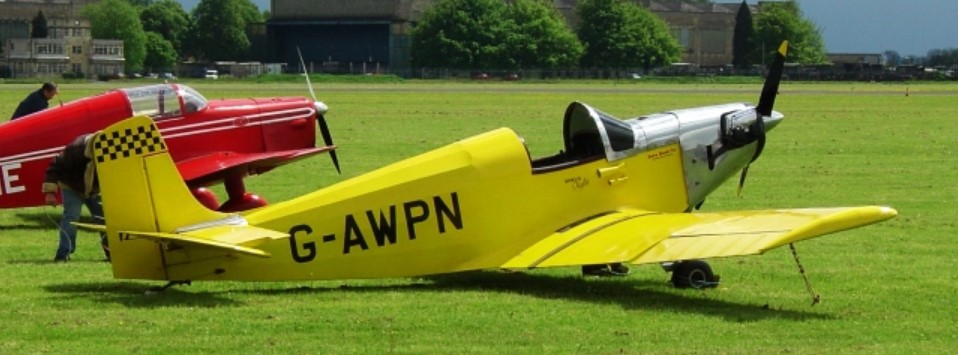
Wings: Cantilever low-wing monoplane. Wing section NACA 4418 at root with a chord of 6 ft 3 in (1.91 m), NACA 4416 at junction of center section and outer panels (3 ft, 0.91 m from aircraft center line) and NACA 4412 at tip with a chord of 3 ft 9 in (1.14 m). Dihedral 4° 30′ on outer panels. Incidence 3°. All-wood structure of spruce, with birch plywood covering. Wooden Frise-type ailerons. No flaps or tabs.
Fuselage: All-wood structure, of Warren-girder construction; plywood-covered to rear of cockpit.
Tail unit: Cantilever type, of similar construction to wings. Tail plane incidence adjustable on ground. No tabs. Tail plane span 9 ft 0 in (2.74 m).
Landing gear: Non-retractable tail wheel type. Cantilever main legs attached to wing front spar. Steel coil-spring shock-absorption. Spitfire tail wheels, of 1 ft (0.305 m) diameter, are used as main wheels. Tire pressure 30 lb/sq in (2’11 kg/crri’). Wheel track 6 ft 0 in (1.83 m), No brakes.
Power plant: One 92 hp Continental converted PC60 GPU engine, driving initially a Shield two-blade wooden propeller with diameter of 6 ft 0 in (1.83 m) propeller, subsequently a 5 ft 3 in (1.60 m) diameter three-blade wooden propeller, in 1999 refitted with two-blade type. Fuel in two wing tanks, total capacity 13.21 gal (50 l), and one gravity-feed fuselage tank forward of cockpit. Refueling points in fuselage top and each wing. Oil capacity 1 gal (4.5 l).
Accommodation: Single seat in initially open cockpit behind one-piece windshield, later cockpit was covered with canopy.
Equipment: Provision to fit generator and radio.
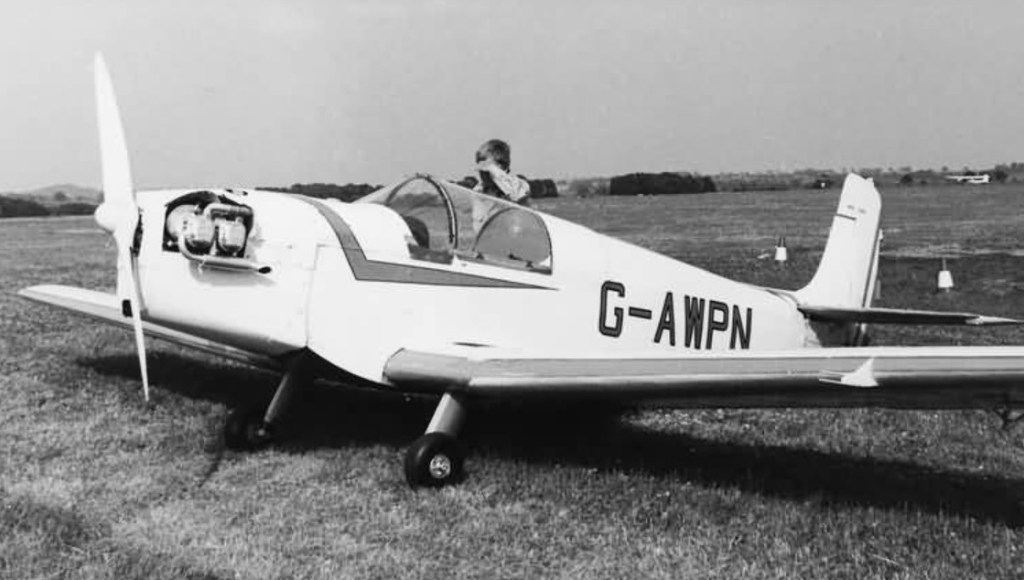
Powered by a converted GPU (ground power unit) engine the aircraft made its first flight at Helmswell on October 30, 1971.
Early test flights indicated that the aircraft performed satisfactorily at low levels, but that some modification to the areas of the vertical and horizontal tail surfaces might improve overall handling and performance. Hence, to prevent leakage of air, the tail-surface hinge lines were sealed with fabric; the fin was relocated at an angle of 4° to port; and a three-blade wooden propeller replaced the original two-blade one.
Shield sold the aircraft seven years after the first flight and it was seven times reregistered:
October 13, 1978, to Terry Girvon of Roterham, Yorkshire
February 19, 1986, to Alan Price of Aylesbury, Buckinghamshire
January 29, 1991, to Michael Herlihy of Haywards Heath, West Sussex
December 9, 1997, to Kenneth Snell of Uckfield, East Sussex
April 28, 2006, to Paul Stacey of Ventnor, Isle of Wight
September 3, 2009, to Stacey Aviation of Ventnor, Isle of Wight
October 15, 2010, to Peter Gasson of Reading, Berkshire
In 1980 the Xyla was damaged when it ground-looped at Finmere, Buckinghamshire, it was grounded and sold in 1986. The new owner did not manage to repair the aircraft and it was stored at the attic of a paint shop. When Schnell bought the aircraft in 1997, he started a restoration to airworthiness that took 1,500 hours. Finished in a new yellow livery with polished metal cowlings, and fitted again with a two-blade propeller the Xyla participated in the PFA Rally in 1999.
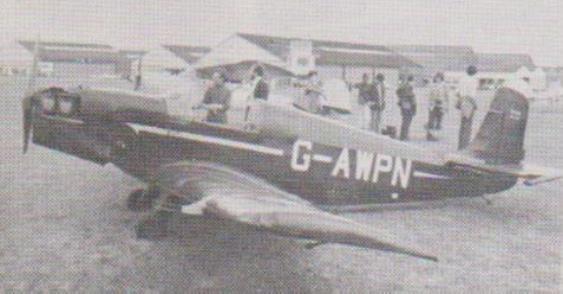
The aircraft is pictured at the PFA Rally at Leicester in an overall white paint scheme which was apparently worn only briefly before its 1980 mishap.
Span: 27 ft 3 in (8.31 m)
Length: 19 ft 3 in (5.87 m)
Height: 5 ft 4 in (1.63 m)
Wing area: 126 sq.ft (11.7 sq.m)
Max weight: 1,000 lb (454 kg)
Max never-exceed speed: 200 mph (322 kmh)
Max cruise speed: 110 mph (177 kmh)
Econ. cruise speed at sea level: 98 mph (157 kmh)
Stall speed: 47 mph (76 kmh)
Climb: 400 ft (122 m)/min
Take off run: 150 ft (46 m)
Seats: 1

The Sherpa K-650T 8 place is turbine powered and capable of operating on wheels, skis, or floats.
I don’t like it. For me the worst aircraft of all bush planes.
The plane is hard to land correctly and difficult to control.
I regret the purchase.
ry.ma@gmx.net
Engine: Honeywell TPE331-5, 840 hp
Optional engine: Honeywell TPE331-10, 1000 hp
Prop: 116 in 3-blade
Wingspan: 47 ft 4 in
Wing chord: 6 ft 8 in
Aspect ratio: 7.1
Length: 34 ft 1 in
Height: 9 ft 9 in
Empty weight: 3500 lb
MTOW: 6500 lb
Max wing loading: 20.63 lb/sq.ft
Max power loading: 8.66 lb/hp
Fuel capacity: 346 USG
Tailplane span: 18 ft 3 in
Wheel track: 8 ft 10 in
Prop ground clearance 3 pt: 3 ft 1 in
Prop ground clearance level: 1 ft 7 in
Cabin door height: 3 ft 7 in
Cargo door width: 5 ft 1 in
Baggage door height; 1 ft 8 in
Baggage door width: 2 ft 6 in
Cruise 18,000 ft: 188 mph
Econ cruise 18,000 ft: 174 mph
Stall clean: 58 mph
Stall flaps down: 34 mph
ROC SL: 1400 fpm
Service ceiling: 25,000 ft
TO run gross: 336 ft
Landing run gross; 240 ft
Range max cruise (42USG/hr) + res: 1256 sm
Range econ cruise (36USG/hr) + res: 1500 sm
Cabin volume: 220 cu.ft
Baggage volume: 7.5 cu.ft
Useful load: 3000 lb
Wing area: 315 sq.ft
Aileron area – total: 26.4 sq.ft
Spoileron area – total: 4.6 sq.ft
Flap area: 67.9 sq.ft
Fin area: 32.6 sq.ft
Rudder area: 15.7 sq.ft
Horiz. Stab. Area: 77.6 sq.ft
Elevator area: 36.8 sq.ft
Seats: 8
Tires: 29x11x10 (35in opt.)
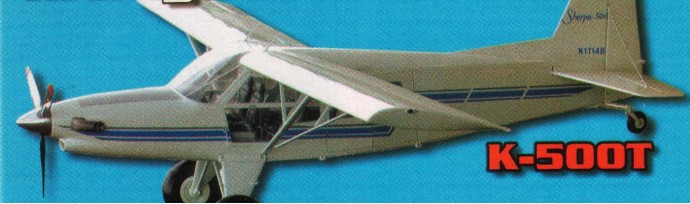
Engine: Walter turbine, 700 hp
Seats: 8
MTOW: 6000 lb
Payload: 2600 lb
Cruise: 175 mph
Fuel cap: 200 USG
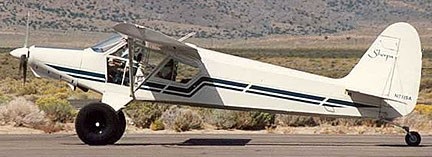
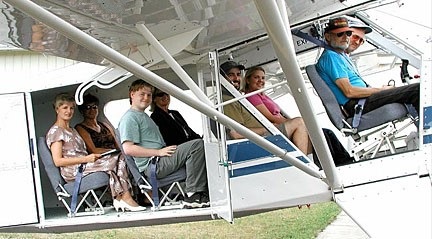
The K-300 can carry up to eight people. They are convertible for freight or passengers, also as two-litter medivac ambulance.
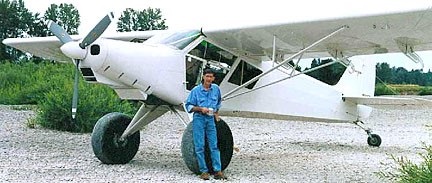
Tires can be up to 42 inch.
Engine: Lycoming O-720, 400 hp
Stall: 41 mph
Seats: 6
Max payload: 2200 lb
Engine: Lycoming TIO-720 twin-turbo, 450hp
Wingspan: 44’10”
Useful load: 2504 lb
Max speed: 166 mph
Stall: 42 mph
Ceiling: 12,000′
Seats: 8
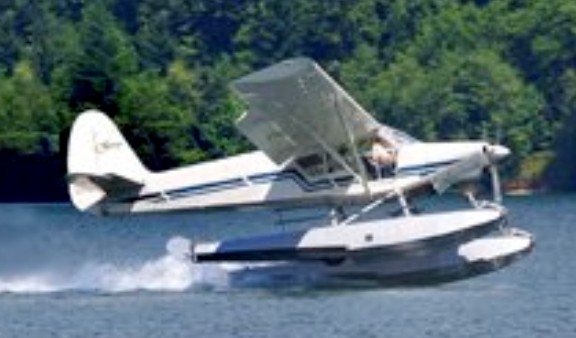
Designed as a STOL bush plane, it was available in kit packages and amphibious twin-pontoon option.
The first protype was N1415B. The Sherpa 200 was designed circa
Engine: Lycoming IO-720, 400hp
Wingspan: 42’7″
Useful load: 1600 lb
Cruise: 139 mph
Stall: 38 mph
Seats: 5-6
Engine: M-14P, 360 hp
Seats: 5-6
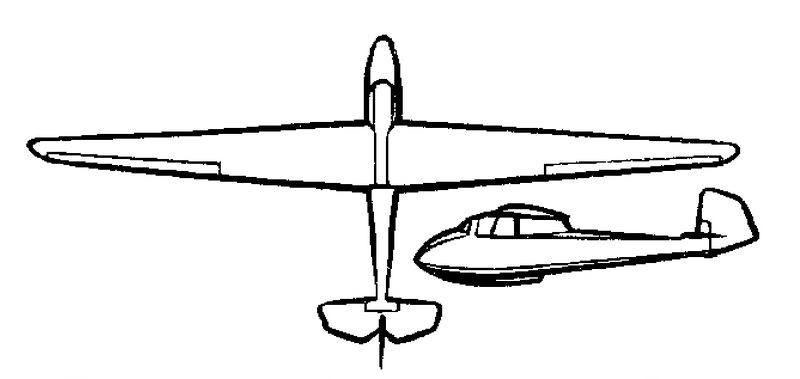
The “Pavel Golovin” glider, also known as PAI-2, was designed and built by a group of enthusiasts consisting of BN Sheremetiev, Yu. I. Koltunov, BL Sirken and AI Pietsuj. The main objective in the construction of this glider was the study of the flight methodology for a training glider with a view to using it for the calculation of record-keeping flights.
The Sheremetiev / Koltunov / Sirken / Pietsuj “Pavel Golovin” glider (Russian: Шереметев, Колтунов, Сиркен, Пьецух – Павел Головин) was designed as a cantilever monoplane with high wing in parasol. The wing construction was characterized by a single spar.
The fuselage was constructed of wood and featured a hexagonal cross section.
In order to provide the pilot with the highest level of comfort, a large cockpit was designed, equipped with all the necessary instruments: altimeter, speedometer, barometer, thermometer, compass, reversal indicator. The cabin was closed using an angled cover, which opened to the side and could be released from the inside in case of emergencies.
The tests carried out in July 1937 with the pilot II Shelest at the controls, showed good stability in the air and response to the controls, as well as excellent manoeuvrability. At speeds of 80 – 160 km / h it was possible to make high school piloting figures.
The negative aspects were the long take-off run and the large wing loading. The landing, on the other hand, was quite short.
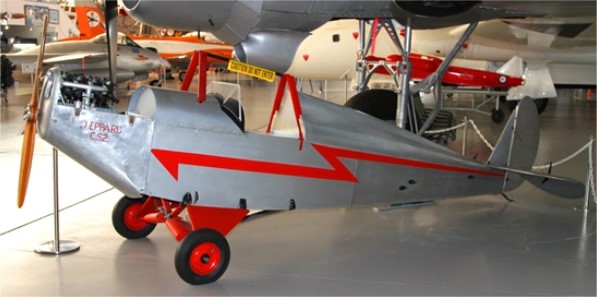
After building the CS1 glider in the early 1930s, Clem Reginald Sheppard of Adelaide, Australia, designed the single seat Sheppard CS2 aircraft in the 1930s. The plans for this aircraft were first drawn in chalk on his parents’ lounge room floor at Kensington Park. The aircraft was later built in the backyard and garage. The fabric to cover the aircraft was sewn by his mother.
By 1938, after Clem had spent all his spare time and money, the aircraft was ready to fly. The CS2 had fold-back wings so it could be towed behind a car to Virginia, where it was flown on a number of occasions by Bill Maddocks. Bill was a Royal Aero Club of SA instructor.
On Clem Sheppard’s death, the aircraft was taken into store by the Royal Aero Club of SA. It went to the South Australia Aviation Museum in November 1987. The wings were to be refitted following restoration.
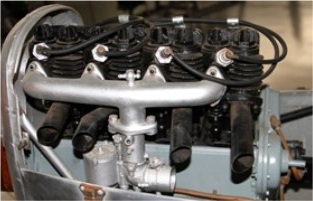
Engine: 4-cylinder Henderson Ace Motorcycle engine rated at 8 hp
Wingspan: 7.62 m
Length: 5 m
Height: 1.68 m
Maximum take-off weight: 174 kg
Capacity: 1 pilot
 All Aero