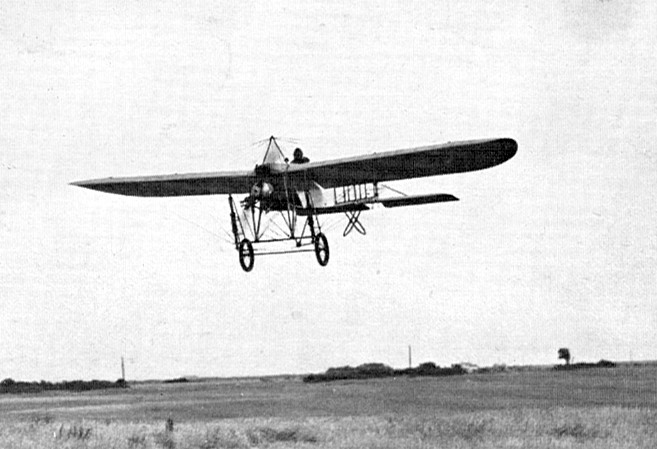
Jean Salis built one Bleriot XI replica to commemorate 46 years after the first cross channel flight.
Jean Salis built one Bleriot XI replica to commemorate 46 years after the first cross channel flight.
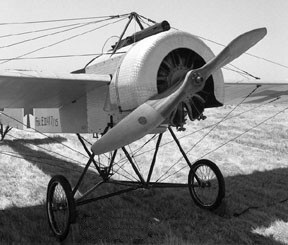
In 1963 Antique Aero built two Fokker E.III replica powered by 80hp LeRhône engines.
The first went to San Diego Aerospace Museum, where it was destroyed in the 1978 fire, the second to Champlin Fighter Museum in 1980.
The 1911 Skinner monoplane was constructed by Mulliner’s Coachworks Ltd in the UK.
The 1911 Sirius monoplane was designed and built by Atelier Sirius in France
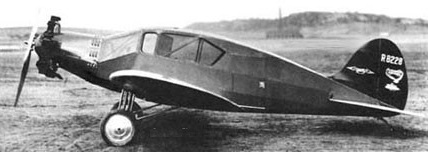
The 1929 Alexander Bullet was designed by Al Mooney, Max Munk (of NACA), and Ludwig Muther as a 3-4 seat cabin, lowing monoplane, with retractable undercarriage. One prototype, NX6390/] c/n 1, was built and first flown on 12 November 1929, piloted by Ted Haeuter and Al Mooney. In all, 12 Bullets were built and 4 partially completed.
Two were built as C-1 in 1929, NX8227 c/n 2000 and NX8228 c/n 2001, with Kinner K-5 engines, also seen in one reference as C-3. They were priced at $6,500-7,200.
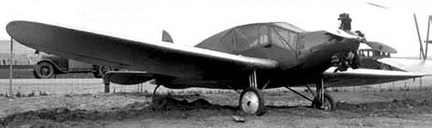
One Bullet C-3 racer for the 1930 Nationals was built, registered NR8228 c/n 2001. It was later dismantled.
The 1929 Bullet C-4 and Bullet C-5 (ATC 2-181) was priced at $8,888. Eight were built: NX700H (appears in regs as a C-4), NR705H (as C-4), N732H, N741H, N747H, N761H, N771H, and N774H (as C-4).
Motor options of 165hp Comet 7-E and Axelson B were never installed.

Although flown successfully in many competitions by Edith Foltz and Errett Williams (hence the “R” licensing), C-5s were rough on test pilots. On 16 September 1929 undefined problems arose during a test flight, and Errett Williams had to bail out, then L W Sylvester was killed 21 September 1929 in a spin test. On 7 October 1929, Shelly Charles was forced to bail out during a spin, and on 5 November 1929, Lewis Love’s plane failed to recover from a fatal spin.
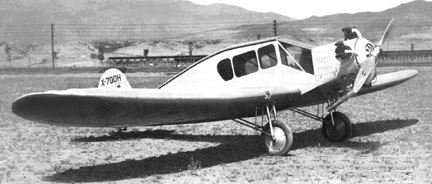
The 1930 Bullet C-7 (ATC 2-181, superseded by 318) was the final sleeked-up version with longer fuselage, full-panted fixed gear, partly-cowled motor, and redesigned tail group.
Priced at $7,200, and $6,500 by 1931, it was the first low-wing cabin monoplane to be granted an ATC, many of its design innovations are evident in Mooney’s subsequent aircraft.
Only one was built; NC309V c/n 2013
Bullet C
Engine: 120hp Anzani, later 100hp Kinner
Wingspan: 38’7″
Length: 21’1″
Max speed: 140 mph
Ceuise: 120 mph
Stall: 40 mph
Range: 612 mi
Seats: 3-4
Bullet C-1
Engine: 150hp Wright J-6-5
Wingspan: 38’7″
Length: 21’6″
Useful load: 1098 lb
Max speed: 150 mph
Cruise: 127 mph
Stall: 45 mph
Range: 612 mi
Ceiling: 15,000′
Bullet C-1
Engine: 100 hp Kinner K-5
Wingspan: 38’7″
Length: 21’1″
Useful load: 1065 lb
Max speed: 130 mph
Cruise: 111 mph
Range: 42 mph
Range: 550 mi
Ceiling: 11,000′
Bullet C-3
Engine: Kinner K-5
Wingspan: 38’7″
Seats: 4
Bullet C-4 / Bullet C-5
Engine: 165hp Wright J-6
Wingspan: 38’7″
Length: 21’6″
Max speed: 150 mph
Cruise: 128 mph
Range: 600 mi
Ceiling: 15,000′
Seats: 4
Undercarriage: retractable
Bullet C-7
Engine: 165hp Wright J-6
Wingspan: 36’0″
Length: 26’10”
Useful load: 1082 lb
Max speed: 148 mph
Cruise: 125 mph
Stall: 48 mph
Range: 540 mi
Ceiling: 15,000′
Seats: 4
The 1930 Alexander B-1 was Alexander’s popular glider fitted with a Henderson motorcycle engine.
It is not known how many were built but one registered might be the only powered version of many gliders N602W c/n 101.
The 1930 Aircraft Builders Parrot was a two-place cabin monoplane powered by a Velie M-5 (or possibly Anzani) engine.
Registered N11132 c/n 100, it was dismantled and the registration cancelled on 19 May 1931.
Produced in 1936 by Aircraft Associates, the company, a principal distributor, began producing Taylor J-2 under a subcontract for Taylor Co after their disastrous Bradford PA plant fire in Mar 1937. With ATC 620, 10-20 were built priced at $1,270.
Engine: 40hp Continental A-40
Wingspan: 35’3″
Length: 22’5″
Useful load: 407 lb
Max speed: 87 mph
Cruise: 80 mph
Stall: 35 mph
Range: 210 mi
Seats: 2
The Air-Craft Corp of America Falcon of 1932 was a two-place high wing monoplane probably designed by Orin Welch (and likely a principal), for the plane featured on a full-page Air-Craft Corp ad in Jan 1932 Popular Aviation bore the tail number of N11382 c/n 107, which was the first of the later Welch OW-5M batch. Possibly N13500 c/n 108 was initially manufactured under this parent name, as well.
It was priced at $995, or $1,150 with a Continental A-40 engine.
Engine: 42hp two-cyl Air-Craft (Welch)
Wingspan: 26’0″
Length: 20’6″
Seats: 2

The Alia-250 was inspired by an Arctic tern and features a 50-foot (15-m) wingspan and an in-house-built electric propulsion system powered by high-density lithium batteries. Beta estimates a 250-mile (402-km) range and top speed of 138 mph (222 km/h).
In 2021 Beta Technologies received the very first military airworthiness approval for manned electric aircraft flight, meaning the Air Force was confident enough to put its own pilot in the seat and take flight. A few months ago, Beta delivered the Alia platform (in conventional takeoff and landing/CTOL form) to the US Air Force at Florida’s Eglin Air Force Base.
Beta completed a full transition from VTOL hover to wing-borne cruise, and then back to hovering for landing, becoming the first company ever to demonstrate that feat with a pilot on board. Beta test pilot Nate Moyer took the helm at New York’s Plattsburgh International Airport, guiding the Alia-250 straight upward off the ground via its four horizontal electric propellers in April 2024.
Once it was high enough, the rear propeller kicked in, and as the aircraft gained enough speed for the wing to take over, the wing-top propellers slowed to a stop for a short cruise flight. Shortly thereafter, it turned around, the four propellers flipped back on, and it glided down toward the airstrip before coming to a mid-air halt and gently dropping straight down for the landing.

This ALIA CX300 electric conventional take-off and landing aircraft has kicked off Norway’s Test Arena for Zero & Low Emission Aviation after completing a weeks-long tour of major European countries in 2025.

In 2025 BETA Technologies has delivered its ALIA CX300 electric CTOL to the company’s first customer. The short-hop passenger aircraft will now be used to evaluate use cases and possible routes for zero-emission operation in the Nordic region.
Unlike its electric vertical take-off and landing counterpart – the A250 – the ALIA CX300 gets in the air and lands using a runway. It’s designed to carry five passengers plus a pilot over short distances between airports, and features an electric motor driving a single five-blade prop to its rear. According to the spec sheet, its onboard batteries should be good for more than 300 nautical miles between one-hour top-ups.

The aircraft’s very first passenger pioneers were flown from Long Island to the John F. Kennedy International Airport, staying in the air for 45 minutes. Now the first ALIA CX300 has been delivered to Bristow Norway AS, a subsidiary of US helicopter operator, the Bristow Group.
The delivery to Stavanger Airport in Western Norway’s Rogaland county also marks the end of a weeks-long 6.976-km (4,335 mile) demonstration tour of seven EU countries by the aircraft, which began in Ireland and closed in Norway. It also signals the start of operations for Norway’s Test Arena for Zero & Low Emission Aviation.
The first test flight by a BETA-trained Bristow pilot was also undertaken at the launch event, following on-site instruction at BETA’s Vermont headquarters recently. Bristow pilots and aircraft maintenance personnel will now undertake further demonstration flights over the next six months, in cooperation with Avinor and the Civil Aviation Authority of Norway, as part of a “six-month regulatory sandbox evaluation project.”

The battery-electric aircraft, manufactured by BETA, seats two crew and up to 5.6 cubic metres of cargo on missions for up to approximately 398km.
The ALIA CX300 first took off in New Zealand on 17 October 2025, flying in New Zealand from Tauranga to Hamilton after a sunrise blessing ceremony.
 All Aero