A proposed postwar development of the T.13 Petrel was the T.22 Petrel 2, which had a revised cockpit with a step, wing spoilers, a monowheel and a tailplane with elevators, but this version was not built. A Petrel was fitted with a small engine on top of the fuselage in 1947 by Wing-Commander K. H. Wallis but this version of the Petrel was never flown.
Monoplane
Slingsby T.21 Sedbergh

Designed by F. N. Slingsby, this side-by-side two-seater was designed to meet the ATC’s requirements for a simple dual control sailplane of medium performance and low price. The prototype, designated T21P, first flew in 1944 and had a wing span of 50ft 0in using the same wing section as the Grunau Baby, and with a removable nose upper deck section to give students the same exposure to the airflow as experienced in primary gliders. Structure: All wood frame, wing D-box and forward fuselage plywood covered, remainder fabric.
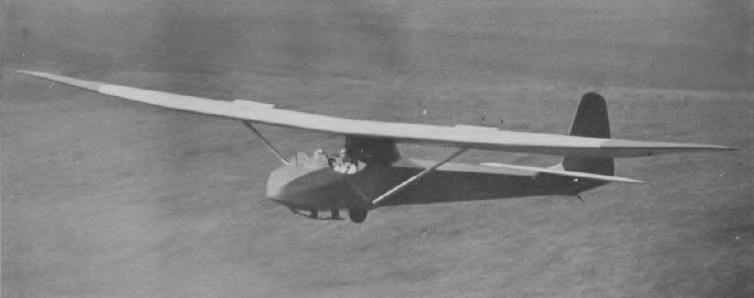
The first production version was the T21A for clubs and other civil customers, with the span increased to 54ft 0in, which first flew in April 1947.
The T21B (originally designated T28) was the version of the T21A, with fixed nose, ordered for the ATC and known as the Sedbergh TX Mk 1 in Service use, being named after the famous Yorkshire public school; this first flew in December 1947.
Altogether 121 civil T21As were built and 73 T21B Sedberghs for the ATC, plus 19 more T21Bs built under sub-contract by Martin Hearn Ltd, who had also built Cadets for Slingsby. Three more T21s were built outside – by the Midland Gliding Club, by Leighton Park School and by Mr J. Hulme, making a total, including upper surfaces.

The forward portion of the fuselage back to the two main wing attachment frames is a wooden stressed skin structure, and the centre and rear portions are of fabric-covered girder construction. The tailplane is braced and the rudder and elevators fabric-covered. Landing gear consists of a large non-retractable monowheel with a nose skid in front of it, and a sprung tailskid. The two pilots sit side-by-side in an open cockpit with dual controls, and with two small windscreens ahead of them; the spoiler lever, cable quick-release and trimming controls are positioned on a console between the two pilots.
The Royal Air Force operated 92 T.21B’s (known as the Sedbergh T.X. Mk. 1) in its air cadet training program until the 1980’s. Approach control is accomplished only by upper surface spoilers. Most examples had open cockpits; a few were modified to incorporate a canopy (T. 21 C).
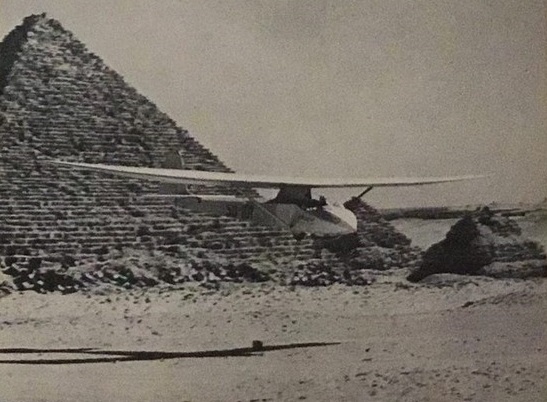
Sedbergh T.21 B
Wing span: 16.5 m / 54 ft 0 in
Wing area: 24.2 sq.m /260.5 sq.ft
Aspect ratio: 11.2
Airfoil: Gottingen 535
Length: 8.16 m / 26 ft 8 in
Empty Weight: 272 kg /600 lb
Payload: 204 kg / 450 lb
Gross Weight: 476 kg / 1050 lb
Water ballast: None
Wing Load: 19.6 kg/sq.m / 4.01 lb/sq.ft
Max speed: 105 mph / 92 kt / 170 km/h
Stalling speed: 28 kt / 52 km/h
L/DMax: 21 @ 69 kph / 37 kt / 43 mph
Min sinking speed: 0.85 m/sec / 2.79 ft/sec at 38.5 mph / 33.5 kt / 62 km/h
No. of Seats: 2
No. Built: 218

Slingsby T.13 Petrel
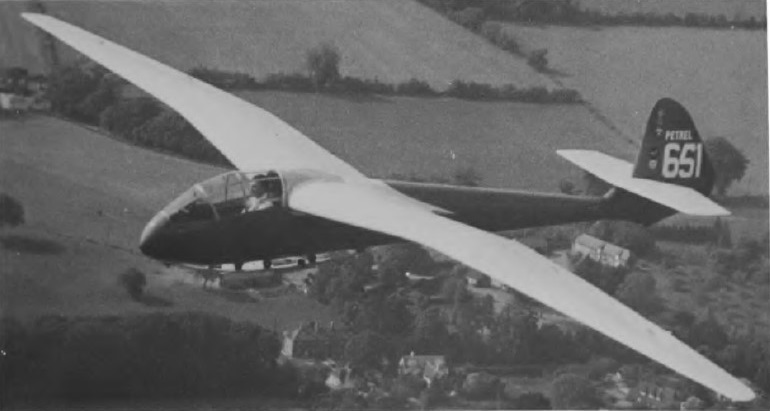
This high performance single-seater was one of the first prewar British attempts to produce a sailplane to rival such well-known German types as the Condor, Rhonadler and Minimoa in terms of performance and aerodynamic refinement. It was, in fact, based on the Rhonadler, with a gull wing of very similar plan form and long span ailerons, with a low wing loading suitable for the rather weak British thermals; no air brakes or flaps were fitted.
Of conventional spruce and birch plywood construction, the Petrel had an all-moving tailplane very similar in outline to the Rhonadler’s in its initial form, but later production aircraft had a larger, broader chord tailplane and elevators with a step in the rear fuselage underneath the tailplane.
The cockpit canopy was of a type later to become commonplace on many sailplanes, flush-fitting and completely faired into the fuselage line without a step, while the landing gear consisted of a long wooden skid under the fuselage, without a monowheel, and a tail bumper.
The Petrel first flew in prototype form in December 1938 and production aircraft, known as the Petrel 1, were offered to customers for a mere £266 in 1939, but only six were built before the war put a stop to further production. Two of these G-ALNP and GALPP, survived the war, the latter later being sold to Eire as IGA101.
T.I3 Petrel
Wing span: 17.3 m (56 ft 9 in)
Length: 7.25 m (23 ft 9.5 in)
Wing area: 16.72 sq.m (180 sq ft)
Wing section: Gottingen 535
Aspect ratio: 17.9
Empty weight: 199 kg (440 lb)
Max weight: 289 kg (637 lb)
Water ballast: None
Max wing loading: 17.3 kg/sq.m (3.54 lb/sq ft)
Max speed: 92 kt / 170 km/h / 105 mph
Stalling speed: 25.5 kt (47 km/h)
Min sinking speed: 0.64 m/sec / 2.1 ft/sec at 31 kt / 58 km/h / 50 mph
Best glide ratio: 27 at 36 kt / 67 km/h / 42 mph
Slingsby T.12 Kirby Gull 1 / Blue Gull / T.14 Gull II / T.15 Gull III
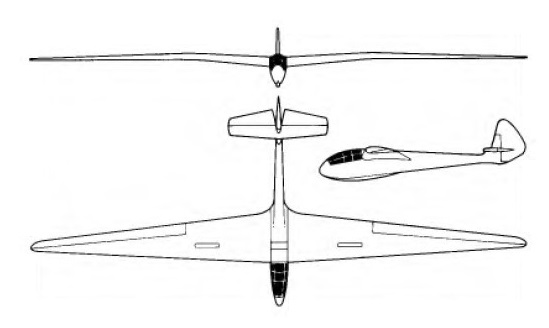
In the late 1930s the gliding movement in the UK did not receive the support from the government that was forthcoming in other European states. Fred Slingsby , John S. Sproule and Mungo Buxton designed the Type 12 Gull to be relatively inexpensive and easy to fly in the hands of the inexperienced pilots in the UK. Slingsby had had a bad experience with the Type 9 King Kite entering incipient spins at low airspeed which was ascribed to the use of a NACA 4312 aerofoil section at the wing-tips, so he designed the Gull with a modified RAF 34 profile at the tips. The cause of the wing drop problem on the King Kite was later found to be inaccurate manufacture, but the Gull retained the modified RAF 34 section.
Construction of the Gull aircraft was of semi-monocoque wood and plywood throughout, with a mixture of plywood and fabric skinning and covering. The wings were skinned with plywood forward of the main spar to form torsion boxes which increased their rigidity. They had a distinctive gull wing form, as the inner 2 metres carried marked dihedral out to the attachment points of the lift struts to the wing spars. Beyond, the wings lacked dihedral. The rectangular planform of the inner wings included the gulled portion and 2 metres beyond, with spoilers in the upper surface outboard of the gull joint in some later aircraft. Ailerons filled the trailing edge of the tapered outer wings.
The cockpit was enclosed with a faired multi-panel canopy which was removed for entry and egress. Ten Gulls were built, nine by Slingsby at Kirbymoorside and one by Herman Kursawe in the United States, from plans supplied by Slingsby.
The Gull 1 first flew in 1938, spoilers were fitted to all Gulls after the first production example, and in 1939, a Gull flown by Geoffrey Stephenson was the first sailplane ever to cross the English Channel in true soaring flight.
A Gull 1, originally the prototype and sold to Australia before World War II and later registered VH-GHL is on display at the Aviation Museum of Western Australia, Bull Creek near Perth, Australia.
The design was developed in 1939 to include what Slingsby called the cantilever Gull, designated as the T15. More commonly known as the Gull III, it had a slightly higher performance, and was fitted with spoilers on the upper surfaces of the wing. Built in 1939, it was not until January 1940 that the type first flew, and was such a success that Slingsby intended to put the type into production once the War was over.
With the tight post-war economy within Britain, gliders of simplified production quickly became a factor in being able to produce cost-effective sailplanes. This led to the Gull 4, which had a more conventional, less complicated straight wing.
The only Gull III to be built survived the war, and it went on to have a long and distinguished career, and was owned at one point by Prince Bira of Siam, who was at the time the World Motor Racing Champion. Bira had bought the Gull III in 1944 and flew it in the company of his dog on many epic flights, including one to 12000 ft.
The Gull III was later bought by a syndicate at the Oxford Gliding Club operating out of Weston on the Green. After a long rebuild, it was finally flown again in 1973. Its C of A expired again in July 1974 because its wing had been damaged by damp (casein glue failure) during the previous winter, when it had been left out in its closed trailer at St. Mary’s Farm, Clifton, near Deddington, Oxon. Restored in the 1980s by Mike Beach, it was initially loaned to Brooklands Museum as a non-flying exhibit but was later bought by the Museum in 1998.
There is one other Gull III in existence. Often referred to as the Gull 3 ½, this Gull is a faithful replica that was made from drawings that had come from Slingsby’s during the 1970s, with the drawings being developed for the project by a worker at Slingsby’s. The project was the brain-child of the late Mike Garnett, and completed by members of the Bowland Forest Gliding Club. It flew from Bowland Forest until 2011 when it was purchased by the current owner and moved to Lincolnshire. This Gull is currently the only airworthy example of either the Gull 1 or Gull III left in Britain. The only other airworthy Gull 1 went to the United States in 2010.
Variants
Slingsby T.12 Gull I / Blue Gull
Initial prototype and nine production gliders with strutted gull wings.
Slingsby T.14 Gull II
Enlarged Gull with two seats side by side, only one built.
Slingsby T.15 Gull III
Specifications:
Gull 1
Wing span: 15.33m / 50 ft 2 in
Wing area: 14.86sq.m / 160sq.ft
Airfoil: root: NACA 4416, tip:RAF34 (modified)
Length: 21 ft 8 in (6.61 m)
Empty Weight: 172kg / 384lb
Payload: 240lb /111kg
Gross Weight: 624lb / 283kg
Wing Load: 3.91lb/sq.ft / 19.1kg/sq.m
Aspect ratio: 15.8
Airfoil: NACA 4416
No of seats: 1
L/DMax: 24 @ 77 kph / 41 kt / 48 mph
MinSink: 142 ft/min / 0.72 m/s at 37 mph / 59.5 km/h / 32.2 kt
Never exceed speed: 80 mph / 70 kt / 129 km/h
Aerotow speed: 60 mph / 96.6 km/h / 52.1 kn
Winch launch speed: 50 mph / 80.5 km/h / 43.4 kn
G limits: +4.9
Number built: 10
Structure: strut-braced wood/ fabric wings, wood/ fabric tail, wood fuselage.
Slingsby Kirby Kitten
In 1938, at Kirbymoorside, Yorkshire, Slingsby Sailplanes Ltd built the Kirby Kitten single-seat monoplane, designed by F. N. Slingsby.
Slingsby T.9 King Kite
The initial layout of the Buxton Hjordis 2 were commenced by Mungo Buxton but it was built as the Slingsby T.9 King Kite. Many of the King Kite drawings were entitled Hjodris 2 (King Kite).
Slingsby had had a bad experience with the Type 9 King Kite entering incipient spins at low airspeed which was ascribed to the use of a NACA 4312 aerofoil section at the wing-tips, so he designed the Gull with a modified RAF 34 profile at the tips. The cause of the wing drop problem on the King Kite was later found to be inaccurate manufacture, but the Gull retained the modified RAF 34 section.
Slingsby T-8 Kirby Tutor
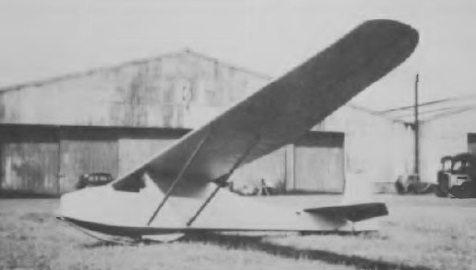
The T8 Tutor single-seater introduced in 1937 was an improved version of the Kirby Kadet with a new two-spar wing of increased span (43ft 3.75in) and tapered outer wing panels married to the same wooden fuselage and wooden tail unit with braced tailplane as the Kadet’s. At the same time a differential mechanism was introduced into the aileron control circuit. This wing was capable of being fitted to the Cadet TX Mk 1, most of which, by the early 1950s, had been converted to Tutor standard as the T8 Cadet TX Mk 2 by the fitting of this wing.
The Tutor prototype first flew in July 1937 and seven examples had been built by the outbreak of war; it re-entered production after the Cadet to meet the demands for an ATC trainer, and 62 more were built in the war as the Cadet TX Mk 2.
Total Tutor production was 106, and the price had risen from £99 10s (£99.50) in 1939 to £360 ex-works in 1948. A two-seater version for teaching the initial stages of flying, and suitable for the circuits and bumps of training, was the T31 Tandem Tutor.
Variation:
Osbourn Twin Cadet
Slingsby T-7 Kirby Cadet
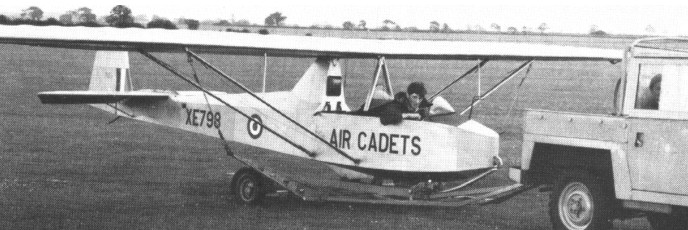
This single-seat intermediate trainer was originally designed by John S. Sproule in 1935 as a soarable version of the Slingsby T3 or Nacelled Primary glider, and was at first known as the T7 Kirby Kadet.
It first flew in prototype form at Sutton Bank on 11 January 1936.
It was of conventional wood and fabric construction, with a high-set, braced, two-spar constant chord wing that was, in fact, interchangeable with that of the later T8 Tutor; no flaps or air brakes were fitted, and the ailerons were fabric-covered. The plywood-skinned wing was mounted on a built-up centre portion of the fuselage, in front of which the pilot sat in an open cockpit. Early examples had a rubber shock absorbed skid for takeoff and landing, but later versions had a modified nose, a less tall rudder and a fixed main wheel and a tailskid. The Cadet’s Gottingen 426 wing section gave it gentle stalling characteristics and good lift at low speeds and this, allied to a simple design making for ease of repair as well as manufacture, made it an excellent trainer.
Only 22 Kadets had been built when the war put a stop to production, the price of a new one being £93 in 1939, which had risen to £325 by 1948, but the type was put back into production with an Air Ministry order for 200 for use by the ATC, the first aircraft from this order, later to be known as Cadet TX Mk 1s, being built in 1943; the ATC variant differed slightly from the prewar civil Kadet in having reduced rudder height and a monowheel in the fuselage as well as the nose skid. The ATC’s predecessor, the Air Defence Cadet Corps, had given its cadets some instruction at British gliding clubs before the war, but this stopped when war broke out, and it was not until 1942 that the first ATC gliding school was opened at Kirbymoorside, Yorkshire, where the Slingsby works were located, and an instructors’ course was started.
By December 1945 the ATC had 84 gliding schools with over 600 Service and civilian instructors, and about 4,500 cadets had received some gliding instruction, as well as instruction in winch-launching, and an equal number had reached the top proficiency stage of their training. The Royal Air Force air cadet training program eventually acquired 376, known as the Kirby Cadet T.X. Mk. 1.
During World War II, Total production by Slingsby and subcontractors (including Ottley Motors Ltd., a batch of 30) amounted to around 430, with some kits being supplied in addition. Plans were made available for license building.
Altogether 226 Cadets were built during the war by Slingsby and three other subcontractors, of which Martin Hearn Ltd of Hooton Park, Cheshire, was the most important; this firm also built 27 of the postwar production for gliding clubs, which brought the total built since 1936 to 431.
By the early 1950s most Cadet TX Mk 1s had been converted to Tutor standard (the RAF Kirby T8 Cadet TX Mk 2) by fitting the Tutor’s longer span (13.24 m / 43.4 ft) tapered wings. This in turn evolved into the T.31 Tandem Tutor (RAF Kirby Cadet T.X. Mk. 3) two-place trainer. Spare T. 7 Kirby Cadet TX Mk 1 wings were used to produce the Slingsby T38 Grasshopper TX Mk 1 post war, which was a version of the SG 38 primary glider with a simplified open-framework fuselage, modified tail unit and the surplus Cadet wings; production began in 1952 and 115 Grasshoppers were built.
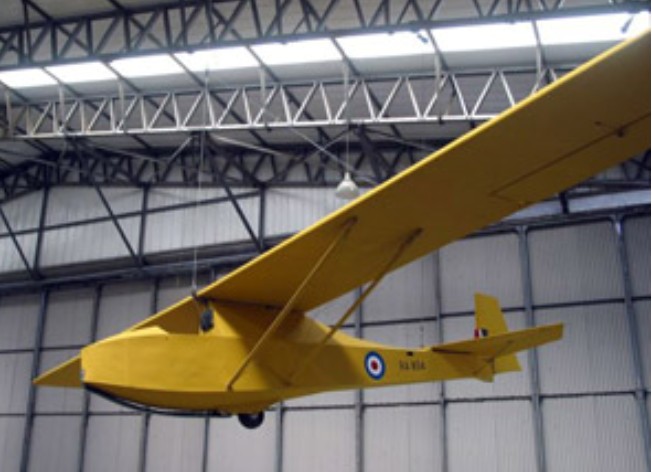
Variation: Cadet Aeronautics Cadet UT-1
Cadet TX Mkl
Wing span: 11.73 m / 38 ft 6 in
Wing area: 15.8 sq.m / 170 sq.ft
Length: 20 ft 10.5 in
Empty Weight: 134 kg / 295 lb
Payload: 218 lb / 99 kg
Gross Weight: 513 lb / 233 kg
Wing Load: 3.02 lb/sq.ft / 14.75 kg/sq.m
Aspect ratio: 8.67
L/DMax: 14 @ 48 kph / 26 kt / 30 mph
Best glide ratio: 16:1
Airfoil: Go 426
MinSink: 1.07 m/s / 3.5 fps / 2.07 kt at 32 mph
No. of Seats: 1
Slingsby T-6 Kirby Kite
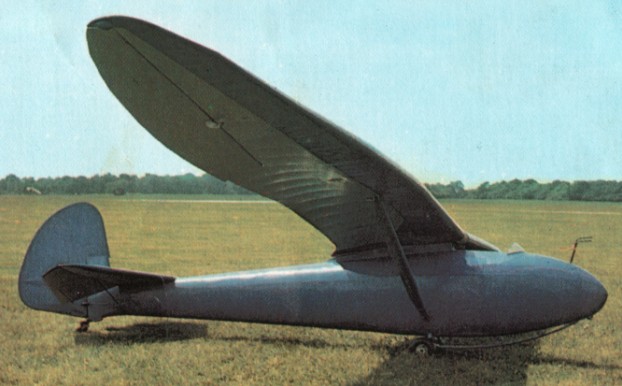
The Kirby Kite was a development of the Schneider Grunau Baby 2 with a gull wing and a streamlined fuselage first flown in 1935. Slingsby had already built a number of Grunau Babies under license and in the construction of the Kite used some of the same components and metal fittings. During World War II most were impressed into military service in 1940, and several kites were used to work out and establish safe towing procedures and instructing techniques for British Military glider pilots. After trials with standard kites, one was fitted with wooden control rods instead of cables to investigate the ability of radar to detect all-wooden aircraft.
Only 25 were built.
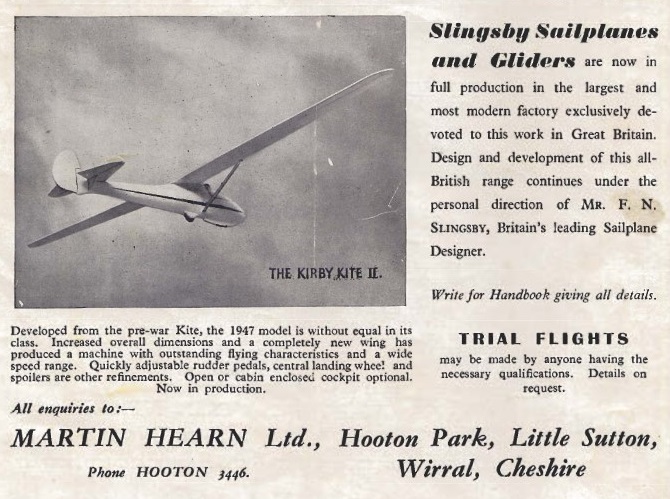
Wing span: 14.2m / 26.6ft
Wing area: 14.49sq.m / 156sq.ft
Empty Weight: 138kg / 304lb
Payload: 93kg / 205lb
Gross Weight: 231kg / 509lb
Wing Load: 15.94kg/sq.m / 3.17 lb/sq.ft
Aspect ratio: 13.8
Airfoil: Go 535
Structure: strut-braced wood/ fabric wings, wood/ fabric tail, wood fuselage
Sling Aircraft Sling
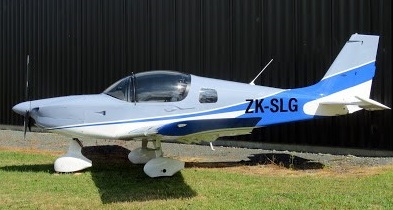
The two-seater Sling was designed by Mike Blyth bigger than some of the comparable sport aircraft and can be certified as an LSA.
The prototype first flew on 18 November 2009. It is produced by Sling Aircraft (Pty) Ltd of Johannesburg in South Africa as a kit or a fully built up aircraft. After a full testing programme the second prototype was flown around the world from East to West in 40 days in 2009, which proved the credentials of the design. The Sling is of all metal construction with composite cowling and fairings. The design has been extended to a 4 seater aircraft which is called the Sling 4 while the 2 seater has been renamed the Sling 2.
Sling
Engine: Rotax 912, 100 hp
Wingspan: 30 ft 1 in / 9.17 m
Wing area: 127.5 sq.ft
Length: 22 ft 10 in / 6.98 m
empty weight: 806 lb / 370 kg
MAUW LSA: 1,320 lb / 598 kg
Cruise: 140 mph / 120 kt
Stall: 46 mph / 40 kt
 All Aero