Soviet Central Hydrofoil Design Bureau KM / Caspian Sea Monster / Lun Class / Alexeyev Hydrofoil Design Bureau Lun Class

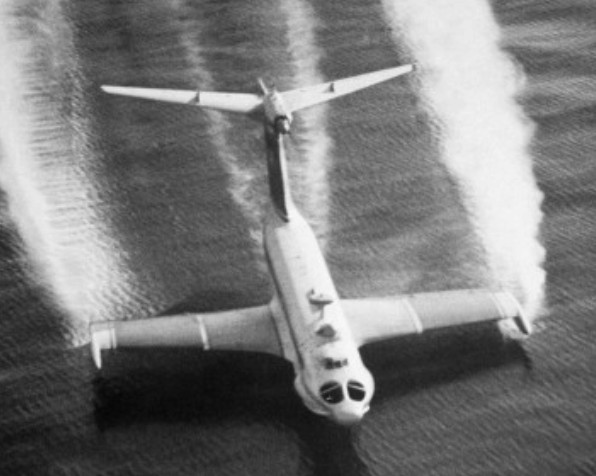
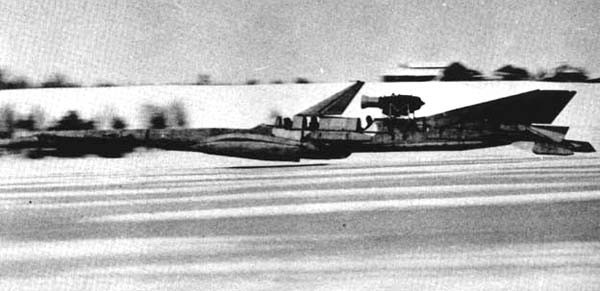
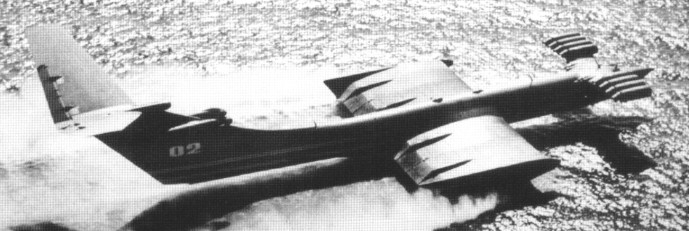
The Monster (its Russian designation was KM, derived from the words Korabl’ Maket or “ship model”) was nothing less than a juggernaut, one of the largest heavier-than-air flying machines ever built. At 500 tonnes it had a 100-tonne MAUW advantage over its fellow winged heavyweight the Boeing 747. No less than ten jet turbines constituted its propulsion system, an array of power used for take-off rather than cruise. Eight turbines were arranged in a shoulder-mounted stub-wing battery just aft of the cockpit. Capable of being deflected under the mainplane where a full-span trailing edge flap would trap their thrust, their combined power could generate an immense lifting force via a hovercraft-like static air cushion to cruise 4 metres above the water
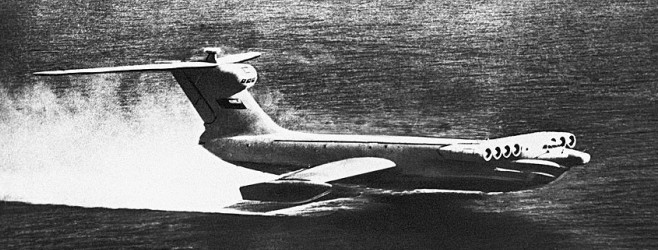
The Lun-class ground effect vehicle (GEV), or sea skimmer, was developed by Russian engineers at the Alexeyev Hydrofoil Design Bureau.

During the Cold War, ekranoplans were sighted for years on the Caspian Sea as huge, fast-moving objects. The name Caspian Sea Monster was given by U.S. intelligence operatives who had discovered the huge vehicle, which looked like an airplane with the outer halves of the wings removed. After the end of the Cold War, the “monster” was revealed to be one of several Russian military designs meant to fly only a few meters above water, saving energy and staying below enemy radar.

The KM, as the Caspian Sea Monster was known in the top secret Soviet military development program, was over 100 m long (330 ft), weighed 540 tonnes fully loaded, and could travel over 400 km/h (250 mi/h), mere meters above the surface of the water.

These craft were originally developed by the Soviet Union as very high-speed (several hundred km/hour) military transports, and were mostly based on the shores of the Caspian Sea and Black Sea. The largest could transport over 100 tonnes of cargo. The only three operational A-90 Orlyonok ekranoplans built (with renewed hull design) and one Lun-class ekranoplan remained at a naval base near Kaspiysk.
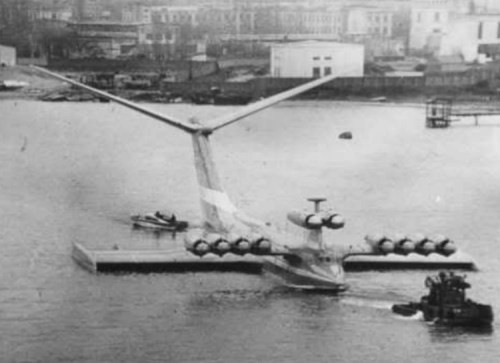
The Lun-class (“Harrier”) Ekranoplan MD-160, dubbed the “Caspian Sea Monster” by US Intelligence services, was one of a kind. It was capable of carrying up to 124 tonnes of troops and equipment, including as many as six nuclear missiles, at speeds up to 560km/h as far as 2000km. Eight Kuznetsov 128.9kN NK-87 turbofans mounted on the front cannards provided the thrust to get the seaplane’s hull up and out of the water and engage the ground effect.

While ground-effect vehicles are a highly efficient way to transport cargo over long distances, the MD-160 had significant drawbacks in its military applications. For one thing, manoeuvrability. Anything resembling a sharp turn was right out, and allowing a wing tip to even sniff the water could result in 500 tonnes of seaplane cartwheeling along the surface of the Caspian. And since the ground effect didn’t actually take effect until the plane was out of the water, the MD-160 had to always take off into the wind.

In 1987, the first flight was made by Lun, an ekranoplan-rocket carrier. It was armed with six guided anti-ship missiles “3M-80 Mosquito”.
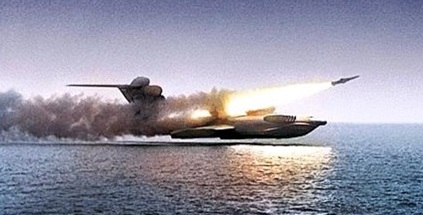
After the successful completion of state tests “Lun” was in 1990 transferred to trial operation. However, the collapse of the Soviet Union led to the cessation of work in this area and the disbanding of the 11th Air Group of the Black Sea Fleet E-Wing.

So while the MD-160 was thoroughly impervious to subsurface mines and torpedoes, its size and complete lack of manoeuvrability made the planes sitting ducks against Western air forces (hence its NATO designation: Duck), often requiring armed escort and forward scouting boats to avoid obstacles. The Ekranoplan carried anti-ship P-270 Moskit guided missiles in six pairs mounted onto its fuselage as well as a pair of 23mm Pl-23 cannons in a tail turret and forward-facing pair under the forward missile tubes.

Despite the the MD-160’s shortcomings, Soviet high command continued to move forward with the program right up until the Soviet Union fell. A second MD-160, destined to be a mobile field hospital, was 90 per cent complete and another 30 A-90 Orlyonok GEVs, meant to strengthen the Black Sea Fleet, were on order when the program’s funding was cut. The MD-160 currently resides at a naval station in Kaspiysk.

MAUW: 540 tonne
Engines: 10
Cruise: 300 kt
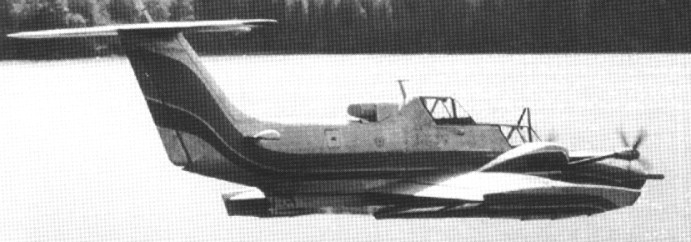
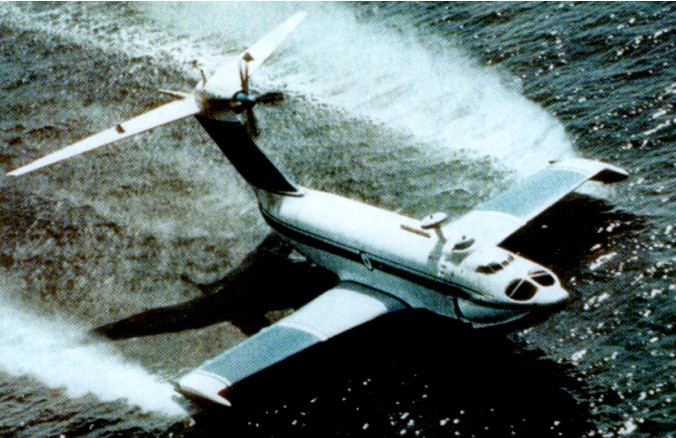
Soviet Central Hydrofoil Design Bureau Orlyonok

A 125-tonne, 200-knot troop transport and assault wing in surface effect craft for the Soviet forces. The development of ekranoplans was supported by Dmitri Ustinov, Minister of Defence of USSR. About 120 ekranoplans (A-90 Orlyonok class) were initially planned to enter military service in the Soviet Navy.

In 1972, the first really working military “Orlyonok” was built, intended for the transfer of amphibious assault forces to a range of up to 1,500 km.

The figure was later reduced to less than thirty vehicles, planned to be deployed mainly for the Black and the Baltic Soviet navies. Marshal Ustinov died in 1985, and the new Minister of Defence Marshal Sokolov effectively ceased the funding for the program. The only three operational A-90 Orlyonok ekranoplans built (with renewed hull design) and one Lun-class ekranoplan remained at a naval base near Kaspiysk.

A-90 “Orlyonok” in the Museum of the Navy in Tushino, Moscow

Soviet Central Hydrofoil Design Bureau

The Central Design Bureau for Hydrofoil named after R.Ye. Alekseev (Central Design Bureau for SEC) was developing a project for an ekranoplan ocean zone with a take-off weight of about 500 tons. About this on Tuesday at the forum “Marine Industry of Russia” said the director and chief designer of the concern “Morinformsystem-Agat” Georgy Antsev.

The International Forum “Marine Industry of Russia” takes place from May 19 to 21, 2015 in Moscow, in the Gostiny Dvor exhibition complex. The forum presented a project of a coastal zone WIG with a take-off weight of 60 tons.

“We need WIG ocean zone with a take-off weight of 500 tons. Such developments are conducted in the CDB Alekseev. Today there is a reboot of the Soviet period, a search is underway for the customer, certain research and development, modeling, and prototyping, ”said Antsev. – It has a very good direction – it is necessary both for passenger transportation, and for northern tasks, and for tasks of protecting state borders. He can use the airfield infrastructure and be at some point, in essence, an airplane. “

The ekranoplan, or a ship on a dynamic air cushion is a high-speed vehicle flying at a height of up to several meters from the surface of water, land, snow or ice. This is a kind of hybrid between an airplane and a watercraft, with equal mass and speed, the winged surface of an ekranoplan is much smaller than that of an airplane, and according to the international classification it belongs to sea vessels. Ekranoplans capable of tearing themselves off the surface for a long time and moving into “airplane” flight mode are called echo flight.

The very first developments, as well as actually operating samples, were obtained by designers of the USSR. The direction was developed by two independent teams. One, under the leadership of Rostislav Alekseev, who, as early as October 1, 1941, defended his thesis “Hydrofoil Glider”. After that, he devoted his life to the development and creation of ekranoplanes. The CDB for SEC was founded in the early 50s.

СМ-1

In the early 60s, a test base for these devices was built on the Gorky Reservoir. In 1961, the first flight of the SM-1 / CM-1 screening vehicle took place, and the following year, the SM-2 / CM-2.

СМ-2

Developed by the Soviets from the 1960s onwards, particularly by Dr Rostislav Alexeyev’s Central Hydrofoil Design Bureau, the leading exponents in the design and operation of Wing in Surface Effect types are now located in the Russian Federation. Far ahead of the West in terms of construction and flying experience, the Soviets planned a fleet of 120 surface skimming WISE military transports in the 1980s and four prototypes were built. However, with the end of the Cold War the funds and the cause for the manufacture of the planned balance-of-power-altering transport fleet ceased.

Southern Crane 1929 monoplane / Manncraft Airplane Co 1929 monoplane

The 1929 monoplane was a two-place open cockpit, powered by a 60hp Anzani engine, replaced by a Chevrolet in December 1930. As NX817N it was sold to J C Norris of Collierville in November 1932, who may have reverted to an Anzani.

The registration was cancelled by the CAA in September 1934.

This could be the Fleming, according to findings by John M Jarratt, but this enigma has yet to be solved as the name of Fleming is not apparent. Mann Co officials of record also included Ricardo Houstee, Mann Jr, and E F Moreland.

Southern Aircraft Corp Aerocar

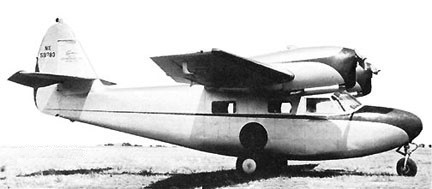
The Aerocar was a roadable aircraft with demountable wing and twin-boom, twin-tail unit, a development by Hall of his twin-boom auto-plane concepts. A high wing, cabin monoplane, it is uncertain if this was ever specifically produced under the Southern banner, or if it was one of Hall’s projects in the works, as it was first flown at San Diego CA in 1939. Only one was built, NX59711, which made several test flights, but proved to be underpowered and the project was abandoned in the post-war slump.

Engine: 130hp Franklin 6AC
Wingspan: 30’0″
Max speed(est): 128 mph
Range (est): 310mph
Seats: 2

Southern Aeronautical Renegade

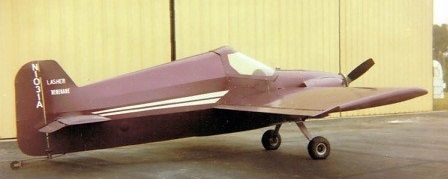
This Formula-V sport racer features a straight-line midwing design. The design was largely based on the Cassutt Special III, but was made suitable to accept VW or VW-based engines. Its designer, Charles Lasher, has chosen steel-tube construction for the fuselage and tail because of its ability to withstand the shock of a crash better than other materials

The wings are a wood-frame structure with fabric covering. The ship is made to handle any Volkswagen from 35 to 65 hp.

The first aircraft was built by M. Ricketts and after eighteen months of construction it was first flown in 1974, registered N73RL (c/n B15). Of conventional construction with all-wood wings and fabric-covered fuselage, the single-seat aircraft was powered by one 55 hp Volkswagen VW1600 motor car engine.

N73RL took second and third places in the Formula V competition at the 1978 and 1979 Cleveland National Air Races respectively, and was used for aerobatic displays.

Plans for amateur construction were marketed via Southern Aero Corporation of Miami Lakes, Florida, after 1983 via Charles Lasher.

Lasher Renegade I (N1031A c/n B96)

At least four Renegade I aircraft were completed in the USA:
N73RL, N1031A, N35DE, and N64JM (designated Michalak R-1).

Biplane Racer Andrew Buehler has set up an LLC and negotiated to acquire the design and manufacturing rights for the Renegade from Creighton King in 2014. Initial planning was for Ed Fisher of Raceair Designs to help with the development and construction of a new Renegade airframe, to use in the promotion of the design. Several minor improvements, and a new wing design were in the works.

Engine: VW 40-hp
Wingspan 16 ft
Length 14 ft
Gross Wt. 652 lb
Empty Wt. 400 lb
Fuel capacity 7.5 USG
Top speed 130 mph
Cruise 120 mph
Stall 49 mph
Climb rate 1000 fpm
Takeoff run 560 ft
Landing roll 400 ft
Range 375 sm

Span: 17 ft 0 in (5.18 m)
Wing chord, constant: 5 ft 0 in (1.52 m)
Length: 15 ft 0 in (4.57 m)
Height: 4 ft 3 in (1.30 m)
Empty weight: 451 lb (205 kg)
Max takeoff weight: 670 lb (304 kg)
Max speed: over 170 mph (273 kmh)
Max cruise speed: 145 mph (233 kmh)
Landing speed: 50 mph (81 kmh)
Max climb at sea level: 850 ft (259 m)/min
Service ceiling: 12,000 ft (3,660 m)
Range: 225 mls (362 km)

Southend MPAG Mayfly

An advanced two-seat man-powered aircraft completed by the Southend Man-Powered Aircraft Group, UK. The pilots were located in the nose, side-by-side, beneath a fully enclosed cockpit. A tractor propellor was mounted above the pilots. The fuselage was circular section, with conventional tail surfaces at the extreme rear. A high mounted wing had considerable taper to the tips. The construction was metal tube with balsa non-load carrying parts. The covering was aluminium foil. Tricycle undercarriage.

The project was abandoned after early tests showed mechanical drive problems.

Wingspan: 90.00 ft
Wing area: 400 sq.ft
Aspect ratio: 20:1
Empty weight: 156 lb